Agricultural Revolution or
Transformation?
The Technology of Paleolithic Societies
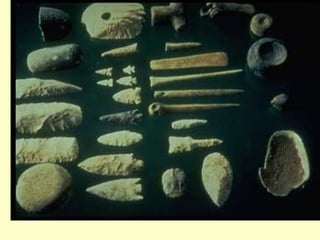
• Early tools (wood, bones, animal skins, and stone)
- shelter, protection, clothing and food
– tents, huts, wooden and stone structures.
– Fire for light and warmth
• First weapons (rocks, clubs, knives, spears, axes,
and the bow and arrow)
• Mats and baskets - carry nuts, berries, and plants
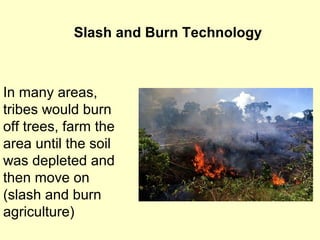
Slash and Burn Technology
In many areas,
tribes would burn
off trees, farm the
area until the soil
was depleted and
then move on
(slash and burn
agriculture)
Social Organization During
Paleolithic Age
• Family Unit
• Extended families clustered together - clans (ties
of kinship)
• Larger groups - bands and tribes
• Sustained themselves by hunting and gathering
(foraging).
• Most were mobile or nomadic.
• Coordination and teamwork were needed
(hunting and war)
Social Organization During
Paleolithic Age
• Gender Division
• Men: hunting, war, heavy labor.
• Women: gathering, preparing food,home
and children.
• Different but equal?
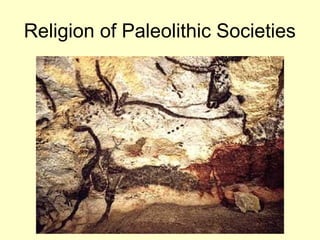
Religion of Paleolithic Societies
• Worshipped gods or deities.
• Practiced a variety of religious rituals.
• Buried their dead.
• Made sacrifices to gods and spirits
• Performed various ceremonies
How do we know?
Religion of Paleolithic Societies
Intellectual Characteristics of
Paleolithic Societies
• Humans expressed
themselves in art and
music.
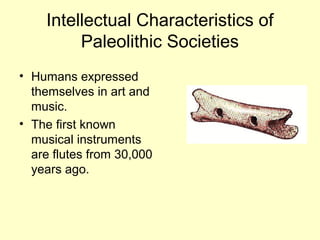
• The first known
musical instruments
are flutes from 30,000
years ago.
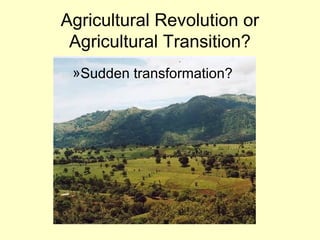
Agricultural Revolution or
Agricultural Transition?
»Sudden transformation?
Why Change?
• Most evidence
suggests that
hunters-gatherers
resisted agriculture
as long as they
could.
• Why?
The Neolithic
Revolution
(8000BCE-3500BCE)
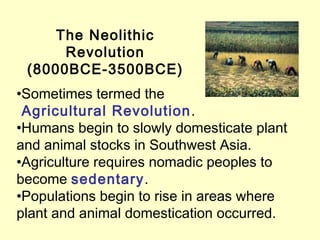
•Sometimes termed the
Agricultural Revolution.
•Humans begin to slowly domesticate plant
and animal stocks in Southwest Asia.
•Agriculture requires nomadic peoples to
become sedentary.
•Populations begin to rise in areas where
plant and animal domestication occurred.
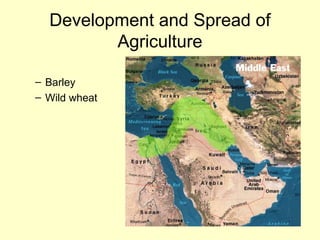
Development and Spread of
Agriculture
– Barley
– Wild wheat
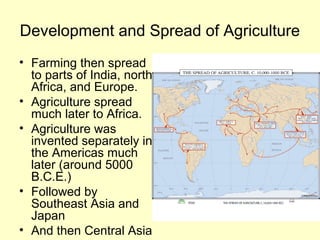
Development and Spread of Agriculture
• Farming then spread
to parts of India, north
Africa, and Europe.
• Agriculture spread
much later to Africa.
• Agriculture was
invented separately in
the Americas much
later (around 5000
B.C.E.)
• Followed by
Southeast Asia and
Japan
• And then Central Asia
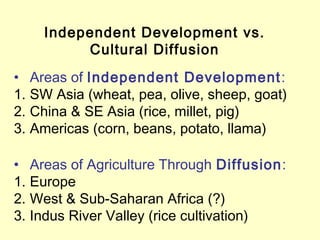
Independent Development vs.
Cultural Diffusion
• Areas of Independent Development:
1. SW Asia (wheat, pea, olive, sheep, goat)
2. China & SE Asia (rice, millet, pig)
3. Americas (corn, beans, potato, llama)
• Areas of Agriculture Through Diffusion:
1. Europe
2. West & Sub-Saharan Africa (?)
3. Indus River Valley (rice cultivation)
Agriculture Prompted New Ideas and
Techniques
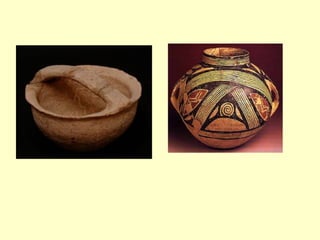
The need for storage facilities for grains and
seeds prompted the development of basket-
making and pottery.
Agricultural needs also encouraged certain kinds
of science, supporting the human desire to learn
more about weather or flooding.
Discovery of metal tools (4000 B.C.E.) in the
Middle East
•Copper was the first metal, followed by bronze
– a more resilient metal.
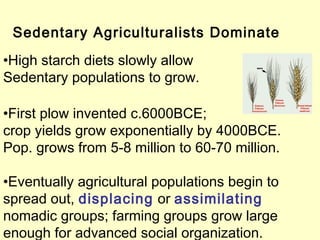
•High starch diets slowly allow
Sedentary populations to grow.
•First plow invented c.6000BCE;
crop yields grow exponentially by 4000BCE.
Pop. grows from 5-8 million to 60-70 million.
•Eventually agricultural populations begin to
spread out, displacing or assimilating
nomadic groups; farming groups grow large
enough for advanced social organization.
Sedentary Agriculturalists Dominate
First Towns Develop
•Towns require social differentiation:
metal workers, pottery workers, farmers,
soldiers, religious and political leaders.
(POSSIBLE B/C FOOD
SURPLUSES!)
•Served as trade centers for the area;
specialized in the production of certain
unique crafts
•Beginnings of social stratification
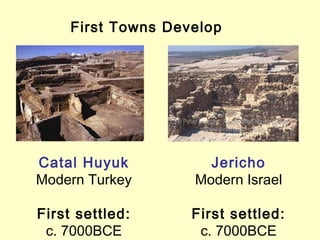
First Towns Develop
Catal Huyuk
Modern Turkey
First settled:
c. 7000BCE
Jericho
Modern Israel
First settled:
c. 7000BCE
First Towns Develop
•Towns require social differentiation:
metal workers, pottery workers, farmers,
soldiers, religious and political leaders.
(POSSIBLE B/C FOOD
SURPLUSES!)
•Served as trade centers for the area;
specialized in the production of certain
unique crafts
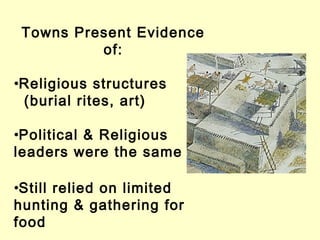
Towns Present Evidence
of:
•Religious structures
(burial rites, art)
•Political & Religious
leaders were the same
•Still relied on limited
hunting & gathering for
food
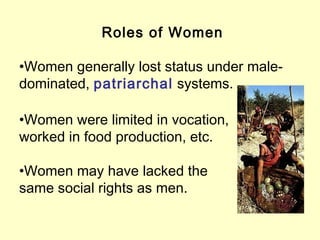
Roles of Women
•Women generally lost status under male-
dominated, patriarchal systems.
•Women were limited in vocation,
worked in food production, etc.
•Women may have lacked the
same social rights as men.
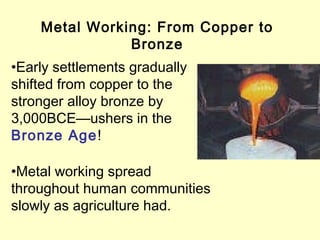
Metal Working: From Copper to
Bronze
•Early settlements gradually
shifted from copper to the
stronger alloy bronze by
3,000BCE—ushers in the
Bronze Age!
•Metal working spread
throughout human communities
slowly as agriculture had.
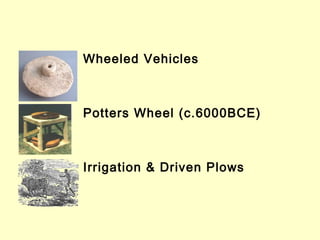
Wheeled Vehicles
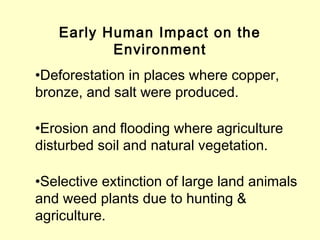
Potters Wheel (c.6000BCE)
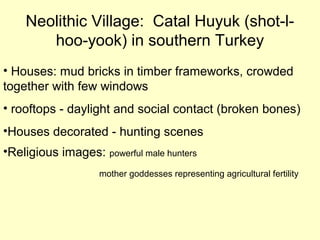
Irrigation & Driven Plows
Early Human Impact on the
Environment
•Deforestation in places where copper,
bronze, and salt were produced.
•Erosion and flooding where agriculture
disturbed soil and natural vegetation.
•Selective extinction of large land animals
and weed plants due to hunting &
agriculture.
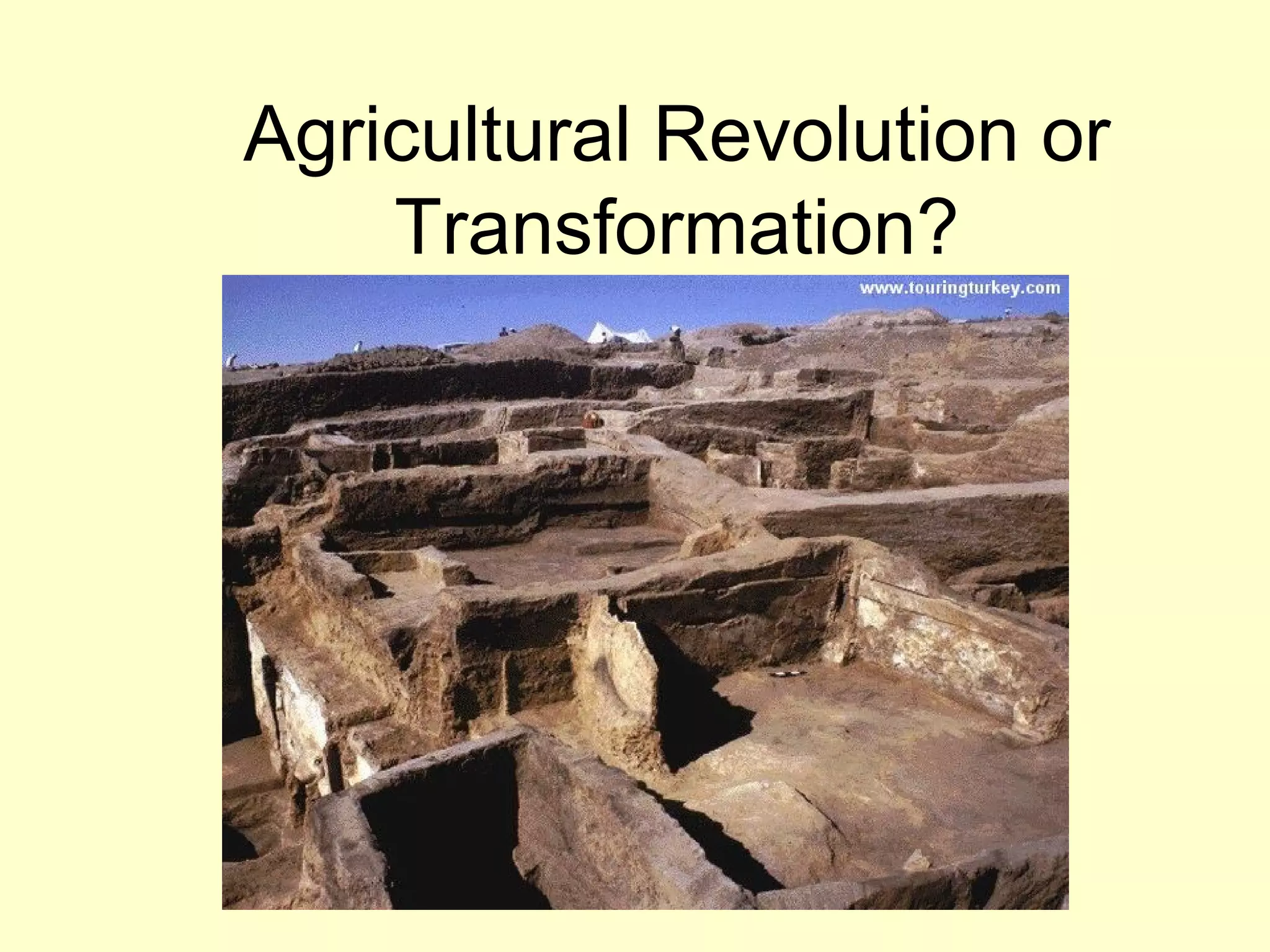
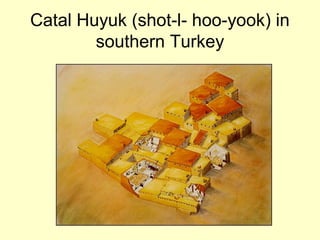
Neolithic Village: Catal Huyuk (shot-l-
hoo-yook) in southern Turkey
• Houses: mud bricks in timber frameworks, crowded
together with few windows
• rooftops - daylight and social contact (broken bones)
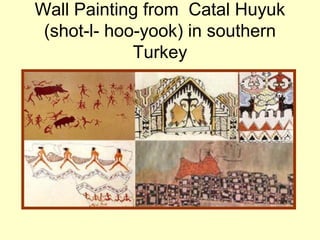
•Houses decorated - hunting scenes
•Religious images: powerful male hunters
mother goddesses representing agricultural fertility
Neolithic Village: Catal Huyuk
(shot-l- hoo-yook) in southern
Turkey
• trade with hunting people in surrounding hills
•Large villages ruled over smaller communities,
-> politics, military
•Accumulation of wealth -> social classes.
Catal Huyuk (shot-l- hoo-yook) in
southern Turkey
Wall Painting from Catal Huyuk
(shot-l- hoo-yook) in southern
Turkey
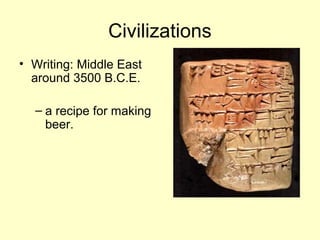
Civilizations
• Writing: Middle East
around 3500 B.C.E.
– a recipe for making
beer.
Civilizations
• Prejudices.
- “barbarian”
• Human history:
civilizations vs primitive nomads?

The Agricultural Revolution

  • 1.
  • 2.
    The Technology ofPaleolithic Societies • Early tools (wood, bones, animal skins, and stone) - shelter, protection, clothing and food – tents, huts, wooden and stone structures. – Fire for light and warmth • First weapons (rocks, clubs, knives, spears, axes, and the bow and arrow) • Mats and baskets - carry nuts, berries, and plants
  • 4.
    Slash and BurnTechnology In many areas, tribes would burn off trees, farm the area until the soil was depleted and then move on (slash and burn agriculture)
  • 5.
    Social Organization During PaleolithicAge • Family Unit • Extended families clustered together - clans (ties of kinship) • Larger groups - bands and tribes • Sustained themselves by hunting and gathering (foraging). • Most were mobile or nomadic. • Coordination and teamwork were needed (hunting and war)
  • 6.
    Social Organization During PaleolithicAge • Gender Division • Men: hunting, war, heavy labor. • Women: gathering, preparing food,home and children. • Different but equal?
  • 7.
    Religion of PaleolithicSocieties • Worshipped gods or deities. • Practiced a variety of religious rituals. • Buried their dead. • Made sacrifices to gods and spirits • Performed various ceremonies How do we know?
  • 8.
  • 9.
    Intellectual Characteristics of PaleolithicSocieties • Humans expressed themselves in art and music. • The first known musical instruments are flutes from 30,000 years ago.
  • 10.
    Agricultural Revolution or AgriculturalTransition? »Sudden transformation?
  • 11.
    Why Change? • Mostevidence suggests that hunters-gatherers resisted agriculture as long as they could. • Why?
  • 12.
    The Neolithic Revolution (8000BCE-3500BCE) •Sometimes termedthe Agricultural Revolution. •Humans begin to slowly domesticate plant and animal stocks in Southwest Asia. •Agriculture requires nomadic peoples to become sedentary. •Populations begin to rise in areas where plant and animal domestication occurred.
  • 13.
    Development and Spreadof Agriculture – Barley – Wild wheat
  • 14.
    Development and Spreadof Agriculture • Farming then spread to parts of India, north Africa, and Europe. • Agriculture spread much later to Africa. • Agriculture was invented separately in the Americas much later (around 5000 B.C.E.) • Followed by Southeast Asia and Japan • And then Central Asia
  • 15.
    Independent Development vs. CulturalDiffusion • Areas of Independent Development: 1. SW Asia (wheat, pea, olive, sheep, goat) 2. China & SE Asia (rice, millet, pig) 3. Americas (corn, beans, potato, llama) • Areas of Agriculture Through Diffusion: 1. Europe 2. West & Sub-Saharan Africa (?) 3. Indus River Valley (rice cultivation)
  • 16.
    Agriculture Prompted NewIdeas and Techniques The need for storage facilities for grains and seeds prompted the development of basket- making and pottery. Agricultural needs also encouraged certain kinds of science, supporting the human desire to learn more about weather or flooding. Discovery of metal tools (4000 B.C.E.) in the Middle East •Copper was the first metal, followed by bronze – a more resilient metal.
  • 18.
    •High starch dietsslowly allow Sedentary populations to grow. •First plow invented c.6000BCE; crop yields grow exponentially by 4000BCE. Pop. grows from 5-8 million to 60-70 million. •Eventually agricultural populations begin to spread out, displacing or assimilating nomadic groups; farming groups grow large enough for advanced social organization. Sedentary Agriculturalists Dominate
  • 19.
    First Towns Develop •Townsrequire social differentiation: metal workers, pottery workers, farmers, soldiers, religious and political leaders. (POSSIBLE B/C FOOD SURPLUSES!) •Served as trade centers for the area; specialized in the production of certain unique crafts •Beginnings of social stratification
  • 20.
    First Towns Develop CatalHuyuk Modern Turkey First settled: c. 7000BCE Jericho Modern Israel First settled: c. 7000BCE
  • 21.
    First Towns Develop •Townsrequire social differentiation: metal workers, pottery workers, farmers, soldiers, religious and political leaders. (POSSIBLE B/C FOOD SURPLUSES!) •Served as trade centers for the area; specialized in the production of certain unique crafts
  • 22.
    Towns Present Evidence of: •Religiousstructures (burial rites, art) •Political & Religious leaders were the same •Still relied on limited hunting & gathering for food
  • 23.
    Roles of Women •Womengenerally lost status under male- dominated, patriarchal systems. •Women were limited in vocation, worked in food production, etc. •Women may have lacked the same social rights as men.
  • 24.
    Metal Working: FromCopper to Bronze •Early settlements gradually shifted from copper to the stronger alloy bronze by 3,000BCE—ushers in the Bronze Age! •Metal working spread throughout human communities slowly as agriculture had.
  • 25.
    Wheeled Vehicles Potters Wheel(c.6000BCE) Irrigation & Driven Plows
  • 26.
    Early Human Impacton the Environment •Deforestation in places where copper, bronze, and salt were produced. •Erosion and flooding where agriculture disturbed soil and natural vegetation. •Selective extinction of large land animals and weed plants due to hunting & agriculture.
  • 27.
    Neolithic Village: CatalHuyuk (shot-l- hoo-yook) in southern Turkey • Houses: mud bricks in timber frameworks, crowded together with few windows • rooftops - daylight and social contact (broken bones) •Houses decorated - hunting scenes •Religious images: powerful male hunters mother goddesses representing agricultural fertility
  • 28.
    Neolithic Village: CatalHuyuk (shot-l- hoo-yook) in southern Turkey • trade with hunting people in surrounding hills •Large villages ruled over smaller communities, -> politics, military •Accumulation of wealth -> social classes.
  • 29.
    Catal Huyuk (shot-l-hoo-yook) in southern Turkey
  • 30.
    Wall Painting fromCatal Huyuk (shot-l- hoo-yook) in southern Turkey
  • 31.
    Civilizations • Writing: MiddleEast around 3500 B.C.E. – a recipe for making beer.
  • 32.
    Civilizations • Prejudices. - “barbarian” •Human history: civilizations vs primitive nomads?

Editor's Notes

  • #3 Between 2 and 3 millions years ago, humanity's immediate ancestors appeared in Africa. Between 100,000 and 200,00 years ago, true humans or homo sapiens, (meaning wise human), appeared. The best known of homo sapiens are the Neanderthal and Cro-Magnon man. What seems certain is that homo sapiens originated in Africa and then migrated outward. This is called the “Out of Africa” thesis.
  • #9 Lascaux is the setting of a complex of caves in southwestern France famous for its Paleolithic cave paintings. The original caves are located near the village of Montignac, in the Dordogne département. They contain some of the most well-known Upper Paleolithic art. These paintings are estimated to be 16,000 years old. They primarily consist of realistic images of large animals, most of which are known from fossil evidence to have lived in the area at the time. In 1979, Lascaux was added to the UNESCO World Heritage Sites list along with other prehistoric sites in the Vézère valley.[1]
  • #10 The Divje Babe flute is a cave bear femur pierced by spaced holes that was found at the Divje Babe archeological park located near Cerkno in northwestern Slovenia. It has been suggested that it is the world's oldest known musical instrument,[1] but this is in dispute.[2][3][4] The continuing dispute notwithstanding, the artifact remains on prominent public display as a flute in the National Museum of Slovenia (Narodni Muzej Slovenije) in Ljubljana. The museum's visitor leaflet maintains that manufacture by Neanderthals "is reliably proven".[5]