Precursors of Civilization: Mesolithic and Neolithic The Prehistoric Roots of the Humanities and the Arts
Formation of Human Settlements The formation of settled communities is the next phase The Mesolithic is not well defined except for the lack of domesticated plants or animals (Dogs for hunting is an exception.) The Neolithic is defined by the domestication of plant and animals By then, settled communities develop
Mesolithic Communities: Some Examples Mount Sandel, Ireland, was settled after the extinction of megafauna (big game animals) Vedbaek, Denmark, was a coastal and Island community Nittano, Japan, is a classic example of a settled community with sophisticated pottery— And no agriculture or animal husbandry All three communities were seacoast communities that depended on fishing, hunting, and gathering All three began to develop specialized trades
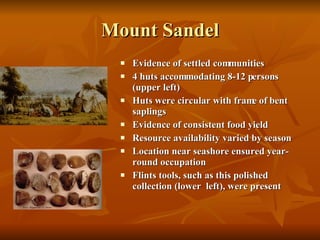
Mount Sandel Evidence of settled communities 4 huts accommodating 8-12 persons (upper left) Huts were circular with frame of bent saplings Evidence of consistent food yield Resource availability varied by season Location near seashore ensured year-round occupation Flints tools, such as this polished   collection (lower  left), were present
Vedbaek Grave sites (22) reveal a rich material culture, including ornaments Main living areas near sea, also with a rich marine life  Land animals important but secondary The island of Vaenget Nord reveals specialized sites Butchering sites Stone and bone tool manufacture Woodworking
Nittano, Japan: Settlements Period is included in the Jomon pottery tradition (12,500-300 BCE) Settlements were permanent, as shown by: Complex tool assemblages Stone drills, knives, and scrapers Milling stones, including mortars and pestles, which indicate seeds and/or grains Pottery, with elaborate designs Horseshoe style residential patterns
Nittano, Japan: Subsistence Base Heavy dependence on sea resources 30 species of shellfish Fish was harvested in all seasons but winter Fishing gear: fishhooks, harpoons,  canoes Land Resources: Land animals (deer and boar) Edible plant sources (180 species) Bones indicate year-round occupation
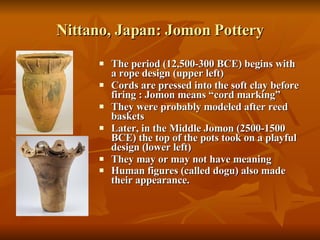
Nittano, Japan: Jomon Pottery The period (12,500-300 BCE) begins with a rope design (upper left)  Cords are pressed into the soft clay before firing : Jomon means “cord marking” They were probably modeled after reed baskets Later, in the Middle Jomon (2500-1500 BCE) the top of the pots took on a playful design (lower left) They may or may not have meaning Human figures (called dogu) also made their appearance.
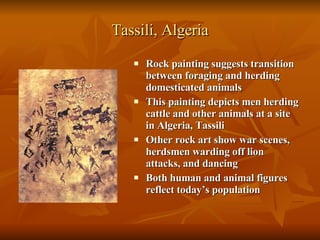
Tassili, Algeria Rock painting suggests transition between foraging and herding domesticated animals This painting depicts men herding cattle and other animals at a site in Algeria, Tassili Other rock art show war scenes, herdsmen warding off lion attacks, and dancing Both human and animal figures reflect today’s population
The Neolithic: Overview The Neolithic, or “New Stone Age” begins at different dates (6000-4000 BCE in the Near East) in different locations. The features are the presence of: Domesticated plants, usually a staple such as wheat (Near East), corn (Mesoamerica) and rice (Central China or Southeast Asia) Domesticated animals (principally cattle, sheep, goats, horses, and camels)
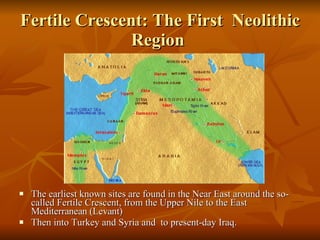
Fertile Crescent: The First  Neolithic Region  The earliest known sites are found in the Near East around the so-called Fertile Crescent, from the Upper Nile to the East Mediterranean (Levant) Then into Turkey and Syria and  to present-day Iraq.
Land Use in Foraging versus Agriculture Hunting and Gathering entails: :  Extensive plant/animal exploitation Foraging over wide era Agriculture entails: Plant/Animal Domestication Intensive plant/animal exploitation Intensive cultivation of a small geographical area; herding (if practiced along) may involve extensive land use.
Defining Characteristics of Neolithic Era Plant/Animal domestication Settled Communities or Regular Migration within small, well-defined area Technologies requiring settlement involve: Stones for grinding grains Pottery for cooking and storage Metallurgy for making agricultural implements Food Storage in pottery or in bins made of stone or clay Housing on permanent sites Trash sites: where you have large populations you have a lot of trash and garbage.
Characteristics of Agriculture: Plants Cultivation:  Preparing  soil Propagation:  Seed selection and planting Husbandry : weeding, providing water, protection from pests Harvesting  of seeds (grain), fruits, or leaves when ripe Reproduction:  seed storage
Characteristics of Agriculture: Animals Selection and breeding of animals for desired characteristics (meat, milk, wool) Husbandry: feeding and protecting animals during nonproductive periods Harvesting: Slaughter for meat, milking, shearing
Primary Centers: Near East Timeline: ca 6 Eastern Mediterranean Wheat, barley, rye Legumes: peas, lentils Fruits: Grapes, figs, olives Fibers: flax Animals: Pigs, sheep, goats Principal technology: canal irrigation
Primary Centers: Egypt and the Nile Valley Timeline: ca 7000-5000 BC Grains: Wheat, Barley Fibers: Flax Animals: Pigs, Sheep, Goats, Cattle Principal Technology: flood plain irrigation
Primary Centers: South Asia (Indus River) Wheat may have diffused from Near East Animals were indigenous: camels, goats, water buffalo Principal technology: canal irrigation
Origins of Agriculture: Commonalities in Explanations Usually rejected: evident advantages of agriculture Involves more work than foraging Productivity beyond need Explanatory Commonalities Less available land for foraging Limitation of water supply Relative overpopulation Occurrence of plants and animals that can be domesticated
Concomitants of Domestication: Technology Grinding tools, from mano and metate or mortar and pestle to millstones Pottery Metallurgy Transportation: horse, oxen and cart Roads and trade routes Seagoing vessels
Concomitants of Domestication: Social Consequences Settled communities Socioeconomic differentiation Simple to complex social structure Economic specialization (nonfarm) and trade Rise of money Political institutions: chiefdom to state Legal institutions and codified law
Concomitants of Domestication: Rise of the Humanities We encounter a more leisured society because High productivity allows freedom for some from subsistence activities. Full-time artisans take up the slack Artisans include those of luxury goods which include sculpture, painting, drawing They also include more intangible pursuits, such as music, drama, dance, and even philosophy
Northern Europe Europe was a secondary center of the Neolithic Revolution, having acquired agriculture from the Near East Several megalith (large stone) structure dotted Malta, France, Germany, and England Temples and a necropolis (city of the dead) were found at Ggandija on Gozo island near in Malta, an island between Italy and North Africa Carnac, Brittany, France, is a site of megaliths  The best known is Stonehenge, southern England
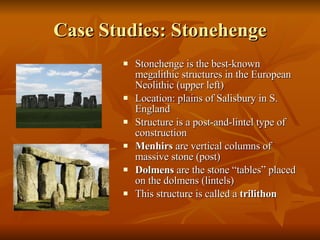
Case Studies: Stonehenge Stonehenge is the best-known megalithic structures in the European Neolithic (upper left) Location: plains of Salisbury in S. England Structure is a post-and-lintel type of construction Menhirs  are vertical columns of massive stone (post) Dolmens  are the stone “tables” placed on the dolmens (lintels) This structure is called a  trilithon
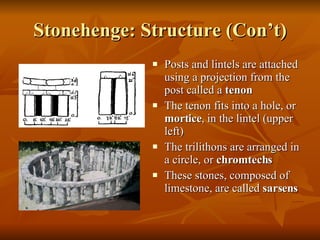
Stonehenge: Structure (Con’t) Posts and lintels are attached using a projection from the post called a  tenon  The tenon fits into a hole, or  mortice , in the lintel (upper left) The trilithons are arranged in a circle, or  chromtechs These stones, composed of limestone, are called  sarsens
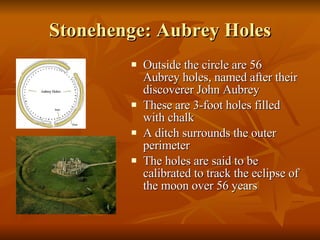
Stonehenge: Aubrey Holes Outside the circle are 56 Aubrey holes, named after their discoverer John Aubrey These are 3-foot holes filled with chalk A ditch surrounds the outer perimeter The holes are said to be calibrated to track the eclipse of the moon over 56 years
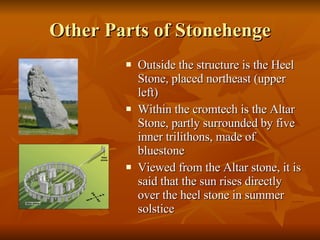
Other Parts of Stonehenge Outside the structure is the Heel Stone, placed northeast (upper left) Within the cromtech is the Altar Stone, partly surrounded by five inner trilithons, made of bluestone Viewed from the Altar stone, it is said that the sun rises directly over the heel stone in summer solstice
Questions Raised by Stonehenge How were such heavy stones moved from their sources no less than 26 miles away and as far away as Wales? How were these structures built without pulleys and other modern technologies? What were these sites for? Religion? Predictions? Is there anything to archaeological astronomy, such as claims of the Aubrey holes forecasting lunar eclipses? How about the claim that the sun rises directly above the Heel Stone when viewed from the Altar Stone? Inferences are many; conclusive evidence is limited.
Neolithic Revolution Every civilization began with a Neolithic Revolution These will be mentioned at the beginning of each section for Egypt, Mesopotamia, and Egypt In all areas, a surplus supported an increasing population Nonagricultural crafts led to specialization and trade Large populations and trade had to be coordination, leading to the rise of a political elite and thereby social classes

Mesolithic and Neolithic

  • 1.
    Precursors of Civilization:Mesolithic and Neolithic The Prehistoric Roots of the Humanities and the Arts
  • 2.
    Formation of HumanSettlements The formation of settled communities is the next phase The Mesolithic is not well defined except for the lack of domesticated plants or animals (Dogs for hunting is an exception.) The Neolithic is defined by the domestication of plant and animals By then, settled communities develop
  • 3.
    Mesolithic Communities: SomeExamples Mount Sandel, Ireland, was settled after the extinction of megafauna (big game animals) Vedbaek, Denmark, was a coastal and Island community Nittano, Japan, is a classic example of a settled community with sophisticated pottery— And no agriculture or animal husbandry All three communities were seacoast communities that depended on fishing, hunting, and gathering All three began to develop specialized trades
  • 4.
    Mount Sandel Evidenceof settled communities 4 huts accommodating 8-12 persons (upper left) Huts were circular with frame of bent saplings Evidence of consistent food yield Resource availability varied by season Location near seashore ensured year-round occupation Flints tools, such as this polished collection (lower left), were present
  • 5.
    Vedbaek Grave sites(22) reveal a rich material culture, including ornaments Main living areas near sea, also with a rich marine life Land animals important but secondary The island of Vaenget Nord reveals specialized sites Butchering sites Stone and bone tool manufacture Woodworking
  • 6.
    Nittano, Japan: SettlementsPeriod is included in the Jomon pottery tradition (12,500-300 BCE) Settlements were permanent, as shown by: Complex tool assemblages Stone drills, knives, and scrapers Milling stones, including mortars and pestles, which indicate seeds and/or grains Pottery, with elaborate designs Horseshoe style residential patterns
  • 7.
    Nittano, Japan: SubsistenceBase Heavy dependence on sea resources 30 species of shellfish Fish was harvested in all seasons but winter Fishing gear: fishhooks, harpoons, canoes Land Resources: Land animals (deer and boar) Edible plant sources (180 species) Bones indicate year-round occupation
  • 8.
    Nittano, Japan: JomonPottery The period (12,500-300 BCE) begins with a rope design (upper left) Cords are pressed into the soft clay before firing : Jomon means “cord marking” They were probably modeled after reed baskets Later, in the Middle Jomon (2500-1500 BCE) the top of the pots took on a playful design (lower left) They may or may not have meaning Human figures (called dogu) also made their appearance.
  • 9.
    Tassili, Algeria Rockpainting suggests transition between foraging and herding domesticated animals This painting depicts men herding cattle and other animals at a site in Algeria, Tassili Other rock art show war scenes, herdsmen warding off lion attacks, and dancing Both human and animal figures reflect today’s population
  • 10.
    The Neolithic: OverviewThe Neolithic, or “New Stone Age” begins at different dates (6000-4000 BCE in the Near East) in different locations. The features are the presence of: Domesticated plants, usually a staple such as wheat (Near East), corn (Mesoamerica) and rice (Central China or Southeast Asia) Domesticated animals (principally cattle, sheep, goats, horses, and camels)
  • 11.
    Fertile Crescent: TheFirst Neolithic Region The earliest known sites are found in the Near East around the so-called Fertile Crescent, from the Upper Nile to the East Mediterranean (Levant) Then into Turkey and Syria and to present-day Iraq.
  • 12.
    Land Use inForaging versus Agriculture Hunting and Gathering entails: : Extensive plant/animal exploitation Foraging over wide era Agriculture entails: Plant/Animal Domestication Intensive plant/animal exploitation Intensive cultivation of a small geographical area; herding (if practiced along) may involve extensive land use.
  • 13.
    Defining Characteristics ofNeolithic Era Plant/Animal domestication Settled Communities or Regular Migration within small, well-defined area Technologies requiring settlement involve: Stones for grinding grains Pottery for cooking and storage Metallurgy for making agricultural implements Food Storage in pottery or in bins made of stone or clay Housing on permanent sites Trash sites: where you have large populations you have a lot of trash and garbage.
  • 14.
    Characteristics of Agriculture:Plants Cultivation: Preparing soil Propagation: Seed selection and planting Husbandry : weeding, providing water, protection from pests Harvesting of seeds (grain), fruits, or leaves when ripe Reproduction: seed storage
  • 15.
    Characteristics of Agriculture:Animals Selection and breeding of animals for desired characteristics (meat, milk, wool) Husbandry: feeding and protecting animals during nonproductive periods Harvesting: Slaughter for meat, milking, shearing
  • 16.
    Primary Centers: NearEast Timeline: ca 6 Eastern Mediterranean Wheat, barley, rye Legumes: peas, lentils Fruits: Grapes, figs, olives Fibers: flax Animals: Pigs, sheep, goats Principal technology: canal irrigation
  • 17.
    Primary Centers: Egyptand the Nile Valley Timeline: ca 7000-5000 BC Grains: Wheat, Barley Fibers: Flax Animals: Pigs, Sheep, Goats, Cattle Principal Technology: flood plain irrigation
  • 18.
    Primary Centers: SouthAsia (Indus River) Wheat may have diffused from Near East Animals were indigenous: camels, goats, water buffalo Principal technology: canal irrigation
  • 19.
    Origins of Agriculture:Commonalities in Explanations Usually rejected: evident advantages of agriculture Involves more work than foraging Productivity beyond need Explanatory Commonalities Less available land for foraging Limitation of water supply Relative overpopulation Occurrence of plants and animals that can be domesticated
  • 20.
    Concomitants of Domestication:Technology Grinding tools, from mano and metate or mortar and pestle to millstones Pottery Metallurgy Transportation: horse, oxen and cart Roads and trade routes Seagoing vessels
  • 21.
    Concomitants of Domestication:Social Consequences Settled communities Socioeconomic differentiation Simple to complex social structure Economic specialization (nonfarm) and trade Rise of money Political institutions: chiefdom to state Legal institutions and codified law
  • 22.
    Concomitants of Domestication:Rise of the Humanities We encounter a more leisured society because High productivity allows freedom for some from subsistence activities. Full-time artisans take up the slack Artisans include those of luxury goods which include sculpture, painting, drawing They also include more intangible pursuits, such as music, drama, dance, and even philosophy
  • 23.
    Northern Europe Europewas a secondary center of the Neolithic Revolution, having acquired agriculture from the Near East Several megalith (large stone) structure dotted Malta, France, Germany, and England Temples and a necropolis (city of the dead) were found at Ggandija on Gozo island near in Malta, an island between Italy and North Africa Carnac, Brittany, France, is a site of megaliths The best known is Stonehenge, southern England
  • 24.
    Case Studies: StonehengeStonehenge is the best-known megalithic structures in the European Neolithic (upper left) Location: plains of Salisbury in S. England Structure is a post-and-lintel type of construction Menhirs are vertical columns of massive stone (post) Dolmens are the stone “tables” placed on the dolmens (lintels) This structure is called a trilithon
  • 25.
    Stonehenge: Structure (Con’t)Posts and lintels are attached using a projection from the post called a tenon The tenon fits into a hole, or mortice , in the lintel (upper left) The trilithons are arranged in a circle, or chromtechs These stones, composed of limestone, are called sarsens
  • 26.
    Stonehenge: Aubrey HolesOutside the circle are 56 Aubrey holes, named after their discoverer John Aubrey These are 3-foot holes filled with chalk A ditch surrounds the outer perimeter The holes are said to be calibrated to track the eclipse of the moon over 56 years
  • 27.
    Other Parts ofStonehenge Outside the structure is the Heel Stone, placed northeast (upper left) Within the cromtech is the Altar Stone, partly surrounded by five inner trilithons, made of bluestone Viewed from the Altar stone, it is said that the sun rises directly over the heel stone in summer solstice
  • 28.
    Questions Raised byStonehenge How were such heavy stones moved from their sources no less than 26 miles away and as far away as Wales? How were these structures built without pulleys and other modern technologies? What were these sites for? Religion? Predictions? Is there anything to archaeological astronomy, such as claims of the Aubrey holes forecasting lunar eclipses? How about the claim that the sun rises directly above the Heel Stone when viewed from the Altar Stone? Inferences are many; conclusive evidence is limited.
  • 29.
    Neolithic Revolution Everycivilization began with a Neolithic Revolution These will be mentioned at the beginning of each section for Egypt, Mesopotamia, and Egypt In all areas, a surplus supported an increasing population Nonagricultural crafts led to specialization and trade Large populations and trade had to be coordination, leading to the rise of a political elite and thereby social classes