History of Civilization 1st Lecture
Beginnings of Humanity
The biological and cultural evolution of humankind took place
against a complex environment of constant climatic change.
The first signs of glacial cooling occurred about 35 million years
ago. There was a major drop in world temperatures between
14 and 11 million years ago, and another about 3.2 million
years ago, when glaciers first formed in northern latitudes. It
was during another glacial period, about 2.5 million years ago
that, in Africa “human-like” beings able to use tools began to
evolve (that is why they are called homo habilis (able man).
More developed Homo erectus (upright man)
fossils are found in East Africa and date to around 2
million years ago. Homo erectus knew to use fire,
and used more diverse and sophisticated tools
than its predecessors.
Most scientists agree that the “modern human”
homo sapiens (wise man) began to exist about
200,000 years ago also in Africa. The best-known
early Homo sapiens populations are the so-called
Neanderthals,
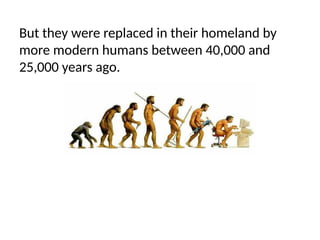
But they were replaced in their homeland by
more modern humans between 40,000 and
25,000 years ago.
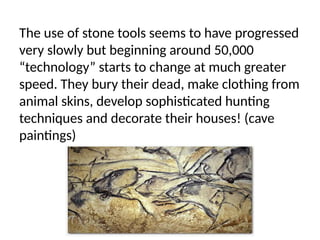
The use of stone tools seems to have progressed
very slowly but beginning around 50,000
“technology” starts to change at much greater
speed. They bury their dead, make clothing from
animal skins, develop sophisticated hunting
techniques and decorate their houses! (cave
paintings)
Periods of evolution
Philosophers, historians and scientists have tried to divide
prehistory into meaningful periods in terms of technological or
organizational changes. One of the most long-lasting subdivisions
of the prehistoric past is a “three age” system: the Stone Age,
the Bronze Age, and the Iron Age.
These three ages are subdivided further. The Stone Age, for
example, is conventionally divided into three periods: the
Paleolithic, or Old Stone Age (Greek: from palaios, old and lithos,
stone), which applies to societies who used chipped-stone
technology; the Mesolithic (Middle Stone Age), which is a
transitional period; and the Neolithic (New Stone Age) when
polished stone tools and objects are used, and agriculture begin.
Prehistoric societies are also classified on the
basis of political and social development: like
pre-state or primitive or hunter-gatherer
evolving to state or sedentary societies.
Hunting and gathering
From emergence till the “Neolithic” period
human beings lived by hunting animals and
gathering eatable plants. That is why such
groups are called “hunter-gatherer” in social
science terminology.
Depending on the season of plant foods and the
movements of animals, human groups were also
moving after their food. In such small, continuously
moving communities, there was little opportunity for
technological as well as social change.
Life was communal and knowledge and skills were
equally diffused. There were no sharp social
distinctions and the only obedience was towards
custom and traditions, transmitted by the legends and
myths of the group. In such a structure the rules are
simple, clear and the conformity to the norms is
closely watched by all group members.
A fundamental difference between hunter gatherers and
agricultural societies is that the latter needs manpower for
production so agricultural populations tend to increase.
( We may even observe this in contemporary societies.
Those living in big cities are obliged to move, leave their
homes each day to their works (hunting) and obtain the
needs from markets (gathering). Inevitably they have to
limit the number of children of the family. On the other
hand in rural areas children are desired as they are the
necessary no-cost elements of agricultural production).
The “Neolithic Revolution” After the
last ice age a global warming began about 15,000
years ago. As glaciers melted river and sea levels
rapidly rose, hunter-gatherers were faced with
the problem of adapting to the changes in the
flora and animals. For example most of the large
animals like mammoths became extinct, as a
result of this rapid climate change.
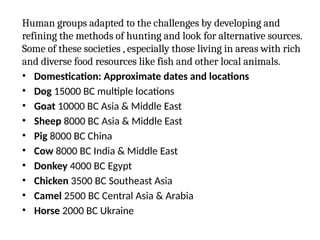
Human groups adapted to the challenges by developing and
refining the methods of hunting and look for alternative sources.
Some of these societies , especially those living in areas with rich
and diverse food resources like fish and other local animals.
• Domestication: Approximate dates and locations
• Dog 15000 BC multiple locations
• Goat 10000 BC Asia & Middle East
• Sheep 8000 BC Asia & Middle East
• Pig 8000 BC China
• Cow 8000 BC India & Middle East
• Donkey 4000 BC Egypt
• Chicken 3500 BC Southeast Asia
• Camel 2500 BC Central Asia & Arabia
• Horse 2000 BC Ukraine
The terms “Neolithic Revolution” is used for the
beginning of agriculture and domestication of
animals, and “Urban Revolution” is used for the
beginning of cities, writing, and literate
civilization in Mesopotamia and Egypt.
With a certain retard about 5000 B.C. similar
developments are observed in the Yellow River
Basin in China and Indus River basin in India.
All these developments required a new mode of
social organization, emergence and
centralization of a “state” authority and
specializations in the economy. Hierarchies of
wealth, status and power began to characterize
these new societies.
New ways, new frontiers Approximately at the same
period when agriculture emerged out of hunting and
gathering, a parallel specialization appeared: societies
particularly living by herding of domesticated or partially
domesticated animals. The necessity to move the herds
continually in search of fresh pastures makes this a semi-
nomadic way of life. On the other hand, for many groups
around the world this mode of life became stable over long
periods of time and reached until our days.
Pastoralism tended to develop often in semi-arid
regions like Central Asia. Wherever agriculture
and pastoralism existed near one another, a
trade usually formed between farmers who had
grain, metal and fabricated objects to exchange
with the hides, wool, meat, and milk products of
pastoral nomads.
States emerged because they were necessary for the
organizing production, irrigation systems and fulfill other
functions, to assure a certain social order and social peace.
The Neolithic revolution is also remarkable for the
development of trade that linked hundreds of societies with
one another.
Trade was inevitable due to the specializations forced by
natural resources and ecological conditions. Such
interregional trade relations can be traced back as early as
6000 B.C. in the Near East and Anatolia where agricultural
goods were exchanged by stone, metals and timber.
During the next millennium long-distance trade even
expanded over the boundaries of the Near East, linking
societies all the way from the India, Iran, Mesopotamia,
Anatolia, and the Nile Valley. You may consider this as a
“globalization” of the “known” world of the time.
Progress towards “civilization” “Civilization” as a term
comes from Latin civilis (of or proper to a citizen) as a
derivation of civis (townsman) . The Turkish term
medeniyet has also a similar correlation as it is derived
from the Arabic word medina which means “town”. The
emergence of civilization in human history by the
development of agriculture and sedentary way of life,
dated back to about 6,000 years BC . The characteristics
of these early civilizations are: food production in
permanent habitations, processing metals and other
natural sources, a division of labor in terms of
occupational specialization and the development of
writing.
More significant than all the establishment of a complex
form of organization, the state and the development of
hierarchical administrative bureaucracies are the central
characteristics of all civilizations. Societies with the above
distinctions appeared in several different parts of the
prehistoric world more or less independent from each
other and at different time periods like Mesopotamia,
Egypt, China and India. Civilizations in history had the
following common particularities:
1. Intensive agricultural techniques, such as crop
development and irrigation permitted a surplus of food
beyond the subsistence. This allowed the sustaining of
a group of population in other fields, such as
administration, industry, war, science or religion etc.
2. Those not in agriculture constituted the population
of the cities. By time a government and its bureaucracy
in charge of coordinating the tasks of production and
protecting the whole community began to concentrate
in the cities.
3. This institutionalized control of production by
a “ruling” class became more complex in time
and other formal social institutions such as
organized religion, education, permanent army
and markets and money as forms of economic
exchange developed. More or less a similar
organization appeared in all early civilizations
which continued to exist until today : “The
State”.
4. A significant aspect of civilization is
considered to be the invention of “writing”. The
distinguishing of pre-history and history is
generally based on the appearance of written
documents. The invention of the first writing
systems is in late 4th millennium BC in Sumer
and 1000 years later developed into cuneiform.
The invention of the first writing systems is in late 4th
millennium BC in Sumer and 1000 years later developed into
cuneiform. The first phase in the development of cities began
around four thousand B.C. Settlements developed in
Mesopotamia between the Tigris and Euphrates rivers in
modern-day Iraq , the Nile valley of Egypt, the Indus Valley
region of modern-day Pakistan and North India, and in the
Huang He (Yellow River) and Yangtze River valleys of China.
The Harappan civilization of the Indus River valley developed
in the middle of the third millennium B.C.E. approximately at
the same time as the river civilizations of the Middle East. The
first Chinese civilization developed along the Yellow River in
the middle of the second millennium B.C.E. In this text, due to
practical reasons of forced by the course hours and
curriculum, only Sumerian and Egyptian civilizations will be
studied.
The early cities were located on fertile flood plains next
to large rivers and had access to pasture land for raising
animals. They also benefited from a warm climate and
a permanent supply of water. Over time, small and
simple settlements grew into larger and more complex
centers with a variety of activities, from agriculture to
trade to manufacturing. Labor became more specialized
and this made production more efficient.
History of Civilization Lecture 2
By time a greater collective organization particularly
the management of irrigation systems and controlling
the redistribution process took shape. The regularity
of agricultural production necessary for the survival,
depends on the regularity of water supply. A regular
supply could be achieved by the control of the water
in irrigation systems and canal networks. Such a task
made necessary the common and organized efforts of
the communities. This aspect inevitably led to a more
centralized organization of the communities.
Mesopotamian Civilization - Sumers
The earliest known “civilization” Sumer, is
believed to have begun around 4000-3500 BC. In
Mesopotamia (meaning land between the rivers
in Greek) where Tigris (Dicle) and Euphrates
(Fırat) flow in a valley and finally meet before
arriving to the Persian Gulf.
Communities had also developed in the
northern regions but since rainfall in that area
was so unpredictable, after 5000 B.C.
communities began to spread towards the rich
alluvial plains of the south. The economy of
these early communities was primarily
agricultural and approximately 100-200 people
lived in villages.
The alluvial plain in southern Mesopotamia was
more fertile than the north but there was much
less rainfall, and to remedy this, irrigation canals
had to be constructed. The construction of
canals demanded cooperation between different
social groups in construction, regulation, and
maintenance. Due to such a necessity, a
common decision organ constituted by the
representatives of the communities.
Later on, the “representation” eliminated and
replaced by a hereditary administrative elite
with a ruler at the top. During the early stages
these rulers were priests. Besides controlling the
religious life of the community, they were also
managing the economy, land ownership as well
as organizing the defense and external relations
of the “state” .
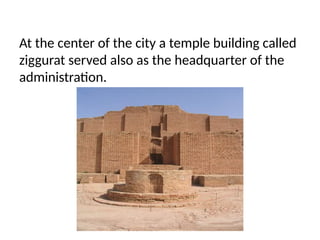
At the center of the city a temple building called
ziggurat served also as the headquarter of the
administration.
Later on, the power began to be represented by a
more secular king. However. the priests continued to
represent the upper class in the society. Below the
ruling class were the scribes and the officials in charge
of supervising every aspect of the city's economic and
social life. In brief the society was divided between an
elite group of a ruling class, an intermediary group of
merchants, artisans, and craftsmen and the free
peasants who composed the majority of the
population.
War captives turned into slaves also existed in
households as well as in various areas of services
and production.
A brief history to 2000 BC
This first historical age, called the Old Sumerian
(or Early Dynastic) period starting around 2800
B.C was characterized by frequent warfare as each
city sought to protect or enlarge its land and
water rights.
Each city-state was a theocracy, for the chief
local god was believed to be the real sovereign.
The god's earthly representative was called
“ensi”, the high priest and city governor, who
fulfilled both religious and secular functions.
The main land was divided in two parts. A part
of the land belonging to the temple called
'common' was worked by all members of the
community, while the remaining land was
divided among the citizens
After 2600 B.C., these common lands started to
become the private property of great
landowners called lugal meaning "great men”.
(Does this remind us the decline of the Ottoman
“timar” system and rise of ayan and derebeyi’s).
In later periods “lugal” will be the political title given
to the "king". Warfare between cities eventually led
to the further empowering of “lugal”s. Their
authority replaced that of early priestly rulers.
Sumeria became a more unified state, with a
common culture and a centralized government. This
led to the establishment of a professional
bureaucracy and an army. By 2375 BC, most of Sumer
was united under one king, Lugal Zaggisi of Umma.
One of the best known lugal is Urukagina, who
declared himself lugal of Lagash near the end of
the Old Sumerian period and ended the rule of
priests and "powerful men".
Urukagina’s reform edict condemns people acting
“for their own benefit" and after describing the
reforms conclude by the following remarks:
"… freed the inhabitants of Lagash from usury,
burdensome controls, hunger, theft, murder, and
seizure (of their property and persons). …
established freedom. The widow and the orphan
were no longer at the mercy of the powerful man."
In about 2340 BC King Sargon of Akkad
conquered Sumer and went on to build an
empire that stretched westward to the
Mediterranean Sea. The empire, though short-
lived, promoted further art and literature.
A picture of the daily life If someone could
narrate his impressions of a Sumerian city state
of 2500 BC, the picture would be somewhat like
that: Farmers working in their fields with ox-
drawn plows and some of the workers use
bronze sickles. The cities surrounded by fields
where agricultural goods produced. These lands
were thought to be "owned" by a local god.
An official organized groups of farmers to work
on the land and provide crops for the
community. In all directions, irrigation canals led
to grain and vegetable fields. Dominating the flat
countryside is the image of a ziggurat placed at
the center of the city. Citizens lived in small,
one-story houses constructed along narrow
alleyways. The river is dotted by boats carrying
products to and from the city.
Inside the city, a large number of specialists pursue
their appointed tasks as agents of the community and
not as private entrepreneurs. Some casting bronze
tools and weapons, others fashioning their wares on
the potter's wheel. Scribes would be at work writing
clay tablets carrying the orders of the administration
addressed to the district administrators. Some would
be registering the inventory of the goods received
that day as donations to the temple.
Also in these clay tablets will take place the
announcements of price and wages, production
figures, lists of taxes, contracts and other
subjects of organizational life in the community.
Some scribes would be occupied in writing basic
texts to be used for the purpose of teaching
future scribes reading and writing at schools
built just for his purpose.
Sumerian contributions
The instability of natural phenomenon was side
by side with the regular patterns of seasons.
These conditions made necessary the
observation of the celestial objects, learn their
regularities. Early cultures identified celestial
objects with gods and spirits. They related these
objects (and their movements) to phenomena
such as rain, drought, seasons, and tides.
Calendars developed to mark the movements and phases of
the Sun and Moon and other bodies of the space. This
knowledge was of importance to agricultural societies because
a good harvest depended on planting at the correct time. The
calendar developed by Sumerians was adjusted to the phases
of the moon. This lunar calendar was adopted later by the
Semites, Egyptians, and Greeks. An example demonstrating
how improvement could be enforced by actual needs is the
following: The Mesopotamian plain had no stone, no metals,
and no timber except its soft palm trees, these materials had
to be transported from Syria and Anatolia.
Water transport down the Tigris and Euphrates solved
the problem. The oldest sailing boat known is
represented by a model found in a Sumerian grave of
about 3500 B.C. Soon after wheeled vehicles also
appear in the form of ass-drawn chariots for warfare
as well as the transport of goods overland. Another
important invention was the potter's wheel, "the first
really mechanical device." used in Sumer around 3500
B.C. Earlier, people had shaped pots by molding or
coiling clay by hand.
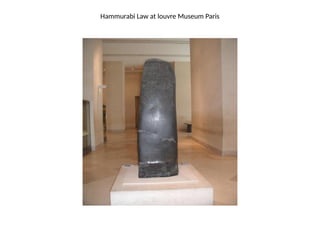
And the first “written” law
We owe the first written law code to a Mesopotamian
king Hammurabi (1792–1750 B.C.) As the king of
Babylonia, he founded an empire that was eventually
destroyed by raids from Asia Minor. To Hammurabi
also attributed the building of the legendary “Tower
of Babel”. His code of laws is carved on a column, in
3,600 lines of cuneiform; it was found (1902) at Susa
and is now at Louvre Museum in Paris.
The code, which addresses such issues as business
and family relations, labor, private property, and
personal injuries and other regulations of
everyday life. A well known aspect is the nature of
the punishments, which is reflected in the popular
culture as “an eye for an eye”. Much of the code is
drawn from earlier Sumerian and Semitic laws and
reflects the social conditions of the Mesopotamian
culture and daily life.
Hammurabi Law at louvre Museum Paris
End of Sumer and after
Immediately to the north of Sumer , where the
two rivers came most closely together, the plain
was less subject to flooding but made fertile by
rainfall and irrigation. This area, known first as
Akkad.
A Semitic people called the Amorites conquered
the area about 2000 B.C. and founded a great
new capital city of Babylon . The area hereafter
came to be known as Babylonia. Except for
invasions of Hittites , Babylonia continued to
dominate Mesopotamia for a thousand years.
The third region, called Assyria , stretched from
the north of Babylonia to the Taurus range. The
Assyrians, were able to conquer the whole of
Mesopotamia in the eighth and seventh
centuries and setup a commercial network
including Anatolia.
Thus the history of Mesopotamia can be
pictured as a shift of the center of power
northwards, from Sumer to Babylonia and then
to Assyria. The Babylonian Empire was able to
establish a unified trade and cultural zone
incorporating much of the Tigris and Euphrates
valleys. About 1600 B.C.E., Hittite invaders from
Asia Minor crushed the Babylonians and
established their own empire.
Hittites, in turn, were displaced by a series of
smaller kingdoms that disputed the control of
Mesopotamia between 1200 and 900 B.C.E.
During this period smaller regional cultures,
such as the Hebrew and Phoenician, flourished.
After 900 B.C.E., a new series of empires the
Assyrian and Persian controlled the region.
Third Lecture – Egyptian Civilization.
Ancient Egypt The Nile River, longest river in the
world, forms a line of life through the sterility of
the giant Sahara desert in North Africa. Nile
begins at near Khartoum in today’s Sudan and
ends at the rives of the Mediterranean sea.
Along this narrow strip, one of the greatest and
most enduring human civilizations established
itself.
Around 5000 BC, people began to live in villages
up and down the Nile Valley, and one thousand
years later Nile culture began to flourish. From
3900 to 3100 B.C., the villages along the Nile
valley grew. The unification of Egypt, took a few
generations and finally the first dynasty of Egypt
founded. This led to a centralization of authority
and capacity through which massive
administrative and building projects could be
realized.
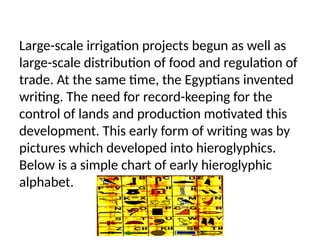
Large-scale irrigation projects begun as well as
large-scale distribution of food and regulation of
trade. At the same time, the Egyptians invented
writing. The need for record-keeping for the
control of lands and production motivated this
development. This early form of writing was by
pictures which developed into hieroglyphics.
Below is a simple chart of early hieroglyphic
alphabet.
The most important consequence of unification
was the establishment of a state system. By time
the institutional structure went beyond the
Individual king (pharaoh) or his administrators.
The pharaoh began to be considered an
incarnated god. As a god, he brought life, fertility,
order, stability, and rationality to the Egyptian
state just as the gods could do and the pyramids
represented also this divine force.
This institution of the divine king lasted for
almost 3000 years and gave to the Egyptian
state a stability unseen by any other early
civilization. During the period called The Old
Kingdom, (2650-2134 BC) agricultural
production had been revolutionized by the
building of massive irrigation projects and the
population increased exponentially.
This period, is considered to be the richest and
most creative period in Egyptian history. The
trade within the county as well as with other
regions developed and transport on Nile was
made by boats.
Almost all the pyramids were built at this time;
the growth in population and wealth allowed
the kings to assign vast amounts of labor and
materials to these monuments. The first
pyramids were almost entirely symbolic in
nature to exhibit the power of the central
administration.
An intermediate period (2134-2040 BC) came
when, due to certain climatic conditions the
level of Nile reduced causing a production crisis
so hunger and death. All the administrative
organization that held the country together
during the Old Kingdom fell apart and the
country divided into dozens of chiefdoms.
For one hundred years after the decline of the
Old Kingdom order and the institution of the
Egyptian king was re-established and this period
is named as the Middle Kingdom (2040-1640
BC.). Trade with foreign countries began again,
irrigation projects were repaired, and the writing
of texts started. As the kings of Egypt slowly
regained the authority of the monarchy, Egypt
again grew in wealth and population.
Large-scale immigration of foreigners into the Nile
Valley during the Middle Kingdom also caused end of
the Middle Kingdom in Egypt. In time, as their
numbers increased, they threatened the power of the
Egyptian monarchy itself and Egypt fell into disorder.
This period, called the Second Intermediate Period,
saw Egypt ruled by foreign kings for almost a hundred
years. The Egyptians, called these kings Heka-Khast,
or "Rulers of the Foreign Lands." The Greeks later
altered this word to “Hyksos”.
1550 BC. an Egyptian general who finally drove
out the Hyksos, founded a new dynasty, and
started a new era that is named as the New
Kingdom, which will last 500 years. It is towards
the end of this period that a young Amenhotep
IV rejected the pantheon of Egyptian gods and
brought the belief to one and only one god
deserved to be worshipped: “Aten” the sun-god.
Renaming himself Akhenaten, with his wife famous
Nefertiti, he is considered as the founder of the first
monotheistic religion we know of in human history.
Also during this time the Hittite empire began to gain
ground towards the Egyptian frontier. The warfare
between Egypt and the Hittites resulted by a treaty
signed between Ramses II (pharaoh of Egypt) and the
Hittite King Hattusili after the Battle of Kadesh, in what
is now modern day Syria, around 1272 B.C. This is the
earliest treaty ever signed in history.
The peace treaty was recorded in two versions,
one in Egyptian hieroglyphs and the other in
Akkadian using Cuneiform script. An interesting
note : although the majority of the text is
identical, the Hittite version claims that the
Egyptians came to them asking for peace
whereas the Egyptian version of the same text
say it was the other way round.
Above
Around 1000 BC. Egypt fall into another period of
political chaos when no-one was really in charge of
Egypt. This period is called “The Third Intermediate
Period”. In 728 BC, after three hundred years of chaos,
Egypt was invaded by the Nubians from the south.
Since then Egypt lived under the domination of
different powers like Assyrians and Persians. In 332 BC
they welcomed the Greek conqueror of Persia,
Alexander the Great, into their country as their great
liberator.
At its height, Alexander's short lived empire included
all of Egypt, Greece, Thrace, Turkey, the Near East,
Mesopotamia, and Asia all the way to India. After the
death of Alexander the short lived empire divided
among his most powerful generals, and Egypt came
under the control of one of his generals and his
dynasty will be called the Ptolemaic period. Even
though they adopted Egyptian customs to a certain
degree, during the reign of Ptolemaic kings Greek
became the state language, and cities were renamed.
Final queen of the Ptolemaic line, is the famous Cleopatra.
She fell into a dispute with her half-brother over the
succession and invited Julius Caesar and the Romans to
intervene. However, when she sided with Mark Antony
against Augustus Caesar and lost in the naval battle of
Actium in 31 B.C., Egypt became a Roman province. In Egypt
anti-Roman sentiment soon crystallized around a new
religion, Christianity, introduced in the middle of the first
century AD. These Egyptian Christians, called "Copts," saw
this religion as a tool to use in anti-Roman struggle but
Egypt never recovered as an independent state .
Egyptian Religion
Religion played a very important role on Egyptian political, social,
economical and artistic aspect of life. Religious beliefs were the basis
of Egyptian art, medicine, astronomy, literature, and government.
The great pyramids were tombs for the Pharaohs, man-gods.
Magical utterances pervaded medical practices, for disease was
attributed to the Gods.
Astronomy evolved to determine the correct time to perform
religious rites and sacrifices.
The earliest examples of literature dealt wholly with religous themes.
Polytheism-Monotheism-Polytheism (evolution of Egyptian religion)
Egyptian POLYTHEISM took many forms, including
the worship of animals, for the people believed
that gods manifested themselves in both human
and animal shapes.
The Egyptians also believed great powers in nature-
sky, sun, earth, the Nile-to be gods. Thus, the
universe was teeming with divinities, and human
lives were tied to the movements of the sun and
the moon and to the rythm of the seasons.
AFTERLIFE
A crucial feature of Egyptian religion was the afterlife
Through pyramid tombs, mummification to preserve the dead,
and funerary art, the Egyptians showed their yearning for
eternity and their desire to overcome death.
To the Egyptians, the other world offered the same pleasures
as those enjoyed on earth-friends, servants, fishing, hunting,
paddling a canoe, picnicking with family members,
entertainment, by musicians and dancers, and good food. But
since earthly existence ws not fundemantally unhappy ,
Egyptians did not long for death.
The religion of the ancient Egyptians went through various stages:
from simple polytheism to the earliest known expression of
monotheism, and then back to polytheism.
In the beginning each city or district seems to have had its local
deities, who were guardian gods of locality.
The unification of the country resulted in a fusion of divinities . All
of the guardian deities were merged into the great SUN GOD RE.
Under the Middle Kingdom this deity was called AMON or AMON-
RE from the name of the chief god of Thebes.
The gods who personified the vegegative powers of the nature
were fused into a deity called OSIRIS, who was also the god of the
NILE.
During the period of Old Kingdom the solar faith,
embodied in the worship of RE, was the dominant belief.
It served as an official religion. Its main function was to
give immortality to the state and the people. The pharaoh
was the living representative of this faith on earth.
RE was not only a guardian deity. He was in addition the
god of righteousness, justice, and truth.
THE CULT OF OSIRIS, began its existence as a nature
religion. It personified the growth of vegetation and the
life-giving powers of the Nile.
OSIRIS LEGEND:
In the remote past, according to belief, OSIRIS had
been a benevolent ruler, who taught his people
agriculture and other practical arts and gave them
laws. After a time he was killed by his wicked brother
SET, and his body cut into pieces. His wife ISIS, whı was
also his sister, went in search of the pieces, put them
together, and miracoulusly restored his body to life.
Horus, his posthumous son, finally grew to a manhood,
and avenged his father’s death by killing SET.
• Originally this legend seems to have been little
more than a nature myth. The death and
resurrection of OSIRIS symbolized the
recession of the NILE in autumn and the
coming of the flood in the Spring.
• More important still, the death and
resurrection of Osiris came to be regarded as
conveying a promise of immortality .
The Egyptian religion attained its fullest
development about the end of the Middle
Kingdom. By this time the solar faith and the cult
of Osiris had been merged in such a way as to
preserve the best features of both. The province of
AMON as the god of living, as the champion of of
good in this world, was accorded almost egual
importance with the functions of Osiris as the giver
of personal immortality and the judge of the dead.
Soon after the establishment of empire, the Egyptian
religion underwent a serious debasement and corruption. Its
ethical significance was largely destroyed, and superstition
and magic gained the ascendancy.
The chief cause seems to have been that the long and bitter
war for the expulsion of the Hyksoses fostered the growth of
irrational attitudes and correspondingly depriciated the
intellect.
The result was a marked increase in the power of the priests,
who prayed upon the fears of the masses to promote their
own advantage.
THE CULT OF ATON
The degradation of the religion at the hands of the priests in to a
system of of magical practices finally resulted in a great religious
upheaval. The leader of this movement was the Paharaoh
AMENHOTEP IV, who began his reign about 1375 B.C. And died
about 15 years later.
He resolved to crush the system entirely. He drove the priests from
the temples, hacked the names of the traditional deities from the
public monuments, and initiated the worship of a new god whom
he called ATON. He changed his own name from Amenhotep to
AKHENATON, which meant “ Aton is satisfied”. His wife NEFERTITI
became NEFER-NEFRU-ATON: “Beatiful is the beauty of Aton”.
More important than these cahanges, was the new set of
doctrines : He taught first of all a religion af a qualified
MONOTHEISM
Aton and Akhenaton himself were the only gods in existence.
Like none of the gods before him, Aton had no human or
animal shape but was to be conceived in terms of lifegiving,
warming rays of the Sun.
He was the creator of all, and thus god not merelyog Egypt
but of the whole universe.
While the pharaoh and his wife worshipped Aton, others
were to worship Akhenaton as a living deity.
Akhenaton restored the ethical quality of Egyptian
religion at its best by insisting that Aton was the
author of the moral order of the world and the
rewarder of mankind for integrity and purity of heart.
He enviseged as a heavenly father who watches with
benovolent care over all his creatures. Conceptions
like these of the unity, rightoussness, and
benevolence of God were not attained again until the
time of the Hebrew prophets some 600 years later.
• Despite the energy with wich Akhenaton pursued his
reşigious revolution it was a FAILURE. It gained little
popular support and following because the masses
remained devoted to their old gods.
• The new religion was too strange for them and lacked
the greatest attraction of the older faith: the promise
of an after life.
• Moreover the pharaohs after Akhenaton, were allied
with the priests of Amon and accordingly restored the
older modes of worship.
Fourth Lecture – Greek Civilization
Most historical observations as well as contemporary
approaches revolve around the structural as well as cultural
and ideological differences between east and west. Even
today the prediction on a certain “clash of civilizations” is
somehow based on this long-lasting approach to “the other”.
From the start of history “the East” was the advanced region
with prosperous cities, developed economy within relatively
centralized states. On the other hand West was
“underdeveloped” with weaker towns, rent-exploited or
enslaved peasantry and in most cases with a weak central
authority. Feudalism and Capitalism evolved in such a region.
Greek and Roman societies political universe is initially
based on small independent cities with their economies
depending on a slave labored agriculture and trade.
Agriculture (throughout all periods) is the dominant area
of production furnishing the main income of cities. The
“citizen” land owners constitute a small segment of the
population as the rest being mostly slaves deprived of any
material means. Production limited mostly to simple
textile, pottery, furniture and glassware is narrow due to
limited demand and expensiveness of transport.
A common particularity for Greece and Rome is the
Aegean and the Mediterranean seas serving a big
geographical zone with the best seaport possibilities. This
situation made possible an urban growth, concentration
and complexity with a developed interregional trade.
Slavery is the only form of “labor” common both in Greece
and Rome. While various forms of slavery were also
existent in the “Eastern” societies but it was mostly
occasional due to war captivity and mainly limited to
household production.
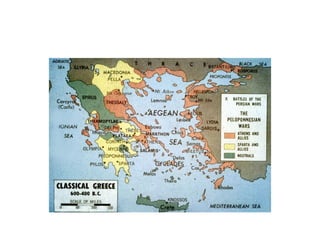
In the Greek city states by 5th century B.C. and in
Rome by 2nd century B.C. slavery became a
dominant form. It was the high number of slaves
used in all production that permitted a "freedom"
and "democracy" to a non-laboring population.
However these systems couldn't reproduce
themselves due to the lack of incentive for
productivity and invention which also caused their
rapid disintegration and evolution to other systems.
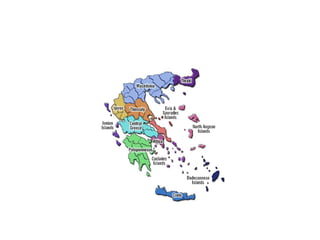
Classical Greece and the Hellenistic World: A
Brief Survey
“Classical Greece” till now is considered as a
cultural ancestor of “the” Western Civilization. It
is a tradition continued by the Roman culture,
Islamic science and philosophy, “rediscovered”
by the Renaissance and so forth. Greek culture
itself was based on the heritage of Minoa,
Mycenae as well as Egypt and the other Middle
Eastern civilizations.
Internal warfare, invasions and probably some
natural disasters had destroyed the earlier
settlements but by 800 B.C. a new civilization named
as “classical” began to emerge and flourished until
400 B.C. With the empire of Alexander the Great
called the “Hellenistic period”, this civilization spread
in the whole Mediterranean region. Later, the
cultural scientific and philosophical heritage will be
transmitted by Roman and Islamic civilizations.
The Greek society was mainly based on private
property thus a further stimulus to Greek
civilization came from the development of sea
trade in the Mediterranean. Increased wealth
with population growth and social change in
Greece encouraged new political forms.
After 800 B.C. the society revolved around city-
states (polis), varying in size. Originally the polis
constituted by a city and its agricultural
hinterland was ruled by landowning aristocrat-
warriors through a more or less “direct
democracy”. After 700 B.C. the system of
aristocratic control was challenged as a result of
commercial expansion.
Many city-states founded colonies along the
coasts of the Mediterranean and Black Sea.
These colonies relieved population pressure,
provided particularly grain supplies, and served
as markets for various products.
However this “capitalist” expansion resulted by a
severe loss for small landholders and an increased
gulf between the rich and poor. By the 6th century
B.C. urban commercial groups and dispossessed
farmers sought reform. And reformers, like Solon
of Athens, developed new laws to regulate the
social environment. By 500 B.C. most city-states
were based upon principles of loyalty to the
community rather than to an individual ruler.
A participation in public life of every male citizen
and the dominant principle of “rule by the
people” was called democracy in Athens. A
popular assembly of citizens was the sovereign
authority. Citizens formed the army and served
as jurors. Offices were chosen by lot and were
responsible to the assembly. Women, slaves,
and foreigners - were excluded from political
rights.
In Ancient Athens only men were citizens, and only
citizens could govern. As young boys they were
trained in reading, writing, arithmetic, poetry, music,
dance, and athletics.
Women were not seen as citizens, they stayed home
and did the housework, which included washing,
cleaning, and taking care of the children, but men
were not expected to share the work . (Among
others we have inherited this tradition also)
Greek political life was based on individual
participation quite different from other centralized
states of the Middle East and Asia. The growing
power of a democratic, commercially active Athens
led to competition with oligarchic, conservative, and
militaristic Sparta. They fought from 431 to 404 B.C.
in the Peloponnesian War. A weakened Athens
surrendered to Sparta in 404 B.C. and this marked
the end of the dominance of the polis culture.
The Peloponnesian Wars had destroyed all basis
for Greek unity which will be realized for a brief
period by a conquering northern state,
Macedonia in 338 BC. Taken the control of
Greece and expanded into the Middle East and
Egypt, short-lived empire of Alexander the Great
greatly helped to the expansion of Hellenistic
culture.
The new empire of Alexander quickly
fragmented into states run by former generals.
The three principal dynasties were the Ptolemy
in Egypt, the Seleucids in Persia, and the
Antigonid in Macedon and Greece.
Early History: the missing Minoans
Today still limited information is known about
Minoan civilization of Crete whose name derives
from a figure of myth rather than history: the
Minotaur, a monster with the body of a man and
the head of a bull. Minoa is famous for its
colossal palaces built from around 2000 BC as the
administrative centre for a large local population
estimated as between 15,000 and 50,000 people.
Minos