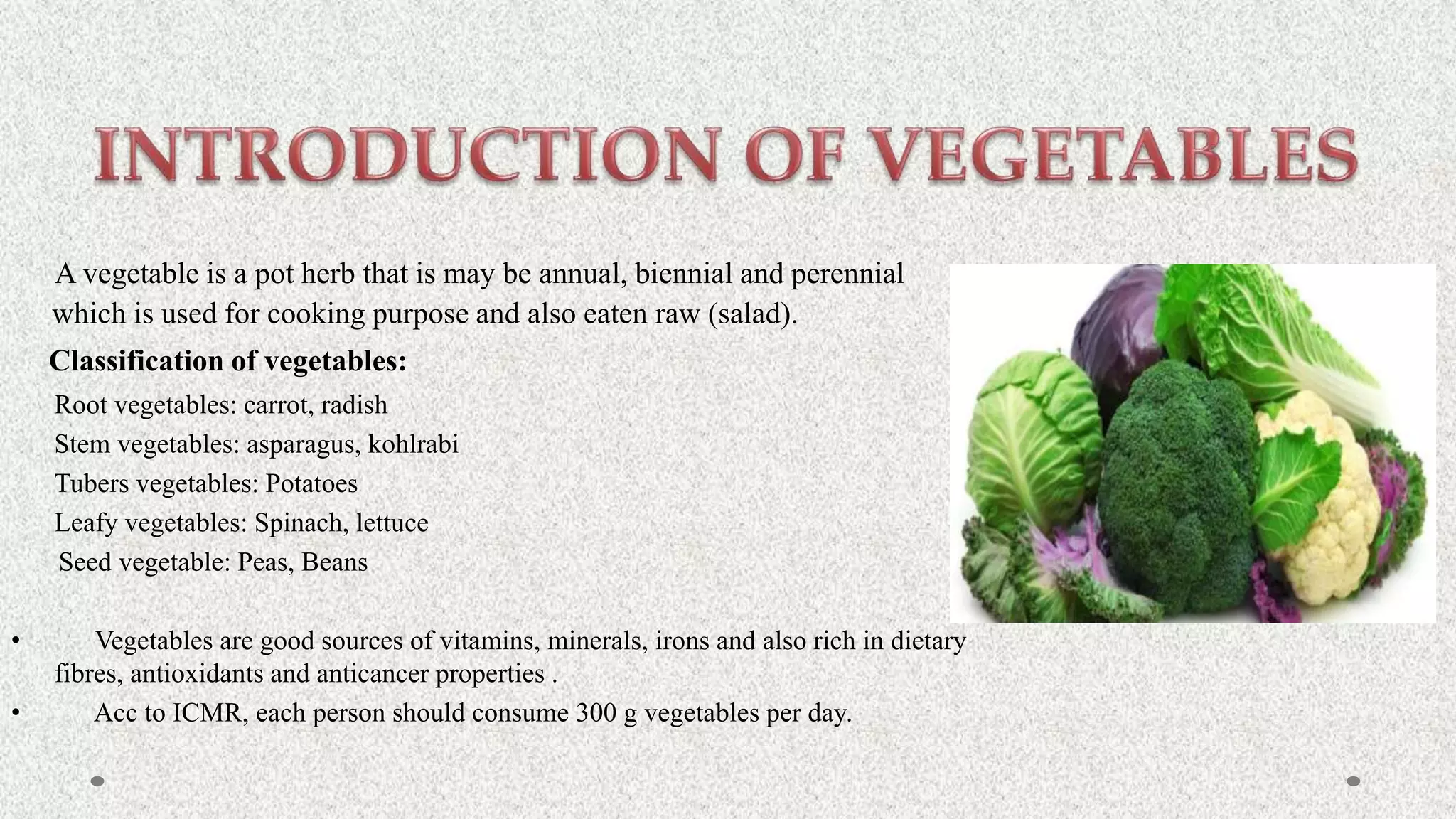
A vegetable is a pot herb that is may be annual, biennial and perennial
which is used for cooking purpose and also eaten raw (salad).
Classification of vegetables:
Root vegetables: carrot, radish
Stem vegetables: asparagus, kohlrabi
Tubers vegetables: Potatoes
Leafy vegetables: Spinach, lettuce
Seed vegetable: Peas, Beans
• Vegetables are good sources of vitamins, minerals, irons and also rich in dietary
fibres, antioxidants and anticancer properties .
• Acc to ICMR, each person should consume 300 g vegetables per day.
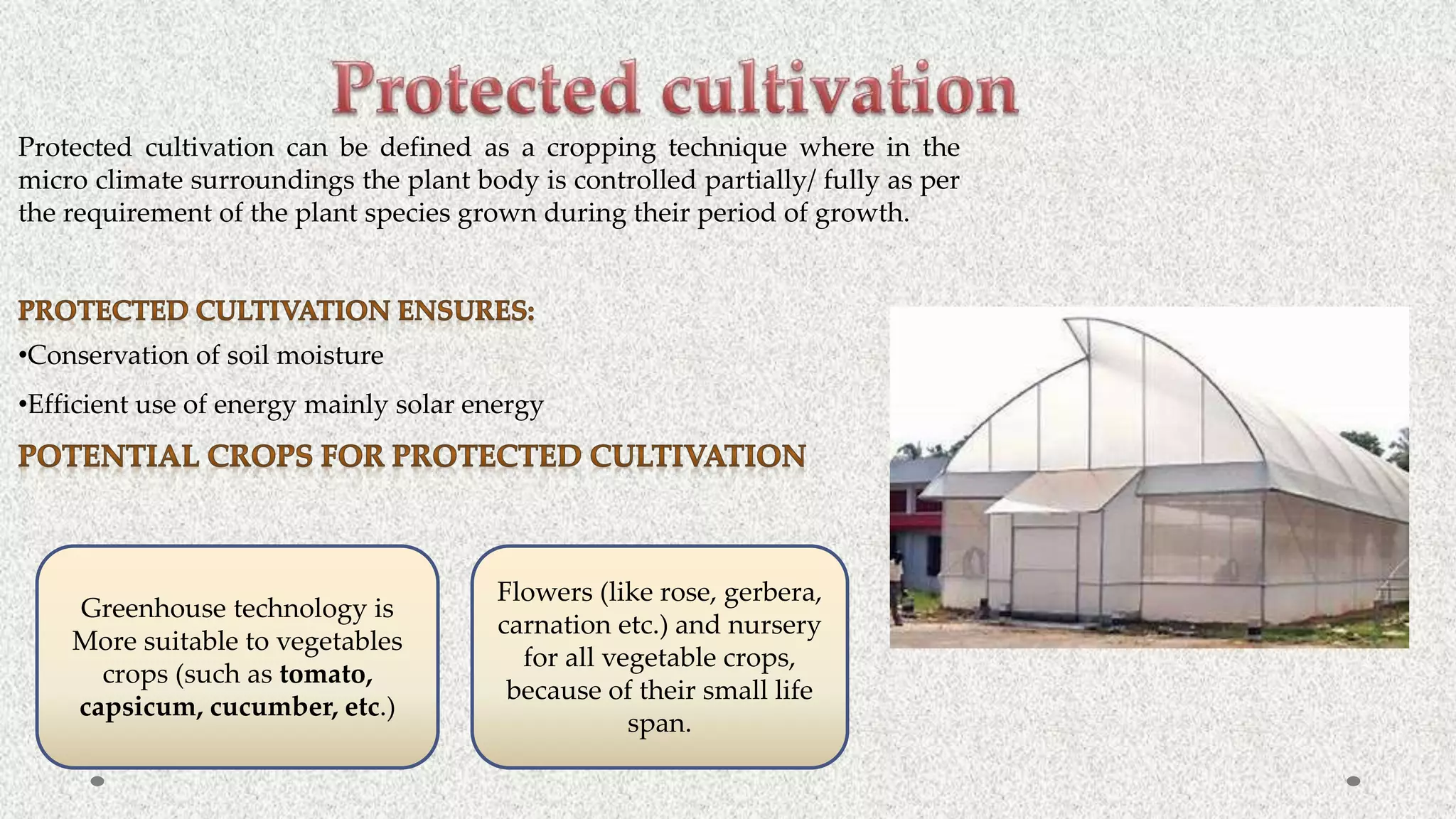
Protected cultivation can be defined as a cropping technique where in the
micro climate surroundings the plant body is controlled partially/ fully as per
the requirement of the plant species grown during their period of growth.
•Conservation of soil moisture
•Efficient use of energy mainly solar energy
Greenhouse technology is
More suitable to vegetables
crops (such as tomato,
capsicum, cucumber, etc.)
Flowers (like rose, gerbera,
carnation etc.) and nursery
for all vegetable crops,
because of their small life
span.
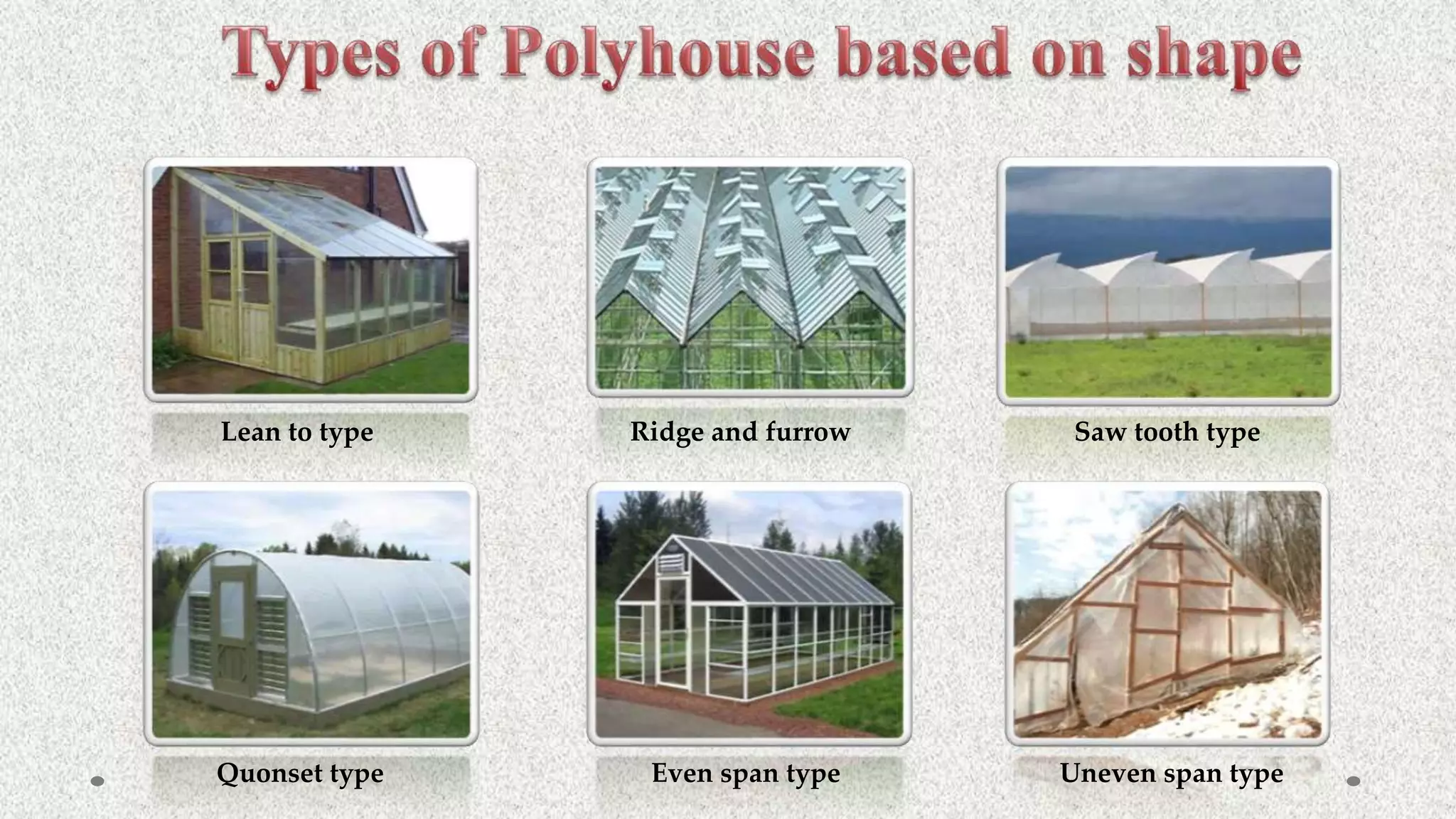
Lean to type Ridge and furrow Saw tooth type
Quonset type Even span type Uneven span type
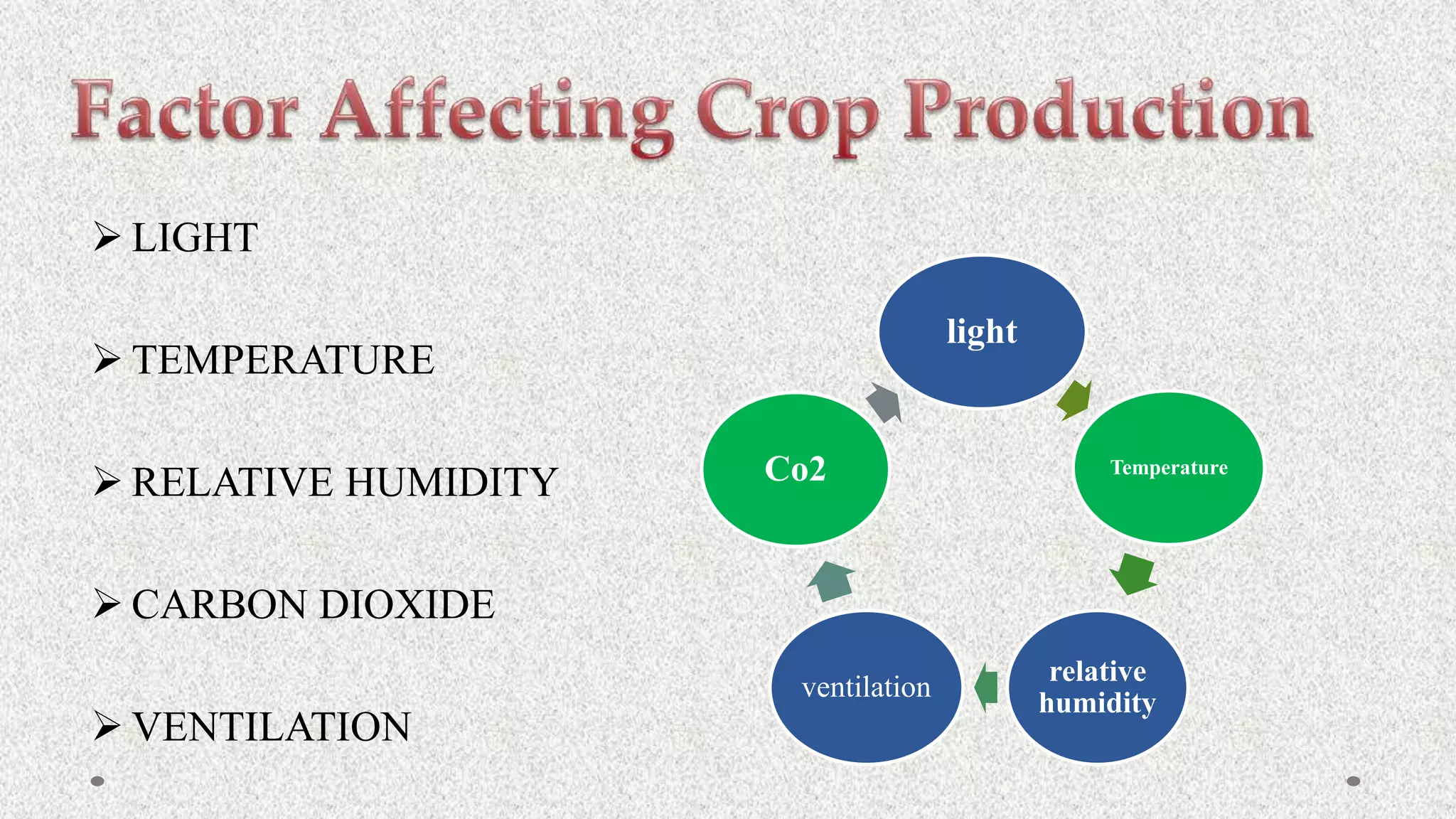
 LIGHT
 TEMPERATURE
 RELATIVE HUMIDITY
 CARBON DIOXIDE
 VENTILATION
light
Temperature
relative
humidity
ventilation
Co2
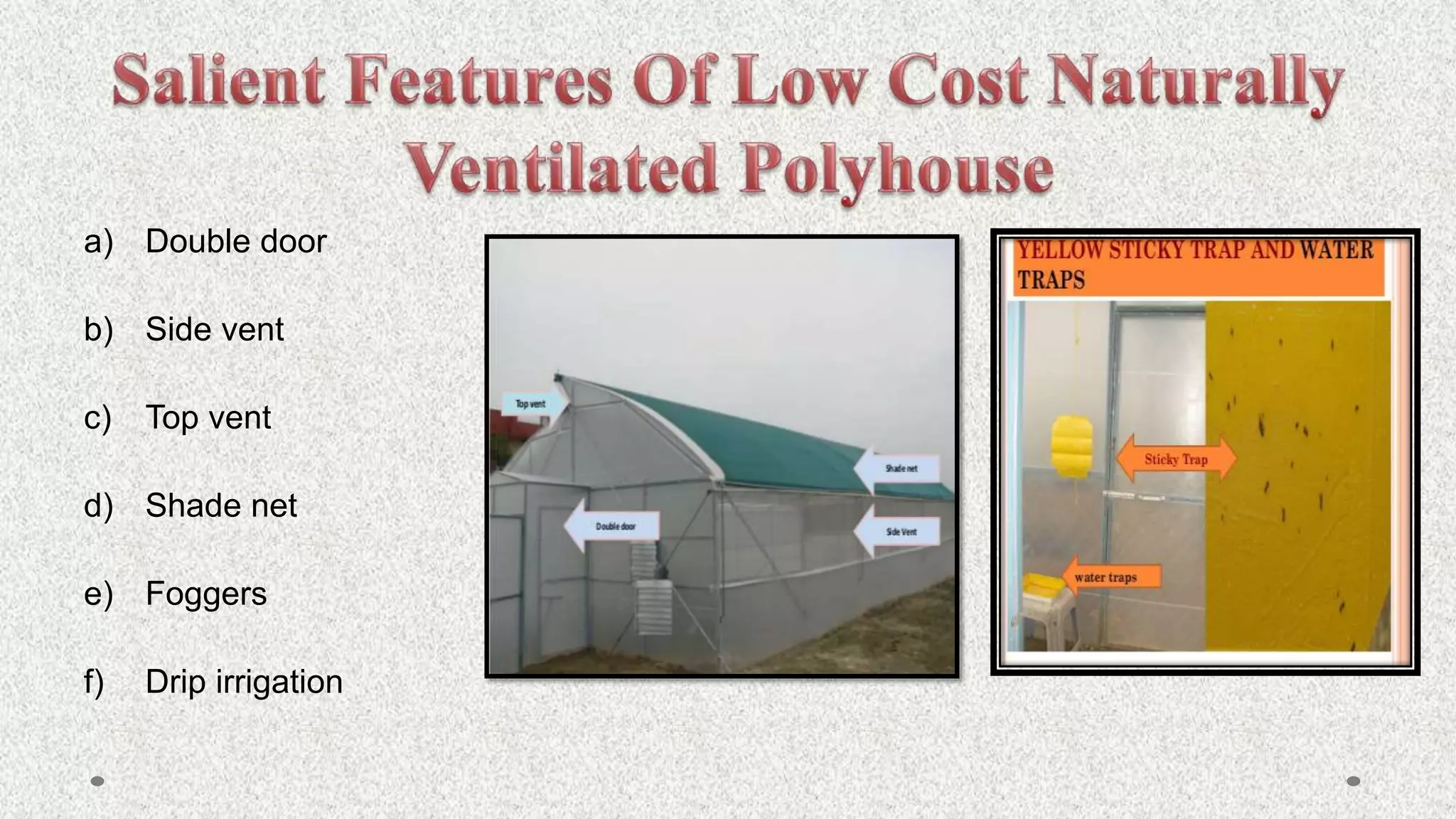
a) Double door
b) Side vent
c) Top vent
d) Shade net
e) Foggers
f) Drip irrigation
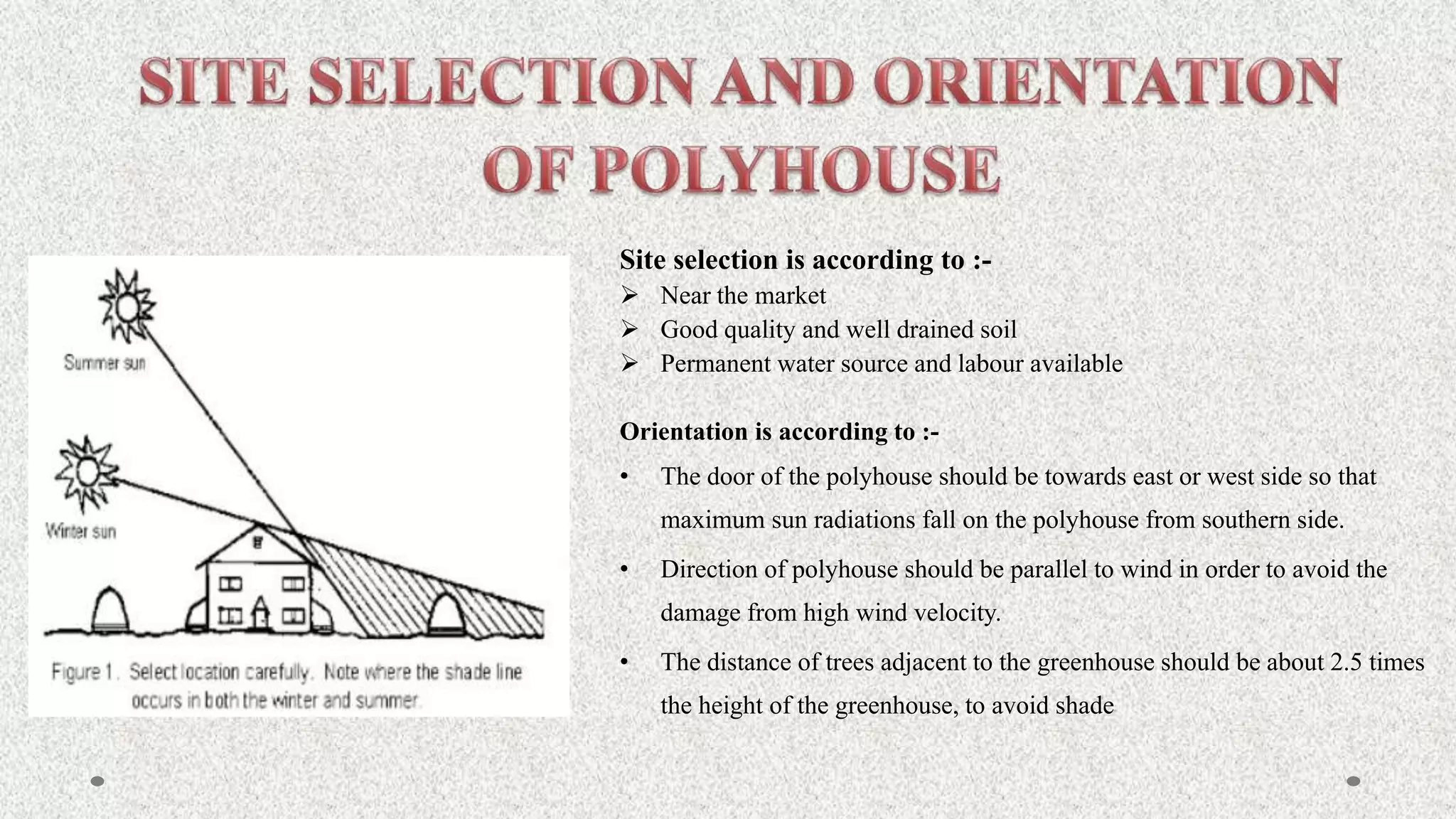
Site selection is according to :-
 Near the market
 Good quality and well drained soil
 Permanent water source and labour available
Orientation is according to :-
• The door of the polyhouse should be towards east or west side so that
maximum sun radiations fall on the polyhouse from southern side.
• Direction of polyhouse should be parallel to wind in order to avoid the
damage from high wind velocity.
• The distance of trees adjacent to the greenhouse should be about 2.5 times
the height of the greenhouse, to avoid shade
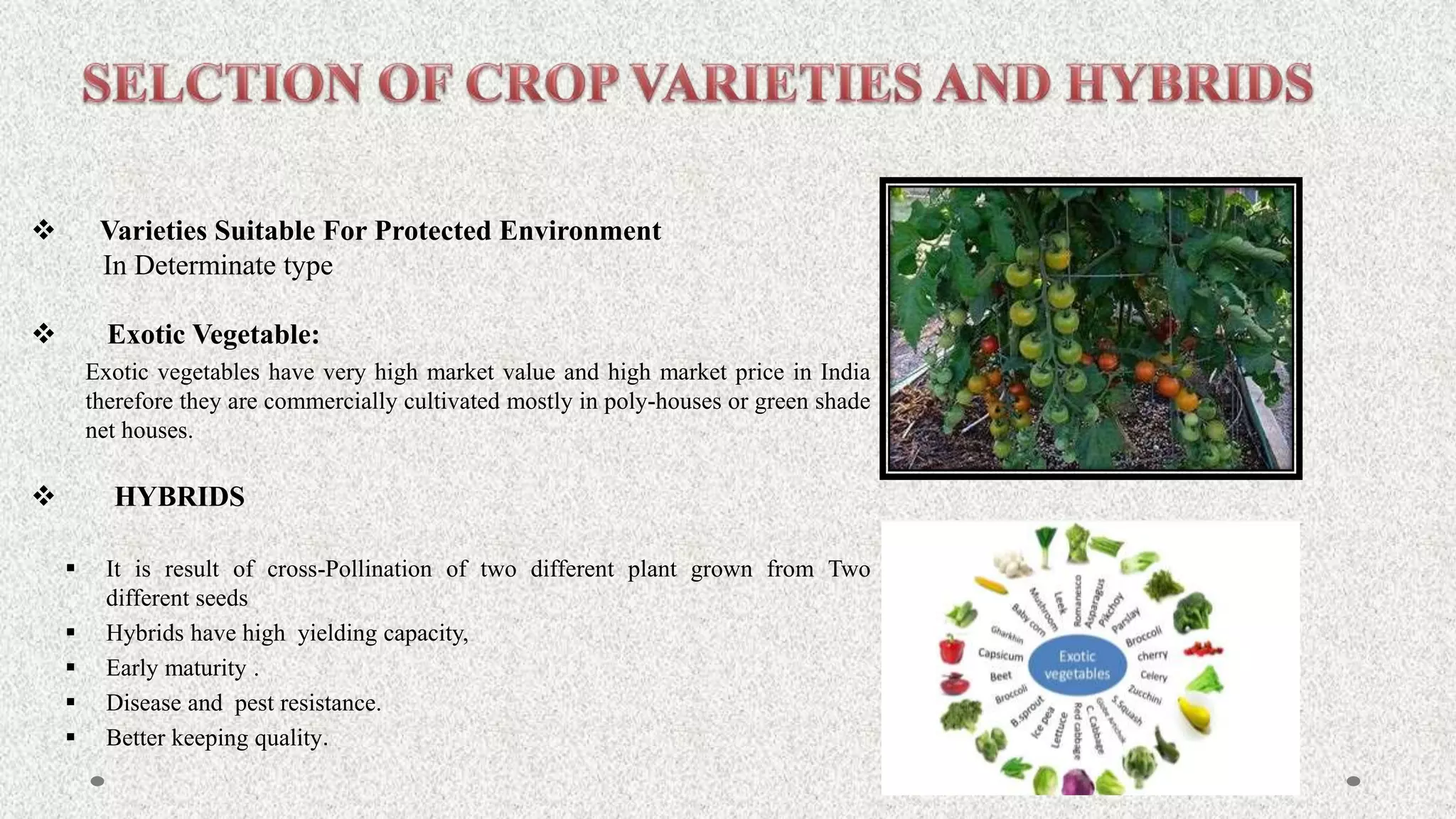
 Varieties Suitable For Protected Environment
In Determinate type
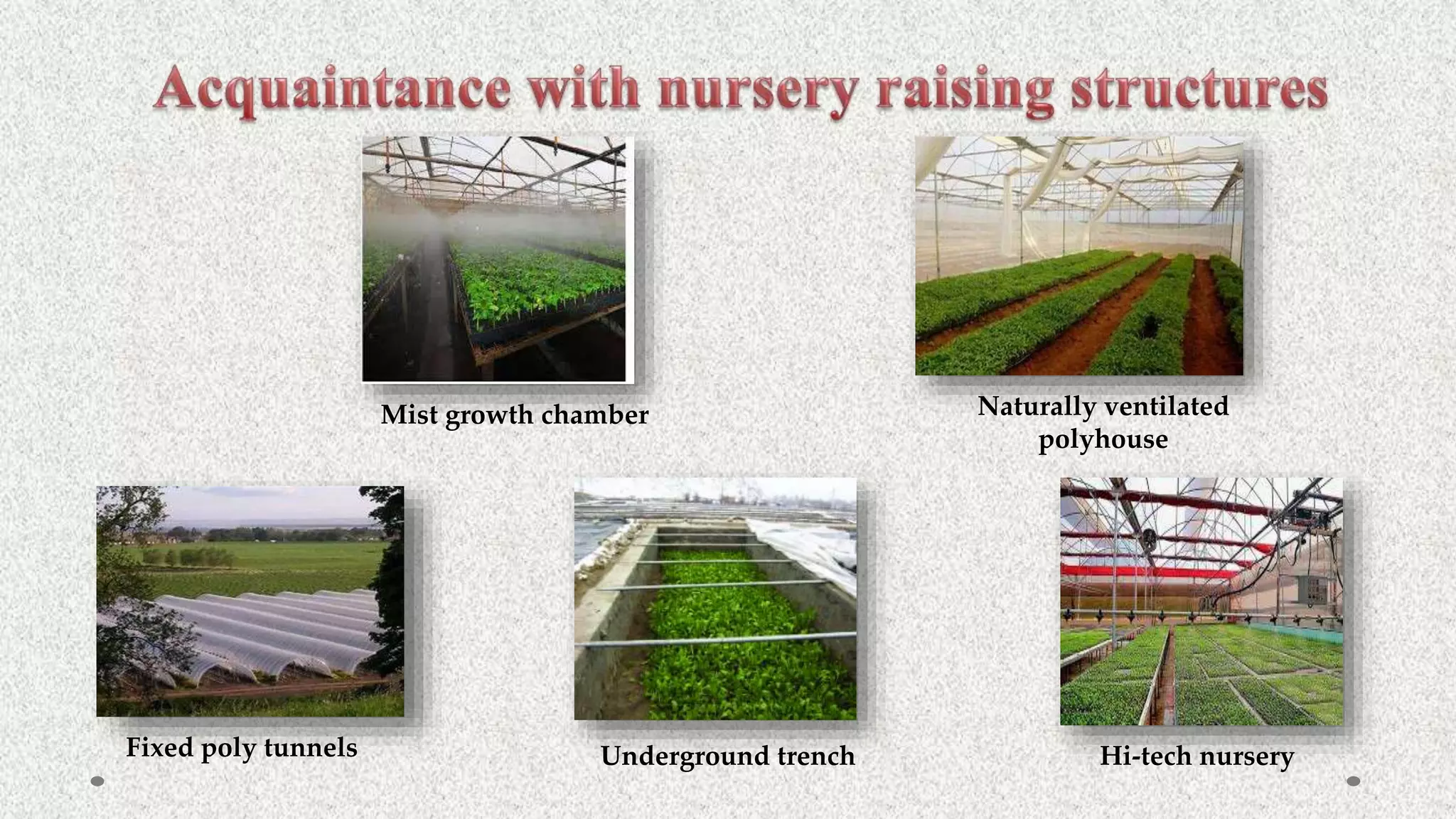
 Exotic Vegetable:
Exotic vegetables have very high market value and high market price in India
therefore they are commercially cultivated mostly in poly-houses or green shade
net houses.
 HYBRIDS
 It is result of cross-Pollination of two different plant grown from Two
different seeds
 Hybrids have high yielding capacity,
 Early maturity .
 Disease and pest resistance.
 Better keeping quality.
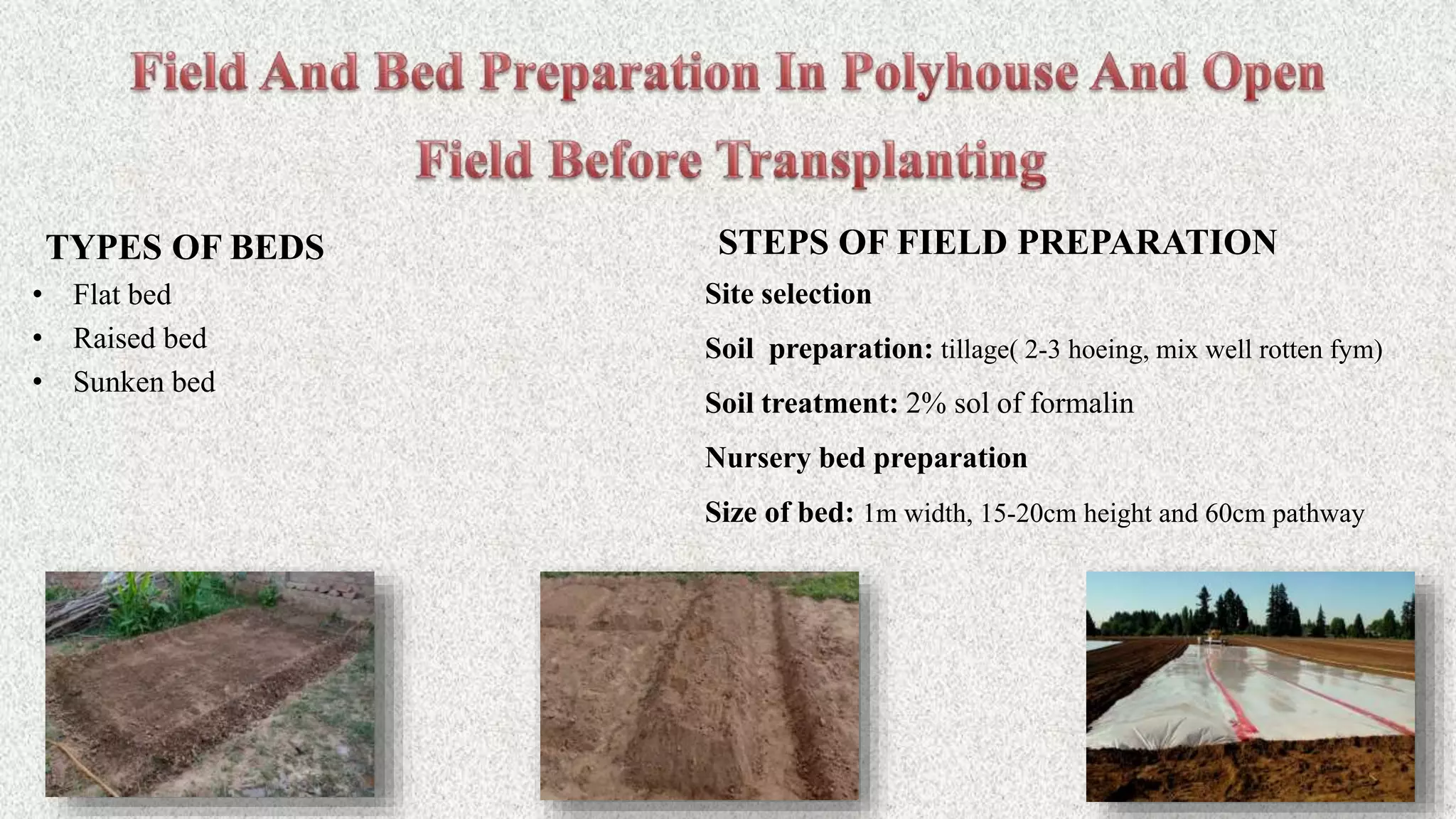
Mist growth chamber
Fixed poly tunnels Underground trench Hi-tech nursery
Naturally ventilated
polyhouse
TYPES OF BEDS
• Flat bed
• Raised bed
• Sunken bed
STEPS OF FIELD PREPARATION
Site selection
Soil preparation: tillage( 2-3 hoeing, mix well rotten fym)
Soil treatment: 2% sol of formalin
Nursery bed preparation
Size of bed: 1m width, 15-20cm height and 60cm pathway
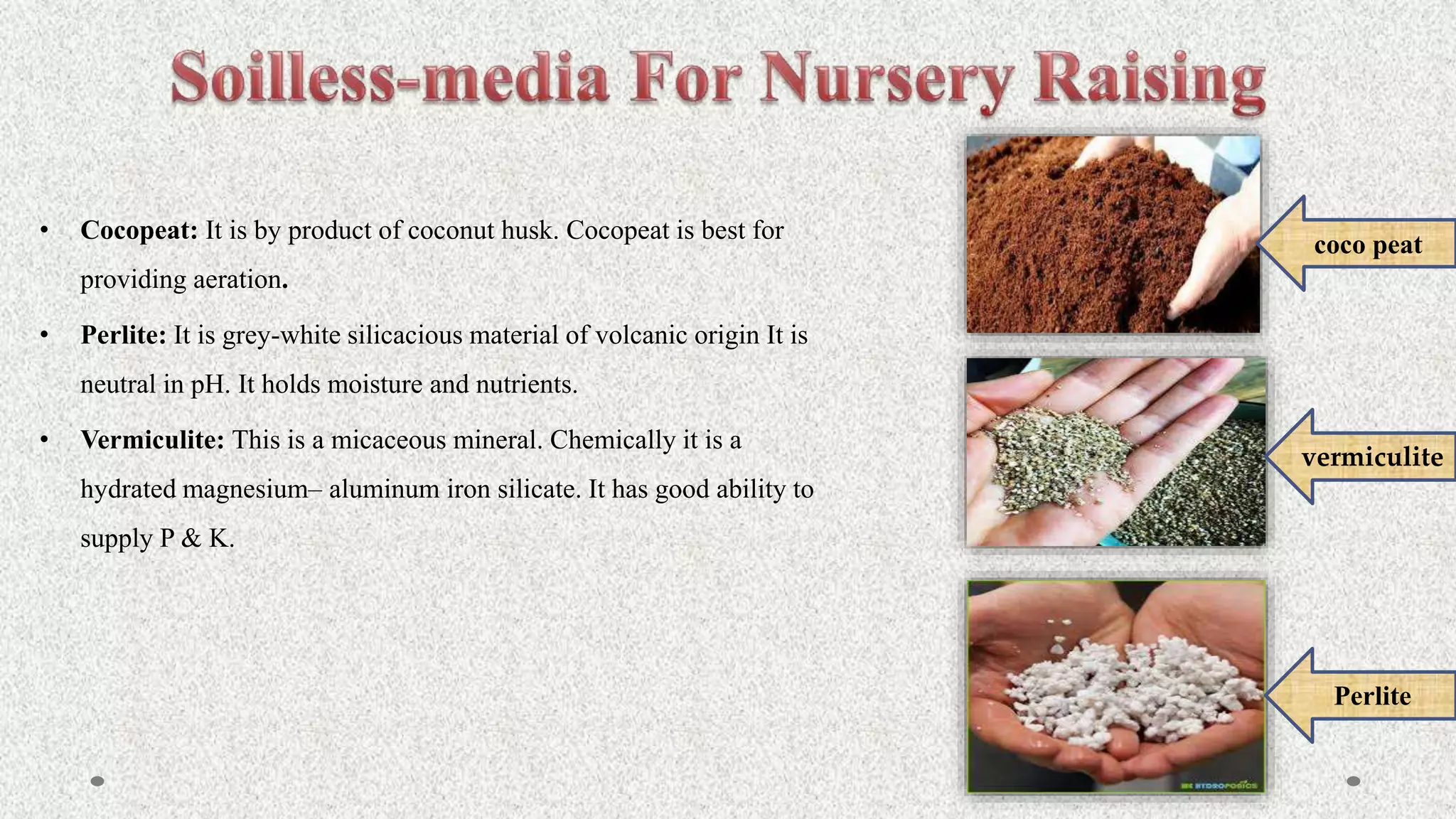
• Cocopeat: It is by product of coconut husk. Cocopeat is best for
providing aeration.
• Perlite: It is grey-white silicacious material of volcanic origin It is
neutral in pH. It holds moisture and nutrients.
• Vermiculite: This is a micaceous mineral. Chemically it is a
hydrated magnesium– aluminum iron silicate. It has good ability to
supply P & K.
coco peat
vermiculite
Perlite
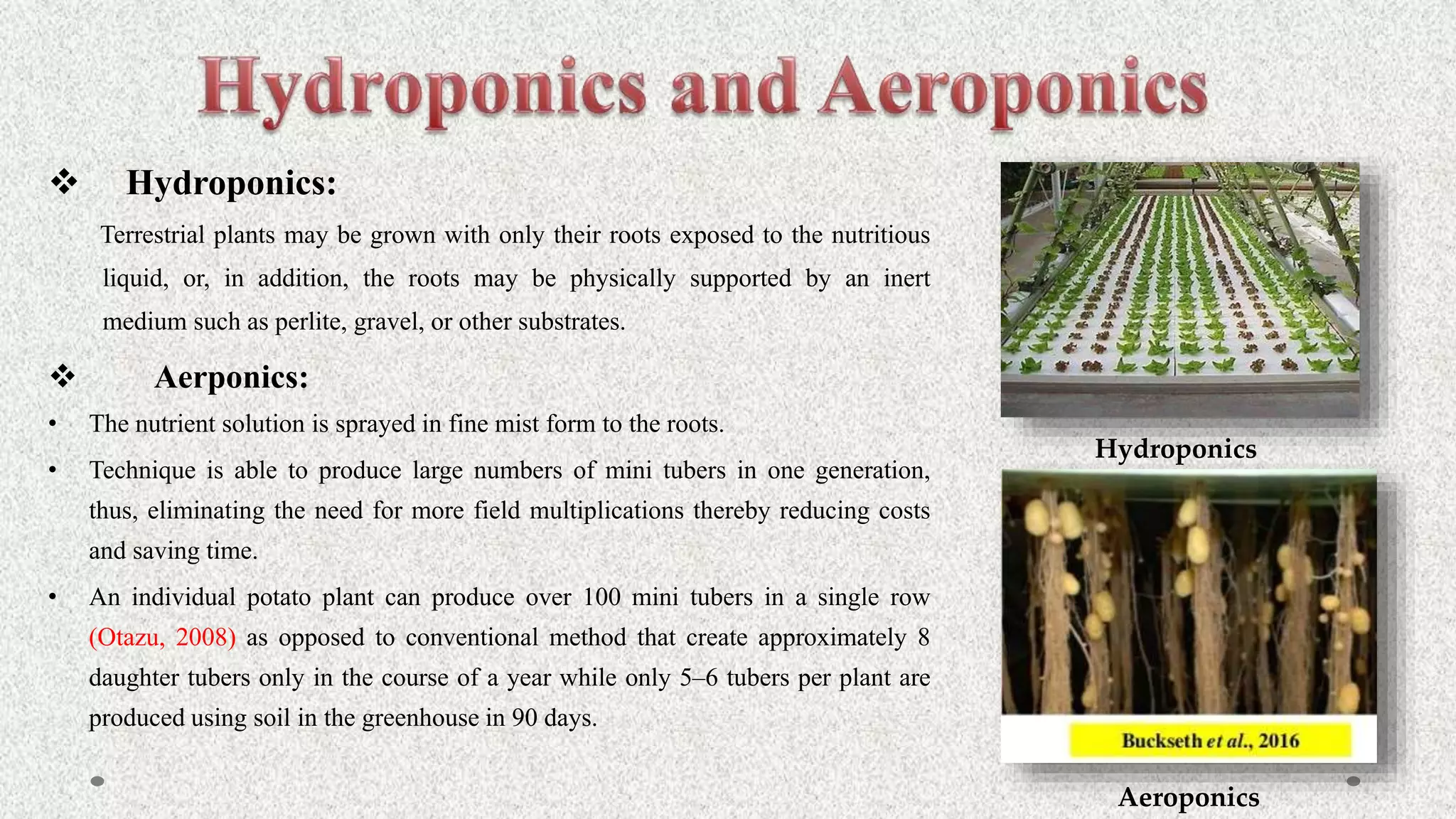
Terrestrial plants may be grown with only their roots exposed to the nutritious
liquid, or, in addition, the roots may be physically supported by an inert
medium such as perlite, gravel, or other substrates.
 Aerponics:
• The nutrient solution is sprayed in fine mist form to the roots.
• Technique is able to produce large numbers of mini tubers in one generation,
thus, eliminating the need for more field multiplications thereby reducing costs
and saving time.
• An individual potato plant can produce over 100 mini tubers in a single row
(Otazu, 2008) as opposed to conventional method that create approximately 8
daughter tubers only in the course of a year while only 5–6 tubers per plant are
produced using soil in the greenhouse in 90 days.
 Hydroponics:
Hydroponics
Aeroponics
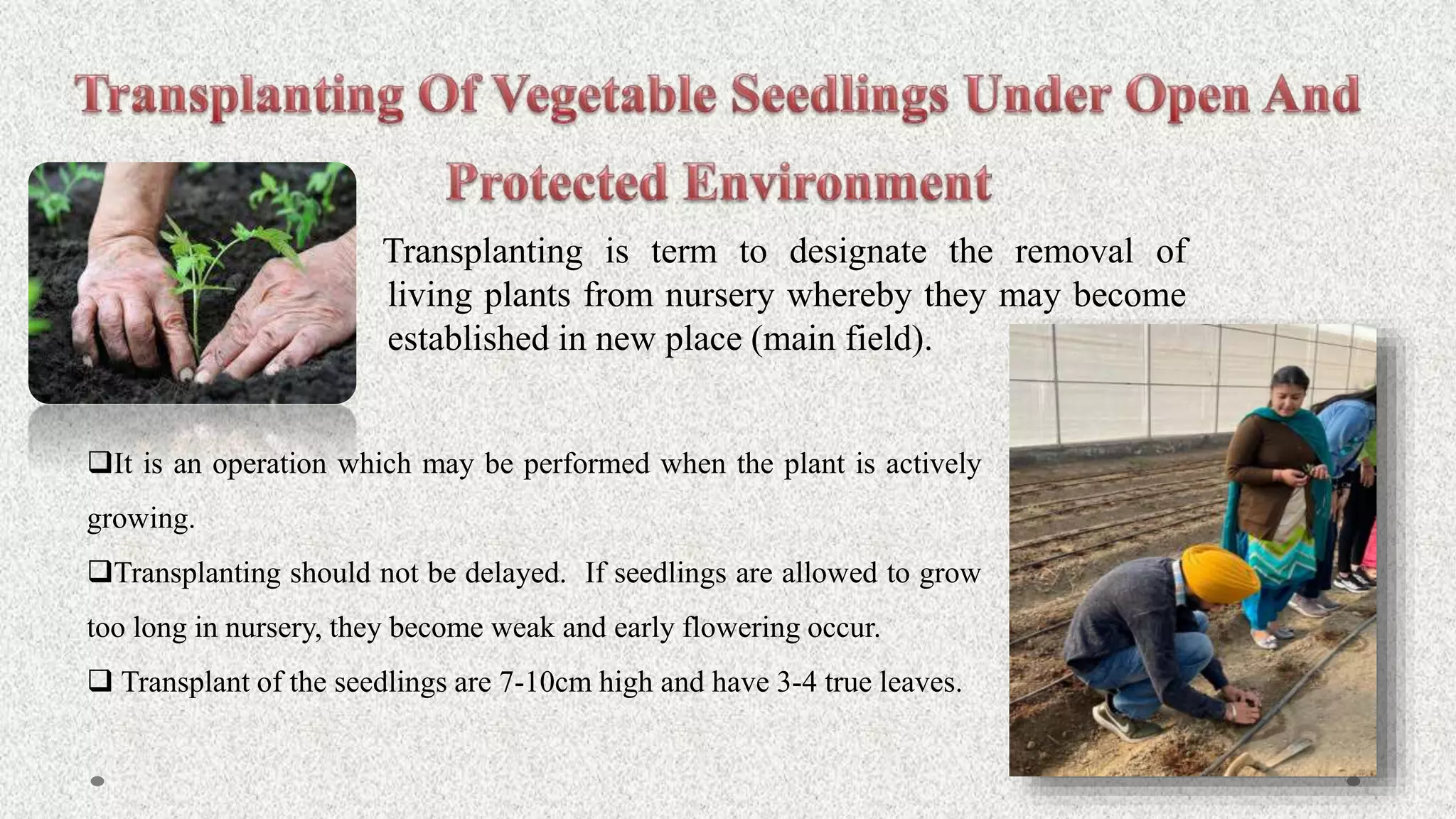
Transplanting is term to designate the removal of
living plants from nursery whereby they may become
established in new place (main field).
It is an operation which may be performed when the plant is actively
growing.
Transplanting should not be delayed. If seedlings are allowed to grow
too long in nursery, they become weak and early flowering occur.
 Transplant of the seedlings are 7-10cm high and have 3-4 true leaves.
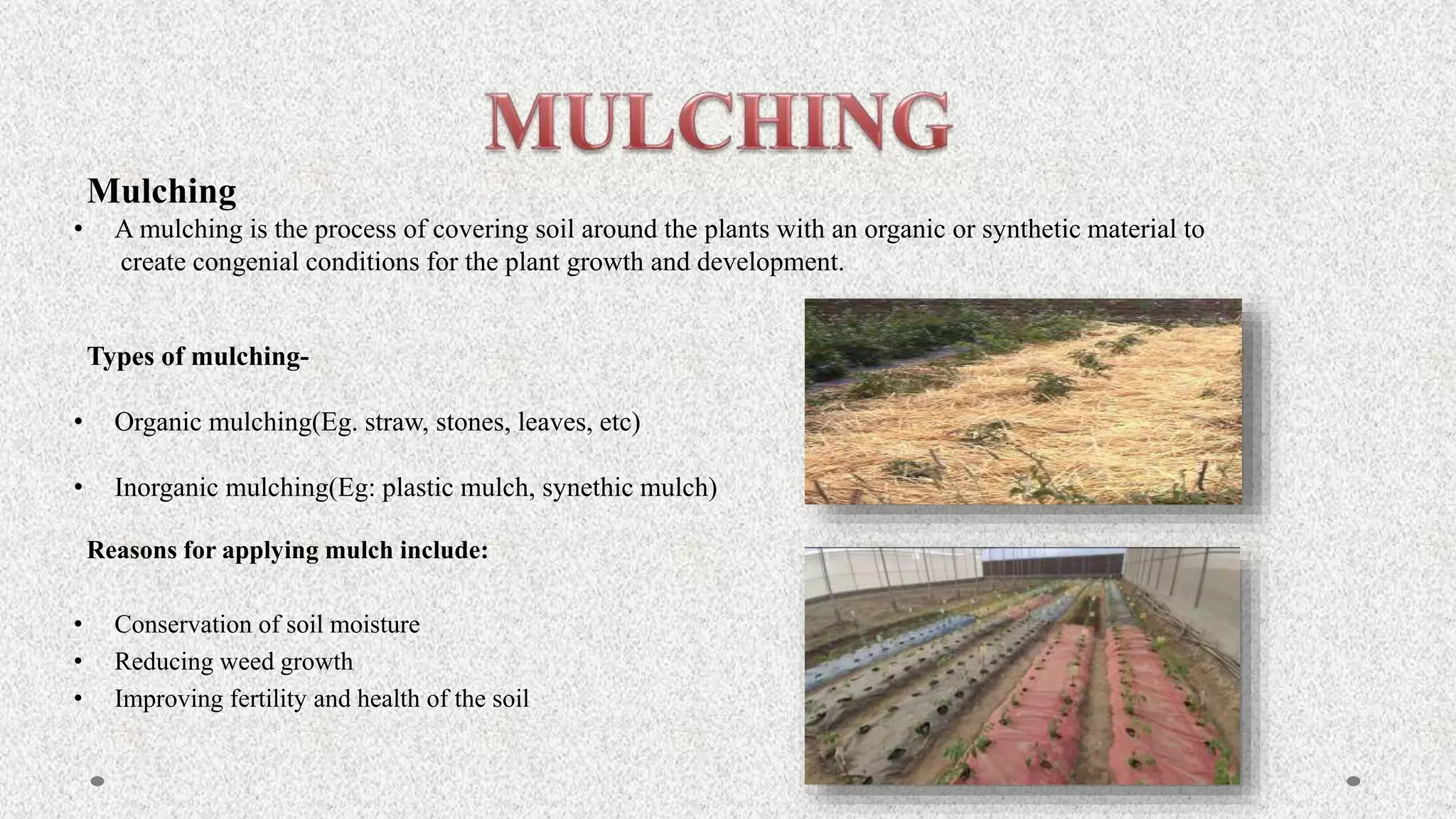
Mulching
• A mulching is the process of covering soil around the plants with an organic or synthetic material to
create congenial conditions for the plant growth and development.
Types of mulching-
• Organic mulching(Eg. straw, stones, leaves, etc)
• Inorganic mulching(Eg: plastic mulch, synethic mulch)
Reasons for applying mulch include:
• Conservation of soil moisture
• Reducing weed growth
• Improving fertility and health of the soil
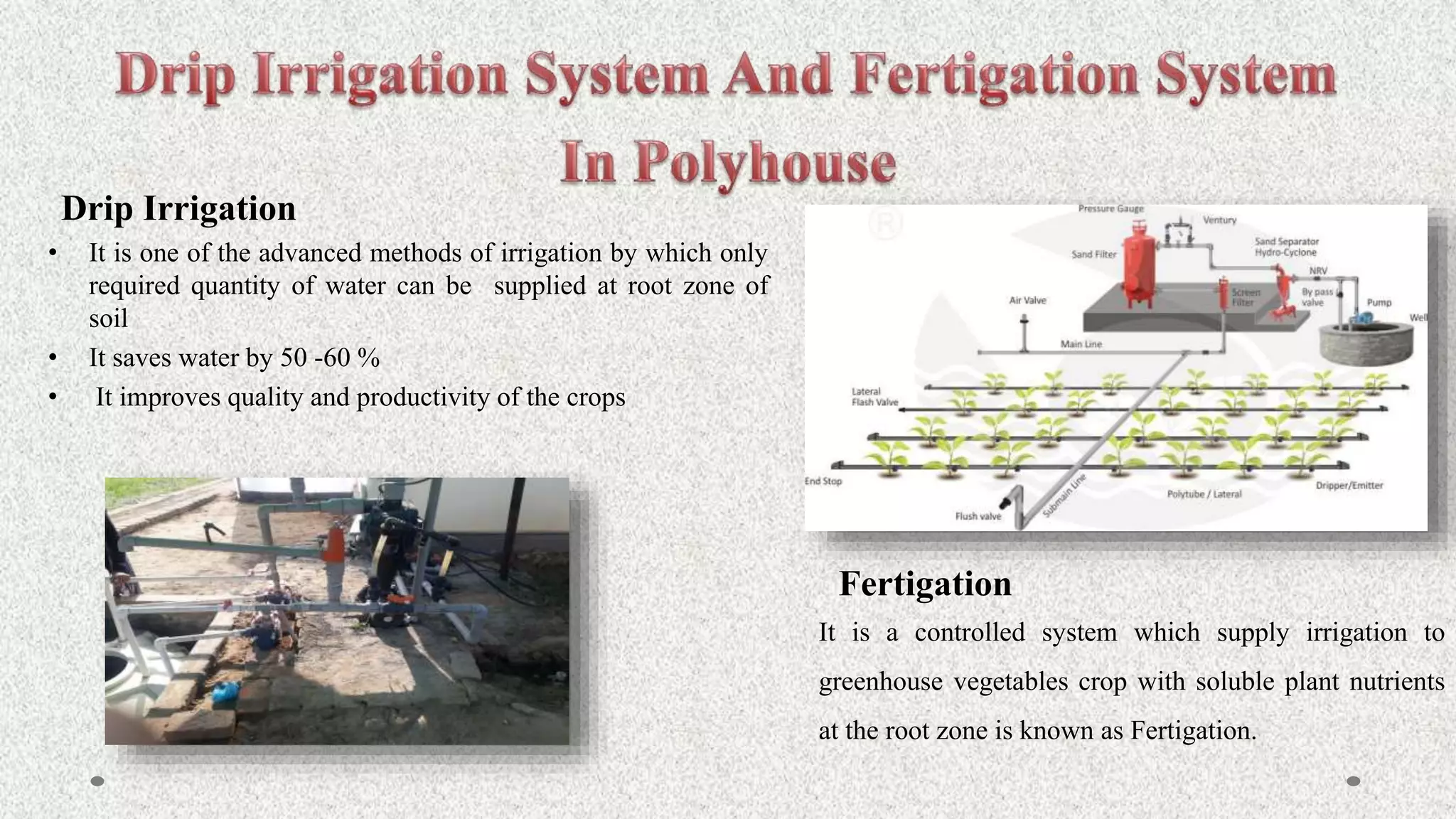
Drip Irrigation
• It is one of the advanced methods of irrigation by which only
required quantity of water can be supplied at root zone of
soil
• It saves water by 50 -60 %
• It improves quality and productivity of the crops
Fertigation
It is a controlled system which supply irrigation to
greenhouse vegetables crop with soluble plant nutrients
at the root zone is known as Fertigation.
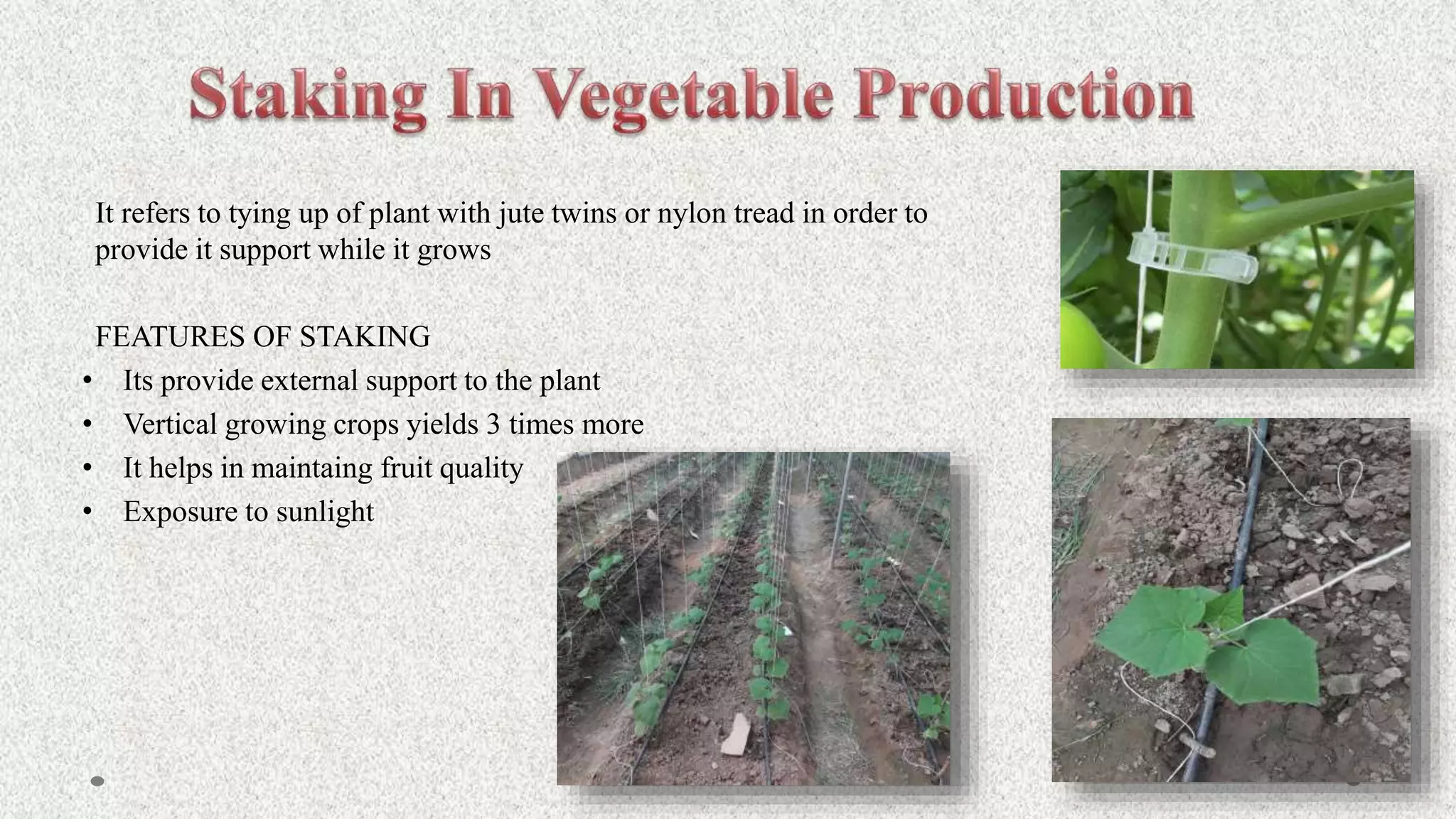
It refers to tying up of plant with jute twins or nylon tread in order to
provide it support while it grows
FEATURES OF STAKING
• Its provide external support to the plant
• Vertical growing crops yields 3 times more
• It helps in maintaing fruit quality
• Exposure to sunlight
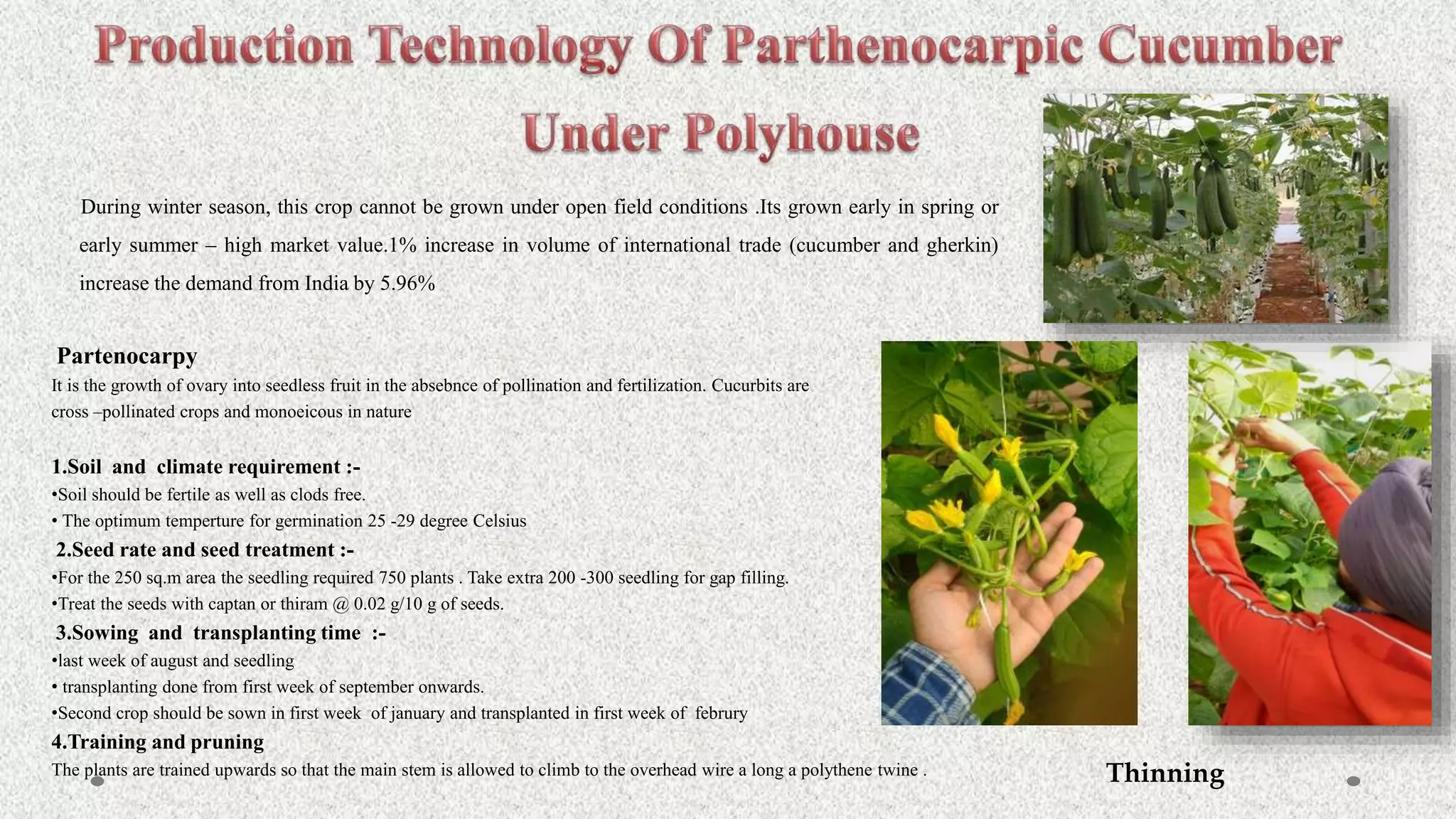
During winter season, this crop cannot be grown under open field conditions .Its grown early in spring or
early summer – high market value.1% increase in volume of international trade (cucumber and gherkin)
increase the demand from India by 5.96%
Partenocarpy
It is the growth of ovary into seedless fruit in the absebnce of pollination and fertilization. Cucurbits are
cross –pollinated crops and monoeicous in nature
1.Soil and climate requirement :-
•Soil should be fertile as well as clods free.
• The optimum temperture for germination 25 -29 degree Celsius
2.Seed rate and seed treatment :-
•For the 250 sq.m area the seedling required 750 plants . Take extra 200 -300 seedling for gap filling.
•Treat the seeds with captan or thiram @ 0.02 g/10 g of seeds.
3.Sowing and transplanting time :-
•last week of august and seedling
• transplanting done from first week of september onwards.
•Second crop should be sown in first week of january and transplanted in first week of februry
4.Training and pruning
The plants are trained upwards so that the main stem is allowed to climb to the overhead wire a long a polythene twine . Thinning
Although a ripe tomato contains as much as 93 to 94 percent water, it has a high
nutritive value being a good source of vitamins and minerals
 Soil And Climate
Tomato prefers moderate temperature and thrives well in the temperature range of 25-300C.
 Seed rate and spacing
The average seed rate for tomato is 100g/ACRE. Seeds are sown with row spacing of 10 cm
and seed spacing of 0.5 cm.
 Varieties
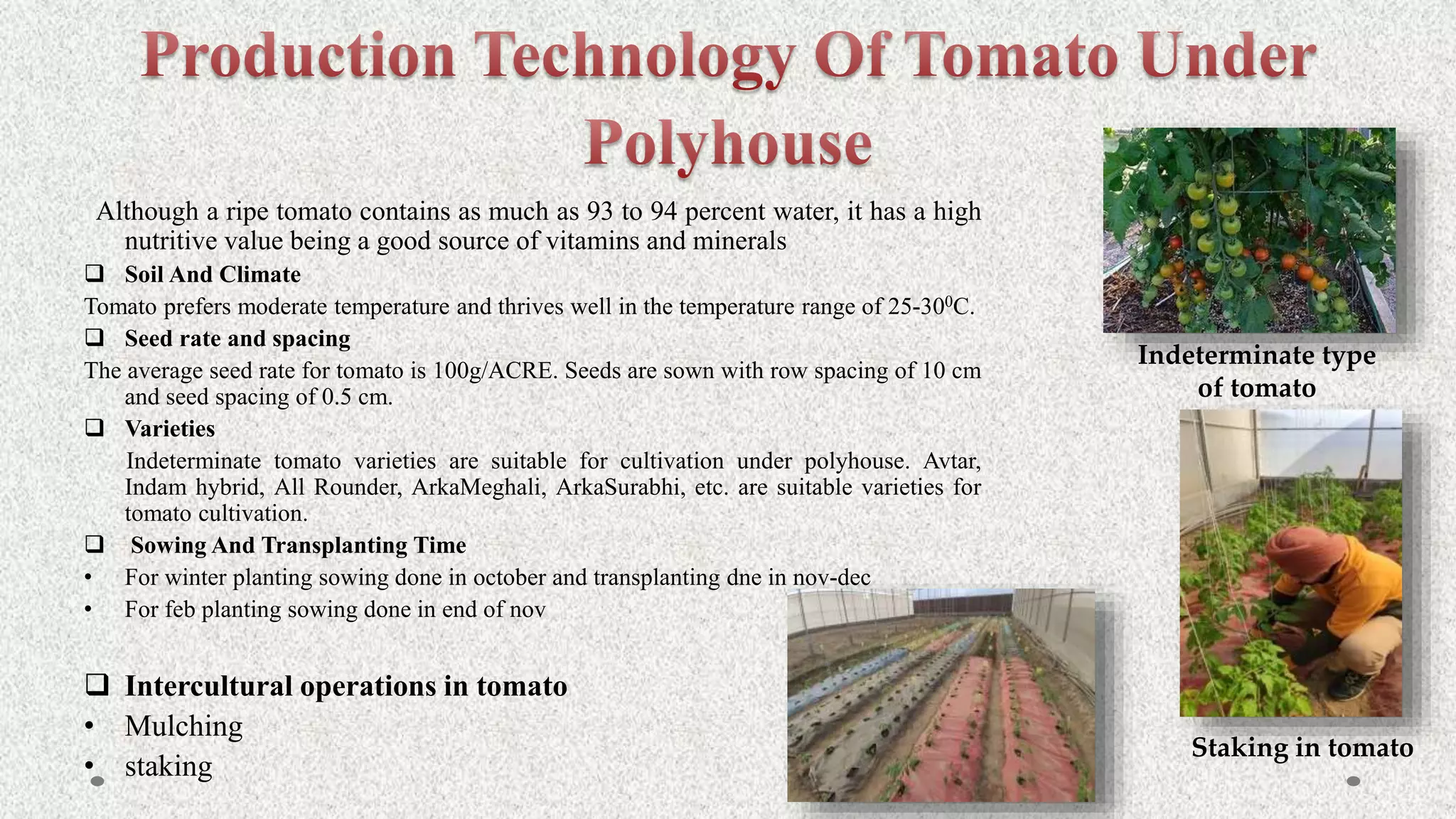
Indeterminate tomato varieties are suitable for cultivation under polyhouse. Avtar,
Indam hybrid, All Rounder, ArkaMeghali, ArkaSurabhi, etc. are suitable varieties for
tomato cultivation.
 Sowing And Transplanting Time
• For winter planting sowing done in october and transplanting dne in nov-dec
• For feb planting sowing done in end of nov
 Intercultural operations in tomato
• Mulching
• staking
Indeterminate type
of tomato
Staking in tomato
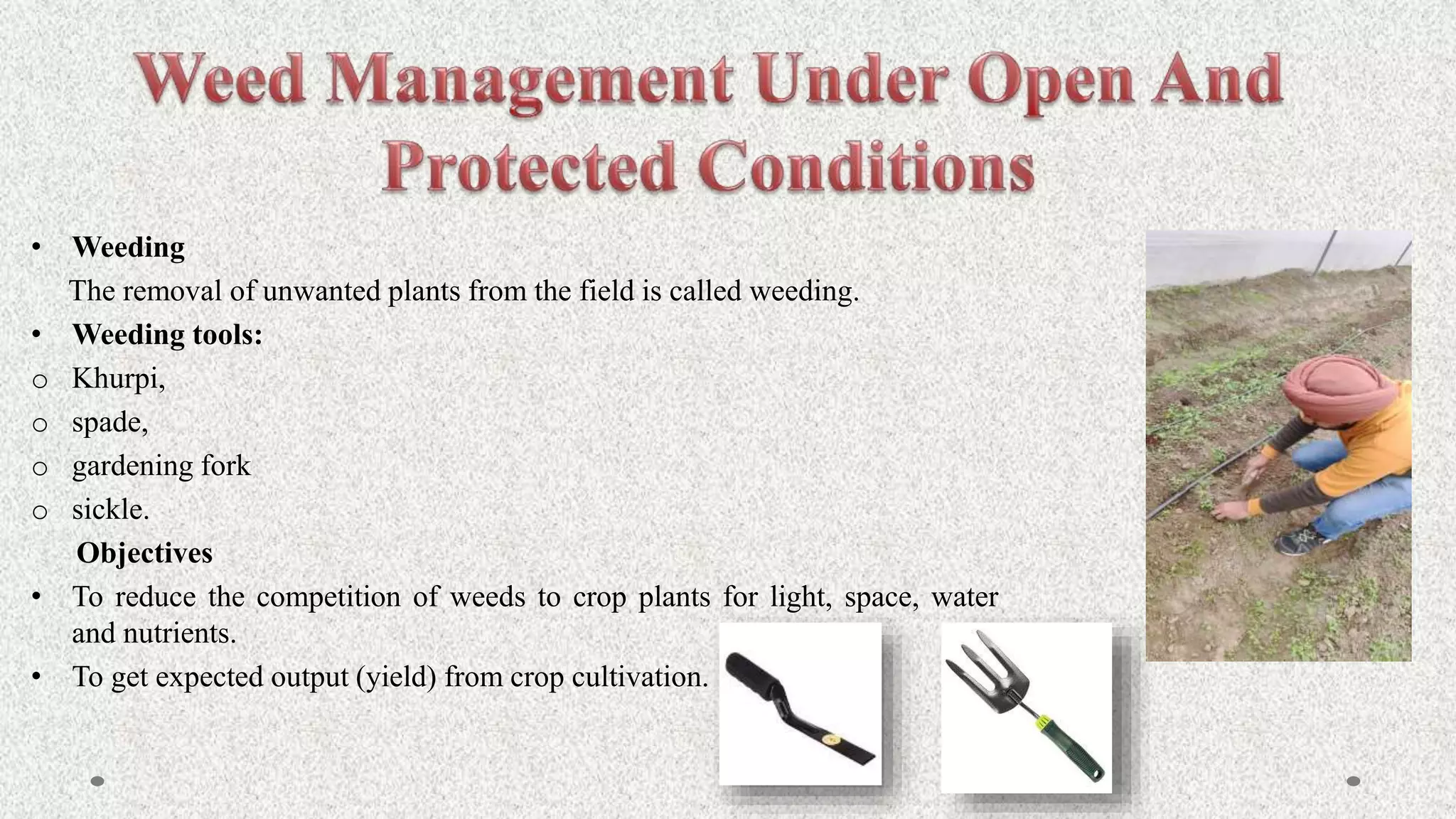
• Weeding
The removal of unwanted plants from the field is called weeding.
• Weeding tools:
o Khurpi,
o spade,
o gardening fork
o sickle.
Objectives
• To reduce the competition of weeds to crop plants for light, space, water
and nutrients.
• To get expected output (yield) from crop cultivation.
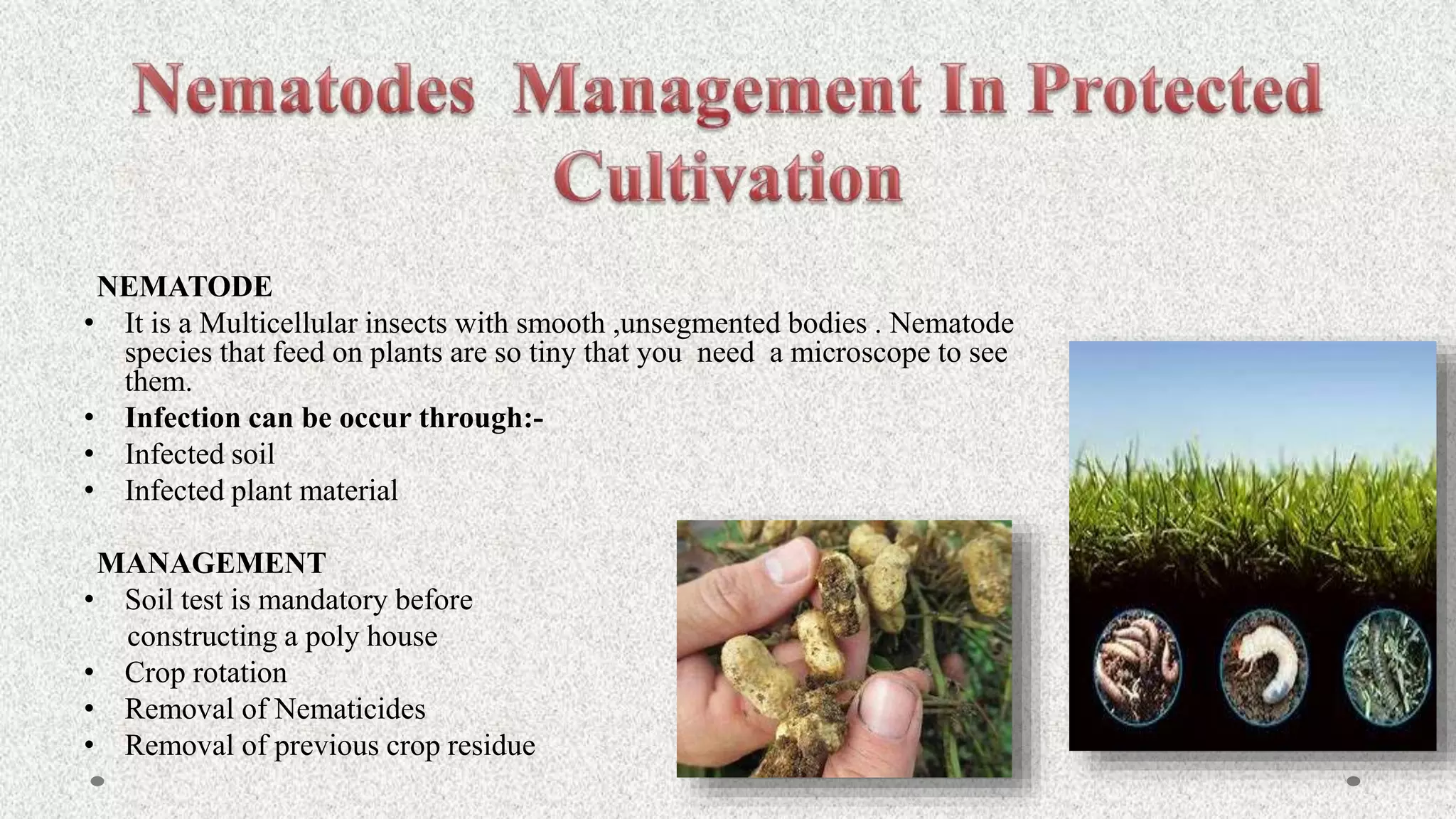
NEMATODE
• It is a Multicellular insects with smooth ,unsegmented bodies . Nematode
species that feed on plants are so tiny that you need a microscope to see
them.
• Infection can be occur through:-
• Infected soil
• Infected plant material
MANAGEMENT
• Soil test is mandatory before
constructing a poly house
• Crop rotation
• Removal of Nematicides
• Removal of previous crop residue
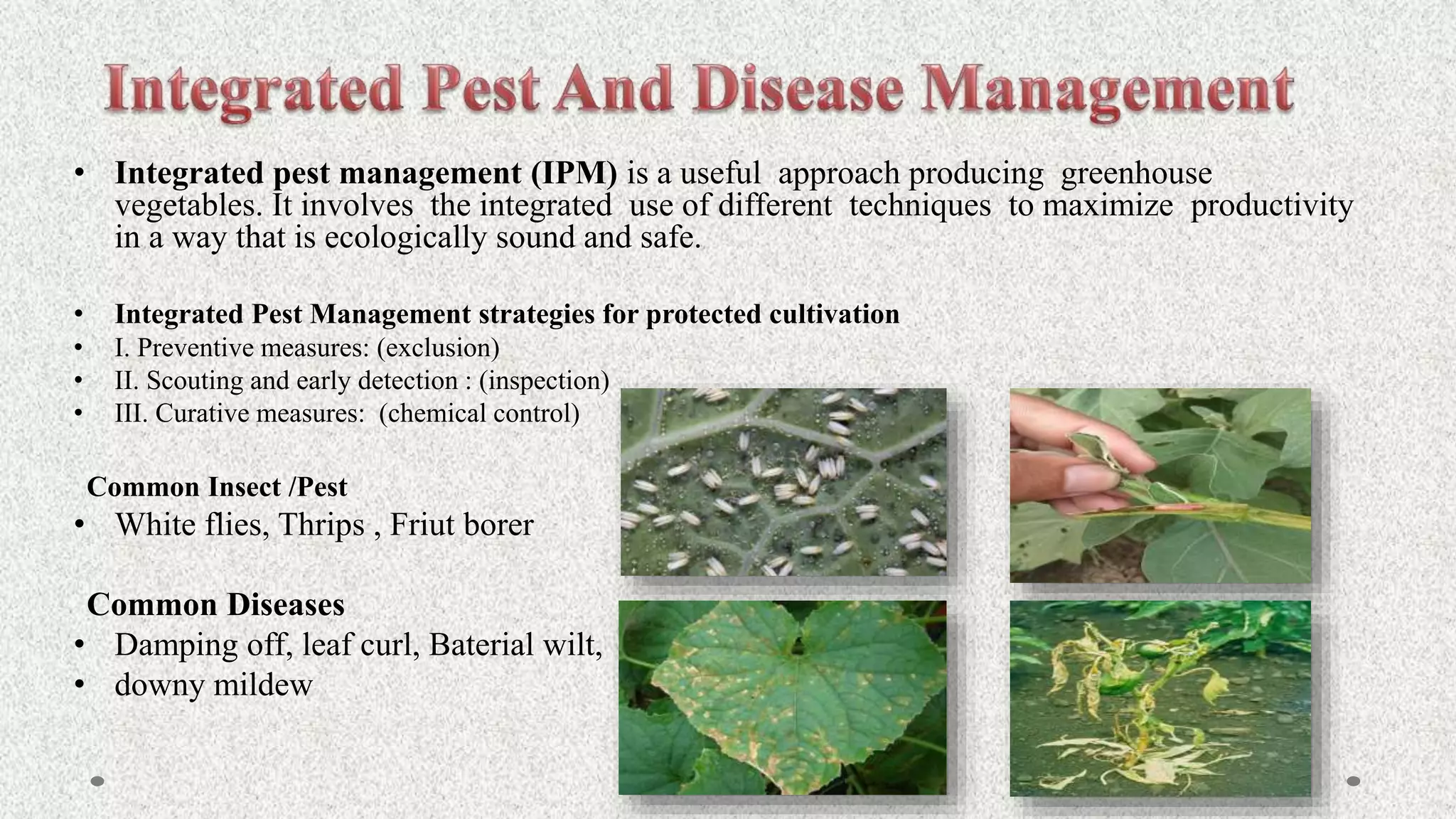
• Integrated pest management (IPM) is a useful approach producing greenhouse
vegetables. It involves the integrated use of different techniques to maximize productivity
in a way that is ecologically sound and safe.
• Integrated Pest Management strategies for protected cultivation
• I. Preventive measures: (exclusion)
• II. Scouting and early detection : (inspection)
• III. Curative measures: (chemical control)
Common Insect /Pest
• White flies, Thrips , Friut borer
Common Diseases
• Damping off, leaf curl, Baterial wilt,
• downy mildew
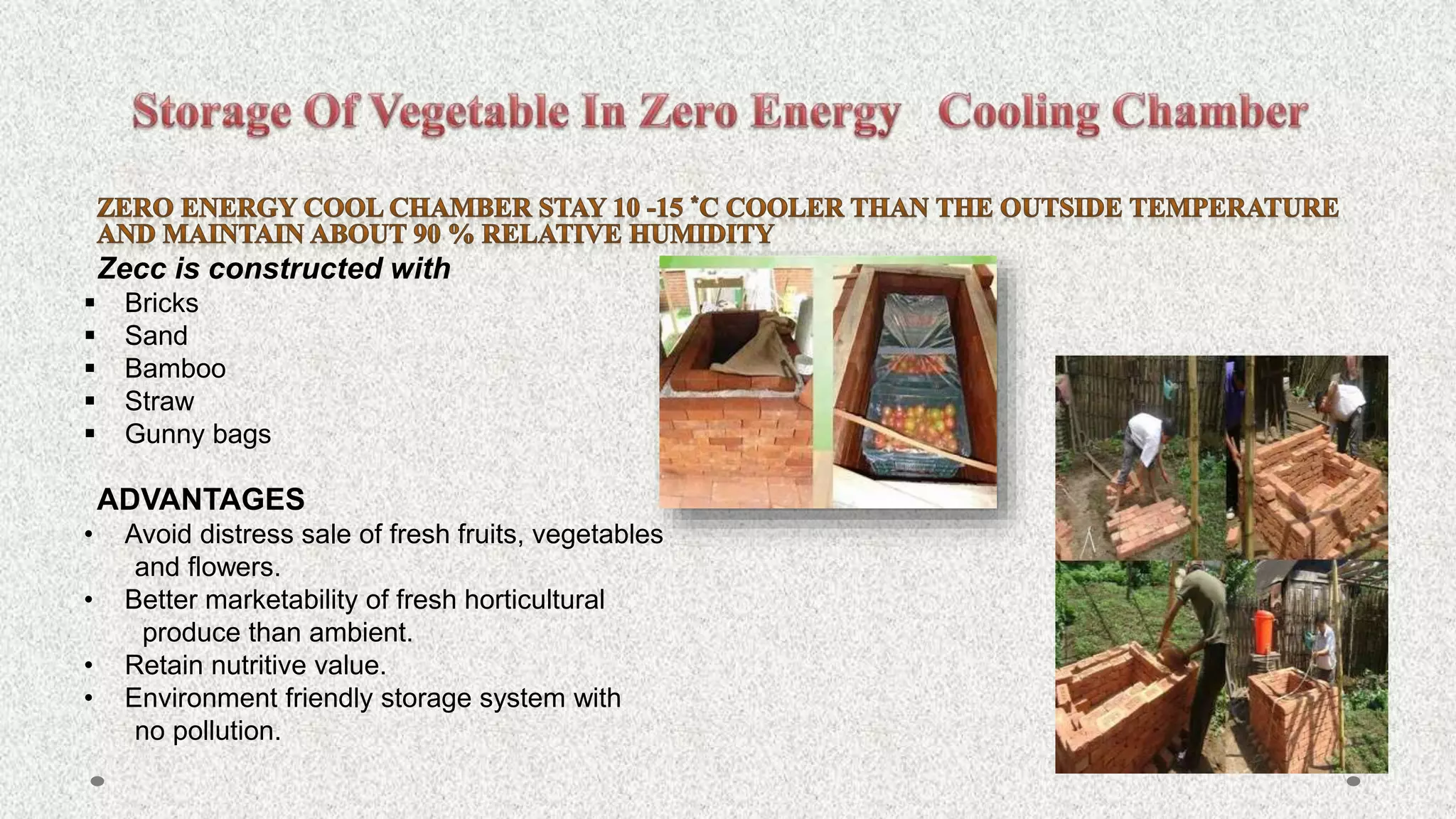
Zecc is constructed with
 Bricks
 Sand
 Bamboo
 Straw
 Gunny bags
ADVANTAGES
• Avoid distress sale of fresh fruits, vegetables
and flowers.
• Better marketability of fresh horticultural
produce than ambient.
• Retain nutritive value.
• Environment friendly storage system with
no pollution.
Seed Extraction Methods in Vegetable Crops
• Dry Method
• Wet method
• Fermentation Method
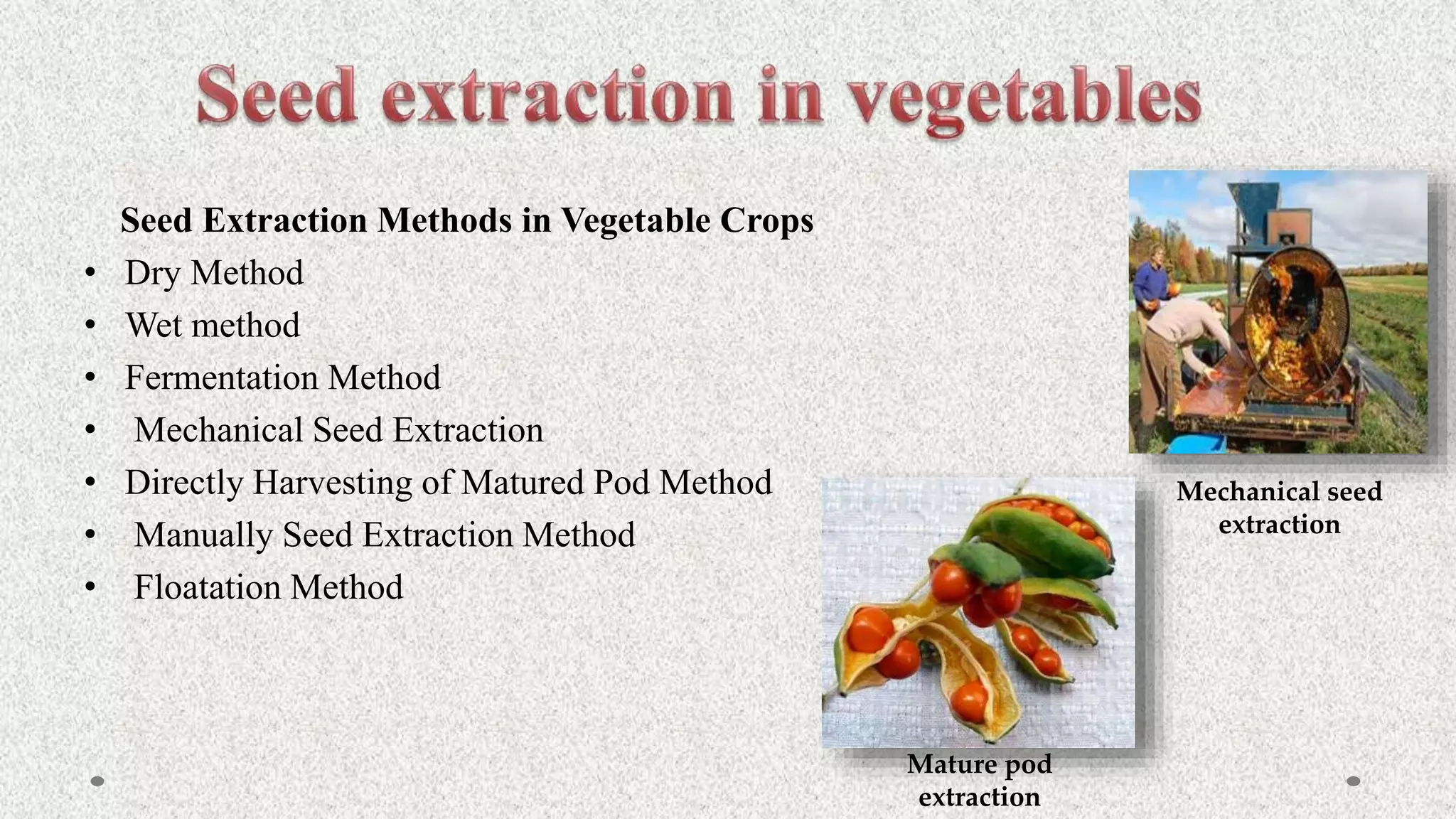
• Mechanical Seed Extraction
• Directly Harvesting of Matured Pod Method
• Manually Seed Extraction Method
• Floatation Method
Mechanical seed
extraction
Mature pod
extraction
vegetable cultivation under open and protected environment

vegetable cultivation under open and protected environment

  • 2.
    A vegetable isa pot herb that is may be annual, biennial and perennial which is used for cooking purpose and also eaten raw (salad). Classification of vegetables: Root vegetables: carrot, radish Stem vegetables: asparagus, kohlrabi Tubers vegetables: Potatoes Leafy vegetables: Spinach, lettuce Seed vegetable: Peas, Beans • Vegetables are good sources of vitamins, minerals, irons and also rich in dietary fibres, antioxidants and anticancer properties . • Acc to ICMR, each person should consume 300 g vegetables per day.
  • 3.
    Protected cultivation canbe defined as a cropping technique where in the micro climate surroundings the plant body is controlled partially/ fully as per the requirement of the plant species grown during their period of growth. •Conservation of soil moisture •Efficient use of energy mainly solar energy Greenhouse technology is More suitable to vegetables crops (such as tomato, capsicum, cucumber, etc.) Flowers (like rose, gerbera, carnation etc.) and nursery for all vegetable crops, because of their small life span.
  • 5.
    Lean to typeRidge and furrow Saw tooth type Quonset type Even span type Uneven span type
  • 6.
     LIGHT  TEMPERATURE RELATIVE HUMIDITY  CARBON DIOXIDE  VENTILATION light Temperature relative humidity ventilation Co2
  • 7.
    a) Double door b)Side vent c) Top vent d) Shade net e) Foggers f) Drip irrigation
  • 8.
    Site selection isaccording to :-  Near the market  Good quality and well drained soil  Permanent water source and labour available Orientation is according to :- • The door of the polyhouse should be towards east or west side so that maximum sun radiations fall on the polyhouse from southern side. • Direction of polyhouse should be parallel to wind in order to avoid the damage from high wind velocity. • The distance of trees adjacent to the greenhouse should be about 2.5 times the height of the greenhouse, to avoid shade
  • 9.
     Varieties SuitableFor Protected Environment In Determinate type  Exotic Vegetable: Exotic vegetables have very high market value and high market price in India therefore they are commercially cultivated mostly in poly-houses or green shade net houses.  HYBRIDS  It is result of cross-Pollination of two different plant grown from Two different seeds  Hybrids have high yielding capacity,  Early maturity .  Disease and pest resistance.  Better keeping quality.
  • 10.
    Mist growth chamber Fixedpoly tunnels Underground trench Hi-tech nursery Naturally ventilated polyhouse
  • 11.
    TYPES OF BEDS •Flat bed • Raised bed • Sunken bed STEPS OF FIELD PREPARATION Site selection Soil preparation: tillage( 2-3 hoeing, mix well rotten fym) Soil treatment: 2% sol of formalin Nursery bed preparation Size of bed: 1m width, 15-20cm height and 60cm pathway
  • 12.
    • Cocopeat: Itis by product of coconut husk. Cocopeat is best for providing aeration. • Perlite: It is grey-white silicacious material of volcanic origin It is neutral in pH. It holds moisture and nutrients. • Vermiculite: This is a micaceous mineral. Chemically it is a hydrated magnesium– aluminum iron silicate. It has good ability to supply P & K. coco peat vermiculite Perlite
  • 13.
    Terrestrial plants maybe grown with only their roots exposed to the nutritious liquid, or, in addition, the roots may be physically supported by an inert medium such as perlite, gravel, or other substrates.  Aerponics: • The nutrient solution is sprayed in fine mist form to the roots. • Technique is able to produce large numbers of mini tubers in one generation, thus, eliminating the need for more field multiplications thereby reducing costs and saving time. • An individual potato plant can produce over 100 mini tubers in a single row (Otazu, 2008) as opposed to conventional method that create approximately 8 daughter tubers only in the course of a year while only 5–6 tubers per plant are produced using soil in the greenhouse in 90 days.  Hydroponics: Hydroponics Aeroponics
  • 14.
    Transplanting is termto designate the removal of living plants from nursery whereby they may become established in new place (main field). It is an operation which may be performed when the plant is actively growing. Transplanting should not be delayed. If seedlings are allowed to grow too long in nursery, they become weak and early flowering occur.  Transplant of the seedlings are 7-10cm high and have 3-4 true leaves.
  • 15.
    Mulching • A mulchingis the process of covering soil around the plants with an organic or synthetic material to create congenial conditions for the plant growth and development. Types of mulching- • Organic mulching(Eg. straw, stones, leaves, etc) • Inorganic mulching(Eg: plastic mulch, synethic mulch) Reasons for applying mulch include: • Conservation of soil moisture • Reducing weed growth • Improving fertility and health of the soil
  • 16.
    Drip Irrigation • Itis one of the advanced methods of irrigation by which only required quantity of water can be supplied at root zone of soil • It saves water by 50 -60 % • It improves quality and productivity of the crops Fertigation It is a controlled system which supply irrigation to greenhouse vegetables crop with soluble plant nutrients at the root zone is known as Fertigation.
  • 17.
    It refers totying up of plant with jute twins or nylon tread in order to provide it support while it grows FEATURES OF STAKING • Its provide external support to the plant • Vertical growing crops yields 3 times more • It helps in maintaing fruit quality • Exposure to sunlight
  • 18.
    During winter season,this crop cannot be grown under open field conditions .Its grown early in spring or early summer – high market value.1% increase in volume of international trade (cucumber and gherkin) increase the demand from India by 5.96% Partenocarpy It is the growth of ovary into seedless fruit in the absebnce of pollination and fertilization. Cucurbits are cross –pollinated crops and monoeicous in nature 1.Soil and climate requirement :- •Soil should be fertile as well as clods free. • The optimum temperture for germination 25 -29 degree Celsius 2.Seed rate and seed treatment :- •For the 250 sq.m area the seedling required 750 plants . Take extra 200 -300 seedling for gap filling. •Treat the seeds with captan or thiram @ 0.02 g/10 g of seeds. 3.Sowing and transplanting time :- •last week of august and seedling • transplanting done from first week of september onwards. •Second crop should be sown in first week of january and transplanted in first week of februry 4.Training and pruning The plants are trained upwards so that the main stem is allowed to climb to the overhead wire a long a polythene twine . Thinning
  • 19.
    Although a ripetomato contains as much as 93 to 94 percent water, it has a high nutritive value being a good source of vitamins and minerals  Soil And Climate Tomato prefers moderate temperature and thrives well in the temperature range of 25-300C.  Seed rate and spacing The average seed rate for tomato is 100g/ACRE. Seeds are sown with row spacing of 10 cm and seed spacing of 0.5 cm.  Varieties Indeterminate tomato varieties are suitable for cultivation under polyhouse. Avtar, Indam hybrid, All Rounder, ArkaMeghali, ArkaSurabhi, etc. are suitable varieties for tomato cultivation.  Sowing And Transplanting Time • For winter planting sowing done in october and transplanting dne in nov-dec • For feb planting sowing done in end of nov  Intercultural operations in tomato • Mulching • staking Indeterminate type of tomato Staking in tomato
  • 20.
    • Weeding The removalof unwanted plants from the field is called weeding. • Weeding tools: o Khurpi, o spade, o gardening fork o sickle. Objectives • To reduce the competition of weeds to crop plants for light, space, water and nutrients. • To get expected output (yield) from crop cultivation.
  • 21.
    NEMATODE • It isa Multicellular insects with smooth ,unsegmented bodies . Nematode species that feed on plants are so tiny that you need a microscope to see them. • Infection can be occur through:- • Infected soil • Infected plant material MANAGEMENT • Soil test is mandatory before constructing a poly house • Crop rotation • Removal of Nematicides • Removal of previous crop residue
  • 22.
    • Integrated pestmanagement (IPM) is a useful approach producing greenhouse vegetables. It involves the integrated use of different techniques to maximize productivity in a way that is ecologically sound and safe. • Integrated Pest Management strategies for protected cultivation • I. Preventive measures: (exclusion) • II. Scouting and early detection : (inspection) • III. Curative measures: (chemical control) Common Insect /Pest • White flies, Thrips , Friut borer Common Diseases • Damping off, leaf curl, Baterial wilt, • downy mildew
  • 23.
    Zecc is constructedwith  Bricks  Sand  Bamboo  Straw  Gunny bags ADVANTAGES • Avoid distress sale of fresh fruits, vegetables and flowers. • Better marketability of fresh horticultural produce than ambient. • Retain nutritive value. • Environment friendly storage system with no pollution.
  • 24.
    Seed Extraction Methodsin Vegetable Crops • Dry Method • Wet method • Fermentation Method • Mechanical Seed Extraction • Directly Harvesting of Matured Pod Method • Manually Seed Extraction Method • Floatation Method Mechanical seed extraction Mature pod extraction