J.C.B Training 2016
Raj Sons Auto Pvt. Ltd
Present By
Vishal Singh
Engine
• Any device which can convert heat energy of fuel
into mechanical energy is known as engine or heat
engine.
• Engine is widely used in automobile industries or we
can say that engine is the heart of an automobile.
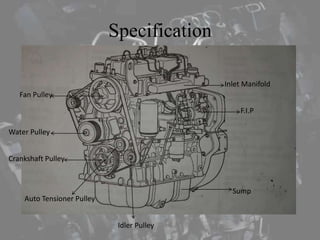
Specification
F.I.P
Sump
Fan Pulley
Water Pulley
Crankshaft Pulley
Idler Pulley
Auto Tensioner Pulley
Inlet Manifold
Types Of Engine
Basically engine may be classified into two types.
1. External combustion (E.C.) Engine
It is an engine in which combustion of fuel take place outside of the
engine. In this type of engine heat, which is generated by burning of fuel
is use to convert the water or other low boiling temperature fluid into
steam. This high pressure steam used to rotate a turbine. In this engine
we can use all solid, liquid and gases fuel. These engines are generally
used in driving locomotive, ships, generation of electric power etc.
• Advantages of E.C. engine-
 In these engines starting torque is generally high.
 Because of external combustion we can use cheaper fuels as well as
solid fuel.
 They are more flexible compare to internal combustion engines.
2. Internal Combustion (I.C.) Engine
• It is an engine in which combustion of fuel take place inside the engine.
When the fuel burns inside the engine cylinder, it generates a high
temperature and pressure. This high pressure force is exerted on the
piston (A device which free to moves inside the cylinder and transmit
the pressure force to crank by use of connecting rod), which used to
rotate the wheels of vehicle. In these engines we can use only gases and
high volatile fuel like petrol, diesel. These engines are generally used in
automobile industries, generation of electric power etc.
• Advantages of I.C. engine-
• It has overall high efficiency over E.C. engine.
• These engines are compact and required less space.
• Initial cost of I.C. engine is lower than E.C. engine.
• This engine easily starts in cold because of it uses high volatile fuel.
Types of I.C. Engine
I.C. engine is widely used in automobile industries so it is also known as
automobile engine. An automobile engine may be classified in many manners.
Today I am going to tell you some important classification of an automobile
engine.
• According to number of stroke:
1. Two stroke engine
In a two stroke engine a piston moves one time up and down
inside the cylinder and complete one crankshaft revolution during single time of
fuel burn. This type of engine has high torque compare to four stroke engine.
These are generally used in scooters, pumping sets etc.
2. Four stroke engine
In a four stroke engine piston moves two times up and down
inside the cylinder and complete two crankshaft revolutions during single time of
fuel burn. This type of engines has high average compare to two stroke engine.
These are generally used in bikes, cars, truck etc.
According to design of engine:
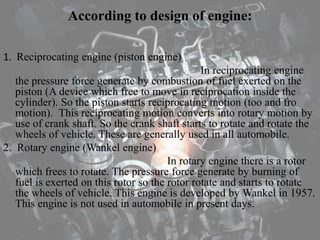
1. Reciprocating engine (piston engine)
In reciprocating engine
the pressure force generate by combustion of fuel exerted on the
piston (A device which free to move in reciprocation inside the
cylinder). So the piston starts reciprocating motion (too and fro
motion). This reciprocating motion converts into rotary motion by
use of crank shaft. So the crank shaft starts to rotate and rotate the
wheels of vehicle. These are generally used in all automobile.
2. Rotary engine (Wankel engine)
In rotary engine there is a rotor
which frees to rotate. The pressure force generate by burning of
fuel is exerted on this rotor so the rotor rotate and starts to rotate
the wheels of vehicle. This engine is developed by Wankel in 1957.
This engine is not used in automobile in present days.
According to method of ignition
1. Compression ignition engine
In these types of engines, there is
no extra equipment to burn the fuel. In these engines burning of fuel
starts due to temperature rise during compression of air. So it is
known as compression ignition engine.
2. Spark ignition engine
In these types of engines, ignition of fuel
start by the spark, generate inside the cylinder by some extra
equipment. So it is known as spark ignition engine.
According to number of cylinder
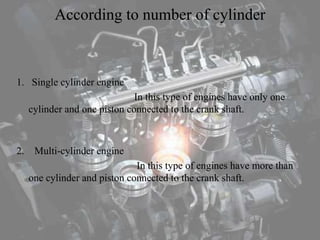
1. Single cylinder engine
In this type of engines have only one
cylinder and one piston connected to the crank shaft.
2. Multi-cylinder engine
In this type of engines have more than
one cylinder and piston connected to the crank shaft.
According to arrangement of cylinder
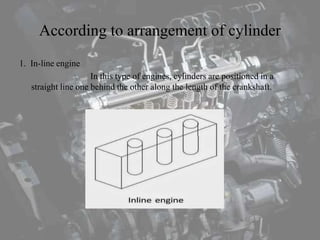
1. In-line engine
In this type of engines, cylinders are positioned in a
straight line one behind the other along the length of the crankshaft.
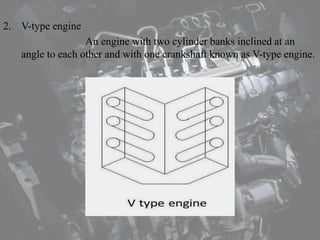
2. V-type engine
An engine with two cylinder banks inclined at an
angle to each other and with one crankshaft known as V-type engine.
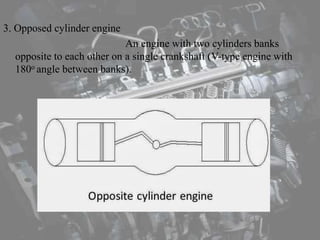
3. Opposed cylinder engine
An engine with two cylinders banks
opposite to each other on a single crankshaft (V-type engine with
180o angle between banks).
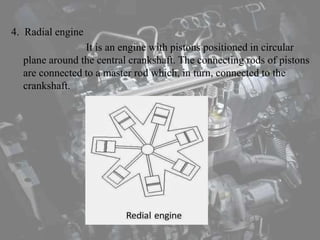
4. Radial engine
It is an engine with pistons positioned in circular
plane around the central crankshaft. The connecting rods of pistons
are connected to a master rod which, in turn, connected to the
crankshaft.
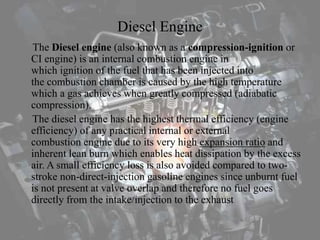
Diesel Engine
The Diesel engine (also known as a compression-ignition or
CI engine) is an internal combustion engine in
which ignition of the fuel that has been injected into
the combustion chamber is caused by the high temperature
which a gas achieves when greatly compressed (adiabatic
compression).
The diesel engine has the highest thermal efficiency (engine
efficiency) of any practical internal or external
combustion engine due to its very high expansion ratio and
inherent lean burn which enables heat dissipation by the excess
air. A small efficiency loss is also avoided compared to two-
stroke non-direct-injection gasoline engines since unburnt fuel
is not present at valve overlap and therefore no fuel goes
directly from the intake/injection to the exhaust
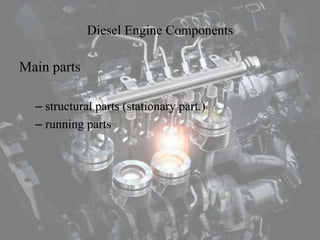
Diesel Engine Components
Main parts
– structural parts (stationary part.)
– running parts
Structural parts
PURPOSE:
- to support running parts
- to keep them in position and line
- to provide jackets and passages for cooling water,
sumps, for lube oil
- to form protective casing for running parts
- to support auxiliaries (valves, camshaft, turbo
blowers)
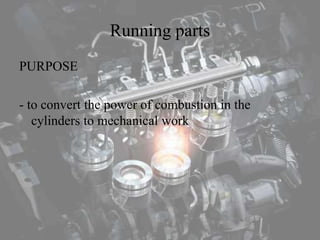
Running parts
PURPOSE
- to convert the power of combustion in the
cylinders to mechanical work
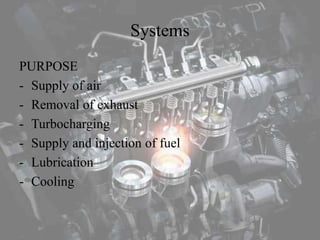
Systems
PURPOSE
- Supply of air
- Removal of exhaust
- Turbocharging
- Supply and injection of fuel
- Lubrication
- Cooling
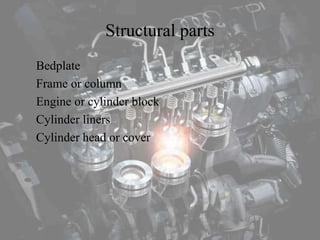
Structural parts
Bedplate
Frame or column
Engine or cylinder block
Cylinder liners
Cylinder head or cover
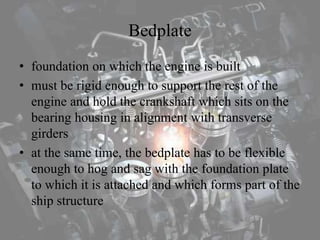
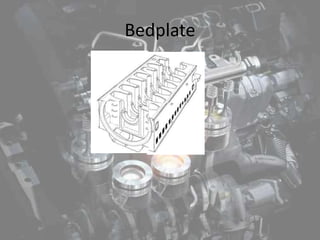
Bedplate
• foundation on which the engine is built
• must be rigid enough to support the rest of the
engine and hold the crankshaft which sits on the
bearing housing in alignment with transverse
girders
• at the same time, the bedplate has to be flexible
enough to hog and sag with the foundation plate
to which it is attached and which forms part of the
ship structure
Bedplate
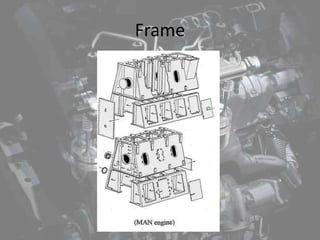
Frame
• load-carrying part of an engine
• it may include parts as the cylinder block,base,
sump and end plates
• in two-stroke engines, frames are sometimes
known as A-frames
Frame
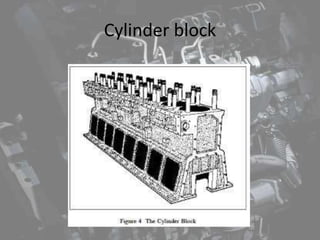
Cylinder Block
=engine block
• part of the engine frame that supports the engine
cylinder liners, heads and crankshafts
• cylinder blocks for most large engines are made
of castings and plates that are welded
horizontally and vertically for strength and rigidity
(stiffener)
• entablature = cylinder block which incorporates
the scavenge air spaces in two-stroke engines
Cylinder block
Cylinder liner
• A bore in which an engine piston moves back and
forth replaceable
• the material of the liner must withstand extreme
heat and pressure developed within the
combustion space at the top of the cylinder, and at
the same time must permit the piston and its
sealing rings to move with a minimum of friction
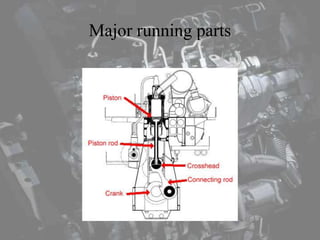
Major running parts
Piston
Piston rod
Crosshead
Connecting rod
Crankshaft & its bearings
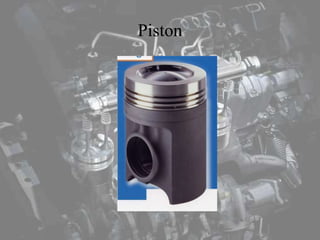
Piston
• one of the major moving parts
• crown
• skirt
• must be designed to withstand extreme heat and
combustion pressure
• made of cast iron or aluminium (to reduce weight)
Piston
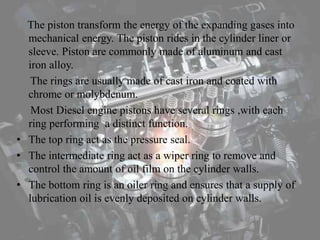
The piston transform the energy of the expanding gases into
mechanical energy. The piston rides in the cylinder liner or
sleeve. Piston are commonly made of aluminum and cast
iron alloy.
The rings are usually made of cast iron and coated with
chrome or molybdenum.
Most Diesel engine pistons have several rings ,with each
ring performing a distinct function.
• The top ring act as the pressure seal.
• The intermediate ring act as a wiper ring to remove and
control the amount of oil film on the cylinder walls.
• The bottom ring is an oiler ring and ensures that a supply of
lubrication oil is evenly deposited on cylinder walls.
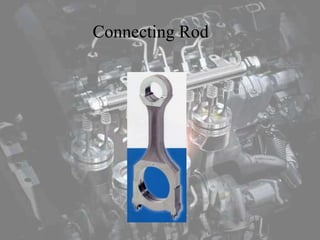
Connecting rod
• It is fitted between the crosshead and the
crankshaft
• It transmits the firing force, and together with the
crankshaft converts the reciprocating motion to a
rotary motion
Connecting Rod
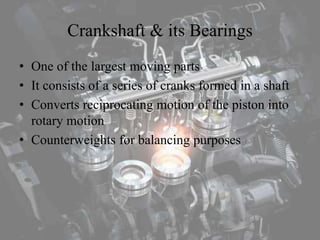
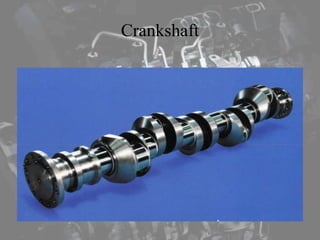
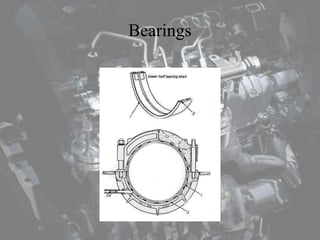
Crankshaft & its Bearings
• One of the largest moving parts
• It consists of a series of cranks formed in a shaft
• Converts reciprocating motion of the piston into
rotary motion
• Counterweights for balancing purposes
Crankshaft
Bearings
Major running parts
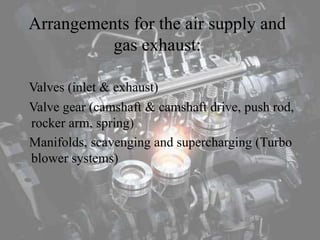
Arrangements for the air supply and
gas exhaust:
Valves (inlet & exhaust)
Valve gear (camshaft & camshaft drive, push rod,
rocker arm, spring)
Manifolds, scavenging and supercharging (Turbo
blower systems)
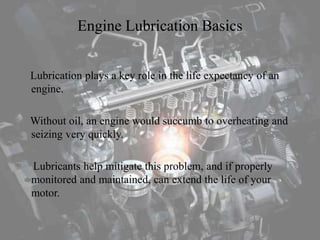
Engine Lubrication Basics
Lubrication plays a key role in the life expectancy of an
engine.
Without oil, an engine would succumb to overheating and
seizing very quickly.
Lubricants help mitigate this problem, and if properly
monitored and maintained, can extend the life of your
motor.
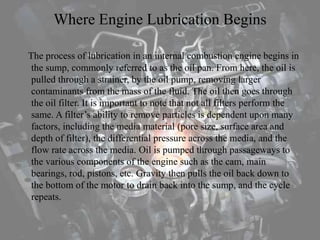
Where Engine Lubrication Begins
The process of lubrication in an internal combustion engine begins in
the sump, commonly referred to as the oil pan. From here, the oil is
pulled through a strainer, by the oil pump, removing larger
contaminants from the mass of the fluid. The oil then goes through
the oil filter. It is important to note that not all filters perform the
same. A filter’s ability to remove particles is dependent upon many
factors, including the media material (pore size, surface area and
depth of filter), the differential pressure across the media, and the
flow rate across the media. Oil is pumped through passageways to
the various components of the engine such as the cam, main
bearings, rod, pistons, etc. Gravity then pulls the oil back down to
the bottom of the motor to drain back into the sump, and the cycle
repeats.
Thanks

Engine

  • 1.
    J.C.B Training 2016 RajSons Auto Pvt. Ltd Present By Vishal Singh
  • 2.
    Engine • Any devicewhich can convert heat energy of fuel into mechanical energy is known as engine or heat engine. • Engine is widely used in automobile industries or we can say that engine is the heart of an automobile.
  • 3.
    Specification F.I.P Sump Fan Pulley Water Pulley CrankshaftPulley Idler Pulley Auto Tensioner Pulley Inlet Manifold
  • 4.
    Types Of Engine Basicallyengine may be classified into two types. 1. External combustion (E.C.) Engine It is an engine in which combustion of fuel take place outside of the engine. In this type of engine heat, which is generated by burning of fuel is use to convert the water or other low boiling temperature fluid into steam. This high pressure steam used to rotate a turbine. In this engine we can use all solid, liquid and gases fuel. These engines are generally used in driving locomotive, ships, generation of electric power etc. • Advantages of E.C. engine-  In these engines starting torque is generally high.  Because of external combustion we can use cheaper fuels as well as solid fuel.  They are more flexible compare to internal combustion engines.
  • 5.
    2. Internal Combustion(I.C.) Engine • It is an engine in which combustion of fuel take place inside the engine. When the fuel burns inside the engine cylinder, it generates a high temperature and pressure. This high pressure force is exerted on the piston (A device which free to moves inside the cylinder and transmit the pressure force to crank by use of connecting rod), which used to rotate the wheels of vehicle. In these engines we can use only gases and high volatile fuel like petrol, diesel. These engines are generally used in automobile industries, generation of electric power etc. • Advantages of I.C. engine- • It has overall high efficiency over E.C. engine. • These engines are compact and required less space. • Initial cost of I.C. engine is lower than E.C. engine. • This engine easily starts in cold because of it uses high volatile fuel.
  • 6.
    Types of I.C.Engine I.C. engine is widely used in automobile industries so it is also known as automobile engine. An automobile engine may be classified in many manners. Today I am going to tell you some important classification of an automobile engine. • According to number of stroke: 1. Two stroke engine In a two stroke engine a piston moves one time up and down inside the cylinder and complete one crankshaft revolution during single time of fuel burn. This type of engine has high torque compare to four stroke engine. These are generally used in scooters, pumping sets etc. 2. Four stroke engine In a four stroke engine piston moves two times up and down inside the cylinder and complete two crankshaft revolutions during single time of fuel burn. This type of engines has high average compare to two stroke engine. These are generally used in bikes, cars, truck etc.
  • 7.
    According to designof engine: 1. Reciprocating engine (piston engine) In reciprocating engine the pressure force generate by combustion of fuel exerted on the piston (A device which free to move in reciprocation inside the cylinder). So the piston starts reciprocating motion (too and fro motion). This reciprocating motion converts into rotary motion by use of crank shaft. So the crank shaft starts to rotate and rotate the wheels of vehicle. These are generally used in all automobile. 2. Rotary engine (Wankel engine) In rotary engine there is a rotor which frees to rotate. The pressure force generate by burning of fuel is exerted on this rotor so the rotor rotate and starts to rotate the wheels of vehicle. This engine is developed by Wankel in 1957. This engine is not used in automobile in present days.
  • 8.
    According to methodof ignition 1. Compression ignition engine In these types of engines, there is no extra equipment to burn the fuel. In these engines burning of fuel starts due to temperature rise during compression of air. So it is known as compression ignition engine. 2. Spark ignition engine In these types of engines, ignition of fuel start by the spark, generate inside the cylinder by some extra equipment. So it is known as spark ignition engine.
  • 9.
    According to numberof cylinder 1. Single cylinder engine In this type of engines have only one cylinder and one piston connected to the crank shaft. 2. Multi-cylinder engine In this type of engines have more than one cylinder and piston connected to the crank shaft.
  • 10.
    According to arrangementof cylinder 1. In-line engine In this type of engines, cylinders are positioned in a straight line one behind the other along the length of the crankshaft.
  • 11.
    2. V-type engine Anengine with two cylinder banks inclined at an angle to each other and with one crankshaft known as V-type engine.
  • 12.
    3. Opposed cylinderengine An engine with two cylinders banks opposite to each other on a single crankshaft (V-type engine with 180o angle between banks).
  • 13.
    4. Radial engine Itis an engine with pistons positioned in circular plane around the central crankshaft. The connecting rods of pistons are connected to a master rod which, in turn, connected to the crankshaft.
  • 14.
    Diesel Engine The Dieselengine (also known as a compression-ignition or CI engine) is an internal combustion engine in which ignition of the fuel that has been injected into the combustion chamber is caused by the high temperature which a gas achieves when greatly compressed (adiabatic compression). The diesel engine has the highest thermal efficiency (engine efficiency) of any practical internal or external combustion engine due to its very high expansion ratio and inherent lean burn which enables heat dissipation by the excess air. A small efficiency loss is also avoided compared to two- stroke non-direct-injection gasoline engines since unburnt fuel is not present at valve overlap and therefore no fuel goes directly from the intake/injection to the exhaust
  • 15.
    Diesel Engine Components Mainparts – structural parts (stationary part.) – running parts
  • 16.
    Structural parts PURPOSE: - tosupport running parts - to keep them in position and line - to provide jackets and passages for cooling water, sumps, for lube oil - to form protective casing for running parts - to support auxiliaries (valves, camshaft, turbo blowers)
  • 17.
    Running parts PURPOSE - toconvert the power of combustion in the cylinders to mechanical work
  • 18.
    Systems PURPOSE - Supply ofair - Removal of exhaust - Turbocharging - Supply and injection of fuel - Lubrication - Cooling
  • 19.
    Structural parts Bedplate Frame orcolumn Engine or cylinder block Cylinder liners Cylinder head or cover
  • 20.
    Bedplate • foundation onwhich the engine is built • must be rigid enough to support the rest of the engine and hold the crankshaft which sits on the bearing housing in alignment with transverse girders • at the same time, the bedplate has to be flexible enough to hog and sag with the foundation plate to which it is attached and which forms part of the ship structure
  • 21.
  • 22.
    Frame • load-carrying partof an engine • it may include parts as the cylinder block,base, sump and end plates • in two-stroke engines, frames are sometimes known as A-frames
  • 23.
  • 24.
    Cylinder Block =engine block •part of the engine frame that supports the engine cylinder liners, heads and crankshafts • cylinder blocks for most large engines are made of castings and plates that are welded horizontally and vertically for strength and rigidity (stiffener) • entablature = cylinder block which incorporates the scavenge air spaces in two-stroke engines
  • 25.
  • 26.
    Cylinder liner • Abore in which an engine piston moves back and forth replaceable • the material of the liner must withstand extreme heat and pressure developed within the combustion space at the top of the cylinder, and at the same time must permit the piston and its sealing rings to move with a minimum of friction
  • 27.
    Major running parts Piston Pistonrod Crosshead Connecting rod Crankshaft & its bearings
  • 28.
    Piston • one ofthe major moving parts • crown • skirt • must be designed to withstand extreme heat and combustion pressure • made of cast iron or aluminium (to reduce weight)
  • 29.
  • 30.
    The piston transformthe energy of the expanding gases into mechanical energy. The piston rides in the cylinder liner or sleeve. Piston are commonly made of aluminum and cast iron alloy. The rings are usually made of cast iron and coated with chrome or molybdenum. Most Diesel engine pistons have several rings ,with each ring performing a distinct function. • The top ring act as the pressure seal. • The intermediate ring act as a wiper ring to remove and control the amount of oil film on the cylinder walls. • The bottom ring is an oiler ring and ensures that a supply of lubrication oil is evenly deposited on cylinder walls.
  • 31.
    Connecting rod • Itis fitted between the crosshead and the crankshaft • It transmits the firing force, and together with the crankshaft converts the reciprocating motion to a rotary motion
  • 32.
  • 33.
    Crankshaft & itsBearings • One of the largest moving parts • It consists of a series of cranks formed in a shaft • Converts reciprocating motion of the piston into rotary motion • Counterweights for balancing purposes
  • 34.
  • 35.
  • 36.
  • 37.
    Arrangements for theair supply and gas exhaust: Valves (inlet & exhaust) Valve gear (camshaft & camshaft drive, push rod, rocker arm, spring) Manifolds, scavenging and supercharging (Turbo blower systems)
  • 38.
    Engine Lubrication Basics Lubricationplays a key role in the life expectancy of an engine. Without oil, an engine would succumb to overheating and seizing very quickly. Lubricants help mitigate this problem, and if properly monitored and maintained, can extend the life of your motor.
  • 39.
    Where Engine LubricationBegins The process of lubrication in an internal combustion engine begins in the sump, commonly referred to as the oil pan. From here, the oil is pulled through a strainer, by the oil pump, removing larger contaminants from the mass of the fluid. The oil then goes through the oil filter. It is important to note that not all filters perform the same. A filter’s ability to remove particles is dependent upon many factors, including the media material (pore size, surface area and depth of filter), the differential pressure across the media, and the flow rate across the media. Oil is pumped through passageways to the various components of the engine such as the cam, main bearings, rod, pistons, etc. Gravity then pulls the oil back down to the bottom of the motor to drain back into the sump, and the cycle repeats.
  • 40.