Tractor Hydraulics
Content
 Introduction
 Working principle
 Why Hydraulic system
 Parts of hydraulic system
 Types of hydraulic system
(a) Based on centre system
(b)Based on control
 Maintenance and repair
Introduction
 A unit responsible for lifting and lowering an agricultural
implement
 Function-draft control and weight transfer
 Fluid is confined inside pipelines, reservoir and cylinders
 Hydraulic pumps transfer the fluid from the reservoir to the
hydraulic system. This transfer raises the energy level of the
fluid by increasing its pressure. The motor provides the
power source for the pump
Working principle
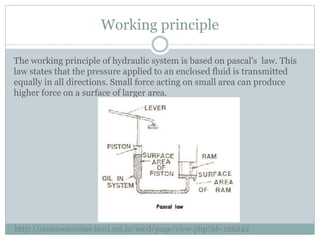
The working principle of hydraulic system is based on pascal's law. This
law states that the pressure applied to an enclosed fluid is transmitted
equally in all directions. Small force acting on small area can produce
higher force on a surface of larger area.
http://ecoursesonline.iasri.res.in/mod/page/view.php?id=126242
Why hydraulic system
 Simpler than mechanical linkage systems
 System is flexible enough
 Power can be engaged or disengaged using a simpler valve
 Input heavy forces can be controlled easily
 A good range of speed operation is possible
 Is safer than mechanical system
Parts of hydraulic system
 Reservoir
 Pump
 Valves
 Fluid
 Motor
 Hose
 Filter
 Cylinder
 Accumulator
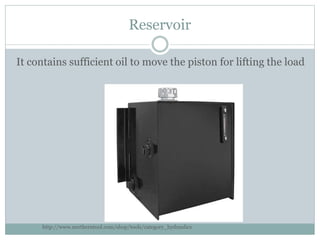
Reservoir
It contains sufficient oil to move the piston for lifting the load
http://www.northerntool.com/shop/tools/category_hydraulics
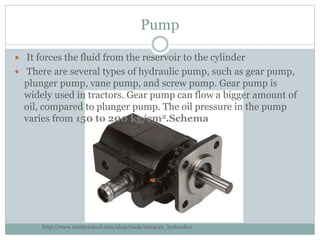
Pump
 It forces the fluid from the reservoir to the cylinder
 There are several types of hydraulic pump, such as gear pump,
plunger pump, vane pump, and screw pump. Gear pump is
widely used in tractors. Gear pump can flow a bigger amount of
oil, compared to plunger pump. The oil pressure in the pump
varies from 150 to 200 kg/cm2.Schema
http://www.northerntool.com/shop/tools/category_hydraulics
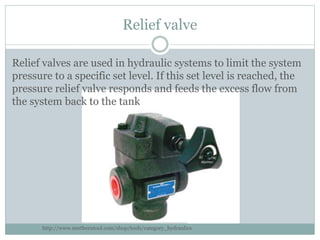
Relief valve
Relief valves are used in hydraulic systems to limit the system
pressure to a specific set level. If this set level is reached, the
pressure relief valve responds and feeds the excess flow from
the system back to the tank
http://www.northerntool.com/shop/tools/category_hydraulics
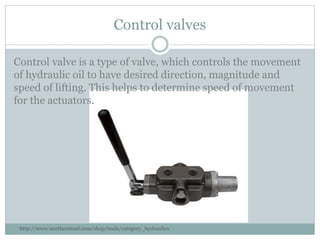
Control valves
Control valve is a type of valve, which controls the movement
of hydraulic oil to have desired direction, magnitude and
speed of lifting. This helps to determine speed of movement
for the actuators.
http://www.northerntool.com/shop/tools/category_hydraulics
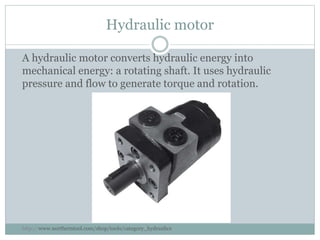
Hydraulic motor
A hydraulic motor converts hydraulic energy into
mechanical energy: a rotating shaft. It uses hydraulic
pressure and flow to generate torque and rotation.
http://www.northerntool.com/shop/tools/category_hydraulics
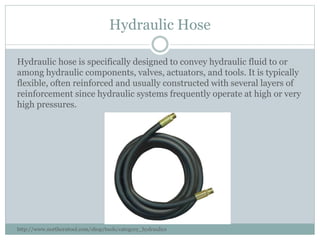
Hydraulic Hose
Hydraulic hose is specifically designed to convey hydraulic fluid to or
among hydraulic components, valves, actuators, and tools. It is typically
flexible, often reinforced and usually constructed with several layers of
reinforcement since hydraulic systems frequently operate at high or very
high pressures.
http://www.northerntool.com/shop/tools/category_hydraulics
Hydraulic filter
Hydraulic filters are used to protect your hydraulic system
components from damage due to contamination of oils
caused by particles
http://www.northerntool.com/shop/tools/category_hydraulics
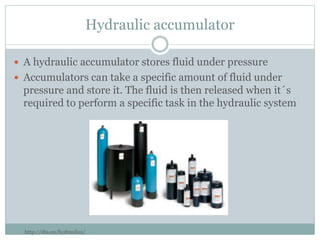
Hydraulic accumulator
 A hydraulic accumulator stores fluid under pressure
 Accumulators can take a specific amount of fluid under
pressure and store it. The fluid is then released when it´s
required to perform a specific task in the hydraulic system
http://dta.eu/hydraulics/
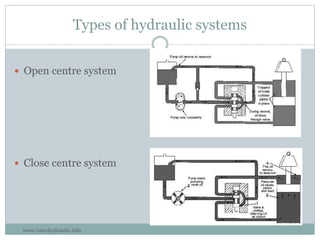
Types of hydraulic systems
 Open centre system
 Close centre system
www.valvehydraulic.info
Implement control
The tractor with a built in lift system is connected to the implement
through a specific type of mechanical linkage termed as three point
linkage and the system is known as mounted system. The implement
is connected to the tractor hydraulic system at two bottom links and
one top link. Both the bottom links are connected to two lift arms
through lift links. The lift arms are directly mounted on a rockshaft,
which is further connected to the piston rod. Any movement of the
piston is transferred to the bottom links. The top link is used for
connecting the third hitch point of the implement and is adjustable for
maintaining the implement level and suction angle. Load sensing for
the draft control can also be done through the top link, which is
spring, loaded. In some tractors the lower links are spring loaded for
draft sensing. Depending upon the soil condition and type of
operation, the mounted implement can be controlled either by
position control or draft control.
Position control
In this system, constant depth of ploughing is maintained by
automatic adjustment of draft of tractor. In this system the
control valve can be operated directly by the driver to raise
lower or hold an implement, mounted on the linkage at any
chosen height.
Draft Control
 Under this system of control, the implement is set for a
particular draft(drawbar pull) rather than depth. In varied
soil conditions the implement automatically takes more or
less depth to maintain the predetermined draft.
 Most of the indigenous tractors possess a draft control
system in addition to position control
Mixed position and draft control
It is also possible in some tractor (viz. HMT, Ford
etc. ) to suitable blend the response through
interlink mechanism so that a desired depth of
ploughing is maintained within closed limits and
draft control too is allowed to function for better
traction
Maintenance and repair of hydraulic system
For successful operation of any hydraulic system,
cleaning and periodic maintenance is very essential. If
the operator is alert and keeps the machine clean ,
refills clean oil , replaces or clean the filter regularly,
keeps the tubes and rubber hose tight and protect the
system from dust and other contaminants, the system
will undoubtedly work efficiently with less trouble
Tractor hydraulics

Tractor hydraulics

  • 1.
  • 2.
    Content  Introduction  Workingprinciple  Why Hydraulic system  Parts of hydraulic system  Types of hydraulic system (a) Based on centre system (b)Based on control  Maintenance and repair
  • 3.
    Introduction  A unitresponsible for lifting and lowering an agricultural implement  Function-draft control and weight transfer  Fluid is confined inside pipelines, reservoir and cylinders  Hydraulic pumps transfer the fluid from the reservoir to the hydraulic system. This transfer raises the energy level of the fluid by increasing its pressure. The motor provides the power source for the pump
  • 4.
    Working principle The workingprinciple of hydraulic system is based on pascal's law. This law states that the pressure applied to an enclosed fluid is transmitted equally in all directions. Small force acting on small area can produce higher force on a surface of larger area. http://ecoursesonline.iasri.res.in/mod/page/view.php?id=126242
  • 5.
    Why hydraulic system Simpler than mechanical linkage systems  System is flexible enough  Power can be engaged or disengaged using a simpler valve  Input heavy forces can be controlled easily  A good range of speed operation is possible  Is safer than mechanical system
  • 6.
    Parts of hydraulicsystem  Reservoir  Pump  Valves  Fluid  Motor  Hose  Filter  Cylinder  Accumulator
  • 7.
    Reservoir It contains sufficientoil to move the piston for lifting the load http://www.northerntool.com/shop/tools/category_hydraulics
  • 8.
    Pump  It forcesthe fluid from the reservoir to the cylinder  There are several types of hydraulic pump, such as gear pump, plunger pump, vane pump, and screw pump. Gear pump is widely used in tractors. Gear pump can flow a bigger amount of oil, compared to plunger pump. The oil pressure in the pump varies from 150 to 200 kg/cm2.Schema http://www.northerntool.com/shop/tools/category_hydraulics
  • 9.
    Relief valve Relief valvesare used in hydraulic systems to limit the system pressure to a specific set level. If this set level is reached, the pressure relief valve responds and feeds the excess flow from the system back to the tank http://www.northerntool.com/shop/tools/category_hydraulics
  • 10.
    Control valves Control valveis a type of valve, which controls the movement of hydraulic oil to have desired direction, magnitude and speed of lifting. This helps to determine speed of movement for the actuators. http://www.northerntool.com/shop/tools/category_hydraulics
  • 11.
    Hydraulic motor A hydraulicmotor converts hydraulic energy into mechanical energy: a rotating shaft. It uses hydraulic pressure and flow to generate torque and rotation. http://www.northerntool.com/shop/tools/category_hydraulics
  • 12.
    Hydraulic Hose Hydraulic hoseis specifically designed to convey hydraulic fluid to or among hydraulic components, valves, actuators, and tools. It is typically flexible, often reinforced and usually constructed with several layers of reinforcement since hydraulic systems frequently operate at high or very high pressures. http://www.northerntool.com/shop/tools/category_hydraulics
  • 13.
    Hydraulic filter Hydraulic filtersare used to protect your hydraulic system components from damage due to contamination of oils caused by particles http://www.northerntool.com/shop/tools/category_hydraulics
  • 14.
    Hydraulic accumulator  Ahydraulic accumulator stores fluid under pressure  Accumulators can take a specific amount of fluid under pressure and store it. The fluid is then released when it´s required to perform a specific task in the hydraulic system http://dta.eu/hydraulics/
  • 15.
    Types of hydraulicsystems  Open centre system  Close centre system www.valvehydraulic.info
  • 16.
    Implement control The tractorwith a built in lift system is connected to the implement through a specific type of mechanical linkage termed as three point linkage and the system is known as mounted system. The implement is connected to the tractor hydraulic system at two bottom links and one top link. Both the bottom links are connected to two lift arms through lift links. The lift arms are directly mounted on a rockshaft, which is further connected to the piston rod. Any movement of the piston is transferred to the bottom links. The top link is used for connecting the third hitch point of the implement and is adjustable for maintaining the implement level and suction angle. Load sensing for the draft control can also be done through the top link, which is spring, loaded. In some tractors the lower links are spring loaded for draft sensing. Depending upon the soil condition and type of operation, the mounted implement can be controlled either by position control or draft control.
  • 17.
    Position control In thissystem, constant depth of ploughing is maintained by automatic adjustment of draft of tractor. In this system the control valve can be operated directly by the driver to raise lower or hold an implement, mounted on the linkage at any chosen height.
  • 18.
    Draft Control  Underthis system of control, the implement is set for a particular draft(drawbar pull) rather than depth. In varied soil conditions the implement automatically takes more or less depth to maintain the predetermined draft.  Most of the indigenous tractors possess a draft control system in addition to position control
  • 19.
    Mixed position anddraft control It is also possible in some tractor (viz. HMT, Ford etc. ) to suitable blend the response through interlink mechanism so that a desired depth of ploughing is maintained within closed limits and draft control too is allowed to function for better traction
  • 20.
    Maintenance and repairof hydraulic system For successful operation of any hydraulic system, cleaning and periodic maintenance is very essential. If the operator is alert and keeps the machine clean , refills clean oil , replaces or clean the filter regularly, keeps the tubes and rubber hose tight and protect the system from dust and other contaminants, the system will undoubtedly work efficiently with less trouble

Editor's Notes

  • #6 Why? Due to merits over mechanical means of power transfer as enumerated below 1.Simpler than mechanical linkage systems because fluid power can be routed around corners with less problems 2.System is flexible enough allow the point of application to move to any location with respect to source of power generation, which is almost constant constant n case of mechanical system 3. 4. Input heavy forces can be controlled simply by increasing the size of the cylinder 5. 6. Because of self lubrication wear and tear is less so system is economical to operate 7. Hydraulic system is safer than mechanical system as moving parts are minimized.
  • #8 It is a bigger size cylinder, fitted with a piston and a connecting rod. It is also called ram cylinder. The connecting rod transmits power from the piston to the lifting arms. Piston moves in the hydraulic cylinder and causes reciprocating motion in the cylinder. The lifting arms are raised by the hydraulic pressure while raising the implement but it is lowered by its own weight.
  • #16 Open centre system uses a constant flow pump with an open centre spool vavle so that when oil is not flowing to the cylinder tit can pass throught he reservior In case of closed centre system the pump is of variable flow type and spool is closed centre type.in the neural position pump starts pumping oil
  • #19  In this system, the working depth of any implement can be controlled continuously without the need for a depth wheel on the implement. The hydraulic control valve reacts to changes in the loading in either the top or lower links which arc due to changes in the draft or pull required by the implement. If any imple­ment goes too deep its draft increases. This increase is sensed through the top link or lower links. The control system then raises the implement until the draft is back to the present level and the implement is at the origi­nal depth again using the draft control system