MACHINE POWER
 REQUIREMENT
Introduction
• To match power units to the size and type of
  machines so all field operations can be carried out
  on time with a minimum of cost

• If tractor is oversized for implements, the costs
  will be excessive for the work done

• If the implements selected are too large for the
  tractor, the quality or quantity of work may be
  lessened or the tractor will be overloaded usually
  causing expensive breakdowns
Factors to consider when selecting
           a power unit
1.   Engine type
2.   Power ratings
3.   Soil resistance to machines
4.   Tractor size
5.   Matching implements
6.   Sizing for critical work
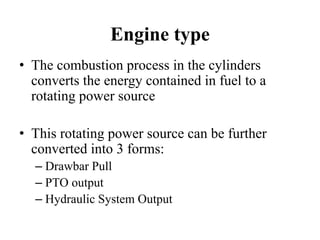
Engine type
• The combustion process in the cylinders
  converts the energy contained in fuel to a
  rotating power source

• This rotating power source can be further
  converted into 3 forms:
  – Drawbar Pull
  – PTO output
  – Hydraulic System Output
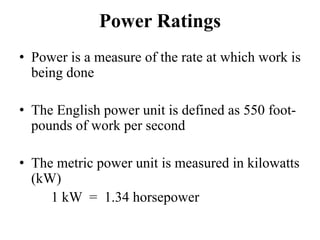
Power Ratings
• Power is a measure of the rate at which work is
  being done

• The English power unit is defined as 550 foot-
  pounds of work per second

• The metric power unit is measured in kilowatts
  (kW)
     1 kW = 1.34 horsepower
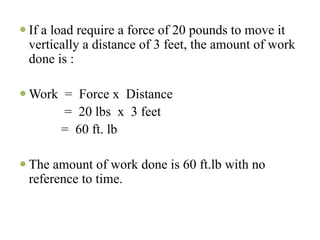
If a load require a force of 20 pounds to move it
vertically a distance of 3 feet, the amount of work
done is :

Work = Force x Distance
     = 20 lbs x 3 feet
    = 60 ft. lb

The amount of work done is 60 ft.lb with no
reference to time.
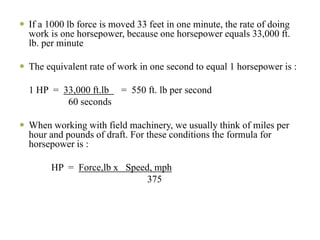
If a 1000 lb force is moved 33 feet in one minute, the rate of doing
work is one horsepower, because one horsepower equals 33,000 ft.
lb. per minute

The equivalent rate of work in one second to equal 1 horsepower is :

1 HP = 33,000 ft.lb = 550 ft. lb per second
        60 seconds

When working with field machinery, we usually think of miles per
hour and pounds of draft. For these conditions the formula for
horsepower is :

     HP = Force,lb x Speed, mph
                          375
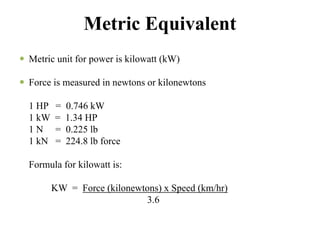
Metric Equivalent
Metric unit for power is kilowatt (kW)

Force is measured in newtons or kilonewtons

1 HP   =   0.746 kW
1 kW   =   1.34 HP
1N     =   0.225 lb
1 kN   =   224.8 lb force

Formula for kilowatt is:

       KW = Force (kilonewtons) x Speed (km/hr)
                           3.6
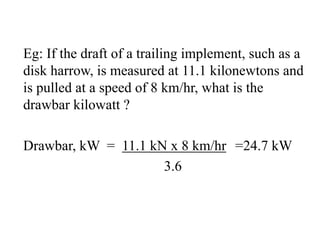
Eg: If the draft of a trailing implement, such as a
disk harrow, is measured at 11.1 kilonewtons and
is pulled at a speed of 8 km/hr, what is the
drawbar kilowatt ?

Drawbar, kW = 11.1 kN x 8 km/hr =24.7 kW
                     3.6
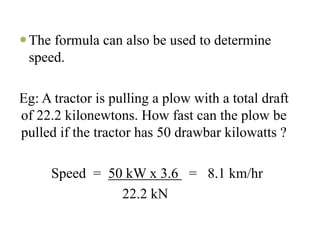
The formula can also be used to determine
 speed.

Eg: A tractor is pulling a plow with a total draft
of 22.2 kilonewtons. How fast can the plow be
pulled if the tractor has 50 drawbar kilowatts ?

     Speed = 50 kW x 3.6 = 8.1 km/hr
               22.2 kN
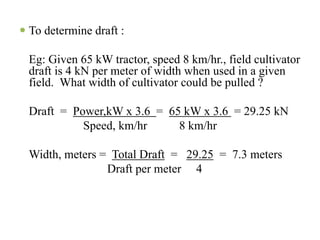
To determine draft :

Eg: Given 65 kW tractor, speed 8 km/hr., field cultivator
draft is 4 kN per meter of width when used in a given
field. What width of cultivator could be pulled ?

Draft = Power,kW x 3.6 = 65 kW x 3.6 = 29.25 kN
          Speed, km/hr     8 km/hr

Width, meters = Total Draft = 29.25 = 7.3 meters
               Draft per meter 4
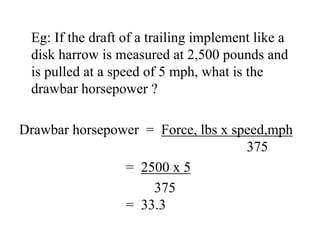
Eg: If the draft of a trailing implement like a
 disk harrow is measured at 2,500 pounds and
 is pulled at a speed of 5 mph, what is the
 drawbar horsepower ?

Drawbar horsepower = Force, lbs x speed,mph
                                    375
                = 2500 x 5
                    375
                = 33.3
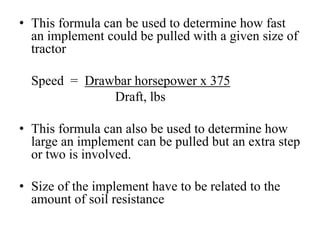
• This formula can be used to determine how fast
  an implement could be pulled with a given size of
  tractor

  Speed = Drawbar horsepower x 375
              Draft, lbs

• This formula can also be used to determine how
  large an implement can be pulled but an extra step
  or two is involved.

• Size of the implement have to be related to the
  amount of soil resistance
Determining tractor size needed

• There are various kind of power
  – Brake
  – PTO
  – Drawbar


• Tractor power is measured in horsepower
  (USA) or in kilowatts (kW)- metric
  equivalents
Brake Horsepower
is the maximum power the engine can develop without
alterations

the engine can be hooked to a dynamometer to determine
how much brake horsepower can be developed

useful in sizing stationary engines for operating irrigation
pumps, grinders and other large equipments

the same engines used for large tractors are often used as
stationary engines
Power Take-Off Horsepower
             (PTO hp)

• the power measured at the PTO shaft
Drawbar Horsepower *
• is the measure of the pulling power of the engine by way of tracks,
  wheels or tires at a uniform speed

• drawbar horsepower varies depending widely on several factors -
  soil surface and type of hitch

• drawbar horsepower is the function of drawbar pull and speed of the
  various kind of horsepower, maximum PTO hp is the most
  commonly used in designating the size of a tractor

• large tractors that do not have PTO shaft, they may be given a brake
  hp (flywheel) or maximum drawbar hp rating
Matching tractors and implements

 When matching a tractor and implement, 3
 important factors must be considered :-

1.     The tractor must not be overloaded or early
  failure of components will occur
2.     The implement must be pulled at the proper
  speed or optimum performance cannot be obtained
3.     The soil conditions and their effects on
  machine performance must be considered
With a given tractor, there is a set of amount of
power available. This available power is used for:-
I. moving the tractor over the ground
II. pulling the implement over the ground
III. powering the implement for useful work


  The softer or looser the soil conditions are, the greater
  amount of power that will be consumed because of
  greater rolling resistance

  This reduces the available usable drawbar power
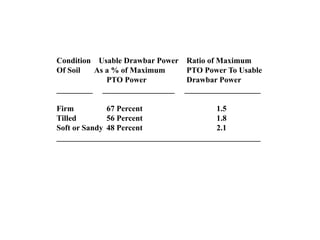
          SOIL CONDITIONS---POWER
Condition Usable Drawbar Power    Ratio of Maximum
Of Soil  As a % of Maximum        PTO Power To Usable
            PTO Power             Drawbar Power
_________ __________________     ___________________

Firm          67 Percent                1.5
Tilled        56 Percent                1.8
Soft or Sandy 48 Percent                2.1
___________________________________________________
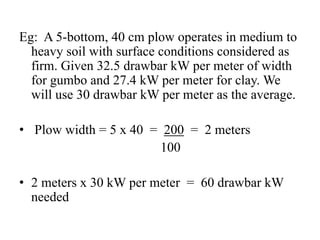
Eg: A 5-bottom, 40 cm plow operates in medium to
  heavy soil with surface conditions considered as
  firm. Given 32.5 drawbar kW per meter of width
  for gumbo and 27.4 kW per meter for clay. We
  will use 30 drawbar kW per meter as the average.

• Plow width = 5 x 40 = 200 = 2 meters
                       100

• 2 meters x 30 kW per meter = 60 drawbar kW
  needed
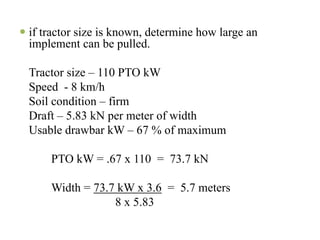
if tractor size is known, determine how large an
implement can be pulled.

Tractor size – 110 PTO kW
Speed - 8 km/h
Soil condition – firm
Draft – 5.83 kN per meter of width
Usable drawbar kW – 67 % of maximum

    PTO kW = .67 x 110 = 73.7 kN

    Width = 73.7 kW x 3.6 = 5.7 meters
                8 x 5.83
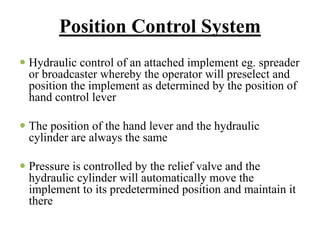
Position Control System
Hydraulic control of an attached implement eg. spreader
or broadcaster whereby the operator will preselect and
position the implement as determined by the position of
hand control lever

The position of the hand lever and the hydraulic
cylinder are always the same

Pressure is controlled by the relief valve and the
hydraulic cylinder will automatically move the
implement to its predetermined position and maintain it
there
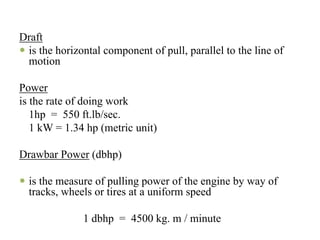
Draft
 is the horizontal component of pull, parallel to the line of
 motion

Power
is the rate of doing work
   1hp = 550 ft.lb/sec.
   1 kW = 1.34 hp (metric unit)

Drawbar Power (dbhp)

  is the measure of pulling power of the engine by way of
  tracks, wheels or tires at a uniform speed

              1 dbhp = 4500 kg. m / minute
THANK YOU

Agriculture Engineering-chptr15

  • 1.
  • 2.
    Introduction • To matchpower units to the size and type of machines so all field operations can be carried out on time with a minimum of cost • If tractor is oversized for implements, the costs will be excessive for the work done • If the implements selected are too large for the tractor, the quality or quantity of work may be lessened or the tractor will be overloaded usually causing expensive breakdowns
  • 3.
    Factors to considerwhen selecting a power unit 1. Engine type 2. Power ratings 3. Soil resistance to machines 4. Tractor size 5. Matching implements 6. Sizing for critical work
  • 4.
    Engine type • Thecombustion process in the cylinders converts the energy contained in fuel to a rotating power source • This rotating power source can be further converted into 3 forms: – Drawbar Pull – PTO output – Hydraulic System Output
  • 5.
    Power Ratings • Poweris a measure of the rate at which work is being done • The English power unit is defined as 550 foot- pounds of work per second • The metric power unit is measured in kilowatts (kW) 1 kW = 1.34 horsepower
  • 6.
    If a loadrequire a force of 20 pounds to move it vertically a distance of 3 feet, the amount of work done is : Work = Force x Distance = 20 lbs x 3 feet = 60 ft. lb The amount of work done is 60 ft.lb with no reference to time.
  • 7.
    If a 1000lb force is moved 33 feet in one minute, the rate of doing work is one horsepower, because one horsepower equals 33,000 ft. lb. per minute The equivalent rate of work in one second to equal 1 horsepower is : 1 HP = 33,000 ft.lb = 550 ft. lb per second 60 seconds When working with field machinery, we usually think of miles per hour and pounds of draft. For these conditions the formula for horsepower is : HP = Force,lb x Speed, mph 375
  • 8.
    Metric Equivalent Metric unitfor power is kilowatt (kW) Force is measured in newtons or kilonewtons 1 HP = 0.746 kW 1 kW = 1.34 HP 1N = 0.225 lb 1 kN = 224.8 lb force Formula for kilowatt is: KW = Force (kilonewtons) x Speed (km/hr) 3.6
  • 9.
    Eg: If thedraft of a trailing implement, such as a disk harrow, is measured at 11.1 kilonewtons and is pulled at a speed of 8 km/hr, what is the drawbar kilowatt ? Drawbar, kW = 11.1 kN x 8 km/hr =24.7 kW 3.6
  • 10.
    The formula canalso be used to determine speed. Eg: A tractor is pulling a plow with a total draft of 22.2 kilonewtons. How fast can the plow be pulled if the tractor has 50 drawbar kilowatts ? Speed = 50 kW x 3.6 = 8.1 km/hr 22.2 kN
  • 11.
    To determine draft: Eg: Given 65 kW tractor, speed 8 km/hr., field cultivator draft is 4 kN per meter of width when used in a given field. What width of cultivator could be pulled ? Draft = Power,kW x 3.6 = 65 kW x 3.6 = 29.25 kN Speed, km/hr 8 km/hr Width, meters = Total Draft = 29.25 = 7.3 meters Draft per meter 4
  • 12.
    Eg: If thedraft of a trailing implement like a disk harrow is measured at 2,500 pounds and is pulled at a speed of 5 mph, what is the drawbar horsepower ? Drawbar horsepower = Force, lbs x speed,mph 375 = 2500 x 5 375 = 33.3
  • 13.
    • This formulacan be used to determine how fast an implement could be pulled with a given size of tractor Speed = Drawbar horsepower x 375 Draft, lbs • This formula can also be used to determine how large an implement can be pulled but an extra step or two is involved. • Size of the implement have to be related to the amount of soil resistance
  • 14.
    Determining tractor sizeneeded • There are various kind of power – Brake – PTO – Drawbar • Tractor power is measured in horsepower (USA) or in kilowatts (kW)- metric equivalents
  • 15.
    Brake Horsepower is themaximum power the engine can develop without alterations the engine can be hooked to a dynamometer to determine how much brake horsepower can be developed useful in sizing stationary engines for operating irrigation pumps, grinders and other large equipments the same engines used for large tractors are often used as stationary engines
  • 16.
    Power Take-Off Horsepower (PTO hp) • the power measured at the PTO shaft
  • 17.
    Drawbar Horsepower * •is the measure of the pulling power of the engine by way of tracks, wheels or tires at a uniform speed • drawbar horsepower varies depending widely on several factors - soil surface and type of hitch • drawbar horsepower is the function of drawbar pull and speed of the various kind of horsepower, maximum PTO hp is the most commonly used in designating the size of a tractor • large tractors that do not have PTO shaft, they may be given a brake hp (flywheel) or maximum drawbar hp rating
  • 18.
    Matching tractors andimplements When matching a tractor and implement, 3 important factors must be considered :- 1. The tractor must not be overloaded or early failure of components will occur 2. The implement must be pulled at the proper speed or optimum performance cannot be obtained 3. The soil conditions and their effects on machine performance must be considered
  • 19.
    With a giventractor, there is a set of amount of power available. This available power is used for:- I. moving the tractor over the ground II. pulling the implement over the ground III. powering the implement for useful work The softer or looser the soil conditions are, the greater amount of power that will be consumed because of greater rolling resistance This reduces the available usable drawbar power SOIL CONDITIONS---POWER
  • 20.
    Condition Usable DrawbarPower Ratio of Maximum Of Soil As a % of Maximum PTO Power To Usable PTO Power Drawbar Power _________ __________________ ___________________ Firm 67 Percent 1.5 Tilled 56 Percent 1.8 Soft or Sandy 48 Percent 2.1 ___________________________________________________
  • 21.
    Eg: A 5-bottom,40 cm plow operates in medium to heavy soil with surface conditions considered as firm. Given 32.5 drawbar kW per meter of width for gumbo and 27.4 kW per meter for clay. We will use 30 drawbar kW per meter as the average. • Plow width = 5 x 40 = 200 = 2 meters 100 • 2 meters x 30 kW per meter = 60 drawbar kW needed
  • 22.
    if tractor sizeis known, determine how large an implement can be pulled. Tractor size – 110 PTO kW Speed - 8 km/h Soil condition – firm Draft – 5.83 kN per meter of width Usable drawbar kW – 67 % of maximum PTO kW = .67 x 110 = 73.7 kN Width = 73.7 kW x 3.6 = 5.7 meters 8 x 5.83
  • 23.
    Position Control System Hydrauliccontrol of an attached implement eg. spreader or broadcaster whereby the operator will preselect and position the implement as determined by the position of hand control lever The position of the hand lever and the hydraulic cylinder are always the same Pressure is controlled by the relief valve and the hydraulic cylinder will automatically move the implement to its predetermined position and maintain it there
  • 24.
    Draft is thehorizontal component of pull, parallel to the line of motion Power is the rate of doing work 1hp = 550 ft.lb/sec. 1 kW = 1.34 hp (metric unit) Drawbar Power (dbhp) is the measure of pulling power of the engine by way of tracks, wheels or tires at a uniform speed 1 dbhp = 4500 kg. m / minute
  • 25.