Reaccredited with A+ grade with a CGPA of 3.39 in the III cycle of NAAC
affiliated to manomanium sundaranar university, tirunelveli.
Post graduate & Research Centre – Department of Microbiology
(government aided)
ACADEMIC YEAR 2022-2023
IV SEM CORE: INDUSTRIAL MICROBIOLOGY
UNIT-4
DOWN STREAM PROCESS-CHROMATOGRAPHY
S.ASHIFA BEGAM SUBMITTEDTO
REG NO:20211232516106 GUIDE:DR.S.VISWANATHAN
II M.SC MICROBIOLOGY ASSISTANT PROFFESSOR&HEAD
ASSIGNEDON: 03.04.2023 SPKC - ALWARKURUCHI
 Objectives
 Introduction
 Chromatography
 Most commonly used chromatography in DSP
 Gel filtration chromatography
 Ion exchange chromatography
 Affinity chromatography
Objectives
To know the role
of
chromatography
in downstream
process
To know the
types of
chromatography
used in
downstream
process
Applications of
chromatography
in downstream
process
To learn the
principle behind
the
chromatography
technique
 After successful fermentation or enzyme reactions, desired products must
be separated and purified.
 The final step is commonly known as downstream processing or bio
separation, which can account for up to 60% of the total production costs.
 The fermentation products can be the cells themselves(biomass),
components within the fermentation broth( extracellular), or those trapped
in the cells(intracellular).
TYPES PRODUCTS
Cell itself Baker’s yeast, single cell protein.
Extracellular Alcohols, aminoacids, enzymes,
antibiotics.
Intracellular Recombinant DNA proteins.
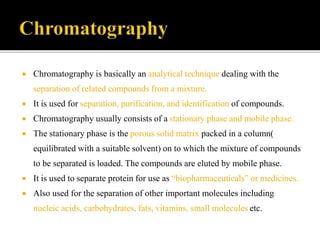
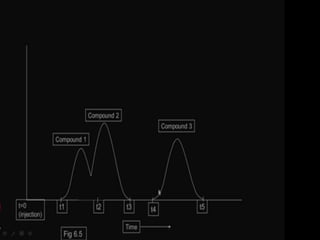
 Chromatography is basically an analytical technique dealing with the
separation of related compounds from a mixture.
 It is used for separation, purification, and identification of compounds.
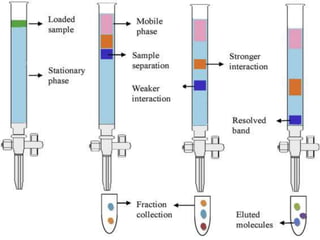
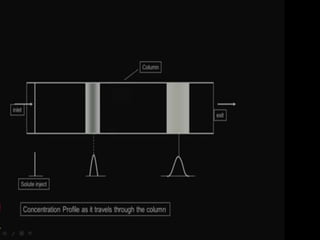
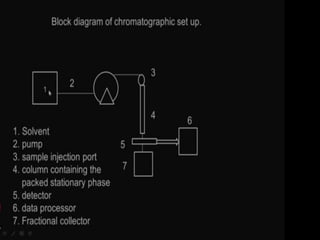
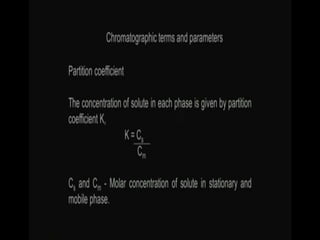
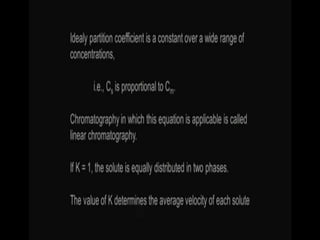
 Chromatography usually consists of a stationary phase and mobile phase.
 The stationary phase is the porous solid matrix packed in a column(
equilibrated with a suitable solvent) on to which the mixture of compounds
to be separated is loaded. The compounds are eluted by mobile phase.
 It is used to separate protein for use as “biopharmaceuticals” or medicines.
 Also used for the separation of other important molecules including
nucleic acids, carbohydrates, fats, vitamins, small molecules etc.
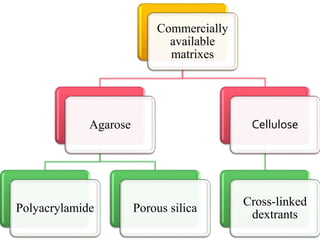
Commercially
available
matrixes
Agarose
Polyacrylamide Porous silica
Cellulose
Cross-linked
dextrants
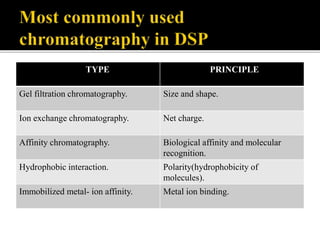
TYPE PRINCIPLE
Gel filtration chromatography. Size and shape.
Ion exchange chromatography. Net charge.
Affinity chromatography. Biological affinity and molecular
recognition.
Hydrophobic interaction. Polarity(hydrophobicity of
molecules).
Immobilized metal- ion affinity. Metal ion binding.
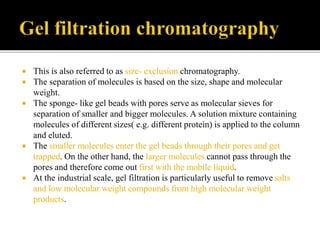
 This is also referred to as size- exclusion chromatography.
 The separation of molecules is based on the size, shape and molecular
weight.
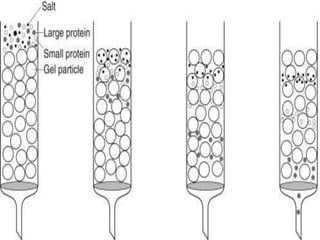
 The sponge- like gel beads with pores serve as molecular sieves for
separation of smaller and bigger molecules. A solution mixture containing
molecules of different sizes( e.g. different protein) is applied to the column
and eluted.
 The smaller molecules enter the gel beads through their pores and get
trapped. On the other hand, the larger molecules cannot pass through the
pores and therefore come out first with the mobile liquid.
 At the industrial scale, gel filtration is particularly useful to remove salts
and low molecular weight compounds from high molecular weight
products.
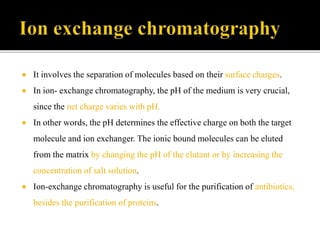
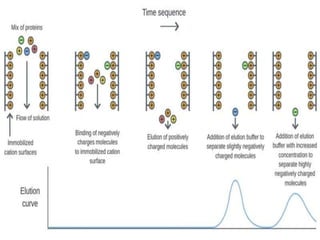
 It involves the separation of molecules based on their surface charges.
 In ion- exchange chromatography, the pH of the medium is very crucial,
since the net charge varies with pH.
 In other words, the pH determines the effective charge on both the target
molecule and ion exchanger. The ionic bound molecules can be eluted
from the matrix by changing the pH of the elutant or by increasing the
concentration of salt solution.
 Ion-exchange chromatography is useful for the purification of antibiotics,
besides the purification of proteins.
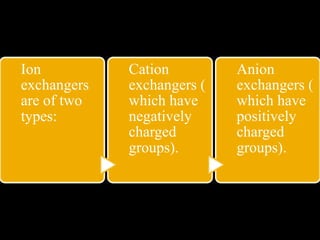
Ion
exchangers
are of two
types:
Cation
exchangers (
which have
negatively
charged
groups).
Anion
exchangers (
which have
positively
charged
groups).
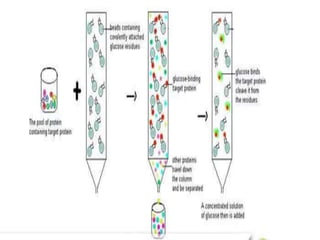
 This is an elegant method for the purification of proteins from a complex
mixture.
 Affinity chromatography is based on an interaction of a protein with
immobilized ligand.
 The ligand can be a specific antibody, substrate, substrate analogue or
inhibitor.
 The protein bound to the ligand can be eluted by reducing their interaction.
 This can be achieved by changing the ph of the buffer, altering the ionic
strength or by using another free ligand molecules.
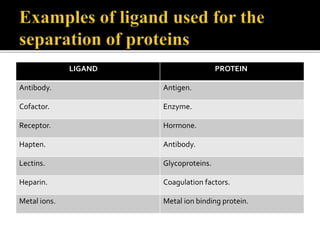
LIGAND PROTEIN
Antibody. Antigen.
Cofactor. Enzyme.
Receptor. Hormone.
Hapten. Antibody.
Lectins. Glycoproteins.
Heparin. Coagulation factors.
Metal ions. Metal ion binding protein.
 Industrial Microbiology:Michael J. Waites,
Neil L. Morgan, John S. Rockey, Gary Higton
 https://youtube.com/playlist?list=PLyqSpQzT
E6M9rBCpPmd0q3os_gui1Pn0T
 https://www.researchgate.net/publication/2591
14653_Chromatographic_Techniques_in_the_
Downstream_Processing_of_Proteins_in_Biot
echnology
THANKYOU
The Chairman.
The secretory.
Management committee.
The principle, Sri paramakalyani college.
The head-Department of microbiology.
The staff members- Department of microbiology.

CHROMATOGRAPHY-UNIT 4.pptx

  • 1.
    Reaccredited with A+grade with a CGPA of 3.39 in the III cycle of NAAC affiliated to manomanium sundaranar university, tirunelveli. Post graduate & Research Centre – Department of Microbiology (government aided) ACADEMIC YEAR 2022-2023 IV SEM CORE: INDUSTRIAL MICROBIOLOGY UNIT-4 DOWN STREAM PROCESS-CHROMATOGRAPHY S.ASHIFA BEGAM SUBMITTEDTO REG NO:20211232516106 GUIDE:DR.S.VISWANATHAN II M.SC MICROBIOLOGY ASSISTANT PROFFESSOR&HEAD ASSIGNEDON: 03.04.2023 SPKC - ALWARKURUCHI
  • 2.
     Objectives  Introduction Chromatography  Most commonly used chromatography in DSP  Gel filtration chromatography  Ion exchange chromatography  Affinity chromatography
  • 3.
    Objectives To know therole of chromatography in downstream process To know the types of chromatography used in downstream process Applications of chromatography in downstream process To learn the principle behind the chromatography technique
  • 4.
     After successfulfermentation or enzyme reactions, desired products must be separated and purified.  The final step is commonly known as downstream processing or bio separation, which can account for up to 60% of the total production costs.  The fermentation products can be the cells themselves(biomass), components within the fermentation broth( extracellular), or those trapped in the cells(intracellular). TYPES PRODUCTS Cell itself Baker’s yeast, single cell protein. Extracellular Alcohols, aminoacids, enzymes, antibiotics. Intracellular Recombinant DNA proteins.
  • 6.
     Chromatography isbasically an analytical technique dealing with the separation of related compounds from a mixture.  It is used for separation, purification, and identification of compounds.  Chromatography usually consists of a stationary phase and mobile phase.  The stationary phase is the porous solid matrix packed in a column( equilibrated with a suitable solvent) on to which the mixture of compounds to be separated is loaded. The compounds are eluted by mobile phase.  It is used to separate protein for use as “biopharmaceuticals” or medicines.  Also used for the separation of other important molecules including nucleic acids, carbohydrates, fats, vitamins, small molecules etc.
  • 7.
  • 15.
    TYPE PRINCIPLE Gel filtrationchromatography. Size and shape. Ion exchange chromatography. Net charge. Affinity chromatography. Biological affinity and molecular recognition. Hydrophobic interaction. Polarity(hydrophobicity of molecules). Immobilized metal- ion affinity. Metal ion binding.
  • 16.
     This isalso referred to as size- exclusion chromatography.  The separation of molecules is based on the size, shape and molecular weight.  The sponge- like gel beads with pores serve as molecular sieves for separation of smaller and bigger molecules. A solution mixture containing molecules of different sizes( e.g. different protein) is applied to the column and eluted.  The smaller molecules enter the gel beads through their pores and get trapped. On the other hand, the larger molecules cannot pass through the pores and therefore come out first with the mobile liquid.  At the industrial scale, gel filtration is particularly useful to remove salts and low molecular weight compounds from high molecular weight products.
  • 18.
     It involvesthe separation of molecules based on their surface charges.  In ion- exchange chromatography, the pH of the medium is very crucial, since the net charge varies with pH.  In other words, the pH determines the effective charge on both the target molecule and ion exchanger. The ionic bound molecules can be eluted from the matrix by changing the pH of the elutant or by increasing the concentration of salt solution.  Ion-exchange chromatography is useful for the purification of antibiotics, besides the purification of proteins.
  • 19.
    Ion exchangers are of two types: Cation exchangers( which have negatively charged groups). Anion exchangers ( which have positively charged groups).
  • 21.
     This isan elegant method for the purification of proteins from a complex mixture.  Affinity chromatography is based on an interaction of a protein with immobilized ligand.  The ligand can be a specific antibody, substrate, substrate analogue or inhibitor.  The protein bound to the ligand can be eluted by reducing their interaction.  This can be achieved by changing the ph of the buffer, altering the ionic strength or by using another free ligand molecules.
  • 23.
    LIGAND PROTEIN Antibody. Antigen. Cofactor.Enzyme. Receptor. Hormone. Hapten. Antibody. Lectins. Glycoproteins. Heparin. Coagulation factors. Metal ions. Metal ion binding protein.
  • 24.
     Industrial Microbiology:MichaelJ. Waites, Neil L. Morgan, John S. Rockey, Gary Higton  https://youtube.com/playlist?list=PLyqSpQzT E6M9rBCpPmd0q3os_gui1Pn0T  https://www.researchgate.net/publication/2591 14653_Chromatographic_Techniques_in_the_ Downstream_Processing_of_Proteins_in_Biot echnology
  • 27.
    THANKYOU The Chairman. The secretory. Managementcommittee. The principle, Sri paramakalyani college. The head-Department of microbiology. The staff members- Department of microbiology.