Learning Outcomes
At theend of this chapter the students should be able to:
1. Define the different concepts related to assessing affective learning
outcomes;
2. Determine different levels of affective domain;
3. Differentiate the three methods of assessing affective learning outcomes;
4. Formulate objectives in the affective domain.
3.
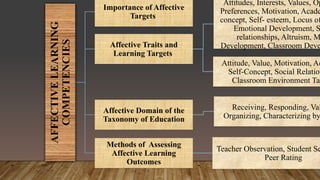
AFFECTIVE
LEARNING
COMPETENCIES
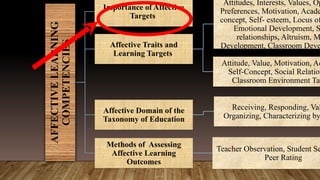
Importance of Affective
Targets
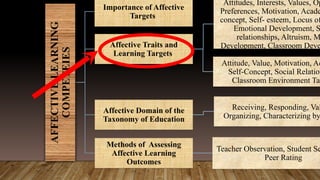
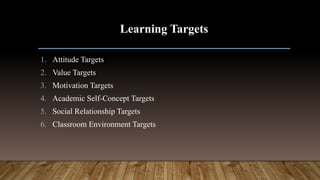
AffectiveTraits and
Learning Targets
Attitudes, Interests, Values, Op
Preferences, Motivation, Acade
concept, Self- esteem, Locus of
Emotional Development, S
relationships, Altruism, M
Development, Classroom Deve
Attitude, Value, Motivation, Ac
Self-Concept, Social Relation
Classroom Environment Tar
Affective Domain of the
Taxonomy of Education
Receiving, Responding, Val
Organizing, Characterizing by
Methods of Assessing
Affective Learning
Outcomes
Teacher Observation, Student Se
Peer Rating
4.
Affect
- a numberof non-cognitive variables such as a person’s attitude,
interests and values.
5.
According to WilliamJames Popham (2003), the
reasons why it is important to assess affect are:
1. Educators should be interested in assessing affective variables because these
variables are excellent predictors of students’ future behavior,
2. teachers should assess affect to remind themselves that there’s more to being a
successful teacher than helping students obtain high scores on achievement
tests;
3. Information regarding students’ affect can help teachers teach more
effectively on a day-to-day basis.
6.
AFFECTIVE
LEARNING
COMPETENCIES
Importance of Affective
Targets
AffectiveTraits and
Learning Targets
Attitudes, Interests, Values, Op
Preferences, Motivation, Acade
concept, Self- esteem, Locus of
Emotional Development, S
relationships, Altruism, M
Development, Classroom Deve
Attitude, Value, Motivation, Ac
Self-Concept, Social Relation
Classroom Environment Tar
Affective Domain of the
Taxonomy of Education
Receiving, Responding, Val
Organizing, Characterizing by
Methods of Assessing
Affective Learning
Outcomes
Teacher Observation, Student Se
Peer Rating
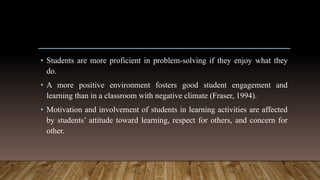
• Students aremore proficient in problem-solving if they enjoy what they
do.
• A more positive environment fosters good student engagement and
learning than in a classroom with negative climate (Fraser, 1994).
• Motivation and involvement of students in learning activities are affected
by students’ attitude toward learning, respect for others, and concern for
other.
9.
Why most teachersdo not utilize any kind of
formal affective assessment?
• School routines are organized based on subject areas; and
• Assessment of affective targets is fraught with difficulties.
(McMillian,2007).
• Many potential sources of error in measuring affective traits often
result in low reliability.
10.
Positive Affective Traitsand Skills are Essential
for:
• Effective learning
• Being an involved and productive member of our society
• Preparing for occupational and vocational satisfaction and productivity
(ex; work habits, willingness to learn, interpersonal skills)
• Maximizing the motivation to learn at present and in the future
• Preventing students from dropping out of school
11.
AFFECTIVE
LEARNING
COMPETEIES
Importance of Affective
Targets
AffectiveTraits and
Learning Targets
Attitudes, Interests, Values, Op
Preferences, Motivation, Acade
concept, Self- esteem, Locus of
Emotional Development, S
relationships, Altruism, M
Development, Classroom Deve
Attitude, Value, Motivation, Ac
Self-Concept, Social Relation
Classroom Environment Tar
Affective Domain of the
Taxonomy of Education
Receiving, Responding, Val
Organizing, Characterizing by
Methods of Assessing
Affective Learning
Outcomes
Teacher Observation, Student Se
Peer Rating
• The wordaffective refers to variety of traits and dispositions that are
different from knowledge, reasoning, and skills (Hohn,1995).
• Technically, this term means the emotions or feelings that one has toward
someone or something.
• Nevertheless, attitudes, values, self concept, citizenship, and other traits
are usually considered to be non-cognitive, include more than emotions or
feelings.
14.
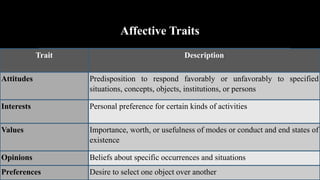
Affective Traits
Trait Description
AttitudesPredisposition to respond favorably or unfavorably to specified
situations, concepts, objects, institutions, or persons
Interests Personal preference for certain kinds of activities
Values Importance, worth, or usefulness of modes or conduct and end states of
existence
Opinions Beliefs about specific occurrences and situations
Preferences Desire to select one object over another
15.
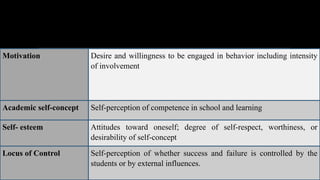
Motivation Desire andwillingness to be engaged in behavior including intensity
of involvement
Academic self-concept Self-perception of competence in school and learning
Self- esteem Attitudes toward oneself; degree of self-respect, worthiness, or
desirability of self-concept
Locus of Control Self-perception of whether success and failure is controlled by the
students or by external influences.
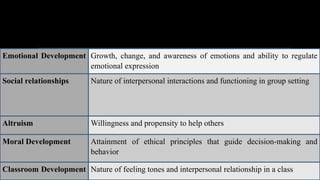
16.
Emotional Development Growth,change, and awareness of emotions and ability to regulate
emotional expression
Social relationships Nature of interpersonal interactions and functioning in group setting
Altruism Willingness and propensity to help others
Moral Development Attainment of ethical principles that guide decision-making and
behavior
Classroom Development Nature of feeling tones and interpersonal relationship in a class
1. Attitude Targets
•McMillan(1980)defines attitudes as internal states that influence what
students are likely to do.
• The internal state can in some degree determine positive or negative or
favorable or unfavorable reaction toward an object, situation, person or
group of objects, general environment, or group of persons.
• In a learning institution, attitude is contingent on subjects, teachers, other
students, homework, and other objects or persons.
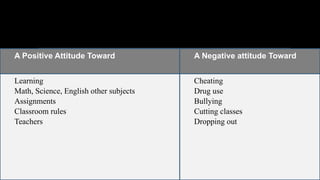
19.
A Positive AttitudeToward A Negative attitude Toward
Learning
Math, Science, English other subjects
Assignments
Classroom rules
Teachers
Cheating
Drug use
Bullying
Cutting classes
Dropping out
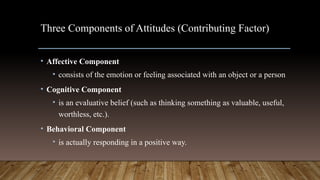
20.
Three Components ofAttitudes (Contributing Factor)
• Affective Component
• consists of the emotion or feeling associated with an object or a person
• Cognitive Component
• is an evaluative belief (such as thinking something as valuable, useful,
worthless, etc.).
• Behavioral Component
• is actually responding in a positive way.
21.
2. Value Targets
•End states of existence
• refer to a conditions and aspects of oneself and the kind of world that a
person wants such as safe life, world peace, freedom, happiness, social
acceptance, and wisdom.
• Mode of conduct
• are manifested in what a person believe is appropriate and needed in
everyday existence such as being honest, cheerful, ambitious, loving,
responsible, and helpful.
22.
Value Sample ValueTarget
Honesty Students should learn to value honesty in their dealing with others.
Integrity Students should firmly observe their own code of values.
Justice Students should support the view that all citizens should be the recipients
of equal justice from government law enforcement agencies.
Freedom Students should believe that democratic countries must provide the
maximum level of freedom to their citizens.
23.
• McMillan(2007) suggestedthat in setting value targets, it is necessary to stick to non-
controversial and those that are clearly related to academic learning and school and
department of educational goals.
• McMillan (2007) and Popham (2005) suggested other non-controversial values (aside
from those mentioned) like kindness, generosity, perseverance, loyalty, respect,
courage, compassion, and tolerance.
• It is better to an excellent job assessing a few important traits than to try to assess
many traits casually.
24.
3. MOTIVATION TARGET
•Expectancy X Value Framework
• implies that motivation is determined by students' expectation, their
belief about whether they are likely to be successful, and the relevance
of the outcome.
• Expectations
• refers to the self efficacy of the students.
• Values
• are self-perception of the importance of the performance
25.
2 Kinds OfMotivation
• Intrinsic Motivation
• when students do something or engage themselves in activities because
they find the activities interesting, enjoyable, or challenging.
• Extrinsic Motivation
• is doing something because it leads rewards or punishment.
26.
4. Academic Self-conceptTargets
• Self-concept and self-esteem are multidimensional.
• Each person has a self-description in each area, that form one's self-
concept or self image.
• Moreover, individuals have a sense of self regards, self affirmation, and
self worth in each area.(self-esteem)
27.
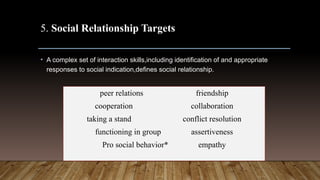
peer relations friendship
cooperationcollaboration
taking a stand conflict resolution
functioning in group assertiveness
Pro social behavior* empathy
5. Social Relationship Targets
• A complex set of interaction skills,including identification of and appropriate
responses to social indication,defines social relationship.
28.
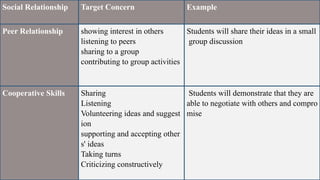
Social Relationship TargetConcern Example
Peer Relationship showing interest in others
listening to peers
sharing to a group
contributing to group activities
Students will share their ideas in a small
group discussion
Cooperative Skills Sharing
Listening
Volunteering ideas and suggest
ion
supporting and accepting other
s' ideas
Taking turns
Criticizing constructively
Students will demonstrate that they are
able to negotiate with others and compro
mise
29.
6. CLASSROOM ENVIRONMENTTARGET
In every classroom there is a unique climate that is felt at every point
in time. Some manifest a comfortable atmosphere, others have relaxed and
productive ambiance. As a result there are classes that are happy and content
while others are serious and tensed due to the effect of the classroom
climate. It follows that students behave differently as dictated also by the
classroom climate, some shows warm and supportive class while others
register as cold and rejecting.
30.
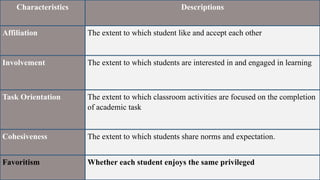
Characteristics Descriptions
Affiliation Theextent to which student like and accept each other
Involvement The extent to which students are interested in and engaged in learning
Task Orientation The extent to which classroom activities are focused on the completion
of academic task
Cohesiveness The extent to which students share norms and expectation.
Favoritism Whether each student enjoys the same privileged
31.
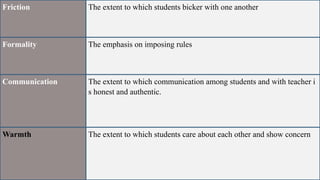
Influence The extentto which each student influences classroom d
ecisions
Friction The extent to which students bicker with one another
Formality The emphasis on imposing rules
Communication The extent to which communication among students and with teacher i
s honest and authentic.
Warmth The extent to which students care about each other and show concern
• In 1964,David R.Krathwohl, together with his colleagues, extended
Bloom's Taxonomy of Education Objectives by publishing the second
taxonomy of objectives, this time giving emphasis on he affective domain.
• Krathwohl and his collaborators attempted to subdivide the affective realm
into relatively distinct divisions.
34.
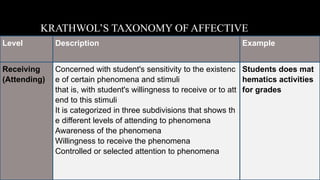
KRATHWOL’S TAXONOMY OFAFFECTIVE
DOMAIN
Level Description Example
Receiving
(Attending)
Concerned with student's sensitivity to the existenc
e of certain phenomena and stimuli
that is, with student's willingness to receive or to att
end to this stimuli
It is categorized in three subdivisions that shows th
e different levels of attending to phenomena
Awareness of the phenomena
Willingness to receive the phenomena
Controlled or selected attention to phenomena
Students does mat
hematics activities
for grades
35.
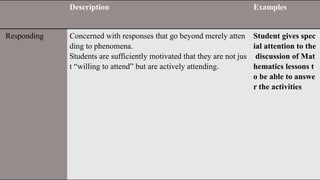
Description Examples
Responding Concernedwith responses that go beyond merely atten
ding to phenomena.
Students are sufficiently motivated that they are not jus
t “willing to attend” but are actively attending.
Student gives spec
ial attention to the
discussion of Mat
hematics lessons t
o be able to answe
r the activities



















![mam gubacLEARNING [Autosaved].pptx](https://cdn.slidesharecdn.com/ss_thumbnails/mamgubaclearningautosaved-220815043843-b819b89e-thumbnail.jpg?width=640&height=640&fit=bounds)


