Assessing and
Evaluating
the Portfolio
According to Paulson ,Paulson and
Meyer Portfolios offer a way of
assessing student learning that is
different form the traditional methods.
Portfolio assessment provides the
teacher and students an opportunity
t5o observe students in a broader
context taking risk developing creative
solution and learning to make
judgments about their own
performances.
Portfolio include the following:
• Thoughtfulness ( including evidence of
students monitoring of their own
comprehension metacognitive reflection
and productive habits of mind.
• Growth and development in relationship
to key curriculum expectancies and
indicators.
• Understanding and application of key
processes.
• Completeness correctness and
appropriateness of products and
processes presented in the portfolio
• Diversity of entries (e.g, use of
multiple formats to demonstrate
achievement of designated
performance standards.
SAMPLE OF RATING
SCALE FOR COVER
LETTER
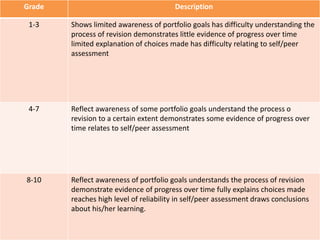
Grade Description
1-3 Shows limited awareness of portfolio goals has difficulty understanding the
process of revision demonstrates little evidence of progress over time
limited explanation of choices made has difficulty relating to self/peer
assessment
4-7 Reflect awareness of some portfolio goals understand the process o
revision to a certain extent demonstrates some evidence of progress over
time relates to self/peer assessment
8-10 Reflect awareness of portfolio goals understands the process of revision
demonstrate evidence of progress over time fully explains choices made
reaches high level of reliability in self/peer assessment draws conclusions
about his/her learning.
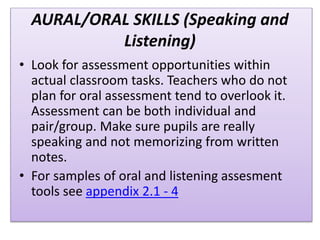
AURAL/ORAL SKILLS (Speaking and
Listening)
• Look for assessment opportunities within
actual classroom tasks. Teachers who do not
plan for oral assessment tend to overlook it.
Assessment can be both individual and
pair/group. Make sure pupils are really
speaking and not memorizing from written
notes.
• For samples of oral and listening assesment
tools see appendix 2.1 - 4
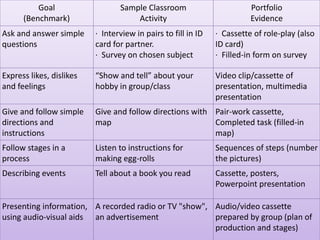
Goal
(Benchmark)
Sample Classroom
Activity
Portfolio
Evidence
Ask and answer simple
questions
· Interview in pairs to fill in ID
card for partner.
· Survey on chosen subject
· Cassette of role-play (also
ID card)
· Filled-in form on survey
Express likes, dislikes
and feelings
“Show and tell” about your
hobby in group/class
Video clip/cassette of
presentation, multimedia
presentation
Give and follow simple
directions and
instructions
Give and follow directions with
map
Pair-work cassette,
Completed task (filled-in
map)
Follow stages in a
process
Listen to instructions for
making egg-rolls
Sequences of steps (number
the pictures)
Describing events Tell about a book you read Cassette, posters,
Powerpoint presentation
Presenting information,
using audio-visual aids
A recorded radio or TV "show",
an advertisement
Audio/video cassette
prepared by group (plan of
production and stages)
Assessment Tools:
Self/peer assessment with rating scales
Checklist with criteria (such as: clear
presentation, relevant vocabulary, correct
spelling/pronunciation), depending on the task
Teacher/peer observation
Learning log
Answer key
Guided reflection on the task
One of the more significant aspects of
Portfolio assessment is its
“Collaborative Approach”
in which students and teachers work
together to identify especially to
significant or important artifacts and
processes to be capture in the
portfolio.
Student-Teacher Conferences
The main philosophy embedded in
portfolio assessment is
“Shared and active assessment”.
The teacher should have short
individual meetings with each
students, in which progress is
discuss and goals are set for a future
meeting .
The teacher and the student keep
careful documentation of the meeting
noting significant agreements and
finding each individual session.
The formative evaluation process of the
portfolio assessment is facilitated.
Indeed the use of portfolio assessment
takes time but in the end it gains
Finally, student-teacher conference can also
be used for summative evaluation
purposes when the students present his
final portfolio product and where final
grades are determined together with the
teacher.
This conference can be prepared in pairs,
where students practice presenting their
portfolio.
Assessing and evaluating

Assessing and evaluating

  • 1.
  • 2.
    According to Paulson,Paulson and Meyer Portfolios offer a way of assessing student learning that is different form the traditional methods. Portfolio assessment provides the teacher and students an opportunity t5o observe students in a broader context taking risk developing creative solution and learning to make judgments about their own performances.
  • 3.
    Portfolio include thefollowing: • Thoughtfulness ( including evidence of students monitoring of their own comprehension metacognitive reflection and productive habits of mind. • Growth and development in relationship to key curriculum expectancies and indicators.
  • 4.
    • Understanding andapplication of key processes. • Completeness correctness and appropriateness of products and processes presented in the portfolio • Diversity of entries (e.g, use of multiple formats to demonstrate achievement of designated performance standards.
  • 5.
    SAMPLE OF RATING SCALEFOR COVER LETTER
  • 6.
    Grade Description 1-3 Showslimited awareness of portfolio goals has difficulty understanding the process of revision demonstrates little evidence of progress over time limited explanation of choices made has difficulty relating to self/peer assessment 4-7 Reflect awareness of some portfolio goals understand the process o revision to a certain extent demonstrates some evidence of progress over time relates to self/peer assessment 8-10 Reflect awareness of portfolio goals understands the process of revision demonstrate evidence of progress over time fully explains choices made reaches high level of reliability in self/peer assessment draws conclusions about his/her learning.
  • 7.
    AURAL/ORAL SKILLS (Speakingand Listening) • Look for assessment opportunities within actual classroom tasks. Teachers who do not plan for oral assessment tend to overlook it. Assessment can be both individual and pair/group. Make sure pupils are really speaking and not memorizing from written notes. • For samples of oral and listening assesment tools see appendix 2.1 - 4
  • 8.
    Goal (Benchmark) Sample Classroom Activity Portfolio Evidence Ask andanswer simple questions · Interview in pairs to fill in ID card for partner. · Survey on chosen subject · Cassette of role-play (also ID card) · Filled-in form on survey Express likes, dislikes and feelings “Show and tell” about your hobby in group/class Video clip/cassette of presentation, multimedia presentation Give and follow simple directions and instructions Give and follow directions with map Pair-work cassette, Completed task (filled-in map) Follow stages in a process Listen to instructions for making egg-rolls Sequences of steps (number the pictures) Describing events Tell about a book you read Cassette, posters, Powerpoint presentation Presenting information, using audio-visual aids A recorded radio or TV "show", an advertisement Audio/video cassette prepared by group (plan of production and stages)
  • 9.
    Assessment Tools: Self/peer assessmentwith rating scales Checklist with criteria (such as: clear presentation, relevant vocabulary, correct spelling/pronunciation), depending on the task Teacher/peer observation Learning log Answer key Guided reflection on the task
  • 10.
    One of themore significant aspects of Portfolio assessment is its “Collaborative Approach” in which students and teachers work together to identify especially to significant or important artifacts and processes to be capture in the portfolio.
  • 11.
  • 12.
    The main philosophyembedded in portfolio assessment is “Shared and active assessment”. The teacher should have short individual meetings with each students, in which progress is discuss and goals are set for a future meeting .
  • 13.
    The teacher andthe student keep careful documentation of the meeting noting significant agreements and finding each individual session. The formative evaluation process of the portfolio assessment is facilitated. Indeed the use of portfolio assessment takes time but in the end it gains
  • 14.
    Finally, student-teacher conferencecan also be used for summative evaluation purposes when the students present his final portfolio product and where final grades are determined together with the teacher. This conference can be prepared in pairs, where students practice presenting their portfolio.