Welcome
ADVANCES IN CLINICAL TRAIL DESIGN ; ADAPTIVE
AND PLATFORM TRIALS
S. REDDEMMA
PHARM.D
082/052023
10/18/2022
www.clinosol.com | follow us on social media
@clinosolresearch
1
introduction
objectives
ADVANCED CLINICAL TRIALs designs
ADAPTIVE Designs
MASTER PROTOCOL
Platform trials
conclusion
references
10/18/2022
www.clinosol.com | follow us on social media
@clinosolresearch
2
contents
INTRODUCTION
Clinical Trial
A clinical trial is a type of clinical research study. Clinical trials are done to determine
whether new drugs or treatments are safe and effective.
Clinical Trial Design
• Clinical study design is the formulation of trials and experiments, as well as observational
studies in medical, clinical and other types of research involving human subjects.
• Clinical trial design is an important aspect of interventional trials that serves to optimize,
ergonomize and economize the clinical trial conduct.
• The importance of study design is to assess the safety, efficacy, and the mechanism of
action of an investigational medicinal product or procedure or new drug or device that is in
development not yet approved by a health authority
10/18/2022
www.clinosol.com | follow us on social media
@clinosolresearch
3
objectives
❖ Choosing the right design is essential for any clinical trial, and before choosing a study design,
one must establish the aims and objectives of the study and select an appropriate target
population that is most representative of the real-world population. These avoid unnecessary
expenses, time delays and improves the chances of approvals.
❖ The objective of clinical trials is to establish the effect of an intervention. Treatment effects are
efficiently isolated by controllingfor bias and confoundingand by minimizing variation.
❖ Reduce or eliminate bias.
❖ Provide a high degree of credibility, reproducibility, and external validity.
❖ Quantify and reduce errors due to chance
❖ Influence future clinical practice
10/18/2022
www.clinosol.com | follow us on social media
@clinosolresearch
4
ADVANCED CLINICAL TRIAL DESIGNS
In contrast to traditional trial designs, which tests a single drug in a single disease population in
one clinical trial, in contrast to traditional trial designs, the master protocols use single
infrastructure, trial design, and protocol to simultaneously evaluate multiple drugs or multiple
populationsin multiplesub studies which allows efficient and accelerateddrug development.
Novel clinical trial designs are
AdaptiveDesign
Master Protocol : MP includes two types
Basket type
Umbrella type
PlatformTrials
10/18/2022
www.clinosol.com | follow us on social media
@clinosolresearch
5
Adaptive design
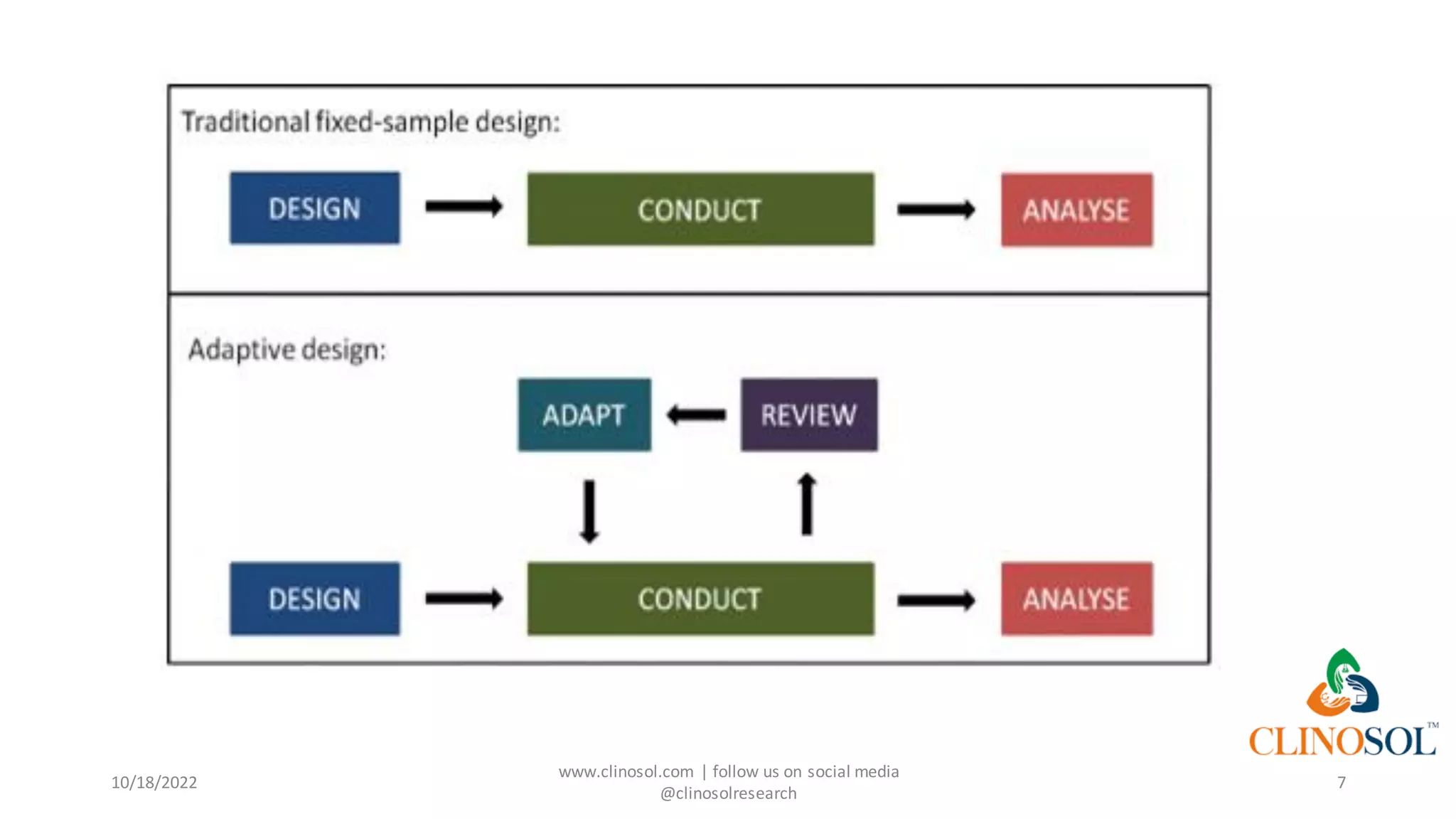
Adaptive design is defined as a clinical trial design that allows modifications to the trial or
statistical procedures after its initiation without undermining its validity and integrity.
Clinical trials will be more flexible, efficient, and fast.
These trials are also called as “flexible designs”
Advantages
➢ Increases the probability of success for your new therapy.
➢ Maximizes the information from the trial.
➢ Reduces overall development costs.
➢ Reduces the risk for study volunteers and sponsor.
➢ No protocol adjustment are required because any prospective modifications have already been
accepted by ethics and regulatory committees.
Disadvantage
➢ In adaptive trials, it is sometimes difficult to control the type 1 error even after applying
Bayesian statistical methods.
10/18/2022
www.clinosol.com | follow us on social media
@clinosolresearch
6
10/18/2022
www.clinosol.com | follow us on social media
@clinosolresearch
7
8
Types of adaptive designs
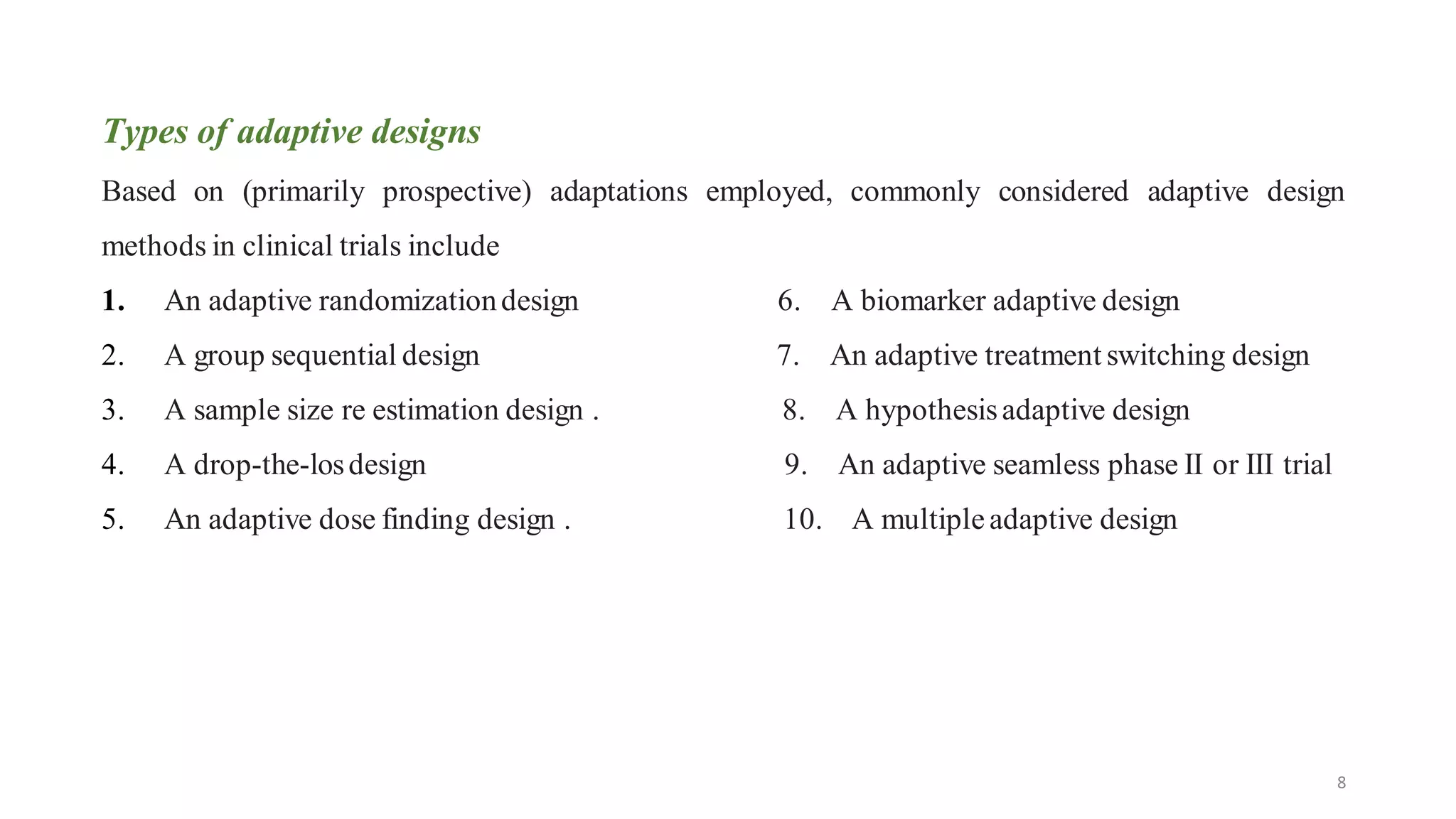
Based on (primarily prospective) adaptations employed, commonly considered adaptive design
methods in clinical trials include
1. An adaptive randomizationdesign 6. A biomarker adaptive design
2. A group sequential design 7. An adaptive treatment switching design
3. A sample size re estimation design . 8. A hypothesisadaptive design
4. A drop-the-losdesign 9. An adaptive seamless phase II or III trial
5. An adaptive dose finding design . 10. A multipleadaptive design
10/18/2022
www.clinosol.com | follow us on social media
@clinosolresearch
9
MASTER PROTOCOL
✓ A master protocol is a unifying study design that includes multiple subgroups and sub studies, with
patients having same or different diseases and they employ one or multiple drugs to treat it.
✓ Initially designed for oncology, master protocol trials are intended to simultaneously evaluate more
than one investigational drug or more than one disease type within the same overall trial structure.
✓ The ability to use a single infrastructure, trial design, and protocol to simultaneously evaluate multiple
drugs and / or disease populations in multiple sub studies speeds up drug development and makes it
more sufficient.
✓ Master protocol includes two types
1. Basket type
2. Umbrella type
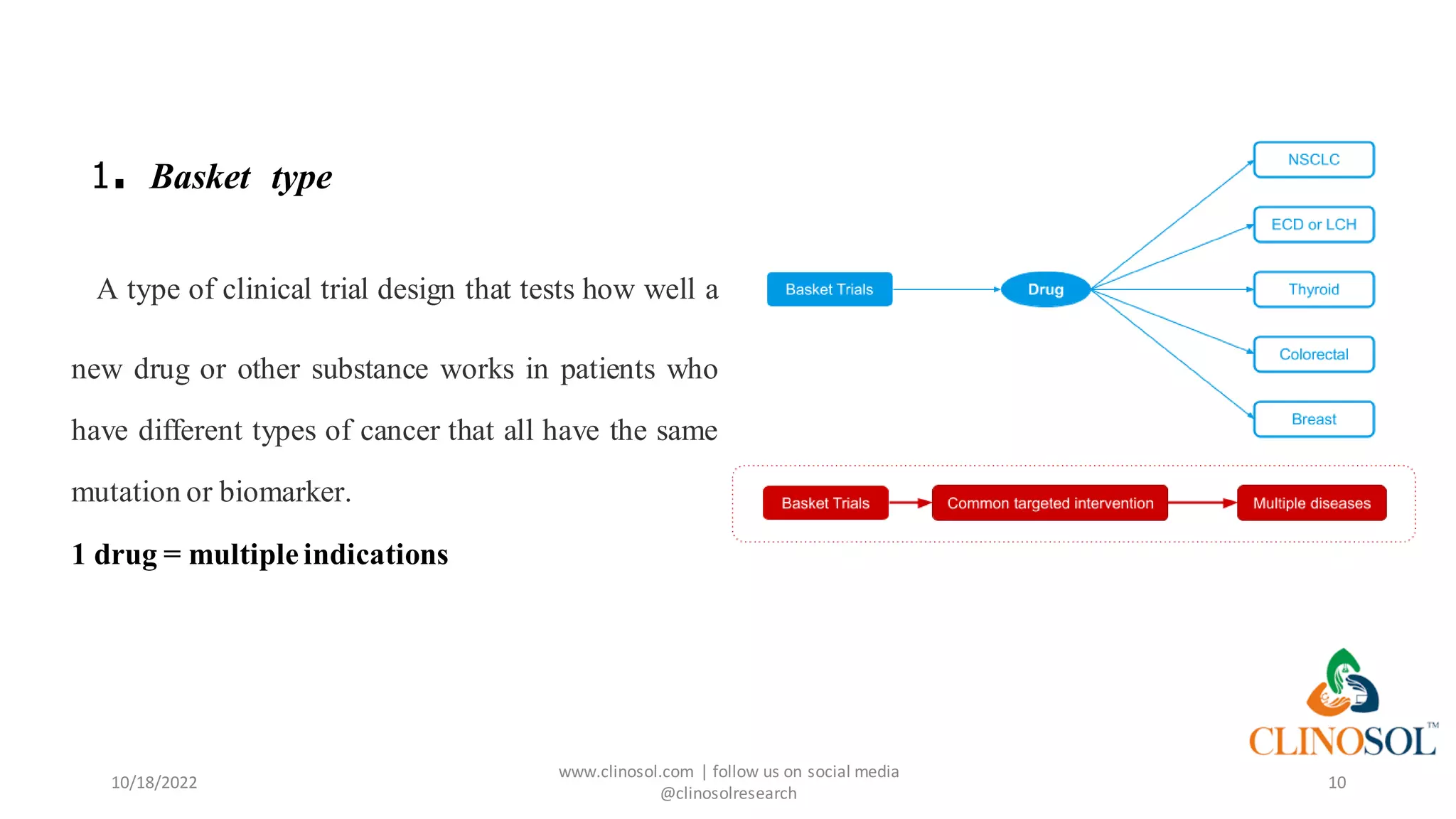
1. Basket type
A type of clinical trial design that tests how well a
new drug or other substance works in patients who
have different types of cancer that all have the same
mutation or biomarker.
1 drug = multiple indications
10/18/2022
www.clinosol.com | follow us on social media
@clinosolresearch
10
10/18/2022
www.clinosol.com | follow us on social media
@clinosolresearch
11
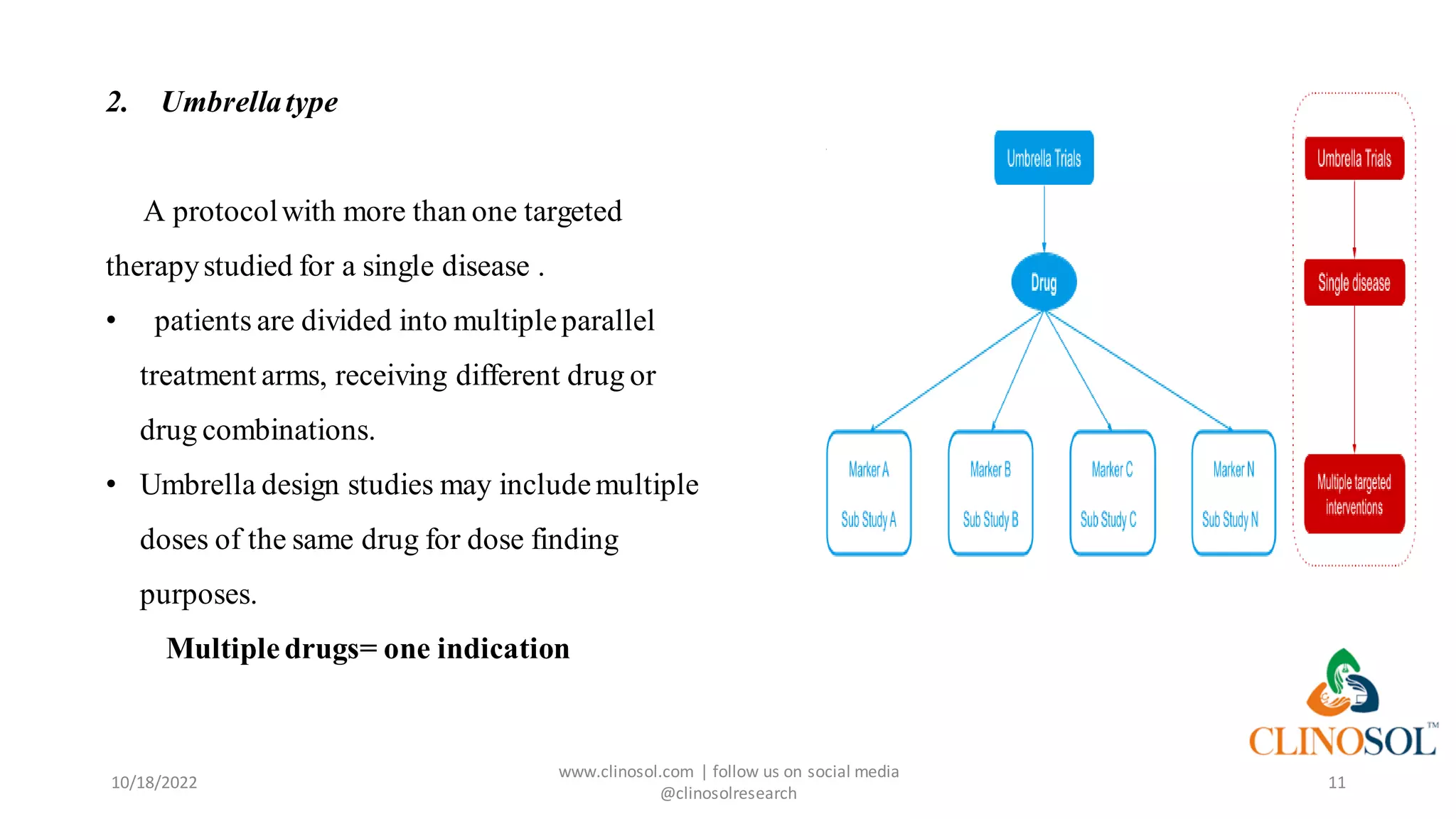
2. Umbrellatype
A protocolwith more than one targeted
therapystudied for a single disease .
• patients are divided into multipleparallel
treatment arms, receiving different drug or
drug combinations.
• Umbrella design studies may includemultiple
doses of the same drug for dose finding
purposes.
Multipledrugs= one indication
Platform Trials
Platform trials referred to as Multi-Arm, Multi-Stage (MAMS) design trials evaluate several
interventions against a common control group and can be perpetual. These designs help to further accept
additionsor exclusions of new therapies or patient populationsduring the clinical trial.
• The platform design where multiple investigational products are tested across multiple indications will
inherit the complexity of both umbrella and basket designs
• In a platform trial, interim analyses evaluate the efficacy or futility of each targeted therapy and use
their results to add new ones or exclude certain targeted therapies.
• The approach is efficient because platform trials allow for concurrentor sequential
evaluationsof multipletreatments.
10/18/2022
www.clinosol.com | follow us on social media
@clinosolresearch
12
10/18/2022
www.clinosol.com | follow us on social media
@clinosolresearch
13
Advantages
• Platform trials permit relatively flexible addition or exclusion of treatment methods or
patient populations, enablingan efficient transition to a confirmatory clinical trial.
• Do not require a new trial infrastructure for every treatment under investigation, and It
allows the sharing control group means require less recruitment of patients.
Drawbacks
• Challenges of the platform trial include its large-scale, long-term nature, high costs of
managing and executing the trial and
• Needs to build organizations or frameworks that can operate these trials perpetually.
10/18/2022
www.clinosol.com | follow us on social media
@clinosolresearch
14
CONCLUSION:
• Drug development is transforming with innovation in clinical trial design.
• In recent years, adaptive and enriched designs have seen a substantial increase in use.
• Using master protocols to investigate multiple treatments or diseases is rapidly increasing, as are
designs that augment or replace a controlarm with historical data.
• Clinical trials require more complex designs to increase efficiency and effectiveness while
maintaining high-qualitydata for regulatory decision-making.
• To provide unmet medical needs with new medicines, the acceptability of data from innovative
clinical trials is essential.
• In order to use novel clinical trial designs effectively, all stakeholdersneed to align.
15
REFERENCES
1. Sessler DI, Myles PS. Novel clinical trial designs to improve the efficiency of research.
Anesthesiology. 2020 Jan;132(1):69-81.
2. Antonijevic Z, Beckman RA, editors. Platform trial designs in drug development: umbrella trials and
basket trials. CRC Press; 2018 Dec 7.
3. Pallmann P, Bedding AW, Choodari-Oskooei B, Dimairo M, Flight L, Hampson LV, Holmes J,
Mander AP, Odondi LO, Sydes MR, Villar SS. Adaptive designs in clinical trials: why use them,
and how to run and report them. BMC medicine. 2018 Dec;16(1):1-5.
4. Chow SC, Chang M. Adaptive design methods in clinical trials- a review .Orphanet journal of rare
diseases. 2008 Dec; 3 (1:1-3.
5. Mahajan R, Gupta k. Adaptive design clinical trials: methodology, challenges and
prospect. Indian journal of pharmacology. 2010 Aug; 42 (4):201
10/18/2022
www.clinosol.com | follow us on social media
@clinosolresearch
Thank You!
www.clinosol.com
(India | Canada)
9121151622/623/624
info@clinosol.com
10/18/2022
www.clinosol.com | follow us on social media
@clinosolresearch
16

Advances in Clincal Trial Design- Adaptive and Platform Trials

  • 1.
    Welcome ADVANCES IN CLINICALTRAIL DESIGN ; ADAPTIVE AND PLATFORM TRIALS S. REDDEMMA PHARM.D 082/052023 10/18/2022 www.clinosol.com | follow us on social media @clinosolresearch 1
  • 2.
    introduction objectives ADVANCED CLINICAL TRIALsdesigns ADAPTIVE Designs MASTER PROTOCOL Platform trials conclusion references 10/18/2022 www.clinosol.com | follow us on social media @clinosolresearch 2 contents
  • 3.
    INTRODUCTION Clinical Trial A clinicaltrial is a type of clinical research study. Clinical trials are done to determine whether new drugs or treatments are safe and effective. Clinical Trial Design • Clinical study design is the formulation of trials and experiments, as well as observational studies in medical, clinical and other types of research involving human subjects. • Clinical trial design is an important aspect of interventional trials that serves to optimize, ergonomize and economize the clinical trial conduct. • The importance of study design is to assess the safety, efficacy, and the mechanism of action of an investigational medicinal product or procedure or new drug or device that is in development not yet approved by a health authority 10/18/2022 www.clinosol.com | follow us on social media @clinosolresearch 3
  • 4.
    objectives ❖ Choosing theright design is essential for any clinical trial, and before choosing a study design, one must establish the aims and objectives of the study and select an appropriate target population that is most representative of the real-world population. These avoid unnecessary expenses, time delays and improves the chances of approvals. ❖ The objective of clinical trials is to establish the effect of an intervention. Treatment effects are efficiently isolated by controllingfor bias and confoundingand by minimizing variation. ❖ Reduce or eliminate bias. ❖ Provide a high degree of credibility, reproducibility, and external validity. ❖ Quantify and reduce errors due to chance ❖ Influence future clinical practice 10/18/2022 www.clinosol.com | follow us on social media @clinosolresearch 4
  • 5.
    ADVANCED CLINICAL TRIALDESIGNS In contrast to traditional trial designs, which tests a single drug in a single disease population in one clinical trial, in contrast to traditional trial designs, the master protocols use single infrastructure, trial design, and protocol to simultaneously evaluate multiple drugs or multiple populationsin multiplesub studies which allows efficient and accelerateddrug development. Novel clinical trial designs are AdaptiveDesign Master Protocol : MP includes two types Basket type Umbrella type PlatformTrials 10/18/2022 www.clinosol.com | follow us on social media @clinosolresearch 5
  • 6.
    Adaptive design Adaptive designis defined as a clinical trial design that allows modifications to the trial or statistical procedures after its initiation without undermining its validity and integrity. Clinical trials will be more flexible, efficient, and fast. These trials are also called as “flexible designs” Advantages ➢ Increases the probability of success for your new therapy. ➢ Maximizes the information from the trial. ➢ Reduces overall development costs. ➢ Reduces the risk for study volunteers and sponsor. ➢ No protocol adjustment are required because any prospective modifications have already been accepted by ethics and regulatory committees. Disadvantage ➢ In adaptive trials, it is sometimes difficult to control the type 1 error even after applying Bayesian statistical methods. 10/18/2022 www.clinosol.com | follow us on social media @clinosolresearch 6
  • 7.
    10/18/2022 www.clinosol.com | followus on social media @clinosolresearch 7
  • 8.
    8 Types of adaptivedesigns Based on (primarily prospective) adaptations employed, commonly considered adaptive design methods in clinical trials include 1. An adaptive randomizationdesign 6. A biomarker adaptive design 2. A group sequential design 7. An adaptive treatment switching design 3. A sample size re estimation design . 8. A hypothesisadaptive design 4. A drop-the-losdesign 9. An adaptive seamless phase II or III trial 5. An adaptive dose finding design . 10. A multipleadaptive design
  • 9.
    10/18/2022 www.clinosol.com | followus on social media @clinosolresearch 9 MASTER PROTOCOL ✓ A master protocol is a unifying study design that includes multiple subgroups and sub studies, with patients having same or different diseases and they employ one or multiple drugs to treat it. ✓ Initially designed for oncology, master protocol trials are intended to simultaneously evaluate more than one investigational drug or more than one disease type within the same overall trial structure. ✓ The ability to use a single infrastructure, trial design, and protocol to simultaneously evaluate multiple drugs and / or disease populations in multiple sub studies speeds up drug development and makes it more sufficient. ✓ Master protocol includes two types 1. Basket type 2. Umbrella type
  • 10.
    1. Basket type Atype of clinical trial design that tests how well a new drug or other substance works in patients who have different types of cancer that all have the same mutation or biomarker. 1 drug = multiple indications 10/18/2022 www.clinosol.com | follow us on social media @clinosolresearch 10
  • 11.
    10/18/2022 www.clinosol.com | followus on social media @clinosolresearch 11 2. Umbrellatype A protocolwith more than one targeted therapystudied for a single disease . • patients are divided into multipleparallel treatment arms, receiving different drug or drug combinations. • Umbrella design studies may includemultiple doses of the same drug for dose finding purposes. Multipledrugs= one indication
  • 12.
    Platform Trials Platform trialsreferred to as Multi-Arm, Multi-Stage (MAMS) design trials evaluate several interventions against a common control group and can be perpetual. These designs help to further accept additionsor exclusions of new therapies or patient populationsduring the clinical trial. • The platform design where multiple investigational products are tested across multiple indications will inherit the complexity of both umbrella and basket designs • In a platform trial, interim analyses evaluate the efficacy or futility of each targeted therapy and use their results to add new ones or exclude certain targeted therapies. • The approach is efficient because platform trials allow for concurrentor sequential evaluationsof multipletreatments. 10/18/2022 www.clinosol.com | follow us on social media @clinosolresearch 12
  • 13.
    10/18/2022 www.clinosol.com | followus on social media @clinosolresearch 13 Advantages • Platform trials permit relatively flexible addition or exclusion of treatment methods or patient populations, enablingan efficient transition to a confirmatory clinical trial. • Do not require a new trial infrastructure for every treatment under investigation, and It allows the sharing control group means require less recruitment of patients. Drawbacks • Challenges of the platform trial include its large-scale, long-term nature, high costs of managing and executing the trial and • Needs to build organizations or frameworks that can operate these trials perpetually.
  • 14.
    10/18/2022 www.clinosol.com | followus on social media @clinosolresearch 14 CONCLUSION: • Drug development is transforming with innovation in clinical trial design. • In recent years, adaptive and enriched designs have seen a substantial increase in use. • Using master protocols to investigate multiple treatments or diseases is rapidly increasing, as are designs that augment or replace a controlarm with historical data. • Clinical trials require more complex designs to increase efficiency and effectiveness while maintaining high-qualitydata for regulatory decision-making. • To provide unmet medical needs with new medicines, the acceptability of data from innovative clinical trials is essential. • In order to use novel clinical trial designs effectively, all stakeholdersneed to align.
  • 15.
    15 REFERENCES 1. Sessler DI,Myles PS. Novel clinical trial designs to improve the efficiency of research. Anesthesiology. 2020 Jan;132(1):69-81. 2. Antonijevic Z, Beckman RA, editors. Platform trial designs in drug development: umbrella trials and basket trials. CRC Press; 2018 Dec 7. 3. Pallmann P, Bedding AW, Choodari-Oskooei B, Dimairo M, Flight L, Hampson LV, Holmes J, Mander AP, Odondi LO, Sydes MR, Villar SS. Adaptive designs in clinical trials: why use them, and how to run and report them. BMC medicine. 2018 Dec;16(1):1-5. 4. Chow SC, Chang M. Adaptive design methods in clinical trials- a review .Orphanet journal of rare diseases. 2008 Dec; 3 (1:1-3. 5. Mahajan R, Gupta k. Adaptive design clinical trials: methodology, challenges and prospect. Indian journal of pharmacology. 2010 Aug; 42 (4):201 10/18/2022 www.clinosol.com | follow us on social media @clinosolresearch
  • 16.
    Thank You! www.clinosol.com (India |Canada) 9121151622/623/624 info@clinosol.com 10/18/2022 www.clinosol.com | follow us on social media @clinosolresearch 16