Data base Creation in Clinical Trials: The AI Advantage
1.
Welcome
Database Creation inClinical trials: The AI Advantage
01/01/2025
www.clinosol.com | follow us on social media
@clinosolresearch
1
P. Vamshika
B Tech biotechnology
May 2025 clinosol batch
2.
Index
Introduction
Overview of ClinicalTrial Databases
Challenges in Traditional Database Creation
Role of AI in Clinical Data Management
AI-Powered Tools in Database Design
Case Studies: AI Integration in Clinical Trials
Advantages of AI in Database Creation
Limitations and Ethical Considerations
Future Trends and Innovations
Conclusion
References
01/01/2025
www.clinosol.com | follow us on social media
@clinosolresearch
2
3.
Introduction
11/06/25
www.clinosol.com | followus on social media
@clinosolresearch
3
✅ Purpose of Clinical Trial Databases
They support the meticulous documentation of treatment outcomes and
patient safety. They are employed by researchers to monitor all aspects of
the trial, including medication, test results, and patient visits. Data is kept
clean by the system and prepared for regulatory checks or audits. Data
analysis is also supported for reports, approvals, and upcoming studies.
📌 Why Accurate Data Collection Matters
Researchers and physicians can make better decisions for patients when they have access to high
quality data. It guarantees that the trial complies with regulations and stays clear of problems.
There are fewer errors in accurate records that could influence the outcome of a trial.
Reliable data increases the trial's credibility with sponsors and regulators.
By lowering mistakes, rework, and delays, it also saves time.
4.
🌐 Digital Changein Healthcare
01/01/2025 www.clinosol.com | follow us on social media @clinosolresearch 4
In order to handle data more quickly and easily, trials have shifted from paper to digital
systems.
These digital systems handle real-time patient data collection by devices including health
apps. AI assists in identifying mistakes and directing the conduct of experiments.
Cloud systems also facilitate seamless collaboration between geographically dispersed
teams.
As a result, trials are now quicker, more effective, and simpler for patients to participate in.
5.
📋 Overview ofClinical Trial Databases
All of the important data from a trial, including patient information,
test results, appointment dates, and any side effects, are kept in
clinical trial databases.
Electronic Case Report Forms, or eCRFs, are digital forms used to
enter this data. The database must follow official rules and
guidelines to make sure the data is accurate, secure, and approved
for use (like ICH-GCP and 21 CFR Part 11).
From setup and tracking to data analysis and final reporting, it is
essential to every phase of a trial.
01/01/2025
www.clinosol.com | follow us on social media
@clinosolresearch
5
6.
Challenges in TraditionalDatabase Creation
01/01/2025
www.clinosol.com | follow us on social media
@clinosolresearch
6
⚠️Challenges include :
Making digital forms (eCRFs) by hand is time-consuming and prone to errors.
It can be challenging to maintain consistency when data is entered differently at different trial sites.
Because the system isn't automated, it takes longer to identify and correct data issues.
.
Costs are higher and more employees are required to oversee the process when things are done by hand.
Without integrated tracking tools, it is also more difficult to maintain accurate records and adhere to legal
requirements.
7.
Role of AIin Clinical
Data Management
🤖 Understanding AI in Clinical Trial Databases
• Giving a computer the capacity to think and act
intelligently—much like humans do when they solve
problems—is known as artificial intelligence (AI). AI
assists in clinical trials by automating repetitive
processes that would typically take a lot of time if
completed by humans, such as organizing information,
cleaning up messy data, and creating data entry forms.
• Machine Learning (ML), a component of artificial
intelligence, enables the system to learn from historical
data and gradually increase its accuracy. Therefore, the
more data it uses, the more intelligent and effective it
gets.
• Natural Language Processing (NLP) is another aspect of
AI that assists the system in reading and comprehending
complex trial documents or protocols. It then uses this
knowledge to automatically set up forms and data fields.
01/01/2025 www.clinosol.com | follow us on social media @clinosolresearch 7
8.
⚙️AI-Powered Tools inDatabase Design
01/01/2025
www.clinosol.com | follow us on social media
@clinosolresearch
8
By simply reading the written plan for the trial, AI tools can now generate digital forms (CRFs)
automatically. Natural Language Processing (NLP), a clever technology that aids computers in
comprehending human language, is used for this.
Additionally, by precisely matching data fields and patient visit schedules, these tools reduce errors
and manual setup
Because AI can identify anomalous or inaccurate data in real time, issues are identified and resolved
sooner rather than later, saving time.
By learning from historical data, it can even identify and categorize things like adverse effects or
medical conditions, which speeds up and improves the consistency of data entry..
To make trials more efficient and intelligent, popular tools that use these features include Medidata,
Saama, IBM Watson for Clinical Trials, and Deep 6 AI.
9.
📊 Case Studies:AI Integration
Example 1: Pfizer or Roche, two major pharmaceutical companies
• AI is being used by Pfizer, Roche, and other companies to automate trial
data management.AI enables them to track patient data, clean it, and
identify errors more quickly than they could with manual methods.
• Better decision-making during the studies and speedier trial procedures
have resulted from this.
Example 2: Astute Startups (Medidata, Saama)
• AI tools specifically designed for clinical trials have been developed by
startups such as Medidata and Saama.
• Their systems are able to organize data, generate digital forms, and detect
errors instantly.
• Many sponsors and CROs are using these tools to streamline and
improve data management.
01/01/2025 www.clinosol.com | follow us on social media @clinosolresearch 9
10.
🌟 Advantages ofAI in Clinical Trial Database Creation
01/01/2025
www.clinosol.com | follow us on social media
@clinosolresearch
10
Improved data quality: It
keeps information accurate,
clean, and compliant with
regulations..
Less manual labor: A lot
of monotonous jobs are
now automated, which
reduces expenses and
human error..
Smart insights in real
time: AI can show useful
patterns and alerts as data
comes in, helping teams
make quicker decisions.
Supports adaptable trial
techniques: AI facilitates
risk-based monitoring and
allows trial plans to be
modified in response to
incoming data.
Faster trial setup: AI
speeds up the
process of building
the database, so
trials can start
sooner.
11.
⚠️
Limitations & EthicalConsiderations of using AI
Privacy issues: AI can be
risky if not used carefully,
and patient data must be
safeguarded.
Bias in results: The AI
may produce inaccurate or
biased results if it is trained
on unfair or unbalanced
data.
Hard to understand: Even
experts may not fully
comprehend the workings
of some sophisticated AI
models, which are like
"black boxes."
Trust issues: Without
evidence of accuracy,
regulators may be wary or
less inclined to accept data
derived from AI.
Clear proof is required: In
order to be trusted in
clinical trials, AI systems
must be transparent,
tested, and thoroughly
documented.
01/01/2025
www.clinosol.com | follow us on social media
@clinosolresearch
11
12.
🔮 Future Trendsin
AI for Clinical Trials
• By automatically converting protocols into databases,
generative AI will save time and minimize errors.
• AI will assist in developing more intelligent, flexible trial
designs that can alter in real time in response to new data.Trial
systems will readily integrate data from wearables and real-
world sources (such as medical records or health apps).
• To safely permit and oversee the application of AI in clinical
research, new regulations and policies will be created.
• Clinical research associates (CRAs) will benefit from AI "co-
pilots" that will manage repetitive tasks and provide guidance
throughout the trial process.
01/01/2025 www.clinosol.com | follow us on social media @clinosolresearch 12
13.
🧩 Conclusion
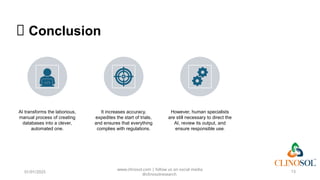
AI transformsthe laborious,
manual process of creating
databases into a clever,
automated one.
It increases accuracy,
expedites the start of trials,
and ensures that everything
complies with regulations.
However, human specialists
are still necessary to direct the
AI, review its output, and
ensure responsible use.
01/01/2025
www.clinosol.com | follow us on social media
@clinosolresearch
13
14.
References
01/01/2025
www.clinosol.com | followus on social media
@clinosolresearch
14
• Artificial intelligence based clinical data management systems: A review
2017, pages 219-229 gazali
• Artificial intelligence in clinical data management: a review of current application and future directions noorush shifa
nizami1* , sameena anjum2
• The role of ai in hospitals and clinics: transforming healthcare in the 21st century
By shiva maleki varnosfaderani and mohamad forouzanfar