Adaptive Study
Designs
Dr. Anirudha Potey
1
Background
2
Defining adaptive study
design
Guidance for Industry: Adaptive Design Clinical
Trials for Drugs and Biologics
‘a study that includes a prospectively planned
opportunity for modification of one or more
specified aspects of the study design and
hypotheses based on analysis of data (usually
interim data) from subjects in the study ’
3
without undermining the validity and integrity of
the trial
Is Adaptive Study Design a
Modern Phenomenon?
4
Not Adaptive Study Design
Revisions based on the data
• Obtained external of the current trial
• After unblinding data and not pre-planned
5
Types of adaptations
• Prospective
• Concurrent
• Retrospective
6
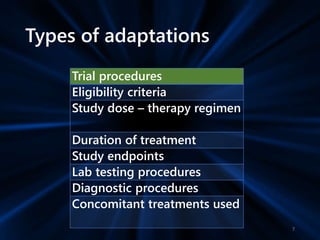
Types of adaptations
Trial procedures
Eligibility criteria
Study dose – therapy regimen
Duration of treatment
Study endpoints
Lab testing procedures
Diagnostic procedures
Concomitant treatments used
7
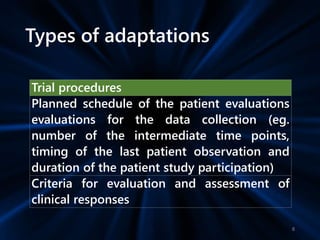
Types of adaptations
Trial procedures
Planned schedule of the patient evaluations
evaluations for the data collection (eg.
number of the intermediate time points,
timing of the last patient observation and
duration of the patient study participation)
Criteria for evaluation and assessment of
clinical responses
8
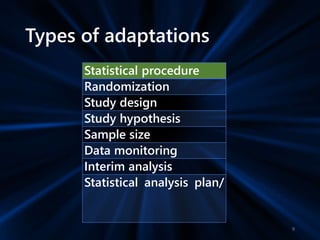
Types of adaptations
9
Statistical procedure
Randomization
Study design
Study hypothesis
Sample size
Data monitoring
Interim analysis
Statistical analysis plan/
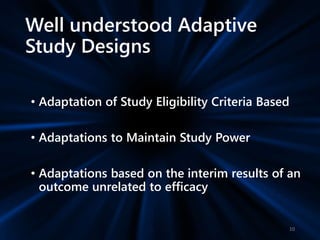
Well understood Adaptive
Study Designs
• Adaptation of Study Eligibility Criteria Based
• Adaptations to Maintain Study Power
• Adaptations based on the interim results of an
outcome unrelated to efficacy
10
Well understood Adaptive
Study Designs
• Adaptations Using Group Sequential Methods
and unblinded Analyses
• Adaptations based on the Data Analysis Plan
• Adaptation for the primary endpoint
11
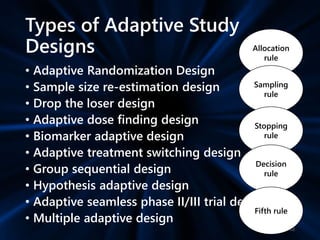
Types of Adaptive Study
Designs
• Adaptive Randomization Design
• Sample size re-estimation design
• Drop the loser design
• Adaptive dose finding design
• Biomarker adaptive design
• Adaptive treatment switching design
• Group sequential design
• Hypothesis adaptive design
• Adaptive seamless phase II/III trial design
• Multiple adaptive design
12
Allocation
rule
Sampling
rule
Stopping
rule
Decision
rule
Fifth rule
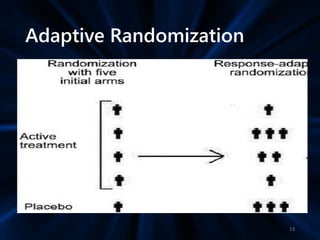
Adaptive Randomization
13
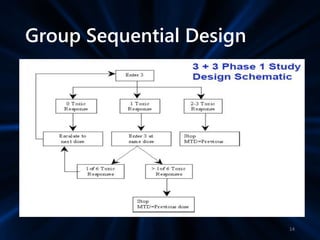
Group Sequential Design
14
Group Sequential Design
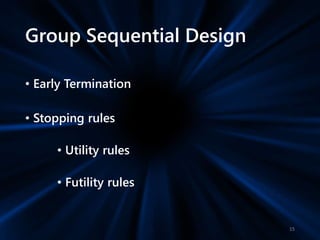
• Early Termination
• Stopping rules
• Utility rules
• Futility rules
15
Sample size re-estimation
16
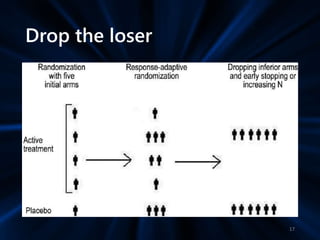
Drop the loser
17
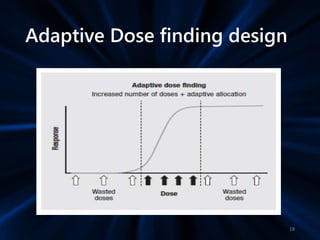
Adaptive Dose finding design
18
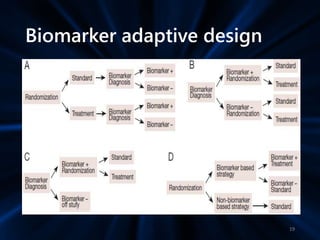
Biomarker adaptive design
19
Adaptive treatment switching
design
20
Hypothesis adaptive design
21
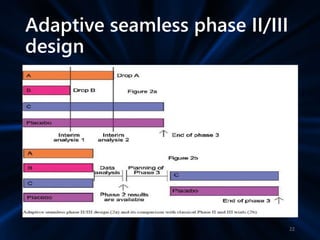
Adaptive seamless phase II/III
design
22
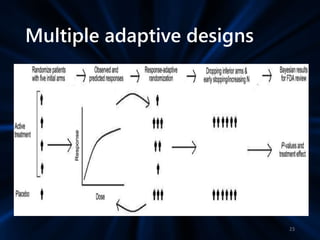
Multiple adaptive designs
23
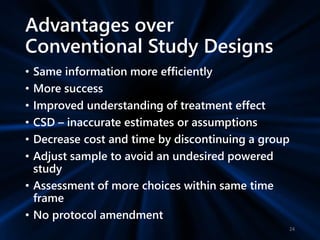
Advantages over
Conventional Study Designs
• Same information more efficiently
• More success
• Improved understanding of treatment effect
• CSD – inaccurate estimates or assumptions
• Decrease cost and time by discontinuing a group
• Adjust sample to avoid an undesired powered
study
• Assessment of more choices within same time
frame
• No protocol amendment
24
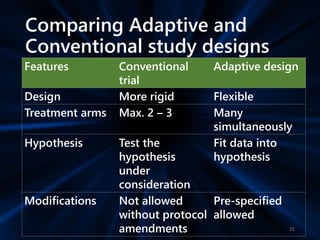
Comparing Adaptive and
Conventional study designs
Features Conventional
trial
Adaptive design
Design More rigid Flexible
Treatment arms Max. 2 – 3 Many
simultaneously
Hypothesis Test the
hypothesis
under
consideration
Fit data into
hypothesis
Modifications Not allowed
without protocol
amendments
Pre-specified
allowed
25
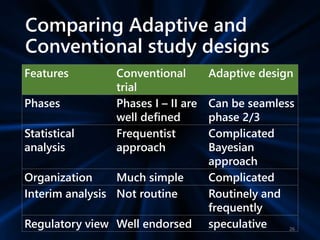
Comparing Adaptive and
Conventional study designs
Features Conventional
trial
Adaptive design
Phases Phases I – II are
well defined
Can be seamless
phase 2/3
Statistical
analysis
Frequentist
approach
Complicated
Bayesian
approach
Organization Much simple Complicated
Interim analysis Not routine Routinely and
frequently
Regulatory view Well endorsed speculative 26
Concerns associated with
Adaptive study designs
• Increased type I error
• Difficult interpretation of results
• More planning and lead time
• Develop into a completely different trial
• Incorporation of a totally different population
• Bayesian statistics
• Computer based simulations
• Challenge to CROs and EC
27
Concerns associated with
Adaptive study designs
• Lack of definition by regulatory authorities
• Bayesian approach is compulsion – non
standard
• Damage to integrity
• Magnify bias with increase in sample size
28
Procedural issues
• Rapid electronic collection of data
• Efficient interaction b/w investigator and
sponsor
• Financial investments
• Computer based simulations with
infrastructure and software
• CRO & EC lack experience of monitoring
29
Regulatory perspective
• Acceptable level of adaptation?
• Regulatory standards for review and approval
process of clinical data?
• A completely new clinical trial post
modification?
• Increased interaction b/w FDA and sponsors
30
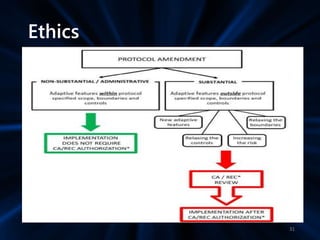
Ethics
31
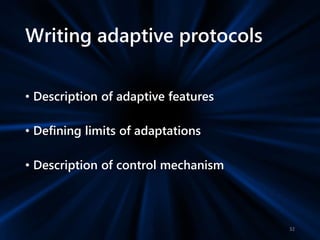
Writing adaptive protocols
• Description of adaptive features
• Defining limits of adaptations
• Description of control mechanism
32
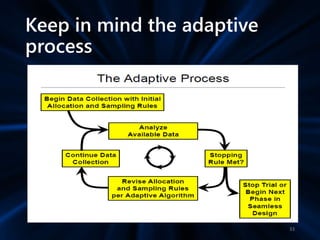
Keep in mind the adaptive
process
33
Conclusion
• Many advantages
• Infant stage – many areas are controversial
• Not an ad hoc measure for poor planning
• Strong promise for the future
• More guidelines and better understanding
• Complexities limit use
34
35

Adaptive Study Designs

  • 1.
  • 2.
  • 3.
    Defining adaptive study design Guidancefor Industry: Adaptive Design Clinical Trials for Drugs and Biologics ‘a study that includes a prospectively planned opportunity for modification of one or more specified aspects of the study design and hypotheses based on analysis of data (usually interim data) from subjects in the study ’ 3 without undermining the validity and integrity of the trial
  • 4.
    Is Adaptive StudyDesign a Modern Phenomenon? 4
  • 5.
    Not Adaptive StudyDesign Revisions based on the data • Obtained external of the current trial • After unblinding data and not pre-planned 5
  • 6.
    Types of adaptations •Prospective • Concurrent • Retrospective 6
  • 7.
    Types of adaptations Trialprocedures Eligibility criteria Study dose – therapy regimen Duration of treatment Study endpoints Lab testing procedures Diagnostic procedures Concomitant treatments used 7
  • 8.
    Types of adaptations Trialprocedures Planned schedule of the patient evaluations evaluations for the data collection (eg. number of the intermediate time points, timing of the last patient observation and duration of the patient study participation) Criteria for evaluation and assessment of clinical responses 8
  • 9.
    Types of adaptations 9 Statisticalprocedure Randomization Study design Study hypothesis Sample size Data monitoring Interim analysis Statistical analysis plan/
  • 10.
    Well understood Adaptive StudyDesigns • Adaptation of Study Eligibility Criteria Based • Adaptations to Maintain Study Power • Adaptations based on the interim results of an outcome unrelated to efficacy 10
  • 11.
    Well understood Adaptive StudyDesigns • Adaptations Using Group Sequential Methods and unblinded Analyses • Adaptations based on the Data Analysis Plan • Adaptation for the primary endpoint 11
  • 12.
    Types of AdaptiveStudy Designs • Adaptive Randomization Design • Sample size re-estimation design • Drop the loser design • Adaptive dose finding design • Biomarker adaptive design • Adaptive treatment switching design • Group sequential design • Hypothesis adaptive design • Adaptive seamless phase II/III trial design • Multiple adaptive design 12 Allocation rule Sampling rule Stopping rule Decision rule Fifth rule
  • 13.
  • 14.
  • 15.
    Group Sequential Design •Early Termination • Stopping rules • Utility rules • Futility rules 15
  • 16.
  • 17.
  • 18.
  • 19.
  • 20.
  • 21.
  • 22.
    Adaptive seamless phaseII/III design 22
  • 23.
  • 24.
    Advantages over Conventional StudyDesigns • Same information more efficiently • More success • Improved understanding of treatment effect • CSD – inaccurate estimates or assumptions • Decrease cost and time by discontinuing a group • Adjust sample to avoid an undesired powered study • Assessment of more choices within same time frame • No protocol amendment 24
  • 25.
    Comparing Adaptive and Conventionalstudy designs Features Conventional trial Adaptive design Design More rigid Flexible Treatment arms Max. 2 – 3 Many simultaneously Hypothesis Test the hypothesis under consideration Fit data into hypothesis Modifications Not allowed without protocol amendments Pre-specified allowed 25
  • 26.
    Comparing Adaptive and Conventionalstudy designs Features Conventional trial Adaptive design Phases Phases I – II are well defined Can be seamless phase 2/3 Statistical analysis Frequentist approach Complicated Bayesian approach Organization Much simple Complicated Interim analysis Not routine Routinely and frequently Regulatory view Well endorsed speculative 26
  • 27.
    Concerns associated with Adaptivestudy designs • Increased type I error • Difficult interpretation of results • More planning and lead time • Develop into a completely different trial • Incorporation of a totally different population • Bayesian statistics • Computer based simulations • Challenge to CROs and EC 27
  • 28.
    Concerns associated with Adaptivestudy designs • Lack of definition by regulatory authorities • Bayesian approach is compulsion – non standard • Damage to integrity • Magnify bias with increase in sample size 28
  • 29.
    Procedural issues • Rapidelectronic collection of data • Efficient interaction b/w investigator and sponsor • Financial investments • Computer based simulations with infrastructure and software • CRO & EC lack experience of monitoring 29
  • 30.
    Regulatory perspective • Acceptablelevel of adaptation? • Regulatory standards for review and approval process of clinical data? • A completely new clinical trial post modification? • Increased interaction b/w FDA and sponsors 30
  • 31.
  • 32.
    Writing adaptive protocols •Description of adaptive features • Defining limits of adaptations • Description of control mechanism 32
  • 33.
    Keep in mindthe adaptive process 33
  • 34.
    Conclusion • Many advantages •Infant stage – many areas are controversial • Not an ad hoc measure for poor planning • Strong promise for the future • More guidelines and better understanding • Complexities limit use 34
  • 35.

Editor's Notes

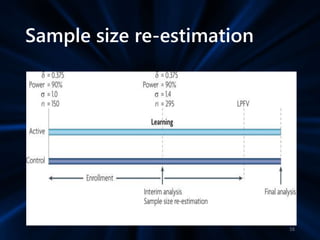
  • #17 The figure illustrates a hypothetical example of a study in which sample size re-estimation due to uncertainty about the standard deviation σ led to an increase in sample size to ensure 90% power was maintained. At the beginning of the trial, the planned sample size was estimated at 150 patients based on a standard deviation of 1.0. At the interim analysis, the actual standard deviation was 1.4. Even though the effect size (d) was as originally predicted, an increase in sample size to 295 patients would be required to maintain 90% power. Without the sample size re-estimation, the power at the final analysis would only be 64% and there would be much greater risk of a failed trial. LPFV, last patient first visit.