Vineetha Menon
5th Pharm.D
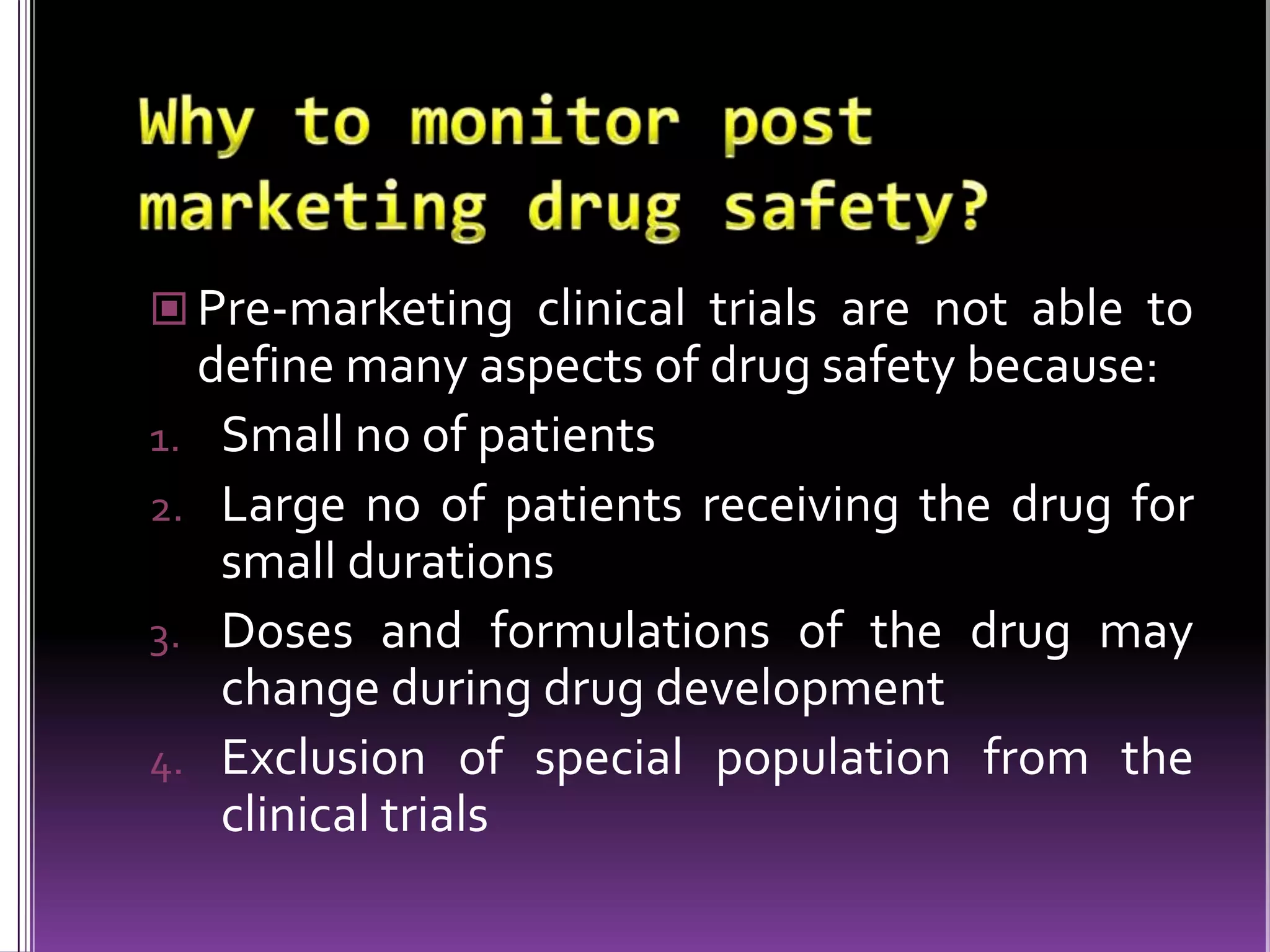
 Pre-marketing clinical trials are not able to

define many aspects of drug safety because:
1. Small no of patients
2. Large no of patients receiving the drug for
small durations
3. Doses and formulations of the drug may
change during drug development
4. Exclusion of special population from the
clinical trials
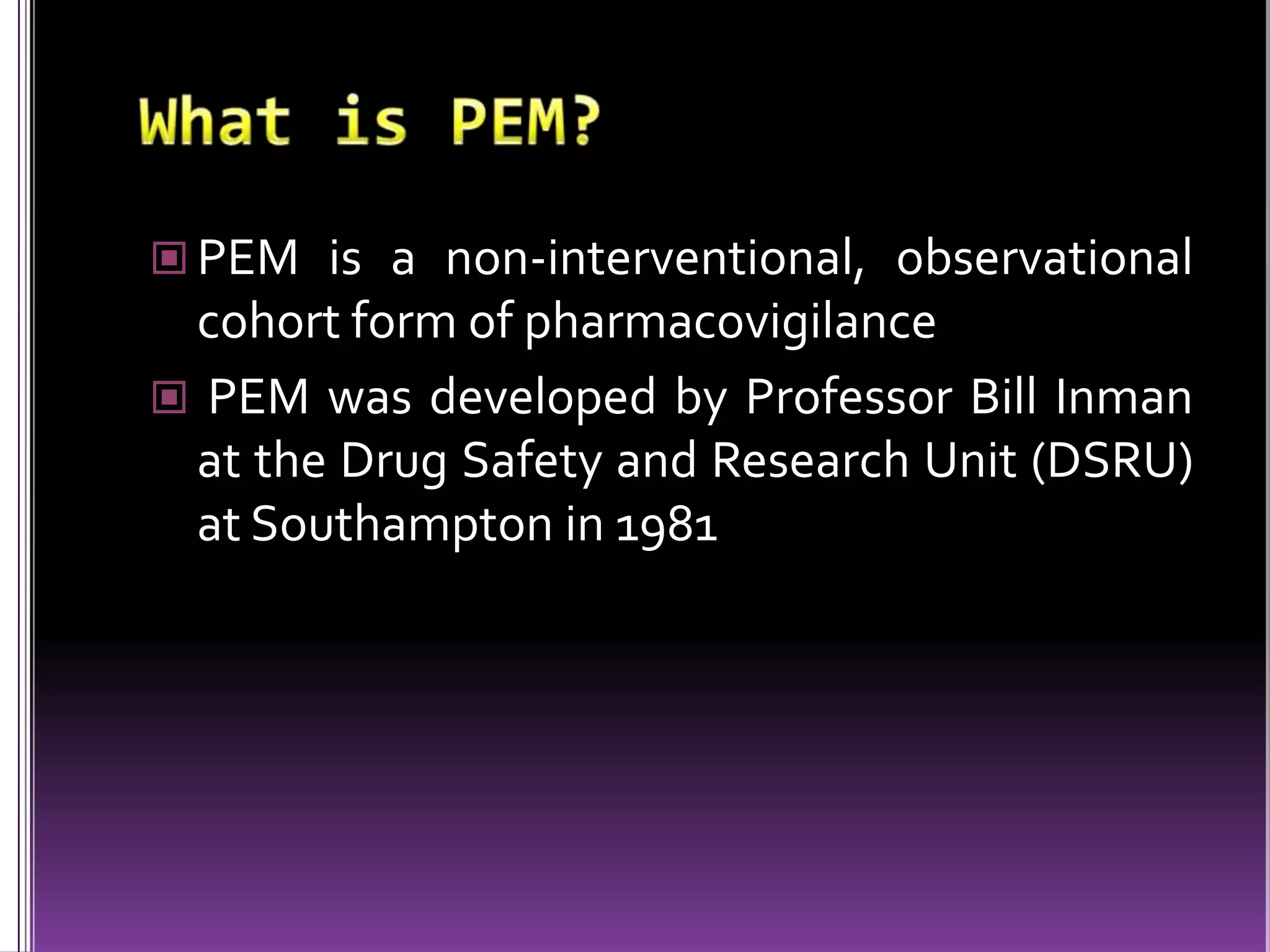
 PEM is a non-interventional, observational

cohort form of pharmacovigilance
 PEM was developed by Professor Bill Inman
at the Drug Safety and Research Unit (DSRU)
at Southampton in 1981
 In UK, all the patients are registered with

NHS-GP
provides the primary care
and act as a gateway to specialist and
hospital care
 File notes in general practice contains
information about primary care, secondary
and tertiary care (life long record)
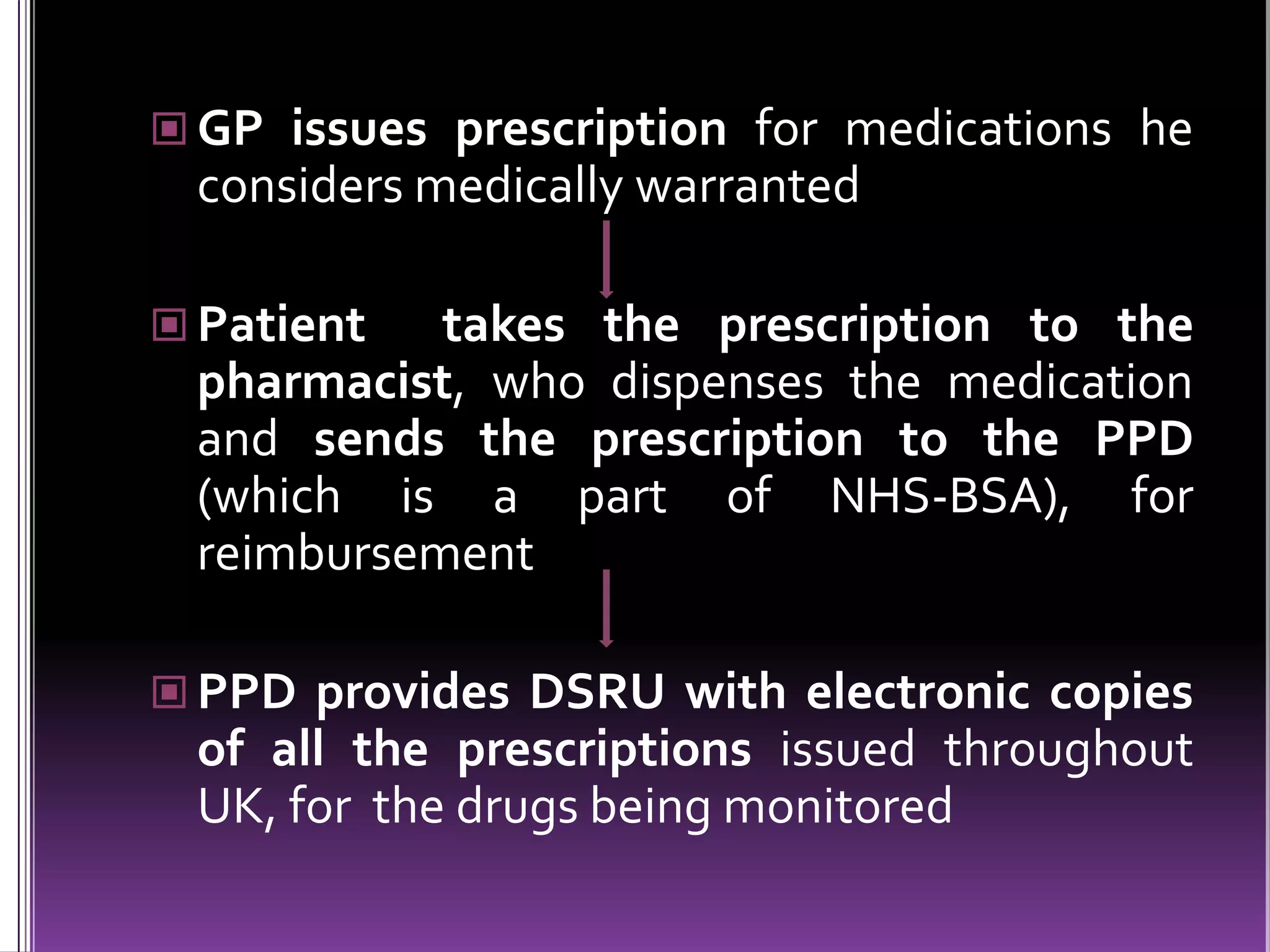
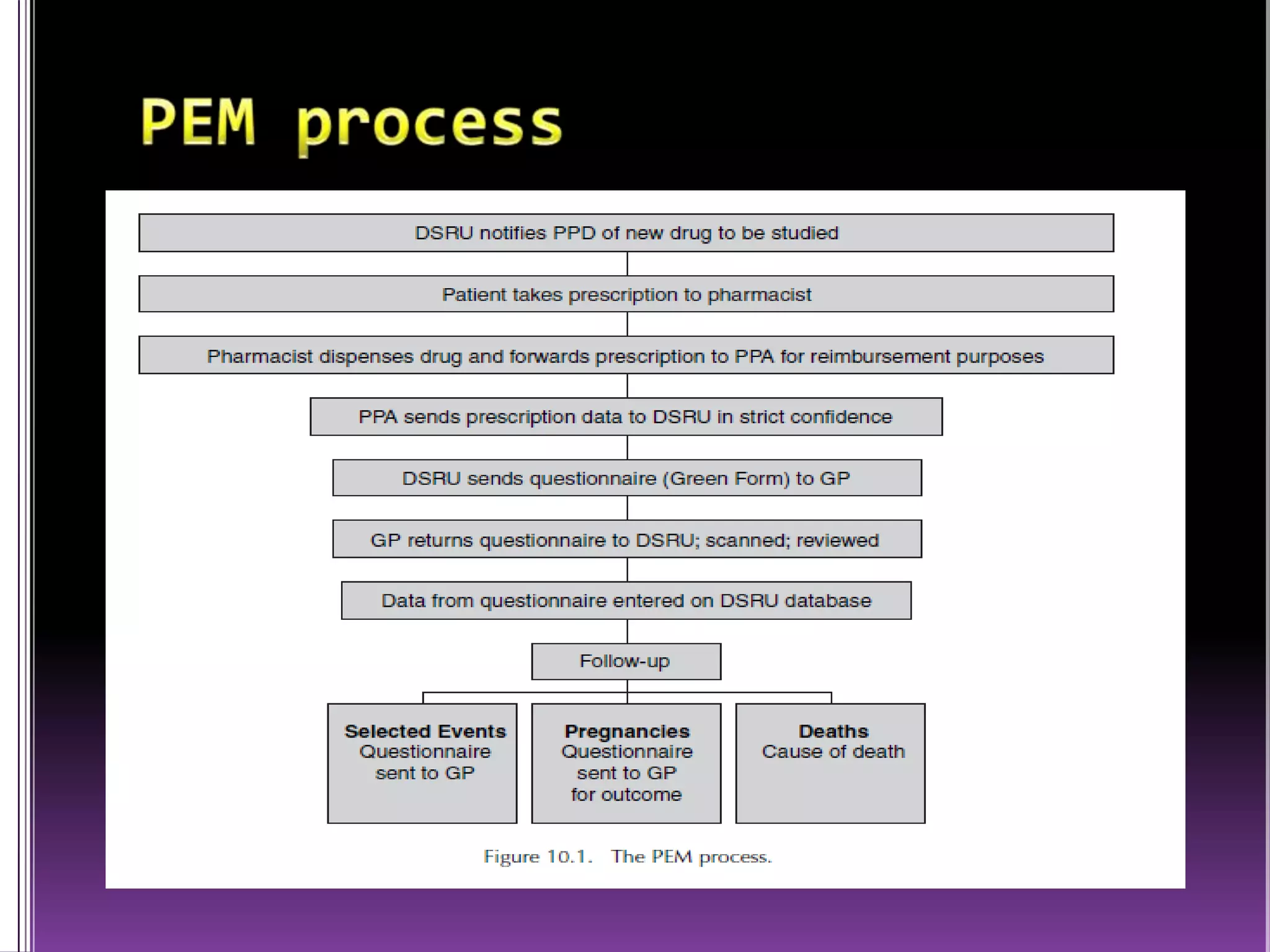
 GP issues prescription for medications he

considers medically warranted
 Patient

takes the prescription to the
pharmacist, who dispenses the medication
and sends the prescription to the PPD
(which is a part of NHS-BSA), for
reimbursement

 PPD provides DSRU with electronic copies

of all the prescriptions issued throughout
UK, for the drugs being monitored
 Products that are selected for study by PEM
1. New drugs, expected to be used widely
2. Established

products, used
indication/ new population

for

new

 Collection of exposure data begins soon

after the new product is launched
 These arrangements operate for a length of
time necessary for the DSRU to collect first
50,000 prescriptions, that identify 20,00030,000 patients given the new drug being
monitored
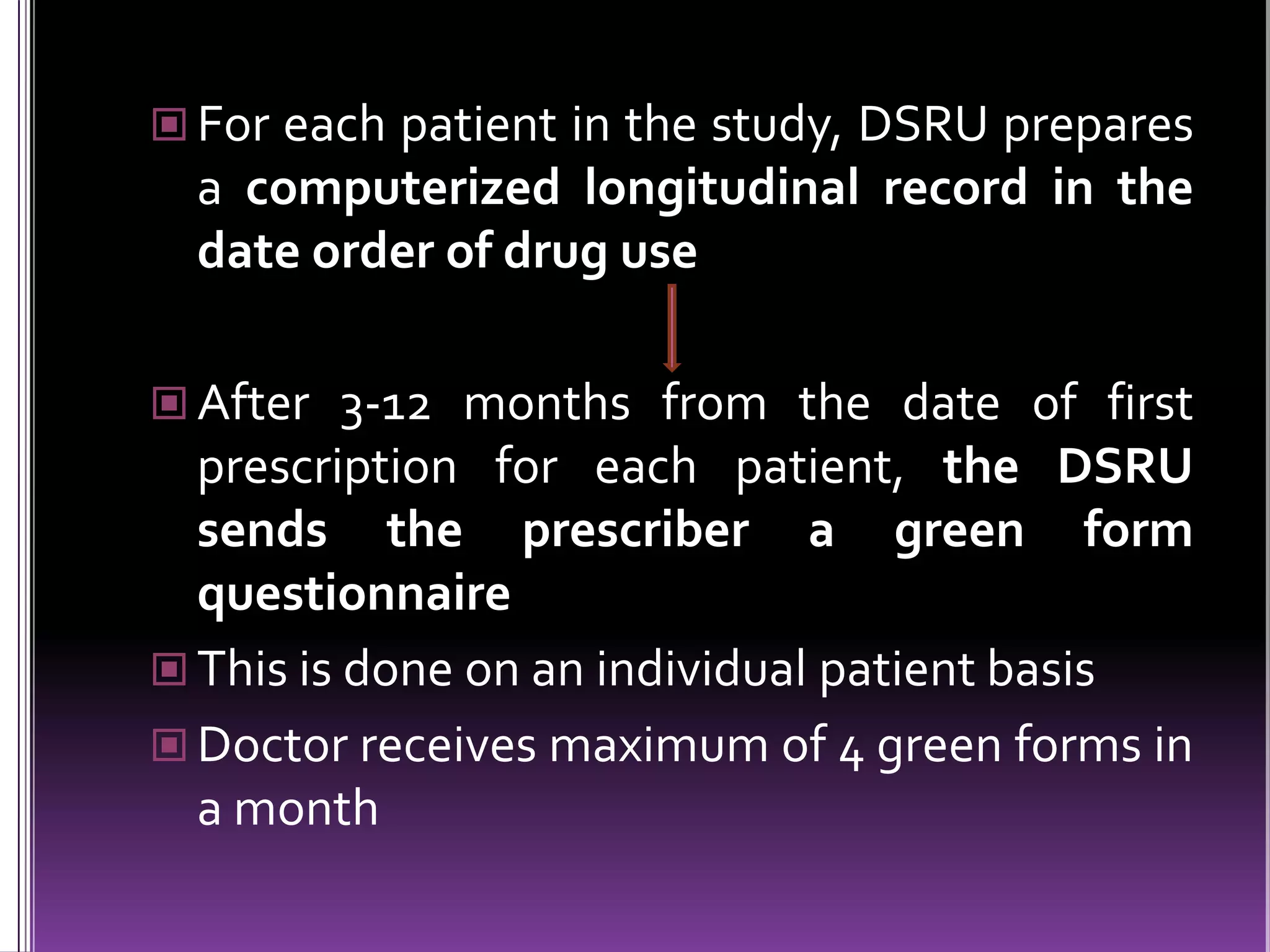
 For each patient in the study, DSRU prepares

a computerized longitudinal record in the
date order of drug use
 After 3-12 months from the date of first

prescription for each patient, the DSRU
sends the prescriber a green form
questionnaire
 This is done on an individual patient basis
 Doctor receives maximum of 4 green forms in
a month
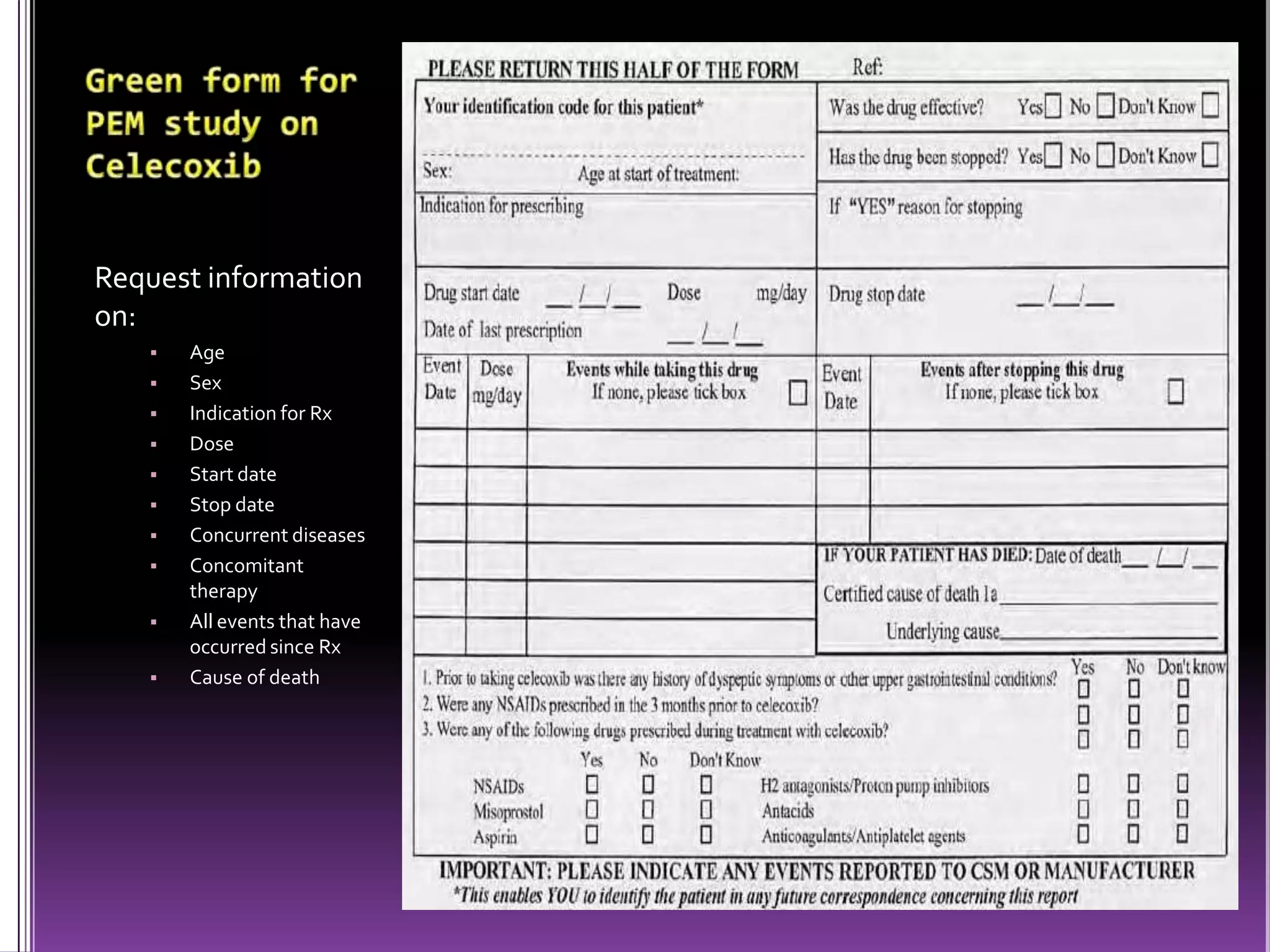
Request information
on:











Age
Sex
Indication for Rx
Dose
Start date
Stop date
Concurrent diseases
Concomitant
therapy
All events that have
occurred since Rx
Cause of death
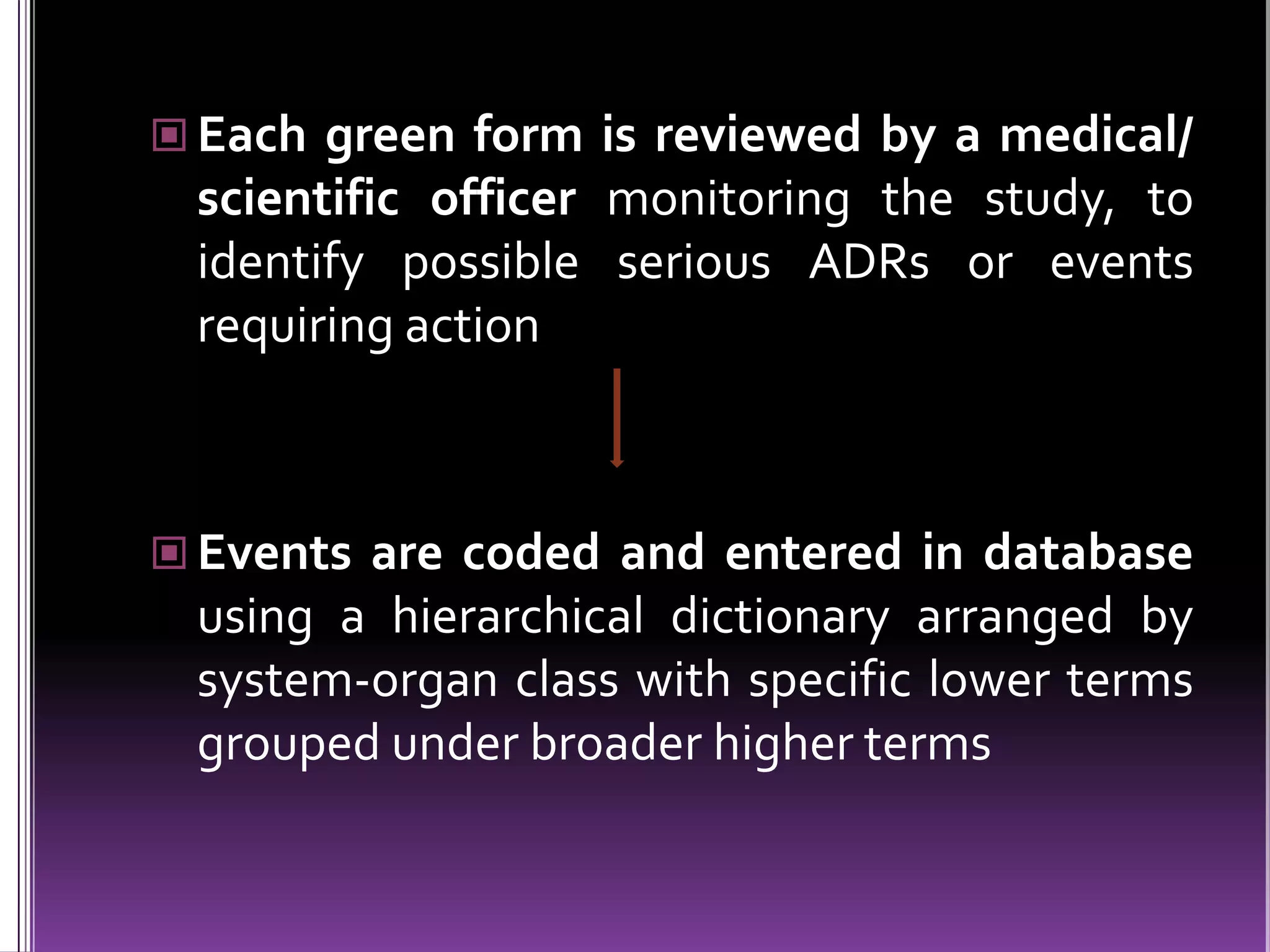
 Each green form is reviewed by a medical/

scientific officer monitoring the study, to
identify possible serious ADRs or events
requiring action

 Events are coded and entered in database

using a hierarchical dictionary arranged by
system-organ class with specific lower terms
grouped under broader higher terms
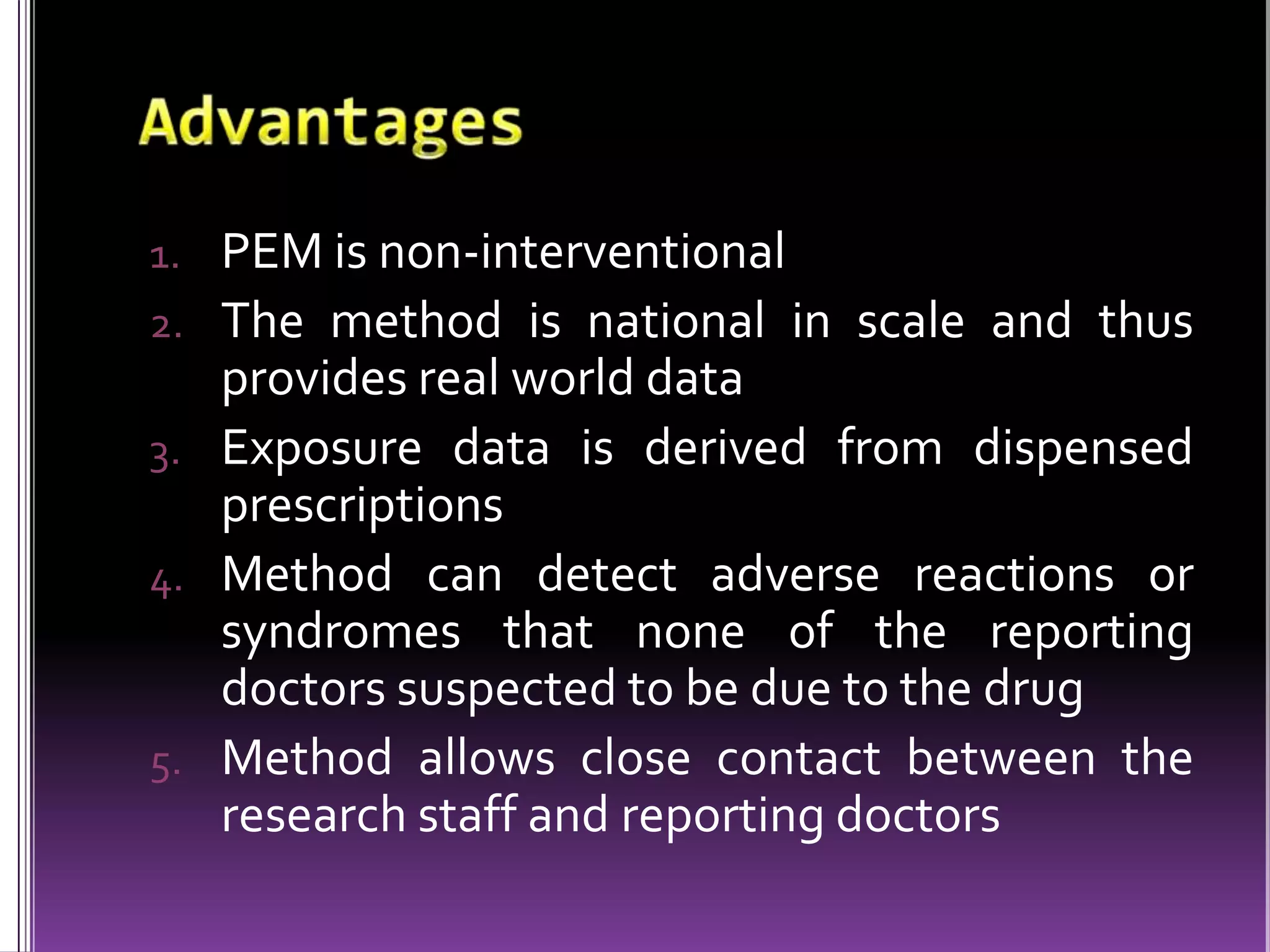
1. PEM is non-interventional
2. The method is national in scale and thus

provides real world data
3. Exposure data is derived from dispensed
prescriptions
4. Method can detect adverse reactions or
syndromes that none of the reporting
doctors suspected to be due to the drug
5. Method allows close contact between the
research staff and reporting doctors
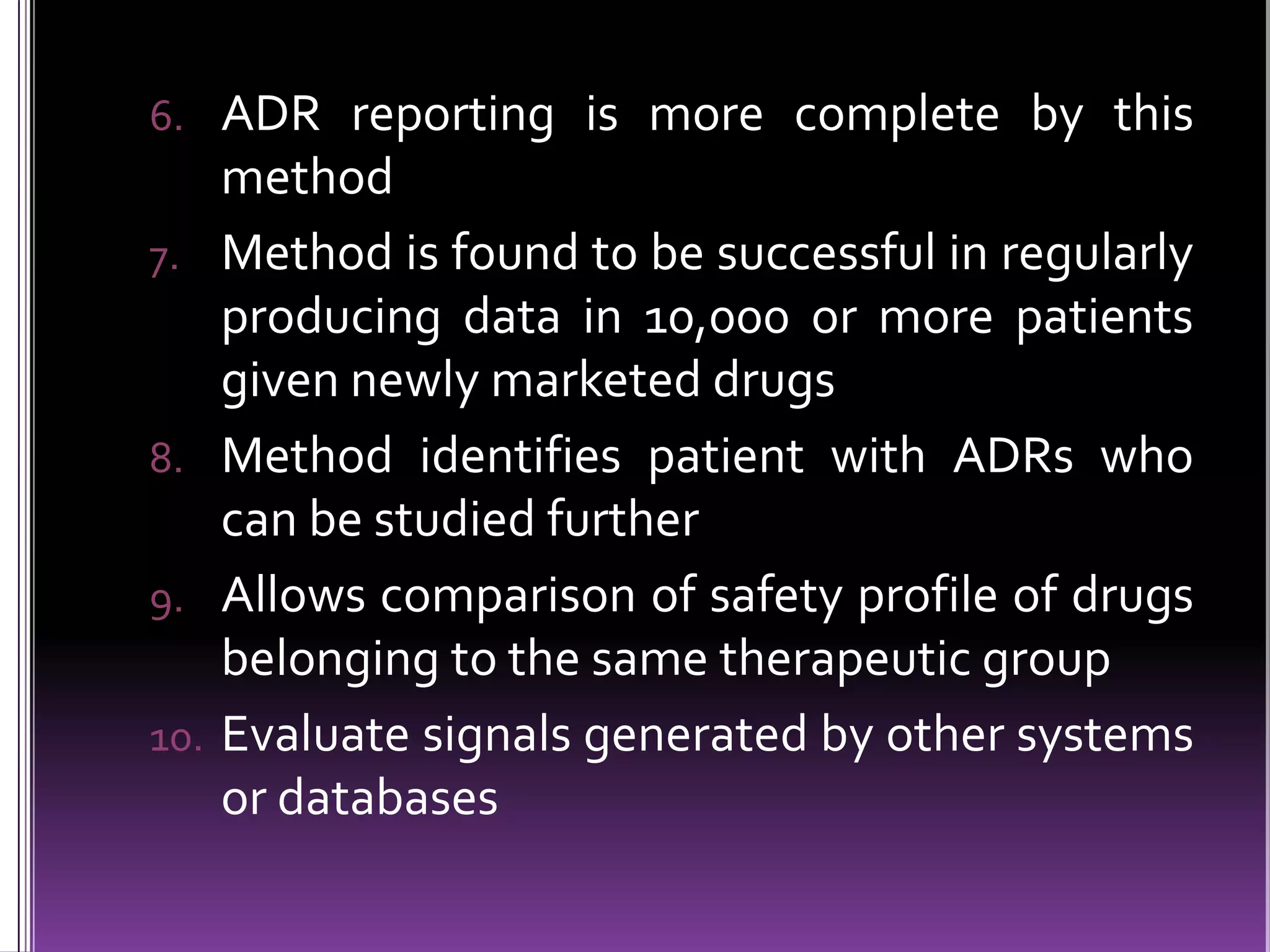
6. ADR reporting is more complete by this
7.

8.
9.
10.

method
Method is found to be successful in regularly
producing data in 10,000 or more patients
given newly marketed drugs
Method identifies patient with ADRs who
can be studied further
Allows comparison of safety profile of drugs
belonging to the same therapeutic group
Evaluate signals generated by other systems
or databases
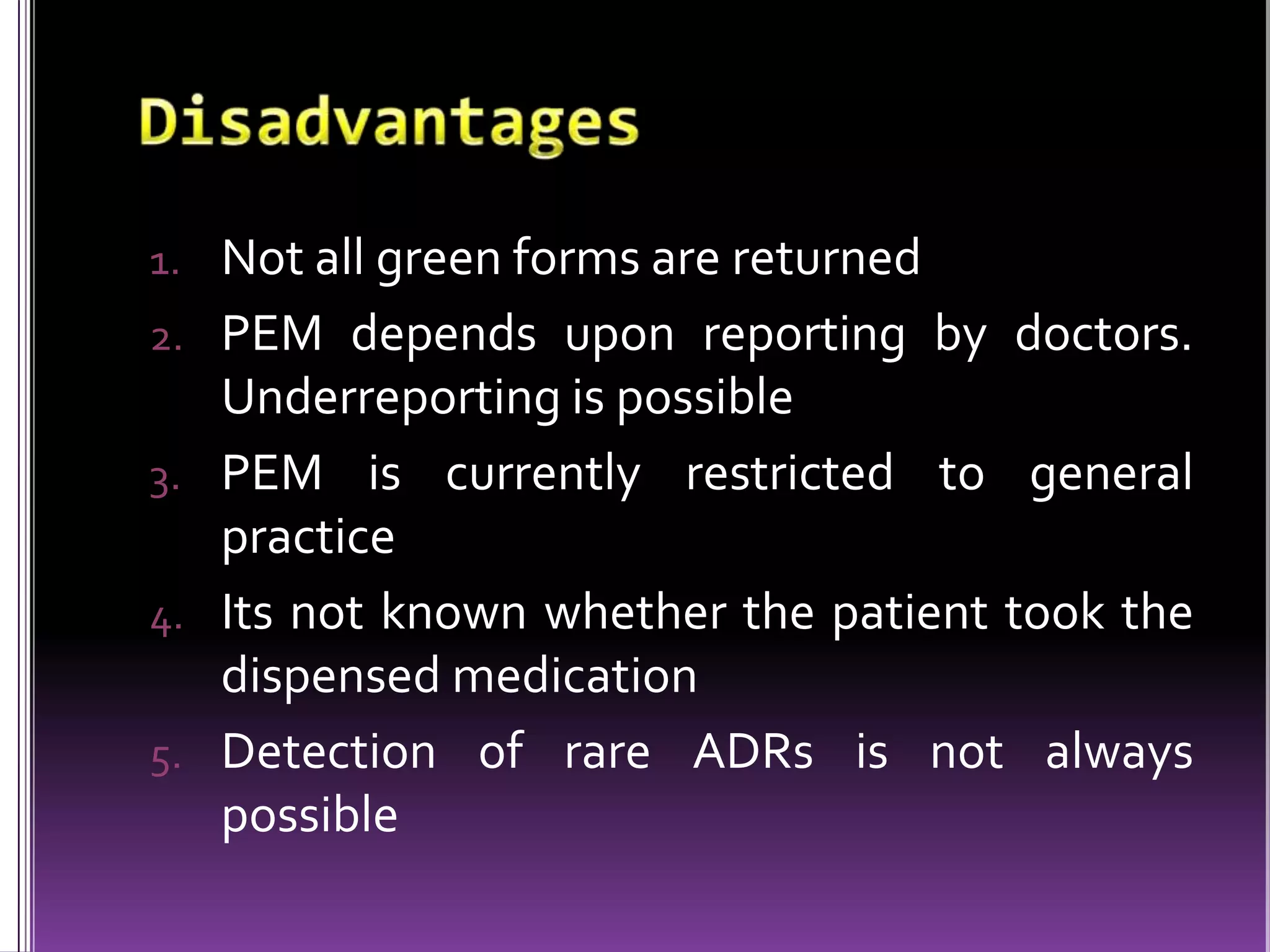
1. Not all green forms are returned
2. PEM depends upon reporting by doctors.

Underreporting is possible
3. PEM is currently restricted to general
practice
4. Its not known whether the patient took the
dispensed medication
5. Detection of rare ADRs is not always
possible
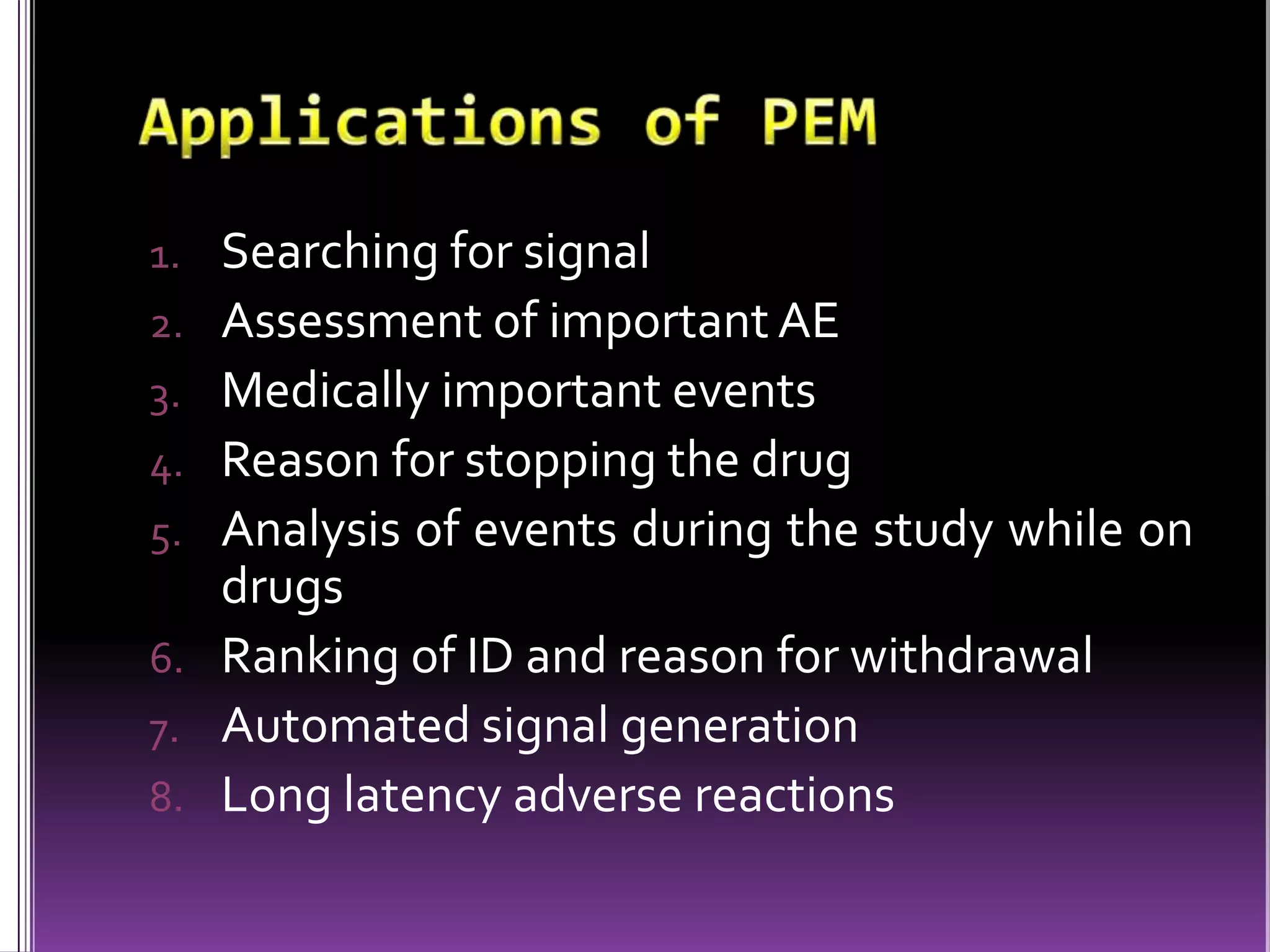
1. Searching for signal
2. Assessment of important AE
3. Medically important events
4. Reason for stopping the drug
5. Analysis of events during the study while on

drugs
6. Ranking of ID and reason for withdrawal
7. Automated signal generation
8. Long latency adverse reactions
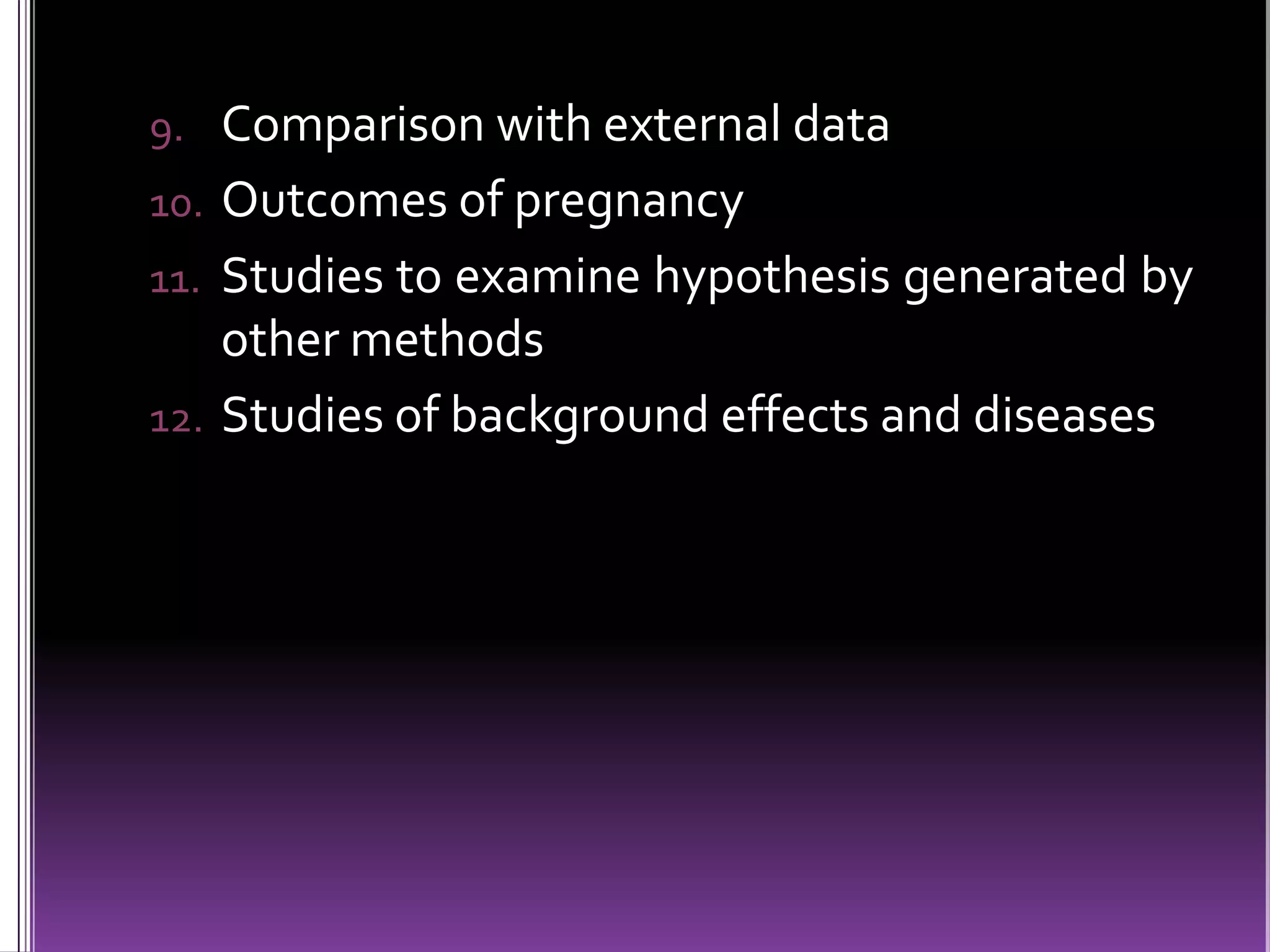
9. Comparison with external data
10. Outcomes of pregnancy
11. Studies to examine hypothesis generated by

other methods
12. Studies of background effects and diseases
 A study was carried out to assess the sedation

properties of 4 anti-histaminic in the market
loratadine, cetrizine, fexofenadine and
acrivastine
 Objectives: To investigate the frequency with
which sedation was reported in post
marketing surveillance studies of four second
generation
antihistamines:
loratadine,
cetrizine, fexofenadine, and acrivastine
 Design: Prescription event monitoring
studies.
 Setting: Prescriptions were obtained for each

cohort in the immediate post marketing
period.
 Subjects: Event data were obtained for a
total of 43,363 patients.
 Main outcome measure: Reporting of
sedation or drowsiness.
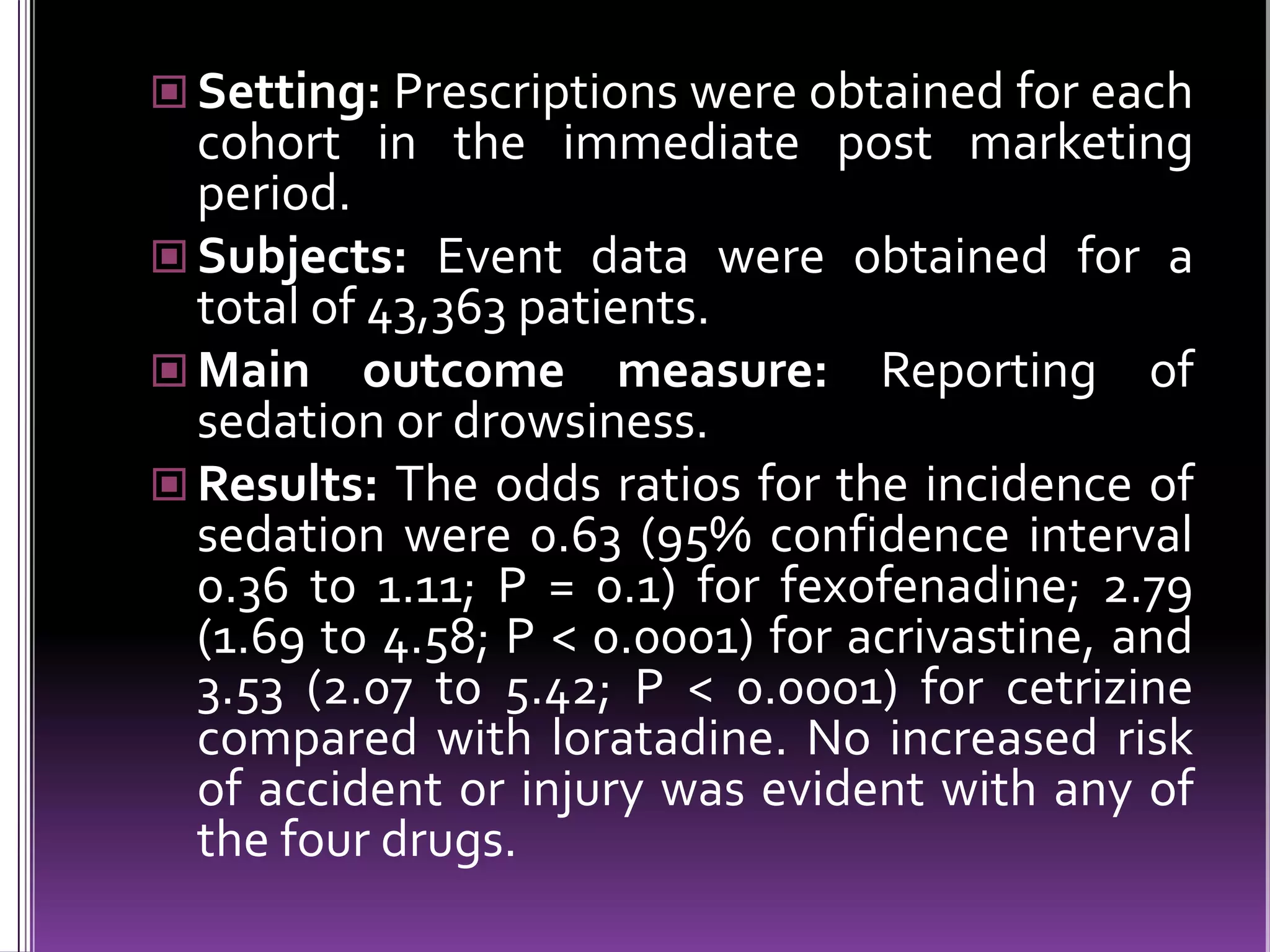
 Results: The odds ratios for the incidence of
sedation were 0.63 (95% confidence interval
0.36 to 1.11; P = 0.1) for fexofenadine; 2.79
(1.69 to 4.58; P < 0.0001) for acrivastine, and
3.53 (2.07 to 5.42; P < 0.0001) for cetrizine
compared with loratadine. No increased risk
of accident or injury was evident with any of
the four drugs.
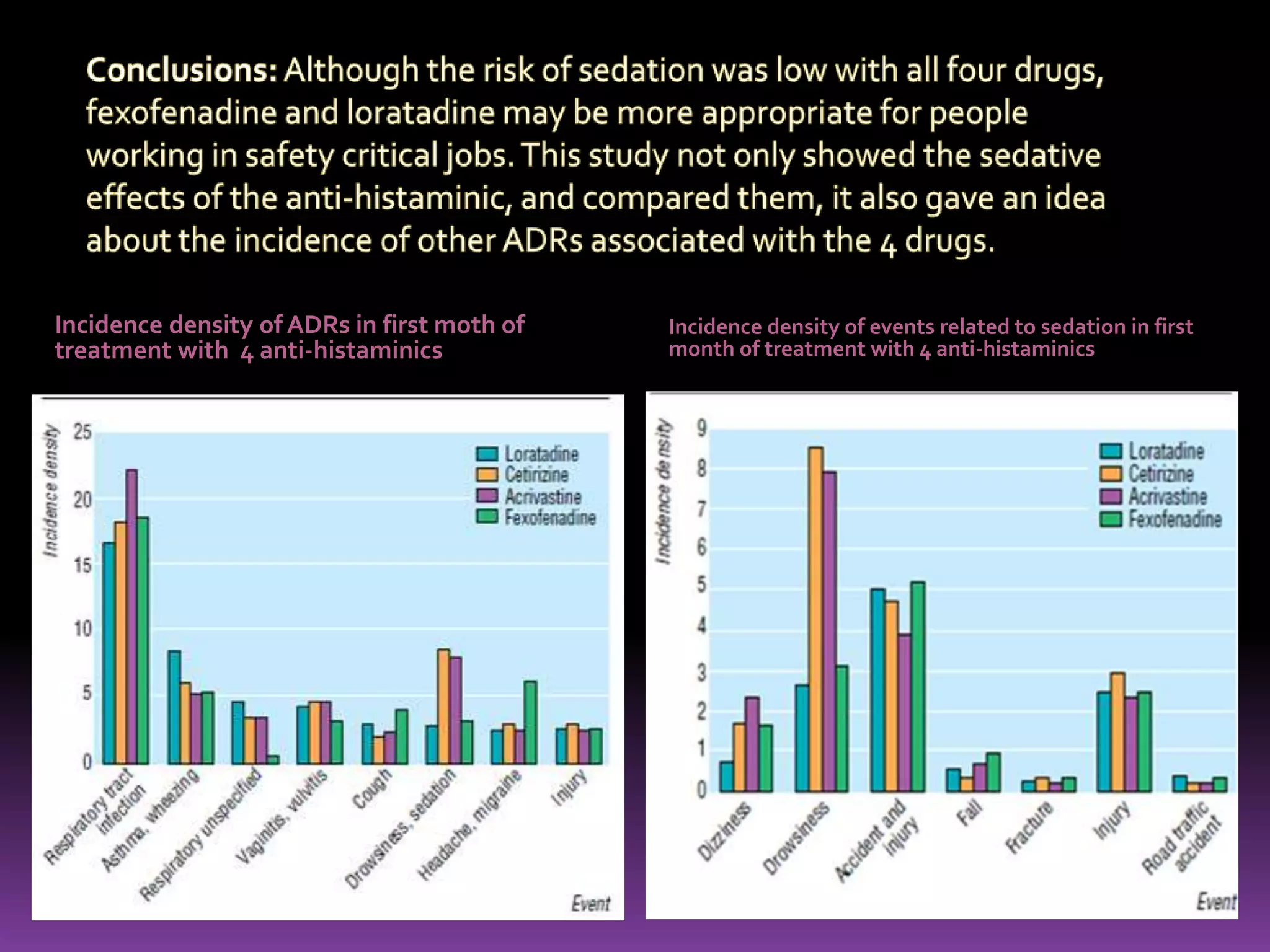
Incidence density of ADRs in first moth of
treatment with 4 anti-histaminics

Incidence density of events related to sedation in first
month of treatment with 4 anti-histaminics
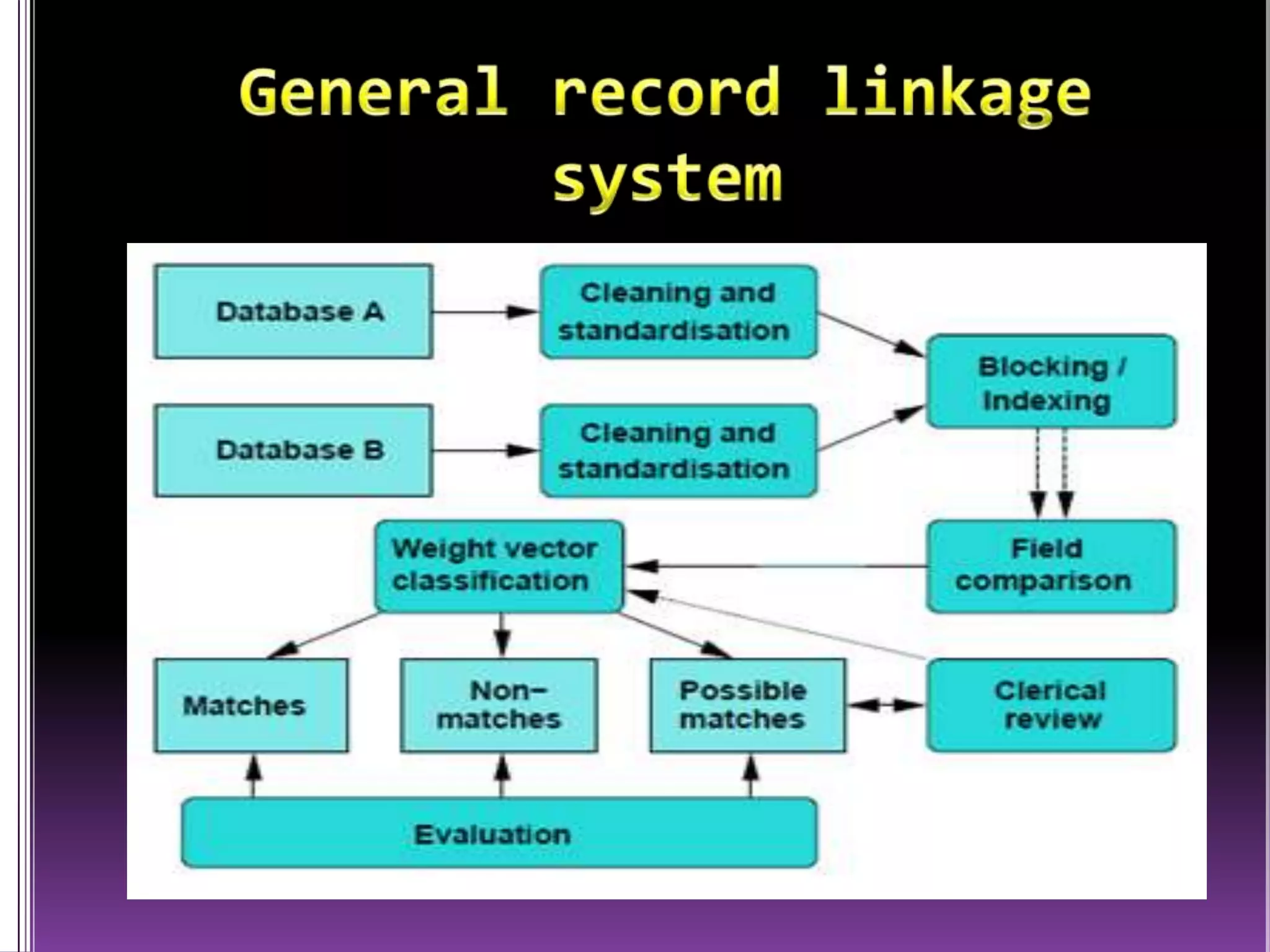
 Record linkage is the process of bringing

together two or more records relating to the
same individual (person), family or entity (e.g.
event, object, geography, business etc).
 It is the process of assembling the outcomes of
drug exposure into a single database
 Record linkage can be considered as part of

the data cleaning process
 Provides rapid access to records of thousands
of patients and thus reduces the time
required for exploring the relationship
between drug exposure and outcomes
 An ideal database would include records from

inpatient, outpatient, emergency care,
mental health care, laboratory and
radiological tests, prescribed and over-thecounter medications as well as alternative
therapies
 All the parts should be easily linked by a
unique patient identifier
 It should be updated regularly
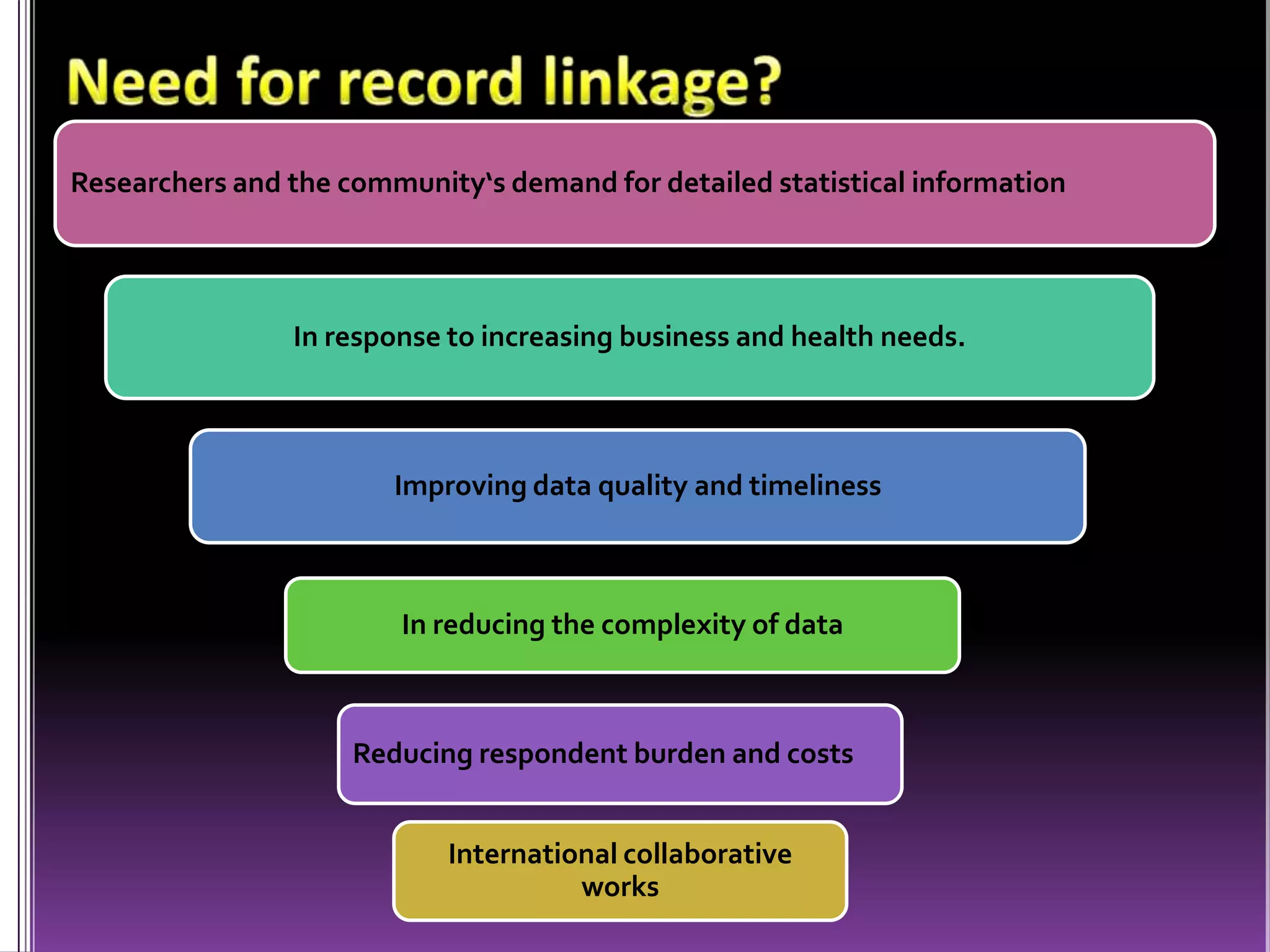
Researchers and the community‘s demand for detailed statistical information

In response to increasing business and health needs.

Improving data quality and timeliness

In reducing the complexity of data

Reducing respondent burden and costs
International collaborative
works
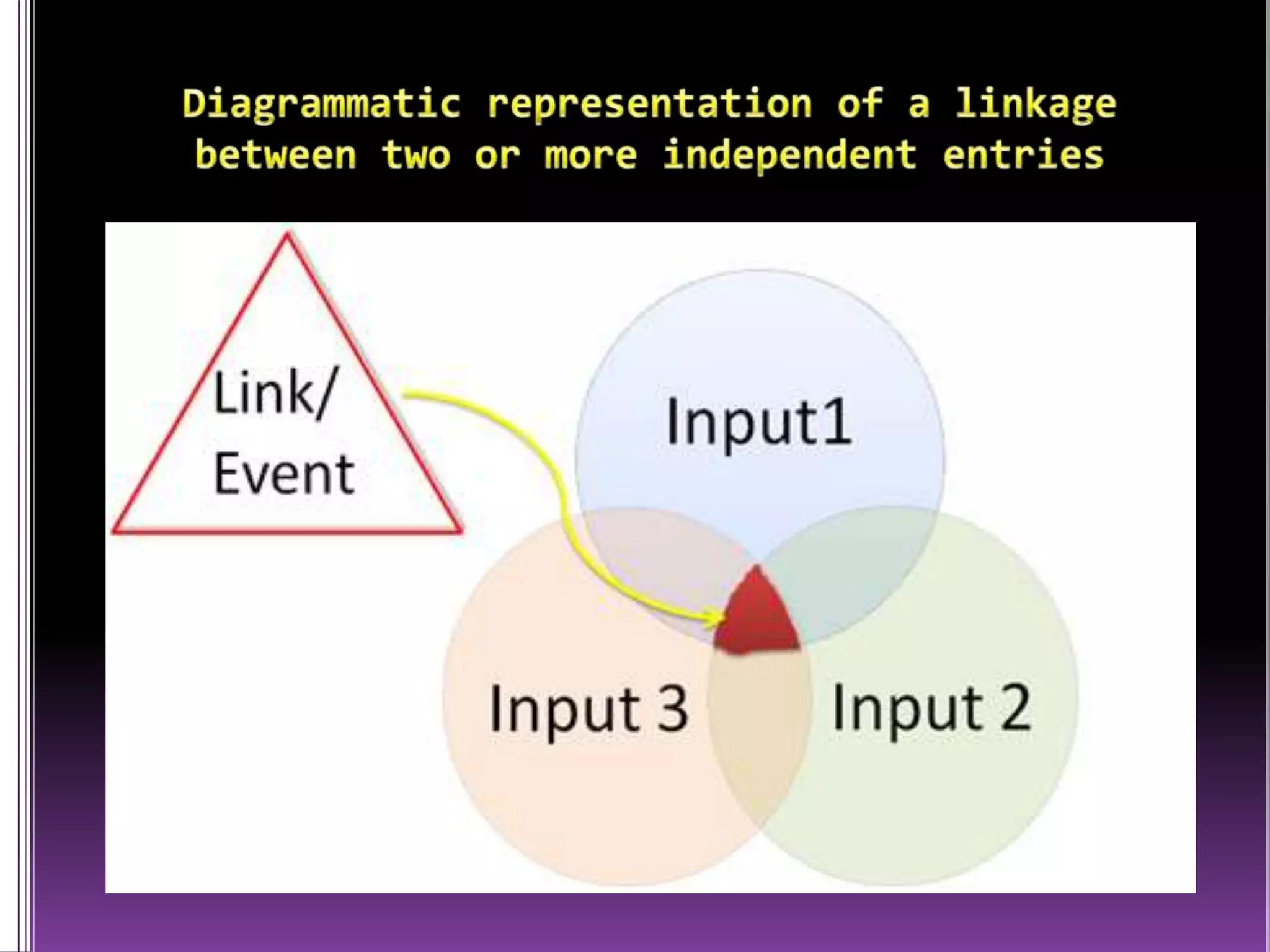
 The objective of the linking process is to

determine whether two or more records refer
to the same person, object or event
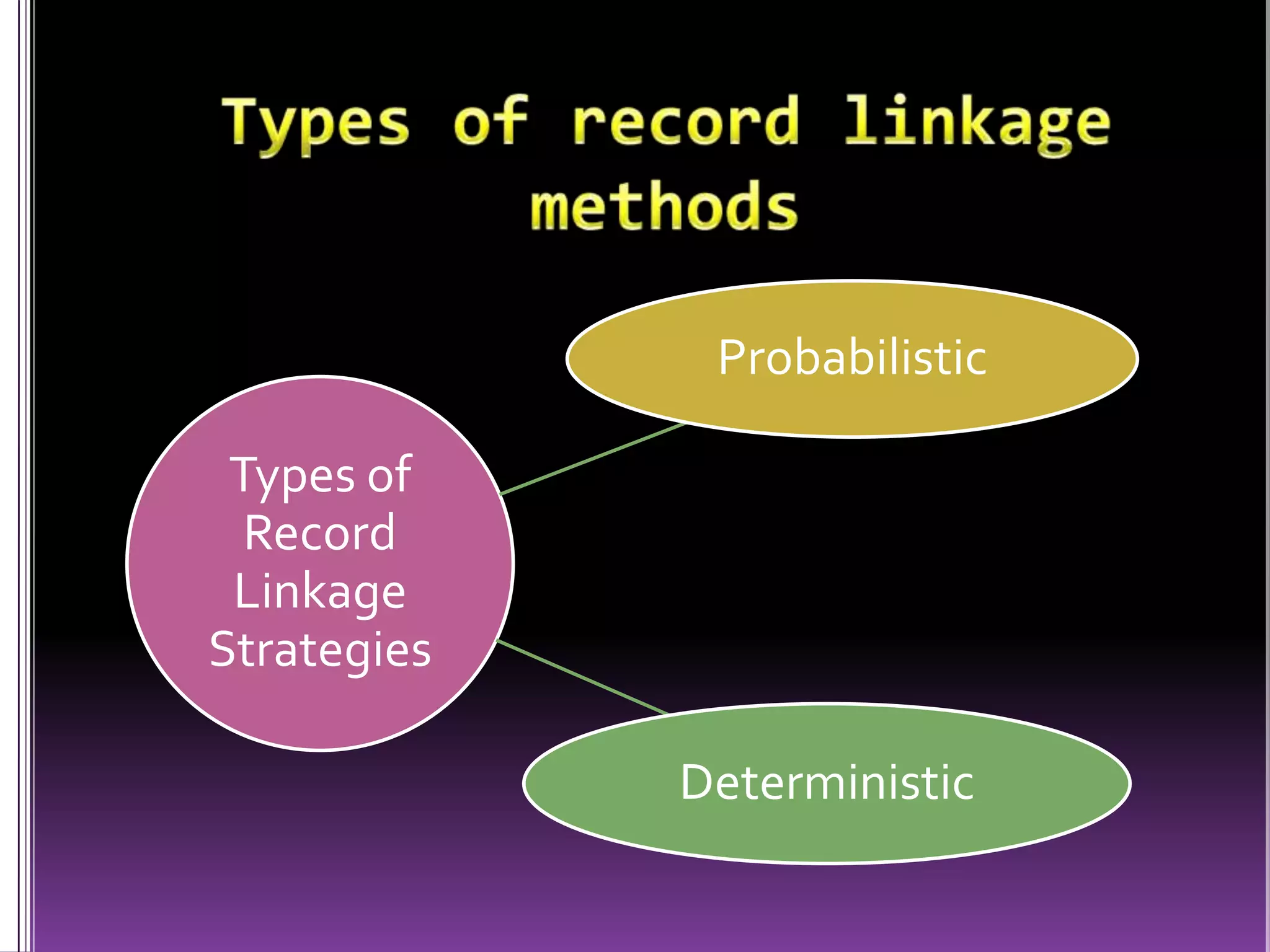
Probabilistic
Types of
Record
Linkage
Strategies

Deterministic
 A pair of records is said to be a link if the two

records agree exactly on each element within
a collection of identifiers called the match
key.
 For example, when comparing two records on
last name, street name, year of birth, and
street number, the pair of records is deemed
to be a link only if the names agree on all
characters, the years of birth are the same,
and the street numbers are identical.
 Pairs of records are classified as links,

possible links, or non-links.
 Here, we consider the probability of a match
in the given observed data.
 In probability matching, a threshold of
likelihood is set (which can be varied in
different circumstances) above which a pair
of records is accepted as a match, relating to
the same person, and below which the match
is rejected
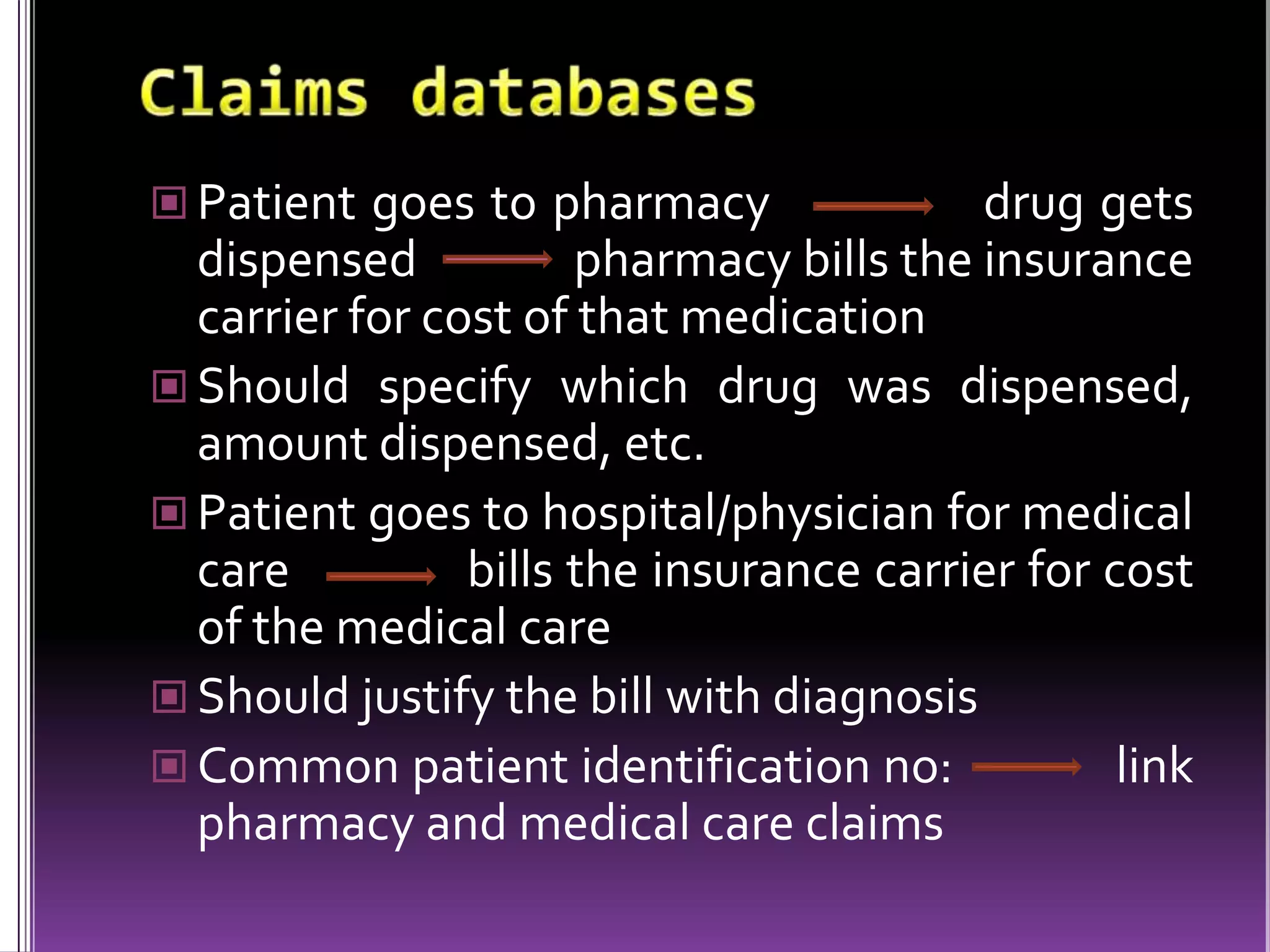
 Patient goes to pharmacy

drug gets
dispensed
pharmacy bills the insurance
carrier for cost of that medication
 Should specify which drug was dispensed,
amount dispensed, etc.
 Patient goes to hospital/physician for medical
care
bills the insurance carrier for cost
of the medical care
 Should justify the bill with diagnosis
 Common patient identification no:
link
pharmacy and medical care claims
 Recent development with increased use of

computerization in medical care
 Computers are used to record medical
information
 Provide

large sample size, esp. for
pharmacoepidemiological studies
 Inexpensive
 Data will be complete
 Population based
 Include information on outpatient drugs and
diseases
 Avoid recall and interviewer bias
 Uncertainty of diagnosis data
 May not contain information regarding

smoking, alcohol, date of menopause, etc.
 May not contain data of medications
obtained without prescription or outside
insurance carriers prescription plan
 Instability of population due to job changes,
changes in insurance plans, etc.
 Include illnesses severe enough to come to
medical attention
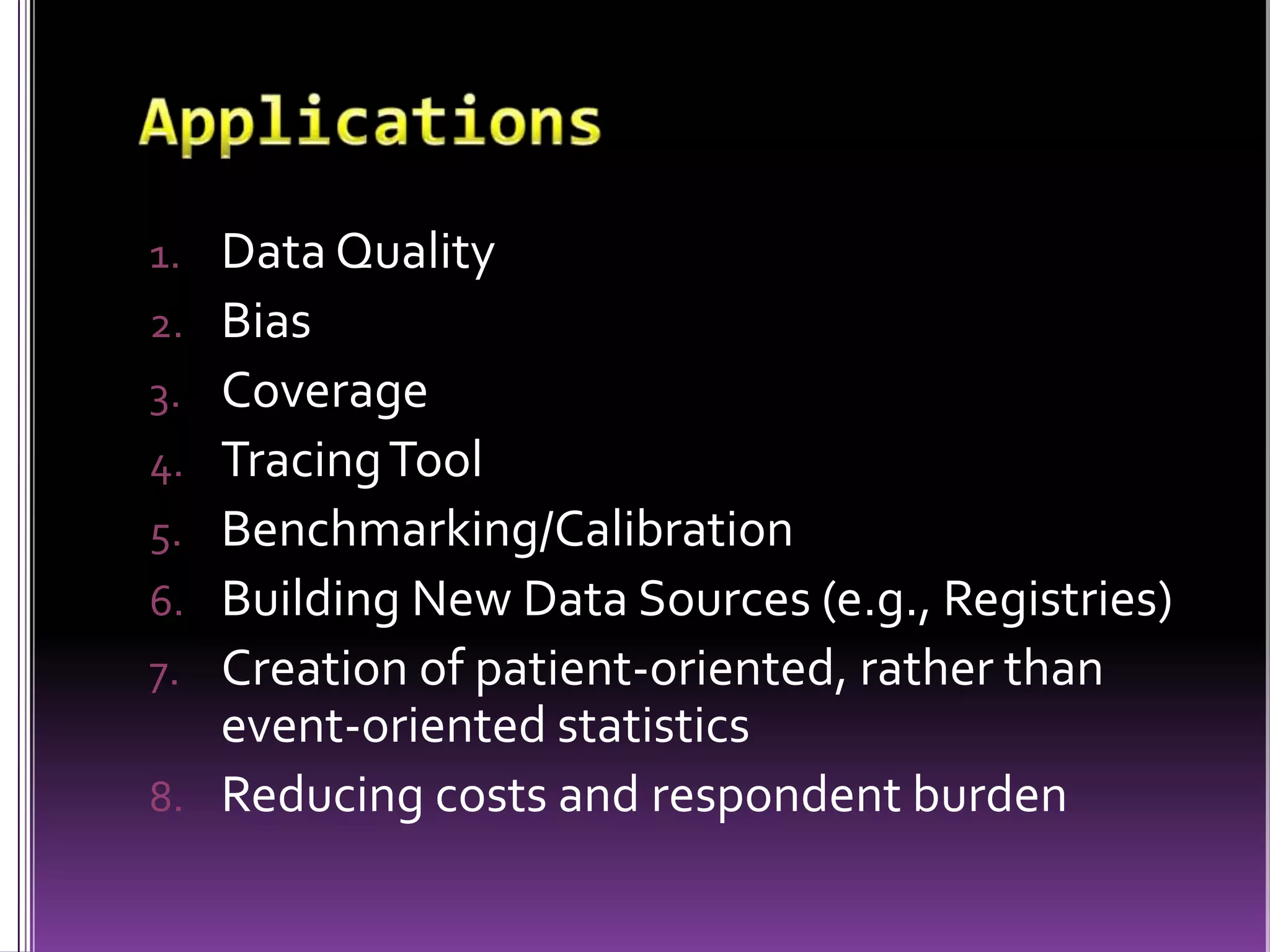
1. Data Quality
2. Bias
3. Coverage
4. Tracing Tool
5. Benchmarking/Calibration
6. Building New Data Sources (e.g., Registries)
7. Creation of patient-oriented, rather than

event-oriented statistics
8. Reducing costs and respondent burden
Thank you!

Prescription event monitoring and record linkage system

  • 1.
  • 2.
     Pre-marketing clinicaltrials are not able to define many aspects of drug safety because: 1. Small no of patients 2. Large no of patients receiving the drug for small durations 3. Doses and formulations of the drug may change during drug development 4. Exclusion of special population from the clinical trials
  • 3.
     PEM isa non-interventional, observational cohort form of pharmacovigilance  PEM was developed by Professor Bill Inman at the Drug Safety and Research Unit (DSRU) at Southampton in 1981
  • 4.
     In UK,all the patients are registered with NHS-GP provides the primary care and act as a gateway to specialist and hospital care  File notes in general practice contains information about primary care, secondary and tertiary care (life long record)
  • 5.
     GP issuesprescription for medications he considers medically warranted  Patient takes the prescription to the pharmacist, who dispenses the medication and sends the prescription to the PPD (which is a part of NHS-BSA), for reimbursement  PPD provides DSRU with electronic copies of all the prescriptions issued throughout UK, for the drugs being monitored
  • 6.
     Products thatare selected for study by PEM 1. New drugs, expected to be used widely 2. Established products, used indication/ new population for new  Collection of exposure data begins soon after the new product is launched  These arrangements operate for a length of time necessary for the DSRU to collect first 50,000 prescriptions, that identify 20,00030,000 patients given the new drug being monitored
  • 7.
     For eachpatient in the study, DSRU prepares a computerized longitudinal record in the date order of drug use  After 3-12 months from the date of first prescription for each patient, the DSRU sends the prescriber a green form questionnaire  This is done on an individual patient basis  Doctor receives maximum of 4 green forms in a month
  • 8.
    Request information on:           Age Sex Indication forRx Dose Start date Stop date Concurrent diseases Concomitant therapy All events that have occurred since Rx Cause of death
  • 9.
     Each greenform is reviewed by a medical/ scientific officer monitoring the study, to identify possible serious ADRs or events requiring action  Events are coded and entered in database using a hierarchical dictionary arranged by system-organ class with specific lower terms grouped under broader higher terms
  • 11.
    1. PEM isnon-interventional 2. The method is national in scale and thus provides real world data 3. Exposure data is derived from dispensed prescriptions 4. Method can detect adverse reactions or syndromes that none of the reporting doctors suspected to be due to the drug 5. Method allows close contact between the research staff and reporting doctors
  • 12.
    6. ADR reportingis more complete by this 7. 8. 9. 10. method Method is found to be successful in regularly producing data in 10,000 or more patients given newly marketed drugs Method identifies patient with ADRs who can be studied further Allows comparison of safety profile of drugs belonging to the same therapeutic group Evaluate signals generated by other systems or databases
  • 13.
    1. Not allgreen forms are returned 2. PEM depends upon reporting by doctors. Underreporting is possible 3. PEM is currently restricted to general practice 4. Its not known whether the patient took the dispensed medication 5. Detection of rare ADRs is not always possible
  • 14.
    1. Searching forsignal 2. Assessment of important AE 3. Medically important events 4. Reason for stopping the drug 5. Analysis of events during the study while on drugs 6. Ranking of ID and reason for withdrawal 7. Automated signal generation 8. Long latency adverse reactions
  • 15.
    9. Comparison withexternal data 10. Outcomes of pregnancy 11. Studies to examine hypothesis generated by other methods 12. Studies of background effects and diseases
  • 16.
     A studywas carried out to assess the sedation properties of 4 anti-histaminic in the market loratadine, cetrizine, fexofenadine and acrivastine  Objectives: To investigate the frequency with which sedation was reported in post marketing surveillance studies of four second generation antihistamines: loratadine, cetrizine, fexofenadine, and acrivastine  Design: Prescription event monitoring studies.
  • 17.
     Setting: Prescriptionswere obtained for each cohort in the immediate post marketing period.  Subjects: Event data were obtained for a total of 43,363 patients.  Main outcome measure: Reporting of sedation or drowsiness.  Results: The odds ratios for the incidence of sedation were 0.63 (95% confidence interval 0.36 to 1.11; P = 0.1) for fexofenadine; 2.79 (1.69 to 4.58; P < 0.0001) for acrivastine, and 3.53 (2.07 to 5.42; P < 0.0001) for cetrizine compared with loratadine. No increased risk of accident or injury was evident with any of the four drugs.
  • 18.
    Incidence density ofADRs in first moth of treatment with 4 anti-histaminics Incidence density of events related to sedation in first month of treatment with 4 anti-histaminics
  • 20.
     Record linkageis the process of bringing together two or more records relating to the same individual (person), family or entity (e.g. event, object, geography, business etc).  It is the process of assembling the outcomes of drug exposure into a single database
  • 21.
     Record linkagecan be considered as part of the data cleaning process  Provides rapid access to records of thousands of patients and thus reduces the time required for exploring the relationship between drug exposure and outcomes
  • 23.
     An idealdatabase would include records from inpatient, outpatient, emergency care, mental health care, laboratory and radiological tests, prescribed and over-thecounter medications as well as alternative therapies  All the parts should be easily linked by a unique patient identifier  It should be updated regularly
  • 24.
    Researchers and thecommunity‘s demand for detailed statistical information In response to increasing business and health needs. Improving data quality and timeliness In reducing the complexity of data Reducing respondent burden and costs International collaborative works
  • 25.
     The objectiveof the linking process is to determine whether two or more records refer to the same person, object or event
  • 26.
  • 27.
     A pairof records is said to be a link if the two records agree exactly on each element within a collection of identifiers called the match key.  For example, when comparing two records on last name, street name, year of birth, and street number, the pair of records is deemed to be a link only if the names agree on all characters, the years of birth are the same, and the street numbers are identical.
  • 28.
     Pairs ofrecords are classified as links, possible links, or non-links.  Here, we consider the probability of a match in the given observed data.  In probability matching, a threshold of likelihood is set (which can be varied in different circumstances) above which a pair of records is accepted as a match, relating to the same person, and below which the match is rejected
  • 30.
     Patient goesto pharmacy drug gets dispensed pharmacy bills the insurance carrier for cost of that medication  Should specify which drug was dispensed, amount dispensed, etc.  Patient goes to hospital/physician for medical care bills the insurance carrier for cost of the medical care  Should justify the bill with diagnosis  Common patient identification no: link pharmacy and medical care claims
  • 31.
     Recent developmentwith increased use of computerization in medical care  Computers are used to record medical information
  • 32.
     Provide large samplesize, esp. for pharmacoepidemiological studies  Inexpensive  Data will be complete  Population based  Include information on outpatient drugs and diseases  Avoid recall and interviewer bias
  • 33.
     Uncertainty ofdiagnosis data  May not contain information regarding smoking, alcohol, date of menopause, etc.  May not contain data of medications obtained without prescription or outside insurance carriers prescription plan  Instability of population due to job changes, changes in insurance plans, etc.  Include illnesses severe enough to come to medical attention
  • 34.
    1. Data Quality 2.Bias 3. Coverage 4. Tracing Tool 5. Benchmarking/Calibration 6. Building New Data Sources (e.g., Registries) 7. Creation of patient-oriented, rather than event-oriented statistics 8. Reducing costs and respondent burden
  • 35.