C
SPONTENOUS ADR
REPORTING
PREPARED BY SONAL VIJAY PANDE
SPONTENOUS ADR REPORTING SYSTEM
• Passive surveillance system:
Health professionals are encouraged to report adverse reactions which
they believe to be drug-related directly to…
the regulatory authority
or
the company marketing the suspected product on a voluntary basis
SPONTENOUS ADR REPORTING PROCESS
1.Data acquisition
2.Data assessment
3.Data interpretation
1. Data acquisition
Which depends largely on the input of information
derived from reports submitted by the health
professionals who have encountered what they
suspect is an ADR.
2.Data assessment
•Which involves assessment of the individual case reports
and assessment of pooled data obtained from various
sources such as the international database of the WHO
3.Data interpretation
•Data interpretation based on the available data and
the assessments made, a signal related to the
adverse reaction may be generated.
 India – ‘Suspected Adverse Drug Reaction
Reporting Form’
 UK – ‘Yellow Card’, since 1964
 Australia – ‘Blue Card’ , since 1964
 US – ‘Med Watch’
CINDIA
INDIA
•Indian Pharmacopoeia Commission (IPC), Ghaziabad is
functioning as a National Coordination Centre (NCC) for
Pharmacovigilance Programme of India (PvPI).
• 150 ADR monitoring centres (AMCs) were established in
various medical institutions/hospitals across India to
monitor and collect ADR reports under NCC-PvPI
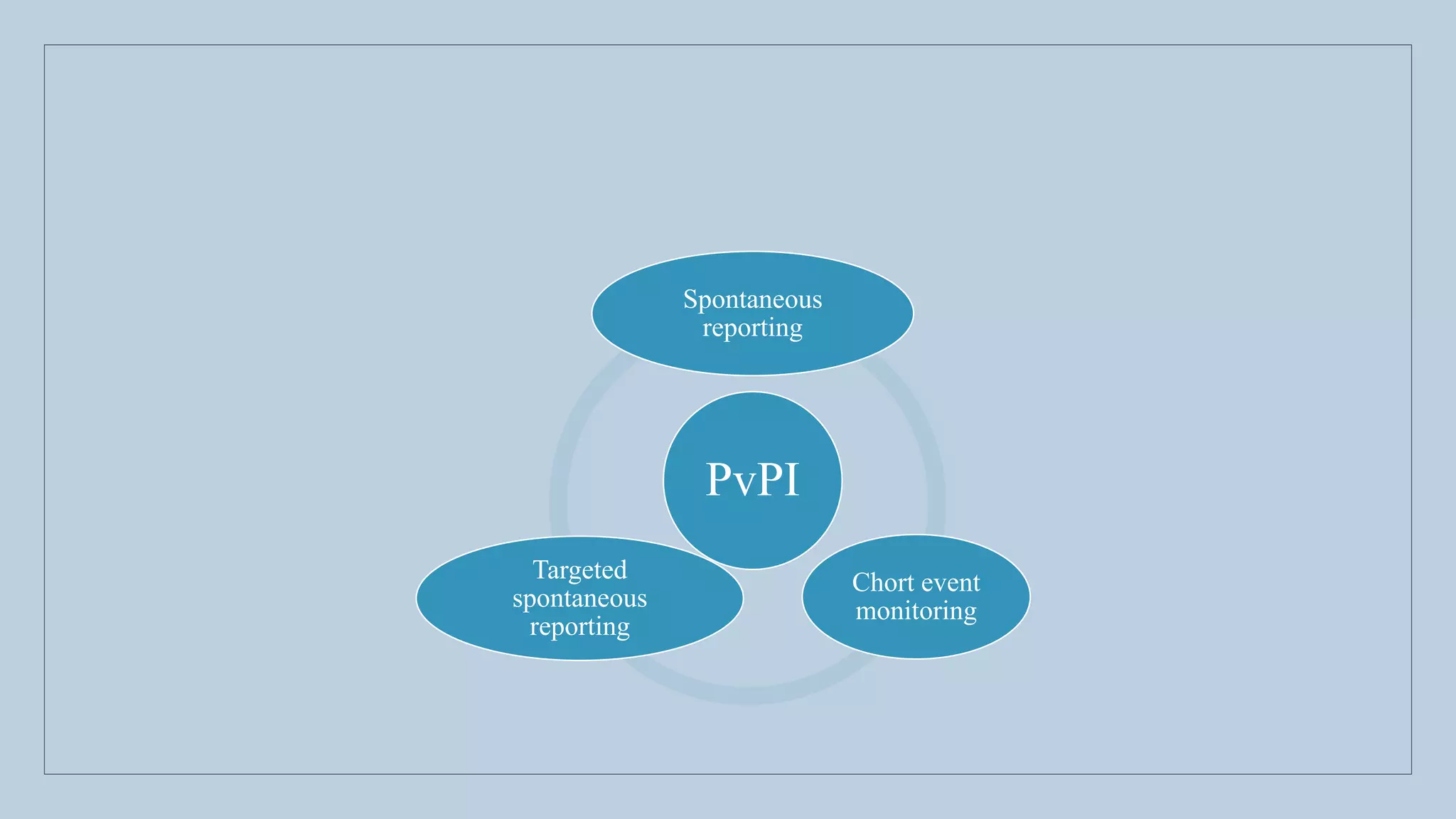
PvPI
Spontaneous
reporting
Chort event
monitoring
Targeted
spontaneous
reporting
Who can report
• Healthcare
professionals
(clinician, dentist
pharmacist ,nurses
and others) can
report suspected
adverse drug
reaction.
• Pharmaceutical
companies can also
send ICSRs
specific for their
product to NCC
What to report
• All types of suspected
ADRs- irrespective of
whether they are known
or unknown, serious and
non-serious, frequent or
rare.
• Although
pharmacovigilance is
primarily concerned with
pharmaceutical
medicines, adverse
reactions associated with
drugs used in traditional
medicine (e.g. herbal
remedies) should also be
considered
Whom to report
• Use the ‘Suspected
Adverse Drug Reaction
Reporting Form’ which is
available on the official
website of IPC
(www.ipc.gov.in) as well
as CDSCO
(www.cdsco.nic.in) to
report any ADR. A reporter
who is not a part of AMC
can submit the ICSR to the
nearest AMC or directly to
the NCC.
What to report
• Any undesirable adverse event suspected to be associated with use of
drug, biological (including blood products), herbal drugs, cosmetics or
medical devices should be reported. They should include;
1. All ADRs as a result of prescription and non-prescription
2. All suspected adverse drug reactions regardless of whether or not the
product was used in accordance with the product information provided by
the company marketing the product.
3. Unexpected reaction, regardless of their nature or severity, whether not
consistent with product information or labelling.
4. An observed increase in frequency of a given reaction.
5. A serious reaction, whether expected or not.
6. All suspected ADRs associated with drug-drug, drug-
food or drug-food supplements interactions.
7. ADRs in special field of interest such as drug abuse and
drug use in pregnancy and during lactation
8. ADRs occurring from overdose or medication error.
9. Unusual lack of efficacy or when suspected
pharmaceutical defects are observed.
What information is required for an ADR case
report?
• The minimal standard information to be provided for proper
assessment of the ADR case report are;
1. Patient
2. Adverse reactions description (include laboratory results if
available)
3. Information related to the suspected drug(s)
4. Information on management of the adverse reactions
5. Information about the reporter
1. Patient information:
• 1. Patient identity: indicate initials or record number of the patient
in hospital, medical institution, dispensary, clinic or pharmacy.

• 2. Birth dates or age: indicate date, month and year
• 3. Sex: Male or Female
• 4. Weight: should be in Kilograms
2. Adverse reaction(s)
• 1. Brief description of the ADR(s): indicate the adverse(s) reaction by
marking X in the appropriate box. Preferably describe briefly the nature of
the adverse reaction being reported but as clearly as possible, including the
body site and severity.
• 2. Time/date of onset of the adverse reactions: State the time of onset or the
occurrence of the adverse reaction in relation to the administration of the
drug. Indicate the date of onset in the following order; day, month and year.
• 3. Other relevant information:
• i. Patient medical history or laboratory data including dates if
available, considered relevant to the case or the adverse reaction
being reported should be entered.
• ii. Mention appropriate laboratory tests done to the patient and
results to confirm the adverse reaction.
• iii. State this concisely but clearly.
3. Suspected drug
• 1. Name of the suspected drug (s): trade name should preferably be used,
if trade name not available, generic name may be used. Strength of the
drug (s) should be stated
• 2. Dosage: Tablet,suspension,injection….
• frequency: 4 times daily…
• and route of administration should be clearly notified.
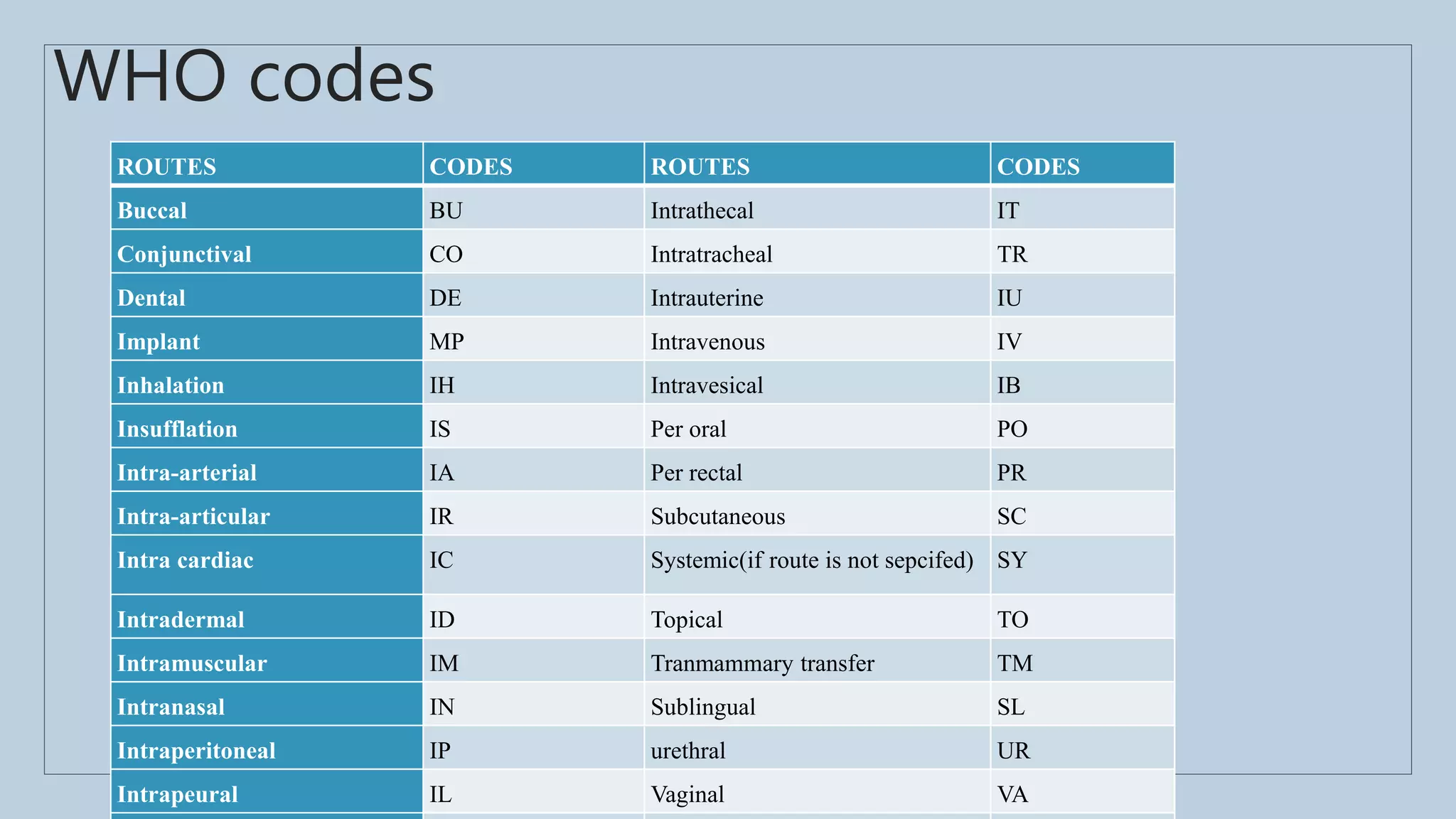
WHO codes
ROUTES CODES ROUTES CODES
Buccal BU Intrathecal IT
Conjunctival CO Intratracheal TR
Dental DE Intrauterine IU
Implant MP Intravenous IV
Inhalation IH Intravesical IB
Insufflation IS Per oral PO
Intra-arterial IA Per rectal PR
Intra-articular IR Subcutaneous SC
Intra cardiac IC Systemic(if route is not sepcifed) SY
Intradermal ID Topical TO
Intramuscular IM Tranmammary transfer TM
Intranasal IN Sublingual SL
Intraperitoneal IP urethral UR
Intrapeural IL Vaginal VA
3. Therapy date: the dates of beginning and termination of the administration of each
drug should be stated, and preferably recorded as follows:- date, month and year.
4. Batch number and expiry date: provide these information if are available.
5. Reason for use: state indication or condition for which the drug(s) was given for.
6. Particular of concurrently drugs(or other treatment): state particulars of other drug (s)
administered by the patient concurrently with the suspected drug, including drug
administration for at least 1 month back with dosage, route of administration, duration of
administration and indications.
7. Provide relevant information on medical devices
4. Management of ADR
1.Confirmation of the ADRs: indicate what assisted in confirming the
suspected adverse reactions. Eg:
• i. Drug reactions confirmed by disappearance of the reaction after stopping
administration of the drug or reducing the doses.
• ii. Recovery on withdrawal of suspected drug(s) if no other drug is
withdrawn and no therapy given.
• iii. Recovery follows treatment of the reaction in addition to withdrawal of
drug.
2. Mention the criteria for regarding the reaction as serious
3. Mention any treatment given to the patient after experiencing the
ADRs.
4. Outcome: indicate the outcome of the adverse reaction by
marking X in the appropriate box with dates in case of fatal outcome.
5. Reporter information Details on
reporter of an ADR:
• mention your particulars:-
• name, address of the health facility (hospital, institution, dispensary,
clinic, company, pharmacy or maternity home).
• E-mail address (optional), signature, telephone number and date of
reporting the reaction (indicate date, month and year)
When to report
• Any suspected ADR should be reported as soon as possible.
• Delay in reporting will make reporting inaccurate and unreliable.
• If possible, report while the patient is still in the health facility this gives
a chance to reporter to clear any ambiguity by re-questioning or
examining the patient.
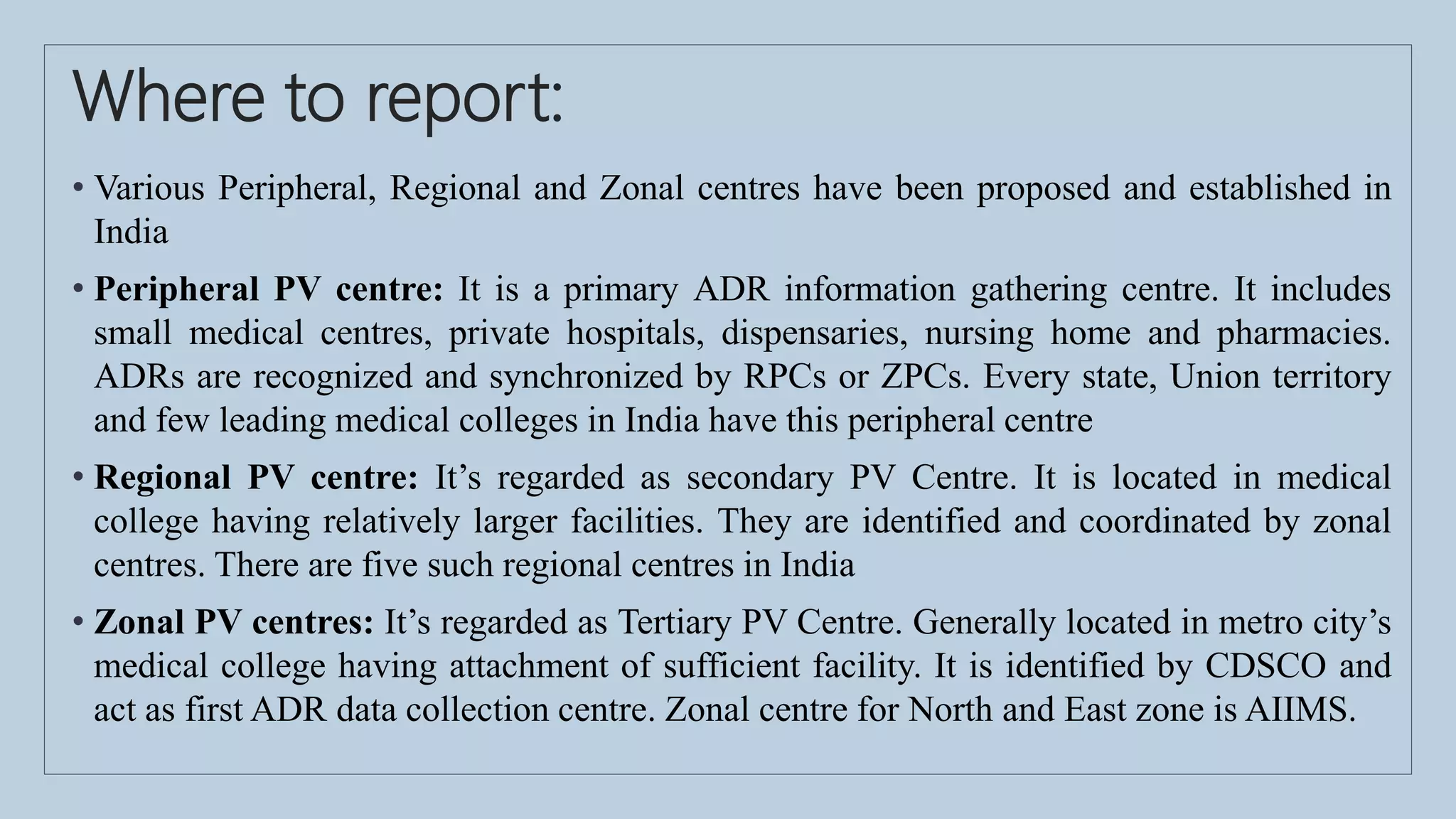
Where to report:
• Various Peripheral, Regional and Zonal centres have been proposed and established in
India
• Peripheral PV centre: It is a primary ADR information gathering centre. It includes
small medical centres, private hospitals, dispensaries, nursing home and pharmacies.
ADRs are recognized and synchronized by RPCs or ZPCs. Every state, Union territory
and few leading medical colleges in India have this peripheral centre
• Regional PV centre: It’s regarded as secondary PV Centre. It is located in medical
college having relatively larger facilities. They are identified and coordinated by zonal
centres. There are five such regional centres in India
• Zonal PV centres: It’s regarded as Tertiary PV Centre. Generally located in metro city’s
medical college having attachment of sufficient facility. It is identified by CDSCO and
act as first ADR data collection centre. Zonal centre for North and East zone is AIIMS.
List of Central Drug Standard Control Organisation (CDSCO)
Zonal and Sub-Zonal Offices
• Zonal Centre-Ahmadabad
• Zonal Centre-Hyderabad
• North Zonal centre-Ghaziabad a) Sub-Zone Office-Ghaziabad b) Chandigarh,
c) Sub-Zonal Office, Jammu
• East Zonal Centre-Kolkata-Air Port and Sea Office, Kolkata
• West Zonal Centre-Mumbai-Air Port and Sea Office, Mumbai, Jawaharlal
Nehru Port Office, Navi Mumbai
• South Zonal Centre-Chennai a) Air Port and Sea Office, b) Sub-Zonal and Port
Office, Chennai c) Port Office, Kochi- Bangalore.
Flow of ADR reporting
CWORK FLOW
Data collection
Signal detection
Review panel
Causality
assement
Case processing
Data entry in
database
Regulatory
authority
Aggregate
reporting
Actions
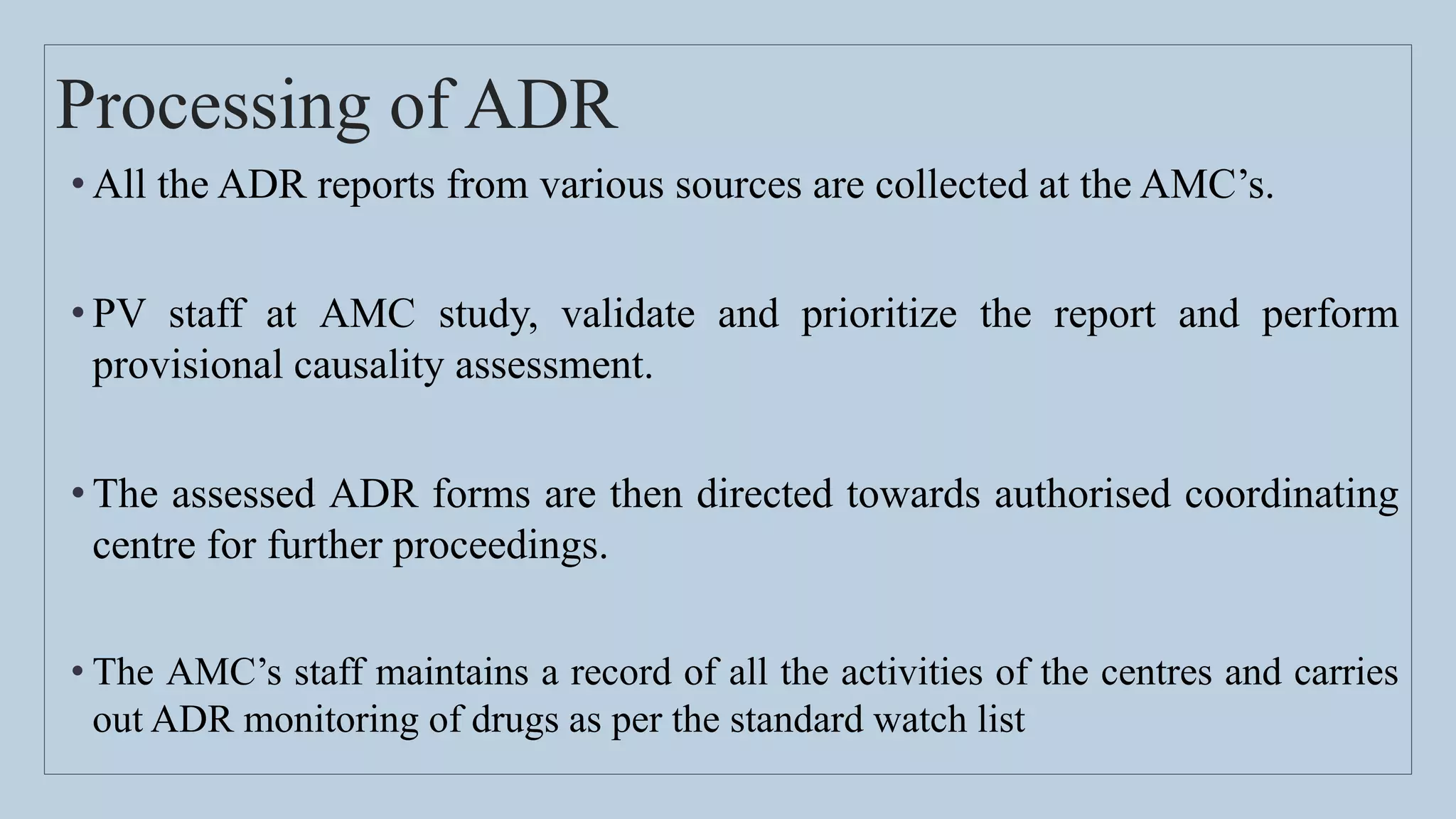
Processing of ADR
• All the ADR reports from various sources are collected at the AMC’s.
• PV staff at AMC study, validate and prioritize the report and perform
provisional causality assessment.
• The assessed ADR forms are then directed towards authorised coordinating
centre for further proceedings.
• The AMC’s staff maintains a record of all the activities of the centres and carries
out ADR monitoring of drugs as per the standard watch list
• The coordinating centres then conduct final causality evaluation
and feed the reports into the PV database.
• These centres also prepare an aggregate report of ADRs collected at
said time interval and send it to WHO-UMC.
• The finding of PV analysis is then implemented and integrated into
general population health program.
• Finally, the integrated ADR data is transferred through Vigi-Flow
database to the UMC database.
• UMC team analyses the submitted data and detects drug-ADR
relationship called as a signal, is very important aspect and
communicate with NCC-PvPI via CDSCO to stop the marketing or
use of drug in India.
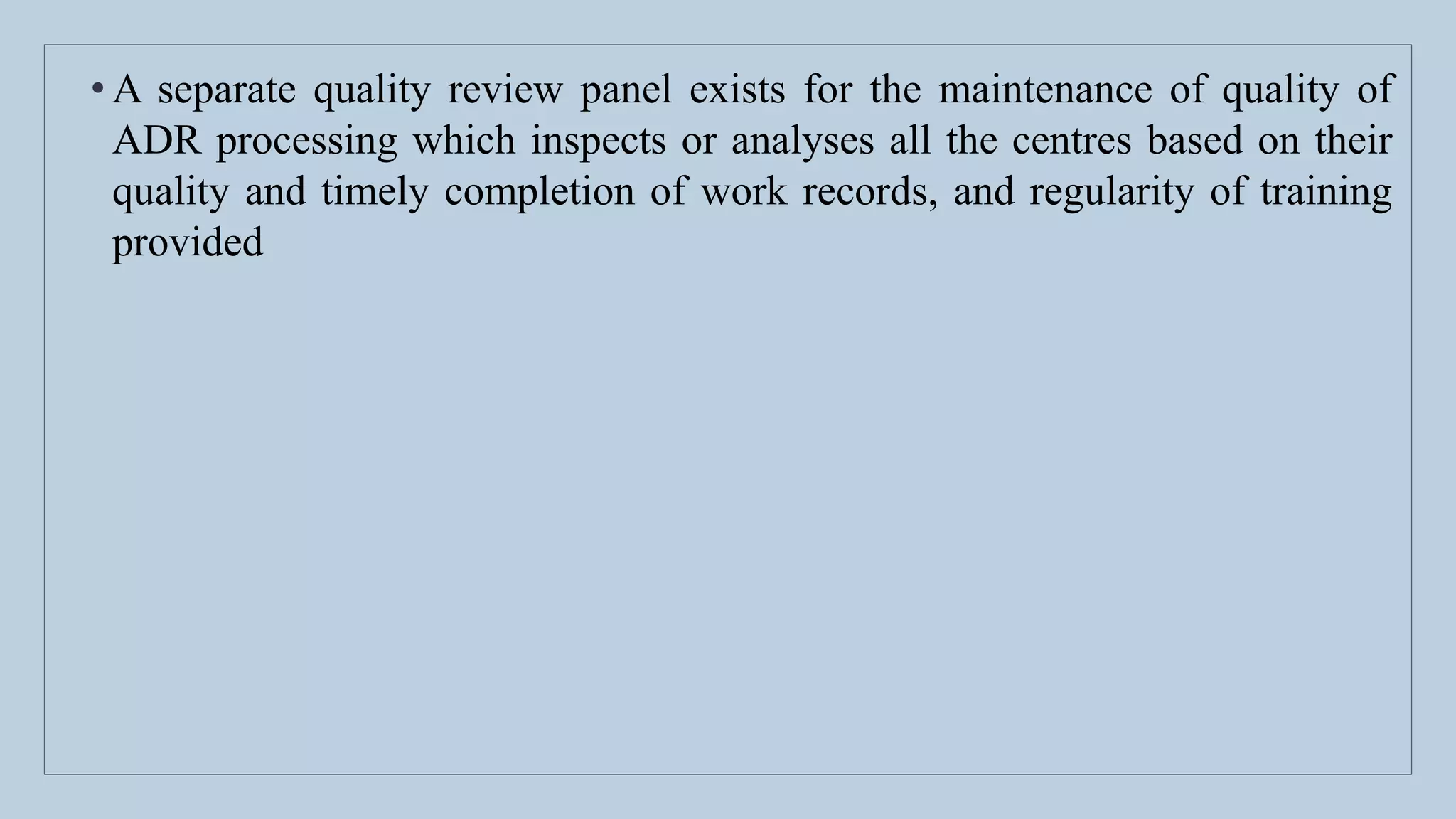
• A separate quality review panel exists for the maintenance of quality of
ADR processing which inspects or analyses all the centres based on their
quality and timely completion of work records, and regularity of training
provided
C
HOW DRUG IS
BANNED ?
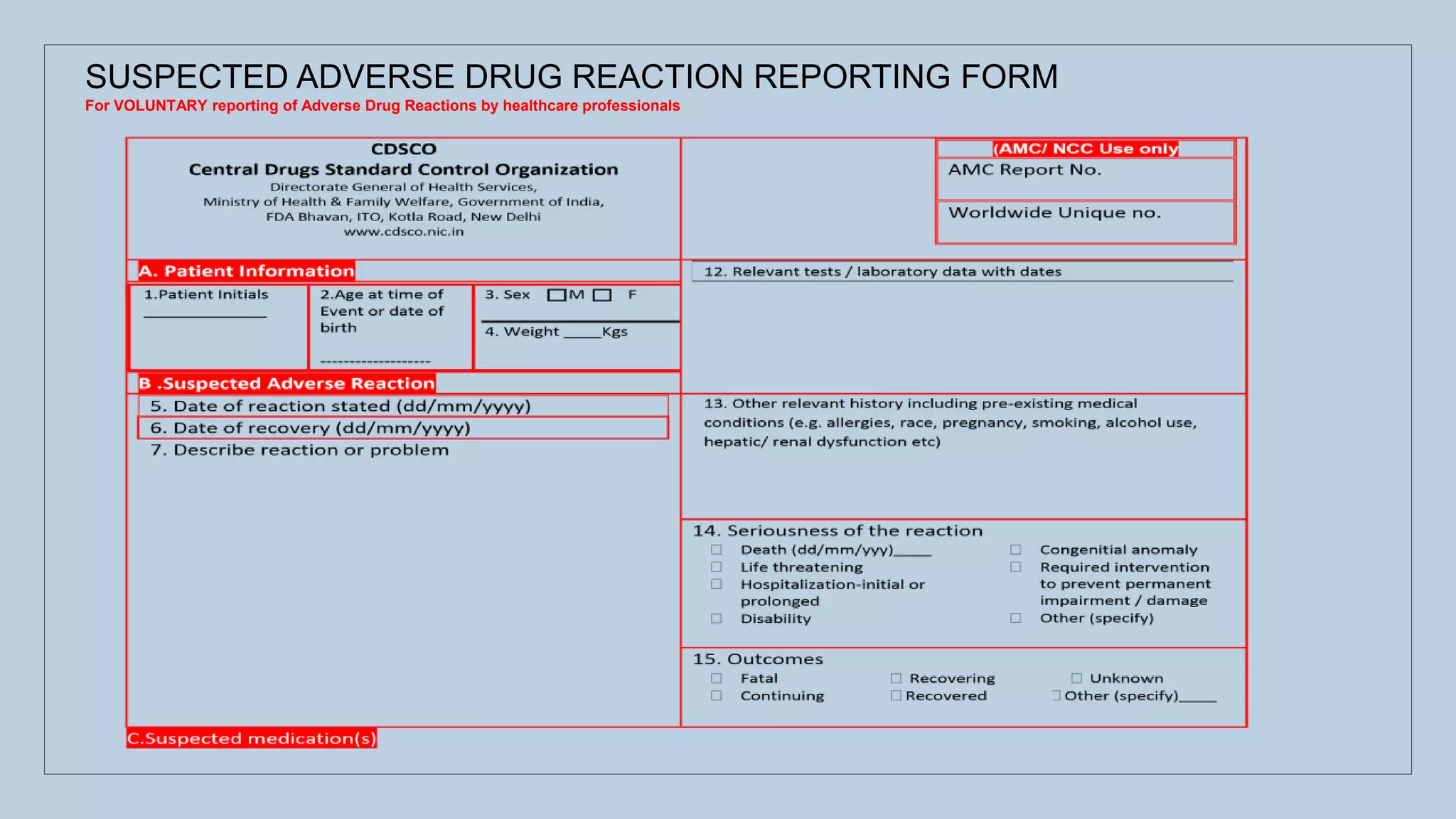
SUSPECTED ADVERSE DRUG REACTION REPORTING FORM
For VOLUNTARY reporting of Adverse Drug Reactions by healthcare professionals
Services Enhancing ADR reporting Activity in India
• Helpline facility for the assistance of ADR reporting:
• Toll free helpline number (1800 180 3024) on 11 October, 2013 which helps to
increase the involvement of the patients, stakeholders and public in ADR
reporting.
• Android mobile application for ADR reporting:
• For easy and faster reporting of ADR, NCCPvPI had developed a mobile app
in association with NSCBMC (Netaji Subhash Chandra Bose Medical
College), Jabalpur, on 22 May 2015.
• Feedback form for consumer
Spontenous adr reporting

Spontenous adr reporting

  • 1.
  • 2.
    SPONTENOUS ADR REPORTINGSYSTEM • Passive surveillance system: Health professionals are encouraged to report adverse reactions which they believe to be drug-related directly to… the regulatory authority or the company marketing the suspected product on a voluntary basis
  • 3.
    SPONTENOUS ADR REPORTINGPROCESS 1.Data acquisition 2.Data assessment 3.Data interpretation
  • 4.
    1. Data acquisition Whichdepends largely on the input of information derived from reports submitted by the health professionals who have encountered what they suspect is an ADR.
  • 5.
    2.Data assessment •Which involvesassessment of the individual case reports and assessment of pooled data obtained from various sources such as the international database of the WHO
  • 6.
    3.Data interpretation •Data interpretationbased on the available data and the assessments made, a signal related to the adverse reaction may be generated.
  • 7.
     India –‘Suspected Adverse Drug Reaction Reporting Form’  UK – ‘Yellow Card’, since 1964  Australia – ‘Blue Card’ , since 1964  US – ‘Med Watch’
  • 8.
  • 9.
    INDIA •Indian Pharmacopoeia Commission(IPC), Ghaziabad is functioning as a National Coordination Centre (NCC) for Pharmacovigilance Programme of India (PvPI). • 150 ADR monitoring centres (AMCs) were established in various medical institutions/hospitals across India to monitor and collect ADR reports under NCC-PvPI
  • 10.
  • 11.
    Who can report •Healthcare professionals (clinician, dentist pharmacist ,nurses and others) can report suspected adverse drug reaction. • Pharmaceutical companies can also send ICSRs specific for their product to NCC What to report • All types of suspected ADRs- irrespective of whether they are known or unknown, serious and non-serious, frequent or rare. • Although pharmacovigilance is primarily concerned with pharmaceutical medicines, adverse reactions associated with drugs used in traditional medicine (e.g. herbal remedies) should also be considered Whom to report • Use the ‘Suspected Adverse Drug Reaction Reporting Form’ which is available on the official website of IPC (www.ipc.gov.in) as well as CDSCO (www.cdsco.nic.in) to report any ADR. A reporter who is not a part of AMC can submit the ICSR to the nearest AMC or directly to the NCC.
  • 12.
    What to report •Any undesirable adverse event suspected to be associated with use of drug, biological (including blood products), herbal drugs, cosmetics or medical devices should be reported. They should include; 1. All ADRs as a result of prescription and non-prescription 2. All suspected adverse drug reactions regardless of whether or not the product was used in accordance with the product information provided by the company marketing the product. 3. Unexpected reaction, regardless of their nature or severity, whether not consistent with product information or labelling.
  • 13.
    4. An observedincrease in frequency of a given reaction. 5. A serious reaction, whether expected or not. 6. All suspected ADRs associated with drug-drug, drug- food or drug-food supplements interactions. 7. ADRs in special field of interest such as drug abuse and drug use in pregnancy and during lactation 8. ADRs occurring from overdose or medication error. 9. Unusual lack of efficacy or when suspected pharmaceutical defects are observed.
  • 14.
    What information isrequired for an ADR case report? • The minimal standard information to be provided for proper assessment of the ADR case report are; 1. Patient 2. Adverse reactions description (include laboratory results if available) 3. Information related to the suspected drug(s) 4. Information on management of the adverse reactions 5. Information about the reporter
  • 15.
    1. Patient information: •1. Patient identity: indicate initials or record number of the patient in hospital, medical institution, dispensary, clinic or pharmacy. • 2. Birth dates or age: indicate date, month and year • 3. Sex: Male or Female • 4. Weight: should be in Kilograms
  • 16.
    2. Adverse reaction(s) •1. Brief description of the ADR(s): indicate the adverse(s) reaction by marking X in the appropriate box. Preferably describe briefly the nature of the adverse reaction being reported but as clearly as possible, including the body site and severity. • 2. Time/date of onset of the adverse reactions: State the time of onset or the occurrence of the adverse reaction in relation to the administration of the drug. Indicate the date of onset in the following order; day, month and year.
  • 17.
    • 3. Otherrelevant information: • i. Patient medical history or laboratory data including dates if available, considered relevant to the case or the adverse reaction being reported should be entered. • ii. Mention appropriate laboratory tests done to the patient and results to confirm the adverse reaction. • iii. State this concisely but clearly.
  • 18.
    3. Suspected drug •1. Name of the suspected drug (s): trade name should preferably be used, if trade name not available, generic name may be used. Strength of the drug (s) should be stated • 2. Dosage: Tablet,suspension,injection…. • frequency: 4 times daily… • and route of administration should be clearly notified.
  • 19.
    WHO codes ROUTES CODESROUTES CODES Buccal BU Intrathecal IT Conjunctival CO Intratracheal TR Dental DE Intrauterine IU Implant MP Intravenous IV Inhalation IH Intravesical IB Insufflation IS Per oral PO Intra-arterial IA Per rectal PR Intra-articular IR Subcutaneous SC Intra cardiac IC Systemic(if route is not sepcifed) SY Intradermal ID Topical TO Intramuscular IM Tranmammary transfer TM Intranasal IN Sublingual SL Intraperitoneal IP urethral UR Intrapeural IL Vaginal VA
  • 20.
    3. Therapy date:the dates of beginning and termination of the administration of each drug should be stated, and preferably recorded as follows:- date, month and year. 4. Batch number and expiry date: provide these information if are available. 5. Reason for use: state indication or condition for which the drug(s) was given for. 6. Particular of concurrently drugs(or other treatment): state particulars of other drug (s) administered by the patient concurrently with the suspected drug, including drug administration for at least 1 month back with dosage, route of administration, duration of administration and indications. 7. Provide relevant information on medical devices
  • 21.
    4. Management ofADR 1.Confirmation of the ADRs: indicate what assisted in confirming the suspected adverse reactions. Eg: • i. Drug reactions confirmed by disappearance of the reaction after stopping administration of the drug or reducing the doses. • ii. Recovery on withdrawal of suspected drug(s) if no other drug is withdrawn and no therapy given. • iii. Recovery follows treatment of the reaction in addition to withdrawal of drug. 2. Mention the criteria for regarding the reaction as serious
  • 22.
    3. Mention anytreatment given to the patient after experiencing the ADRs. 4. Outcome: indicate the outcome of the adverse reaction by marking X in the appropriate box with dates in case of fatal outcome.
  • 23.
    5. Reporter informationDetails on reporter of an ADR: • mention your particulars:- • name, address of the health facility (hospital, institution, dispensary, clinic, company, pharmacy or maternity home). • E-mail address (optional), signature, telephone number and date of reporting the reaction (indicate date, month and year)
  • 24.
    When to report •Any suspected ADR should be reported as soon as possible. • Delay in reporting will make reporting inaccurate and unreliable. • If possible, report while the patient is still in the health facility this gives a chance to reporter to clear any ambiguity by re-questioning or examining the patient.
  • 25.
    Where to report: •Various Peripheral, Regional and Zonal centres have been proposed and established in India • Peripheral PV centre: It is a primary ADR information gathering centre. It includes small medical centres, private hospitals, dispensaries, nursing home and pharmacies. ADRs are recognized and synchronized by RPCs or ZPCs. Every state, Union territory and few leading medical colleges in India have this peripheral centre • Regional PV centre: It’s regarded as secondary PV Centre. It is located in medical college having relatively larger facilities. They are identified and coordinated by zonal centres. There are five such regional centres in India • Zonal PV centres: It’s regarded as Tertiary PV Centre. Generally located in metro city’s medical college having attachment of sufficient facility. It is identified by CDSCO and act as first ADR data collection centre. Zonal centre for North and East zone is AIIMS.
  • 26.
    List of CentralDrug Standard Control Organisation (CDSCO) Zonal and Sub-Zonal Offices • Zonal Centre-Ahmadabad • Zonal Centre-Hyderabad • North Zonal centre-Ghaziabad a) Sub-Zone Office-Ghaziabad b) Chandigarh, c) Sub-Zonal Office, Jammu • East Zonal Centre-Kolkata-Air Port and Sea Office, Kolkata • West Zonal Centre-Mumbai-Air Port and Sea Office, Mumbai, Jawaharlal Nehru Port Office, Navi Mumbai • South Zonal Centre-Chennai a) Air Port and Sea Office, b) Sub-Zonal and Port Office, Chennai c) Port Office, Kochi- Bangalore.
  • 27.
    Flow of ADRreporting
  • 28.
  • 29.
    Data collection Signal detection Reviewpanel Causality assement Case processing Data entry in database Regulatory authority Aggregate reporting Actions
  • 30.
    Processing of ADR •All the ADR reports from various sources are collected at the AMC’s. • PV staff at AMC study, validate and prioritize the report and perform provisional causality assessment. • The assessed ADR forms are then directed towards authorised coordinating centre for further proceedings. • The AMC’s staff maintains a record of all the activities of the centres and carries out ADR monitoring of drugs as per the standard watch list
  • 31.
    • The coordinatingcentres then conduct final causality evaluation and feed the reports into the PV database. • These centres also prepare an aggregate report of ADRs collected at said time interval and send it to WHO-UMC. • The finding of PV analysis is then implemented and integrated into general population health program. • Finally, the integrated ADR data is transferred through Vigi-Flow database to the UMC database. • UMC team analyses the submitted data and detects drug-ADR relationship called as a signal, is very important aspect and communicate with NCC-PvPI via CDSCO to stop the marketing or use of drug in India.
  • 32.
    • A separatequality review panel exists for the maintenance of quality of ADR processing which inspects or analyses all the centres based on their quality and timely completion of work records, and regularity of training provided
  • 33.
  • 35.
    SUSPECTED ADVERSE DRUGREACTION REPORTING FORM For VOLUNTARY reporting of Adverse Drug Reactions by healthcare professionals
  • 37.
    Services Enhancing ADRreporting Activity in India • Helpline facility for the assistance of ADR reporting: • Toll free helpline number (1800 180 3024) on 11 October, 2013 which helps to increase the involvement of the patients, stakeholders and public in ADR reporting. • Android mobile application for ADR reporting: • For easy and faster reporting of ADR, NCCPvPI had developed a mobile app in association with NSCBMC (Netaji Subhash Chandra Bose Medical College), Jabalpur, on 22 May 2015. • Feedback form for consumer