
IRENE .V.R
IST M.PHARM
PHARMACYPRACTIC
E
CASE REPORT FORM
AND APPLICATION
IRENE.V.R
IST M.PHARM
DEPT. PHARMACY
PRACTICE
1
2
DEFINITION :
A printed, optical or electronic document designed to
record all of the protocol required information to be
reported to the sponsor
A case report form (CRF) is a paper or electronic
questionnaire specifically used in clinical trial research.
All data on each patient participating in a clinical trial
are held and/or documented in the CRF, including
adverse events
INTRODUCTION
 Case report form (CRF) is a specialized
document in clinical research. It should
be study protocol driven, robust in
content and have material to collect the
study specific data
 The size of a CRF can range from a handwritten
one-time 'snapshot' of a patient's physical
condition to hundreds of pages of electronically
captured data obtained over a period of weeks or
months
3
4
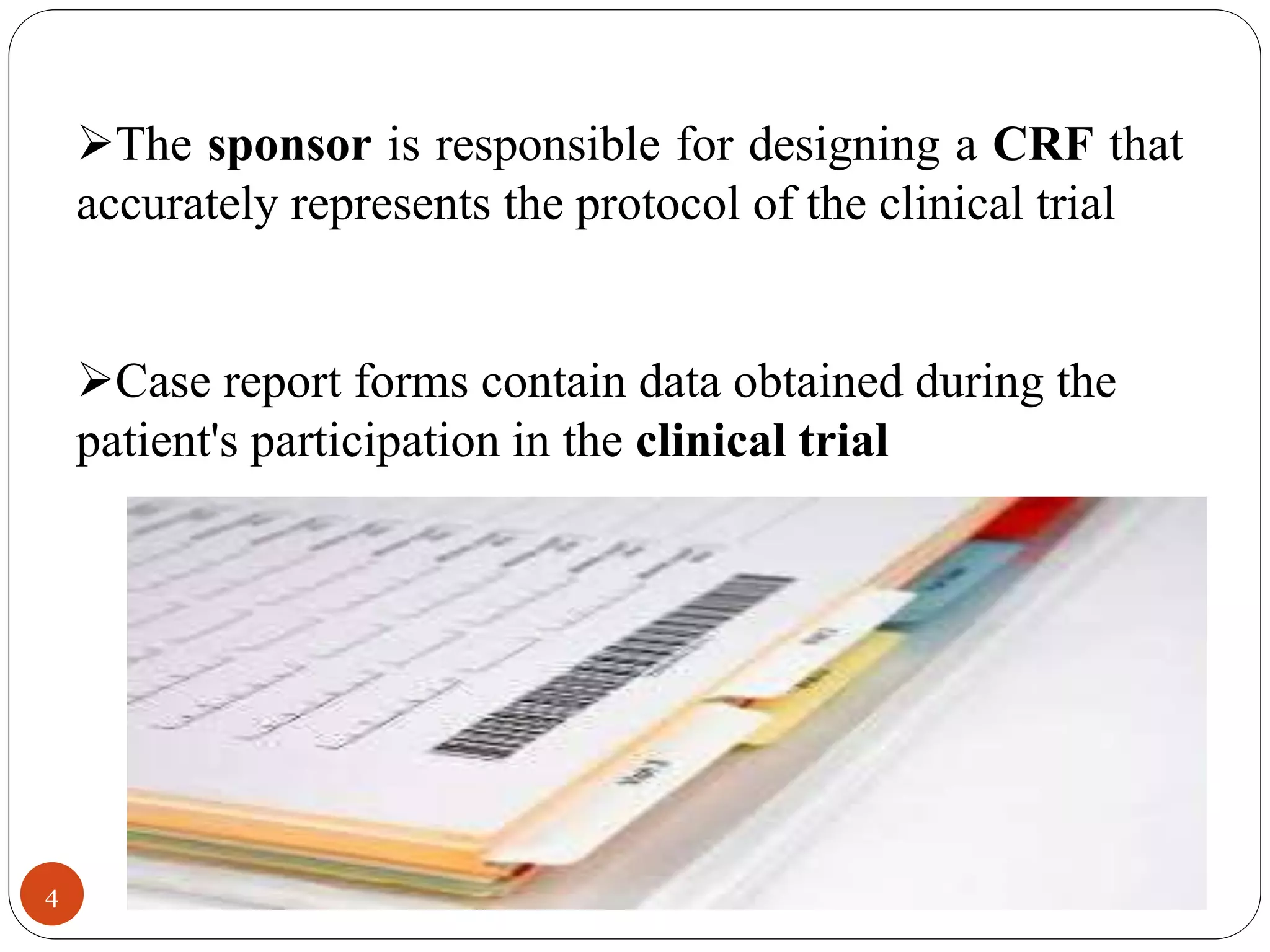
The sponsor is responsible for designing a CRF that
accurately represents the protocol of the clinical trial
Case report forms contain data obtained during the
patient's participation in the clinical trial
GOALS
5
 to collect data that can be verified and used
for analysis according to Good Clinical
Practice (GCP)
OBJECTIVES
 Primary objective of CRF designing is to
gather complete and accurate data by avoiding
duplication and facilitating transcription of data
from source documents onto the CRF
6
Because of human and machine error, the data entered in
CRFs is rarely completely accurate or entirely readable
To combat these errors monitors are usually hired by the
sponsor to audit the CRF to make sure the CRF contains the
correct data.
From the sponsor's point of view, the main logistic goal of a
clinical trial is to obtain accurate CRFs
Before being sent to the sponsor, this data is usually de-
identified (not traceable to the patient) by removing the
patient's name, medical record number, etc., and giving the
patient a unique study number
DESIGNING THE CRF
7
 Should reflect the protocol
 Must be developed and tested in advance
 Must follow a logical order
 Must be easy to enter in a database
 Can be computerized (eCRF)
 Collect only needed variables depending of the
objective of the study – Neither too few nor
too much
STANDARD CASE REPORT FORM
DESIGN
8
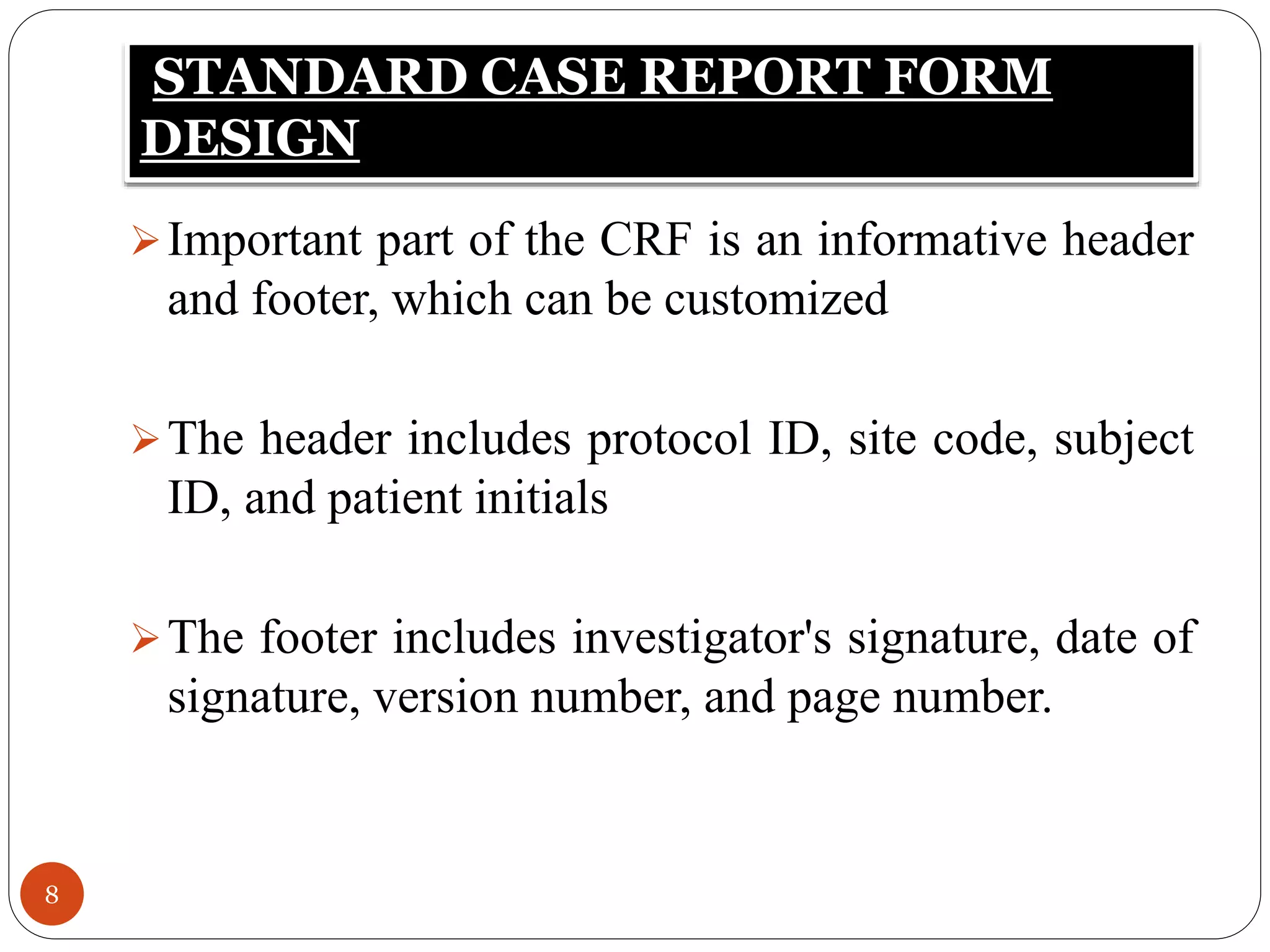
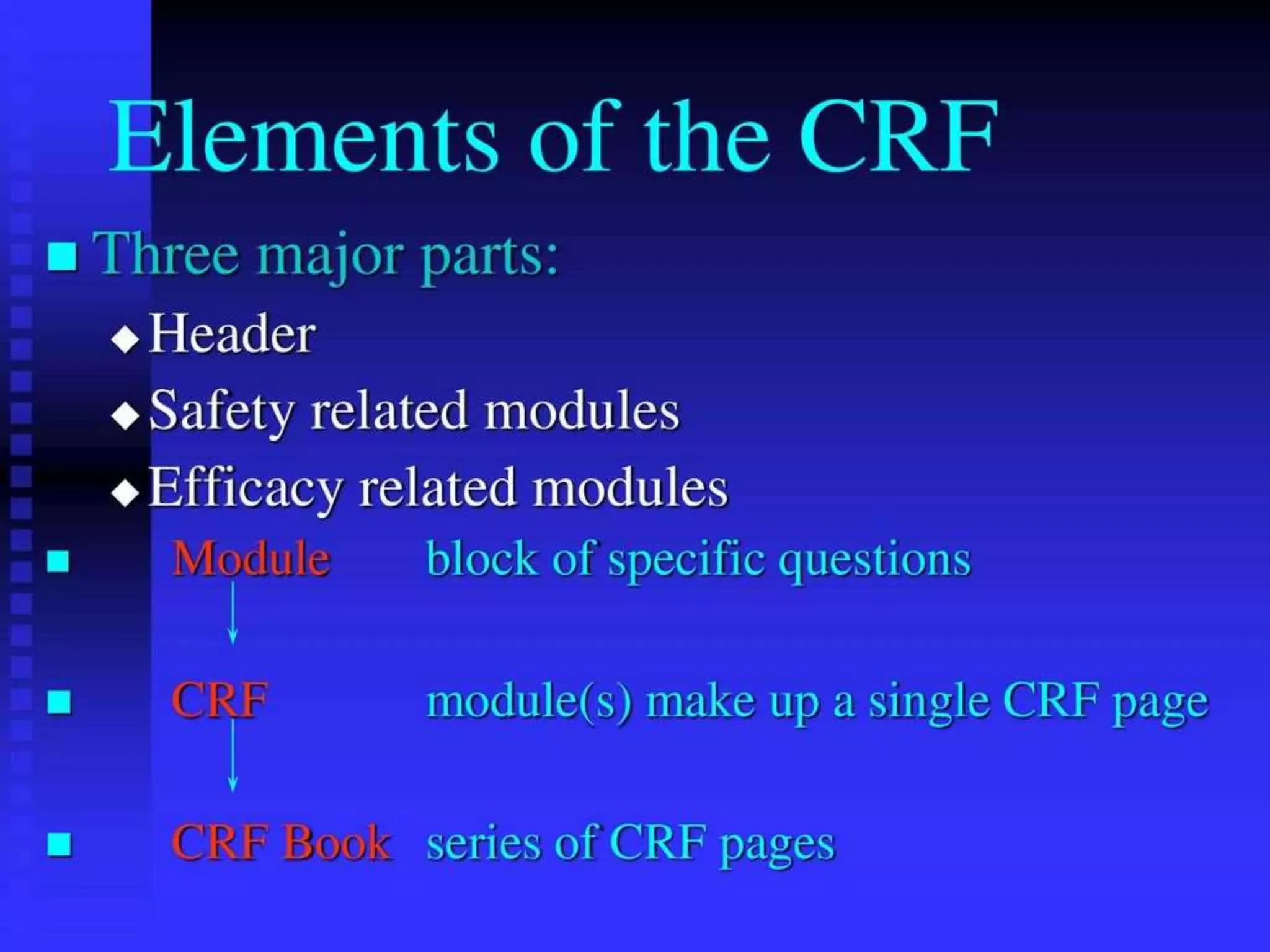
Important part of the CRF is an informative header
and footer, which can be customized
The header includes protocol ID, site code, subject
ID, and patient initials
The footer includes investigator's signature, date of
signature, version number, and page number.
9
10
While designing a CRF,
• Use of consistent formats, font style and font sizes
throughout the CRF booklet
•Use of clear and concise questions and instructions
•boxes that clearly indicate place and format of data to be
recorded should be provided to the person recording the
data as much as possible
•Using the option of “circling of answers” should be limited
as it's hard to interpret; instead check boxes would be
appropriate
11
•Provide bold and italicized instructions
•Minimize free text responses
•Page numbering if necessary, should be consistent
throughout
•Specify the unit of measurement
•Indicate the number of decimal places to be recorded
•Use standard data format (e.g., dd/mm/yyyy)
12
•Use “no carbon required (NCR)” copies to ensure
exact replica of CRF
•Use instructions including page numbers where data
has to be entered
•Provide boxes or separate lines to hold the answers.
This indirectly informs the data recorder where to
write/enter the response and helps to differentiate it
visually from the entry fields for other questions
•Separate the columns with thick lines
13
IMPORTANCE OF CRF
14
 It provides valid information for hypothesis-
testing during clinical research.
 A case report form captures standardized clinical
data at every stage of the research process. This
data is analyzed to arrive at research outcomes.
 Case report forms play an essential part in medical
research breakthroughs. By storing unique data
from each research subject, case report forms
create a large pool of verifiable medical research
information.
 It improves problem-based medical education.
15
•Medical researchers leverage existing data from different case
report forms to advance systematic investigations in specific
fields and sub-fields.
•Data from case report forms have helped us develop
treatments and vaccines for different diseases, viruses, and
infections.
CONTENTS IN CRF
16
1. On the front page provide :
– Title of the study
– Registration number
– Name or code of the centre
2. On the second page provide a contact list :
Sponsor, investigator
3. Patient identifier
4. Informed Consent
5. Inclusion / non inclusion criteria
17
 Follow the study schedule
– Socio-demographic characteristics
– Clinical and biological data
– Treatment
– Adverse event, safety data
• Self explanatory
• Appendix – Classification used, classification of
adverse event severity – SOP for inclusion,
randomisation, biological sampling
– List of Prohibited Concomitant Medications
18
19
20
TYPES : paper CRF and eCRF
•Design of the CRF (paper form/electronic form) is a key quality
step in ensuring the data required by the protocol
1. Paper CRF :
•traditional way of data capture
• and a better option if studies are small or vary in
design
• preparation is tedious job results in data error and
wrong conclusion
21
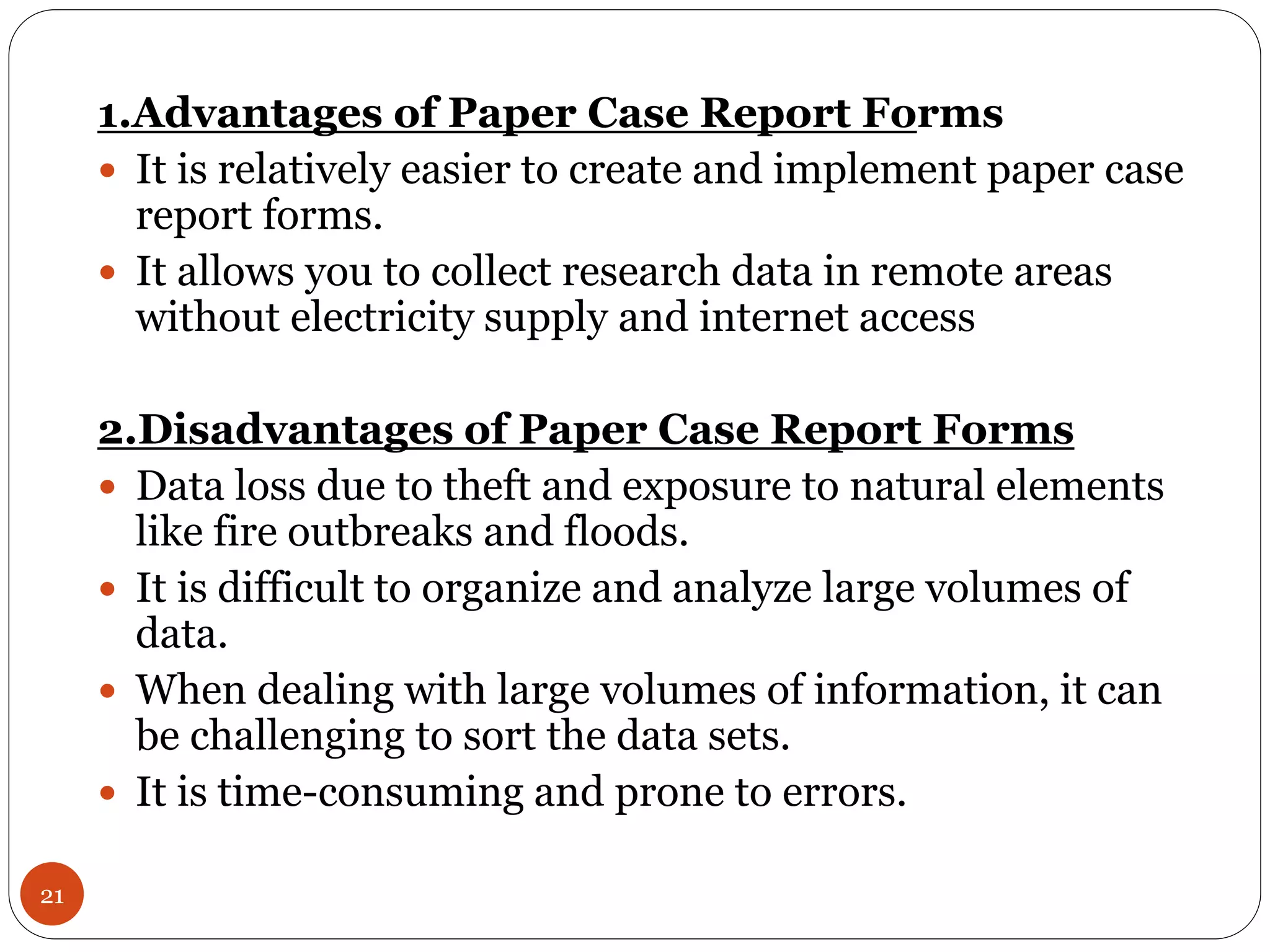
1.Advantages of Paper Case Report Forms
 It is relatively easier to create and implement paper case
report forms.
 It allows you to collect research data in remote areas
without electricity supply and internet access
2.Disadvantages of Paper Case Report Forms
 Data loss due to theft and exposure to natural elements
like fire outbreaks and floods.
 It is difficult to organize and analyze large volumes of
data.
 When dealing with large volumes of information, it can
be challenging to sort the data sets.
 It is time-consuming and prone to errors.
22
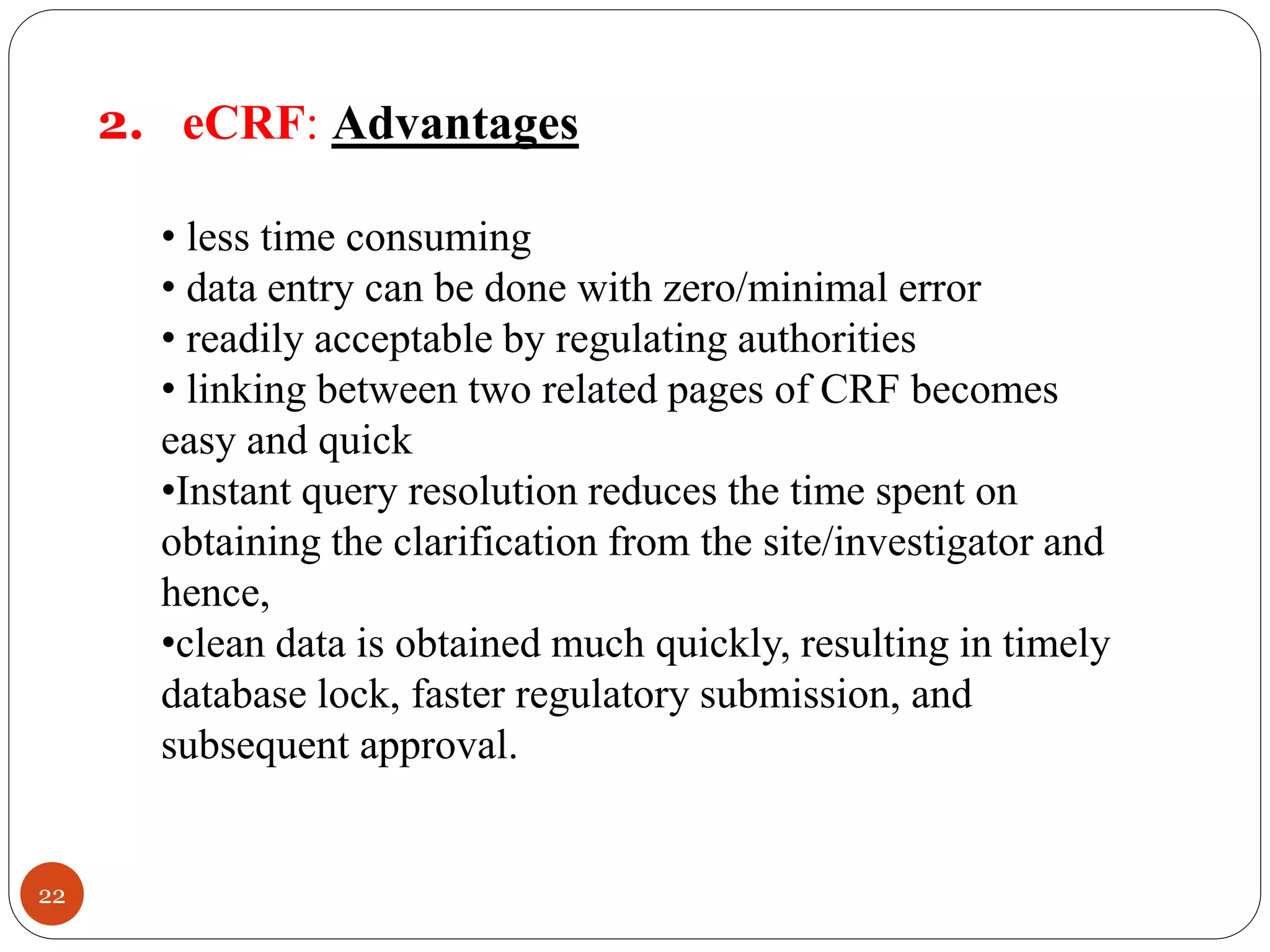
2. eCRF: Advantages
• less time consuming
• data entry can be done with zero/minimal error
• readily acceptable by regulating authorities
• linking between two related pages of CRF becomes
easy and quick
•Instant query resolution reduces the time spent on
obtaining the clarification from the site/investigator and
hence,
•clean data is obtained much quickly, resulting in timely
database lock, faster regulatory submission, and
subsequent approval.
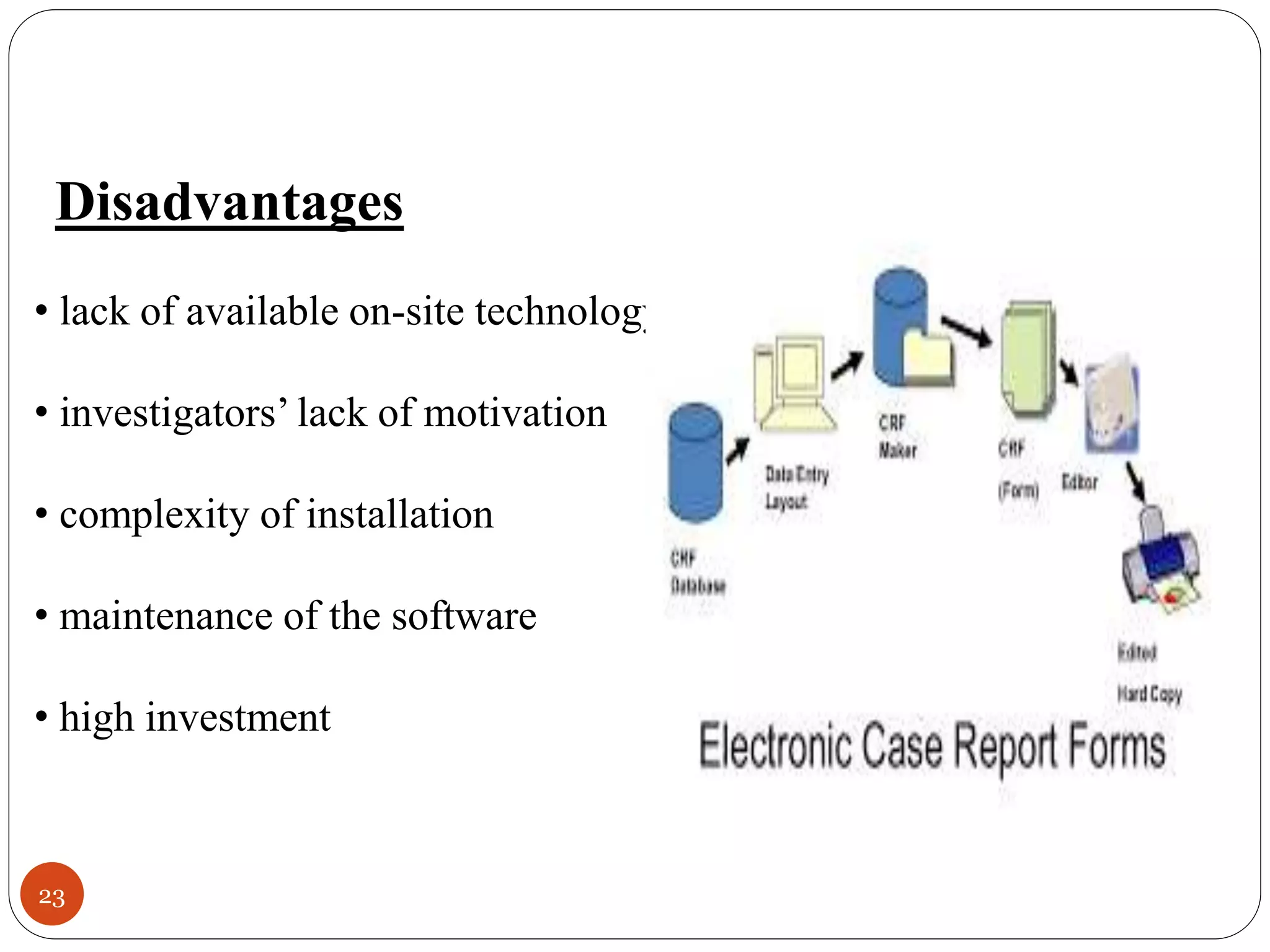
23
Disadvantages
• lack of available on-site technology
• investigators’ lack of motivation
• complexity of installation
• maintenance of the software
• high investment
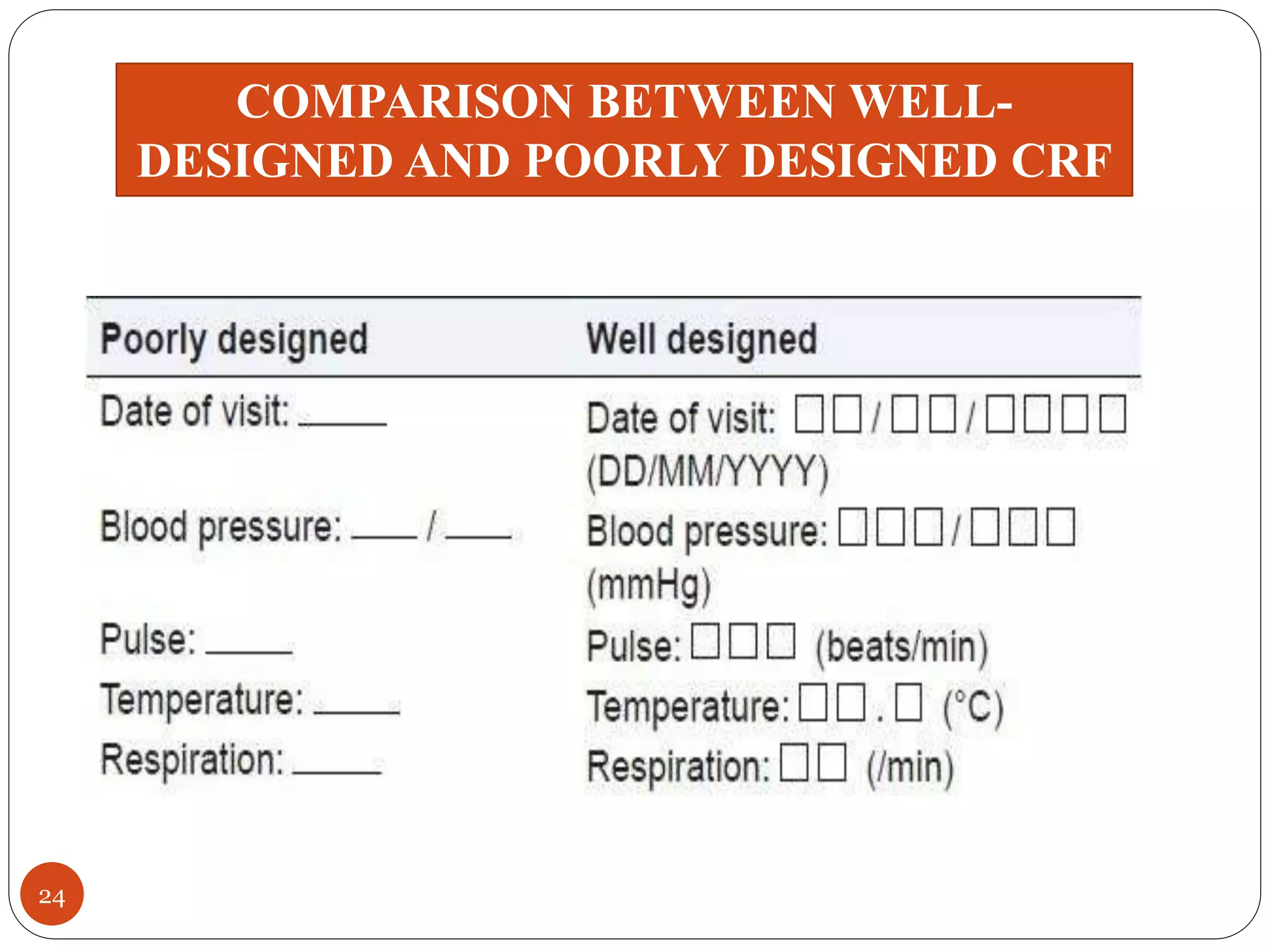
24
COMPARISON BETWEEN WELL-
DESIGNED AND POORLY DESIGNED CRF
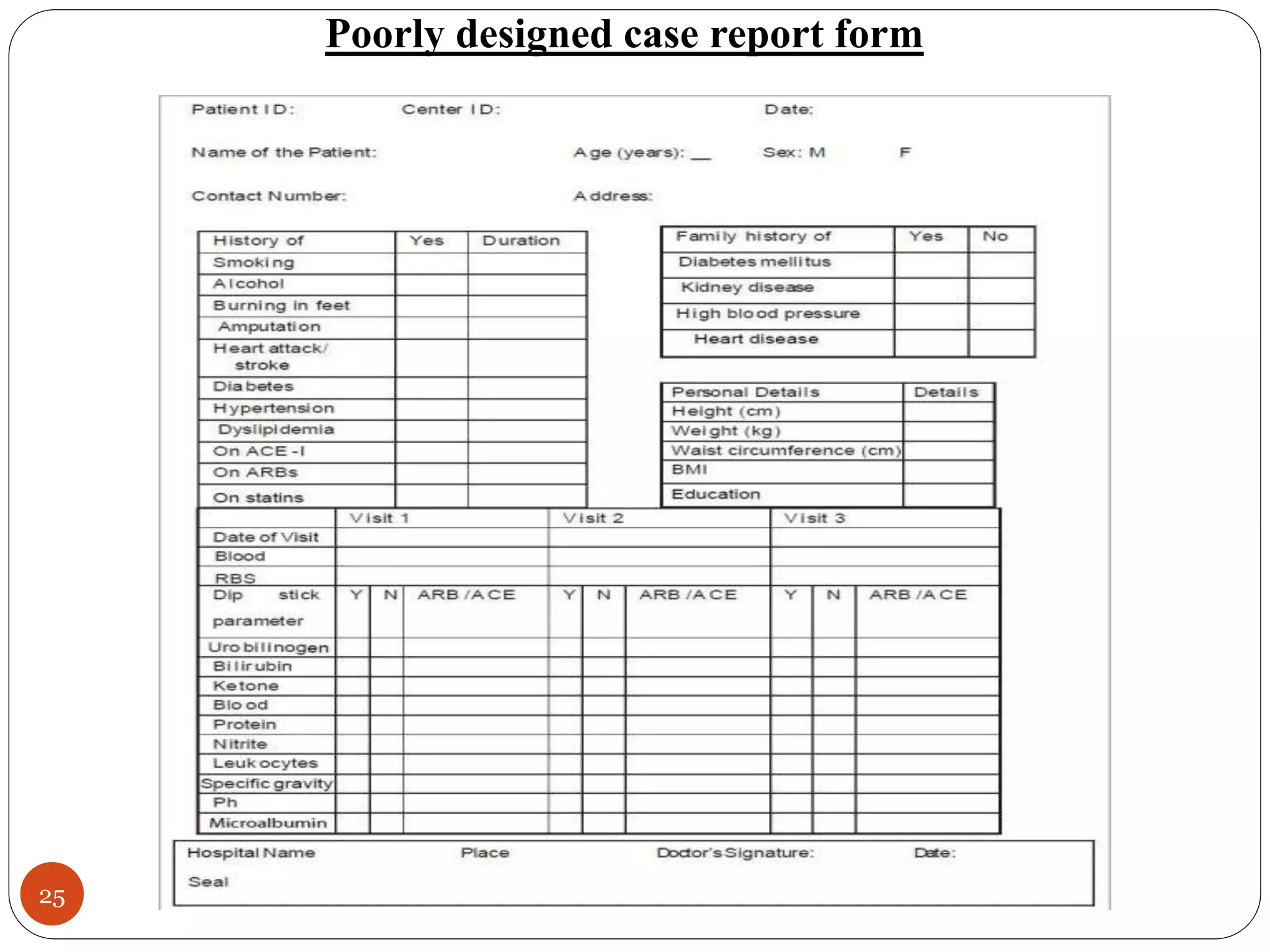
25
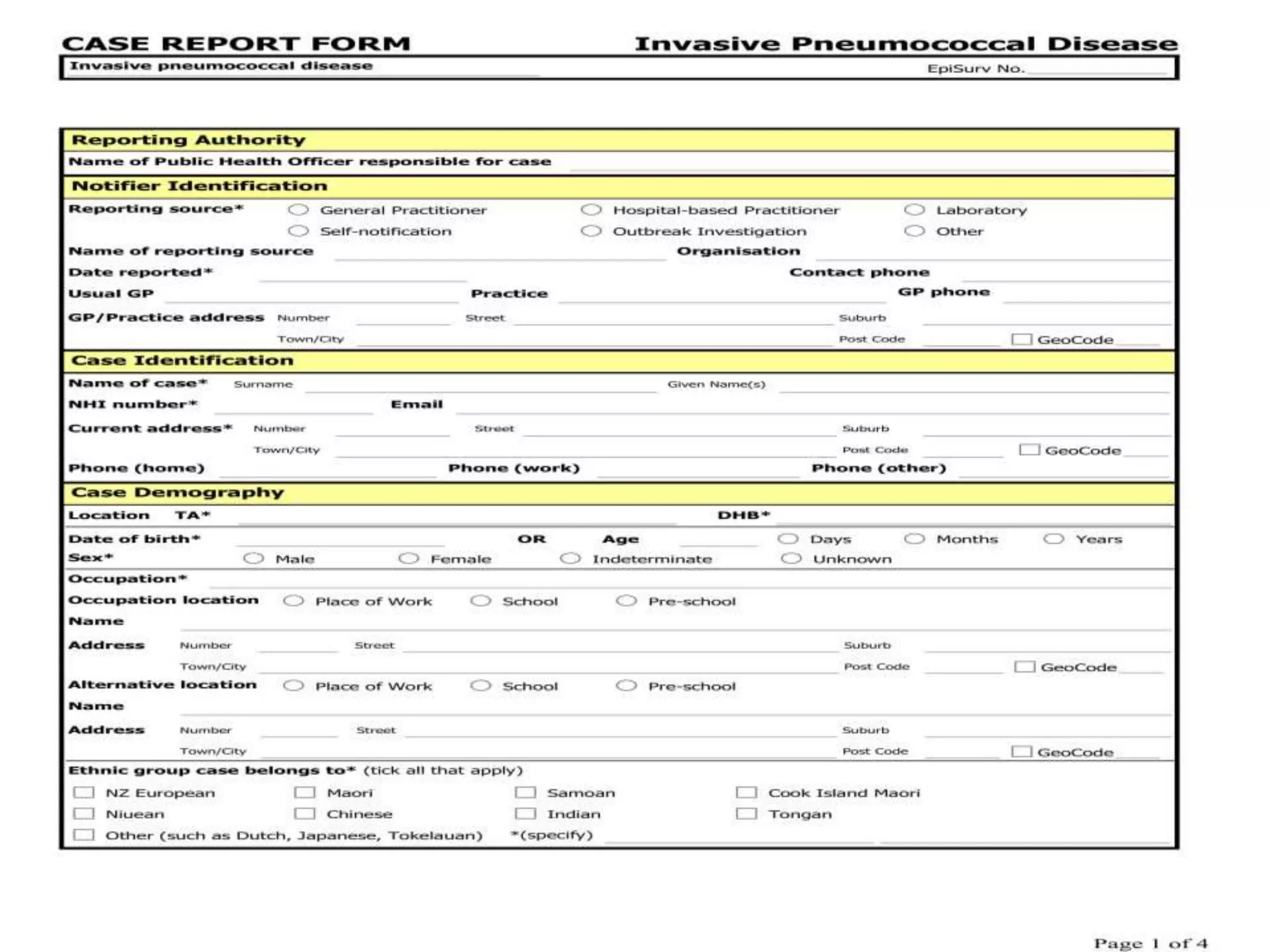
Poorly designed case report form
26
STANDARD CASE REPORT FORM TEMPLATES
A “library” of standard templates should be established
and maintained by the sponsor/contract research
organizations, pharmaceutical companies
It is to maintain uniformity in the CRF design and to
save time.
Most commonly used standard CRF templates are
inclusion criteria, exclusion criteria, demography, medical
history, PE, AE, concomitant medication and study
outcome modules
27
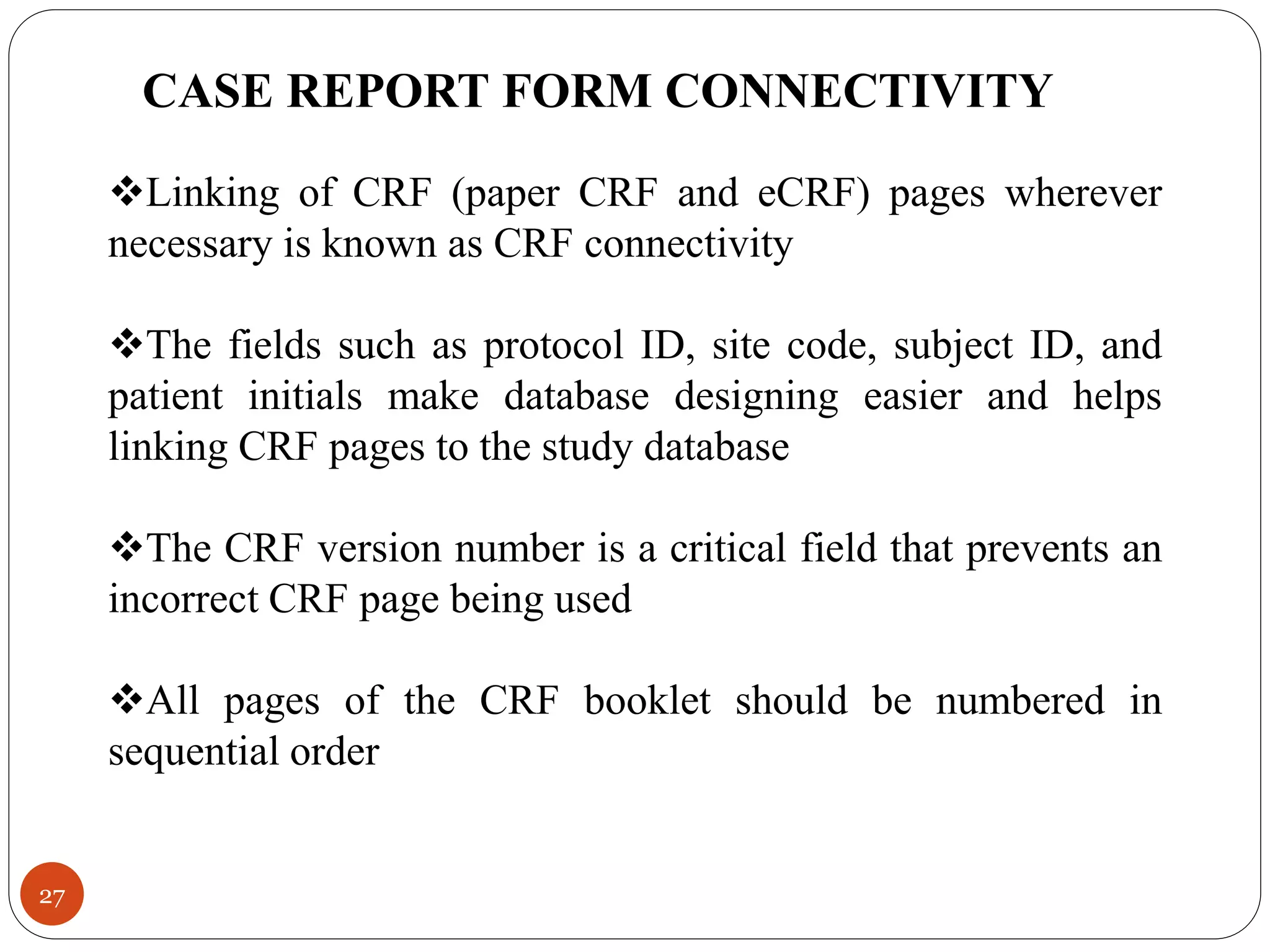
CASE REPORT FORM CONNECTIVITY
Linking of CRF (paper CRF and eCRF) pages wherever
necessary is known as CRF connectivity
The fields such as protocol ID, site code, subject ID, and
patient initials make database designing easier and helps
linking CRF pages to the study database
The CRF version number is a critical field that prevents an
incorrect CRF page being used
All pages of the CRF booklet should be numbered in
sequential order
CASE REPORT COMPLETION
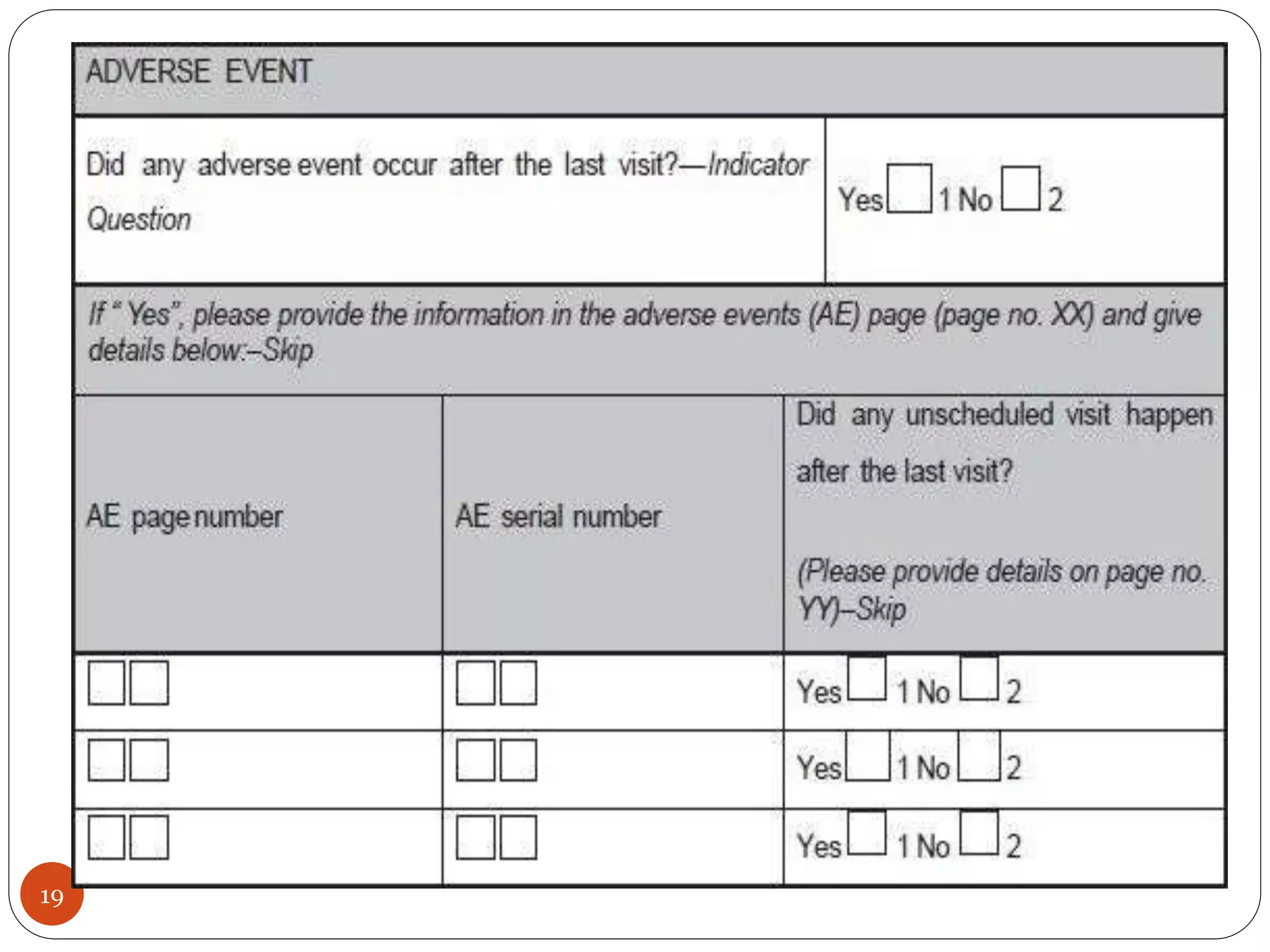
GUIDELINES :
28
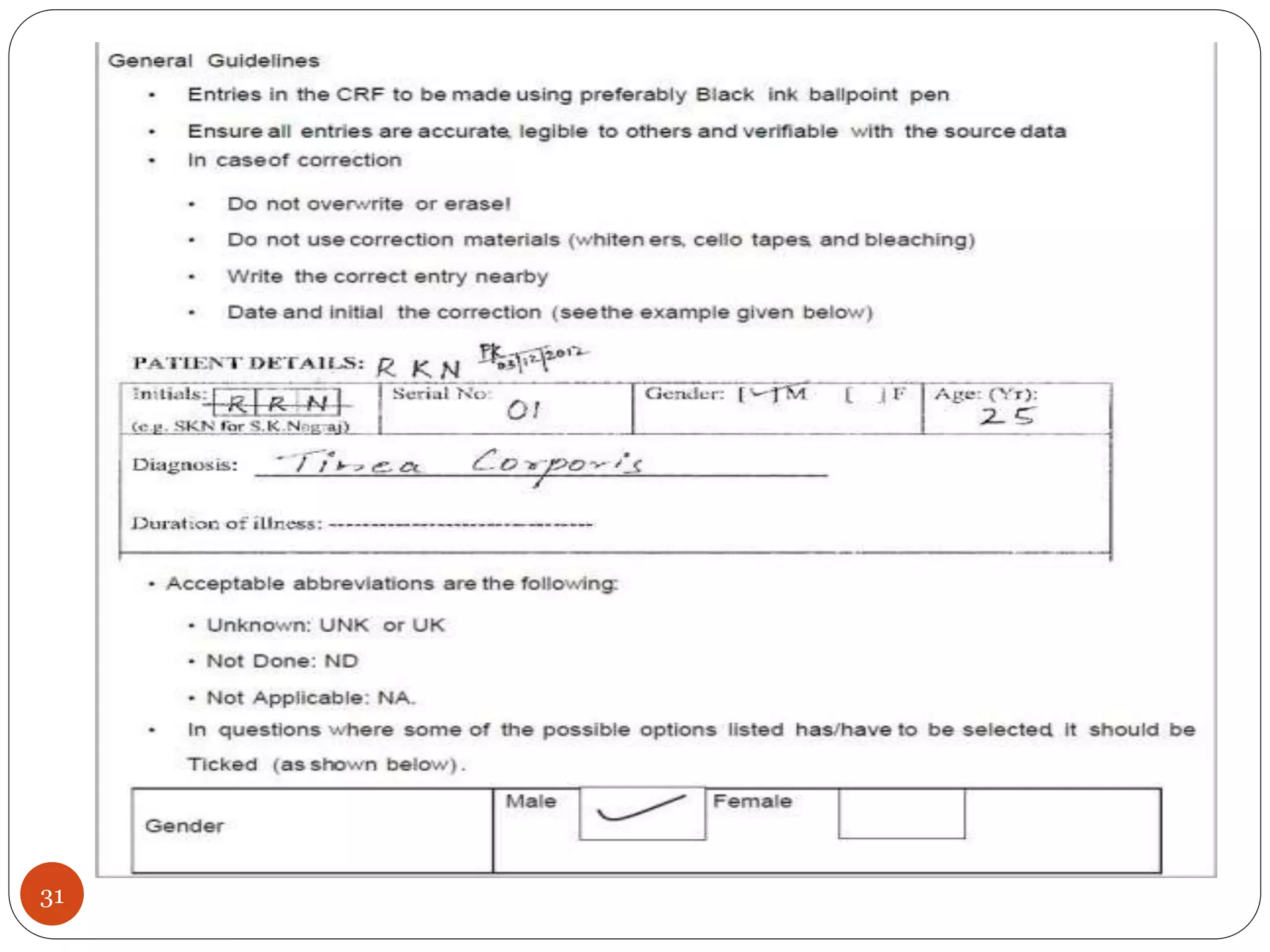
 A CRF completion guideline is a document to
assist the investigator to complete the CRF in a step
by step manner and is drafted concurrently in line
with the CRF and protocol
 There is no standard template for CRF completion
guidelines as it is study specific.
 It should be prepared in such a way that it enables
the site personnel to complete the CRFs with ease
and legibility
29
•CRF completion manual should provide clear
instructions to site personnel for accurate
completion of CRFs along with clear expectations
including proper instructions on handling
unknown data.
General Instructions
30
 These forms are printed on 3‐part NCR paper.
 Please ensure that the guardboard/wrap‐around cover is
inserted between each page before writing.
 Press firmly when writing.
 Complete the CRF using a black ballpoint pen.
 Other colours [pen tips] may not show on all copies.
 Ensure that all entries are printed and legible.
 Ensure that the header information (i.e. centre no.,
subject’s initials and subject’s ID) is completed consistently
throughout the CRF. If a subject prematurely discontinues
from the trial, the header information and CRF pages must
be completed and a single line drawn across each page.
 Ensure that all fields are completed on each page or an
explanation for missing data is recorded on the Comments
page.
31
REFERENCES
32
1. Latha, M,Bellary, Krishnankutty,(2014). Basics
of case report form designing in clinical
research. Perspectives in Clinical Research;159.
2. Kelly Hills,Tara Bartlett,b Isabelle Leconte,
PhD, Meredith Zozus, PhD. CRF Completion
Guidelines;25-30.

Case report form and application

  • 1.
    IRENE .V.R IST M.PHARM PHARMACYPRACTIC E CASEREPORT FORM AND APPLICATION IRENE.V.R IST M.PHARM DEPT. PHARMACY PRACTICE 1
  • 2.
    2 DEFINITION : A printed,optical or electronic document designed to record all of the protocol required information to be reported to the sponsor A case report form (CRF) is a paper or electronic questionnaire specifically used in clinical trial research. All data on each patient participating in a clinical trial are held and/or documented in the CRF, including adverse events
  • 3.
    INTRODUCTION  Case reportform (CRF) is a specialized document in clinical research. It should be study protocol driven, robust in content and have material to collect the study specific data  The size of a CRF can range from a handwritten one-time 'snapshot' of a patient's physical condition to hundreds of pages of electronically captured data obtained over a period of weeks or months 3
  • 4.
    4 The sponsor isresponsible for designing a CRF that accurately represents the protocol of the clinical trial Case report forms contain data obtained during the patient's participation in the clinical trial
  • 5.
    GOALS 5  to collectdata that can be verified and used for analysis according to Good Clinical Practice (GCP) OBJECTIVES  Primary objective of CRF designing is to gather complete and accurate data by avoiding duplication and facilitating transcription of data from source documents onto the CRF
  • 6.
    6 Because of humanand machine error, the data entered in CRFs is rarely completely accurate or entirely readable To combat these errors monitors are usually hired by the sponsor to audit the CRF to make sure the CRF contains the correct data. From the sponsor's point of view, the main logistic goal of a clinical trial is to obtain accurate CRFs Before being sent to the sponsor, this data is usually de- identified (not traceable to the patient) by removing the patient's name, medical record number, etc., and giving the patient a unique study number
  • 7.
    DESIGNING THE CRF 7 Should reflect the protocol  Must be developed and tested in advance  Must follow a logical order  Must be easy to enter in a database  Can be computerized (eCRF)  Collect only needed variables depending of the objective of the study – Neither too few nor too much
  • 8.
    STANDARD CASE REPORTFORM DESIGN 8 Important part of the CRF is an informative header and footer, which can be customized The header includes protocol ID, site code, subject ID, and patient initials The footer includes investigator's signature, date of signature, version number, and page number.
  • 9.
  • 10.
    10 While designing aCRF, • Use of consistent formats, font style and font sizes throughout the CRF booklet •Use of clear and concise questions and instructions •boxes that clearly indicate place and format of data to be recorded should be provided to the person recording the data as much as possible •Using the option of “circling of answers” should be limited as it's hard to interpret; instead check boxes would be appropriate
  • 11.
    11 •Provide bold anditalicized instructions •Minimize free text responses •Page numbering if necessary, should be consistent throughout •Specify the unit of measurement •Indicate the number of decimal places to be recorded •Use standard data format (e.g., dd/mm/yyyy)
  • 12.
    12 •Use “no carbonrequired (NCR)” copies to ensure exact replica of CRF •Use instructions including page numbers where data has to be entered •Provide boxes or separate lines to hold the answers. This indirectly informs the data recorder where to write/enter the response and helps to differentiate it visually from the entry fields for other questions •Separate the columns with thick lines
  • 13.
  • 14.
    IMPORTANCE OF CRF 14 It provides valid information for hypothesis- testing during clinical research.  A case report form captures standardized clinical data at every stage of the research process. This data is analyzed to arrive at research outcomes.  Case report forms play an essential part in medical research breakthroughs. By storing unique data from each research subject, case report forms create a large pool of verifiable medical research information.  It improves problem-based medical education.
  • 15.
    15 •Medical researchers leverageexisting data from different case report forms to advance systematic investigations in specific fields and sub-fields. •Data from case report forms have helped us develop treatments and vaccines for different diseases, viruses, and infections.
  • 16.
    CONTENTS IN CRF 16 1.On the front page provide : – Title of the study – Registration number – Name or code of the centre 2. On the second page provide a contact list : Sponsor, investigator 3. Patient identifier 4. Informed Consent 5. Inclusion / non inclusion criteria
  • 17.
    17  Follow thestudy schedule – Socio-demographic characteristics – Clinical and biological data – Treatment – Adverse event, safety data • Self explanatory • Appendix – Classification used, classification of adverse event severity – SOP for inclusion, randomisation, biological sampling – List of Prohibited Concomitant Medications
  • 18.
  • 19.
  • 20.
    20 TYPES : paperCRF and eCRF •Design of the CRF (paper form/electronic form) is a key quality step in ensuring the data required by the protocol 1. Paper CRF : •traditional way of data capture • and a better option if studies are small or vary in design • preparation is tedious job results in data error and wrong conclusion
  • 21.
    21 1.Advantages of PaperCase Report Forms  It is relatively easier to create and implement paper case report forms.  It allows you to collect research data in remote areas without electricity supply and internet access 2.Disadvantages of Paper Case Report Forms  Data loss due to theft and exposure to natural elements like fire outbreaks and floods.  It is difficult to organize and analyze large volumes of data.  When dealing with large volumes of information, it can be challenging to sort the data sets.  It is time-consuming and prone to errors.
  • 22.
    22 2. eCRF: Advantages •less time consuming • data entry can be done with zero/minimal error • readily acceptable by regulating authorities • linking between two related pages of CRF becomes easy and quick •Instant query resolution reduces the time spent on obtaining the clarification from the site/investigator and hence, •clean data is obtained much quickly, resulting in timely database lock, faster regulatory submission, and subsequent approval.
  • 23.
    23 Disadvantages • lack ofavailable on-site technology • investigators’ lack of motivation • complexity of installation • maintenance of the software • high investment
  • 24.
    24 COMPARISON BETWEEN WELL- DESIGNEDAND POORLY DESIGNED CRF
  • 25.
  • 26.
    26 STANDARD CASE REPORTFORM TEMPLATES A “library” of standard templates should be established and maintained by the sponsor/contract research organizations, pharmaceutical companies It is to maintain uniformity in the CRF design and to save time. Most commonly used standard CRF templates are inclusion criteria, exclusion criteria, demography, medical history, PE, AE, concomitant medication and study outcome modules
  • 27.
    27 CASE REPORT FORMCONNECTIVITY Linking of CRF (paper CRF and eCRF) pages wherever necessary is known as CRF connectivity The fields such as protocol ID, site code, subject ID, and patient initials make database designing easier and helps linking CRF pages to the study database The CRF version number is a critical field that prevents an incorrect CRF page being used All pages of the CRF booklet should be numbered in sequential order
  • 28.
    CASE REPORT COMPLETION GUIDELINES: 28  A CRF completion guideline is a document to assist the investigator to complete the CRF in a step by step manner and is drafted concurrently in line with the CRF and protocol  There is no standard template for CRF completion guidelines as it is study specific.  It should be prepared in such a way that it enables the site personnel to complete the CRFs with ease and legibility
  • 29.
    29 •CRF completion manualshould provide clear instructions to site personnel for accurate completion of CRFs along with clear expectations including proper instructions on handling unknown data.
  • 30.
    General Instructions 30  Theseforms are printed on 3‐part NCR paper.  Please ensure that the guardboard/wrap‐around cover is inserted between each page before writing.  Press firmly when writing.  Complete the CRF using a black ballpoint pen.  Other colours [pen tips] may not show on all copies.  Ensure that all entries are printed and legible.  Ensure that the header information (i.e. centre no., subject’s initials and subject’s ID) is completed consistently throughout the CRF. If a subject prematurely discontinues from the trial, the header information and CRF pages must be completed and a single line drawn across each page.  Ensure that all fields are completed on each page or an explanation for missing data is recorded on the Comments page.
  • 31.
  • 32.
    REFERENCES 32 1. Latha, M,Bellary,Krishnankutty,(2014). Basics of case report form designing in clinical research. Perspectives in Clinical Research;159. 2. Kelly Hills,Tara Bartlett,b Isabelle Leconte, PhD, Meredith Zozus, PhD. CRF Completion Guidelines;25-30.