Welcome
The Role of Artificial Intelligence In Signal Detection And
Risk Management
A rp ita H az ra
M . Sc, C ertifica te cou rse In P ha rm acov ig ila nce
C SR PL_STD _IN D_H Y D_ON L/CLS _1 5 7 /0 92 0 2 4
11/20/2024
www.clinosol.com | follow us on social media
@clinosolresearch
1
Index
□ Intro du ctio n
□ Sig na l
So urces o f sig nal
□ Sig na l D etectio n
M eth od s O f Sig na l D etec tio n
C ha lleng es In Trad ition al Sign al D etection
A rtificial Intellig ence(A I) U se In Sig nal D etectio n
□ Risk M an ag em ent
A rtificia l Intellig ence Integratio n In R isk M a nag em ent w o rk flow
□ B enefits of A I In Sig na l D etectio n A nd Risk M an ag em ent
□ C ha llen ges
□ C o nclu sion
□ Reference
www.clinosol.com | follow us on social media
@clinosolresearch
2
Introduction
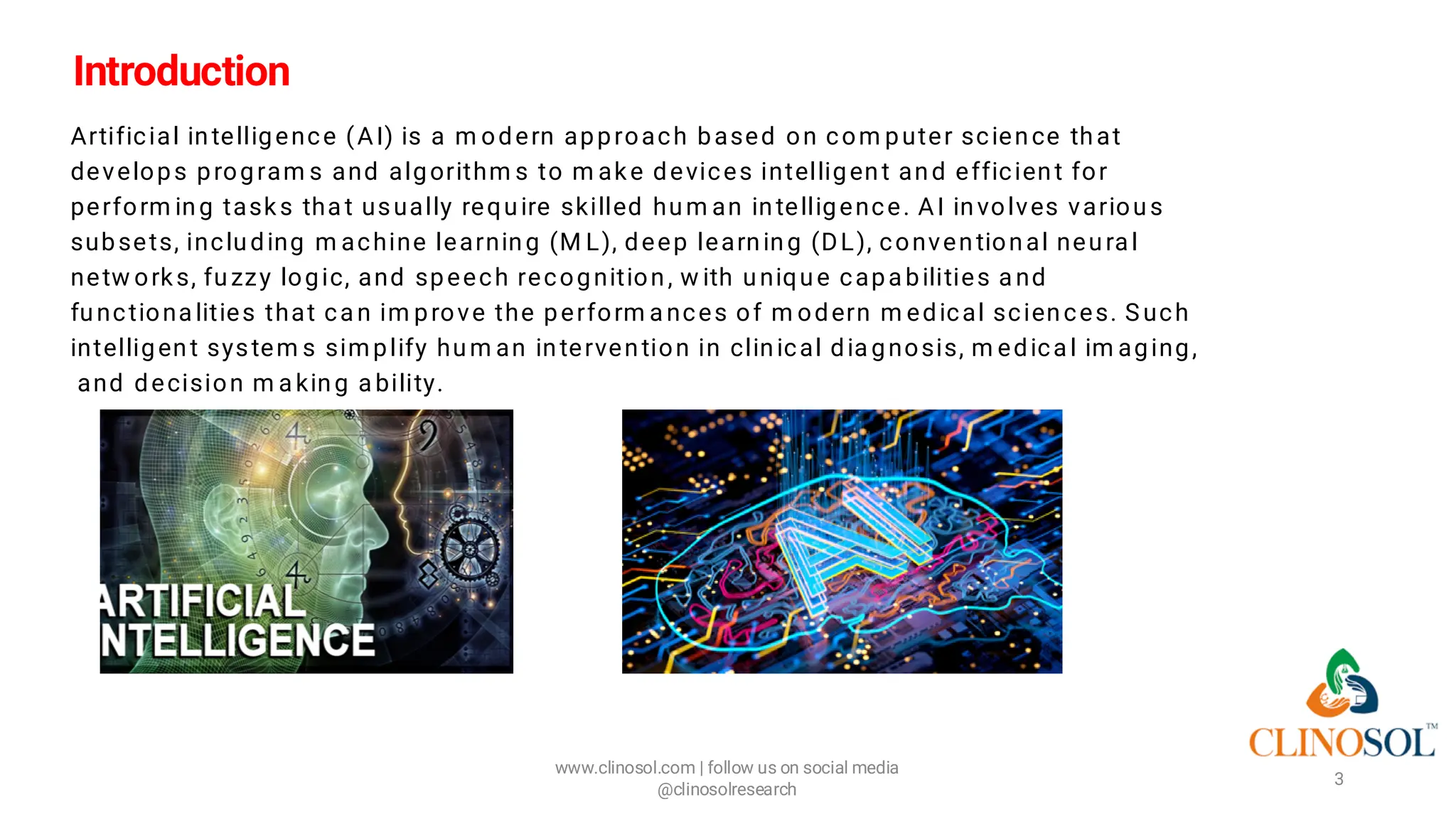
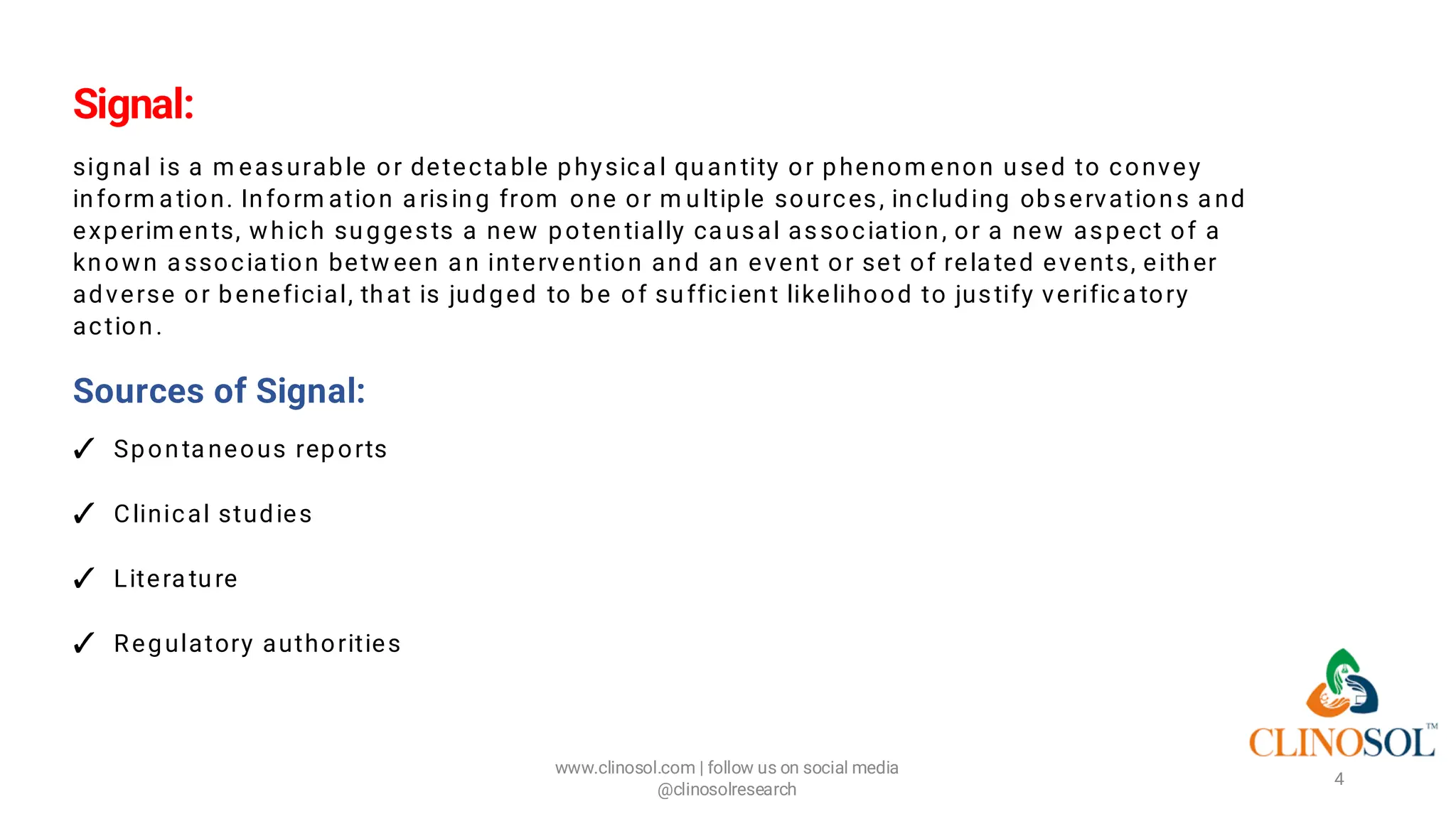
Artificial intelligence (AI) is a m odern approach based on com puter science that
develops program s and algorithm s to m ake devices intelligent and efficient for
perform ing tasks tha t usually require skilled hum an intelligence. AI involves various
subsets, including m achine learning (M L), deep learning (DL), conventional neura l
netw orks, fuzzy logic, and speech recognition, w ith unique capa bilities a nd
functiona lities that ca n im prove the perform a nces of m odern m edical sciences. Such
intelligent system s simplify hum an intervention in clinical dia gnosis, m edica l im aging,
and decision m a king a bility.
www.clinosol.com | follow us on social media
@clinosolresearch
3
Signal:
signal is a m easurable or detecta ble physica l quantity or phenom enon used to convey
inform a tion. Inform ation a rising from one or m ultiple sources, including observations a nd
experim ents, which suggests a new potentially ca usal association, or a new aspect of a
known a ssocia tion betw een a n intervention and an event or set of rela ted events, either
adverse or beneficial, that is judged to be of sufficient likelihood to justify verifica tory
action.
Sources of Signal:
✓ Sponta neous reports
✓ Clinical studies
✓ Litera ture
✓ Regulatory authorities
www.clinosol.com | follow us on social media
@clinosolresearch
4
Signal detection:
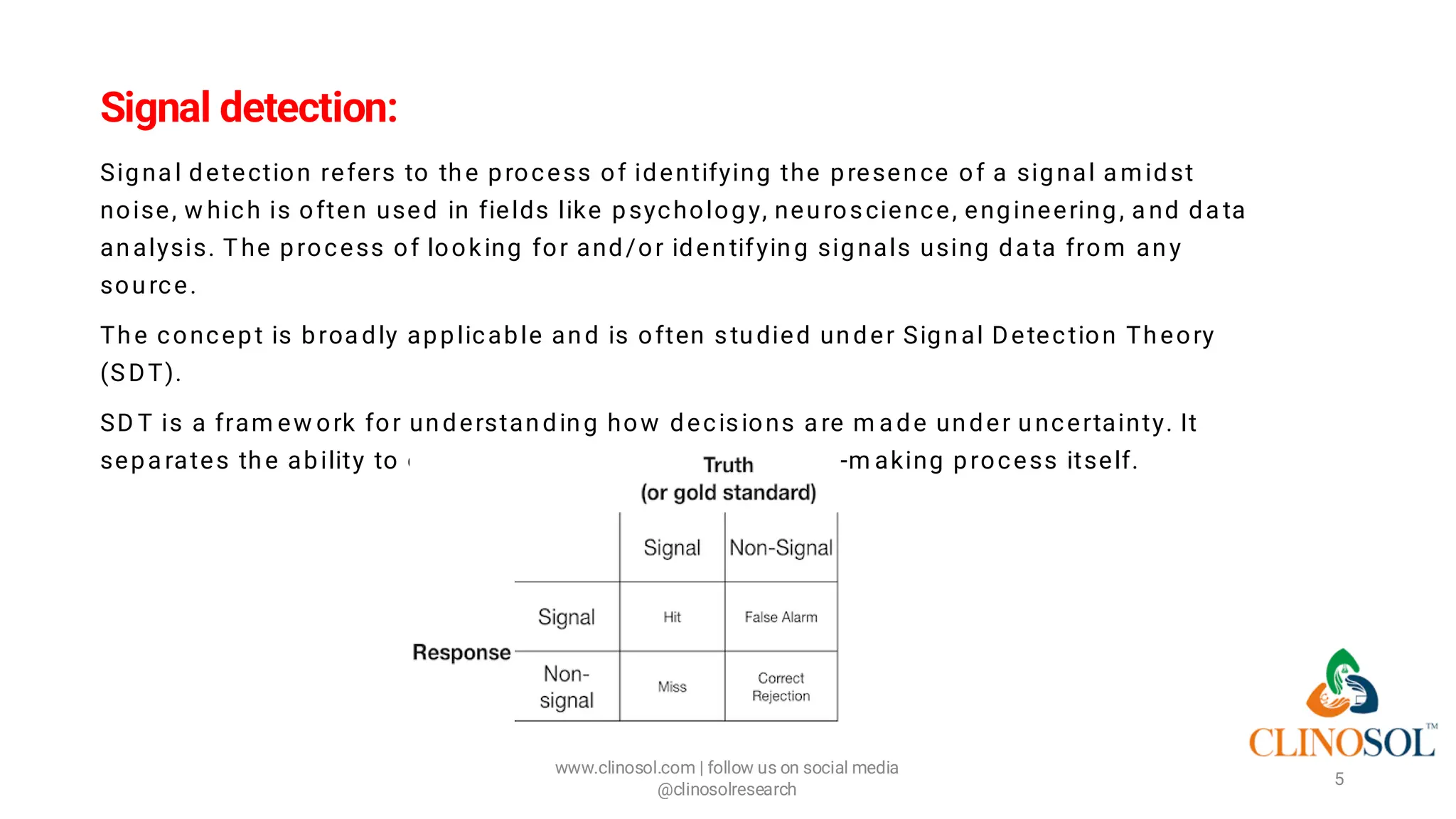
Signa l detection refers to the process of identifying the presence of a signal a midst
noise, w hich is often used in fields like psychology, neuroscience, engineering, a nd da ta
analysis. The process of looking for and/or identifying signals using da ta from any
source.
The concept is broa dly applicable and is often studied under Signal Detection Theory
(SDT).
SD T is a fram ew ork for understanding how decisions a re m a de under uncertainty. It
sepa rates the ability to detect a signa l from the decision-m aking process itself.
www.clinosol.com | follow us on social media
@clinosolresearch
5
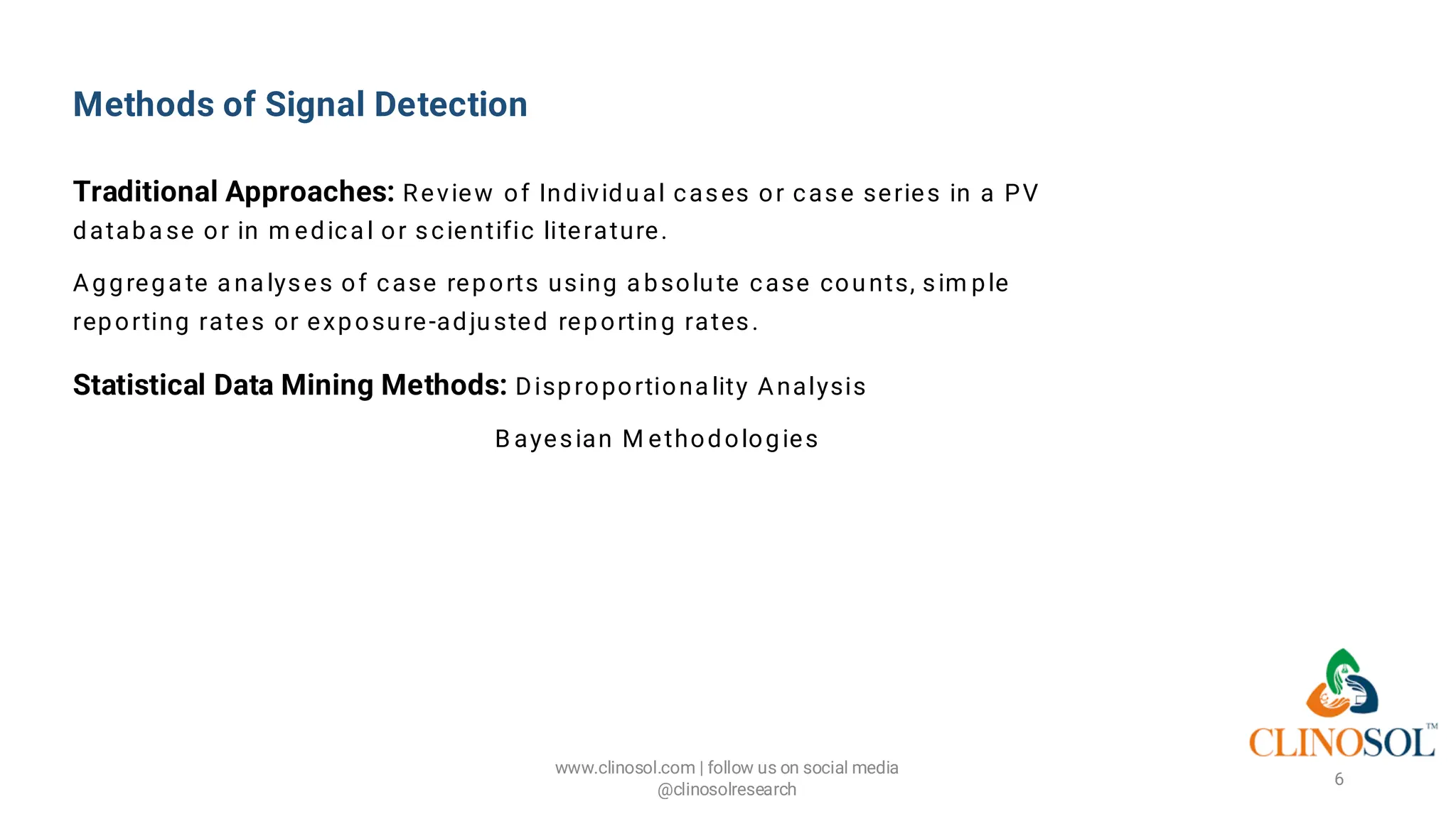
Methods of Signal Detection
Traditional Approaches: Review of Individual cases or case series in a PV
databa se or in m edica l or scientific literature.
Aggrega te a na lyses of case reports using a bsolute case counts, sim ple
reporting rates or exposure-adjusted reporting rates.
Statistical Data Mining Methods: Disproportiona lity Analysis
B ayesian M ethodologies
www.clinosol.com | follow us on social media
@clinosolresearch
6
Challenges In Traditional Signal Detection
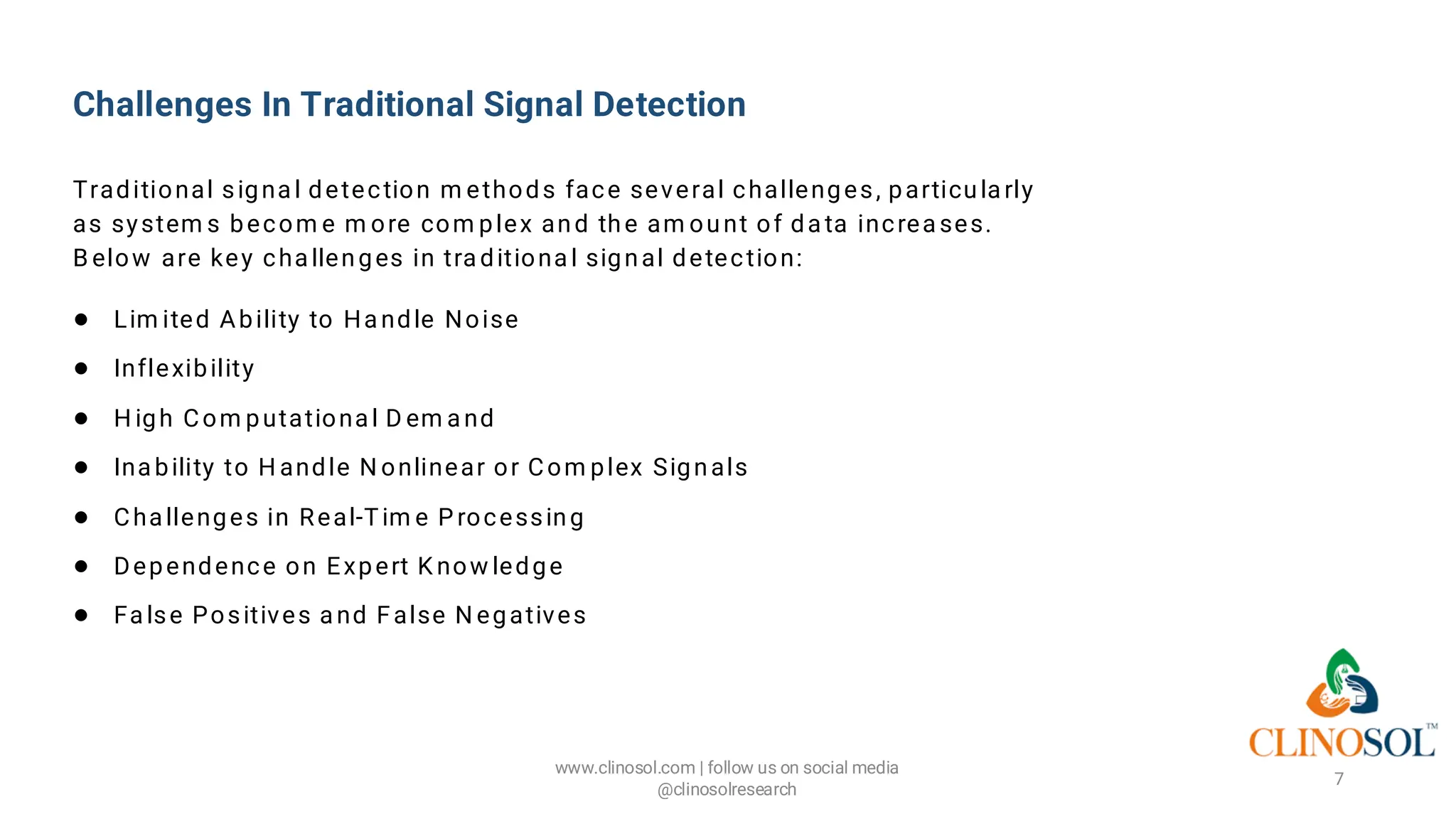
Traditional signa l detection m ethods face several challenges, particula rly
as system s becom e m ore com plex and the am ount of da ta increa ses.
B elow are key cha llenges in tra ditiona l signal detection:
● Lim ited Ability to Ha ndle Noise
● Inflexibility
● H igh Com putationa l D em a nd
● Ina bility to H andle N onlinear or Com plex Signals
● Cha llenges in Real-Tim e P rocessing
● Dependence on Expert K now ledge
● Fa lse Positives a nd False N egatives
www.clinosol.com | follow us on social media
@clinosolresearch
7
Artificial Intelligence(AI)Use in Signal Detection:
Artificia l Intelligence (AI) plays a significant role in enha ncing signa l
detection across va rious fields by levera ging advanced algorithm s,
m achine learning, a nd com putational power to im prove accuracy and
efficiency. H ere's how AI is utilized in signal detection:
1. Machine Learning for Signal Classification
AI m odels, particula rly m a chine lea rning (M L) a lgorithm s, a re tra ined to
distinguish betw een signal and noise using la beled da ta sets.
www.clinosol.com | follow us on social media
@clinosolresearch
8
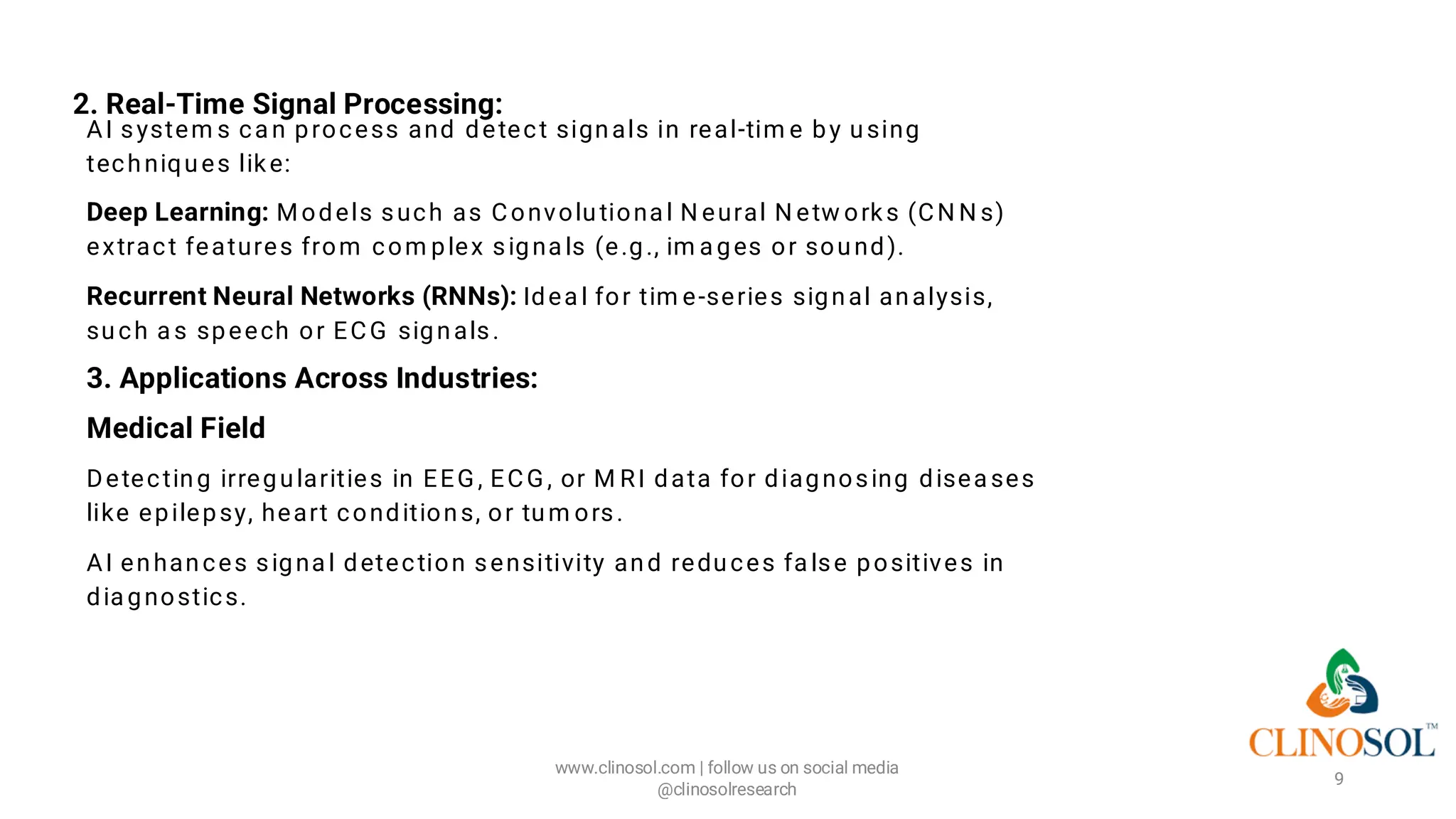
2. Real-Time Signal Processing:
AI system s ca n process and detect signals in real-tim e by using
techniques like:
Deep Learning: Models such as Convolutiona l N eural N etw orks (CN N s)
extract features from com plex signa ls (e.g., im a ges or sound).
Recurrent Neural Networks (RNNs): Idea l for tim e-series signal analysis,
such a s speech or ECG signals.
3. Applications Across Industries:
Medical Field
Detecting irregularities in EEG , ECG , or M RI data for diagnosing disea ses
like epilepsy, heart conditions, or tum ors.
AI enhances signa l detection sensitivity and reduces fa lse positives in
dia gnostics.
www.clinosol.com | follow us on social media
@clinosolresearch
9
Telecommunication
AI-based algorithm s optim ize signa l-to-noise ra tios (SNR) for better da ta
transm ission quality in w ireless a nd fiber-optic com m unications.
4. Signal Denoising:
AI techniques like a utoencoders and other neural network architectures
can sepa ra te signa ls from noise effectively. This is crucial in
environm ents w ith significant interference, such as:
Spa ce com m unications.
Underw ater a coustics.
www.clinosol.com | follow us on social media
@clinosolresearch
10
Risk Management:
Risk m a na gem ent is a funda m enta l com ponent of a ny successful com pany, w hether it is
in econom ic, societal or environm ental aspect. Risk m ana gement is an especia lly
im porta nt activity for com pa nies that optim al security challenge of products and services
is grea t. This is the case especia lly for the hea lth sector institutions. Risk m a na gem ent is
therefore a decision support tool and a m ea ns to ensure the susta ina bility of an
orga niza tion.
Artificial Intelligence (AI) Integration in Risk Management Workflow:
Integra ting AI into the risk ma na gem ent workflow significa ntly enhances the process by
ena bling predictive insights, real-tim e m onitoring, a nd autom ated decision-m aking. Here's
how A I can be effectively incorporated into various stages of risk m a nagem ent:
1. Risk Identification
AI helps uncover risks tha t might not be im m ediately appa rent through traditional
m ethods.
www.clinosol.com | follow us on social media
@clinosolresearch
11
2. Risk Assessment
AI provides advanced ana lytica l ca pabilities for eva lua ting risks w ith
grea ter precision.
3. Risk Prioritization
AI ca n prioritize risks ba sed on their potential im pa ct and likelihood m ore effectively.
4. Risk Mitigation
AI a ids in designing and im plem enting strategies to m ana ge or reduce risks.
5. Risk Monitoring
AI enha nces rea l-tim e m onitoring and early w arning system s to detect and address risks
proa ctively.
6. Risk Reporting
AI stream lines reporting a nd ensures tim ely com m unication of risks to stakeholders.
www.clinosol.com | follow us on social media
@clinosolresearch
12
Benefits of AI in Signal Detection and Risk Management:
Artificia l Intelligence (AI) in signal detection a nd risk m ana gement offers
transform ative benefits by im proving a ccura cy, efficiency, a nd scala bility.
Shared Benefits Across Both Fields:
1. Improved Efficiency
AI a ccelera tes processes, reducing m anual la bor and increasing overall operationa l
speed.
2. Customization and Personalization
AI tailors’ detection a nd risk strategies to specific environm ents, industries, or
orga niza tional needs.
www.clinosol.com | follow us on social media
@clinosolresearch
13
3. Global Applications
AI technologies are versa tile, a pplica ble a cross industries such as
hea lthcare, finance, defense, and m anufa cturing.
4. Continuous Improvement
M achine learning m odels refine their perform ance over tim e, ensuring
ongoing enhancements in signa l detection a nd risk m a nagem ent.
5. Resilience and Reliability
AI system s a re robust, ca pable of opera ting effectively in unpredictable or
high-pressure environm ents.
www.clinosol.com | follow us on social media
@clinosolresearch
14
Challenges
• Dependency on high-quality da ta .
• Explaina bility and trust in AI-driven decisions.
• Integra tion w ith existing system s and w orkflow s.
• Addressing ethica l, privacy, and regulatory concerns.
Conclusion
AI significa ntly enha nces signal detection and risk m ana gem ent by enabling precision,
rea l-tim e a nalysis, a nd proactive decision-m a king. Despite challenges, its integration is
resha ping industries, fostering efficiency, resilience, and innovation. Addressing data,
trust, and ethical issues w ill further optim ize its im pa ct.
www.clinosol.com | follow us on social media
@clinosolresearch
15
Reference:
• M anicka m P , M ariappa n SA, M urugesan SM , H a nsda S, Ka ushik A,
Shinde R, Thipperudra sw am y SP . Artificial Intelligence (AI) and Internet
of M edica l Things (IoM T) Assisted Biom edical System s for Intelligent
H ealthca re. B iosensors (B asel). 2022 Jul 25;12(8):562. doi:
10.3390/bios12080562. PM ID: 35892459; P M CID: P M C9330886.
• Sghaier W , H ergon E, Desroches A. G estion globa le des risques [G loba l
risk m anagem ent]. Transfus Clin Biol. 2015 Aug;22(3):158-67. French.
doi: 10.1016/j.tra cli.2015.05.007. Epub 2015 Jun 25. P M ID: 26119049.
11/20/2024
www.clinosol.com | follow us on social media
@clinosolresearch
16
Thank You!
www.clinosol.com
(India | Canada)
9121151622/623/624
info@clinosol.com
11/20/2024
www.clinosol.com | follow us on social media
@clinosolresearch
17

The Role of Artificial Intelligence in Signal Detection and Risk Management

  • 1.
    Welcome The Role ofArtificial Intelligence In Signal Detection And Risk Management A rp ita H az ra M . Sc, C ertifica te cou rse In P ha rm acov ig ila nce C SR PL_STD _IN D_H Y D_ON L/CLS _1 5 7 /0 92 0 2 4 11/20/2024 www.clinosol.com | follow us on social media @clinosolresearch 1
  • 2.
    Index □ Intro ductio n □ Sig na l So urces o f sig nal □ Sig na l D etectio n M eth od s O f Sig na l D etec tio n C ha lleng es In Trad ition al Sign al D etection A rtificial Intellig ence(A I) U se In Sig nal D etectio n □ Risk M an ag em ent A rtificia l Intellig ence Integratio n In R isk M a nag em ent w o rk flow □ B enefits of A I In Sig na l D etectio n A nd Risk M an ag em ent □ C ha llen ges □ C o nclu sion □ Reference www.clinosol.com | follow us on social media @clinosolresearch 2
  • 3.
    Introduction Artificial intelligence (AI)is a m odern approach based on com puter science that develops program s and algorithm s to m ake devices intelligent and efficient for perform ing tasks tha t usually require skilled hum an intelligence. AI involves various subsets, including m achine learning (M L), deep learning (DL), conventional neura l netw orks, fuzzy logic, and speech recognition, w ith unique capa bilities a nd functiona lities that ca n im prove the perform a nces of m odern m edical sciences. Such intelligent system s simplify hum an intervention in clinical dia gnosis, m edica l im aging, and decision m a king a bility. www.clinosol.com | follow us on social media @clinosolresearch 3
  • 4.
    Signal: signal is am easurable or detecta ble physica l quantity or phenom enon used to convey inform a tion. Inform ation a rising from one or m ultiple sources, including observations a nd experim ents, which suggests a new potentially ca usal association, or a new aspect of a known a ssocia tion betw een a n intervention and an event or set of rela ted events, either adverse or beneficial, that is judged to be of sufficient likelihood to justify verifica tory action. Sources of Signal: ✓ Sponta neous reports ✓ Clinical studies ✓ Litera ture ✓ Regulatory authorities www.clinosol.com | follow us on social media @clinosolresearch 4
  • 5.
    Signal detection: Signa ldetection refers to the process of identifying the presence of a signal a midst noise, w hich is often used in fields like psychology, neuroscience, engineering, a nd da ta analysis. The process of looking for and/or identifying signals using da ta from any source. The concept is broa dly applicable and is often studied under Signal Detection Theory (SDT). SD T is a fram ew ork for understanding how decisions a re m a de under uncertainty. It sepa rates the ability to detect a signa l from the decision-m aking process itself. www.clinosol.com | follow us on social media @clinosolresearch 5
  • 6.
    Methods of SignalDetection Traditional Approaches: Review of Individual cases or case series in a PV databa se or in m edica l or scientific literature. Aggrega te a na lyses of case reports using a bsolute case counts, sim ple reporting rates or exposure-adjusted reporting rates. Statistical Data Mining Methods: Disproportiona lity Analysis B ayesian M ethodologies www.clinosol.com | follow us on social media @clinosolresearch 6
  • 7.
    Challenges In TraditionalSignal Detection Traditional signa l detection m ethods face several challenges, particula rly as system s becom e m ore com plex and the am ount of da ta increa ses. B elow are key cha llenges in tra ditiona l signal detection: ● Lim ited Ability to Ha ndle Noise ● Inflexibility ● H igh Com putationa l D em a nd ● Ina bility to H andle N onlinear or Com plex Signals ● Cha llenges in Real-Tim e P rocessing ● Dependence on Expert K now ledge ● Fa lse Positives a nd False N egatives www.clinosol.com | follow us on social media @clinosolresearch 7
  • 8.
    Artificial Intelligence(AI)Use inSignal Detection: Artificia l Intelligence (AI) plays a significant role in enha ncing signa l detection across va rious fields by levera ging advanced algorithm s, m achine learning, a nd com putational power to im prove accuracy and efficiency. H ere's how AI is utilized in signal detection: 1. Machine Learning for Signal Classification AI m odels, particula rly m a chine lea rning (M L) a lgorithm s, a re tra ined to distinguish betw een signal and noise using la beled da ta sets. www.clinosol.com | follow us on social media @clinosolresearch 8
  • 9.
    2. Real-Time SignalProcessing: AI system s ca n process and detect signals in real-tim e by using techniques like: Deep Learning: Models such as Convolutiona l N eural N etw orks (CN N s) extract features from com plex signa ls (e.g., im a ges or sound). Recurrent Neural Networks (RNNs): Idea l for tim e-series signal analysis, such a s speech or ECG signals. 3. Applications Across Industries: Medical Field Detecting irregularities in EEG , ECG , or M RI data for diagnosing disea ses like epilepsy, heart conditions, or tum ors. AI enhances signa l detection sensitivity and reduces fa lse positives in dia gnostics. www.clinosol.com | follow us on social media @clinosolresearch 9
  • 10.
    Telecommunication AI-based algorithm soptim ize signa l-to-noise ra tios (SNR) for better da ta transm ission quality in w ireless a nd fiber-optic com m unications. 4. Signal Denoising: AI techniques like a utoencoders and other neural network architectures can sepa ra te signa ls from noise effectively. This is crucial in environm ents w ith significant interference, such as: Spa ce com m unications. Underw ater a coustics. www.clinosol.com | follow us on social media @clinosolresearch 10
  • 11.
    Risk Management: Risk ma na gem ent is a funda m enta l com ponent of a ny successful com pany, w hether it is in econom ic, societal or environm ental aspect. Risk m ana gement is an especia lly im porta nt activity for com pa nies that optim al security challenge of products and services is grea t. This is the case especia lly for the hea lth sector institutions. Risk m a na gem ent is therefore a decision support tool and a m ea ns to ensure the susta ina bility of an orga niza tion. Artificial Intelligence (AI) Integration in Risk Management Workflow: Integra ting AI into the risk ma na gem ent workflow significa ntly enhances the process by ena bling predictive insights, real-tim e m onitoring, a nd autom ated decision-m aking. Here's how A I can be effectively incorporated into various stages of risk m a nagem ent: 1. Risk Identification AI helps uncover risks tha t might not be im m ediately appa rent through traditional m ethods. www.clinosol.com | follow us on social media @clinosolresearch 11
  • 12.
    2. Risk Assessment AIprovides advanced ana lytica l ca pabilities for eva lua ting risks w ith grea ter precision. 3. Risk Prioritization AI ca n prioritize risks ba sed on their potential im pa ct and likelihood m ore effectively. 4. Risk Mitigation AI a ids in designing and im plem enting strategies to m ana ge or reduce risks. 5. Risk Monitoring AI enha nces rea l-tim e m onitoring and early w arning system s to detect and address risks proa ctively. 6. Risk Reporting AI stream lines reporting a nd ensures tim ely com m unication of risks to stakeholders. www.clinosol.com | follow us on social media @clinosolresearch 12
  • 13.
    Benefits of AIin Signal Detection and Risk Management: Artificia l Intelligence (AI) in signal detection a nd risk m ana gement offers transform ative benefits by im proving a ccura cy, efficiency, a nd scala bility. Shared Benefits Across Both Fields: 1. Improved Efficiency AI a ccelera tes processes, reducing m anual la bor and increasing overall operationa l speed. 2. Customization and Personalization AI tailors’ detection a nd risk strategies to specific environm ents, industries, or orga niza tional needs. www.clinosol.com | follow us on social media @clinosolresearch 13
  • 14.
    3. Global Applications AItechnologies are versa tile, a pplica ble a cross industries such as hea lthcare, finance, defense, and m anufa cturing. 4. Continuous Improvement M achine learning m odels refine their perform ance over tim e, ensuring ongoing enhancements in signa l detection a nd risk m a nagem ent. 5. Resilience and Reliability AI system s a re robust, ca pable of opera ting effectively in unpredictable or high-pressure environm ents. www.clinosol.com | follow us on social media @clinosolresearch 14
  • 15.
    Challenges • Dependency onhigh-quality da ta . • Explaina bility and trust in AI-driven decisions. • Integra tion w ith existing system s and w orkflow s. • Addressing ethica l, privacy, and regulatory concerns. Conclusion AI significa ntly enha nces signal detection and risk m ana gem ent by enabling precision, rea l-tim e a nalysis, a nd proactive decision-m a king. Despite challenges, its integration is resha ping industries, fostering efficiency, resilience, and innovation. Addressing data, trust, and ethical issues w ill further optim ize its im pa ct. www.clinosol.com | follow us on social media @clinosolresearch 15
  • 16.
    Reference: • M anickam P , M ariappa n SA, M urugesan SM , H a nsda S, Ka ushik A, Shinde R, Thipperudra sw am y SP . Artificial Intelligence (AI) and Internet of M edica l Things (IoM T) Assisted Biom edical System s for Intelligent H ealthca re. B iosensors (B asel). 2022 Jul 25;12(8):562. doi: 10.3390/bios12080562. PM ID: 35892459; P M CID: P M C9330886. • Sghaier W , H ergon E, Desroches A. G estion globa le des risques [G loba l risk m anagem ent]. Transfus Clin Biol. 2015 Aug;22(3):158-67. French. doi: 10.1016/j.tra cli.2015.05.007. Epub 2015 Jun 25. P M ID: 26119049. 11/20/2024 www.clinosol.com | follow us on social media @clinosolresearch 16
  • 17.
    Thank You! www.clinosol.com (India |Canada) 9121151622/623/624 info@clinosol.com 11/20/2024 www.clinosol.com | follow us on social media @clinosolresearch 17