MULTICENTRIC TRIALS
PRESENTED BY:
SwATI SARIN
JAgMohAN
hARDIPENDER
CLINICAL TRIAL
“Study of drug, biologic or device in human subjects with the intent
to discover potential beneficial effects and/or determine its safety
and efficacy.”
OR
“Clinical trials are research studies in which people help doctors find
ways to improve health and cancer care. Each study tries to
answer scientific questions and to find better ways to prevent,
diagnose, or treat cancer.”
INTRoDUCTIoN
A multicenter research trial is a clinical trial
conducted at more than one medical center or clinic.
KEY PoINTS IN
MUTICENTRIC STUDIES
 needs to assure standardization
 uniformity of procedures
 high data quality
 collaboration across sites
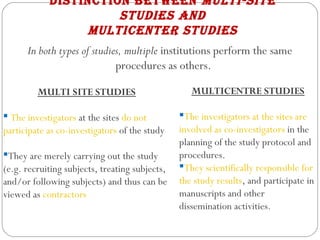
DISTINCTIoN BETwEEN MULTI-SITE
STUDIES AND
MULTICENTER STUDIES
In both types of studies, multiple institutions perform the same
procedures as others.
MULTICENTRE STUDIES
The investigators at the sites are
involved as co-investigators in the
planning of the study protocol and
procedures.
They scientifically responsible for
the study results, and participate in
manuscripts and other
dissemination activities.
MULTI SITE STUDIES
 The investigators at the sites do not
participate as co-investigators of the study
They are merely carrying out the study
(e.g. recruiting subjects, treating subjects,
and/or following subjects) and thus can be
viewed as contractors
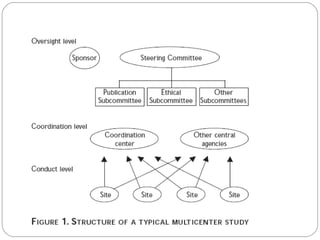
CooRDINATIoN IN MULTI SITE
STUDIES
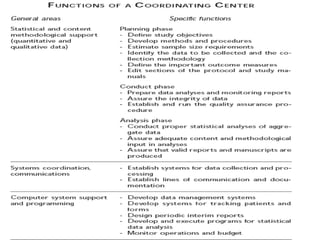
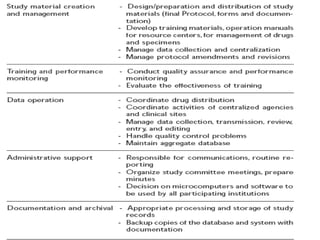
 In a multi-site study, activities of protocol development ,development of
study materials, training, communication, laboratory determinations, data
processing and management, report generation, statistical analysis, and
manuscript development are often centralized because of the need to
standardize them across all sites, which often also has the further benefit of
resulting in a gain of cost efficiency.
 The central group ‘controls’ the data and hence the study; and must take
steps to assure other participating institutions that it is managing it
adequately.
 This assurance is provided by developing adequate systems for staff training
and quality assurance, collecting, entering, managing and analyzing the data.
These activities are done by the statistical coordinating center
AdvAntAges
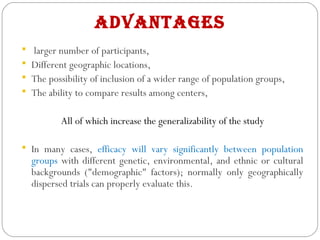
 larger number of participants,
 Different geographic locations,
 The possibility of inclusion of a wider range of population groups,
 The ability to compare results among centers,
All of which increase the generalizability of the study
 In many cases, efficacy will vary significantly between population
groups with different genetic, environmental, and ethnic or cultural
backgrounds ("demographic" factors); normally only geographically
dispersed trials can properly evaluate this.
enrollment of subjects
 Enrollment should be competitive.
 If the subject recruitment rate is lower than expected at one centre and
higher than expected at another, planned allocation numbers should be
transferred from the centre with low subject recruitment to a centre with
high recruitment where subject inclusion is expected to be completed
earlier than planned. This will be done to help ensure that subject
enrollment is completed as planned.
set up costs
The low set up costs should be negotiated in order to enable to sign
agreements with larger number of sites
recruitment rAte
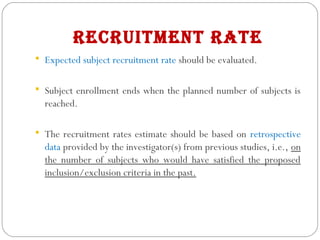
 Expected subject recruitment rate should be evaluated.
 Subject enrollment ends when the planned number of subjects is
reached.
 The recruitment rates estimate should be based on retrospective
data provided by the investigator(s) from previous studies, i.e., on
the number of subjects who would have satisfied the proposed
inclusion/exclusion criteria in the past.
contd…
 The investigator(s) should make every effort to ensure that the planned
accrual rate is maintained
 CRF’s are completed promptly and completely, and that data quality is
maintained at all times.
 The investigator(s) should discuss with the monitor any anticipated problems
with recruitment or delays in study completion.
 Number of sites for the study depends on estimated recruitment rates.
multicenter, phAse ii triAl of
sunitinib in previously treAted,
AdvAnced non–smAll-cell lung
cAncer
Journal of Clinical Oncology, Vol 26, No 4 (February 1), 2008:
pp. 650-656
introduction
Lung cancer remains the leading cause of cancer-related mortality
worldwide, accounting for 1.18 million deaths per year.
Contd…
 Non–small-cell lung cancer (NSCLC)
 Vascular endothelial growth factor (VEGF)
 Platelet-derived growth factor (PDGF)
 Growth factors that play an important role in tumor growth.
PurPose
Aberrant vascular endothelial growth factor (VEGF) and platelet-derived
growth factor (PDGF) signaling have been shown to play a role in non–
small-cell lung cancer (NSCLC) pathogenesis and are associated with
decreased survival.
PurPose Contd..
Evaluate the clinical activity and tolerability of sunitinib malate
(SU11248), an oral, multi targeted tyrosine kinase inhibitor that blocks
the activity of receptors for VEGF and PDGF, as well as related
tyrosine kinases in patients with previously treated, advanced NSCLC.
Patients
Male and female patients 18 years of age or older had histologically
proven stage IIIB or IV NSCLC which had progressed during or
after treatment with at least one platinum-based combination
chemotherapy regimen
study design and
treatment
 Phase II
 Open-label
 Multicenter study
 Patients received sunitinib (50 mg/d) in 6-week cycles, comprising
once-daily treatment for 4 consecutive weeks, followed by 2 weeks of
no treatment
 Treatment was otherwise administered for up to 54 weeks until
disease progression or withdrawal of consent occurred
assessment
 The primary end point was objective response rate (ORR)
 Secondary end points included progression-free survival, overall
survival, and safety
end Points
 Endpoint is the overall outcome that the protocol is designed to evaluate.
 PRIMARY ENDPOINTS
 These are the principal outcomes that the investigator is looking for.
 Cure
 Sometimes difficult to reach
 SECONDARY ENDPOINTS
 Evaluated when a significant number of trial subjects fail to reach the primary
end point , secondary end points help analyze the trial data
Contd..
 The primary end point of this study was the overall confirmed
objective response rate (ORR),
defined as the percentage of patients with confirmed complete
responses (CRs) or partial responses (PRs) based on radiologic tumor
assessments (computed tomography, magnetic resonance imaging,
and bone scans as appropriate)
 Imaging scans included the chest, abdomen, and pelvis and were
collected at the end of dosing in cycles 1 to 4, 6, and 8, and at study
termination.
Contd…
 Other evaluations included medical history, physical examination
(including height, weight, and vital sign measurements), laboratory
tests (urinalysis, hematology, coagulation, and blood chemistry),
cardiac function (12-lead ECGs), and adverse events (AEs)
 Progression-free survival (PFS), duration of response (DR), overall
survival (OS), and the 1-year survival rate were evaluated as secondary
end points of the study.
Results
 Of the 63 patients treated with sunitinib
 Seven patients had confirmed partial responses, yielding an ORR
of 11.1%
 An additional 18 patients (28.6%) experienced stable disease of at
least 8 weeks in duration.
 Therapy was generally well tolerated.
ConClusion 
Sunitinib has promising single-agent activity in patients with recurrent
NSCLC, with an ORR similar to that of currently approved agents and
an acceptable safety profile.
RefeRenCes
 Journal of Clinical Oncology, Vol 26, No 4 (February 1), 2008: pp. 650-
656 © 2008 American Society of Clinical Oncology.
 Shrikant I. Bangdiwala, PhD,(1) Cristiane S. de Paula, MS,(2) Laurie
S. Ramiro, PhD,(3) Sergio R. Muñoz, PhD.(4); Coordination of
international multicenter studies
 Governance and administrative structure
 en.wikipedia.org/wiki/Multicenter_trial
 www.nih.gov/news/health/sep2008/nci-1
Questions ??
thank You!!!

Multicenter trial

  • 1.
    MULTICENTRIC TRIALS PRESENTED BY: SwATISARIN JAgMohAN hARDIPENDER
  • 2.
    CLINICAL TRIAL “Study ofdrug, biologic or device in human subjects with the intent to discover potential beneficial effects and/or determine its safety and efficacy.” OR “Clinical trials are research studies in which people help doctors find ways to improve health and cancer care. Each study tries to answer scientific questions and to find better ways to prevent, diagnose, or treat cancer.”
  • 3.
    INTRoDUCTIoN A multicenter researchtrial is a clinical trial conducted at more than one medical center or clinic.
  • 4.
    KEY PoINTS IN MUTICENTRICSTUDIES  needs to assure standardization  uniformity of procedures  high data quality  collaboration across sites
  • 5.
    DISTINCTIoN BETwEEN MULTI-SITE STUDIESAND MULTICENTER STUDIES In both types of studies, multiple institutions perform the same procedures as others. MULTICENTRE STUDIES The investigators at the sites are involved as co-investigators in the planning of the study protocol and procedures. They scientifically responsible for the study results, and participate in manuscripts and other dissemination activities. MULTI SITE STUDIES  The investigators at the sites do not participate as co-investigators of the study They are merely carrying out the study (e.g. recruiting subjects, treating subjects, and/or following subjects) and thus can be viewed as contractors
  • 6.
    CooRDINATIoN IN MULTISITE STUDIES  In a multi-site study, activities of protocol development ,development of study materials, training, communication, laboratory determinations, data processing and management, report generation, statistical analysis, and manuscript development are often centralized because of the need to standardize them across all sites, which often also has the further benefit of resulting in a gain of cost efficiency.  The central group ‘controls’ the data and hence the study; and must take steps to assure other participating institutions that it is managing it adequately.  This assurance is provided by developing adequate systems for staff training and quality assurance, collecting, entering, managing and analyzing the data. These activities are done by the statistical coordinating center
  • 10.
    AdvAntAges  larger numberof participants,  Different geographic locations,  The possibility of inclusion of a wider range of population groups,  The ability to compare results among centers, All of which increase the generalizability of the study  In many cases, efficacy will vary significantly between population groups with different genetic, environmental, and ethnic or cultural backgrounds ("demographic" factors); normally only geographically dispersed trials can properly evaluate this.
  • 11.
    enrollment of subjects Enrollment should be competitive.  If the subject recruitment rate is lower than expected at one centre and higher than expected at another, planned allocation numbers should be transferred from the centre with low subject recruitment to a centre with high recruitment where subject inclusion is expected to be completed earlier than planned. This will be done to help ensure that subject enrollment is completed as planned.
  • 12.
    set up costs Thelow set up costs should be negotiated in order to enable to sign agreements with larger number of sites
  • 13.
    recruitment rAte  Expectedsubject recruitment rate should be evaluated.  Subject enrollment ends when the planned number of subjects is reached.  The recruitment rates estimate should be based on retrospective data provided by the investigator(s) from previous studies, i.e., on the number of subjects who would have satisfied the proposed inclusion/exclusion criteria in the past.
  • 14.
    contd…  The investigator(s)should make every effort to ensure that the planned accrual rate is maintained  CRF’s are completed promptly and completely, and that data quality is maintained at all times.  The investigator(s) should discuss with the monitor any anticipated problems with recruitment or delays in study completion.  Number of sites for the study depends on estimated recruitment rates.
  • 15.
    multicenter, phAse iitriAl of sunitinib in previously treAted, AdvAnced non–smAll-cell lung cAncer Journal of Clinical Oncology, Vol 26, No 4 (February 1), 2008: pp. 650-656
  • 16.
    introduction Lung cancer remainsthe leading cause of cancer-related mortality worldwide, accounting for 1.18 million deaths per year.
  • 17.
    Contd…  Non–small-cell lungcancer (NSCLC)  Vascular endothelial growth factor (VEGF)  Platelet-derived growth factor (PDGF)  Growth factors that play an important role in tumor growth.
  • 18.
    PurPose Aberrant vascular endothelialgrowth factor (VEGF) and platelet-derived growth factor (PDGF) signaling have been shown to play a role in non– small-cell lung cancer (NSCLC) pathogenesis and are associated with decreased survival.
  • 19.
    PurPose Contd.. Evaluate theclinical activity and tolerability of sunitinib malate (SU11248), an oral, multi targeted tyrosine kinase inhibitor that blocks the activity of receptors for VEGF and PDGF, as well as related tyrosine kinases in patients with previously treated, advanced NSCLC.
  • 20.
    Patients Male and femalepatients 18 years of age or older had histologically proven stage IIIB or IV NSCLC which had progressed during or after treatment with at least one platinum-based combination chemotherapy regimen
  • 21.
    study design and treatment Phase II  Open-label  Multicenter study  Patients received sunitinib (50 mg/d) in 6-week cycles, comprising once-daily treatment for 4 consecutive weeks, followed by 2 weeks of no treatment  Treatment was otherwise administered for up to 54 weeks until disease progression or withdrawal of consent occurred
  • 22.
    assessment  The primaryend point was objective response rate (ORR)  Secondary end points included progression-free survival, overall survival, and safety
  • 23.
    end Points  Endpointis the overall outcome that the protocol is designed to evaluate.  PRIMARY ENDPOINTS  These are the principal outcomes that the investigator is looking for.  Cure  Sometimes difficult to reach  SECONDARY ENDPOINTS  Evaluated when a significant number of trial subjects fail to reach the primary end point , secondary end points help analyze the trial data
  • 24.
    Contd..  The primaryend point of this study was the overall confirmed objective response rate (ORR), defined as the percentage of patients with confirmed complete responses (CRs) or partial responses (PRs) based on radiologic tumor assessments (computed tomography, magnetic resonance imaging, and bone scans as appropriate)  Imaging scans included the chest, abdomen, and pelvis and were collected at the end of dosing in cycles 1 to 4, 6, and 8, and at study termination.
  • 25.
    Contd…  Other evaluationsincluded medical history, physical examination (including height, weight, and vital sign measurements), laboratory tests (urinalysis, hematology, coagulation, and blood chemistry), cardiac function (12-lead ECGs), and adverse events (AEs)  Progression-free survival (PFS), duration of response (DR), overall survival (OS), and the 1-year survival rate were evaluated as secondary end points of the study.
  • 26.
    Results  Of the 63patients treated with sunitinib  Seven patients had confirmed partial responses, yielding an ORR of 11.1%  An additional 18 patients (28.6%) experienced stable disease of at least 8 weeks in duration.  Therapy was generally well tolerated.
  • 27.
    ConClusion  Sunitinib has promisingsingle-agent activity in patients with recurrent NSCLC, with an ORR similar to that of currently approved agents and an acceptable safety profile.
  • 28.
    RefeRenCes  Journal ofClinical Oncology, Vol 26, No 4 (February 1), 2008: pp. 650- 656 © 2008 American Society of Clinical Oncology.  Shrikant I. Bangdiwala, PhD,(1) Cristiane S. de Paula, MS,(2) Laurie S. Ramiro, PhD,(3) Sergio R. Muñoz, PhD.(4); Coordination of international multicenter studies  Governance and administrative structure  en.wikipedia.org/wiki/Multicenter_trial  www.nih.gov/news/health/sep2008/nci-1
  • 29.
  • 30.