Welcome
STUDY DESIGNS IN CLINICAL TRIALS
VISHNU. S
B PHARM
CSRPL_INT_ONL_WKD_139/0722
11/1/2022
www.clinosol.com | follow us on social media
@clinosolresearch
1
Index
• What is study design?
• Research design
• Fundamental types
• Conclusion
• Reference
11/1/2022
www.clinosol.com | follow us on social media
@clinosolresearch
2
WHAT IS A STUDY DESIGN ?
11/1/2022
www.clinosol.com | follow us on social media
@clinosolresearch
3
▪ A specific plan or protocol for conducting the study
▪ Allows the investigator to translate the conceptual
hypothesis into a operational one
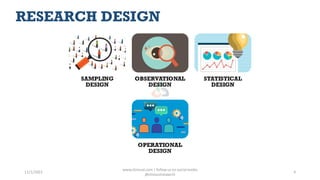
RESEARCH DESIGN
11/1/2022
www.clinosol.com | follow us on social media
@clinosolresearch
4
SAMPLING
DESIGN
OBSERVATIONAL
DESIGN
STATISTICAL
DESIGN
OPERATIONAL
DESIGN
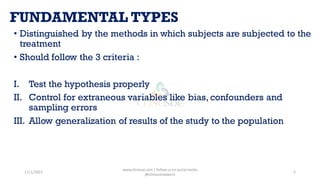
FUNDAMENTAL TYPES
• Distinguished by the methods in which subjects are subjected to the
treatment
• Should follow the 3 criteria :
I. Test the hypothesis properly
II. Control for extraneous variables like bias, confounders and
sampling errors
III. Allow generalization of results of the study to the population
11/1/2022
www.clinosol.com | follow us on social media
@clinosolresearch
5
11/1/2022
www.clinosol.com | follow us on social media
@clinosolresearch
6
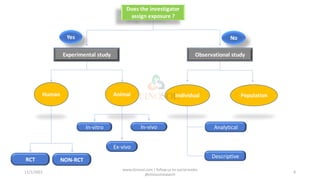
Does the investigator
assign exposure ?
Yes No
Experimental study
Human Animal
In-vitro In-vivo
Ex-vivo
NON-RCT
RCT
Observational study
Individual Population
Descriptive
Analytical
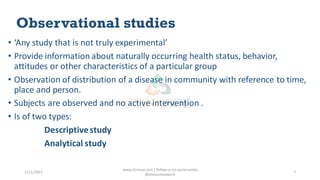
Observational studies
• ‘Any study that is not truly experimental’
• Provide information about naturally occurring health status, behavior,
attitudes or other characteristics of a particular group
• Observation of distribution of a disease in community with reference to time,
place and person.
• Subjects are observed and no active intervention .
• Is of two types:
Descriptivestudy
Analytical study
11/1/2022
www.clinosol.com | follow us on social media
@clinosolresearch
7
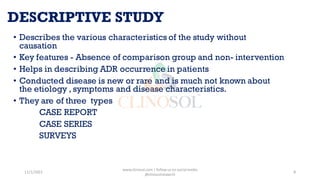
DESCRIPTIVE STUDY
• Describes the various characteristics of the study without
causation
• Key features - Absence of comparison group and non- intervention
• Helps in describing ADR occurrence in patients
• Conducted disease is new or rare and is much not known about
the etiology , symptoms and disease characteristics.
• They are of three types
CASE REPORT
CASE SERIES
SURVEYS
11/1/2022
www.clinosol.com | follow us on social media
@clinosolresearch
8
• Case Report
reports of events and individual patient experience on drug exposure and
outcome observed in single patient.
It is not ordinarily used to make a statement on causation of an event , but it gives
signal that can make others alert to the possibility of causal association.
Example: best classical example of a case report was that of Dr.William Mc Bride ,
report indicating that thalidomide might be a human teratogen .
• Case series
collection of individual case reports(multiple patients with the same findings)
no control group involved
• Surveys
collection of information from a group , can be demographic, opinions,
knowledge and behaviors.
11/1/2022
www.clinosol.com | follow us on social media
@clinosolresearch
9
Analytical studies
• Studies used to test hypothesis concerning the relationship between
a suspected risk factor and an outcome and to measure the
magnitude of the association and its statistical significance.
COHORT STUDY:
starts with exposure (risk factor) and follow for the
outcome(disease). Consist of two groups:
first group – exposed to some risk
second group – free from exposure
CASE CONTROL STUDY
a retrospective study , study start with outcome and search for risk
factors by taking case records.
11/1/2022
www.clinosol.com | follow us on social media
@clinosolresearch
10
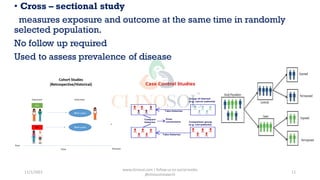
• Cross – sectional study
measures exposure and outcome at the same time in randomly
selected population.
No follow up required
Used to assess prevalence of disease
11/1/2022
www.clinosol.com | follow us on social media
@clinosolresearch
11
EXPERIMENTAL STUDIES
• Set of observations , conducted under controlled
circumstances , manipulated in order to check the effect of
such manipulations .
• Consists of two types :
Animal studies
a) In vitro
b) In vivo
c) Ex vivo
Human studies
11/1/2022
www.clinosol.com | follow us on social media
@clinosolresearch
12
RANDOMIZED CONTROLLEDTRIAL
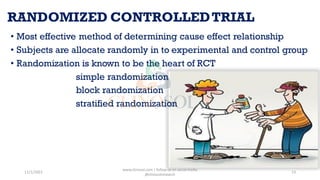
• Most effective method of determining cause effect relationship
• Subjects are allocate randomly in to experimental and control group
• Randomization is known to be the heart of RCT
simple randomization
block randomization
stratified randomization
11/1/2022
www.clinosol.com | follow us on social media
@clinosolresearch
13
CONCLUSION
Study design should be highly specific plan that is to be
followed without deviation in order to bring in relevance to the
research purpose.
11/1/2022
www.clinosol.com | follow us on social media
@clinosolresearch
14
REFERENCES
• Clinical trials Steven piantadosi et al , 2017
• Adaptive design – clinical trials, methodology, challenges and
prospect, Rajiv mahajan et al
• Coffey Cs et al clinical trials , progress and challenges .Drugs
RD.2008;9:229-42
11/1/2022
www.clinosol.com | follow us on social media
@clinosolresearch
15
ThankYou!
www.clinosol.com
(India | Canada)
9121151622/623/624
info@clinosol.com
11/1/2022
www.clinosol.com | follow us on social media
@clinosolresearch
16

STUDY DESIGNS IN CLINICAL TRIALS.pdf

  • 1.
    Welcome STUDY DESIGNS INCLINICAL TRIALS VISHNU. S B PHARM CSRPL_INT_ONL_WKD_139/0722 11/1/2022 www.clinosol.com | follow us on social media @clinosolresearch 1
  • 2.
    Index • What isstudy design? • Research design • Fundamental types • Conclusion • Reference 11/1/2022 www.clinosol.com | follow us on social media @clinosolresearch 2
  • 3.
    WHAT IS ASTUDY DESIGN ? 11/1/2022 www.clinosol.com | follow us on social media @clinosolresearch 3 ▪ A specific plan or protocol for conducting the study ▪ Allows the investigator to translate the conceptual hypothesis into a operational one
  • 4.
    RESEARCH DESIGN 11/1/2022 www.clinosol.com |follow us on social media @clinosolresearch 4 SAMPLING DESIGN OBSERVATIONAL DESIGN STATISTICAL DESIGN OPERATIONAL DESIGN
  • 5.
    FUNDAMENTAL TYPES • Distinguishedby the methods in which subjects are subjected to the treatment • Should follow the 3 criteria : I. Test the hypothesis properly II. Control for extraneous variables like bias, confounders and sampling errors III. Allow generalization of results of the study to the population 11/1/2022 www.clinosol.com | follow us on social media @clinosolresearch 5
  • 6.
    11/1/2022 www.clinosol.com | followus on social media @clinosolresearch 6 Does the investigator assign exposure ? Yes No Experimental study Human Animal In-vitro In-vivo Ex-vivo NON-RCT RCT Observational study Individual Population Descriptive Analytical
  • 7.
    Observational studies • ‘Anystudy that is not truly experimental’ • Provide information about naturally occurring health status, behavior, attitudes or other characteristics of a particular group • Observation of distribution of a disease in community with reference to time, place and person. • Subjects are observed and no active intervention . • Is of two types: Descriptivestudy Analytical study 11/1/2022 www.clinosol.com | follow us on social media @clinosolresearch 7
  • 8.
    DESCRIPTIVE STUDY • Describesthe various characteristics of the study without causation • Key features - Absence of comparison group and non- intervention • Helps in describing ADR occurrence in patients • Conducted disease is new or rare and is much not known about the etiology , symptoms and disease characteristics. • They are of three types CASE REPORT CASE SERIES SURVEYS 11/1/2022 www.clinosol.com | follow us on social media @clinosolresearch 8
  • 9.
    • Case Report reportsof events and individual patient experience on drug exposure and outcome observed in single patient. It is not ordinarily used to make a statement on causation of an event , but it gives signal that can make others alert to the possibility of causal association. Example: best classical example of a case report was that of Dr.William Mc Bride , report indicating that thalidomide might be a human teratogen . • Case series collection of individual case reports(multiple patients with the same findings) no control group involved • Surveys collection of information from a group , can be demographic, opinions, knowledge and behaviors. 11/1/2022 www.clinosol.com | follow us on social media @clinosolresearch 9
  • 10.
    Analytical studies • Studiesused to test hypothesis concerning the relationship between a suspected risk factor and an outcome and to measure the magnitude of the association and its statistical significance. COHORT STUDY: starts with exposure (risk factor) and follow for the outcome(disease). Consist of two groups: first group – exposed to some risk second group – free from exposure CASE CONTROL STUDY a retrospective study , study start with outcome and search for risk factors by taking case records. 11/1/2022 www.clinosol.com | follow us on social media @clinosolresearch 10
  • 11.
    • Cross –sectional study measures exposure and outcome at the same time in randomly selected population. No follow up required Used to assess prevalence of disease 11/1/2022 www.clinosol.com | follow us on social media @clinosolresearch 11
  • 12.
    EXPERIMENTAL STUDIES • Setof observations , conducted under controlled circumstances , manipulated in order to check the effect of such manipulations . • Consists of two types : Animal studies a) In vitro b) In vivo c) Ex vivo Human studies 11/1/2022 www.clinosol.com | follow us on social media @clinosolresearch 12
  • 13.
    RANDOMIZED CONTROLLEDTRIAL • Mosteffective method of determining cause effect relationship • Subjects are allocate randomly in to experimental and control group • Randomization is known to be the heart of RCT simple randomization block randomization stratified randomization 11/1/2022 www.clinosol.com | follow us on social media @clinosolresearch 13
  • 14.
    CONCLUSION Study design shouldbe highly specific plan that is to be followed without deviation in order to bring in relevance to the research purpose. 11/1/2022 www.clinosol.com | follow us on social media @clinosolresearch 14
  • 15.
    REFERENCES • Clinical trialsSteven piantadosi et al , 2017 • Adaptive design – clinical trials, methodology, challenges and prospect, Rajiv mahajan et al • Coffey Cs et al clinical trials , progress and challenges .Drugs RD.2008;9:229-42 11/1/2022 www.clinosol.com | follow us on social media @clinosolresearch 15
  • 16.