PHARMACOEPIDEMIOLOGY
Submitted by: ASMA M A
FIRST M.PHARM
PHARMACOLOGY
INTRODUCTION
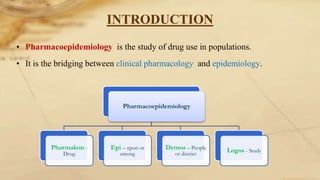
Pharmacoepidemiology
Pharmakon -
Drug
Epi – upon or
among
Demos – People
or district
Logos - Study
• Pharmacoepidemiology is the study of drug use in populations.
• It is the bridging between clinical pharmacology and epidemiology.
DEFINITION
• Hartzema et al. have defined pharmacoepidemiology as “the
application of epidemiologic reasoning methods and knowledge to the
study of the uses and effects (beneficial and adverse) of drugs in
human populations.”
• Populations are large groups of people, which may include thousands
or even millions of people.
• Pharmacoepidemiological research in practice includes:
― Evaluation of specific drug use in certain conditions,
― Patterns of drug use, that is, how it is being used-how much,
where, when and by whom,
― Drug taking behaviours in society.
AIM
• WHO targets its pharmacoepidemiological efforts to ensure the
quality , safety and efficacy of drugs.
• The studies focus on
― Global trends in prescribing
― Appropriateness of drug use
― Medication adherence
― Lifestyle effects on drug therapy
― Special population (Elderly, Pediatric, etc.) drug therapy
― Drug Interactions
― Predictable ADRs
― Uncommon and unpredictable ADRs
SOURCES OF DATA
• The sources of drug data includes:
―Institutionalized medical records and databases from hospital and
pharmacy claims.
―System wide databases from health insurance claims or pharmaceutical
organization.
―National databases like Medical Expenditure Panel Survey, National
Ambulatory Medical Care Survey.
―Field data like records from dispensers, sellers or distributers or from
small groups.
―Experimental clinical trial data.
TYPES
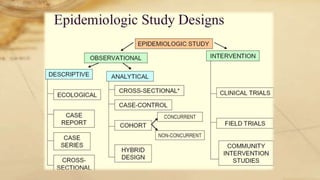
• Epidemiological studies can be divided into two main types:
1. Observational Study
2. Intervention Study
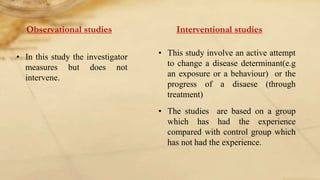
Observational studies
• In this study the investigator
measures but does not
intervene.
Interventional studies
• This study involve an active attempt
to change a disease determinant(e.g
an exposure or a behaviour) or the
progress of a disaese (through
treatment)
• The studies are based on a group
which has had the experience
compared with control group which
has not had the experience.
DESCRIPTIVE EPIDEMIOLOGY
• Descriptive study: focuses on the description of the occurrence of a
disease in a population.
• Purpose of descriptive epidemiology :
‐ To generate hypothesis
‐ To permit evaluation of trends in health & disease and comparisons among
countries and subgroups within countries.
‐ To provide a basis for planning, provision and evaluation of health services
‐ To identify problems to be studied by analytical methods and to suggest
areas that may be fruitful for investigation.
CASE REPORTS
• It is the simplest form of observational study.
• During their daily routine, practitioners notice the emergence of an
outcome and relate it to a drug exposure.
• The reporting of that event through an official reporting system or
medical or pharmacy journal generates a signal that alerts others to the
possibility of casual association.
• Eg: Zappacosta presented a case report of a patient treated with
minoxidil that was discovered to stimulate the hair growth.
Subsequently a topical formulation of minoxidil was developed to
take advantage of that effect.
CASE SERIES
• A case series is a set of sequential case reports identified either by
exposure or by outcome.
• It resembles an open trial of a drug, except that it lacks a formal protocol.
• Enlarges the information about drug use and their consequences.
• Help to confirm ADRs or new indications of the drug.
• Eg: Krishnamoorthy and king reported on the adverse effects associated
with the use of olanzapine in 5 children with severe behavioural
problems.
Adverse events includes: wt. gain(3/5 children), sedation(2/5 children)
and akathisia( 2/5 children).
Advantages
• Useful for hypothesis
generation.
• Informative for very rare
disease with few
established risk factors.
• Usually of short duration.
Disadvantages
• Cannot study cause and
effect relationships.
• Cannot assess disease
frequency.
TREND ANALYSES (ECOLOGICAL STUDIES)
• It involves the plotting of data over time.
• By inspecting the plot, patterns may emerge that can explain events
that have occurred.
• They are useful to provide rapid evidence for hypotheses.
• Eg: If a new pharmacy law is passed or a drug policy is implemented,
we can plot drug usage over time and note what happens before and
after the change. Any shift in the trend line suggest that the change in
law or policy may have an impact on drug utilization.
CROSS-SECTIONAL STUDY
• These studies are examinations of the use of drugs at one specific point in
time.
• They are usually done through surveys, chart reviews and data base
analyses.
• They provide a view of the state of affairs at that time and an estimate of
the prevalence of utilization and of outcomes.
• Such information can be used for formulary management and policy
development.
• Used to compare drug use between countries or regions within in a
country.
• Eg: cross-sectional studies was published by Dua and
colleagues, who examined inappropriate sale of antibiotic use in
pharmacies in Nagpur.
• Such studies can identify problem areas and suggest where
remedial action should be directed.
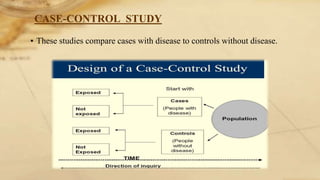
CASE-CONTROL STUDY
• These studies compare cases with disease to controls without disease.
Advantages
• Useful to study multiple possible
causes of a single disease.
• Useful to study uncommon diseases.
• Relatively easy to carry out.
• Rapid and inexpensive.
• Requires comparatively few subjects.
• Does not need an ethical clearance.
• There is no risk to the subject .
Disadvantages
• It introduces bias.
• To select an appropriate control
could be difficult .
• It may be difficult to distinguish
between the cause of a disease
and an associated factor.
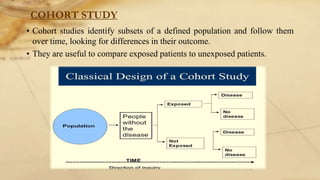
COHORT STUDY
• Cohort studies identify subsets of a defined population and follow them
over time, looking for differences in their outcome.
• They are useful to compare exposed patients to unexposed patients.
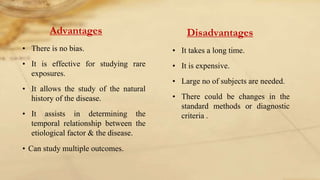
Advantages
• There is no bias.
• It is effective for studying rare
exposures.
• It allows the study of the natural
history of the disease.
• It assists in determining the
temporal relationship between the
etiological factor & the disease.
• Can study multiple outcomes.
Disadvantages
• It takes a long time.
• It is expensive.
• Large no of subjects are needed.
• There could be changes in the
standard methods or diagnostic
criteria .
APPLICATIONS OF
PHARMACOEPIDEMIOLOGY
• Government agencies & Health care plans:
Pharmacoepidemiology research is important for the government
agencies like the Agency for Healthcare Research and Quality
(AHRQ) and the Centers for Medicare and Medicaid Services (CMS)
and Healthcare plans.
• Practitioners:
Pharmacoepidemiological studies can help Pharmacists,
Physicians, Nurses and other Public health care practitioners to make
informed decisions about treatment for patients.
• Pharmaceutical industries:
The pharmaceutical industry want to understand how a drug is prescribed,
used and what are all the positive and negative outcomes.
• Academicians:
Academicians often conduct pharmacoepidemiological studies to find
answers to practice related questions.
• Attorneys:
Findings from pharmacoepidemiological studies can be used as
evidence that a drug product did or didn’t cause an event.
• Consumers and Patients:
To learn about safety and effectiveness of drug products, patients and
consumers rely on pharmacoepidemiological studies.
REFERENCES
1. Textbook of clinical pharmacy practice, pharmacoepidemiology, by
Jayashri Sankaranararyanan and Thomas R Einarson; page no: 467-
483.
2. https://en.wikipedia.org/wiki/Pharmacoepidemiology
3. https://www.slideshare.net/DivjyotKaur/pharmacoepidemiology

Pharmacoepidemiology

  • 1.
    PHARMACOEPIDEMIOLOGY Submitted by: ASMAM A FIRST M.PHARM PHARMACOLOGY
  • 2.
    INTRODUCTION Pharmacoepidemiology Pharmakon - Drug Epi –upon or among Demos – People or district Logos - Study • Pharmacoepidemiology is the study of drug use in populations. • It is the bridging between clinical pharmacology and epidemiology.
  • 3.
    DEFINITION • Hartzema etal. have defined pharmacoepidemiology as “the application of epidemiologic reasoning methods and knowledge to the study of the uses and effects (beneficial and adverse) of drugs in human populations.” • Populations are large groups of people, which may include thousands or even millions of people.
  • 4.
    • Pharmacoepidemiological researchin practice includes: ― Evaluation of specific drug use in certain conditions, ― Patterns of drug use, that is, how it is being used-how much, where, when and by whom, ― Drug taking behaviours in society.
  • 5.
    AIM • WHO targetsits pharmacoepidemiological efforts to ensure the quality , safety and efficacy of drugs. • The studies focus on ― Global trends in prescribing ― Appropriateness of drug use ― Medication adherence ― Lifestyle effects on drug therapy ― Special population (Elderly, Pediatric, etc.) drug therapy ― Drug Interactions ― Predictable ADRs ― Uncommon and unpredictable ADRs
  • 6.
    SOURCES OF DATA •The sources of drug data includes: ―Institutionalized medical records and databases from hospital and pharmacy claims. ―System wide databases from health insurance claims or pharmaceutical organization. ―National databases like Medical Expenditure Panel Survey, National Ambulatory Medical Care Survey. ―Field data like records from dispensers, sellers or distributers or from small groups. ―Experimental clinical trial data.
  • 7.
    TYPES • Epidemiological studiescan be divided into two main types: 1. Observational Study 2. Intervention Study
  • 9.
    Observational studies • Inthis study the investigator measures but does not intervene. Interventional studies • This study involve an active attempt to change a disease determinant(e.g an exposure or a behaviour) or the progress of a disaese (through treatment) • The studies are based on a group which has had the experience compared with control group which has not had the experience.
  • 10.
    DESCRIPTIVE EPIDEMIOLOGY • Descriptivestudy: focuses on the description of the occurrence of a disease in a population. • Purpose of descriptive epidemiology : ‐ To generate hypothesis ‐ To permit evaluation of trends in health & disease and comparisons among countries and subgroups within countries. ‐ To provide a basis for planning, provision and evaluation of health services ‐ To identify problems to be studied by analytical methods and to suggest areas that may be fruitful for investigation.
  • 11.
    CASE REPORTS • Itis the simplest form of observational study. • During their daily routine, practitioners notice the emergence of an outcome and relate it to a drug exposure. • The reporting of that event through an official reporting system or medical or pharmacy journal generates a signal that alerts others to the possibility of casual association. • Eg: Zappacosta presented a case report of a patient treated with minoxidil that was discovered to stimulate the hair growth. Subsequently a topical formulation of minoxidil was developed to take advantage of that effect.
  • 12.
    CASE SERIES • Acase series is a set of sequential case reports identified either by exposure or by outcome. • It resembles an open trial of a drug, except that it lacks a formal protocol. • Enlarges the information about drug use and their consequences. • Help to confirm ADRs or new indications of the drug. • Eg: Krishnamoorthy and king reported on the adverse effects associated with the use of olanzapine in 5 children with severe behavioural problems. Adverse events includes: wt. gain(3/5 children), sedation(2/5 children) and akathisia( 2/5 children).
  • 13.
    Advantages • Useful forhypothesis generation. • Informative for very rare disease with few established risk factors. • Usually of short duration. Disadvantages • Cannot study cause and effect relationships. • Cannot assess disease frequency.
  • 14.
    TREND ANALYSES (ECOLOGICALSTUDIES) • It involves the plotting of data over time. • By inspecting the plot, patterns may emerge that can explain events that have occurred. • They are useful to provide rapid evidence for hypotheses. • Eg: If a new pharmacy law is passed or a drug policy is implemented, we can plot drug usage over time and note what happens before and after the change. Any shift in the trend line suggest that the change in law or policy may have an impact on drug utilization.
  • 15.
    CROSS-SECTIONAL STUDY • Thesestudies are examinations of the use of drugs at one specific point in time. • They are usually done through surveys, chart reviews and data base analyses. • They provide a view of the state of affairs at that time and an estimate of the prevalence of utilization and of outcomes. • Such information can be used for formulary management and policy development. • Used to compare drug use between countries or regions within in a country.
  • 16.
    • Eg: cross-sectionalstudies was published by Dua and colleagues, who examined inappropriate sale of antibiotic use in pharmacies in Nagpur. • Such studies can identify problem areas and suggest where remedial action should be directed.
  • 17.
    CASE-CONTROL STUDY • Thesestudies compare cases with disease to controls without disease.
  • 18.
    Advantages • Useful tostudy multiple possible causes of a single disease. • Useful to study uncommon diseases. • Relatively easy to carry out. • Rapid and inexpensive. • Requires comparatively few subjects. • Does not need an ethical clearance. • There is no risk to the subject . Disadvantages • It introduces bias. • To select an appropriate control could be difficult . • It may be difficult to distinguish between the cause of a disease and an associated factor.
  • 19.
    COHORT STUDY • Cohortstudies identify subsets of a defined population and follow them over time, looking for differences in their outcome. • They are useful to compare exposed patients to unexposed patients.
  • 20.
    Advantages • There isno bias. • It is effective for studying rare exposures. • It allows the study of the natural history of the disease. • It assists in determining the temporal relationship between the etiological factor & the disease. • Can study multiple outcomes. Disadvantages • It takes a long time. • It is expensive. • Large no of subjects are needed. • There could be changes in the standard methods or diagnostic criteria .
  • 21.
    APPLICATIONS OF PHARMACOEPIDEMIOLOGY • Governmentagencies & Health care plans: Pharmacoepidemiology research is important for the government agencies like the Agency for Healthcare Research and Quality (AHRQ) and the Centers for Medicare and Medicaid Services (CMS) and Healthcare plans. • Practitioners: Pharmacoepidemiological studies can help Pharmacists, Physicians, Nurses and other Public health care practitioners to make informed decisions about treatment for patients.
  • 22.
    • Pharmaceutical industries: Thepharmaceutical industry want to understand how a drug is prescribed, used and what are all the positive and negative outcomes. • Academicians: Academicians often conduct pharmacoepidemiological studies to find answers to practice related questions. • Attorneys: Findings from pharmacoepidemiological studies can be used as evidence that a drug product did or didn’t cause an event. • Consumers and Patients: To learn about safety and effectiveness of drug products, patients and consumers rely on pharmacoepidemiological studies.
  • 23.
    REFERENCES 1. Textbook ofclinical pharmacy practice, pharmacoepidemiology, by Jayashri Sankaranararyanan and Thomas R Einarson; page no: 467- 483. 2. https://en.wikipedia.org/wiki/Pharmacoepidemiology 3. https://www.slideshare.net/DivjyotKaur/pharmacoepidemiology