WHAT IS GRAMMAR?
Aslıgül KÖYÜK
Hacettepe University
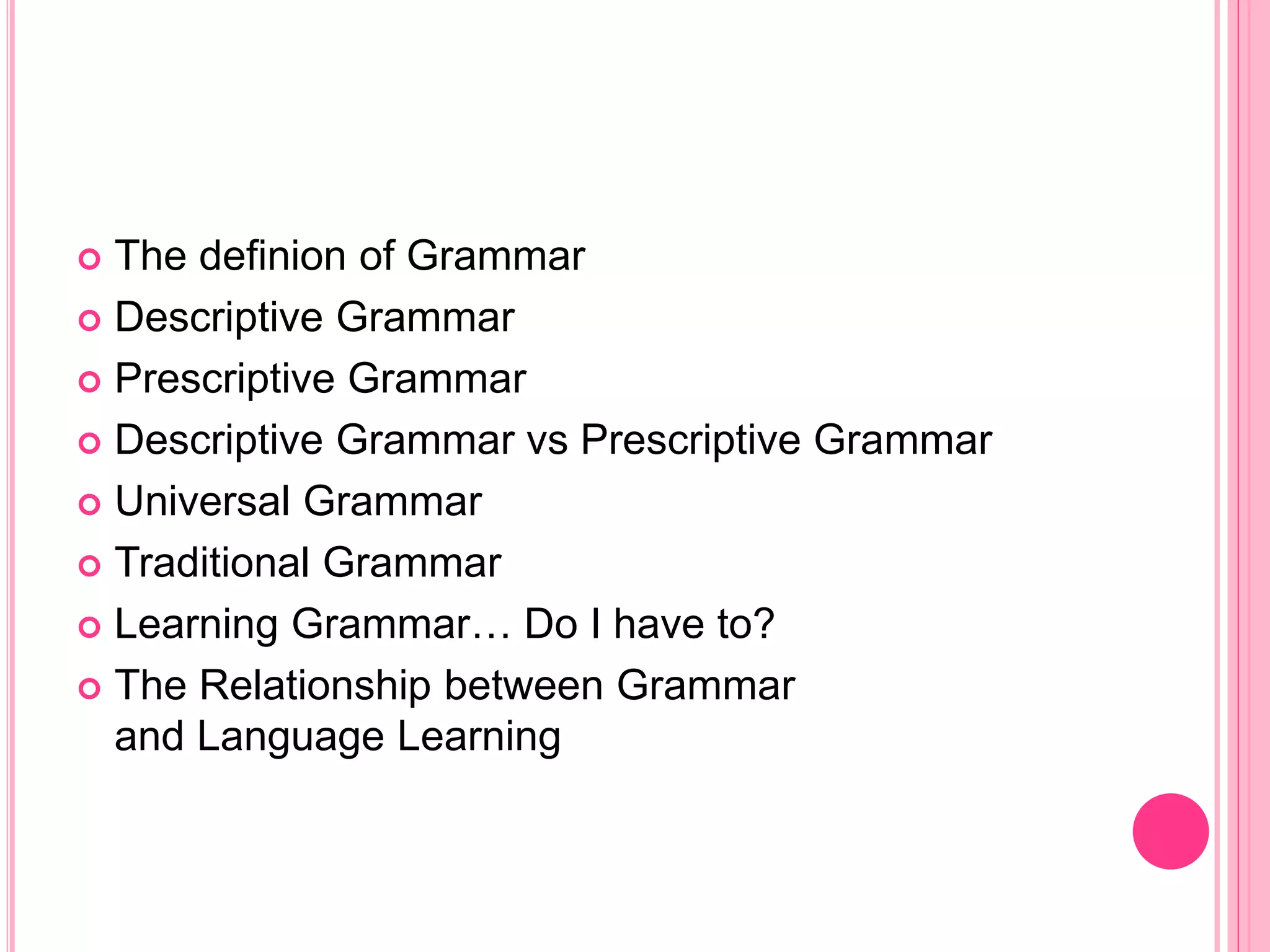
 The definion of Grammar
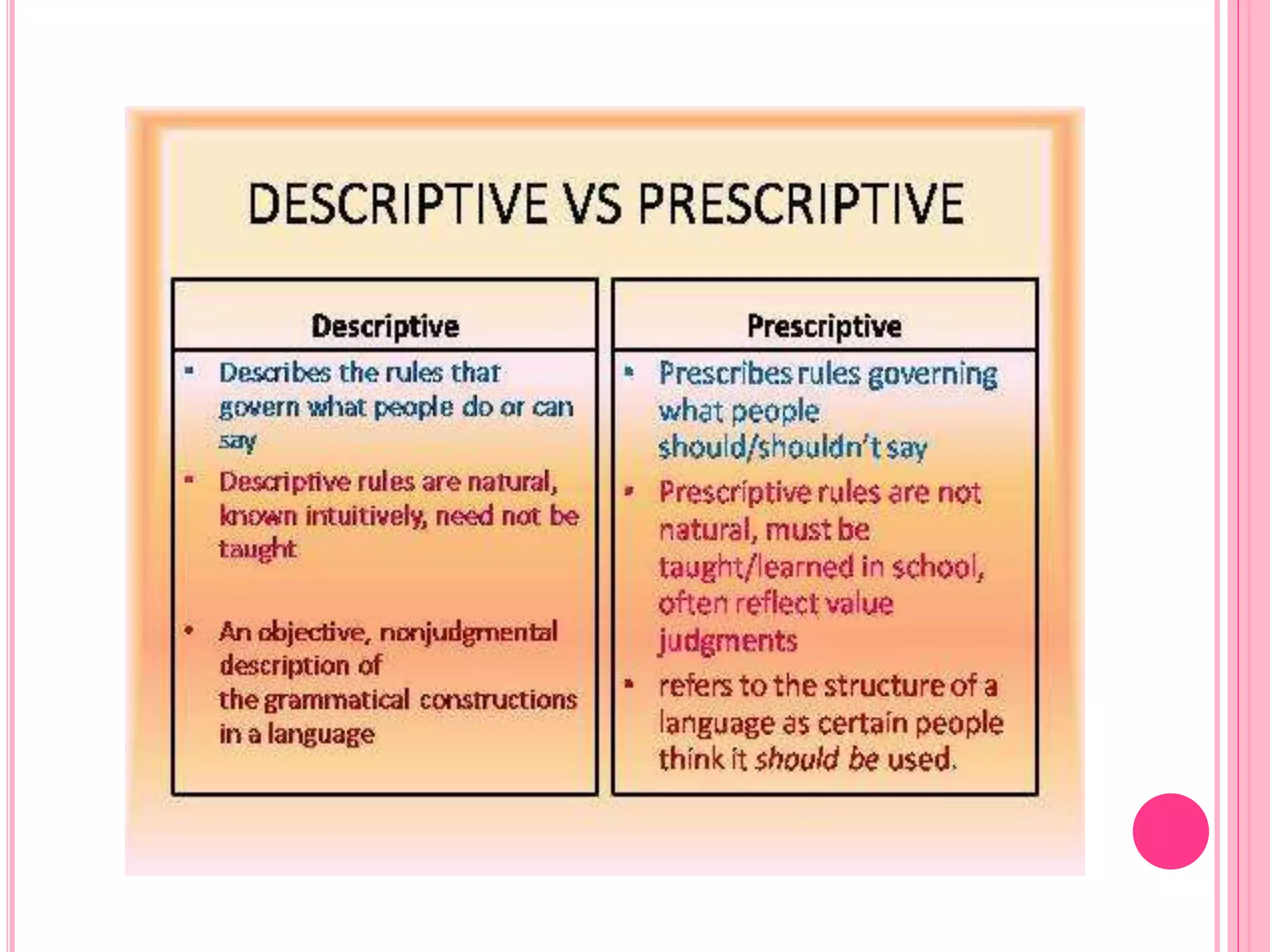
 Descriptive Grammar
 Prescriptive Grammar
 Descriptive Grammar vs Prescriptive Grammar
 Universal Grammar
 Traditional Grammar
 Learning Grammar… Do I have to?
 The Relationship between Grammar
and Language Learning
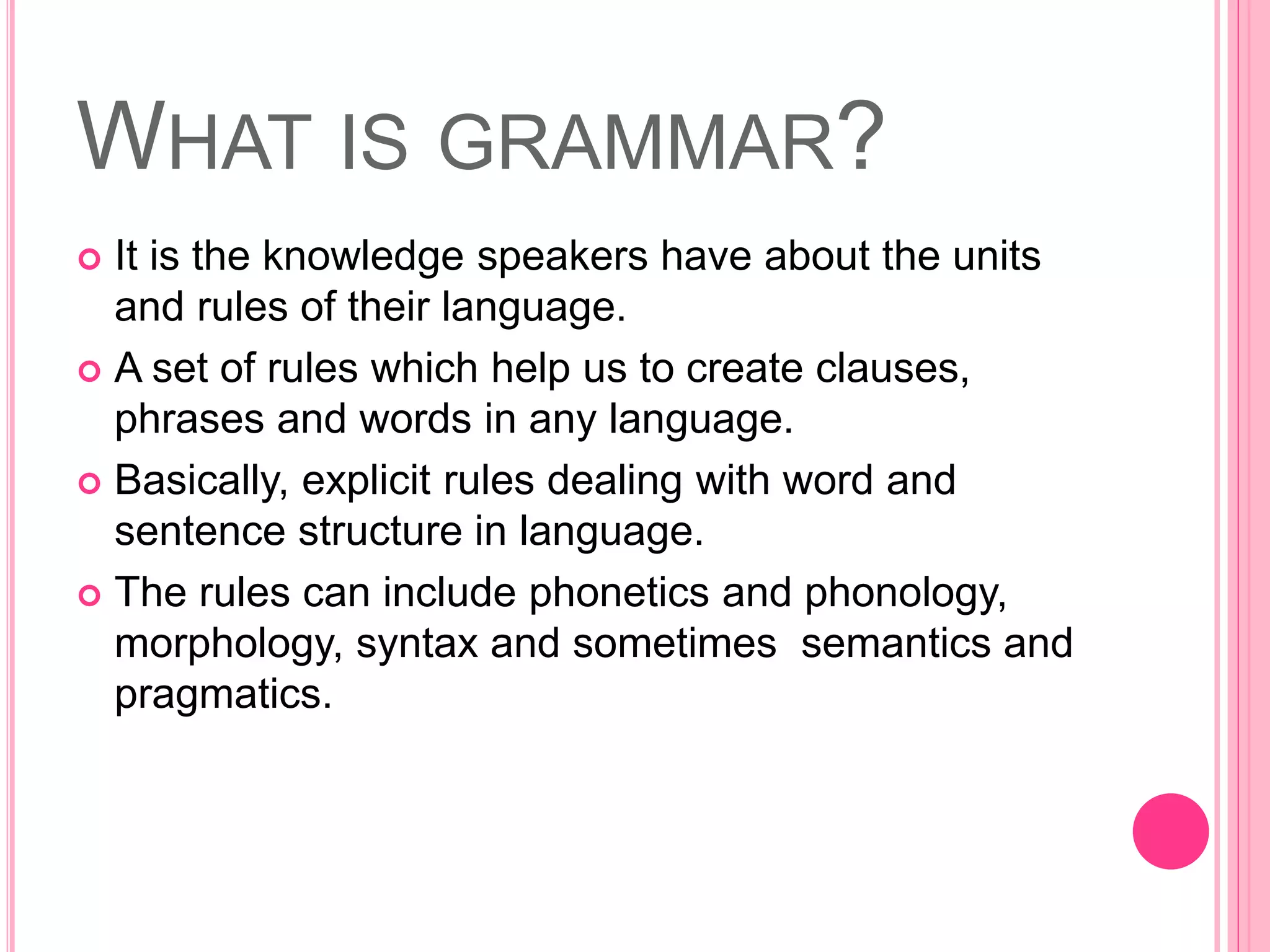
WHAT IS GRAMMAR?
 It is the knowledge speakers have about the units
and rules of their language.
 A set of rules which help us to create clauses,
phrases and words in any language.
 Basically, explicit rules dealing with word and
sentence structure in language.
 The rules can include phonetics and phonology,
morphology, syntax and sometimes semantics and
pragmatics.
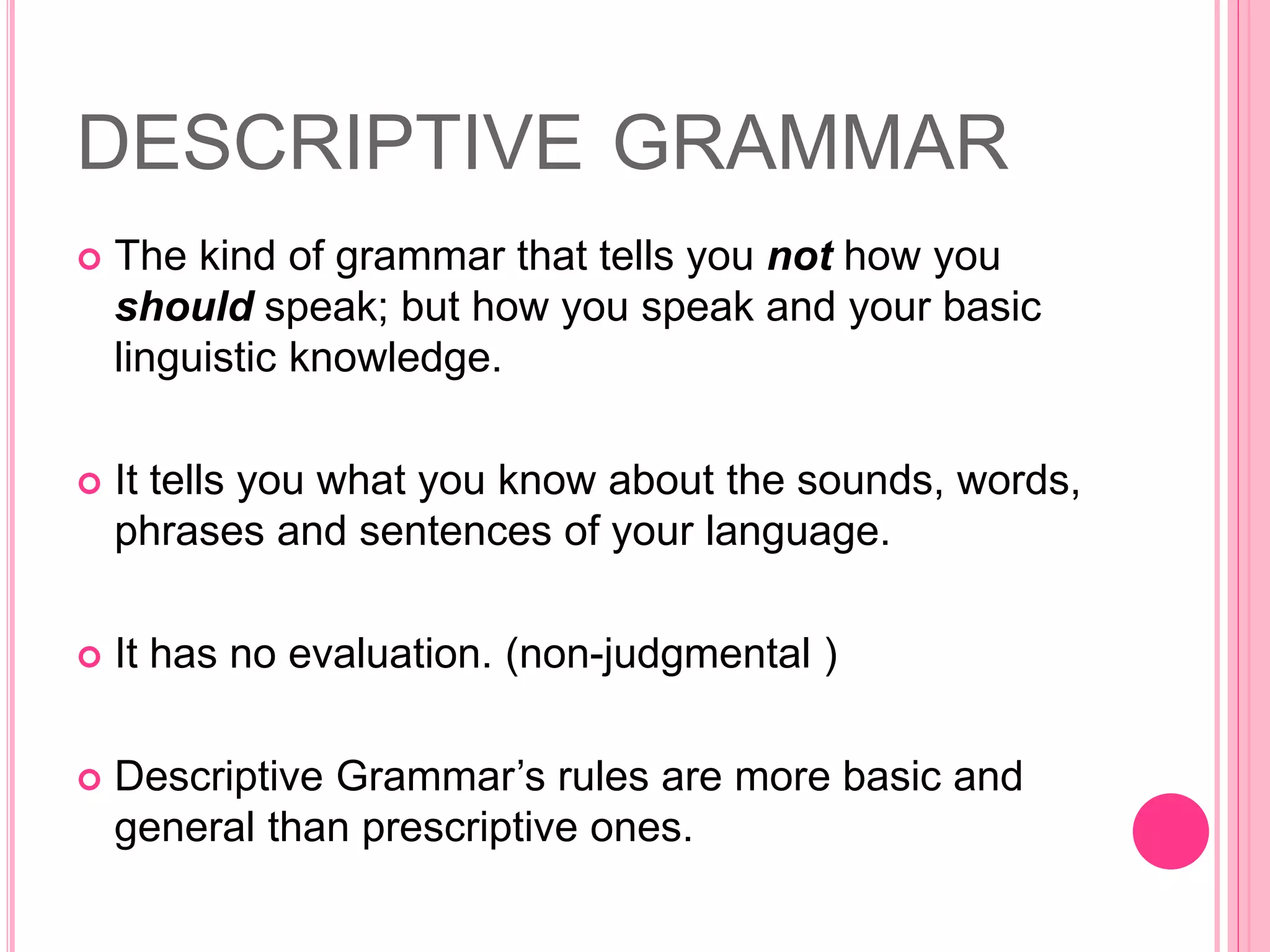
DESCRIPTIVE GRAMMAR
 The kind of grammar that tells you not how you
should speak; but how you speak and your basic
linguistic knowledge.
 It tells you what you know about the sounds, words,
phrases and sentences of your language.
 It has no evaluation. (non-judgmental )
 Descriptive Grammar’s rules are more basic and
general than prescriptive ones.
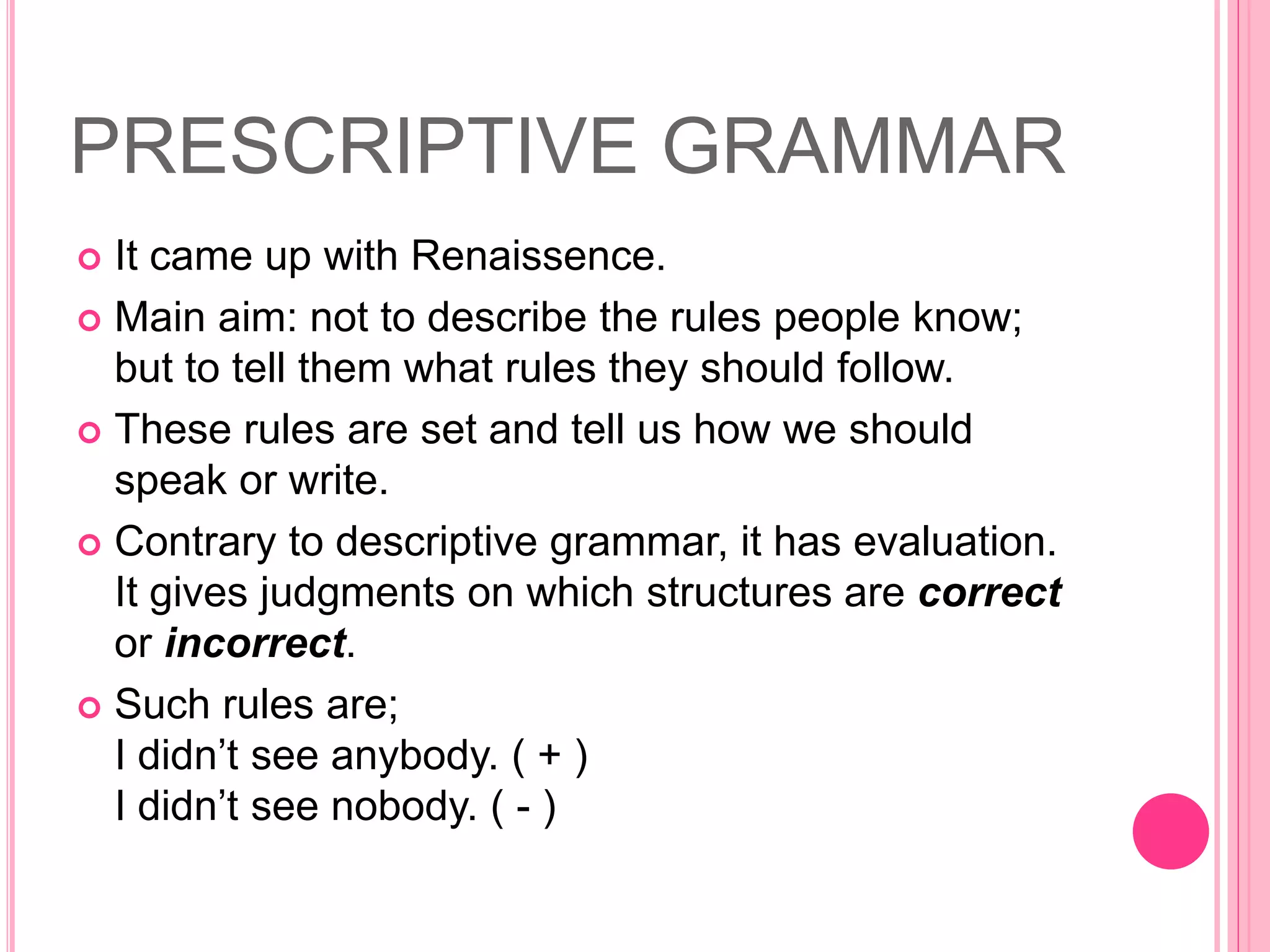
PRESCRIPTIVE GRAMMAR
 It came up with Renaissence.
 Main aim: not to describe the rules people know;
but to tell them what rules they should follow.
 These rules are set and tell us how we should
speak or write.
 Contrary to descriptive grammar, it has evaluation.
It gives judgments on which structures are correct
or incorrect.
 Such rules are;
I didn’t see anybody. ( + )
I didn’t see nobody. ( - )
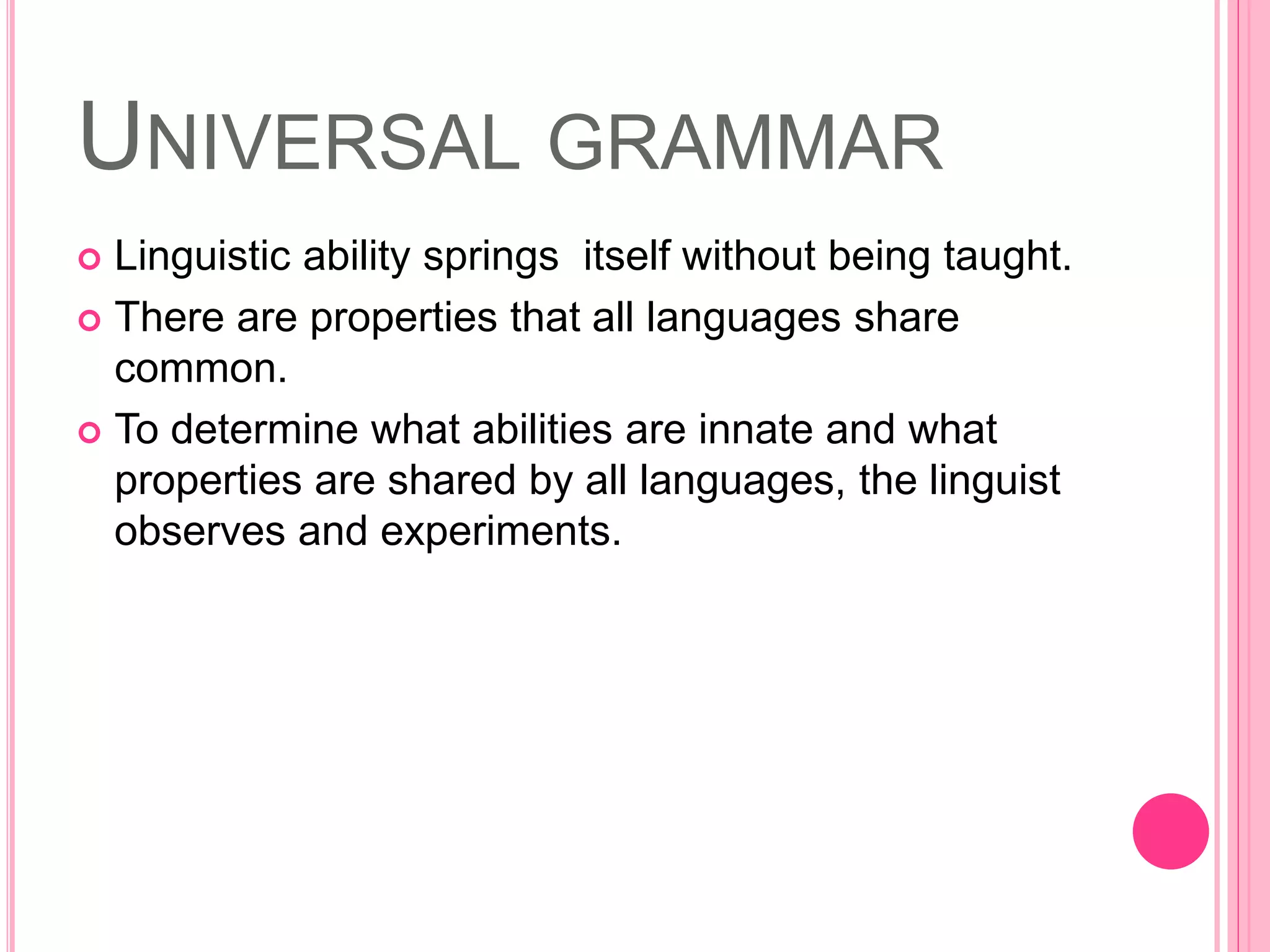
UNIVERSAL GRAMMAR
 Linguistic ability springs itself without being taught.
 There are properties that all languages share
common.
 To determine what abilities are innate and what
properties are shared by all languages, the linguist
observes and experiments.
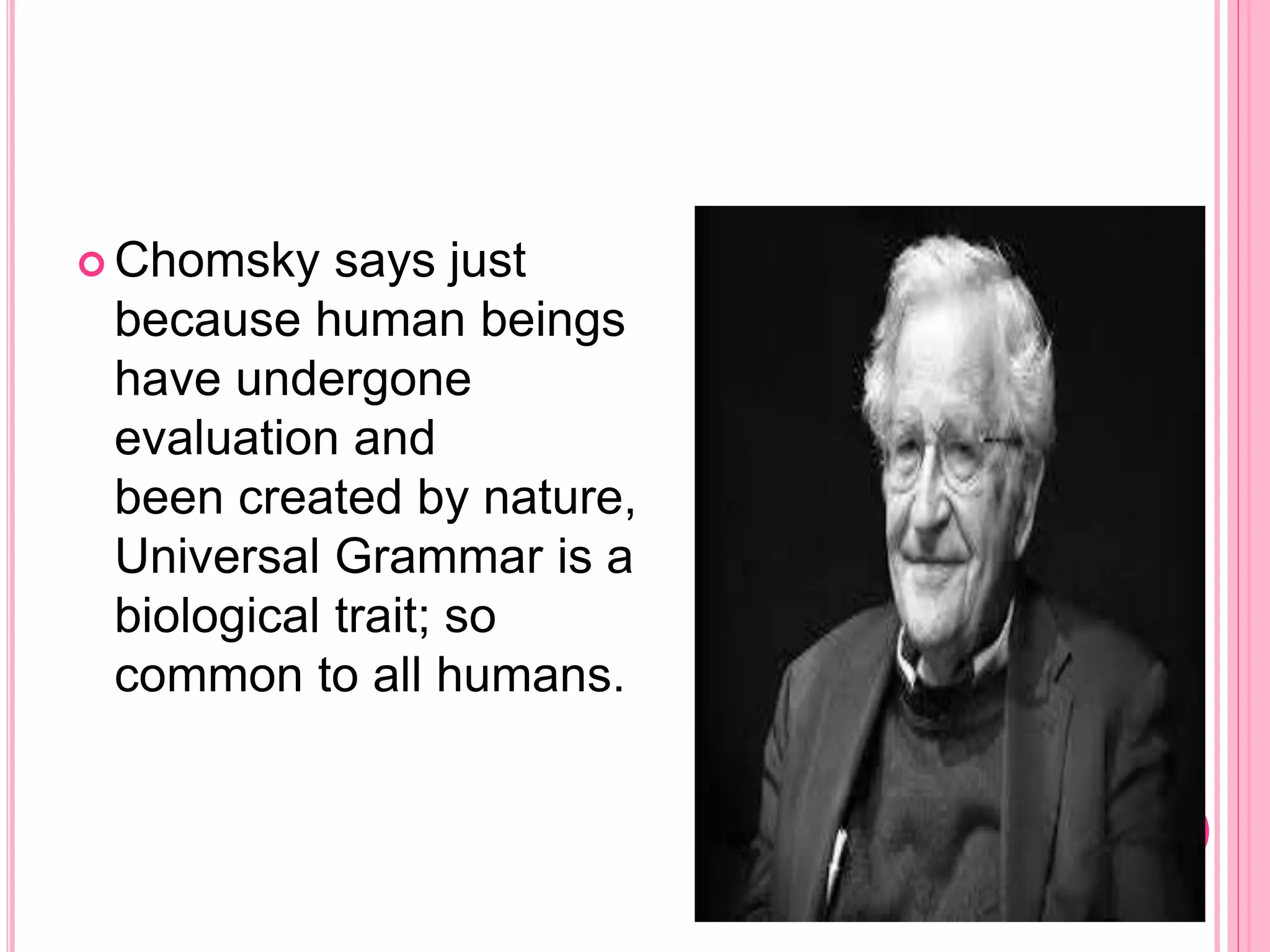
 Chomsky says just
because human beings
have undergone
evaluation and
been created by nature,
Universal Grammar is a
biological trait; so
common to all humans.
TRADITIONAL GRAMMAR
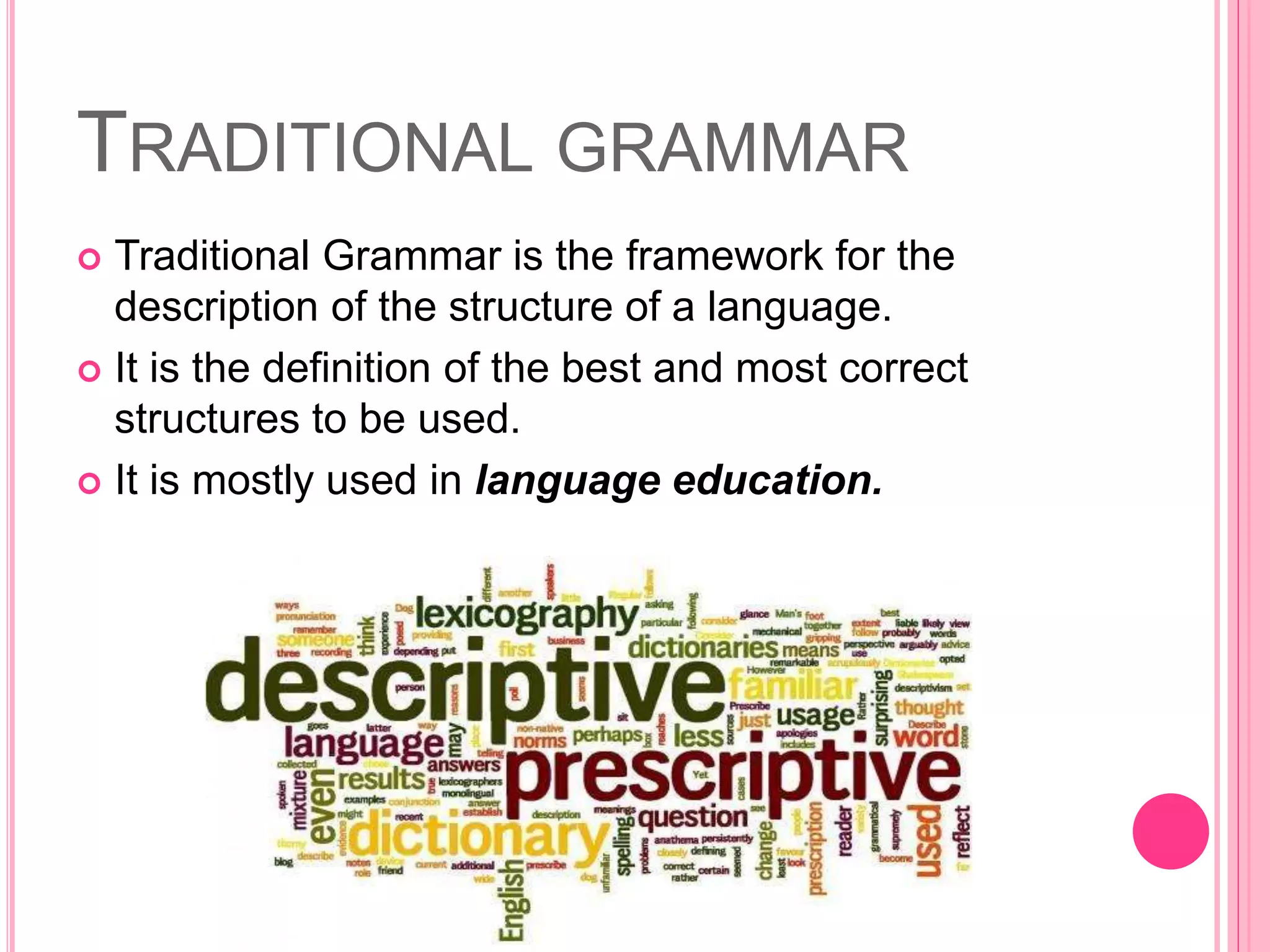
 Traditional Grammar is the framework for the
description of the structure of a language.
 It is the definition of the best and most correct
structures to be used.
 It is mostly used in language education.
LEARNING GRAMMAR.. DO I HAVE TO?
 Grammar is important because thanks to it, it is
possible for us to talk about language.
 Knowing grammar offers a window into the human
mind and it’s mental capacity.
 For communication, all kinds of texts ( does not
matter whether it is formal or not ), we use
language.
 To understand others and to be understood by
them, we create endless sentences with the rules of
grammar.
GRAMMAR AND LANGUAGE LEARNING
 The common thing is all languages have their own
grammar structures.
 For speaking any language, we should be able to
create sentences; to create sentences, we must
know grammar rules.
 At beginning stages of language learning, it starts
with basic words and basic grammar rules. It is the
root of language.
 Example:
*She, ill, go, school, today. ( ??? )
*She is ill; that’s why she couldn’t go to school
today.
REFERENCES
 http://www.lingholic.com/important-grammar-
language-learning/
 https://en.wikipedia.org/wiki/Traditional_grammar
 http://grammar.about.com/od/grammarfaq/f/gramma
rvalue.htm
 http://www.ingilizcealanbilgisi.com/oabt/descriptive-
grammar-vs-prescriptive-grammar/
 http://amyrey.web.unc.edu/classes/ling-101-
online/tutorials/understanding-prescriptive-vs-
descriptive-grammar/

What is grammar

  • 1.
    WHAT IS GRAMMAR? AslıgülKÖYÜK Hacettepe University
  • 2.
     The definionof Grammar  Descriptive Grammar  Prescriptive Grammar  Descriptive Grammar vs Prescriptive Grammar  Universal Grammar  Traditional Grammar  Learning Grammar… Do I have to?  The Relationship between Grammar and Language Learning
  • 3.
    WHAT IS GRAMMAR? It is the knowledge speakers have about the units and rules of their language.  A set of rules which help us to create clauses, phrases and words in any language.  Basically, explicit rules dealing with word and sentence structure in language.  The rules can include phonetics and phonology, morphology, syntax and sometimes semantics and pragmatics.
  • 4.
    DESCRIPTIVE GRAMMAR  Thekind of grammar that tells you not how you should speak; but how you speak and your basic linguistic knowledge.  It tells you what you know about the sounds, words, phrases and sentences of your language.  It has no evaluation. (non-judgmental )  Descriptive Grammar’s rules are more basic and general than prescriptive ones.
  • 5.
    PRESCRIPTIVE GRAMMAR  Itcame up with Renaissence.  Main aim: not to describe the rules people know; but to tell them what rules they should follow.  These rules are set and tell us how we should speak or write.  Contrary to descriptive grammar, it has evaluation. It gives judgments on which structures are correct or incorrect.  Such rules are; I didn’t see anybody. ( + ) I didn’t see nobody. ( - )
  • 7.
    UNIVERSAL GRAMMAR  Linguisticability springs itself without being taught.  There are properties that all languages share common.  To determine what abilities are innate and what properties are shared by all languages, the linguist observes and experiments.
  • 8.
     Chomsky saysjust because human beings have undergone evaluation and been created by nature, Universal Grammar is a biological trait; so common to all humans.
  • 9.
    TRADITIONAL GRAMMAR  TraditionalGrammar is the framework for the description of the structure of a language.  It is the definition of the best and most correct structures to be used.  It is mostly used in language education.
  • 10.
    LEARNING GRAMMAR.. DOI HAVE TO?  Grammar is important because thanks to it, it is possible for us to talk about language.  Knowing grammar offers a window into the human mind and it’s mental capacity.  For communication, all kinds of texts ( does not matter whether it is formal or not ), we use language.  To understand others and to be understood by them, we create endless sentences with the rules of grammar.
  • 11.
    GRAMMAR AND LANGUAGELEARNING  The common thing is all languages have their own grammar structures.  For speaking any language, we should be able to create sentences; to create sentences, we must know grammar rules.  At beginning stages of language learning, it starts with basic words and basic grammar rules. It is the root of language.  Example: *She, ill, go, school, today. ( ??? ) *She is ill; that’s why she couldn’t go to school today.
  • 13.
    REFERENCES  http://www.lingholic.com/important-grammar- language-learning/  https://en.wikipedia.org/wiki/Traditional_grammar http://grammar.about.com/od/grammarfaq/f/gramma rvalue.htm  http://www.ingilizcealanbilgisi.com/oabt/descriptive- grammar-vs-prescriptive-grammar/  http://amyrey.web.unc.edu/classes/ling-101- online/tutorials/understanding-prescriptive-vs- descriptive-grammar/