Better listeners versus more listening: rethinking the Comprehension Approach   John Field Universities of Reading and Cambridge, UK
The Comprehension Approach Pre-listening: motivation, mental set Extensive listening: general questions Pre-set task or questions Intensive listening Checking answers (? with replay?) [Language review] [Listen with tapescript]
Teaching not testing ‘ Until we have some diagnostic procedures, the teacher [of L2 listening] can only continue to test comprehension, not to teach it. We need to move into a position where the teacher is able to recognise particular patterns of behaviour in listening manifested by an unsuccessful listener and to provide exercises for the student which will promote superior patterns of behaviour (superior strategies)’.   (Brown, 1986: 286)
Concerns about the Comprehension Approach Teacher-centred; isolation of learners The notion of ‘right’ and ‘wrong’ answers Origins in L2 reading methods; consequent misconceptions about the nature of listening Heavy emphasis on  meaning building  at the expense of  decoding Emphasis on the  products   of listening in the form of correct answers, and not the  process
A partial solution: a diagnostic approach a. Teacher adopts  a non-interventionist stance Who thinks the answer is A? Who thinks it is B? Shall we hear it again? b. Teacher  follows up  both right and wrong answers. Why do you think answer A is right? Why do you think answer B is right?
A more radical solution (Field 1998) An approach based upon intensive small-scale exercises that practise the various sub-skills that contribute to skilled listening. A distinction between  sub-skills  (part of the behaviour of a skilled listener) strategies  used to compensate short-term for problems of understanding.
Field (2008):A process approach Listening is a form of  expertise . We acquire it like other skills such as playing chess or driving. Achieving any type of expertise requires the novice to adjust slowly to the way in which an expert behaves…  Teachers need to understand expert behaviour if they are to induce it in novices . Becoming an expert of any kind requires: Intensive practice in important processes so that they become more and more  automatic Combining  the processes into larger operations Exposure to real-life experiences, where taught processes have to be used  appropriately  and under the pressure of  time.
A process approach assumes: Language instruction is not the solution:  knowledge    recognition
A process approach distinguishes … Decoding:  matching groups of sounds in the speech stream to words in the listener's vocabulary Meaning building : constructing a larger-scale meaning on the basis of the words that have been decoded. Both are critical to successful listening
A process approach: 3 strands 1. Expose   … Teachers need greater understanding of the  nature of the input , and its problems for learners; 2. Model … Teachers need a methodology that  trains better listeners  instead of just providing practice; 3. Enable … Learners must be helped to  crack the code of speech at an early stage , despite their lack of a) language knowledge b) experience of L2 listening.
1.   Expose : Understand the input  (Brown, 1990) * Much variation in the signal * No consistent boundaries between words * No physical evidence: the listener needs to carry meaning forward in the mind . * Time pressures On-line processing Timing is largely controlled by speaker
Variability of speech Phoneme variation Word variation assimilation – elision pressures inside the intonation group Speaker variation voice – speech rate – context – accent
Implications for teaching Examples of the same words / phrases in different voices and contexts Repetition and recycling. The importance of replay. Attention to chunks and to rhythm (esp. as a means of decoding function words)
Focused practice in L2 input Identify aspects of the input that are likely to cause problems of decoding Practise each one intensively by means of small-scale micro-listening exercises Use simple exercise types such as transcribing short sentences
Weak form decoding exercise Write down what you hear. [samples of authentic or naturalistic speech] I should have [ ə ] done. Just wait a [ ə ]  moment. A box of  [ ə ] cigars. The buses are [ ə ] late. I’m looking for a [ frə ] photo. I’m looking at a [ ətə ] key. I’m talking to [ tə ] the meeting. I’m talking at [ ət ] the meeting.
2. Model:  Emulate expert processing L1 processes provide a model for the L2 instructor L1 processes provide a benchmark that enables us to understand better where L2 problems lie. Rationale: long exposure has enabled L1 listeners to adopt routines which are more effective and more highly automatic than those of L2 listeners.
Questions about L1 processes How do expert listeners process syllables? L1:   [ ˡspɔ:t ]     L2:   [ eˡspɔ:t ] [ sɪˡpɔ:t ]   How do expert listeners recognise words by association with words heard earlier? DOCTOR – nurse How do expert listeners deal with unfamiliar words? How do expert listeners make use of intonation patterns and pauses in the input? How do expert listeners recognise words in connected speech?
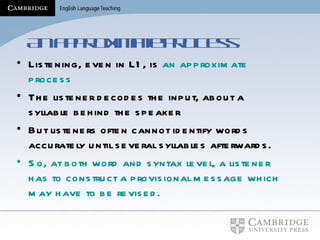
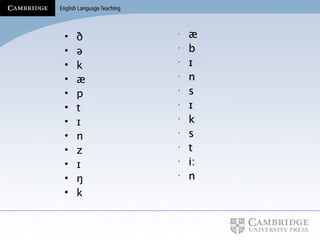
An approximate process Listening, even in L1, is  an approximate process The listener decodes the input, about a syllable behind the speaker But listeners often cannot identify words accurately until several syllables afterwards. So, at both word and syntax level, a listener has to construct a provisional message which may have to be revised.
ð ə k æ p t ɪ n z ɪ ŋ k æ b ɪ n s ɪ k s t i: n  
The expert listener versus the novice [ maɪˈtreɪn ]     my train / might rain / ( might train) + or     might rain > might train > my train + snow     might rain or snow [ maɪˈtreɪn ]     my train + or     my train or + snow     my train or snow
How do expert listeners recognise grammar patterns? The heavy fall… clumsily The actor learnt the words… had been written by Shakespeare The teachers taught by modern methods … did better than their colleagues The rescuers discovered the plane … had crashed The promise made… was finally kept.
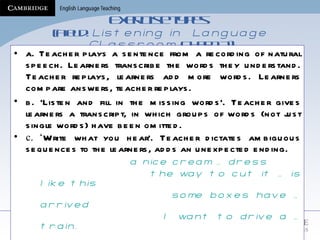
Exercise types   (Field:  Listening in  Language Classroom,  Chap 12) a. Teacher plays a sentence from a recording of natural speech. Learners transcribe the words they understand. Teacher replays, learners add more words. Learners compare answers, teacher replays. b. ‘Listen and fill in the missing words’. Teacher gives learners a transcript, in which groups of words (not just single words) have been omitted.  c. ‘ Write what you hear’. Teacher dictates ambiguous sequences to the learners, adds an unexpected ending.   a nice cream … dress the way to cut it … is like this  some boxes have … arrived  I want to drive a … train.
Dealing with unknown words I  found  out  that  the  thud  was  the  cat the  sound  was  the  cat I found  out  that  the  front  was  the  cat   the  thing  was  the  cat   the  fog  of  the  cat I found  that  the  sun  in  the  cat I found out  the  frog  and  the  cat I found  out  that  is  a  cat I found  that  was  the  cat   I thought  it  was  a  cat in  the  front  was  the  cat I found  out  where  was  the  cat   what I thought  that  a  cat
Unfamiliar words I found out that the thud was the cat. L2 listener in class ‘ Can you work out the meaning from the context?’ L2 listener in the real world the thought / front / sun  was the cat L1 listener hearing a new word: Identify as new word rather  than known Ignore – Generalise – Infer meaning from context
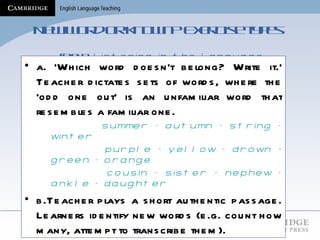
New word or known?  Exercise types    (Field:  Listening in the Language Classroom,  Chap 12) a. ‘Which word doesn’t belong? Write it.’ Teacher dictates sets of words, where the ‘odd one out’ is an unfamiliar word that resembles a familiar one.   summer – autumn – string – winter  purple – yellow – drown - green – orange cousin – sister – nephew – ankle – daughter b.Teacher plays a short authentic passage. Learners identify new words (e.g. count how many, attempt to transcribe them).
3. Enable.  Short term techniques We can design a long-term developmental programme based upon: Familiarising the listener with L2 input Training the listener in L1 processes. But meanwhile the learner needs strategies for making sense of what she hears despite limited language knowledge a. to participate in L2 encounters b. to benefit from real-world sources c. to sustain motivation
Explicit teaching of listening strategies Raise awareness of strategy use. Present the strategies one by one. Practise the strategies individually. Learners evaluate their own strategy use.
Problems of explicit teaching Many standard check-lists of L2 strategies were constructed with speaking in mind. The strategy that is chosen depends heavily upon the problem of understanding that has occurred. Effective strategy use is appropriate rapid  a choice between alternatives.
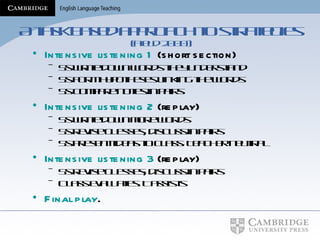
A task-based approach to strategies  (Field 2000) Intensive listening 1  (short section) Ss write down words they understand Ss form hypotheses linking the words Ss compare notes in pairs Intensive listening 2  (replay) Ss write down more words Ss revise guesses, discuss in pairs Ss present ideas to class. Teacher neutral Intensive listening 3  (replay) Ss revise guesses; discuss in pairs Class evaluates. T assists Final play .
A role for the comprehension approach Training in listening, like training in any form of expertise, requires: Intensive micro-listening exercises  that focus on a particular process, combined with Exposure  of the kind the comprehension approach gives [But we need to rethink the way in which we implement the comprehension approach in the classroom]
Summary: A process approach to listening… 1.  diagnoses  why understanding fails 2. identifies   phonetic features  of the TL which are likely to cause decoding problems for L2 listening; 3. recognises  processes  which characterise the performance of the L1 listener; Uses this information  to build a programme of micro-listening practice, with exercises that involve the transcription or interpretation of short pieces of input. Supports with larger-scale comprehension work to ensure that the skills that are acquired become integrated into overall competence.
A long-term process programme must also allow for strategy instruction Purpose: to equip the learner short-term to make minimal sense of the input  Strategy instruction needs to be mainly task-based so that strategies can be used a. in combination with each other b. in ways that take account of: the demands of the problem - the listener’s goals  - the listener’s own listening style
References Brown, G. Investigating listening comprehension in context.  Applied Linguistics  7/3 Field, J. 1998. Skills and strategies: towards a new methodology for listening.  ELT Journal  52/2  Field, J. 2000. ‘Not waving but drowning’  ELT Journal  54/2  Field, J. 2008.  Listening in the Language Classroom.  Cambridge: Cambridge University Press
j.c.field@ reading.ac.uk Dr John Field, Dept of Applied Linguistics, University of Reading, Whiteknights, Reading RG6 6AA, UK

John+field+presentation

  • 1.
    Better listeners versusmore listening: rethinking the Comprehension Approach John Field Universities of Reading and Cambridge, UK
  • 2.
    The Comprehension ApproachPre-listening: motivation, mental set Extensive listening: general questions Pre-set task or questions Intensive listening Checking answers (? with replay?) [Language review] [Listen with tapescript]
  • 3.
    Teaching not testing‘ Until we have some diagnostic procedures, the teacher [of L2 listening] can only continue to test comprehension, not to teach it. We need to move into a position where the teacher is able to recognise particular patterns of behaviour in listening manifested by an unsuccessful listener and to provide exercises for the student which will promote superior patterns of behaviour (superior strategies)’. (Brown, 1986: 286)
  • 4.
    Concerns about theComprehension Approach Teacher-centred; isolation of learners The notion of ‘right’ and ‘wrong’ answers Origins in L2 reading methods; consequent misconceptions about the nature of listening Heavy emphasis on meaning building at the expense of decoding Emphasis on the products of listening in the form of correct answers, and not the process
  • 5.
    A partial solution:a diagnostic approach a. Teacher adopts a non-interventionist stance Who thinks the answer is A? Who thinks it is B? Shall we hear it again? b. Teacher follows up both right and wrong answers. Why do you think answer A is right? Why do you think answer B is right?
  • 6.
    A more radicalsolution (Field 1998) An approach based upon intensive small-scale exercises that practise the various sub-skills that contribute to skilled listening. A distinction between sub-skills (part of the behaviour of a skilled listener) strategies used to compensate short-term for problems of understanding.
  • 7.
    Field (2008):A processapproach Listening is a form of expertise . We acquire it like other skills such as playing chess or driving. Achieving any type of expertise requires the novice to adjust slowly to the way in which an expert behaves… Teachers need to understand expert behaviour if they are to induce it in novices . Becoming an expert of any kind requires: Intensive practice in important processes so that they become more and more automatic Combining the processes into larger operations Exposure to real-life experiences, where taught processes have to be used appropriately and under the pressure of time.
  • 8.
    A process approachassumes: Language instruction is not the solution: knowledge  recognition
  • 9.
    A process approachdistinguishes … Decoding: matching groups of sounds in the speech stream to words in the listener's vocabulary Meaning building : constructing a larger-scale meaning on the basis of the words that have been decoded. Both are critical to successful listening
  • 10.
    A process approach:3 strands 1. Expose … Teachers need greater understanding of the nature of the input , and its problems for learners; 2. Model … Teachers need a methodology that trains better listeners instead of just providing practice; 3. Enable … Learners must be helped to crack the code of speech at an early stage , despite their lack of a) language knowledge b) experience of L2 listening.
  • 11.
    1. Expose : Understand the input (Brown, 1990) * Much variation in the signal * No consistent boundaries between words * No physical evidence: the listener needs to carry meaning forward in the mind . * Time pressures On-line processing Timing is largely controlled by speaker
  • 12.
    Variability of speechPhoneme variation Word variation assimilation – elision pressures inside the intonation group Speaker variation voice – speech rate – context – accent
  • 13.
    Implications for teachingExamples of the same words / phrases in different voices and contexts Repetition and recycling. The importance of replay. Attention to chunks and to rhythm (esp. as a means of decoding function words)
  • 14.
    Focused practice inL2 input Identify aspects of the input that are likely to cause problems of decoding Practise each one intensively by means of small-scale micro-listening exercises Use simple exercise types such as transcribing short sentences
  • 15.
    Weak form decodingexercise Write down what you hear. [samples of authentic or naturalistic speech] I should have [ ə ] done. Just wait a [ ə ] moment. A box of [ ə ] cigars. The buses are [ ə ] late. I’m looking for a [ frə ] photo. I’m looking at a [ ətə ] key. I’m talking to [ tə ] the meeting. I’m talking at [ ət ] the meeting.
  • 16.
    2. Model: Emulate expert processing L1 processes provide a model for the L2 instructor L1 processes provide a benchmark that enables us to understand better where L2 problems lie. Rationale: long exposure has enabled L1 listeners to adopt routines which are more effective and more highly automatic than those of L2 listeners.
  • 17.
    Questions about L1processes How do expert listeners process syllables? L1: [ ˡspɔ:t ]  L2: [ eˡspɔ:t ] [ sɪˡpɔ:t ] How do expert listeners recognise words by association with words heard earlier? DOCTOR – nurse How do expert listeners deal with unfamiliar words? How do expert listeners make use of intonation patterns and pauses in the input? How do expert listeners recognise words in connected speech?
  • 18.
    An approximate processListening, even in L1, is an approximate process The listener decodes the input, about a syllable behind the speaker But listeners often cannot identify words accurately until several syllables afterwards. So, at both word and syntax level, a listener has to construct a provisional message which may have to be revised.
  • 19.
    ð ə kæ p t ɪ n z ɪ ŋ k æ b ɪ n s ɪ k s t i: n  
  • 20.
    The expert listenerversus the novice [ maɪˈtreɪn ]  my train / might rain / ( might train) + or  might rain > might train > my train + snow  might rain or snow [ maɪˈtreɪn ]  my train + or  my train or + snow  my train or snow
  • 21.
    How do expertlisteners recognise grammar patterns? The heavy fall… clumsily The actor learnt the words… had been written by Shakespeare The teachers taught by modern methods … did better than their colleagues The rescuers discovered the plane … had crashed The promise made… was finally kept.
  • 22.
    Exercise types (Field: Listening in Language Classroom, Chap 12) a. Teacher plays a sentence from a recording of natural speech. Learners transcribe the words they understand. Teacher replays, learners add more words. Learners compare answers, teacher replays. b. ‘Listen and fill in the missing words’. Teacher gives learners a transcript, in which groups of words (not just single words) have been omitted. c. ‘ Write what you hear’. Teacher dictates ambiguous sequences to the learners, adds an unexpected ending. a nice cream … dress the way to cut it … is like this some boxes have … arrived I want to drive a … train.
  • 23.
    Dealing with unknownwords I found out that the thud was the cat the sound was the cat I found out that the front was the cat the thing was the cat the fog of the cat I found that the sun in the cat I found out the frog and the cat I found out that is a cat I found that was the cat I thought it was a cat in the front was the cat I found out where was the cat what I thought that a cat
  • 24.
    Unfamiliar words Ifound out that the thud was the cat. L2 listener in class ‘ Can you work out the meaning from the context?’ L2 listener in the real world the thought / front / sun was the cat L1 listener hearing a new word: Identify as new word rather than known Ignore – Generalise – Infer meaning from context
  • 25.
    New word orknown? Exercise types (Field: Listening in the Language Classroom, Chap 12) a. ‘Which word doesn’t belong? Write it.’ Teacher dictates sets of words, where the ‘odd one out’ is an unfamiliar word that resembles a familiar one. summer – autumn – string – winter purple – yellow – drown - green – orange cousin – sister – nephew – ankle – daughter b.Teacher plays a short authentic passage. Learners identify new words (e.g. count how many, attempt to transcribe them).
  • 26.
    3. Enable. Short term techniques We can design a long-term developmental programme based upon: Familiarising the listener with L2 input Training the listener in L1 processes. But meanwhile the learner needs strategies for making sense of what she hears despite limited language knowledge a. to participate in L2 encounters b. to benefit from real-world sources c. to sustain motivation
  • 27.
    Explicit teaching oflistening strategies Raise awareness of strategy use. Present the strategies one by one. Practise the strategies individually. Learners evaluate their own strategy use.
  • 28.
    Problems of explicitteaching Many standard check-lists of L2 strategies were constructed with speaking in mind. The strategy that is chosen depends heavily upon the problem of understanding that has occurred. Effective strategy use is appropriate rapid a choice between alternatives.
  • 29.
    A task-based approachto strategies (Field 2000) Intensive listening 1 (short section) Ss write down words they understand Ss form hypotheses linking the words Ss compare notes in pairs Intensive listening 2 (replay) Ss write down more words Ss revise guesses, discuss in pairs Ss present ideas to class. Teacher neutral Intensive listening 3 (replay) Ss revise guesses; discuss in pairs Class evaluates. T assists Final play .
  • 30.
    A role forthe comprehension approach Training in listening, like training in any form of expertise, requires: Intensive micro-listening exercises that focus on a particular process, combined with Exposure of the kind the comprehension approach gives [But we need to rethink the way in which we implement the comprehension approach in the classroom]
  • 31.
    Summary: A processapproach to listening… 1. diagnoses why understanding fails 2. identifies phonetic features of the TL which are likely to cause decoding problems for L2 listening; 3. recognises processes which characterise the performance of the L1 listener; Uses this information to build a programme of micro-listening practice, with exercises that involve the transcription or interpretation of short pieces of input. Supports with larger-scale comprehension work to ensure that the skills that are acquired become integrated into overall competence.
  • 32.
    A long-term processprogramme must also allow for strategy instruction Purpose: to equip the learner short-term to make minimal sense of the input Strategy instruction needs to be mainly task-based so that strategies can be used a. in combination with each other b. in ways that take account of: the demands of the problem - the listener’s goals - the listener’s own listening style
  • 33.
    References Brown, G.Investigating listening comprehension in context. Applied Linguistics 7/3 Field, J. 1998. Skills and strategies: towards a new methodology for listening. ELT Journal 52/2 Field, J. 2000. ‘Not waving but drowning’ ELT Journal 54/2 Field, J. 2008. Listening in the Language Classroom. Cambridge: Cambridge University Press
  • 34.
    j.c.field@ reading.ac.uk DrJohn Field, Dept of Applied Linguistics, University of Reading, Whiteknights, Reading RG6 6AA, UK