The American Cultural Center
English Pre-Intermediate / Intermediate Course
3 Weeks: 6 Sessions
 English Skills
 Grammar
 Pronunciation
Instructor: Ms Sawsan Fawzi
Learner's Name:
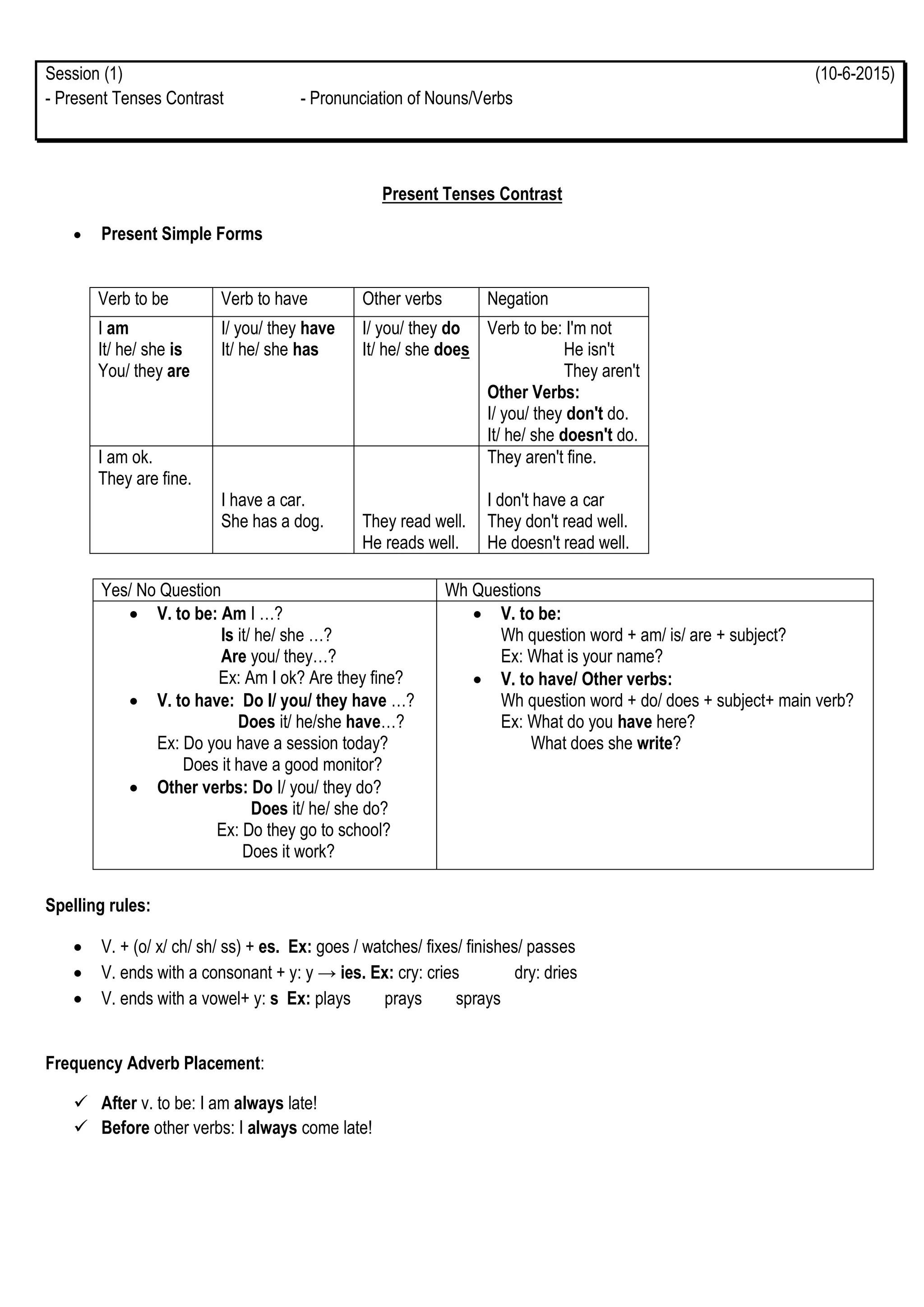
Session (1) (10-6-2015)
- Present Tenses Contrast - Pronunciation of Nouns/Verbs
Present Tenses Contrast
 Present Simple Forms
Verb to be Verb to have Other verbs Negation
I am
It/ he/ she is
You/ they are
I/ you/ they have
It/ he/ she has
I/ you/ they do
It/ he/ she does
Verb to be: I'm not
He isn't
They aren't
Other Verbs:
I/ you/ they don't do.
It/ he/ she doesn't do.
I am ok.
They are fine.
I have a car.
She has a dog. They read well.
He reads well.
They aren't fine.
I don't have a car
They don't read well.
He doesn't read well.
Yes/ No Question Wh Questions
 V. to be: Am I …?
Is it/ he/ she …?
Are you/ they…?
Ex: Am I ok? Are they fine?
 V. to have: Do I/ you/ they have …?
Does it/ he/she have…?
Ex: Do you have a session today?
Does it have a good monitor?
 Other verbs: Do I/ you/ they do?
Does it/ he/ she do?
Ex: Do they go to school?
Does it work?
 V. to be:
Wh question word + am/ is/ are + subject?
Ex: What is your name?
 V. to have/ Other verbs:
Wh question word + do/ does + subject+ main verb?
Ex: What do you have here?
What does she write?
Spelling rules:
 V. + (o/ x/ ch/ sh/ ss) + es. Ex: goes / watches/ fixes/ finishes/ passes
 V. ends with a consonant + y: y → ies. Ex: cry: cries dry: dries
 V. ends with a vowel+ y: s Ex: plays prays sprays
Frequency Adverb Placement:
 After v. to be: I am always late!
 Before other verbs: I always come late!
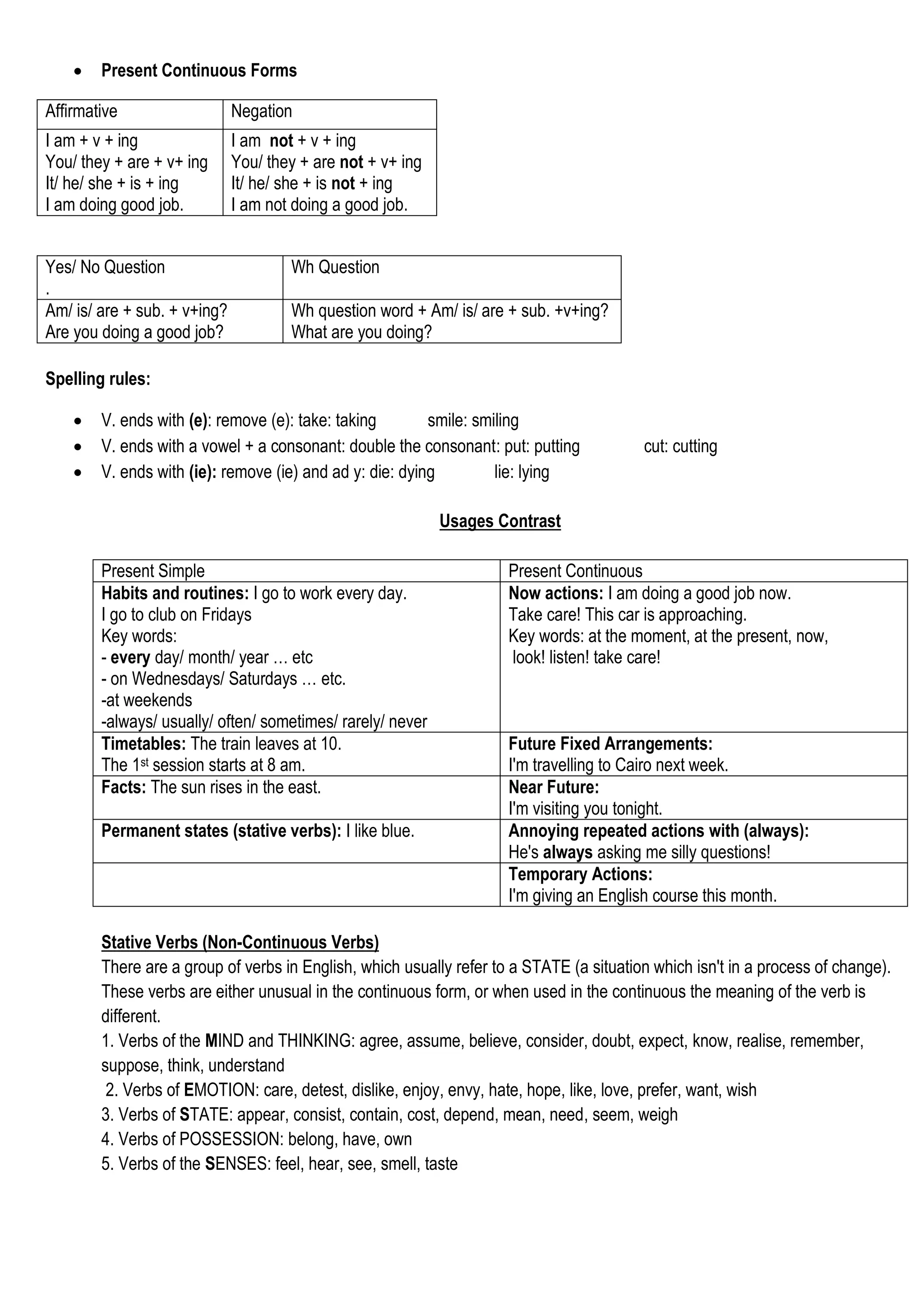
 Present Continuous Forms
Affirmative Negation
I am + v + ing
You/ they + are + v+ ing
It/ he/ she + is + ing
I am doing good job.
I am not + v + ing
You/ they + are not + v+ ing
It/ he/ she + is not + ing
I am not doing a good job.
Yes/ No Question
.
Wh Question
Am/ is/ are + sub. + v+ing?
Are you doing a good job?
Wh question word + Am/ is/ are + sub. +v+ing?
What are you doing?
Spelling rules:
 V. ends with (e): remove (e): take: taking smile: smiling
 V. ends with a vowel + a consonant: double the consonant: put: putting cut: cutting
 V. ends with (ie): remove (ie) and ad y: die: dying lie: lying
Usages Contrast
Present Simple Present Continuous
Habits and routines: I go to work every day.
I go to club on Fridays
Key words:
- every day/ month/ year … etc
- on Wednesdays/ Saturdays … etc.
-at weekends
-always/ usually/ often/ sometimes/ rarely/ never
Now actions: I am doing a good job now.
Take care! This car is approaching.
Key words: at the moment, at the present, now,
look! listen! take care!
Timetables: The train leaves at 10.
The 1st session starts at 8 am.
Future Fixed Arrangements:
I'm travelling to Cairo next week.
Facts: The sun rises in the east. Near Future:
I'm visiting you tonight.
Permanent states (stative verbs): I like blue. Annoying repeated actions with (always):
He's always asking me silly questions!
Temporary Actions:
I'm giving an English course this month.
Stative Verbs (Non-Continuous Verbs)
There are a group of verbs in English, which usually refer to a STATE (a situation which isn't in a process of change).
These verbs are either unusual in the continuous form, or when used in the continuous the meaning of the verb is
different.
1. Verbs of the MIND and THINKING: agree, assume, believe, consider, doubt, expect, know, realise, remember,
suppose, think, understand
2. Verbs of EMOTION: care, detest, dislike, enjoy, envy, hate, hope, like, love, prefer, want, wish
3. Verbs of STATE: appear, consist, contain, cost, depend, mean, need, seem, weigh
4. Verbs of POSSESSION: belong, have, own
5. Verbs of the SENSES: feel, hear, see, smell, taste
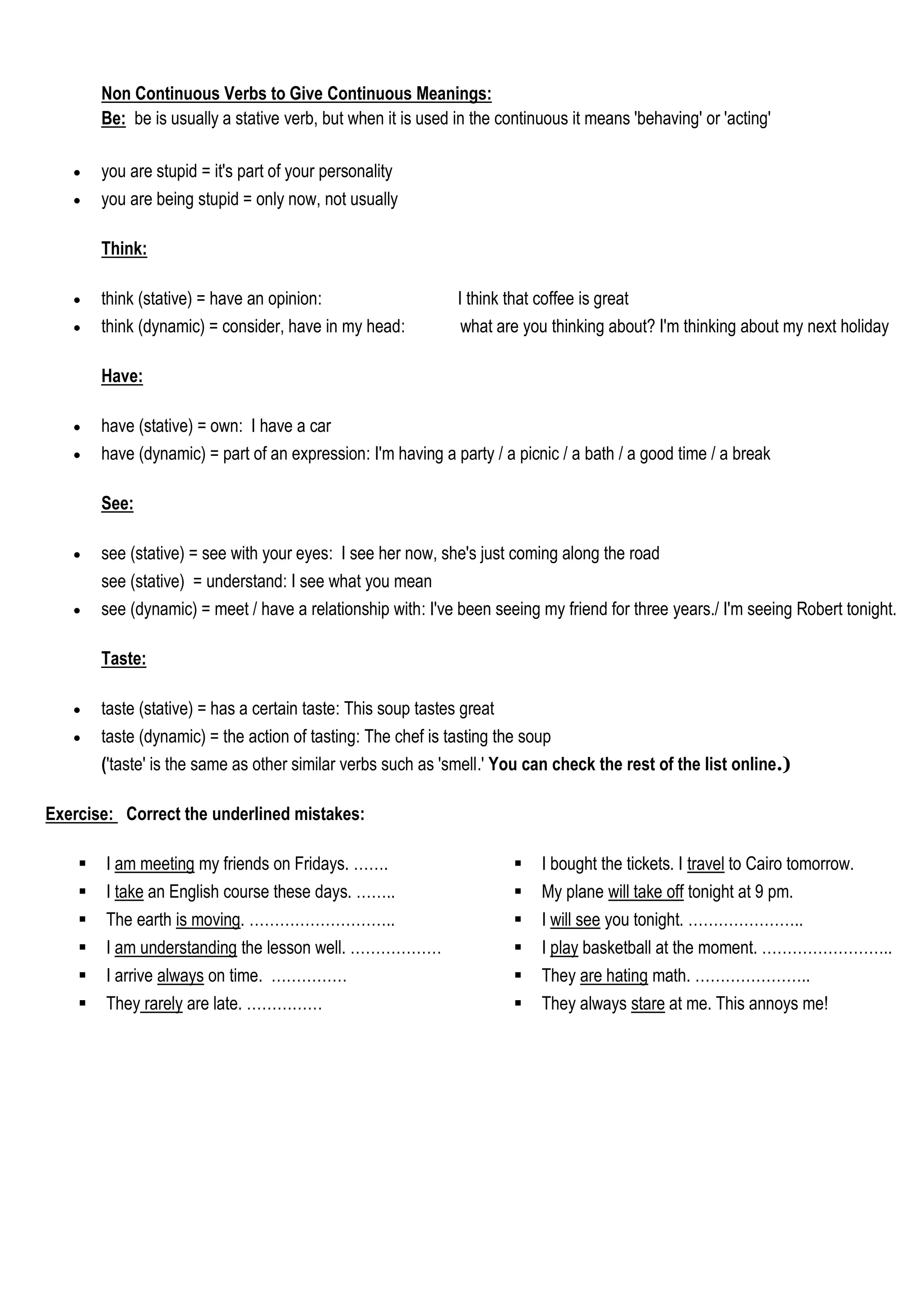
Non Continuous Verbs to Give Continuous Meanings:
Be: be is usually a stative verb, but when it is used in the continuous it means 'behaving' or 'acting'
 you are stupid = it's part of your personality
 you are being stupid = only now, not usually
Think:
 think (stative) = have an opinion: I think that coffee is great
 think (dynamic) = consider, have in my head: what are you thinking about? I'm thinking about my next holiday
Have:
 have (stative) = own: I have a car
 have (dynamic) = part of an expression: I'm having a party / a picnic / a bath / a good time / a break
See:
 see (stative) = see with your eyes: I see her now, she's just coming along the road
see (stative) = understand: I see what you mean
 see (dynamic) = meet / have a relationship with: I've been seeing my friend for three years./ I'm seeing Robert tonight.
Taste:
 taste (stative) = has a certain taste: This soup tastes great
 taste (dynamic) = the action of tasting: The chef is tasting the soup
('taste' is the same as other similar verbs such as 'smell.' You can check the rest of the list online.)
Exercise: Correct the underlined mistakes:
 I bought the tickets. I travel to Cairo tomorrow.
 My plane will take off tonight at 9 pm.
 I will see you tonight. …………………..
 I play basketball at the moment. ……………………..
 They are hating math. …………………..
 They always stare at me. This annoys me!
 I am meeting my friends on Fridays. …….
 I take an English course these days. ……..
 The earth is moving. ………………………..
 I am understanding the lesson well. ………………
 I arrive always on time. ……………
 They rarely are late. ……………
Pronunciation of Nouns/ Verbs:
Some nouns and verbs have the same form in English. For example:
She set an Olympic record. (noun)
She's recording her new song in the studios. (verb)
However, the pronunciation (i.e. syllable stress) is different. Where "record" is used as a noun, the stress is on the first
syllable: RE-cord (where "re" is the same sound as the "re" in "relative").
But when "record" is used as a verb, the stress is on the second syllable: re-CORD, and the "re" sounds like "ri", as in
"remember".)
Here are some more examples of nouns and verbs that have the same form, but different pronunciation. You can listen to the
audio (under each pair of sentences) to hear the differences in syllable stress.
http://www.english-at-home.com/pronunciation/noun-and-verb-syllable-stress/
project
Noun: PROject "They're working on a project."
Verb: proJECT "He projects himself well."
present
Noun: PREsent "He gave her a present."
Verb: preSENT "He's going to present his findings."
subject
Noun: SUBject "What subjects do you study?"
Verb: subJECT "She was subjected to harsh criticism."
object
Noun: OBject "She treats me like an object."
Verb: obJECT "She objected to the proposals."
rebel
Noun: REbel "He was a rebel when he was younger."
Verb: reBEL "He rebelled against authority."
insult
Noun: INsult "Your offer is so low it's an insult."
Verb: inSULT "Don't insult me!"
contest
Noun: CONtest "She entered a beauty contest."
Verb: conTEST "He plans to contest the world heavyweight title again next year."
conflict
Noun: CONflict "They're reporting armed conflict in the area."
Verb: conFLICT "His opinion conflicted with hers."
import
Noun: IMport "This is a cheap import."
Verb: imPORT "They import their oil from the UK."
(You can check the rest of the list on the website.)
Session (2) 13-6-2015
- Four Language Skills - Gram: Past Tenses Contrast - Pronunciation of Past Verbs
 Exercise 1: Listen to the dialogue twice and answer the questions on the board.
 Exercise 2: Read the passage and underline the past verbs.
Past Simple:
- Forms:
- Affirmative: 2nd form of the verb: played / wrote/ became / put/ cut. (Memorize the irregular verbs)
- Negative: did not + inf: did not write / did not become/ did not put
- Yes/ No Question: Did + sub. + inf …? Did you see him yesterday?
- Wh question: Question word + did + sub. + inf…? What did you do yesterday?
-Usages:
- An action that started and ended in the past. I finished my homework.
- Keywords: in the past/ yesterday/ (in May, in 1980, on Wednesday … ) / ( last week, month, year…)/ (a month, a
year, a week, a day ago)
-Spelling Rules:
- V. ends with a vowel+ y: ed Ex: play: played
- V. ends with a consonant + y: y → ied. Ex: cry: cried dry: dried
- V. ends with a vowel + a consonant: double the consonant: stop: stopped wet: wetted
Except for: happen: happened open: opened
Pronunciation of Past Verbs:
 We pronounce the (ed) like a (t) if it follows
these letters:
 [p] “He popped a balloon.” [papt]
 [k] “They talked a lot” [takt]
 [θ] (th): “She frothed a cup of milk” [frawθt]
 [f] “I laughed at the movie.” [læft]
 [s] “She missed the bus.” [mist]
 [ʃ] (sh): “We brushed it off.” [bruʃt]
 [tʃ] (ch): “I reached around for it.” [riytʃt]
 We pronounce the (ed) like a (d) if it follows
these letters:
 [b] “It bobbed up and down.” [babd]
 [g] (gg/ gu) “He begged her to stay.” [bɛgd]
 [ð] (th) “She breathed loudly.” [briyðd]
 [v] “They loved it.” [luvd]
 [z] “We raised her expectations.” [reyzd]
 [dʒ] (dg) “They bridged the gap.” [brIdʒd]
 [m] “I claimed it was mine.” [kleymd]
 [n] “They banned new members.” [bænd]
 [ŋ] (ng) “She banged into the chair.” [bæŋd]
 [r] “He cleared it up.” [kliyrd]
 [l] “I rolled up the paper.” [rowld]
 We Pronounce the (ed) like (id) when if follows these letters:
 [t] “She edited the research paper.” [ɛdɪtɪd]
 [d] “We ended the game early.” [ɛndɪd]
 We don’t pronounce the (g) when if follows the (n):
Ex: interesting/ writing/ doing/ cling to/ bang …etc.
 Exercise 3: Build a dialogue that talks about a past situation.
 Exercise 4: Listen to the story and put the events in order.
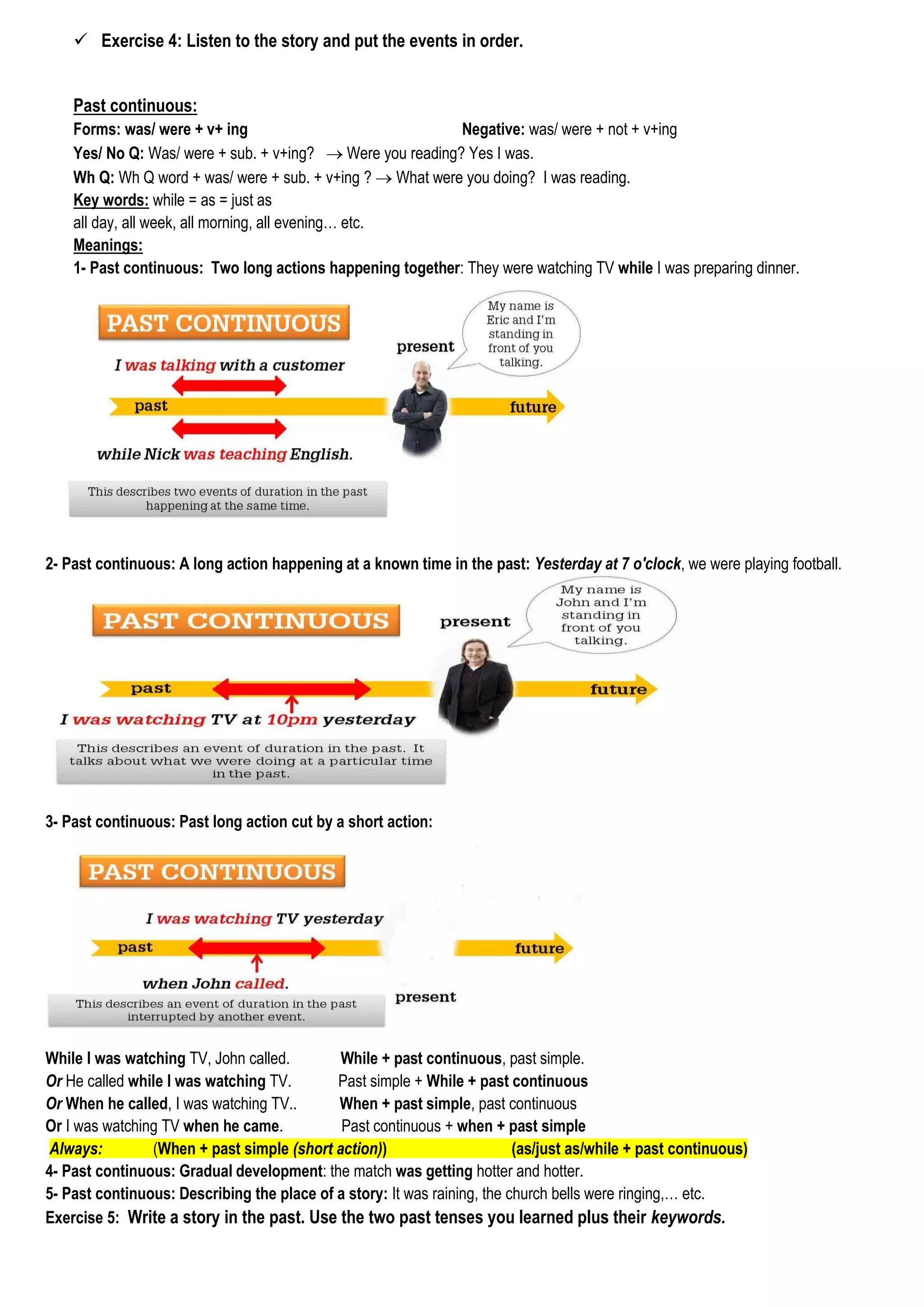
Past continuous:
Forms: was/ were + v+ ing Negative: was/ were + not + v+ing
Yes/ No Q: Was/ were + sub. + v+ing?  Were you reading? Yes I was.
Wh Q: Wh Q word + was/ were + sub. + v+ing ?  What were you doing? I was reading.
Key words: while = as = just as
all day, all week, all morning, all evening… etc.
Meanings:
1- Past continuous: Two long actions happening together: They were watching TV while I was preparing dinner.
2- Past continuous: A long action happening at a known time in the past: Yesterday at 7 o'clock, we were playing football.
3- Past continuous: Past long action cut by a short action:
While I was watching TV, John called. While + past continuous, past simple.
Or He called while I was watching TV. Past simple + While + past continuous
Or When he called, I was watching TV.. When + past simple, past continuous
Or I was watching TV when he came. Past continuous + when + past simple
Always: (When + past simple (short action)) (as/just as/while + past continuous)
4- Past continuous: Gradual development: the match was getting hotter and hotter.
5- Past continuous: Describing the place of a story: It was raining, the church bells were ringing,… etc.
Exercise 5: Write a story in the past. Use the two past tenses you learned plus their keywords.
Session (3) 13-6-2015
- Four Language Skills - Gram: Present Perfect - Pronunciation of Short Forms
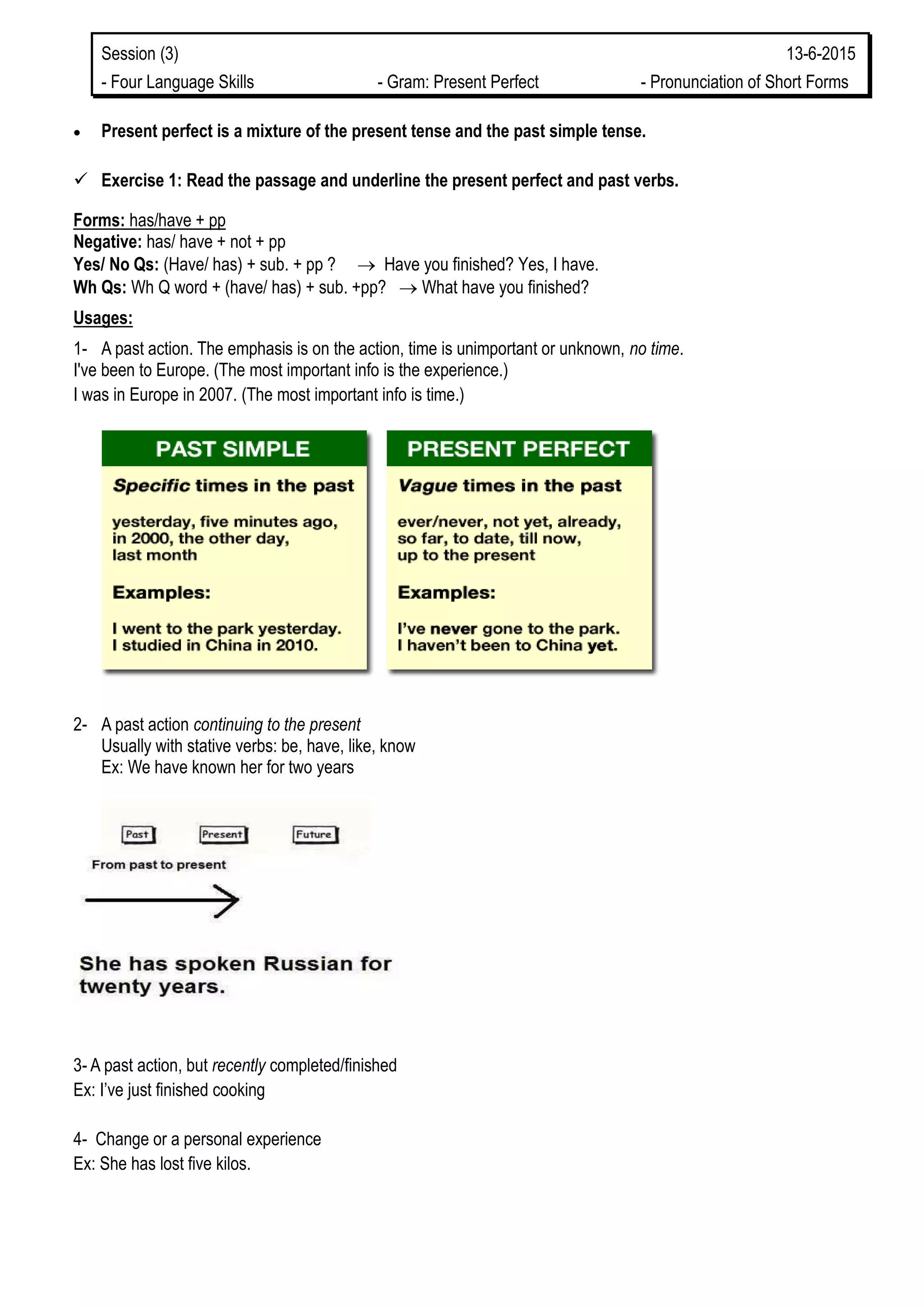
 Present perfect is a mixture of the present tense and the past simple tense.
 Exercise 1: Read the passage and underline the present perfect and past verbs.
Forms: has/have + pp
Negative: has/ have + not + pp
Yes/ No Qs: (Have/ has) + sub. + pp ?  Have you finished? Yes, I have.
Wh Qs: Wh Q word + (have/ has) + sub. +pp?  What have you finished?
Usages:
1- A past action. The emphasis is on the action, time is unimportant or unknown, no time.
I've been to Europe. (The most important info is the experience.)
I was in Europe in 2007. (The most important info is time.)
2- A past action continuing to the present
Usually with stative verbs: be, have, like, know
Ex: We have known her for two years
3- A past action, but recently completed/finished
Ex: I’ve just finished cooking
4- Change or a personal experience
Ex: She has lost five kilos.
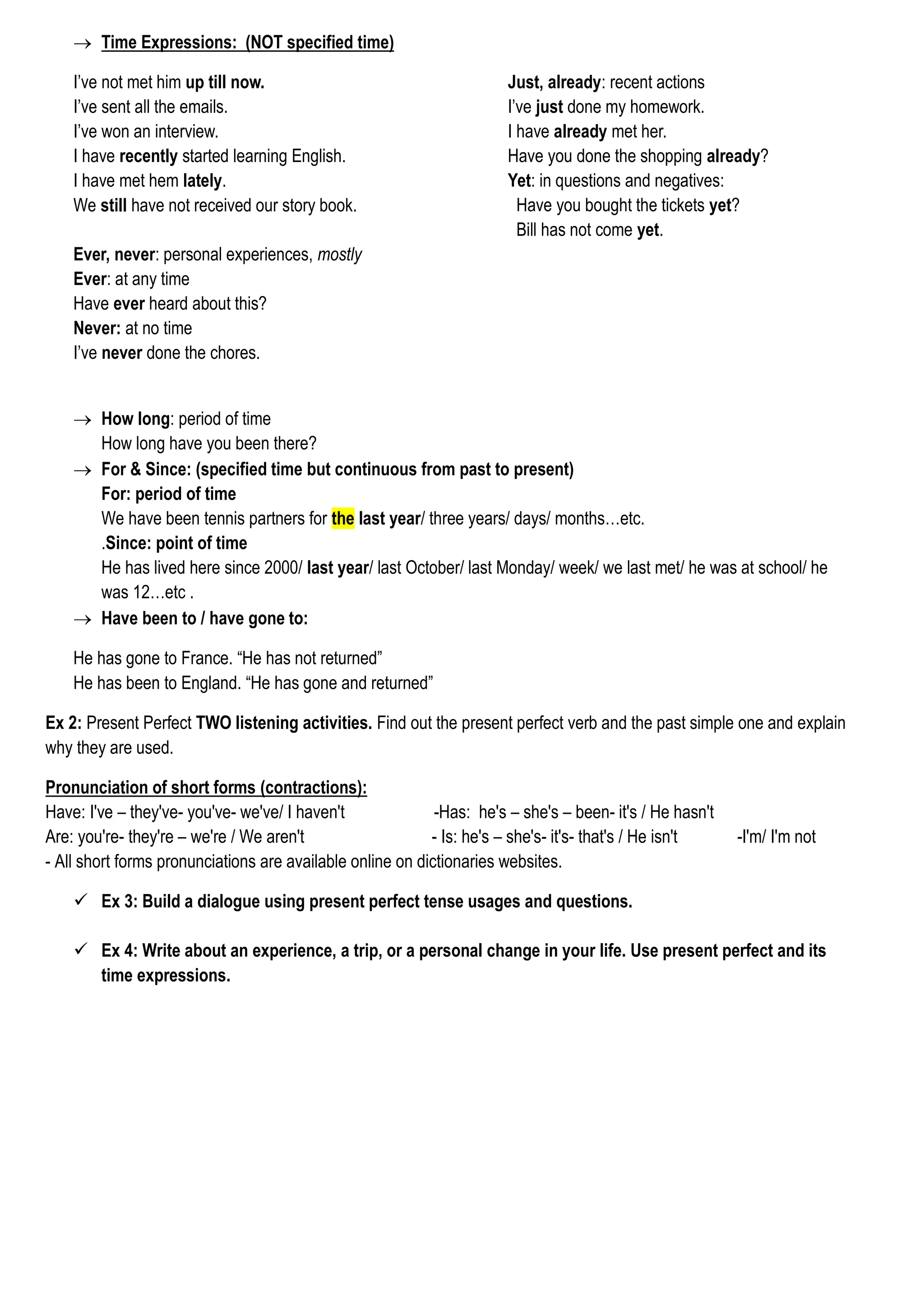
 Time Expressions: (NOT specified time)
Just, already: recent actions
I’ve just done my homework.
I have already met her.
Have you done the shopping already?
Yet: in questions and negatives:
Have you bought the tickets yet?
Bill has not come yet.
I’ve not met him up till now.
I’ve sent all the emails.
I’ve won an interview.
I have recently started learning English.
I have met hem lately.
We still have not received our story book.
Ever, never: personal experiences, mostly
Ever: at any time
Have ever heard about this?
Never: at no time
I’ve never done the chores.
 How long: period of time
How long have you been there?
 For & Since: (specified time but continuous from past to present)
For: period of time
We have been tennis partners for the last year/ three years/ days/ months…etc.
.Since: point of time
He has lived here since 2000/ last year/ last October/ last Monday/ week/ we last met/ he was at school/ he
was 12…etc .
 Have been to / have gone to:
He has gone to France. “He has not returned”
He has been to England. “He has gone and returned”
Ex 2: Present Perfect TWO listening activities. Find out the present perfect verb and the past simple one and explain
why they are used.
Pronunciation of short forms (contractions):
Have: I've – they've- you've- we've/ I haven't -Has: he's – she's – been- it's / He hasn't
Are: you're- they're – we're / We aren't - Is: he's – she's- it's- that's / He isn't -I'm/ I'm not
- All short forms pronunciations are available online on dictionaries websites.
 Ex 3: Build a dialogue using present perfect tense usages and questions.
 Ex 4: Write about an experience, a trip, or a personal change in your life. Use present perfect and its
time expressions.

Intermediate Writing Grammar Course Sessions 1+2+3

  • 1.
    The American CulturalCenter English Pre-Intermediate / Intermediate Course 3 Weeks: 6 Sessions  English Skills  Grammar  Pronunciation Instructor: Ms Sawsan Fawzi Learner's Name:
  • 2.
    Session (1) (10-6-2015) -Present Tenses Contrast - Pronunciation of Nouns/Verbs Present Tenses Contrast  Present Simple Forms Verb to be Verb to have Other verbs Negation I am It/ he/ she is You/ they are I/ you/ they have It/ he/ she has I/ you/ they do It/ he/ she does Verb to be: I'm not He isn't They aren't Other Verbs: I/ you/ they don't do. It/ he/ she doesn't do. I am ok. They are fine. I have a car. She has a dog. They read well. He reads well. They aren't fine. I don't have a car They don't read well. He doesn't read well. Yes/ No Question Wh Questions  V. to be: Am I …? Is it/ he/ she …? Are you/ they…? Ex: Am I ok? Are they fine?  V. to have: Do I/ you/ they have …? Does it/ he/she have…? Ex: Do you have a session today? Does it have a good monitor?  Other verbs: Do I/ you/ they do? Does it/ he/ she do? Ex: Do they go to school? Does it work?  V. to be: Wh question word + am/ is/ are + subject? Ex: What is your name?  V. to have/ Other verbs: Wh question word + do/ does + subject+ main verb? Ex: What do you have here? What does she write? Spelling rules:  V. + (o/ x/ ch/ sh/ ss) + es. Ex: goes / watches/ fixes/ finishes/ passes  V. ends with a consonant + y: y → ies. Ex: cry: cries dry: dries  V. ends with a vowel+ y: s Ex: plays prays sprays Frequency Adverb Placement:  After v. to be: I am always late!  Before other verbs: I always come late!
  • 3.
     Present ContinuousForms Affirmative Negation I am + v + ing You/ they + are + v+ ing It/ he/ she + is + ing I am doing good job. I am not + v + ing You/ they + are not + v+ ing It/ he/ she + is not + ing I am not doing a good job. Yes/ No Question . Wh Question Am/ is/ are + sub. + v+ing? Are you doing a good job? Wh question word + Am/ is/ are + sub. +v+ing? What are you doing? Spelling rules:  V. ends with (e): remove (e): take: taking smile: smiling  V. ends with a vowel + a consonant: double the consonant: put: putting cut: cutting  V. ends with (ie): remove (ie) and ad y: die: dying lie: lying Usages Contrast Present Simple Present Continuous Habits and routines: I go to work every day. I go to club on Fridays Key words: - every day/ month/ year … etc - on Wednesdays/ Saturdays … etc. -at weekends -always/ usually/ often/ sometimes/ rarely/ never Now actions: I am doing a good job now. Take care! This car is approaching. Key words: at the moment, at the present, now, look! listen! take care! Timetables: The train leaves at 10. The 1st session starts at 8 am. Future Fixed Arrangements: I'm travelling to Cairo next week. Facts: The sun rises in the east. Near Future: I'm visiting you tonight. Permanent states (stative verbs): I like blue. Annoying repeated actions with (always): He's always asking me silly questions! Temporary Actions: I'm giving an English course this month. Stative Verbs (Non-Continuous Verbs) There are a group of verbs in English, which usually refer to a STATE (a situation which isn't in a process of change). These verbs are either unusual in the continuous form, or when used in the continuous the meaning of the verb is different. 1. Verbs of the MIND and THINKING: agree, assume, believe, consider, doubt, expect, know, realise, remember, suppose, think, understand 2. Verbs of EMOTION: care, detest, dislike, enjoy, envy, hate, hope, like, love, prefer, want, wish 3. Verbs of STATE: appear, consist, contain, cost, depend, mean, need, seem, weigh 4. Verbs of POSSESSION: belong, have, own 5. Verbs of the SENSES: feel, hear, see, smell, taste
  • 4.
    Non Continuous Verbsto Give Continuous Meanings: Be: be is usually a stative verb, but when it is used in the continuous it means 'behaving' or 'acting'  you are stupid = it's part of your personality  you are being stupid = only now, not usually Think:  think (stative) = have an opinion: I think that coffee is great  think (dynamic) = consider, have in my head: what are you thinking about? I'm thinking about my next holiday Have:  have (stative) = own: I have a car  have (dynamic) = part of an expression: I'm having a party / a picnic / a bath / a good time / a break See:  see (stative) = see with your eyes: I see her now, she's just coming along the road see (stative) = understand: I see what you mean  see (dynamic) = meet / have a relationship with: I've been seeing my friend for three years./ I'm seeing Robert tonight. Taste:  taste (stative) = has a certain taste: This soup tastes great  taste (dynamic) = the action of tasting: The chef is tasting the soup ('taste' is the same as other similar verbs such as 'smell.' You can check the rest of the list online.) Exercise: Correct the underlined mistakes:  I bought the tickets. I travel to Cairo tomorrow.  My plane will take off tonight at 9 pm.  I will see you tonight. …………………..  I play basketball at the moment. ……………………..  They are hating math. …………………..  They always stare at me. This annoys me!  I am meeting my friends on Fridays. …….  I take an English course these days. ……..  The earth is moving. ………………………..  I am understanding the lesson well. ………………  I arrive always on time. ……………  They rarely are late. ……………
  • 5.
    Pronunciation of Nouns/Verbs: Some nouns and verbs have the same form in English. For example: She set an Olympic record. (noun) She's recording her new song in the studios. (verb) However, the pronunciation (i.e. syllable stress) is different. Where "record" is used as a noun, the stress is on the first syllable: RE-cord (where "re" is the same sound as the "re" in "relative"). But when "record" is used as a verb, the stress is on the second syllable: re-CORD, and the "re" sounds like "ri", as in "remember".) Here are some more examples of nouns and verbs that have the same form, but different pronunciation. You can listen to the audio (under each pair of sentences) to hear the differences in syllable stress. http://www.english-at-home.com/pronunciation/noun-and-verb-syllable-stress/ project Noun: PROject "They're working on a project." Verb: proJECT "He projects himself well." present Noun: PREsent "He gave her a present." Verb: preSENT "He's going to present his findings." subject Noun: SUBject "What subjects do you study?" Verb: subJECT "She was subjected to harsh criticism." object Noun: OBject "She treats me like an object." Verb: obJECT "She objected to the proposals." rebel Noun: REbel "He was a rebel when he was younger." Verb: reBEL "He rebelled against authority." insult Noun: INsult "Your offer is so low it's an insult." Verb: inSULT "Don't insult me!" contest Noun: CONtest "She entered a beauty contest." Verb: conTEST "He plans to contest the world heavyweight title again next year." conflict Noun: CONflict "They're reporting armed conflict in the area." Verb: conFLICT "His opinion conflicted with hers." import Noun: IMport "This is a cheap import." Verb: imPORT "They import their oil from the UK." (You can check the rest of the list on the website.)
  • 6.
    Session (2) 13-6-2015 -Four Language Skills - Gram: Past Tenses Contrast - Pronunciation of Past Verbs  Exercise 1: Listen to the dialogue twice and answer the questions on the board.  Exercise 2: Read the passage and underline the past verbs. Past Simple: - Forms: - Affirmative: 2nd form of the verb: played / wrote/ became / put/ cut. (Memorize the irregular verbs) - Negative: did not + inf: did not write / did not become/ did not put - Yes/ No Question: Did + sub. + inf …? Did you see him yesterday? - Wh question: Question word + did + sub. + inf…? What did you do yesterday? -Usages: - An action that started and ended in the past. I finished my homework. - Keywords: in the past/ yesterday/ (in May, in 1980, on Wednesday … ) / ( last week, month, year…)/ (a month, a year, a week, a day ago) -Spelling Rules: - V. ends with a vowel+ y: ed Ex: play: played - V. ends with a consonant + y: y → ied. Ex: cry: cried dry: dried - V. ends with a vowel + a consonant: double the consonant: stop: stopped wet: wetted Except for: happen: happened open: opened Pronunciation of Past Verbs:  We pronounce the (ed) like a (t) if it follows these letters:  [p] “He popped a balloon.” [papt]  [k] “They talked a lot” [takt]  [θ] (th): “She frothed a cup of milk” [frawθt]  [f] “I laughed at the movie.” [læft]  [s] “She missed the bus.” [mist]  [ʃ] (sh): “We brushed it off.” [bruʃt]  [tʃ] (ch): “I reached around for it.” [riytʃt]  We pronounce the (ed) like a (d) if it follows these letters:  [b] “It bobbed up and down.” [babd]  [g] (gg/ gu) “He begged her to stay.” [bɛgd]  [ð] (th) “She breathed loudly.” [briyðd]  [v] “They loved it.” [luvd]  [z] “We raised her expectations.” [reyzd]  [dʒ] (dg) “They bridged the gap.” [brIdʒd]  [m] “I claimed it was mine.” [kleymd]  [n] “They banned new members.” [bænd]  [ŋ] (ng) “She banged into the chair.” [bæŋd]  [r] “He cleared it up.” [kliyrd]  [l] “I rolled up the paper.” [rowld]  We Pronounce the (ed) like (id) when if follows these letters:  [t] “She edited the research paper.” [ɛdɪtɪd]  [d] “We ended the game early.” [ɛndɪd]  We don’t pronounce the (g) when if follows the (n): Ex: interesting/ writing/ doing/ cling to/ bang …etc.  Exercise 3: Build a dialogue that talks about a past situation.
  • 7.
     Exercise 4:Listen to the story and put the events in order. Past continuous: Forms: was/ were + v+ ing Negative: was/ were + not + v+ing Yes/ No Q: Was/ were + sub. + v+ing?  Were you reading? Yes I was. Wh Q: Wh Q word + was/ were + sub. + v+ing ?  What were you doing? I was reading. Key words: while = as = just as all day, all week, all morning, all evening… etc. Meanings: 1- Past continuous: Two long actions happening together: They were watching TV while I was preparing dinner. 2- Past continuous: A long action happening at a known time in the past: Yesterday at 7 o'clock, we were playing football. 3- Past continuous: Past long action cut by a short action: While I was watching TV, John called. While + past continuous, past simple. Or He called while I was watching TV. Past simple + While + past continuous Or When he called, I was watching TV.. When + past simple, past continuous Or I was watching TV when he came. Past continuous + when + past simple Always: (When + past simple (short action)) (as/just as/while + past continuous) 4- Past continuous: Gradual development: the match was getting hotter and hotter. 5- Past continuous: Describing the place of a story: It was raining, the church bells were ringing,… etc. Exercise 5: Write a story in the past. Use the two past tenses you learned plus their keywords.
  • 8.
    Session (3) 13-6-2015 -Four Language Skills - Gram: Present Perfect - Pronunciation of Short Forms  Present perfect is a mixture of the present tense and the past simple tense.  Exercise 1: Read the passage and underline the present perfect and past verbs. Forms: has/have + pp Negative: has/ have + not + pp Yes/ No Qs: (Have/ has) + sub. + pp ?  Have you finished? Yes, I have. Wh Qs: Wh Q word + (have/ has) + sub. +pp?  What have you finished? Usages: 1- A past action. The emphasis is on the action, time is unimportant or unknown, no time. I've been to Europe. (The most important info is the experience.) I was in Europe in 2007. (The most important info is time.) 2- A past action continuing to the present Usually with stative verbs: be, have, like, know Ex: We have known her for two years 3- A past action, but recently completed/finished Ex: I’ve just finished cooking 4- Change or a personal experience Ex: She has lost five kilos.
  • 9.
     Time Expressions:(NOT specified time) Just, already: recent actions I’ve just done my homework. I have already met her. Have you done the shopping already? Yet: in questions and negatives: Have you bought the tickets yet? Bill has not come yet. I’ve not met him up till now. I’ve sent all the emails. I’ve won an interview. I have recently started learning English. I have met hem lately. We still have not received our story book. Ever, never: personal experiences, mostly Ever: at any time Have ever heard about this? Never: at no time I’ve never done the chores.  How long: period of time How long have you been there?  For & Since: (specified time but continuous from past to present) For: period of time We have been tennis partners for the last year/ three years/ days/ months…etc. .Since: point of time He has lived here since 2000/ last year/ last October/ last Monday/ week/ we last met/ he was at school/ he was 12…etc .  Have been to / have gone to: He has gone to France. “He has not returned” He has been to England. “He has gone and returned” Ex 2: Present Perfect TWO listening activities. Find out the present perfect verb and the past simple one and explain why they are used. Pronunciation of short forms (contractions): Have: I've – they've- you've- we've/ I haven't -Has: he's – she's – been- it's / He hasn't Are: you're- they're – we're / We aren't - Is: he's – she's- it's- that's / He isn't -I'm/ I'm not - All short forms pronunciations are available online on dictionaries websites.  Ex 3: Build a dialogue using present perfect tense usages and questions.  Ex 4: Write about an experience, a trip, or a personal change in your life. Use present perfect and its time expressions.