Competition Model (CM)
By Sawsan Fawzy
 It was developed by Bates and MacWhinney (1982)
 Mechanistic explanation of NLA and SLA concerning language
meanings and uses rather than forms
 Associating meanings and uses: How to use language cues
(signals) to show relationships among words in a sentence to
understand meanings; to get comprehensible input
(Lightbown & Spada, 2013, p. 111)
 Kinds of cues are universal and limited (Gass & Selinker,
2008, p. 221).
 However, different languages use different cues
 CM: NLA, SLA
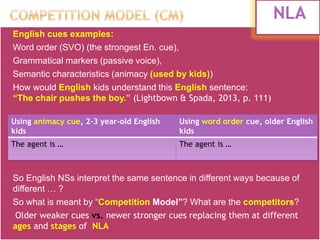
 English cues examples:
 Word order (SVO) (the strongest En. cue),
 Grammatical markers (passive voice),
 Semantic characteristics (animacy (used by kids))
 How would English kids understand this English sentence:
“The chair pushes the boy.” (Lightbown & Spada, 2013, p. 111)
 So English NSs interpret the same sentence in different ways because of
different … ?
 So what is meant by “Competition Model”? What are the competitors?
 Older weaker cues vs. newer stronger cues replacing them at different
ages and stages of NLA
Using animacy cue, 2-3 year-old English
kids
Using word order cue, older English
kids
The agent is … The agent is …
NLA
Competition Model:
 Language processing involves competition among various cues,
each of which contributes to a different interpretation of the same
sentence (Gass & Selinker, 2008, p. 221).
 So what determines the correct interpretation of a sentence is
which cue is stronger or more appropriate
 Strength and appropriateness of cues sometimes depend on
age
 Relationship between modified input and CM regarding NLA?
 Competition among cues modify and correct NL input at
different ages and different stages of NLA
NLA
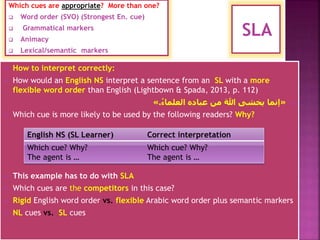
Which cues are appropriate? More than one?
 Word order (SVO) (Strongest En. cue)
 Grammatical markers
 Animacy
 Lexical/semantic markers
 How to interpret correctly:
 How would an English NS interpret a sentence from an SL with a more
flexible word order than English (Lightbown & Spada, 2013, p. 112)
«‫العلماء‬ ‫عباده‬ ‫من‬ َ‫هللا‬ ‫يخشى‬ ‫إنما‬.»
 Which cue is more likely to be used by the following readers? Why?
 This example has to do with SLA
 Which cues are the competitors in this case?
 Rigid English word order vs. flexible Arabic word order plus semantic markers
 NL cues vs. SL cues
SLA
English NS (SL Learner) Correct interpretation
Which cue? Why?
The agent is …
Which cue? Why?
The agent is …
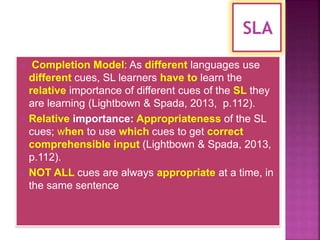
 Completion Model: As different languages use
different cues, SL learners have to learn the
relative importance of different cues of the SL they
are learning (Lightbown & Spada, 2013, p.112).
 Relative importance: Appropriateness of the SL
cues; when to use which cues to get correct
comprehensible input (Lightbown & Spada, 2013,
p.112).
 NOT ALL cues are always appropriate at a time, in
the same sentence
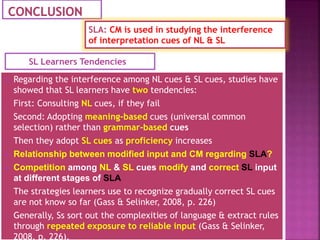
 Regarding the interference among NL cues & SL cues, studies have
showed that SL learners have two tendencies:
 First: Consulting NL cues, if they fail
 Second: Adopting meaning-based cues (universal common
selection) rather than grammar-based cues
 Then they adopt SL cues as proficiency increases
 Relationship between modified input and CM regarding SLA?
 Competition among NL & SL cues modify and correct SL input
at different stages of SLA
 The strategies learners use to recognize gradually correct SL cues
are not know so far (Gass & Selinker, 2008, p. 226)
 Generally, Ss sort out the complexities of language & extract rules
through repeated exposure to reliable input (Gass & Selinker,
2008, p. 226).
SL Learners Tendencies
SLA: CM is used in studying the interference
of interpretation cues of NL & SL
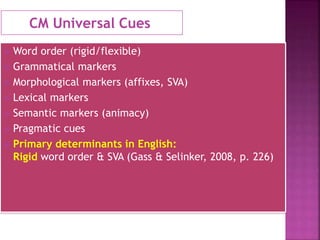
CM Universal Cues
 Word order (rigid/flexible)
 Grammatical markers
 Morphological markers (affixes, SVA)
 Lexical markers
 Semantic markers (animacy)
 Pragmatic cues
 Primary determinants in English:
Rigid word order & SVA (Gass & Selinker, 2008, p. 226)
Gass, S. & Selinker, L. (2008). Second language acquisition (3rd
ed.). Mahwah, NJ: Taylor & Francis.
Lightbown, P. & Spada, N. (2013). How languages are learned
(4th ed.). Oxford: Oxford University Press.
Modified Input (Competition Model)

Modified Input (Competition Model)

  • 1.
  • 2.
     It wasdeveloped by Bates and MacWhinney (1982)  Mechanistic explanation of NLA and SLA concerning language meanings and uses rather than forms  Associating meanings and uses: How to use language cues (signals) to show relationships among words in a sentence to understand meanings; to get comprehensible input (Lightbown & Spada, 2013, p. 111)  Kinds of cues are universal and limited (Gass & Selinker, 2008, p. 221).  However, different languages use different cues  CM: NLA, SLA
  • 3.
     English cuesexamples:  Word order (SVO) (the strongest En. cue),  Grammatical markers (passive voice),  Semantic characteristics (animacy (used by kids))  How would English kids understand this English sentence: “The chair pushes the boy.” (Lightbown & Spada, 2013, p. 111)  So English NSs interpret the same sentence in different ways because of different … ?  So what is meant by “Competition Model”? What are the competitors?  Older weaker cues vs. newer stronger cues replacing them at different ages and stages of NLA Using animacy cue, 2-3 year-old English kids Using word order cue, older English kids The agent is … The agent is … NLA
  • 4.
    Competition Model:  Languageprocessing involves competition among various cues, each of which contributes to a different interpretation of the same sentence (Gass & Selinker, 2008, p. 221).  So what determines the correct interpretation of a sentence is which cue is stronger or more appropriate  Strength and appropriateness of cues sometimes depend on age  Relationship between modified input and CM regarding NLA?  Competition among cues modify and correct NL input at different ages and different stages of NLA NLA
  • 5.
    Which cues areappropriate? More than one?  Word order (SVO) (Strongest En. cue)  Grammatical markers  Animacy  Lexical/semantic markers  How to interpret correctly:  How would an English NS interpret a sentence from an SL with a more flexible word order than English (Lightbown & Spada, 2013, p. 112) «‫العلماء‬ ‫عباده‬ ‫من‬ َ‫هللا‬ ‫يخشى‬ ‫إنما‬.»  Which cue is more likely to be used by the following readers? Why?  This example has to do with SLA  Which cues are the competitors in this case?  Rigid English word order vs. flexible Arabic word order plus semantic markers  NL cues vs. SL cues SLA English NS (SL Learner) Correct interpretation Which cue? Why? The agent is … Which cue? Why? The agent is …
  • 6.
     Completion Model:As different languages use different cues, SL learners have to learn the relative importance of different cues of the SL they are learning (Lightbown & Spada, 2013, p.112).  Relative importance: Appropriateness of the SL cues; when to use which cues to get correct comprehensible input (Lightbown & Spada, 2013, p.112).  NOT ALL cues are always appropriate at a time, in the same sentence
  • 7.
     Regarding theinterference among NL cues & SL cues, studies have showed that SL learners have two tendencies:  First: Consulting NL cues, if they fail  Second: Adopting meaning-based cues (universal common selection) rather than grammar-based cues  Then they adopt SL cues as proficiency increases  Relationship between modified input and CM regarding SLA?  Competition among NL & SL cues modify and correct SL input at different stages of SLA  The strategies learners use to recognize gradually correct SL cues are not know so far (Gass & Selinker, 2008, p. 226)  Generally, Ss sort out the complexities of language & extract rules through repeated exposure to reliable input (Gass & Selinker, 2008, p. 226). SL Learners Tendencies SLA: CM is used in studying the interference of interpretation cues of NL & SL
  • 8.
    CM Universal Cues Word order (rigid/flexible)  Grammatical markers  Morphological markers (affixes, SVA)  Lexical markers  Semantic markers (animacy)  Pragmatic cues  Primary determinants in English: Rigid word order & SVA (Gass & Selinker, 2008, p. 226)
  • 9.
    Gass, S. &Selinker, L. (2008). Second language acquisition (3rd ed.). Mahwah, NJ: Taylor & Francis. Lightbown, P. & Spada, N. (2013). How languages are learned (4th ed.). Oxford: Oxford University Press.