8 básico present simple presente simple y past simcple. .pptx
Presente simple, explicación en power point mas toda la clase planeada, con presente simple y la diferencia entre presente simple y pasado simple. Las relglas de la clase para tener un ambiente mejor para el aprendizaje
8 básico present simple presente simple y past simcple. .pptx
2.
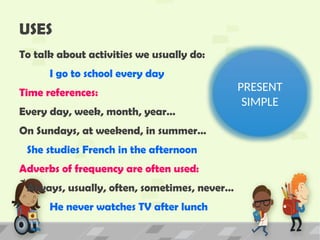
USES
To talk aboutactivities we usually do:
I go to school every day
Time references:
Every day, week, month, year…
On Sundays, at weekend, in summer…
She studies French in the afternoon
Adverbs of frequency are often used:
Always, usually, often, sometimes, never…
He never watches TV after lunch
PRESENT
SIMPLE
3.
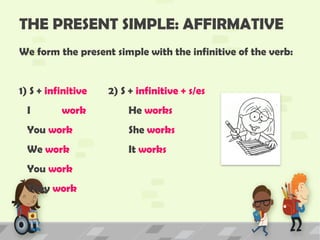
THE PRESENT SIMPLE:AFFIRMATIVE
We form the present simple with the infinitive of the verb:
1) S + infinitive 2) S + infinitive + s/es
I work He works
You work She works
We work It works
You work
They work
4.
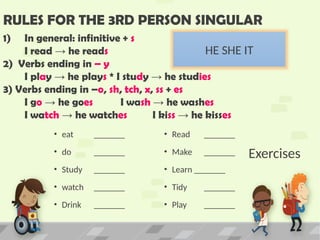
1) In general:infinitive + s
I read → he reads
2) Verbs ending in – y
I play → he plays * I study → he studies
3) Verbs ending in –o, sh, tch, x, ss + es
I go → he goes I wash → he washes
I watch → he watches I kiss → he kisses
RULES FOR THE 3RD PERSON SINGULAR
HE SHE IT
Exercises
• eat _______
• do _______
• Study _______
• watch _______
• Drink _______
• Read _______
• Make _______
• Learn _______
• Tidy _______
• Play _______
5.
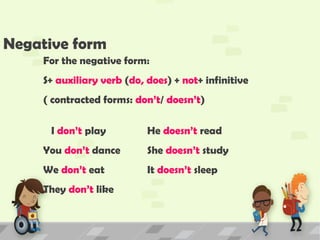
Negative form
For thenegative form:
S+ auxiliary verb (do, does) + not+ infinitive
( contracted forms: don’t/ doesn’t)
I don’t play He doesn’t read
You don’t dance She doesn’t study
We don’t eat It doesn’t sleep
They don’t like
6.
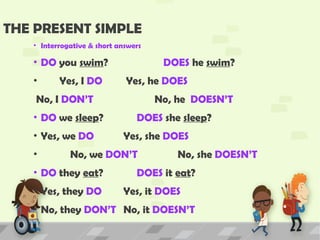
THE PRESENT SIMPLE
•Interrogative & short answers
• DO you swim? DOES he swim?
• Yes, I DO Yes, he DOES
No, I DON’T No, he DOESN’T
• DO we sleep? DOES she sleep?
• Yes, we DO Yes, she DOES
• No, we DON’T No, she DOESN’T
• DO they eat? DOES it eat?
• Yes, they DO Yes, it DOES
• No, they DON’T No, it DOESN’T
7.
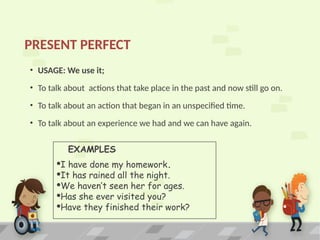
PRESENT PERFECT
• USAGE:We use it;
• To talk about actions that take place in the past and now still go on.
• To talk about an action that began in an unspecified time.
• To talk about an experience we had and we can have again.
EXAMPLES
·I have done my homework.
·It has rained all the night.
·We haven’t seen her for ages.
·Has she ever visited you?
·Have they finished their work?
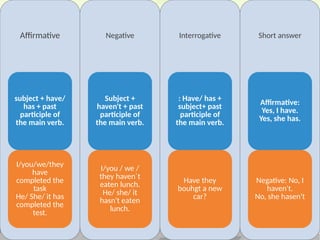
Affirmative
subject + have/
has+ past
participle of
the main verb.
I/you/we/they
have
completed the
task
He/ She/ it has
completed the
test.
Negative
Subject +
haven't + past
participle of
the main verb.
I/you / we /
they haven´t
eaten lunch.
He/ she/ it
hasn't eaten
lunch.
Interrogative
: Have/ has +
subject+ past
participle of
the main verb.
Have they
bouhgt a new
car?
Short answer
Affirmative:
Yes, I have.
Yes, she has.
Negative: No, I
haven't.
No, she hasen't
11.
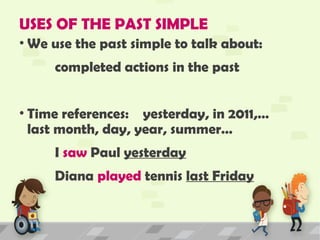
USES OF THEPAST SIMPLE
• We use the past simple to talk about:
completed actions in the past
• Time references: yesterday, in 2011,…
last month, day, year, summer…
I saw Paul yesterday
Diana played tennis last Friday
12.
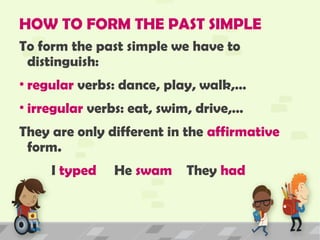
HOW TO FORMTHE PAST SIMPLE
To form the past simple we have to
distinguish:
• regular verbs: dance, play, walk,…
• irregular verbs: eat, swim, drive,…
They are only different in the affirmative
form.
I typed He swam They had
13.
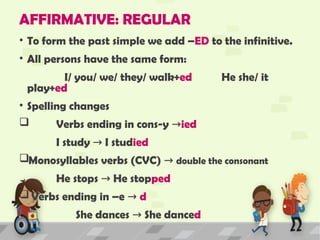
AFFIRMATIVE: REGULAR
• Toform the past simple we add –ED to the infinitive.
• All persons have the same form:
I/ you/ we/ they/ walk+ed He she/ it
play+ed
• Spelling changes
Verbs ending in cons-y →ied
I study I stud
→ ied
Monosyllables verbs (CVC) → double the consonant
He stops He stop
→ ped
Verbs ending in –e → d
She dances She dance
→ d
14.
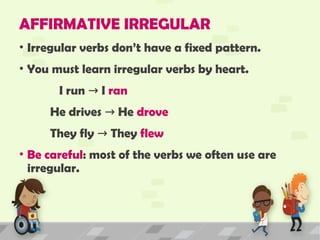
AFFIRMATIVE IRREGULAR
• Irregularverbs don’t have a fixed pattern.
• You must learn irregular verbs by heart.
I run I
→ ran
He drives He
→ drove
They fly They
→ flew
• Be careful: most of the verbs we often use are
irregular.
15.
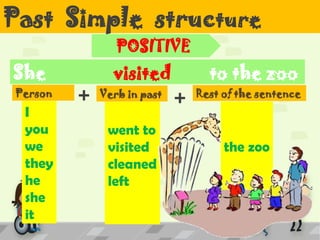
Past Simple structure
Person
Shevisited to the zoo
Verb in past Rest of the sentence
I
you
we
they
he
she
it
went to
visited
cleaned
left
the zoo
POSITIVE
+ +
16.
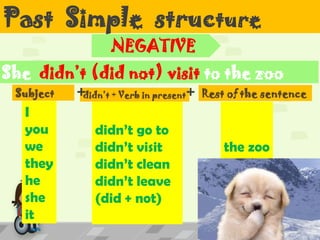
Past Simple structure
Subject
Shedidn’t (did not) visit to the zoo
didn’t + Verb in present Rest of the sentence
I
you
we
they
he
she
it
didn’t go to
didn’t visit
didn’t clean
didn’t leave
(did + not)
the zoo
NEGATIVE
+ +
17.
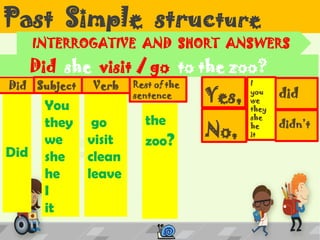
Past Simple structure
Did
Didshe visit / go to the zoo?
Subject Rest of the
sentence
Did
You
they
we
she
he
I
it
the
zoo?
INTERROGATIVE AND SHORT ANSWERS
Verb
go
visit
clean
leave
Yes,
I
you
we
they
she
he
it
did
.
No,
didn’t
18.
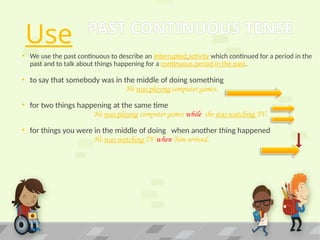
Use
• We usethe past continuous to describe an interrupted activity which continued for a period in the
past and to talk about things happening for a continuous period in the past.
• to say that somebody was in the middle of doing something
He was playing computer games.
• for two things happening at the same time
He was playing computer games while she was watching TV.
• for things you were in the middle of doing when another thing happened
He was watching TV when Tom arrived.
PAST CONTINUOUS TENSE
19.
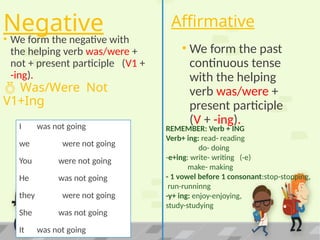
Negative
• We formthe negative with
the helping verb was/were +
not + present participle (V1 +
-ing).
Was/Were Not
V1+Ing
I was not going
we were not going
You were not going
He was not going
they were not going
She was not going
It was not going
• We form the past
continuous tense
with the helping
verb was/were +
present participle
(V + -ing).
Affirmative
REMEMBER: Verb + ING
Verb+ ing: read- reading
do- doing
-e+ing: write- writing (-e)
make- making
- 1 vowel before 1 consonant:stop-stopping,
run-runninng
-y+ ing: enjoy-enjoying,
study-studying
20.
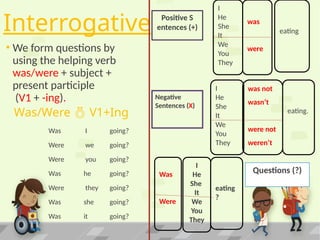
Interrogative
• We formquestions by
using the helping verb
was/were + subject +
present participle
(V1 + -ing).
Was/Were V1+Ing
Was I going?
Were we going?
Were you going?
Was he going?
Were they going?
Was she going?
Was it going?
Positive S
entences (+)
I
He
She
It
We
You
They
was
were
eating
Negative
Sentences (X)
I
He
She
It
We
You
They
was not
wasn’t
were not
weren’t
eating.
Questions (?)
Was
Were
I
He
She
It
We
You
They
eating
?
21.
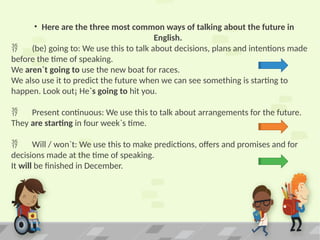
• Here arethe three most common ways of talking about the future in
English.
(be) going to: We use this to talk about decisions, plans and intentions made
before the time of speaking.
We aren`t going to use the new boat for races.
We also use it to predict the future when we can see something is starting to
happen. Look out¡ He`s going to hit you.
Present continuous: We use this to talk about arrangements for the future.
They are starting in four week`s time.
Will / won`t: We use this to make predictions, offers and promises and for
decisions made at the time of speaking.
It will be finished in December.
23.
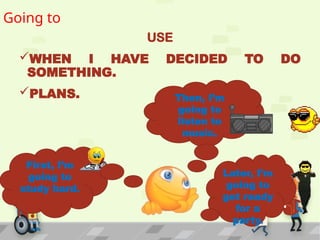
Going to
USE
WHEN IHAVE DECIDED TO DO
SOMETHING.
PLANS.
First, I’m
going to
study hard.
Then, I’m
going to
listen to
music.
Later, I’m
going to
get ready
for a
party.
24.
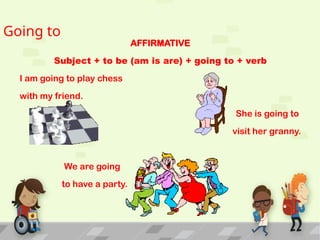
Going to
AFFIRMATIVE
Subject +to be (am is are) + going to + verb
I am going to play chess
with my friend.
She is going to
visit her granny.
We are going
to have a party.
25.
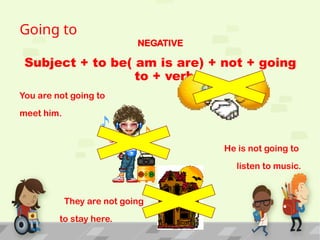
Going to
NEGATIVE
Subject +to be( am is are) + not + going
to + verb
You are not going to
meet him.
He is not going to
listen to music.
They are not going
to stay here.
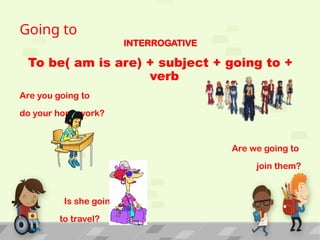
26.
Going to
INTERROGATIVE
To be(am is are) + subject + going to +
verb
Are you going to
do your homework?
Are we going to
join them?
Is she going
to travel?
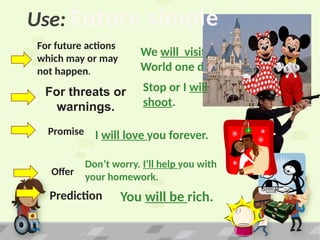
27.
Use:
For future actions
whichmay or may
not happen.
We will visit Disney
World one day.
For threats or
warnings.
Stop or I will
shoot.
Prediction
Offer
Promise
Don’t worry. I’ll help you with
your homework.
I will love you forever.
You will be rich.
Future simple
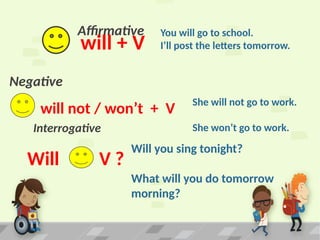
28.
Affirmative
will + V
Youwill go to school.
I’ll post the letters tomorrow.
Negative
will not / won’t + V
She will not go to work.
She won’t go to work.
Interrogative
Will V ?
Will you sing tonight?
What will you do tomorrow
morning?
29.
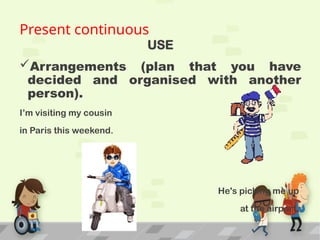
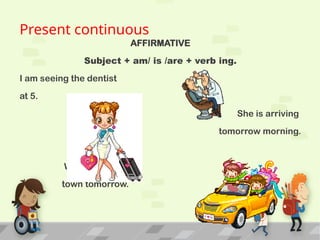
Present continuous
USE
Arrangements (planthat you have
decided and organised with another
person).
I’m visiting my cousin
in Paris this weekend.
He's picking me up
at the airport.
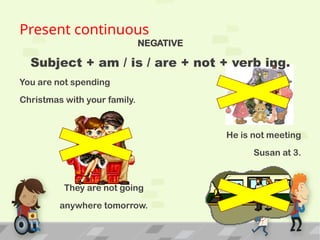
Present continuous
NEGATIVE
Subject +am / is / are + not + verb ing.
You are not spending
Christmas with your family.
He is not meeting
Susan at 3.
They are not going
anywhere tomorrow.
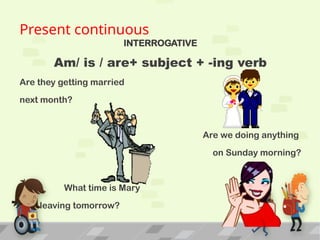
32.
Present continuous
INTERROGATIVE
Am/ is/ are+ subject + -ing verb
Are they getting married
next month?
Are we doing anything
on Sunday morning?
What time is Mary
leaving tomorrow?
33.
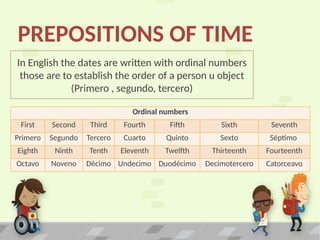
In English thedates are written with ordinal numbers
those are to establish the order of a person u object
(Primero , segundo, tercero)
PREPOSITIONS OF TIME
Ordinal numbers
First Second Third Fourth Fifth Sixth Seventh
Primero Segundo Tercero Cuarto Quinto Sexto Séptimo
Eighth Ninth Tenth Eleventh Twelfth Thirteenth Fourteenth
Octavo Noveno Décimo Undecimo Duodécimo Decimotercero Catorceavo
34.
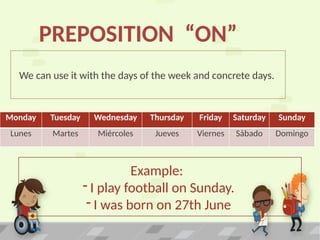
We can useit with the days of the week and concrete days.
PREPOSITION “ON”
Monday Tuesday Wednesday Thursday Friday Saturday Sunday
Lunes Martes Miércoles Jueves Viernes Sábado Domingo
Example:
- I play football on Sunday.
- I was born on 27th June
35.
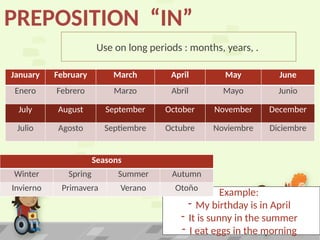
Use on longperiods : months, years, .
PREPOSITION “IN”
Example:
- My birthday is in April
- It is sunny in the summer
- I eat eggs in the morning
January February March April May June
Enero Febrero Marzo Abril Mayo Junio
July August September October November December
Julio Agosto Septiembre Octubre Noviembre Diciembre
Seasons
Winter Spring Summer Autumn
Invierno Primavera Verano Otoño
36.
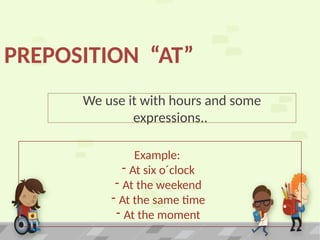
We use itwith hours and some
expressions..
PREPOSITION “AT”
Example:
- At six o´clock
- At the weekend
- At the same time
- At the moment
37.
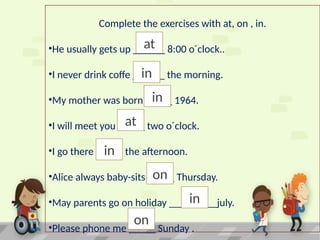
Complete the exerciseswith at, on , in.
•He usually gets up ______ 8:00 o´clock..
•I never drink coffe ______ the morning.
•My mother was born _____ 1964.
•I will meet you _____ two o´clock.
•I go there _____ the afternoon.
•Alice always baby-sits _____ Thursday.
•May parents go on holiday _________july.
•Please phone me _____ Sunday .
at
in
in
at
in
on
in
on
38.
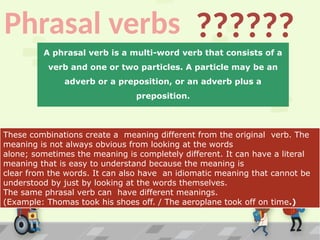
Phrasal verbs ??????
Thesecombinations create a meaning different from the original verb. The
meaning is not always obvious from looking at the words
alone; sometimes the meaning is completely different. It can have a literal
meaning that is easy to understand because the meaning is
clear from the words. It can also have an idiomatic meaning that cannot be
understood by just by looking at the words themselves.
The same phrasal verb can have different meanings.
(Example: Thomas took his shoes off. / The aeroplane took off on time.)
A phrasal verb is a multi-word verb that consists of a
verb and one or two particles. A particle may be an
adverb or a preposition, or an adverb plus a
preposition.
39.
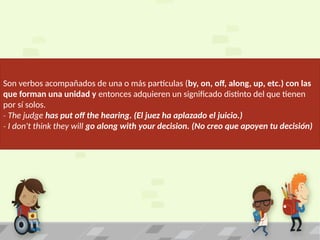
Son verbos acompañadosde una o más partículas (by, on, off, along, up, etc.) con las
que forman una unidad y entonces adquieren un significado distinto del que tienen
por sí solos.
‐ The judge has put off the hearing. (El juez ha aplazado el juicio.)
‐ I don't think they will go along with your decision. (No creo que apoyen tu decisión)
41.
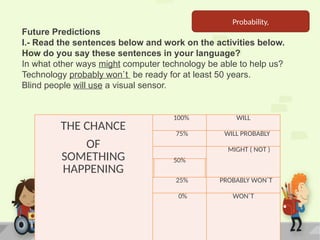
THE CHANCE
OF
SOMETHING
HAPPENING
100% WILL
75%WILL PROBABLY
MIGHT ( NOT )
50%
25% PROBABLY WON´T
0% WON´T
Future Predictions
I.- Read the sentences below and work on the activities below.
How do you say these sentences in your language?
In what other ways might computer technology be able to help us?
Technology probably won`t be ready for at least 50 years.
Blind people will use a visual sensor.
Probability,
42.
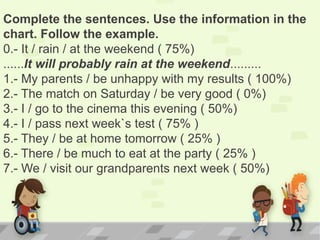
Complete the sentences.Use the information in the
chart. Follow the example.
0.- It / rain / at the weekend ( 75%)
......It will probably rain at the weekend.........
1.- My parents / be unhappy with my results ( 100%)
2.- The match on Saturday / be very good ( 0%)
3.- I / go to the cinema this evening ( 50%)
4.- I / pass next week`s test ( 75% )
5.- They / be at home tomorrow ( 25% )
6.- There / be much to eat at the party ( 25% )
7.- We / visit our grandparents next week ( 50%)
43.
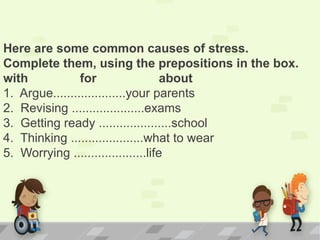
Here are somecommon causes of stress.
Complete them, using the prepositions in the box.
with for about
1. Argue.....................your parents
2. Revising .....................exams
3. Getting ready .....................school
4. Thinking .....................what to wear
5. Worrying .....................life
44.
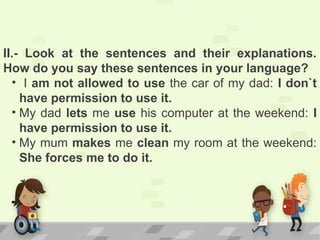
II.- Look atthe sentences and their explanations.
How do you say these sentences in your language?
• I am not allowed to use the car of my dad: I don`t
have permission to use it.
• My dad lets me use his computer at the weekend: I
have permission to use it.
• My mum makes me clean my room at the weekend:
She forces me to do it.
45.
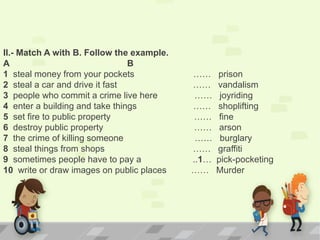
II.- Match Awith B. Follow the example.
A B
1 steal money from your pockets …… prison
2 steal a car and drive it fast …… vandalism
3 people who commit a crime live here …… joyriding
4 enter a building and take things …… shoplifting
5 set fire to public property …… fine
6 destroy public property …… arson
7 the crime of killing someone …… burglary
8 steal things from shops …… graffiti
9 sometimes people have to pay a ..1… pick-pocketing
10 write or draw images on public places …… Murder
46.
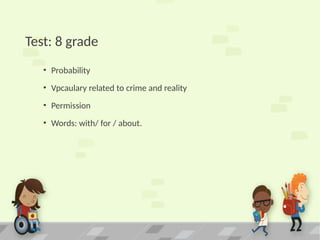
Test: 8 grade
•Probability
• Vpcaulary related to crime and reality
• Permission
• Words: with/ for / about.
47.
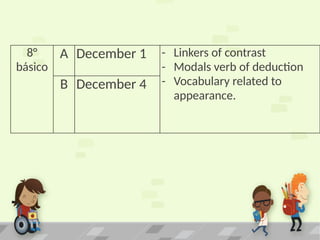
8°
básico
A December 1- Linkers of contrast
- Modals verb of deduction
- Vocabulary related to
appearance.
B December 4
48.
Connectors / Linkingwords are very
important because they indicate the
relationship between ideas in
sentences and paragraphs. They
have different functions and
positions in the sentences.
49.
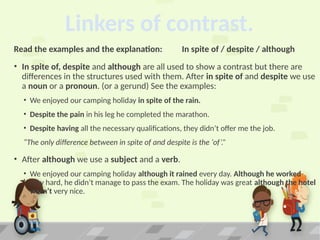
Linkers of contrast.
Readthe examples and the explanation: In spite of / despite / although
• In spite of, despite and although are all used to show a contrast but there are
differences in the structures used with them. After in spite of and despite we use
a noun or a pronoun. (or a gerund) See the examples:
• We enjoyed our camping holiday in spite of the rain.
• Despite the pain in his leg he completed the marathon.
• Despite having all the necessary qualifications, they didn’t offer me the job.
“The only difference between in spite of and despite is the ‘of’.”
• After although we use a subject and a verb.
• We enjoyed our camping holiday although it rained every day. Although he worked
very hard, he didn’t manage to pass the exam. The holiday was great although the hotel
wasn’t very nice.
50.
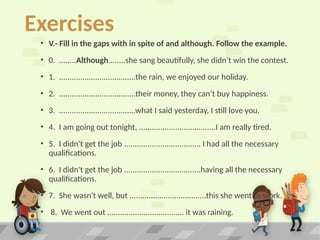
Exercises
• V.- Fillin the gaps with in spite of and although. Follow the example.
• 0. ........Although........she sang beautifully, she didn’t win the contest.
• 1. ....................................the rain, we enjoyed our holiday.
• 2. ....................................their money, they can’t buy happiness.
• 3. ....................................what I said yesterday, I still love you.
• 4. I am going out tonight, ....................................I am really tired.
• 5. I didn't get the job .................................... I had all the necessary
qualifications.
• 6. I didn't get the job ....................................having all the necessary
qualifications.
• 7. She wasn't well, but ....................................this she went to work.
• 8. We went out .................................... it was raining.
51.
Jack the Ripper
Jackthe Ripper is a pseudonym given to an unidentified serial
killer (or killers) active in the largely impoverished Whitechapel
area and adjacent districts of London in the second half of
1888. The name is taken from a letter to the Central News
Agency by someone claiming to be the murderer, published at
the time of the killings. Although many theories have been
advanced, Jack the Ripper's identity may never be proven.
52.
The legends surroundingthe Ripper murders have become a
complex muddle of genuine historical research, freewheeling
conspiracy theory and dubious folklore. The lack of a confirmed
identity for the killer has allowed subsequent authors, historians
and mostly amateur sleuths—dubbed Ripperologists—to point
their fingers at a wide variety of candidates. Newspapers,
whose circulation had been growing during this era, bestowed
widespread and enduring notoriety on the killer due to the
savagery of the murders and the failure of police to effect a
capture, with the Ripper sometimes escaping discovery by mere
minutes.
53.
• Victims werewomen earning income as casual
prostitutes. Typical Ripper murders were perpetrated
in a public or semi-public place; the victim's throat
was cut, after which the cadaver was subjected to
abdominal and sometimes other mutilations such as
those found in lust murder. Many now believe that
the victims were first strangled in order to silence
them. Due to the nature of the wounds on some
presumed Ripper victims, several of whom had
internal organs removed, it has been proposed that
the killer had a degree of surgical or medical skill, or
was perhaps a butcher, although this point, like most
of the beliefs about the killer and facts in the case, is
in dispute.
54.
• 1. Themurders were committed in 1888. A) True. :B) False. C)We
don't know.
• 2. The name was taken from a letter received by the Central News
Agency. A)True.B)False. C)We don't know.
• 3. The killer was never identified. A)True.B)False. C)We don't
know.
• 4. The killer may have had medical skills. A)True.B)False.
C)We don't know.
• 5. The killer may have been a butcher. A)True.B)False.
C)We don't know.
55.
Modals verbs ofdeduction
• Look at the sentences and underline the modal verb in each sentence.
Follow the example.
• 0. He must live near here because he comes to work on foot.
• 1. Come inside and get warm – you must be freezing out there.
• 2. You’re a zookeeper? That must be very interesting.
• 3. Did you hear that? I think there might be a burglar downstairs.
56.
Explanation
• See moreexamples and read the explanation.
• 1. must + verb is used to describe something we are sure is true.
For example: "It must be raining because I can hear the rain hitting
the roof."
• 2. may, might, or could + verb are used to describe something
which is possiblytrue. For example: "You look tired, you might be
working too hard."
• 3. can't + verb is used to describe something which we are certain
is not true. For example: "This can't be the right street because it
doesn't make sense with what is on the map."
57.
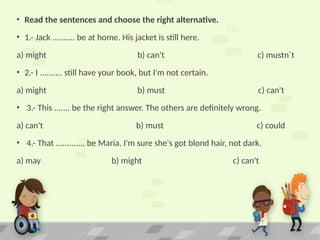
• Read thesentences and choose the right alternative.
• 1.- Jack .......... be at home. His jacket is still here.
a) might b) can't c) mustn´t
• 2.- I .......... still have your book, but I'm not certain.
a) might b) must c) can't
• 3.- This ....... be the right answer. The others are definitely wrong.
a) can't b) must c) could
• 4.- That ............. be Maria. I'm sure she's got blond hair, not dark.
a) may b) might c) can't
58.
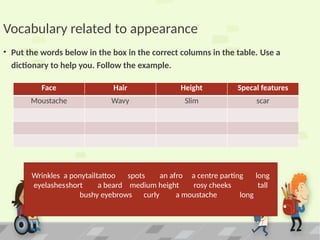
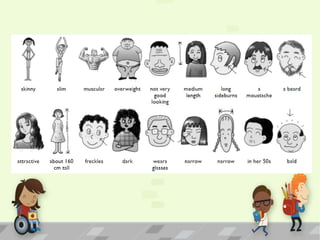
Vocabulary related toappearance
• Put the words below in the box in the correct columns in the table. Use a
dictionary to help you. Follow the example.
Wrinkles a ponytailtattoo spots an afro a centre parting long
eyelashesshort a beard medium height rosy cheeks tall
bushy eyebrows curly a moustache long
Face Hair Height Specal features
Moustache Wavy Slim scar
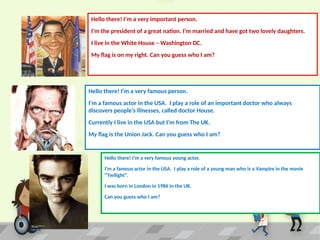
Hello there! I’ma very important person.
I’m the president of a great nation. I’m married and have got two lovely daughters.
I live in the White House – Washington DC.
My flag is on my right. Can you guess who I am?
Hello there! I’m a very famous person.
I’m a famous actor in the USA. I play a role of an important doctor who always
discovers people’s illnesses, called doctor House.
Currently I live in the USA but I’m from The UK.
My flag is the Union Jack. Can you guess who I am?
Hello there! I’m a very famous young actor.
I’m a famous actor in the USA. I play a role of a young man who is a Vampire in the movie
“Twilight”.
I was born in London in 1986 in the UK.
Can you guess who I am?
62.
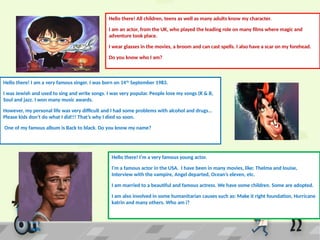
Hello there! Allchildren, teens as well as many adults know my character.
I am an actor, from the UK, who played the leading role on many films where magic and
adventure took place.
I wear glasses in the movies, a broom and can cast spells. I also have a scar on my forehead.
Do you know who I am?
Hello there! I am a very famous singer. I was born on 14th
September 1983.
I was Jewish and used to sing and write songs. I was very popular. People love my songs (R & B,
Soul and jazz. I won many music awards.
However, my personal life was very difficult and I had some problems with alcohol and drugs…
Please kids don’t do what I did!!! That’s why I died so soon.
One of my famous album is Back to black. Do you know my name?
Hello there! I’m a very famous young actor.
I’m a famous actor in the USA. I have been in many movies, like: Thelma and louise,
Interview with the vampire, Angel departed, Ocean’s eleven, etc.
I am married to a beautiful and famous actress. We have some children. Some are adopted.
I am also involved in some humanitarian causes such as: Make it right foundation, Hurricane
katrin and many others. Who am i?