Content
Present Simple and Present Continuous tense
Past Simple and Past Continuous tense
Past Simple and Present Perfect tense
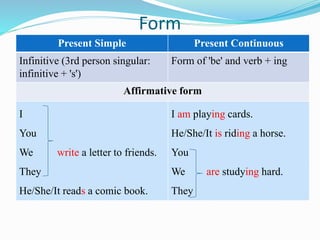
Form
Present Simple Present Continuous
Infinitive (3rd person singular:
infinitive + 's')
Form of 'be' and verb + ing
Affirmative form
I
You
We write a letter to friends.
They
He/She/It reads a comic book.
I am playing cards.
He/She/It is riding a horse.
You
We are studying hard.
They
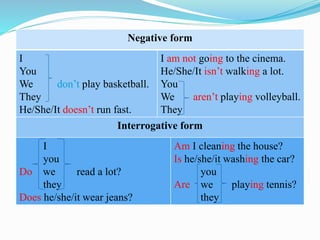
Negative form
I
You
We don’t play basketball.
They
He/She/It doesn’t run fast.
I am not going to the cinema.
He/She/It isn’t walking a lot.
You
We aren’t playing volleyball.
They
Interrogative form
I
you
Do we read a lot?
they
Does he/she/it wear jeans?
Am I cleaning the house?
Is he/she/it washing the car?
you
Are we playing tennis?
they
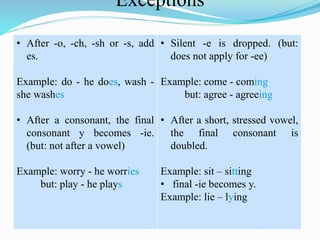
Exceptions
• After -o, -ch, -sh or -s, add
es.
Example: do - he does, wash -
she washes
• After a consonant, the final
consonant y becomes -ie.
(but: not after a vowel)
Example: worry - he worries
but: play - he plays
• Silent -e is dropped. (but:
does not apply for -ee)
Example: come - coming
but: agree - agreeing
• After a short, stressed vowel,
the final consonant is
doubled.
Example: sit – sitting
• final -ie becomes y.
Example: lie – lying
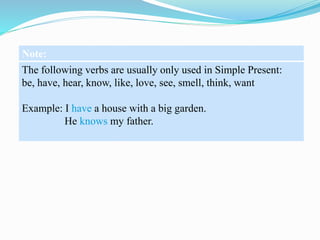
Note:
The following verbs are usually only used in Simple Present:
be, have, hear, know, like, love, see, smell, think, want
Example: I have a house with a big garden.
He knows my father.
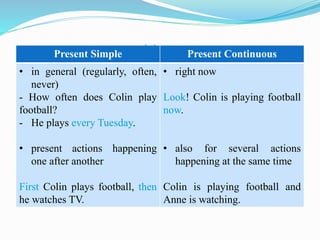
UsePresent Simple Present Continuous
• in general (regularly, often,
never)
- How often does Colin play
football?
- He plays every Tuesday.
• present actions happening
one after another
First Colin plays football, then
he watches TV.
• right now
Look! Colin is playing football
now.
• also for several actions
happening at the same time
Colin is playing football and
Anne is watching.
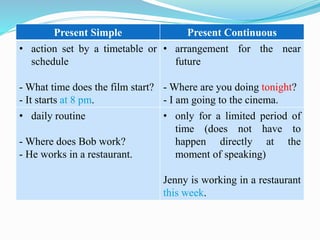
Present Simple Present Continuous
• action set by a timetable or
schedule
- What time does the film start?
- It starts at 8 pm.
• arrangement for the near
future
- Where are you doing tonight?
- I am going to the cinema.
• daily routine
- Where does Bob work?
- He works in a restaurant.
• only for a limited period of
time (does not have to
happen directly at the
moment of speaking)
Jenny is working in a restaurant
this week.
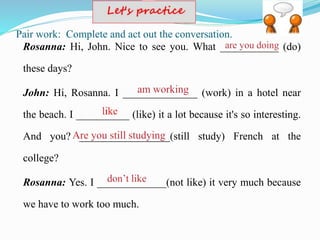
Pair work: Complete and act out the conversation.
Rosanna: Hi, John. Nice to see you. What ___________ (do)
these days?
John: Hi, Rosanna. I ______________ (work) in a hotel near
the beach. I __________ (like) it a lot because it's so interesting.
And you? _________________(still study) French at the
college?
Rosanna: Yes. I _____________(not like) it very much because

we have to work too much.
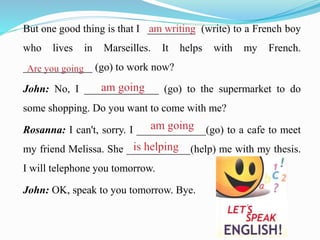
But one good thing is that I _________ (write) to a French boy
who lives in Marseilles. It helps with my French.
_____________ (go) to work now?
John: No, I ______________ (go) to the supermarket to do
some shopping. Do you want to come with me?
Rosanna: I can't, sorry. I _____________(go) to a cafe to meet
my friend Melissa. She ____________(help) me with my thesis.
I will telephone you tomorrow.
John: OK, speak to you tomorrow. Bye.
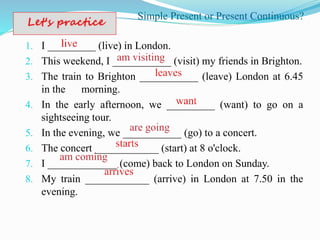
Simple Present or Present Continuous?
1. I _________ (live) in London.
2. This weekend, I ___________ (visit) my friends in Brighton.
3. The train to Brighton ___________ (leave) London at 6.45
in the morning.
4. In the early afternoon, we _________ (want) to go on a
sightseeing tour.
5. In the evening, we ___________ (go) to a concert.
6. The concert ____________ (start) at 8 o'clock.
7. I _____________ (come) back to London on Sunday.
8. My train ____________ (arrive) in London at 7.50 in the
evening.
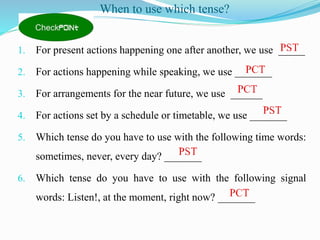
When to use which tense?
1. For present actions happening one after another, we use _____
2. For actions happening while speaking, we use _______
3. For arrangements for the near future, we use ______
4. For actions set by a schedule or timetable, we use _______
5. Which tense do you have to use with the following time words:
sometimes, never, every day? _______
6. Which tense do you have to use with the following signal
words: Listen!, at the moment, right now? _______
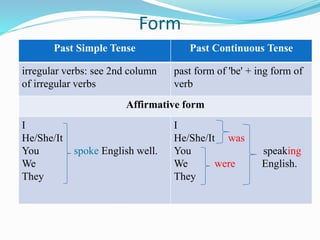
Form
Past Simple Tense Past Continuous Tense
irregular verbs: see 2nd column
of irregular verbs
past form of 'be' + ing form of
verb
Affirmative form
I
He/She/It
You spoke English well.
We
They
I
He/She/It was
You speaking
We were English.
They
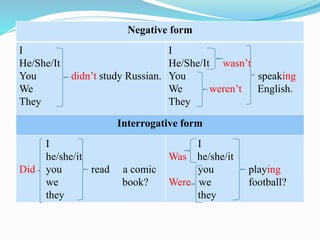
Negative form
I
He/She/It
You didn’t study Russian.
We
They
I
He/She/It wasn’t
You speaking
We weren’t English.
They
Interrogative form
I
he/she/it
Did you read a comic
we book?
they
I
Was he/she/it
you playing
Were we football?
they
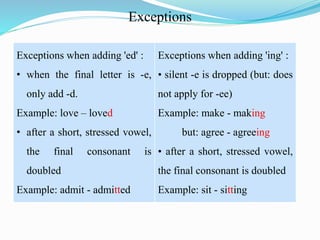
Exceptions when adding 'ed' :
• when the final letter is -e,
only add -d.
Example: love – loved
• after a short, stressed vowel,
the final consonant is
doubled
Example: admit - admitted
Exceptions when adding 'ing' :
• silent -e is dropped (but: does
not apply for -ee)
Example: make - making
but: agree - agreeing
• after a short, stressed vowel,
the final consonant is doubled
Example: sit - sitting
Exceptions
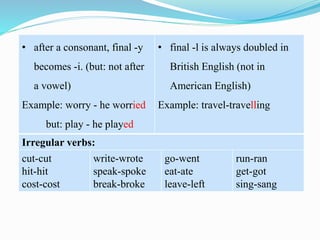
• after a consonant, final -y
becomes -i. (but: not after
a vowel)
Example: worry - he worried
but: play - he played
• final -l is always doubled in
British English (not in
American English)
Example: travel-travelling
Irregular verbs:
cut-cut
hit-hit
cost-cost
write-wrote
speak-spoke
break-broke
go-went
eat-ate
leave-left
run-ran
get-got
sing-sang
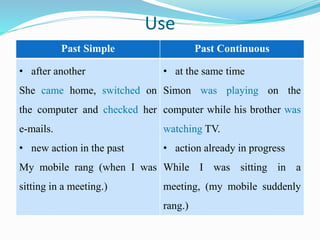
Use
Past Simple Past Continuous
• after another
She came home, switched on
the computer and checked her
e-mails.
• new action in the past
My mobile rang (when I was
sitting in a meeting.)
• at the same time
Simon was playing on the
computer while his brother was
watching TV.
• action already in progress
While I was sitting in a
meeting, (my mobile suddenly
rang.)
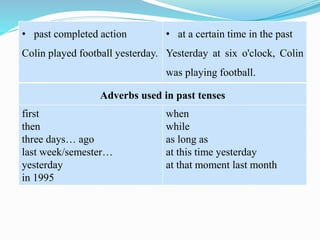
• past completed action
Colin played football yesterday.
• at a certain time in the past
Yesterday at six o'clock, Colin
was playing football.
Adverbs used in past tenses
first
then
three days… ago
last week/semester…
yesterday
in 1995
when
while
as long as
at this time yesterday
at that moment last month
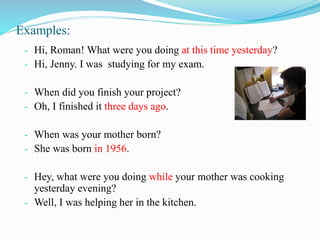
Examples:
- Hi, Roman! What were you doing at this time yesterday?
- Hi, Jenny. I was studying for my exam.
- When did you finish your project?
- Oh, I finished it three days ago.
- When was your mother born?
- She was born in 1956.
- Hey, what were you doing while your mother was cooking
yesterday evening?
- Well, I was helping her in the kitchen.
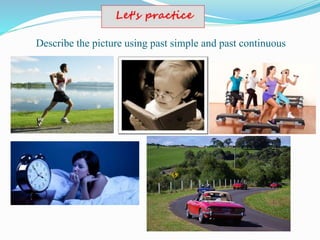
Describe the picture using past simple and past continuous
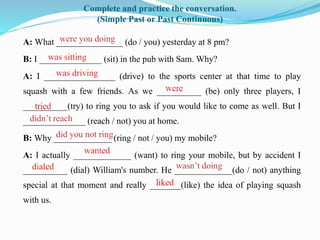
Complete and practice the conversation.
(Simple Past or Past Continuous)
A: What _______________ (do / you) yesterday at 8 pm?
B: I ______________ (sit) in the pub with Sam. Why?
A: I ________________ (drive) to the sports center at that time to play
squash with a few friends. As we __________ (be) only three players, I
__________(try) to ring you to ask if you would like to come as well. But I
______________ (reach / not) you at home.
B: Why _____________ (ring / not / you) my mobile?
A: I actually _____________ (want) to ring your mobile, but by accident I
__________ (dial) William's number. He _____________(do / not) anything
special at that moment and really _______(like) the idea of playing squash
with us.
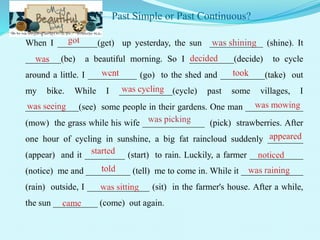
Past Simple or Past Continuous?
When I _________(get) up yesterday, the sun ____________ (shine). It
________(be) a beautiful morning. So I __________(decide) to cycle
around a little. I ___________ (go) to the shed and __________(take) out
my bike. While I ____________(cycle) past some villages, I
____________(see) some people in their gardens. One man _____________
(mow) the grass while his wife ______________ (pick) strawberries. After
one hour of cycling in sunshine, a big fat raincloud suddenly ________
(appear) and it _________ (start) to rain. Luckily, a farmer ____________
(notice) me and __________ (tell) me to come in. While it ______________
(rain) outside, I ______________ (sit) in the farmer's house. After a while,
the sun __________ (come) out again.
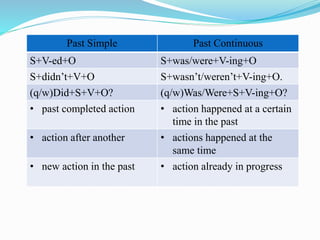
Past Simple Past Continuous
S+V-ed+O S+was/were+V-ing+O
S+didn’t+V+O S+wasn’t/weren’t+V-ing+O.
(q/w)Did+S+V+O? (q/w)Was/Were+S+V-ing+O?
• past completed action • action happened at a certain
time in the past
• action after another • actions happened at the
same time
• new action in the past • action already in progress
Simple Past
vs.
Present Perfect
When do we use each tense in English?
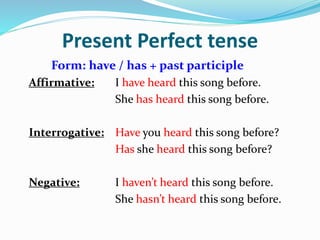
Present Perfect tense
Form: have / has + past participle
Affirmative: I have heard this song before.
She has heard this song before.
Interrogative: Have you heard this song before?
Has she heard this song before?
Negative: I haven’t heard this song before.
She hasn’t heard this song before.
Remember:
Grammar has meaning!
Different grammar tenses are used in
different situations or contexts and they
carry different meanings.
For example …
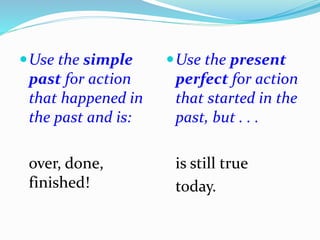
Use the simple
past for action
that happened in
the past and is:
over, done,
finished!
Use the present
perfect for action
that started in the
past, but . . .
is still true
today.
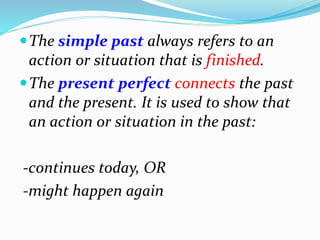
The simple past always refers to an
action or situation that is finished.
The present perfect connects the past
and the present. It is used to show that
an action or situation in the past:
-continues today, OR
-might happen again
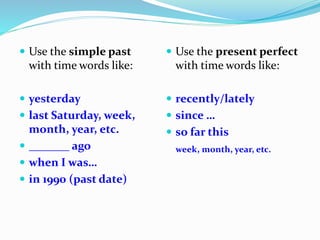
 Use the simple past
with time words like:
 yesterday
 last Saturday, week,
month, year, etc.
 _______ ago
 when I was…
 in 1990 (past date)
 Use the present perfect
with time words like:
 recently/lately
 since …
 so far this
week, month, year, etc.
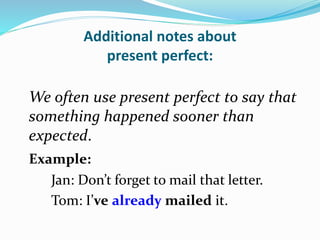
Additional notes about
present perfect:
We often use present perfect to say that
something happened sooner than
expected.
Example:
Jan: Don’t forget to mail that letter.
Tom: I’ve already mailed it.
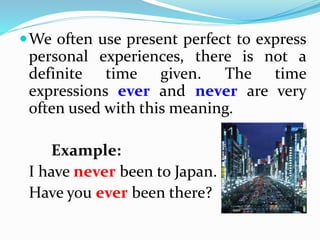
We often use present perfect to express
personal experiences, there is not a
definite time given. The time
expressions ever and never are very
often used with this meaning.
Example:
I have never been to Japan.
Have you ever been there?
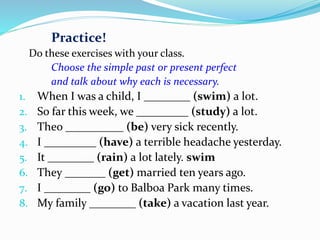
Practice!
Do these exercises with your class.
Choose the simple past or present perfect
and talk about why each is necessary.
1. When I was a child, I ________ (swim) a lot.
2. So far this week, we _________ (study) a lot.
3. Theo __________ (be) very sick recently.
4. I _________ (have) a terrible headache yesterday.
5. It ________ (rain) a lot lately. swim
6. They _______ (get) married ten years ago.
7. I ________ (go) to Balboa Park many times.
8. My family ________ (take) a vacation last year.
-Have you ever…(enjoy,see,stay in,visit,go on,experience)?
- …
- When ?
- …
Practice
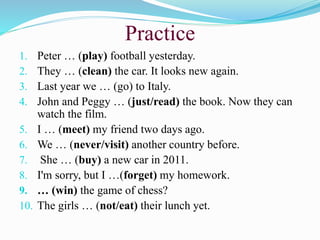
1. Peter … (play) football yesterday.
2. They … (clean) the car. It looks new again.
3. Last year we … (go) to Italy.
4. John and Peggy … (just/read) the book. Now they can
watch the film.
5. I … (meet) my friend two days ago.
6. We … (never/visit) another country before.
7. She … (buy) a new car in 2011.
8. I'm sorry, but I …(forget) my homework.
9. … (win) the game of chess?
10. The girls … (not/eat) their lunch yet.
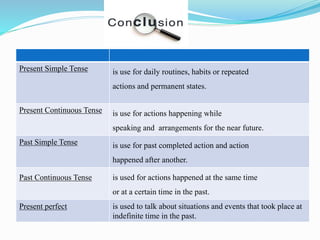
Present Simple Tense is use for daily routines, habits or repeated
actions and permanent states.
Present Continuous Tense is use for actions happening while
speaking and arrangements for the near future.
Past Simple Tense is use for past completed action and action
happened after another.
Past Continuous Tense is used for actions happened at the same time
or at a certain time in the past.
Present perfect is used to talk about situations and events that took place at
indefinite time in the past.
Lecture8 review (1)

Lecture8 review (1)

  • 3.
    Content Present Simple andPresent Continuous tense Past Simple and Past Continuous tense Past Simple and Present Perfect tense
  • 4.
    Form Present Simple PresentContinuous Infinitive (3rd person singular: infinitive + 's') Form of 'be' and verb + ing Affirmative form I You We write a letter to friends. They He/She/It reads a comic book. I am playing cards. He/She/It is riding a horse. You We are studying hard. They
  • 5.
    Negative form I You We don’tplay basketball. They He/She/It doesn’t run fast. I am not going to the cinema. He/She/It isn’t walking a lot. You We aren’t playing volleyball. They Interrogative form I you Do we read a lot? they Does he/she/it wear jeans? Am I cleaning the house? Is he/she/it washing the car? you Are we playing tennis? they
  • 6.
    Exceptions • After -o,-ch, -sh or -s, add es. Example: do - he does, wash - she washes • After a consonant, the final consonant y becomes -ie. (but: not after a vowel) Example: worry - he worries but: play - he plays • Silent -e is dropped. (but: does not apply for -ee) Example: come - coming but: agree - agreeing • After a short, stressed vowel, the final consonant is doubled. Example: sit – sitting • final -ie becomes y. Example: lie – lying
  • 7.
    Note: The following verbsare usually only used in Simple Present: be, have, hear, know, like, love, see, smell, think, want Example: I have a house with a big garden. He knows my father.
  • 8.
    UsePresent Simple PresentContinuous • in general (regularly, often, never) - How often does Colin play football? - He plays every Tuesday. • present actions happening one after another First Colin plays football, then he watches TV. • right now Look! Colin is playing football now. • also for several actions happening at the same time Colin is playing football and Anne is watching.
  • 9.
    Present Simple PresentContinuous • action set by a timetable or schedule - What time does the film start? - It starts at 8 pm. • arrangement for the near future - Where are you doing tonight? - I am going to the cinema. • daily routine - Where does Bob work? - He works in a restaurant. • only for a limited period of time (does not have to happen directly at the moment of speaking) Jenny is working in a restaurant this week.
  • 10.
    Pair work: Completeand act out the conversation. Rosanna: Hi, John. Nice to see you. What ___________ (do) these days? John: Hi, Rosanna. I ______________ (work) in a hotel near the beach. I __________ (like) it a lot because it's so interesting. And you? _________________(still study) French at the college? Rosanna: Yes. I _____________(not like) it very much because we have to work too much.
  • 11.
    But one goodthing is that I _________ (write) to a French boy who lives in Marseilles. It helps with my French. _____________ (go) to work now? John: No, I ______________ (go) to the supermarket to do some shopping. Do you want to come with me? Rosanna: I can't, sorry. I _____________(go) to a cafe to meet my friend Melissa. She ____________(help) me with my thesis. I will telephone you tomorrow. John: OK, speak to you tomorrow. Bye.
  • 12.
    Simple Present orPresent Continuous? 1. I _________ (live) in London. 2. This weekend, I ___________ (visit) my friends in Brighton. 3. The train to Brighton ___________ (leave) London at 6.45 in the morning. 4. In the early afternoon, we _________ (want) to go on a sightseeing tour. 5. In the evening, we ___________ (go) to a concert. 6. The concert ____________ (start) at 8 o'clock. 7. I _____________ (come) back to London on Sunday. 8. My train ____________ (arrive) in London at 7.50 in the evening.
  • 13.
    When to usewhich tense? 1. For present actions happening one after another, we use _____ 2. For actions happening while speaking, we use _______ 3. For arrangements for the near future, we use ______ 4. For actions set by a schedule or timetable, we use _______ 5. Which tense do you have to use with the following time words: sometimes, never, every day? _______ 6. Which tense do you have to use with the following signal words: Listen!, at the moment, right now? _______
  • 14.
    Form Past Simple TensePast Continuous Tense irregular verbs: see 2nd column of irregular verbs past form of 'be' + ing form of verb Affirmative form I He/She/It You spoke English well. We They I He/She/It was You speaking We were English. They
  • 15.
    Negative form I He/She/It You didn’tstudy Russian. We They I He/She/It wasn’t You speaking We weren’t English. They Interrogative form I he/she/it Did you read a comic we book? they I Was he/she/it you playing Were we football? they
  • 16.
    Exceptions when adding'ed' : • when the final letter is -e, only add -d. Example: love – loved • after a short, stressed vowel, the final consonant is doubled Example: admit - admitted Exceptions when adding 'ing' : • silent -e is dropped (but: does not apply for -ee) Example: make - making but: agree - agreeing • after a short, stressed vowel, the final consonant is doubled Example: sit - sitting Exceptions
  • 17.
    • after aconsonant, final -y becomes -i. (but: not after a vowel) Example: worry - he worried but: play - he played • final -l is always doubled in British English (not in American English) Example: travel-travelling Irregular verbs: cut-cut hit-hit cost-cost write-wrote speak-spoke break-broke go-went eat-ate leave-left run-ran get-got sing-sang
  • 18.
    Use Past Simple PastContinuous • after another She came home, switched on the computer and checked her e-mails. • new action in the past My mobile rang (when I was sitting in a meeting.) • at the same time Simon was playing on the computer while his brother was watching TV. • action already in progress While I was sitting in a meeting, (my mobile suddenly rang.)
  • 19.
    • past completedaction Colin played football yesterday. • at a certain time in the past Yesterday at six o'clock, Colin was playing football. Adverbs used in past tenses first then three days… ago last week/semester… yesterday in 1995 when while as long as at this time yesterday at that moment last month
  • 20.
    Examples: - Hi, Roman!What were you doing at this time yesterday? - Hi, Jenny. I was studying for my exam. - When did you finish your project? - Oh, I finished it three days ago. - When was your mother born? - She was born in 1956. - Hey, what were you doing while your mother was cooking yesterday evening? - Well, I was helping her in the kitchen.
  • 21.
    Describe the pictureusing past simple and past continuous
  • 22.
    Complete and practicethe conversation. (Simple Past or Past Continuous) A: What _______________ (do / you) yesterday at 8 pm? B: I ______________ (sit) in the pub with Sam. Why? A: I ________________ (drive) to the sports center at that time to play squash with a few friends. As we __________ (be) only three players, I __________(try) to ring you to ask if you would like to come as well. But I ______________ (reach / not) you at home. B: Why _____________ (ring / not / you) my mobile? A: I actually _____________ (want) to ring your mobile, but by accident I __________ (dial) William's number. He _____________(do / not) anything special at that moment and really _______(like) the idea of playing squash with us.
  • 23.
    Past Simple orPast Continuous? When I _________(get) up yesterday, the sun ____________ (shine). It ________(be) a beautiful morning. So I __________(decide) to cycle around a little. I ___________ (go) to the shed and __________(take) out my bike. While I ____________(cycle) past some villages, I ____________(see) some people in their gardens. One man _____________ (mow) the grass while his wife ______________ (pick) strawberries. After one hour of cycling in sunshine, a big fat raincloud suddenly ________ (appear) and it _________ (start) to rain. Luckily, a farmer ____________ (notice) me and __________ (tell) me to come in. While it ______________ (rain) outside, I ______________ (sit) in the farmer's house. After a while, the sun __________ (come) out again.
  • 24.
    Past Simple PastContinuous S+V-ed+O S+was/were+V-ing+O S+didn’t+V+O S+wasn’t/weren’t+V-ing+O. (q/w)Did+S+V+O? (q/w)Was/Were+S+V-ing+O? • past completed action • action happened at a certain time in the past • action after another • actions happened at the same time • new action in the past • action already in progress
  • 25.
    Simple Past vs. Present Perfect Whendo we use each tense in English?
  • 26.
    Present Perfect tense Form:have / has + past participle Affirmative: I have heard this song before. She has heard this song before. Interrogative: Have you heard this song before? Has she heard this song before? Negative: I haven’t heard this song before. She hasn’t heard this song before.
  • 27.
    Remember: Grammar has meaning! Differentgrammar tenses are used in different situations or contexts and they carry different meanings. For example …
  • 28.
    Use the simple pastfor action that happened in the past and is: over, done, finished! Use the present perfect for action that started in the past, but . . . is still true today.
  • 29.
    The simple pastalways refers to an action or situation that is finished. The present perfect connects the past and the present. It is used to show that an action or situation in the past: -continues today, OR -might happen again
  • 30.
     Use thesimple past with time words like:  yesterday  last Saturday, week, month, year, etc.  _______ ago  when I was…  in 1990 (past date)  Use the present perfect with time words like:  recently/lately  since …  so far this week, month, year, etc.
  • 31.
    Additional notes about presentperfect: We often use present perfect to say that something happened sooner than expected. Example: Jan: Don’t forget to mail that letter. Tom: I’ve already mailed it.
  • 32.
    We often usepresent perfect to express personal experiences, there is not a definite time given. The time expressions ever and never are very often used with this meaning. Example: I have never been to Japan. Have you ever been there?
  • 33.
    Practice! Do these exerciseswith your class. Choose the simple past or present perfect and talk about why each is necessary. 1. When I was a child, I ________ (swim) a lot. 2. So far this week, we _________ (study) a lot. 3. Theo __________ (be) very sick recently. 4. I _________ (have) a terrible headache yesterday. 5. It ________ (rain) a lot lately. swim 6. They _______ (get) married ten years ago. 7. I ________ (go) to Balboa Park many times. 8. My family ________ (take) a vacation last year.
  • 34.
    -Have you ever…(enjoy,see,stayin,visit,go on,experience)? - … - When ? - …
  • 35.
    Practice 1. Peter …(play) football yesterday. 2. They … (clean) the car. It looks new again. 3. Last year we … (go) to Italy. 4. John and Peggy … (just/read) the book. Now they can watch the film. 5. I … (meet) my friend two days ago. 6. We … (never/visit) another country before. 7. She … (buy) a new car in 2011. 8. I'm sorry, but I …(forget) my homework. 9. … (win) the game of chess? 10. The girls … (not/eat) their lunch yet.
  • 36.
    Present Simple Tenseis use for daily routines, habits or repeated actions and permanent states. Present Continuous Tense is use for actions happening while speaking and arrangements for the near future. Past Simple Tense is use for past completed action and action happened after another. Past Continuous Tense is used for actions happened at the same time or at a certain time in the past. Present perfect is used to talk about situations and events that took place at indefinite time in the past.