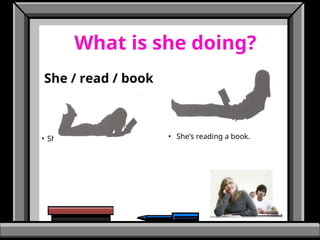
What is she doing?
She / read / book
• She is reading the book. • She’s reading a book.
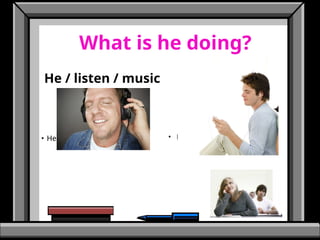
What is he doing?
He / listen / music
• He is listening to music. • He’s listening to music.
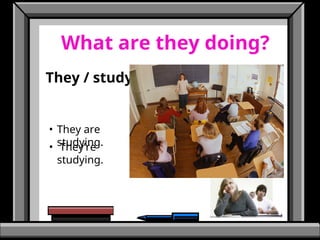
What are they doing?
They / study
• They’re
studying.
• They are
studying.
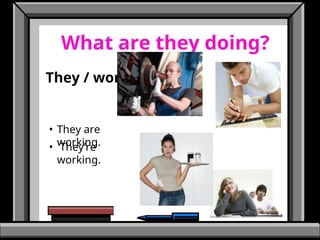
What are they doing?
They / work
• They’re
working.
• They are
working.
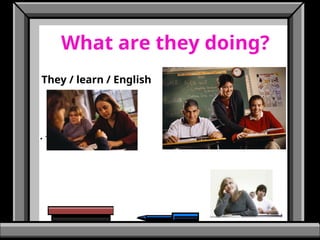
What are they doing?
They / learn / English
• They are learning English. • They’re learning English.
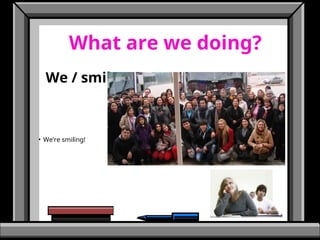
What are we doing?
We / smile
• We’re smiling!
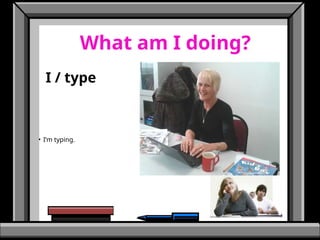
What am I doing?
I / type
• I’m typing.
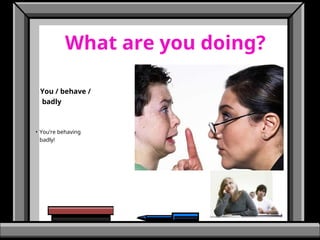
What are you doing?
You / behave /
badly
• You’re behaving
badly!
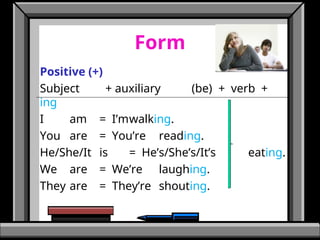
Form
Positive (+)
Subject + auxiliary (be) + verb +
ing
I am = I’mwalking.
You are = You’re reading.
He/She/It is = He’s/She’s/It’s eating.
We are = We’re laughing.
They are = They’re shouting.
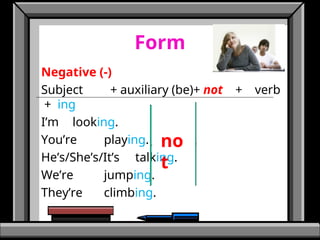
Form
Negative (-)
Subject + auxiliary (be)+ not + verb
+ ing
I’m looking.
You’re playing.
He’s/She’s/It’s talking.
We’re jumping.
They’re climbing.
no
t
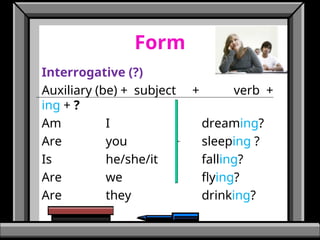
Form
Interrogative (?)
Auxiliary (be) + subject + verb +
ing + ?
Am I dreaming?
Are you sleeping ?
Is he/she/it falling?
Are we flying?
Are they drinking?
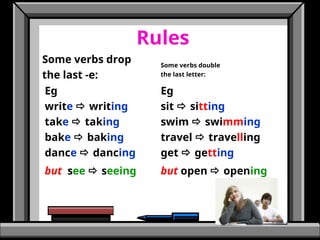
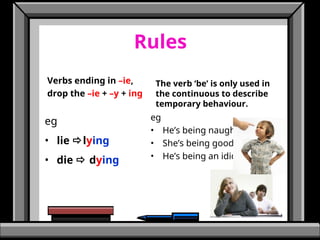
Rules
Some verbs drop
the last -e:
Eg
write  writing
take  taking
bake  baking
dance  dancing
but see  seeing
Some verbs double
the last letter:
Eg
sit  sitting
swim  swimming
travel  travelling
get  getting
but open  opening
Rules
eg
• lie lying
• die  dying
The verb ‘be’ is only used in
the continuous to describe
temporary behaviour.
eg
• He’s being naughty.
• She’s being good.
• He’s being an idiot.
Verbs ending in –ie,
drop the –ie + –y + ing
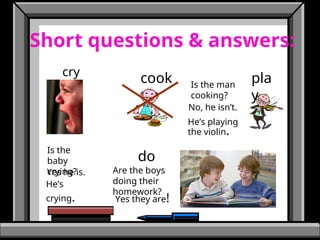
Short questions & answers:
cry
cook pla
y
do
Is the
baby
crying?
Is the man
cooking?
Are the boys
doing their
homework?
No, he isn’t.
He’s playing
the violin.
Yes he is.
He’s
crying. Yes they are!
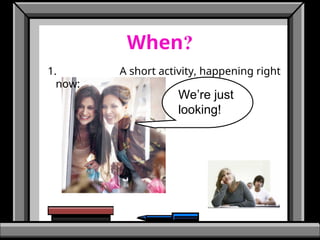
When?
1. A short activity, happening right
now:
We’re just
looking!
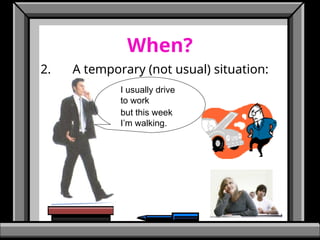
When?
2. A temporary (not usual) situation:
I usually drive
to work
but this week
I’m walking.
When?
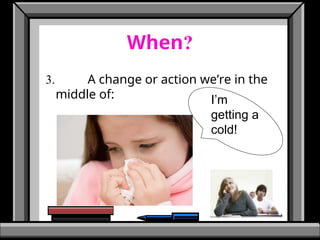
3. A change or action we’re in the
middle of: I’m
getting a
cold!
When?
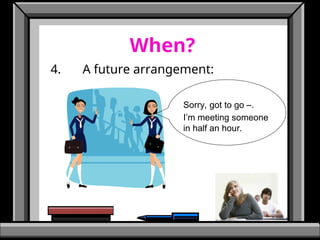
4. A future arrangement:
Sorry, got to go –.
I’m meeting someone
in half an hour.
Making future
arrangements:
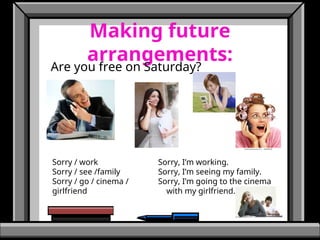
Are you free on Saturday?
Sorry / work
Sorry / see /family
Sorry / go / cinema /
girlfriend
Sorry, I’m working.
Sorry, I’m seeing my family.
Sorry, I’m going to the cinema
with my girlfriend.
Exceptions:
• Some verbs aren’t usually used in
the present continuous:
– Feelings
– Mental states
– Senses
– Also: belong, include, contain
(hate, like, love, prefer, want,
wish)
(believe, feel, know,
remember,
mean, understand)
(hear, see, sound, smell,
taste)
(BUT ‘How are you feeling? I’m feeling
happy.)
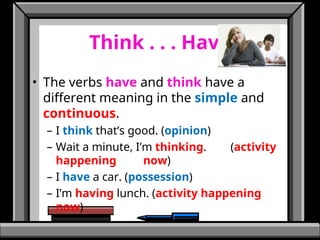
Think . . . Have
• The verbs have and think have a
different meaning in the simple and
continuous.
– I think that’s good. (opinion)
– Wait a minute, I’m thinking. (activity
happening now)
– I have a car. (possession)
– I’m having lunch. (activity happening
now)
English Presentation Present Continuous Tense

English Presentation Present Continuous Tense

  • 2.
    What is shedoing? She / read / book • She is reading the book. • She’s reading a book.
  • 3.
    What is hedoing? He / listen / music • He is listening to music. • He’s listening to music.
  • 4.
    What are theydoing? They / study • They’re studying. • They are studying.
  • 5.
    What are theydoing? They / work • They’re working. • They are working.
  • 6.
    What are theydoing? They / learn / English • They are learning English. • They’re learning English.
  • 7.
    What are wedoing? We / smile • We’re smiling!
  • 8.
    What am Idoing? I / type • I’m typing.
  • 9.
    What are youdoing? You / behave / badly • You’re behaving badly!
  • 10.
    Form Positive (+) Subject +auxiliary (be) + verb + ing I am = I’mwalking. You are = You’re reading. He/She/It is = He’s/She’s/It’s eating. We are = We’re laughing. They are = They’re shouting.
  • 11.
    Form Negative (-) Subject +auxiliary (be)+ not + verb + ing I’m looking. You’re playing. He’s/She’s/It’s talking. We’re jumping. They’re climbing. no t
  • 12.
    Form Interrogative (?) Auxiliary (be)+ subject + verb + ing + ? Am I dreaming? Are you sleeping ? Is he/she/it falling? Are we flying? Are they drinking?
  • 13.
    Rules Some verbs drop thelast -e: Eg write  writing take  taking bake  baking dance  dancing but see  seeing Some verbs double the last letter: Eg sit  sitting swim  swimming travel  travelling get  getting but open  opening
  • 14.
    Rules eg • lie lying •die  dying The verb ‘be’ is only used in the continuous to describe temporary behaviour. eg • He’s being naughty. • She’s being good. • He’s being an idiot. Verbs ending in –ie, drop the –ie + –y + ing
  • 15.
    Short questions &answers: cry cook pla y do Is the baby crying? Is the man cooking? Are the boys doing their homework? No, he isn’t. He’s playing the violin. Yes he is. He’s crying. Yes they are!
  • 16.
    When? 1. A shortactivity, happening right now: We’re just looking!
  • 17.
    When? 2. A temporary(not usual) situation: I usually drive to work but this week I’m walking.
  • 18.
    When? 3. A changeor action we’re in the middle of: I’m getting a cold!
  • 19.
    When? 4. A futurearrangement: Sorry, got to go –. I’m meeting someone in half an hour.
  • 20.
    Making future arrangements: Are youfree on Saturday? Sorry / work Sorry / see /family Sorry / go / cinema / girlfriend Sorry, I’m working. Sorry, I’m seeing my family. Sorry, I’m going to the cinema with my girlfriend.
  • 21.
    Exceptions: • Some verbsaren’t usually used in the present continuous: – Feelings – Mental states – Senses – Also: belong, include, contain (hate, like, love, prefer, want, wish) (believe, feel, know, remember, mean, understand) (hear, see, sound, smell, taste) (BUT ‘How are you feeling? I’m feeling happy.)
  • 22.
    Think . .. Have • The verbs have and think have a different meaning in the simple and continuous. – I think that’s good. (opinion) – Wait a minute, I’m thinking. (activity happening now) – I have a car. (possession) – I’m having lunch. (activity happening now)