Grammar is easy Anna Davtjan 8b Tallinn Linna m a e  Russian  L yc eum Teacher :   Elena Soshina Tallinn 2006
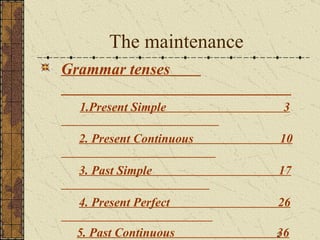
The maintenance Grammar tense s                                                          1.Present Simple                                       3                                                      2. Present Continuous                             10                                                     3. Past Simple                                          17                                                   4. Present Perfect                                    26                                                    5. Past Continuous                                  36                                                   Common test                                 43                        Internet Recourses                       44
Present Simple
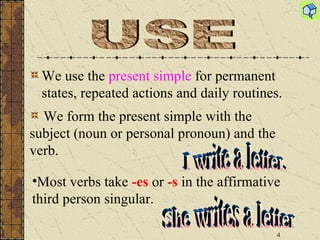
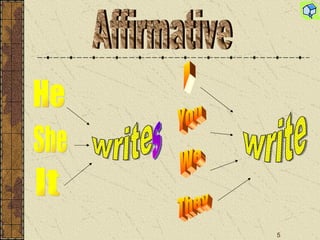
We use the  present simple  for permanent states, repeated actions and daily routines. USE I write a letter. We form the present simple with the  subject (noun or personal pronoun) and the  verb. She writes a letter Most verbs take  -es   or   -s  in the affirmative third person singular.
He She It write I You We They write S Affirmative
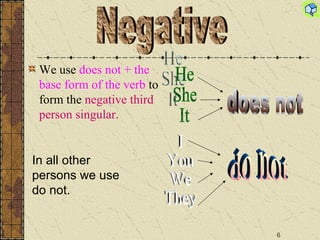
We use  does not + the base form of the verb  to form the  negative third person singular. He She It does not In all other persons we use do not. I You We They do not Negative
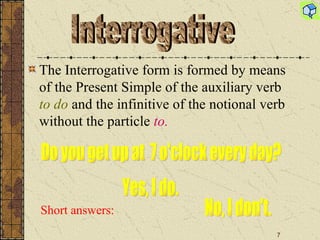
The Interrogative form is formed by means of the Present Simple of the auxiliary verb  to do  and the infinitive of the notional verb without the particle  to. Interrogative Do you get up at  7 o'clock every day? Short answers: Yes, I do. No, I don't.
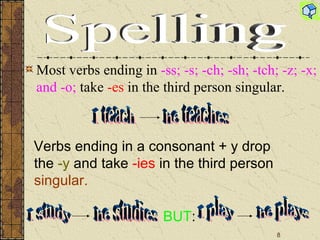
Most verbs ending in  - ss ; - s ; - ch ; - sh ; - tch ; - z ; - x ;  and  - o ;   take  -es  in the third person singular. Spelling I teach he teaches Verbs ending in a consonant + y drop the  -y  and take  -ies  in the third person  singular. I study he studies BUT : I play he plays
Tests http://web2.uvcs.uvic.ca/elc/studyzone/330/grammar/pres1.htm http://web2.uvcs.uvic.ca/elc/studyzone/330/grammar/presnq1.htm Present Simple Tense
Present Continuous
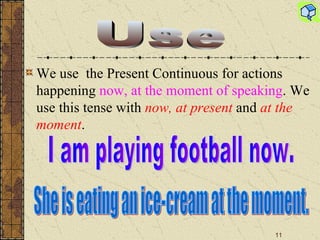
We use  the Present Continuous for actions happening  now, at the moment of speaking . We use this tense with  now, at present  and  at the moment .  Use I am playing football now. She is eating an ice-cream at the moment.
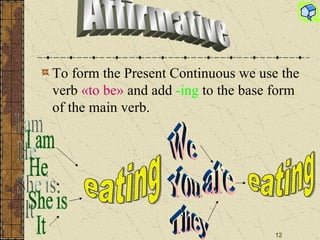
To form the Present Continuous we use the verb  « to be »   and add  -ing  to the base form of the main verb.  I am He She It is eating We You They Affirmative are eating
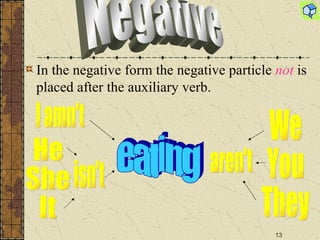
In the negative form the negative particle  not  is placed after the auxiliary verb. Negative eating I amn't He She It isn't We You They aren't
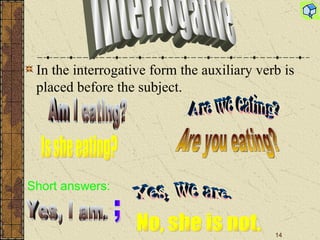
In the interrogative form the auxiliary verb is placed before the subject. Am I eating? Is she eating? Are we eating? Are you eating? Short answers : Yes, I am. ; Yes, we are. No, she is not. Interrogative
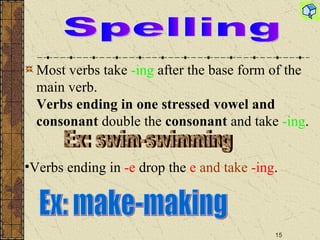
Most verbs take  -ing  after the base form of the main verb.  Verbs ending in one stressed vowel and consonant  double the  consonant  and take  -ing .     Ex: swim-swimming Ex: make-making Spelling Verbs ending in  -e  drop the  e   and take  -ing .
Tests http://web2.uvcs.uvic.ca/elc/studyzone/330/grammar/pcont1.htm http://web2.uvcs.uvic.ca/elc/studyzone/330/grammar/pcontnq1.htm Present Continuous Tense
Past Simple
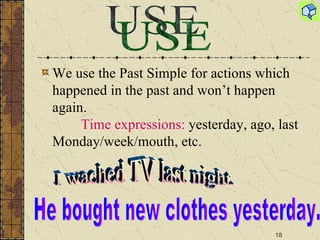
We use the Past Simple for actions which happened in the past and won ’ t happen again.   Time expressions :  yesterday, ago, last Monday/week/mouth, etc. USE I wached TV last night. He bought new clothes yesterday.
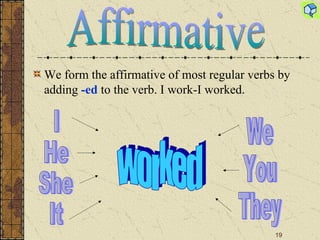
We form the affirmative of most regular verbs by adding  -ed  to the verb. I work-I worked . I He She It We You They worked Affirmative
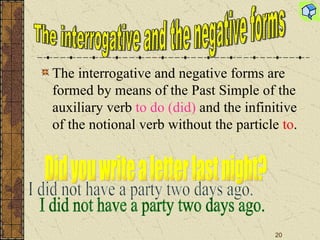
The interrogative and negative forms are formed by means of the P a st Simple of the auxiliary verb  to do (did)  and the infinitive of the notional verb without the particle  to . The interrogative and the negative forms Did you write a letter last night? I did not have a party two days ago.
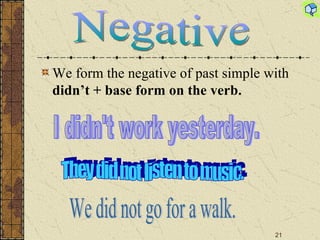
We form the negative of past simple with  didn ’t  + base form on the verb. We did not go for a walk. They did not listen to music. Negative I didn't work yesterday.
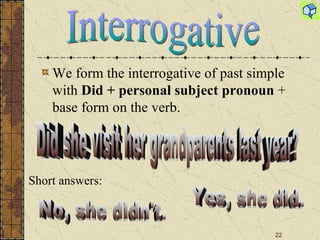
We form the interrogative of past simple with  Did + personal subject pronoun  + base form on the verb. Interrogative Did she visit her grandparents last year? Short answers : No, she didn't. Yes, she did.
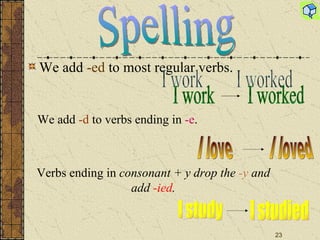
We add  -ed  to most regular verbs .   I work I worked We add  -d  to verbs ending in  -e . I love I loved Verbs ending in  consonant + y drop the  -y   and add  -ied . I study I studied Spelling
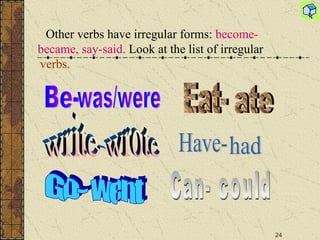
Other verbs have irregular forms :   become-became, say-said.  Look at the list of irregular  verbs.	 Be-  was/were write- wrote Go- went Eat- ate Have- had Can- could
Tests http://web2.uvcs.uvic.ca/elc/studyzone/330/grammar/pasted2.htm http://web2.uvcs.uvic.ca/elc/studyzone/330/grammar/irpast2.htm Past Simple Tense
Present Perfect
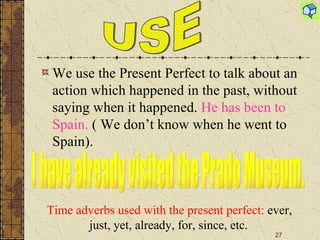
We use the Present Perfect to talk about an action which happened in the past, without saying when it happened.  He has been to Spa i n.   ( We don ’t know when he went to Spain ). USE I have already visited the Prado Museum. Time adverbs used with the present perfect :  ever, just, yet, already, for, since, etc.
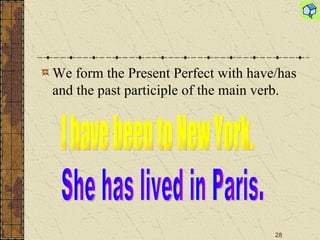
We form the Present Perfect with have/has and the past participle of the main verb. I have been to New York. She has lived in Paris.
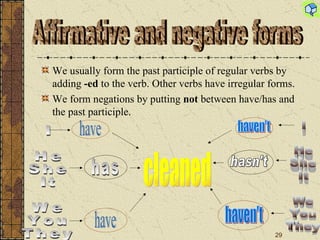
We usually form the past participle of regular verbs by adding  -ed  to the verb. Other verbs have irregular forms.  We form negations by putting  not  between have/has and the past participle. Affirmative and negative forms I  He She It We You They have has have I He She It We You They haven't haven't hasn't cleaned
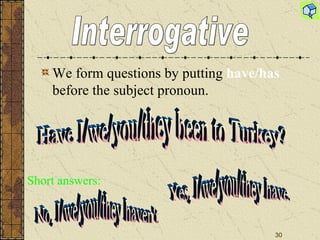
We form questions by putting  have/has  before the subject pronoun.  Interrogative Have I/we/you/they been to Turkey? Short answers : Yes, I/we/you/they have. No, I/we/you/they haven't
We use  ever  in questions and statements. Present Perfect + Ever/Never Have you ever visited Brazil? Brazil is the best place I've ever visited. We use  never  in statements. He has never cut the grass. He hasn't cut the grass.
We use  already  in positive statements.  We use  yet  in questions and negatives. Have you packed your suitcase yet? No, I haven't. I haven't packed it yet. Yes, I have. I have already packed it. Present Perfect+Yet/Already
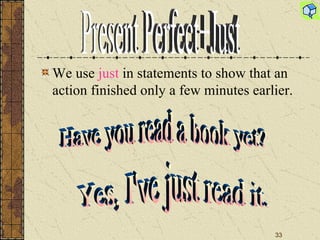
We use  just  in statements to show that an action finished only a few minutes earlier. Have you read a book yet? Yes, I've just read it. Present Perfect+Just
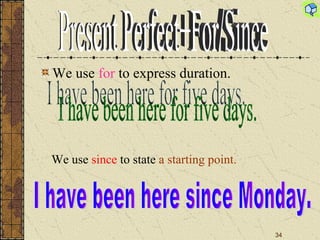
We use  for  to express duration. I have been here for five days. We use  since  to state  a starting point. I have been here since Monday. Present Perfect+For/Since
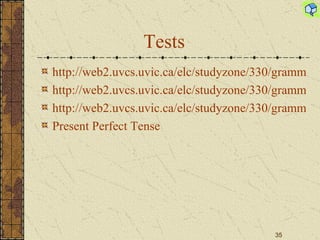
 Tests http://web2.uvcs.uvic.ca/elc/studyzone/330/grammar/prperf1.htm http://web2.uvcs.uvic.ca/elc/studyzone/330/grammar/upperf2.htm http://web2.uvcs.uvic.ca/elc/studyzone/330/grammar/upperf3.htm Present Perfect Tense
Past Continuous
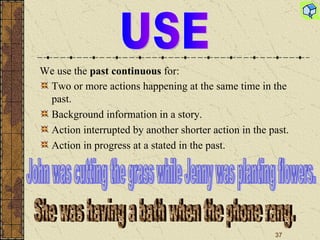
Two or more actions happening at the same time in the past. Background information in a story. Action interrupted by another shorter action in the past. Action in progress at a stated in the past. USE John was cutting the grass while Jenny was planting flowers. She was having a bath when the phone rang. We use the  past continuous  for :
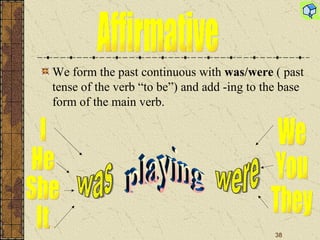
We form the past continuous with  was/were  ( past tense of the verb  “ to be ” ) and add -ing to the base form of the main verb.  Affirmative I He She It We You They was were playing
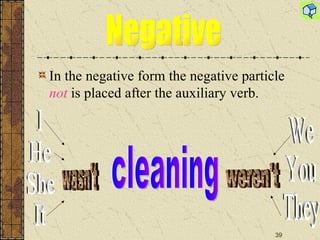
In the negative form the negative particle  not  is placed after the auxiliary verb. Negative I He She It We You They wasn't weren't cleaning
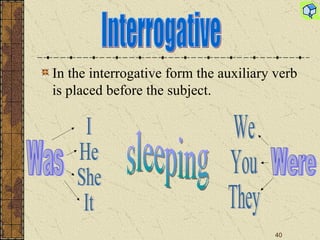
In the interrogative form the auxiliary verb is placed before the subject. Interrogative Was Were I He She It We You They sleeping
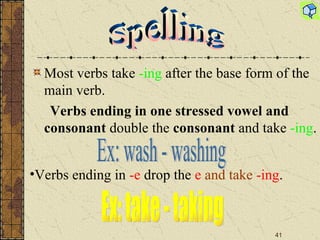
Most verbs take  -ing  after the base form of the main verb.  Verbs ending in one stressed vowel and consonant  double the  consonant  and take  -ing .     Spelling Ex: wash - washing Verbs ending in  -e  drop the  e   and take  -ing .   Ex: take - taking
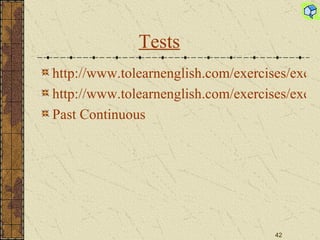
Tests http://www.tolearnenglish.com/exercises/exercise-english-2/exercise-english-2110.php http://www.tolearnenglish.com/exercises/exercise-english-2/exercise-english-1453.php Past Continuous
Common test http:// www.englishjet.com / english_courses_files / test_intermediate.asp
Internet Recourses www.tolearnenglish.com www.english.language.ru
THANKS FOR ATTENTION. My special gratitude for Elena Soshina!!!

English Grammar Is Easy

  • 1.
    Grammar is easyAnna Davtjan 8b Tallinn Linna m a e Russian L yc eum Teacher : Elena Soshina Tallinn 2006
  • 2.
    The maintenance Grammartense s 1.Present Simple 3 2. Present Continuous 10 3. Past Simple 17 4. Present Perfect 26 5. Past Continuous 36 Common test 43 Internet Recourses 44
  • 3.
  • 4.
    We use the present simple for permanent states, repeated actions and daily routines. USE I write a letter. We form the present simple with the subject (noun or personal pronoun) and the verb. She writes a letter Most verbs take -es or -s in the affirmative third person singular.
  • 5.
    He She Itwrite I You We They write S Affirmative
  • 6.
    We use does not + the base form of the verb to form the negative third person singular. He She It does not In all other persons we use do not. I You We They do not Negative
  • 7.
    The Interrogative formis formed by means of the Present Simple of the auxiliary verb to do and the infinitive of the notional verb without the particle to. Interrogative Do you get up at 7 o'clock every day? Short answers: Yes, I do. No, I don't.
  • 8.
    Most verbs endingin - ss ; - s ; - ch ; - sh ; - tch ; - z ; - x ; and - o ; take -es in the third person singular. Spelling I teach he teaches Verbs ending in a consonant + y drop the -y and take -ies in the third person singular. I study he studies BUT : I play he plays
  • 9.
  • 10.
  • 11.
    We use the Present Continuous for actions happening now, at the moment of speaking . We use this tense with now, at present and at the moment . Use I am playing football now. She is eating an ice-cream at the moment.
  • 12.
    To form thePresent Continuous we use the verb « to be » and add -ing to the base form of the main verb. I am He She It is eating We You They Affirmative are eating
  • 13.
    In the negativeform the negative particle not is placed after the auxiliary verb. Negative eating I amn't He She It isn't We You They aren't
  • 14.
    In the interrogativeform the auxiliary verb is placed before the subject. Am I eating? Is she eating? Are we eating? Are you eating? Short answers : Yes, I am. ; Yes, we are. No, she is not. Interrogative
  • 15.
    Most verbs take -ing after the base form of the main verb. Verbs ending in one stressed vowel and consonant double the consonant and take -ing . Ex: swim-swimming Ex: make-making Spelling Verbs ending in -e drop the e and take -ing .
  • 16.
  • 17.
  • 18.
    We use thePast Simple for actions which happened in the past and won ’ t happen again. Time expressions : yesterday, ago, last Monday/week/mouth, etc. USE I wached TV last night. He bought new clothes yesterday.
  • 19.
    We form theaffirmative of most regular verbs by adding -ed to the verb. I work-I worked . I He She It We You They worked Affirmative
  • 20.
    The interrogative andnegative forms are formed by means of the P a st Simple of the auxiliary verb to do (did) and the infinitive of the notional verb without the particle to . The interrogative and the negative forms Did you write a letter last night? I did not have a party two days ago.
  • 21.
    We form thenegative of past simple with didn ’t + base form on the verb. We did not go for a walk. They did not listen to music. Negative I didn't work yesterday.
  • 22.
    We form theinterrogative of past simple with Did + personal subject pronoun + base form on the verb. Interrogative Did she visit her grandparents last year? Short answers : No, she didn't. Yes, she did.
  • 23.
    We add -ed to most regular verbs . I work I worked We add -d to verbs ending in -e . I love I loved Verbs ending in consonant + y drop the -y and add -ied . I study I studied Spelling
  • 24.
    Other verbs haveirregular forms : become-became, say-said. Look at the list of irregular verbs. Be- was/were write- wrote Go- went Eat- ate Have- had Can- could
  • 25.
  • 26.
  • 27.
    We use thePresent Perfect to talk about an action which happened in the past, without saying when it happened. He has been to Spa i n. ( We don ’t know when he went to Spain ). USE I have already visited the Prado Museum. Time adverbs used with the present perfect : ever, just, yet, already, for, since, etc.
  • 28.
    We form thePresent Perfect with have/has and the past participle of the main verb. I have been to New York. She has lived in Paris.
  • 29.
    We usually formthe past participle of regular verbs by adding -ed to the verb. Other verbs have irregular forms. We form negations by putting not between have/has and the past participle. Affirmative and negative forms I He She It We You They have has have I He She It We You They haven't haven't hasn't cleaned
  • 30.
    We form questionsby putting have/has before the subject pronoun. Interrogative Have I/we/you/they been to Turkey? Short answers : Yes, I/we/you/they have. No, I/we/you/they haven't
  • 31.
    We use ever in questions and statements. Present Perfect + Ever/Never Have you ever visited Brazil? Brazil is the best place I've ever visited. We use never in statements. He has never cut the grass. He hasn't cut the grass.
  • 32.
    We use already in positive statements. We use yet in questions and negatives. Have you packed your suitcase yet? No, I haven't. I haven't packed it yet. Yes, I have. I have already packed it. Present Perfect+Yet/Already
  • 33.
    We use just in statements to show that an action finished only a few minutes earlier. Have you read a book yet? Yes, I've just read it. Present Perfect+Just
  • 34.
    We use for to express duration. I have been here for five days. We use since to state a starting point. I have been here since Monday. Present Perfect+For/Since
  • 35.
    Tests http://web2.uvcs.uvic.ca/elc/studyzone/330/grammar/prperf1.htmhttp://web2.uvcs.uvic.ca/elc/studyzone/330/grammar/upperf2.htm http://web2.uvcs.uvic.ca/elc/studyzone/330/grammar/upperf3.htm Present Perfect Tense
  • 36.
  • 37.
    Two or moreactions happening at the same time in the past. Background information in a story. Action interrupted by another shorter action in the past. Action in progress at a stated in the past. USE John was cutting the grass while Jenny was planting flowers. She was having a bath when the phone rang. We use the past continuous for :
  • 38.
    We form thepast continuous with was/were ( past tense of the verb “ to be ” ) and add -ing to the base form of the main verb. Affirmative I He She It We You They was were playing
  • 39.
    In the negativeform the negative particle not is placed after the auxiliary verb. Negative I He She It We You They wasn't weren't cleaning
  • 40.
    In the interrogativeform the auxiliary verb is placed before the subject. Interrogative Was Were I He She It We You They sleeping
  • 41.
    Most verbs take -ing after the base form of the main verb. Verbs ending in one stressed vowel and consonant double the consonant and take -ing . Spelling Ex: wash - washing Verbs ending in -e drop the e and take -ing . Ex: take - taking
  • 42.
  • 43.
    Common test http://www.englishjet.com / english_courses_files / test_intermediate.asp
  • 44.
  • 45.
    THANKS FOR ATTENTION.My special gratitude for Elena Soshina!!!