National Institute of
Business
Department of English

Topic: Present Simple ,present
perfect & Present continuous
Lecturer: BUN CHEAMPHANG
Group: 1
1.SOEM SAMEANG
2.KEN THEARITH
3.YIM SONY
4.UM KIMCHANRAKSMEY
Ken Thearith B10
Content

1.Present Simple
2.Present perfect Simple
3.Present Continuous
PRESENT SIMPLE
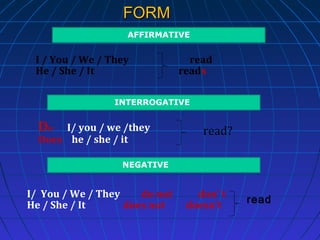
FORM
AFFIRMATIVE

I / You / We / They
He / She / It

read
reads

INTERROGATIVE

Do

I/ you / we /they
Does he / she / it

read?

NEGATIVE

I/ You / We / They
do not
He / She / It
does not

don’ t
doesn’t

read
USE
 We use the Present Simple Tense :
 To describe routines.
 To describe habits.
 To describe what we frequently do.
IN A SENTENCE
It is easy to recognize when we have to use the
present simple tense, we can find some of
these words :
 Every Adverbs of frequency (usually, often, never,
…)
 Expressions like “ on Mondays, in summer…”
Adverbs and Expressions of
Frequency and use present simple
 We often use the present simple with
adverbs of frequency (always, usually, often,
sometimes, rarely, seldom, hardly ever,
never). The go before the main verb, but
after ‘to be’.
• They often go out.
• I’m always late.
 Expressions of frequency (every day, once a
month, three times a year) usually go at the
end of the sentence
• I have English classed twice a week.
 To describe repeated actions or habits
• I get up at seven every morning.

 To talk about things that are always or generally true
• Water boils at 100o C.

 To describe a permanent situation or a condition with
no definite start or finish but which is true now
• We live in London.

 With adverbs of frequency such as always, usually, etc.
• She often studies in the library.

 With time expressions such as every day/ week/ year,
in the morning/ afternoon/ evening and at night
• I go to the gym once a week.

 To express future meaning with actions and events
that are part of a fixed timetable or a schedule
• The train leaves at 8’30.
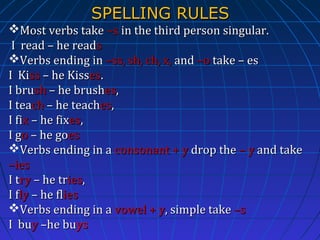
SPELLING RULES

Most verbs take –s in the third person singular.
I read – he reads
Verbs ending in –ss, sh, ch, x, and –o take – es
I Kiss – he Kisses.
I brush – he brushes,
I teach – he teaches,
I fix – he fixes,
I go – he goes
Verbs ending in a consonant + y drop the – y and take
–ies
I try – he tries,
I fly – he flies
Verbs ending in a vowel + y, simple take –s
I buy –he buys
PRESENT PERFECT
SIMPLE
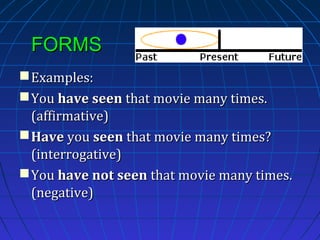
FORMS
 Examples:
 You have seen that movie many times.
(affirmative)
 Have you seen that movie many times?
(interrogative)
 You have not seen that movie many times.
(negative)
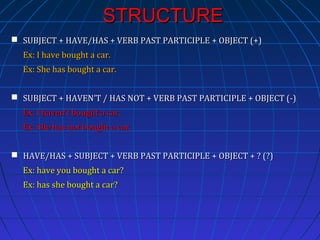
STRUCTURE
 SUBJECT + HAVE/HAS + VERB PAST PARTICIPLE + OBJECT (+)
Ex: I have bought a car.
Ex: She has bought a car.
 SUBJECT + HAVEN’T / HAS NOT + VERB PAST PARTICIPLE + OBJECT (-)
Ex: I haven’t bought a car.
Ex: She has not bought a car.
 HAVE/HAS + SUBJECT + VERB PAST PARTICIPLE + OBJECT + ? (?)
Ex: have you bought a car?
Ex: has she bought a car?
TIME EXPRESSIONS
 You CANNOT use the Present Perfect with specific
time expressions such as: yesterday, one year
ago, last week, when I was a child, when I lived in,
at that moment, that day, one day, etc.
 We CAN use the Present Perfect with unspecific
expressions such as: ever, never, once, many
times, several times, before, so far, already, yet,
etc.
USES:
 ACTIONS THAT STARTED IN THE PAST AND ARE
STILL CONTINUING.
 ACTIONS WHICH HAPPENED AT SOME
UNKNOWN TIME IN THE PAST (EXPERIENCE).
 ACTIONS WHICH HAPPENED IN THE PAST, BUT
HAVE AN EFFECT IN THE PRESENT.
 RECENT PAST.
ACTIONS THAT STARTED IN THE PAST
AND ARE STILL CONTINUING.
 When speaking about something that started in
the past and has continued up until now, we use
words such us FOR and SINCE.
 For: with a length of time.
 Ex: I’ve lived here for five years.
 Since: with a starting time.
 Ex: I’ve been a teacher since 2007.
ACTIONS WHICH HAPPENED AT
SOME UNKNOWN TIME IN THE PAST
(EXPERIENCE)
 You can use the Present Perfect to describe your experience. It is
like saying, "I have the experience of..." You can also use this
tense to say that you have never had a certain experience.
 Ex: Joan has studied two foreign languages
 Ever & Never.
 Examples:
 He has never travelled by train.
 A: Have you ever met him?.
B: No, I have not met him.
ACTIONS WHICH HAPPENED IN THE
PAST, BUT HAVE AN EFFECT IN THE
PRESENT.
 The action happened at some time in the past, but
the effect of the action is still important now.
 Examples:
 I’ve lost my keys. (still missing)
 I’ve cut my finger –and now it’s bleeding- (still
injured)
RECENT PAST
 Recently completed actions.
 Key words: just, already and yet.
 Examples:
 He has JUST played football (it is over now).
 Have you finished yet?
 I’ve already written the report (here it is)
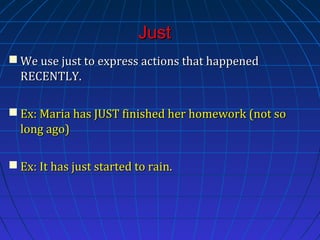
Just
 We use just to express actions that happened
RECENTLY.
 Ex: Maria has JUST finished her homework (not so
long ago)
 Ex: It has just started to rain.
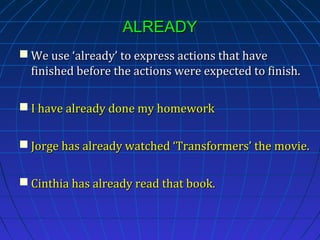
ALREADY
 We use ‘already’ to express actions that have
finished before the actions were expected to finish.
 I have already done my homework
 Jorge has already watched ‘Transformers’ the movie.
 Cinthia has already read that book.
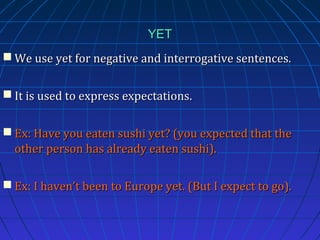
YET
 We use yet for negative and interrogative sentences.
 It is used to express expectations.
 Ex: Have you eaten sushi yet? (you expected that the
other person has already eaten sushi).
 Ex: I haven’t been to Europe yet. (But I expect to go).
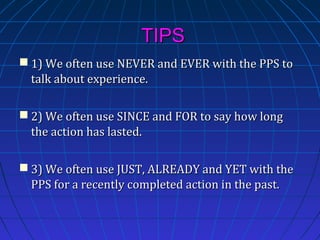
TIPS
 1) We often use NEVER and EVER with the PPS to
talk about experience.
 2) We often use SINCE and FOR to say how long
the action has lasted.
 3) We often use JUST, ALREADY and YET with the
PPS for a recently completed action in the past.
PRESENT
CONTINUOUS
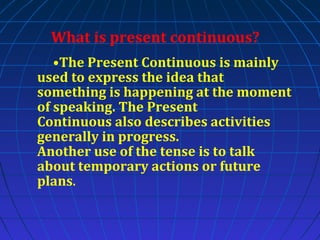
What is present continuous?
•The Present Continuous is mainly
used to express the idea that
something is happening at the moment
of speaking. The Present
Continuous also describes activities
generally in progress.
Another use of the tense is to talk
about temporary actions or future
plans.
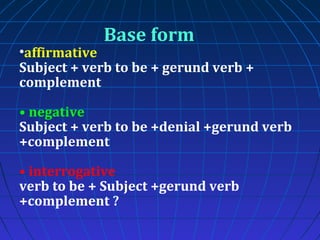
Base form

•affirmative
Subject + verb to be + gerund verb +
complement
• negative
Subject + verb to be +denial +gerund verb
+complement
• interrogative
verb to be + Subject +gerund verb
+complement ?
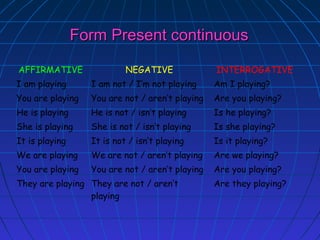
Form Present continuous
AFFIRMATIVE

NEGATIVE

INTERROGATIVE

I am playing

I am not / I’m not playing

Am I playing?

You are playing

You are not / aren’t playing

Are you playing?

He is playing

He is not / isn’t playing

Is he playing?

She is playing

She is not / isn’t playing

Is she playing?

It is playing

It is not / isn’t playing

Is it playing?

We are playing

We are not / aren’t playing

Are we playing?

You are playing

You are not / aren’t playing

Are you playing?

They are playing They are not / aren’t
playing

Are they playing?
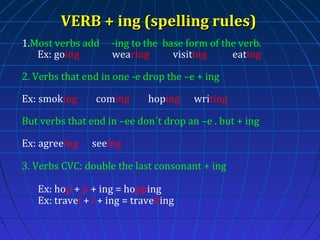
VERB + ing (spelling rules)
1.Most verbs add
Ex: going

-ing to the base form of the verb.
wearing
visiting
eating

2. Verbs that end in one -e drop the –e + ing
Ex: smoking

coming

hoping

writing

But verbs that end in –ee don´t drop an –e . but + ing
Ex: agreeing

seeing

3. Verbs CVC: double the last consonant + ing
Ex: hop + p + ing = hopping
Ex: travel + l + ing = travelling
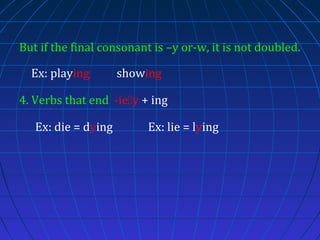
But if the final consonant is –y or-w, it is not doubled.
Ex: playing

showing

4. Verbs that end -iey + ing
Ex: die = dying

Ex: lie = lying
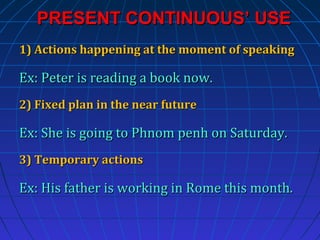
PRESENT CONTINUOUS’ USE
1) Actions happening at the moment of speaking

Ex: Peter is reading a book now.
2) Fixed plan in the near future

Ex: She is going to Phnom penh on Saturday.
3) Temporary actions

Ex: His father is working in Rome this month.
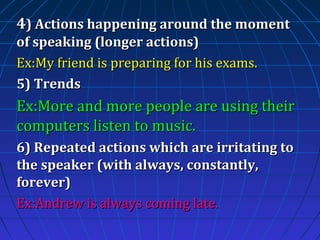
4) Actions happening around the moment
of speaking (longer actions)
Ex:My friend is preparing for his exams.
5) Trends

Ex:More and more people are using their
computers listen to music.
6) Repeated actions which are irritating to
the speaker (with always, constantly,
forever)
Ex:Andrew is always coming late.
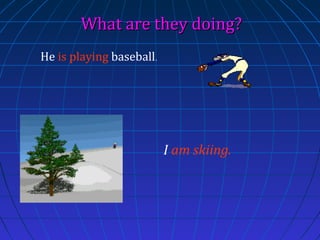
What are they doing?
He is playing baseball.

I am skiing.
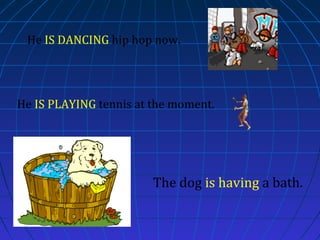
He IS DANCING hip hop now.

He IS PLAYING tennis at the moment.

The dog is having a bath.
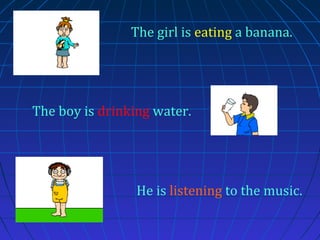
The girl is eating a banana.

The boy is drinking water.

He is listening to the music.
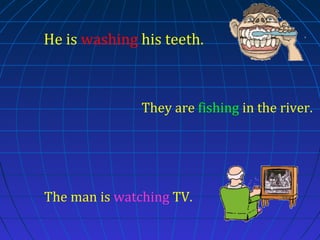
He is washing his teeth.

They are fishing in the river.

The man is watching TV.
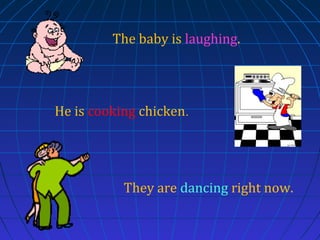
The baby is laughing.

He is cooking chicken.

They are dancing right now.
References
www.google.com
www.slideshare.net
Basic Grammar book. IDE
Question time?

The End

Verbtensespresentsimple 090314094456-phpapp02

  • 1.
    National Institute of Business Departmentof English Topic: Present Simple ,present perfect & Present continuous Lecturer: BUN CHEAMPHANG Group: 1 1.SOEM SAMEANG 2.KEN THEARITH 3.YIM SONY 4.UM KIMCHANRAKSMEY Ken Thearith B10
  • 2.
    Content 1.Present Simple 2.Present perfectSimple 3.Present Continuous
  • 3.
  • 4.
    FORM AFFIRMATIVE I / You/ We / They He / She / It read reads INTERROGATIVE Do I/ you / we /they Does he / she / it read? NEGATIVE I/ You / We / They do not He / She / It does not don’ t doesn’t read
  • 5.
    USE  We usethe Present Simple Tense :  To describe routines.  To describe habits.  To describe what we frequently do.
  • 6.
    IN A SENTENCE Itis easy to recognize when we have to use the present simple tense, we can find some of these words :  Every Adverbs of frequency (usually, often, never, …)  Expressions like “ on Mondays, in summer…”
  • 7.
    Adverbs and Expressionsof Frequency and use present simple  We often use the present simple with adverbs of frequency (always, usually, often, sometimes, rarely, seldom, hardly ever, never). The go before the main verb, but after ‘to be’. • They often go out. • I’m always late.  Expressions of frequency (every day, once a month, three times a year) usually go at the end of the sentence • I have English classed twice a week.
  • 8.
     To describerepeated actions or habits • I get up at seven every morning.  To talk about things that are always or generally true • Water boils at 100o C.  To describe a permanent situation or a condition with no definite start or finish but which is true now • We live in London.  With adverbs of frequency such as always, usually, etc. • She often studies in the library.  With time expressions such as every day/ week/ year, in the morning/ afternoon/ evening and at night • I go to the gym once a week.  To express future meaning with actions and events that are part of a fixed timetable or a schedule • The train leaves at 8’30.
  • 9.
    SPELLING RULES Most verbstake –s in the third person singular. I read – he reads Verbs ending in –ss, sh, ch, x, and –o take – es I Kiss – he Kisses. I brush – he brushes, I teach – he teaches, I fix – he fixes, I go – he goes Verbs ending in a consonant + y drop the – y and take –ies I try – he tries, I fly – he flies Verbs ending in a vowel + y, simple take –s I buy –he buys
  • 10.
  • 11.
    FORMS  Examples:  Youhave seen that movie many times. (affirmative)  Have you seen that movie many times? (interrogative)  You have not seen that movie many times. (negative)
  • 12.
    STRUCTURE  SUBJECT +HAVE/HAS + VERB PAST PARTICIPLE + OBJECT (+) Ex: I have bought a car. Ex: She has bought a car.  SUBJECT + HAVEN’T / HAS NOT + VERB PAST PARTICIPLE + OBJECT (-) Ex: I haven’t bought a car. Ex: She has not bought a car.  HAVE/HAS + SUBJECT + VERB PAST PARTICIPLE + OBJECT + ? (?) Ex: have you bought a car? Ex: has she bought a car?
  • 13.
    TIME EXPRESSIONS  YouCANNOT use the Present Perfect with specific time expressions such as: yesterday, one year ago, last week, when I was a child, when I lived in, at that moment, that day, one day, etc.  We CAN use the Present Perfect with unspecific expressions such as: ever, never, once, many times, several times, before, so far, already, yet, etc.
  • 14.
    USES:  ACTIONS THATSTARTED IN THE PAST AND ARE STILL CONTINUING.  ACTIONS WHICH HAPPENED AT SOME UNKNOWN TIME IN THE PAST (EXPERIENCE).  ACTIONS WHICH HAPPENED IN THE PAST, BUT HAVE AN EFFECT IN THE PRESENT.  RECENT PAST.
  • 15.
    ACTIONS THAT STARTEDIN THE PAST AND ARE STILL CONTINUING.  When speaking about something that started in the past and has continued up until now, we use words such us FOR and SINCE.  For: with a length of time.  Ex: I’ve lived here for five years.  Since: with a starting time.  Ex: I’ve been a teacher since 2007.
  • 16.
    ACTIONS WHICH HAPPENEDAT SOME UNKNOWN TIME IN THE PAST (EXPERIENCE)  You can use the Present Perfect to describe your experience. It is like saying, "I have the experience of..." You can also use this tense to say that you have never had a certain experience.  Ex: Joan has studied two foreign languages  Ever & Never.  Examples:  He has never travelled by train.  A: Have you ever met him?. B: No, I have not met him.
  • 17.
    ACTIONS WHICH HAPPENEDIN THE PAST, BUT HAVE AN EFFECT IN THE PRESENT.  The action happened at some time in the past, but the effect of the action is still important now.  Examples:  I’ve lost my keys. (still missing)  I’ve cut my finger –and now it’s bleeding- (still injured)
  • 18.
    RECENT PAST  Recentlycompleted actions.  Key words: just, already and yet.  Examples:  He has JUST played football (it is over now).  Have you finished yet?  I’ve already written the report (here it is)
  • 19.
    Just  We usejust to express actions that happened RECENTLY.  Ex: Maria has JUST finished her homework (not so long ago)  Ex: It has just started to rain.
  • 20.
    ALREADY  We use‘already’ to express actions that have finished before the actions were expected to finish.  I have already done my homework  Jorge has already watched ‘Transformers’ the movie.  Cinthia has already read that book.
  • 21.
    YET  We useyet for negative and interrogative sentences.  It is used to express expectations.  Ex: Have you eaten sushi yet? (you expected that the other person has already eaten sushi).  Ex: I haven’t been to Europe yet. (But I expect to go).
  • 22.
    TIPS  1) Weoften use NEVER and EVER with the PPS to talk about experience.  2) We often use SINCE and FOR to say how long the action has lasted.  3) We often use JUST, ALREADY and YET with the PPS for a recently completed action in the past.
  • 23.
  • 24.
    What is presentcontinuous? •The Present Continuous is mainly used to express the idea that something is happening at the moment of speaking. The Present Continuous also describes activities generally in progress. Another use of the tense is to talk about temporary actions or future plans.
  • 25.
    Base form •affirmative Subject +verb to be + gerund verb + complement • negative Subject + verb to be +denial +gerund verb +complement • interrogative verb to be + Subject +gerund verb +complement ?
  • 26.
    Form Present continuous AFFIRMATIVE NEGATIVE INTERROGATIVE Iam playing I am not / I’m not playing Am I playing? You are playing You are not / aren’t playing Are you playing? He is playing He is not / isn’t playing Is he playing? She is playing She is not / isn’t playing Is she playing? It is playing It is not / isn’t playing Is it playing? We are playing We are not / aren’t playing Are we playing? You are playing You are not / aren’t playing Are you playing? They are playing They are not / aren’t playing Are they playing?
  • 27.
    VERB + ing(spelling rules) 1.Most verbs add Ex: going -ing to the base form of the verb. wearing visiting eating 2. Verbs that end in one -e drop the –e + ing Ex: smoking coming hoping writing But verbs that end in –ee don´t drop an –e . but + ing Ex: agreeing seeing 3. Verbs CVC: double the last consonant + ing Ex: hop + p + ing = hopping Ex: travel + l + ing = travelling
  • 28.
    But if thefinal consonant is –y or-w, it is not doubled. Ex: playing showing 4. Verbs that end -iey + ing Ex: die = dying Ex: lie = lying
  • 29.
    PRESENT CONTINUOUS’ USE 1)Actions happening at the moment of speaking Ex: Peter is reading a book now. 2) Fixed plan in the near future Ex: She is going to Phnom penh on Saturday. 3) Temporary actions Ex: His father is working in Rome this month.
  • 30.
    4) Actions happeningaround the moment of speaking (longer actions) Ex:My friend is preparing for his exams. 5) Trends Ex:More and more people are using their computers listen to music. 6) Repeated actions which are irritating to the speaker (with always, constantly, forever) Ex:Andrew is always coming late.
  • 32.
    What are theydoing? He is playing baseball. I am skiing.
  • 33.
    He IS DANCINGhip hop now. He IS PLAYING tennis at the moment. The dog is having a bath.
  • 34.
    The girl iseating a banana. The boy is drinking water. He is listening to the music.
  • 35.
    He is washinghis teeth. They are fishing in the river. The man is watching TV.
  • 36.
    The baby islaughing. He is cooking chicken. They are dancing right now.
  • 37.
  • 38.