Page 1 of 12
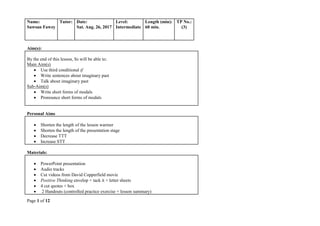
Name:
Sawsan Fawzy
Tutor: Date:
Sat. Aug. 26, 2017
Level:
Intermediate
Length (min):
60 min.
TP No.:
(3)
Aim(s):
By the end of this lesson, Ss will be able to:
Main Aim(s)
 Use third conditional if
 Write sentences about imaginary past
 Talk about imaginary past
Sub-Aim(s)
 Write short forms of modals
 Pronounce short forms of modals
Personal Aims
 Shorten the length of the lesson warmer
 Shorten the length of the presentation stage
 Decrease TTT
 Increase STT
Materials:
 PowerPoint presentation
 Audio tracks
 Cut videos from David Copperfield movie
 Positive Thinking envelop + tack it + letter sheets
 4 cut quotes + box
 2 Handouts (controlled practice exercise + lesson summary)
Page 2 of 12
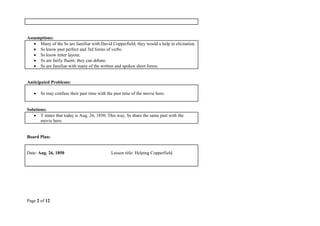
Assumptions:
 Many of the Ss are familiar with David Copperfield; they would a help in elicitation.
 Ss know past perfect and 3rd forms of verbs.
 Ss know letter layout.
 Ss are fairly fluent; they can debate.
 Ss are familiar with many of the written and spoken short forms.
Anticipated Problems:
 Ss may confuse their past time with the past time of the movie hero.
Solutions:
 T states that today is Aug. 26, 1850. This way, Ss share the same past with the
movie hero.
Board Plan:
Date: Aug. 26, 1850 Lesson title: Helping Copperfield
Page 3 of 12
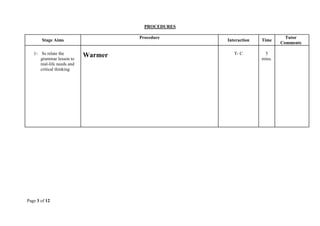
PROCEDURES
Stage Aims
Procedure
Interaction Time
Tutor
Comments
1- Ss relate the
grammar lesson to
real-life needs and
critical thinking
Warmer T- C 5
mins.
Page 4 of 12
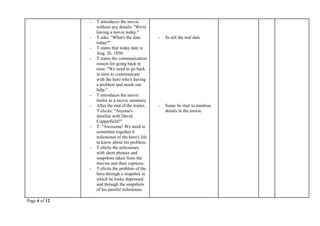
- T introduces the movie
without any details: "We're
having a movie today."
- T asks: "What's the date
today?"
- T states that today date is
Aug, 26, 1850.
- T states the communication
reason for going back in
time: "We need to go back
in time to communicate
with the hero who's having
a problem and needs our
help."
- T introduces the movie
trailer as a movie summary
- After the end of the trailer,
T elicits: "Anyone's
familiar with David
Copperfield?"
- T: "Awesome! We need to
remember together 6
milestones of the hero's life
to know about his problem.
- T elicits the milestones
with short phrases and
snapshots taken from the
movies and their captions.
- T elicits the problem of the
hero through a snapshot in
which he looks depressed
and through the snapshots
of his painful milestones.
- Ss tell the real date
- Some Ss start to mention
details in the movie.
Page 5 of 12
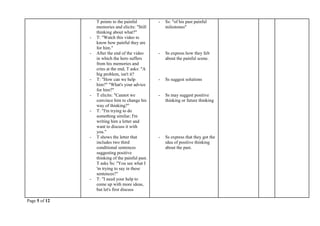
T points to the painful
memories and elicits: "Still
thinking about what?"
- T: "Watch this video to
know how painful they are
for him."
- After the end of the video
in which the hero suffers
from his memories and
cries at the end, T asks: "A
big problem, isn't it?
- T: "How can we help
him?" "What's your advice
for him?"
- T elicits: "Cannot we
convince him to change his
way of thinking?"
- T: "I'm trying to do
something similar; I'm
writing him a letter and
want to discuss it with
you."
- T shows the letter that
includes two third
conditional sentences
suggesting positive
thinking of the painful past.
T asks Ss: "You see what I
'm trying to say in these
sentences?"
- T: "I need your help to
come up with more ideas,
but let's first discuss
- Ss: "of his past painful
milestones"
- Ss express how they felt
about the painful scene.
- Ss suggest solutions
- Ss may suggest positive
thinking or future thinking
- Ss express that they got the
idea of positive thinking
about the past.
Page 6 of 12
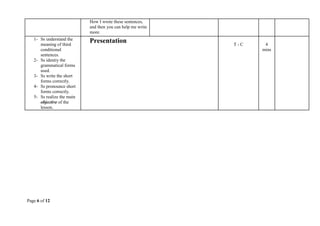
How I wrote these sentences,
and then you can help me write
more.
1- Ss understand the
meaning of third
conditional
sentences.
2- Ss identiy the
grammatical forms
used.
3- Ss write the short
forms correctly.
4- Ss pronounce short
forms correctly.
5- Ss realize the main
objective of the
lesson.
Presentation T - C 4
mins
Page 7 of 12
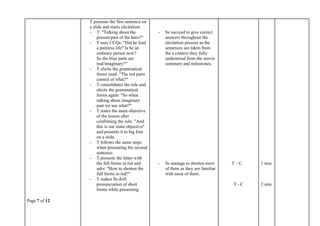
T presents the first sentence on
a slide and starts elicitation:
- T: "Talking about the
present/past of the hero?"
- T uses CCQs: "Did he lead
a painless life? Is he an
ordinary person now?
So the blue parts are
real/imaginary?"
- T elicits the grammatical
forms used: "The red parts
consist of what?"
- T consolidates the rule and
elicits the grammatical
forms again: "So when
talking about imaginary
past we use what?"
- T states the main objective
of the lesson after
confirming the rule: "And
this is our main objective"
and presents it in big font
on a slide.
- T follows the same steps
when presenting the second
sentence.
- T presents the letter with
the full forms in red and
asks: "How to shorten the
full forms in red?"
- T makes Ss drill
pronunciation of short
forms while presenting
- Ss succeed to give correct
answers throughout the
elicitation process as the
sentences are taken from
the a context they fully
understood from the movie
summary and milestones.
- Ss manage to shorten most
of them as they are familiar
with most of them.
T – C
T - C
1 min.
2 min.
Page 8 of 12
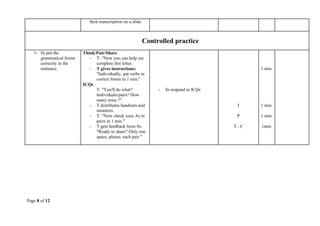
their transcription on a slide.
Controlled practice
1- Ss put the
grammatical forms
correctly in the
sentence.
Think/Pair/Share
- T: "Now you can help me
complete this letter.
- T gives instructions:
"Individually, put verbs in
correct forms in 1 min."
ICQs
T: "You'll do what?
Individuals/pairs? How
many mins.?"
- T distributes handouts and
monitors.
- T: "Now check your As in
pairs in 1 min."
- T gets feedback form Ss:
"Ready to share? Only one
space, please, each pair."
- Ss respond to ICQs
I
P
T - C
1 min.
1 min.
1 min.
1min.
Page 9 of 12
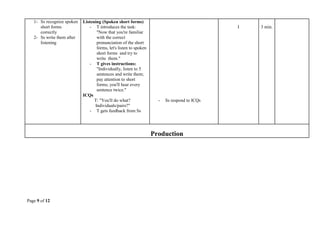
1- Ss recognize spoken
short forms
correctly
2- Ss write them after
listening
Listening (Spoken short forms)
- T introduces the task:
"Now that you're familiar
with the correct
pronunciation of the short
forms, let's listen to spoken
short forms and try to
write them."
- T gives instructions:
"Individually, listen to 5
sentences and write them;
pay attention to short
forms; you'll hear every
sentence twice."
ICQs
T: "You'll do what?
Individuals/pairs?"
- T gets feedback from Ss
- Ss respond to ICQs
I 3 min.
Production
Page 10 of 12
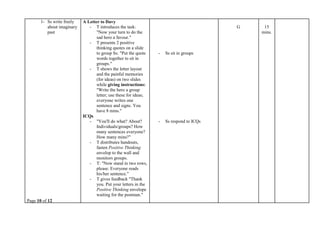
1- Ss write freely
about imaginary
past
A Letter to Davy
- T introduces the task:
"Now your turn to do the
sad hero a favour."
- T presents 2 positive
thinking quotes on a slide
to group Ss: "Put the quote
words together to sit in
groups."
- T shows the letter layout
and the painful memories
(for ideas) on two slides
while giving instructions:
"Write the hero a group
letter; use these for ideas;
everyone writes one
sentence and signs. You
have 8 mins."
ICQs
- "You'll do what? About?
Individuals/groups? How
many sentences everyone?
How many mins?"
- T distributes handouts,
fasten Positive Thinking
envelop to the wall and
monitors groups.
- T: "Now stand in two rows,
please. Everyone reads
his/her sentence."
- T gives feedback "Thank
you. Put your letters in the
Positive Thinking envelope
waiting for the postman."
- Ss sit in groups
- Ss respond to ICQs
G 15
mins.
Page 11 of 12
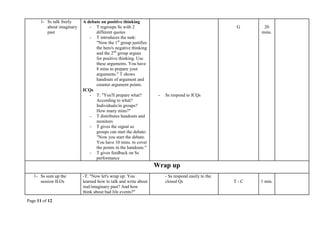
1- Ss talk freely
about imaginary
past
A debate on positive thinking
- T regroups Ss with 2
different quotes
- T introduces the task:
"Now the 1st
group justifies
the hero's negative thinking
and the 2nd
group argues
for positive thinking. Use
these arguments. You have
8 mins to prepare your
arguments." T shows
handouts of argument and
counter argument points.
ICQs
- T: "You'll prepare what?
According to what?
Individuals/in groups?
How many mins?"
- T distributes handouts and
monitors
- T gives the signal so
groups can start the debate:
"Now you start the debate.
You have 10 mins. to cover
the points in the handouts."
- T gives feedback on Ss
performance
- Ss respond to ICQs
G 20
mins.
Wrap up
1- Ss sum up the
session ILOs
-T: "Now let's wrap up: You
learned how to talk and write about
real/imaginary past? And how
think about bad life events?"
- Ss respond easily to the
closed Qs T - C 1 min.
Page 12 of 12

Official Detailed Lesson Plan

  • 1.
    Page 1 of12 Name: Sawsan Fawzy Tutor: Date: Sat. Aug. 26, 2017 Level: Intermediate Length (min): 60 min. TP No.: (3) Aim(s): By the end of this lesson, Ss will be able to: Main Aim(s)  Use third conditional if  Write sentences about imaginary past  Talk about imaginary past Sub-Aim(s)  Write short forms of modals  Pronounce short forms of modals Personal Aims  Shorten the length of the lesson warmer  Shorten the length of the presentation stage  Decrease TTT  Increase STT Materials:  PowerPoint presentation  Audio tracks  Cut videos from David Copperfield movie  Positive Thinking envelop + tack it + letter sheets  4 cut quotes + box  2 Handouts (controlled practice exercise + lesson summary)
  • 2.
    Page 2 of12 Assumptions:  Many of the Ss are familiar with David Copperfield; they would a help in elicitation.  Ss know past perfect and 3rd forms of verbs.  Ss know letter layout.  Ss are fairly fluent; they can debate.  Ss are familiar with many of the written and spoken short forms. Anticipated Problems:  Ss may confuse their past time with the past time of the movie hero. Solutions:  T states that today is Aug. 26, 1850. This way, Ss share the same past with the movie hero. Board Plan: Date: Aug. 26, 1850 Lesson title: Helping Copperfield
  • 3.
    Page 3 of12 PROCEDURES Stage Aims Procedure Interaction Time Tutor Comments 1- Ss relate the grammar lesson to real-life needs and critical thinking Warmer T- C 5 mins.
  • 4.
    Page 4 of12 - T introduces the movie without any details: "We're having a movie today." - T asks: "What's the date today?" - T states that today date is Aug, 26, 1850. - T states the communication reason for going back in time: "We need to go back in time to communicate with the hero who's having a problem and needs our help." - T introduces the movie trailer as a movie summary - After the end of the trailer, T elicits: "Anyone's familiar with David Copperfield?" - T: "Awesome! We need to remember together 6 milestones of the hero's life to know about his problem. - T elicits the milestones with short phrases and snapshots taken from the movies and their captions. - T elicits the problem of the hero through a snapshot in which he looks depressed and through the snapshots of his painful milestones. - Ss tell the real date - Some Ss start to mention details in the movie.
  • 5.
    Page 5 of12 T points to the painful memories and elicits: "Still thinking about what?" - T: "Watch this video to know how painful they are for him." - After the end of the video in which the hero suffers from his memories and cries at the end, T asks: "A big problem, isn't it? - T: "How can we help him?" "What's your advice for him?" - T elicits: "Cannot we convince him to change his way of thinking?" - T: "I'm trying to do something similar; I'm writing him a letter and want to discuss it with you." - T shows the letter that includes two third conditional sentences suggesting positive thinking of the painful past. T asks Ss: "You see what I 'm trying to say in these sentences?" - T: "I need your help to come up with more ideas, but let's first discuss - Ss: "of his past painful milestones" - Ss express how they felt about the painful scene. - Ss suggest solutions - Ss may suggest positive thinking or future thinking - Ss express that they got the idea of positive thinking about the past.
  • 6.
    Page 6 of12 How I wrote these sentences, and then you can help me write more. 1- Ss understand the meaning of third conditional sentences. 2- Ss identiy the grammatical forms used. 3- Ss write the short forms correctly. 4- Ss pronounce short forms correctly. 5- Ss realize the main objective of the lesson. Presentation T - C 4 mins
  • 7.
    Page 7 of12 T presents the first sentence on a slide and starts elicitation: - T: "Talking about the present/past of the hero?" - T uses CCQs: "Did he lead a painless life? Is he an ordinary person now? So the blue parts are real/imaginary?" - T elicits the grammatical forms used: "The red parts consist of what?" - T consolidates the rule and elicits the grammatical forms again: "So when talking about imaginary past we use what?" - T states the main objective of the lesson after confirming the rule: "And this is our main objective" and presents it in big font on a slide. - T follows the same steps when presenting the second sentence. - T presents the letter with the full forms in red and asks: "How to shorten the full forms in red?" - T makes Ss drill pronunciation of short forms while presenting - Ss succeed to give correct answers throughout the elicitation process as the sentences are taken from the a context they fully understood from the movie summary and milestones. - Ss manage to shorten most of them as they are familiar with most of them. T – C T - C 1 min. 2 min.
  • 8.
    Page 8 of12 their transcription on a slide. Controlled practice 1- Ss put the grammatical forms correctly in the sentence. Think/Pair/Share - T: "Now you can help me complete this letter. - T gives instructions: "Individually, put verbs in correct forms in 1 min." ICQs T: "You'll do what? Individuals/pairs? How many mins.?" - T distributes handouts and monitors. - T: "Now check your As in pairs in 1 min." - T gets feedback form Ss: "Ready to share? Only one space, please, each pair." - Ss respond to ICQs I P T - C 1 min. 1 min. 1 min. 1min.
  • 9.
    Page 9 of12 1- Ss recognize spoken short forms correctly 2- Ss write them after listening Listening (Spoken short forms) - T introduces the task: "Now that you're familiar with the correct pronunciation of the short forms, let's listen to spoken short forms and try to write them." - T gives instructions: "Individually, listen to 5 sentences and write them; pay attention to short forms; you'll hear every sentence twice." ICQs T: "You'll do what? Individuals/pairs?" - T gets feedback from Ss - Ss respond to ICQs I 3 min. Production
  • 10.
    Page 10 of12 1- Ss write freely about imaginary past A Letter to Davy - T introduces the task: "Now your turn to do the sad hero a favour." - T presents 2 positive thinking quotes on a slide to group Ss: "Put the quote words together to sit in groups." - T shows the letter layout and the painful memories (for ideas) on two slides while giving instructions: "Write the hero a group letter; use these for ideas; everyone writes one sentence and signs. You have 8 mins." ICQs - "You'll do what? About? Individuals/groups? How many sentences everyone? How many mins?" - T distributes handouts, fasten Positive Thinking envelop to the wall and monitors groups. - T: "Now stand in two rows, please. Everyone reads his/her sentence." - T gives feedback "Thank you. Put your letters in the Positive Thinking envelope waiting for the postman." - Ss sit in groups - Ss respond to ICQs G 15 mins.
  • 11.
    Page 11 of12 1- Ss talk freely about imaginary past A debate on positive thinking - T regroups Ss with 2 different quotes - T introduces the task: "Now the 1st group justifies the hero's negative thinking and the 2nd group argues for positive thinking. Use these arguments. You have 8 mins to prepare your arguments." T shows handouts of argument and counter argument points. ICQs - T: "You'll prepare what? According to what? Individuals/in groups? How many mins?" - T distributes handouts and monitors - T gives the signal so groups can start the debate: "Now you start the debate. You have 10 mins. to cover the points in the handouts." - T gives feedback on Ss performance - Ss respond to ICQs G 20 mins. Wrap up 1- Ss sum up the session ILOs -T: "Now let's wrap up: You learned how to talk and write about real/imaginary past? And how think about bad life events?" - Ss respond easily to the closed Qs T - C 1 min.
  • 12.