UNIT 3 AND 4: PRESENT TENSES
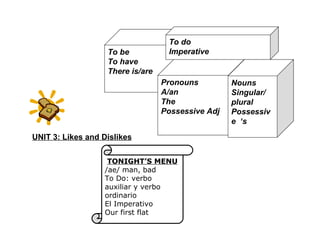
To be To have There is/are Pronouns A/an The Possessive Adj To do Imperative Nouns Singular/ plural Possessive  ‘s UNIT 3: Likes and Dislikes TONIGHT’S MENU /ae/ man, bad To Do: verbo auxiliar y verbo ordinario El Imperativo Our first flat
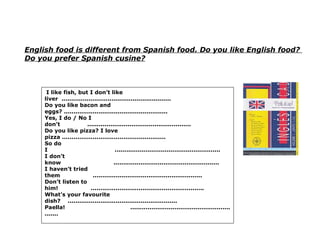
English food is different from Spanish food. Do you like English food?  Do you prefer Spanish cusine? I like fish, but I don’t like liver  ......................................................... Do you like bacon and eggs? ...................................................... Yes, I do / No I don’t  ...................................................... Do you like pizza? I love pizza ...................................................... So do I  ....................................................... I don’t know  ....................................................... I haven’t tried them  ......................................................... Don’t listen to him!  ........................................................... What’s your favourite dish?  ......................................................... Paella!  ...........................................................
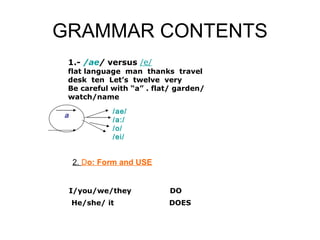
GRAMMAR CONTENTS a /ae/ /a:/ /o/ /ei/ 1.-  /ae /  versus  /e/ flat language  man  thanks  travel desk  ten  Let’s  twelve  very Be careful with “a” . flat/ garden/ watch/name 2.  D o: Form and USE I/you/we/they  DO He/she/ it  DOES
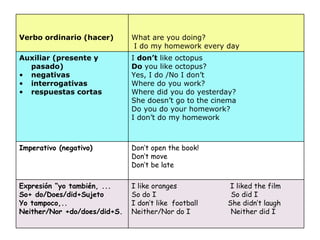
I like oranges  I liked the film So do I  So did I I don’t like  football  She didn’t laugh Neither/Nor do I  Neither did I Expresión “yo también, ...  So+ do/Does/did+Sujeto Yo tampoco,.. Neither/Nor +do/does/did+S. Don’t open the book! Don’t move Don’t be late Imperativo (negativo) I  don’t  like octopus Do  you like octopus? Yes, I do /No I don’t Where do you work? Where did you do yesterday? She doesn’t go to the cinema Do you do your homework? I don’t do my homework Auxiliar (presente y pasado) negativas interrogativas respuestas cortas What are you doing? I do my homework every day Verbo ordinario (hacer)
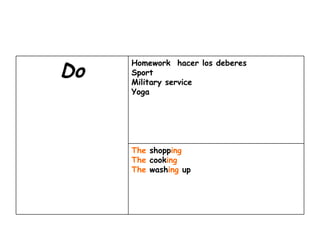
The  shopp ing The  cook ing The  wash ing  up Homework  hacer los deberes Sport Military service Yoga Do
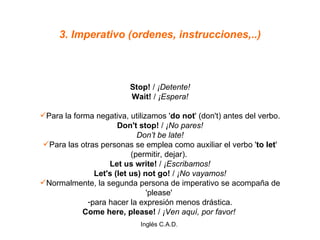
3. Imperativo (ordenes, instrucciones,..) Stop!  /  ¡Detente! Wait!  /  ¡Espera! Para la forma negativa, utilizamos ' do not ' (don't) antes del verbo. Don't stop!  /  ¡No pares! Don’t be late! Para las otras personas se emplea como auxiliar el verbo ' to let ' (permitir, dejar).  Let us write!  /  ¡Escribamos! Let's (let us) not go!  /  ¡No vayamos! Normalmente, la segunda persona de imperativo se acompaña de 'please'  para hacer la expresión menos drástica. Come here, please!  /  ¡Ven aquí, por favor! 
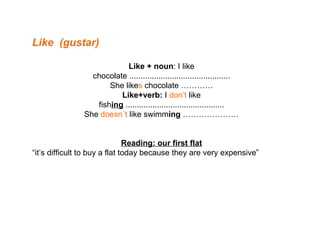
Like  (gustar) Like + noun : I like chocolate ............................................. She like s  chocolate ………… Like+verb:  I  don’t  like fish ing  ............................................ She  doesn´t  like swimm ing  ………………… Reading: our first flat “ it’s difficult to buy a flat today because they are very expensive”
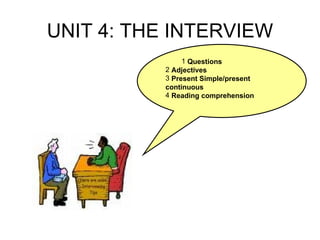
UNIT 4: THE INTERVIEW Questions Adjectives Present Simple/present continuous Reading comprehension
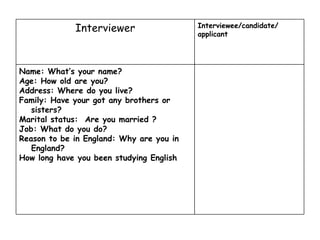
Name: What’s your name? Age: How old are you?  Address: Where do you live? Family: Have your got any brothers or sisters? Marital status:  Are you married ? Job: What do you do? Reason to be in England: Why are you in England? How long have you been studying English Interviewee/candidate/ applicant Interviewer
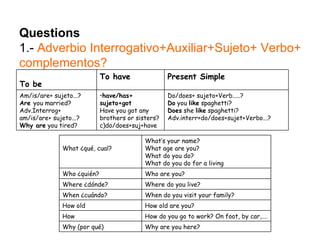
Questions 1.-  Adverbio Interrogativo+Auxiliar+Sujeto+ Verbo+ complementos? Do/does+ sujeto+Verb.....? Do  you  like  spaghetti? Does  she  like  spaghetti? Adv.interr+do/does+sujet+Verbo...? have/has+ sujeto+got Have you got any brothers or sisters? do/does+suj+have Am/is/are+ sujeto...? Are  you married? Adv.Interrog+ am/is/are+ sujeto...? Why are  you tired? Present Simple To have To be Why are you here? Why (por qué) How do you go to work? On foot, by car,…. How How old are you? How old When do you visit your family? When ¿cuándo? Where do you live? Where ¿dónde? Who are you? Who ¿quién? What’s your name? What age are you? What do you do? What do you do for a living What ¿qué, cual?
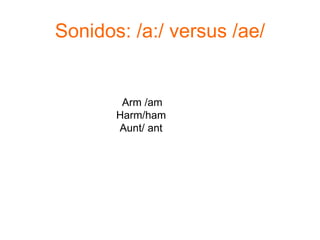
Sonidos: /a:/ versus /ae/ Arm /am Harm/ham Aunt/ ant
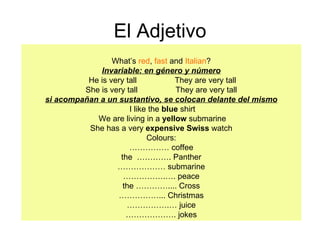
El Adjetivo What’s  red ,  fast  and  Italian ? Invariable: en género y número He is very tall  They are very tall She is very tall  They are very tall si acompañan a un sustantivo, se colocan delante del mismo I like the  blue  shirt We are living in a  yellow  submarine She has a very  expensive Swiss  watch Colours: ……………  coffee the  …………. Panther ………………  submarine …………… .…. peace the ………….... Cross …………… ... Christmas …………… .… juice ……………… . jokes
 
Reading: Australia Cares for the environment
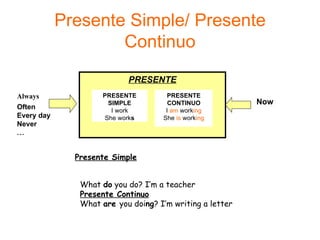
Presente Simple/ Presente Continuo PRESENTE PRESENTE SIMPLE I work She work s PRESENTE CONTINUO I  am  work ing She  is  work ing Always Often Every day Never ... Now Presente Simple   What  do  you do? I’m a teacher   Presente Continuo What  are  you doi ng ? I’m writing a letter
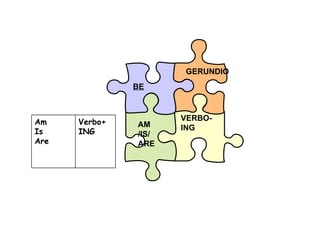
BE AM /IS/ ARE GERUNDIO VERBO-ING Verbo+ ING Am Is Are
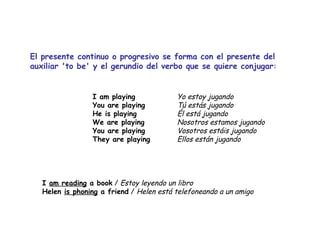
El presente continuo o progresivo se forma con el presente del auxiliar 'to be' y el gerundio del verbo que se quiere conjugar : I  am reading  a book  /  Estoy leyendo un libro Helen  is phoning  a friend  /  Helen está telefoneando a un amigo   Yo estoy jugando Tú estás jugando Él está jugando Nosotros estamos jugando Vosotros estáis jugando Ellos están jugando I am playing You are playing He is playing We are playing You are playing They are playing  
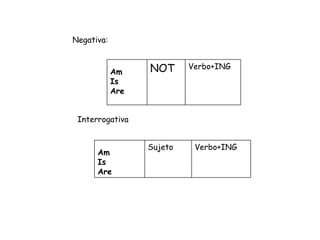
Negativa:  Interrogativa Verbo+ING NOT Am Is Are Verbo+ING  Sujeto Am Is Are
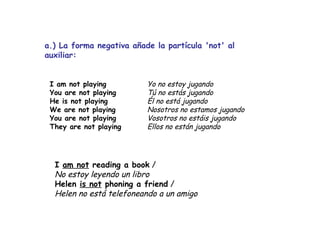
a.) La forma negativa añade la partícula 'not' al auxiliar: I  am not  reading a book  /  No estoy leyendo un libro Helen  is not  phoning a friend  /  Helen no está telefoneando a un amigo   Yo no estoy jugando Tú no estás jugando Él no está jugando Nosotros no estamos jugando Vosotros no estáis jugando Ellos no están jugando I am not playing You are not playing He is not playing We are not playing You are not playing They are not playing  
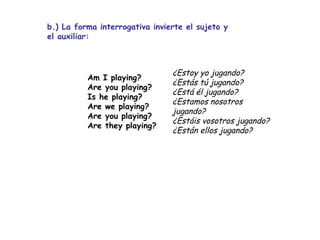
b.) La forma interrogativa invierte el sujeto y el auxiliar: ¿Estoy yo jugando? ¿Estás tú jugando? ¿Está él jugando? ¿Estamos nosotros jugando?  ¿Estáis vosotros jugando? ¿Están ellos jugando? Am I playing? Are you playing? Is he playing? Are we playing? Are you playing? Are they playing?  
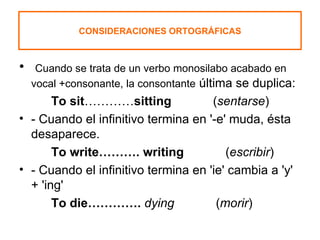
Cuando se trata de un verbo monosilabo acabado en vocal +consonante, la consontante  última se duplica: To sit ………… sitting             ( sentarse ) - Cuando el infinitivo termina en '-e' muda, ésta desaparece. To write……….   writing             ( escribir ) - Cuando el infinitivo termina en 'ie' cambia a 'y' + 'ing' To die………….   dying             ( morir ) CONSIDERACIONES ORTOGRÁFICAS
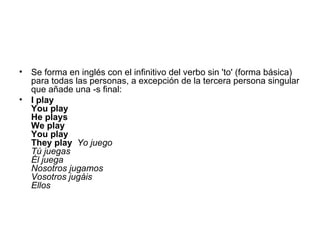
Se forma en inglés con el infinitivo del verbo sin 'to' (forma básica) para todas las personas, a excepción de la tercera persona singular que añade una -s final: I play You play He plays We play You play They play   Yo juego Tú juegas Él juega Nosotros jugamos Vosotros jugáis Ellos
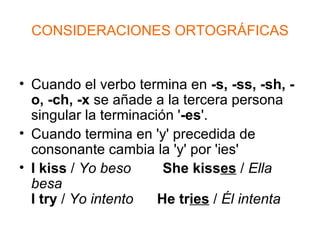
CONSIDERACIONES ORTOGRÁFICAS Cuando el verbo termina en  -s, -ss, -sh, -o, -ch, -x  se añade a la tercera persona singular la terminación ' -es '.  Cuando termina en 'y' precedida de consonante cambia la 'y' por 'ies' I kiss  /  Yo beso          She kiss es  /  Ella besa I try  /  Yo intento        He tr ies  /  Él intenta
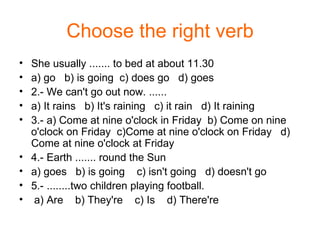
Choose the right verb She usually ....... to bed at about 11.30 a) go  b) is going  c) does go  d) goes 2.- We can't go out now. ...... a) It rains  b) It's raining  c) it rain  d) It raining 3.- a) Come at nine o'clock in Friday  b) Come on nine o'clock on Friday  c)Come at nine o'clock on Friday  d) Come at nine o'clock at Friday 4.- Earth ....... round the Sun a) goes  b) is going  c) isn't going  d) doesn't go 5.- ........two children playing football. a) Are  b) They're  c) Is  d) There're
 

Unit 3

  • 1.
    UNIT 3 AND4: PRESENT TENSES
  • 2.
    To be Tohave There is/are Pronouns A/an The Possessive Adj To do Imperative Nouns Singular/ plural Possessive ‘s UNIT 3: Likes and Dislikes TONIGHT’S MENU /ae/ man, bad To Do: verbo auxiliar y verbo ordinario El Imperativo Our first flat
  • 3.
    English food isdifferent from Spanish food. Do you like English food? Do you prefer Spanish cusine? I like fish, but I don’t like liver ......................................................... Do you like bacon and eggs? ...................................................... Yes, I do / No I don’t ...................................................... Do you like pizza? I love pizza ...................................................... So do I ....................................................... I don’t know ....................................................... I haven’t tried them ......................................................... Don’t listen to him! ........................................................... What’s your favourite dish? ......................................................... Paella! ...........................................................
  • 4.
    GRAMMAR CONTENTS a/ae/ /a:/ /o/ /ei/ 1.- /ae / versus /e/ flat language man thanks travel desk ten Let’s twelve very Be careful with “a” . flat/ garden/ watch/name 2. D o: Form and USE I/you/we/they DO He/she/ it DOES
  • 5.
    I like oranges I liked the film So do I So did I I don’t like football She didn’t laugh Neither/Nor do I Neither did I Expresión “yo también, ... So+ do/Does/did+Sujeto Yo tampoco,.. Neither/Nor +do/does/did+S. Don’t open the book! Don’t move Don’t be late Imperativo (negativo) I don’t like octopus Do you like octopus? Yes, I do /No I don’t Where do you work? Where did you do yesterday? She doesn’t go to the cinema Do you do your homework? I don’t do my homework Auxiliar (presente y pasado) negativas interrogativas respuestas cortas What are you doing? I do my homework every day Verbo ordinario (hacer)
  • 6.
    The shopping The cook ing The wash ing up Homework hacer los deberes Sport Military service Yoga Do
  • 7.
    3. Imperativo (ordenes,instrucciones,..) Stop! / ¡Detente! Wait! / ¡Espera! Para la forma negativa, utilizamos ' do not ' (don't) antes del verbo. Don't stop! / ¡No pares! Don’t be late! Para las otras personas se emplea como auxiliar el verbo ' to let ' (permitir, dejar).  Let us write! / ¡Escribamos! Let's (let us) not go! / ¡No vayamos! Normalmente, la segunda persona de imperativo se acompaña de 'please' para hacer la expresión menos drástica. Come here, please! / ¡Ven aquí, por favor! 
  • 8.
    Like (gustar)Like + noun : I like chocolate ............................................. She like s chocolate ………… Like+verb: I don’t like fish ing ............................................ She doesn´t like swimm ing ………………… Reading: our first flat “ it’s difficult to buy a flat today because they are very expensive”
  • 9.
    UNIT 4: THEINTERVIEW Questions Adjectives Present Simple/present continuous Reading comprehension
  • 10.
    Name: What’s yourname? Age: How old are you? Address: Where do you live? Family: Have your got any brothers or sisters? Marital status: Are you married ? Job: What do you do? Reason to be in England: Why are you in England? How long have you been studying English Interviewee/candidate/ applicant Interviewer
  • 11.
    Questions 1.- Adverbio Interrogativo+Auxiliar+Sujeto+ Verbo+ complementos? Do/does+ sujeto+Verb.....? Do you like spaghetti? Does she like spaghetti? Adv.interr+do/does+sujet+Verbo...? have/has+ sujeto+got Have you got any brothers or sisters? do/does+suj+have Am/is/are+ sujeto...? Are you married? Adv.Interrog+ am/is/are+ sujeto...? Why are you tired? Present Simple To have To be Why are you here? Why (por qué) How do you go to work? On foot, by car,…. How How old are you? How old When do you visit your family? When ¿cuándo? Where do you live? Where ¿dónde? Who are you? Who ¿quién? What’s your name? What age are you? What do you do? What do you do for a living What ¿qué, cual?
  • 12.
    Sonidos: /a:/ versus/ae/ Arm /am Harm/ham Aunt/ ant
  • 13.
    El Adjetivo What’s red , fast and Italian ? Invariable: en género y número He is very tall They are very tall She is very tall They are very tall si acompañan a un sustantivo, se colocan delante del mismo I like the blue shirt We are living in a yellow submarine She has a very expensive Swiss watch Colours: …………… coffee the …………. Panther ……………… submarine …………… .…. peace the ………….... Cross …………… ... Christmas …………… .… juice ……………… . jokes
  • 14.
  • 15.
    Reading: Australia Caresfor the environment
  • 16.
    Presente Simple/ PresenteContinuo PRESENTE PRESENTE SIMPLE I work She work s PRESENTE CONTINUO I am work ing She is work ing Always Often Every day Never ... Now Presente Simple What do you do? I’m a teacher Presente Continuo What are you doi ng ? I’m writing a letter
  • 17.
    BE AM /IS/ARE GERUNDIO VERBO-ING Verbo+ ING Am Is Are
  • 18.
    El presente continuoo progresivo se forma con el presente del auxiliar 'to be' y el gerundio del verbo que se quiere conjugar : I am reading a book / Estoy leyendo un libro Helen is phoning a friend / Helen está telefoneando a un amigo Yo estoy jugando Tú estás jugando Él está jugando Nosotros estamos jugando Vosotros estáis jugando Ellos están jugando I am playing You are playing He is playing We are playing You are playing They are playing  
  • 19.
    Negativa: InterrogativaVerbo+ING NOT Am Is Are Verbo+ING Sujeto Am Is Are
  • 20.
    a.) La formanegativa añade la partícula 'not' al auxiliar: I am not reading a book / No estoy leyendo un libro Helen is not phoning a friend / Helen no está telefoneando a un amigo Yo no estoy jugando Tú no estás jugando Él no está jugando Nosotros no estamos jugando Vosotros no estáis jugando Ellos no están jugando I am not playing You are not playing He is not playing We are not playing You are not playing They are not playing  
  • 21.
    b.) La formainterrogativa invierte el sujeto y el auxiliar: ¿Estoy yo jugando? ¿Estás tú jugando? ¿Está él jugando? ¿Estamos nosotros jugando?  ¿Estáis vosotros jugando? ¿Están ellos jugando? Am I playing? Are you playing? Is he playing? Are we playing? Are you playing? Are they playing?  
  • 22.
    Cuando se tratade un verbo monosilabo acabado en vocal +consonante, la consontante última se duplica: To sit ………… sitting             ( sentarse ) - Cuando el infinitivo termina en '-e' muda, ésta desaparece. To write………. writing             ( escribir ) - Cuando el infinitivo termina en 'ie' cambia a 'y' + 'ing' To die…………. dying             ( morir ) CONSIDERACIONES ORTOGRÁFICAS
  • 23.
    Se forma eninglés con el infinitivo del verbo sin 'to' (forma básica) para todas las personas, a excepción de la tercera persona singular que añade una -s final: I play You play He plays We play You play They play   Yo juego Tú juegas Él juega Nosotros jugamos Vosotros jugáis Ellos
  • 24.
    CONSIDERACIONES ORTOGRÁFICAS Cuandoel verbo termina en -s, -ss, -sh, -o, -ch, -x se añade a la tercera persona singular la terminación ' -es '. Cuando termina en 'y' precedida de consonante cambia la 'y' por 'ies' I kiss / Yo beso         She kiss es / Ella besa I try / Yo intento       He tr ies / Él intenta
  • 25.
    Choose the rightverb She usually ....... to bed at about 11.30 a) go b) is going c) does go d) goes 2.- We can't go out now. ...... a) It rains b) It's raining c) it rain d) It raining 3.- a) Come at nine o'clock in Friday b) Come on nine o'clock on Friday c)Come at nine o'clock on Friday d) Come at nine o'clock at Friday 4.- Earth ....... round the Sun a) goes b) is going c) isn't going d) doesn't go 5.- ........two children playing football. a) Are b) They're c) Is d) There're
  • 26.