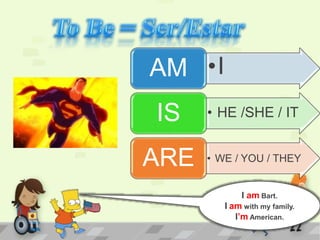
•IAM
• HE /SHE / ITIS
• WE / YOU / THEYARE
I am Bart.
I am with my family.
I’m American.
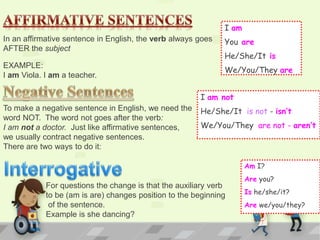
In an affirmative sentence in English, the verb always goes
AFTER the subject
EXAMPLE:
I am Viola. I am a teacher.
To make a negative sentence in English, we need the
word NOT. The word not goes after the verb:
I am not a doctor. Just like affirmative sentences,
we usually contract negative sentences.
There are two ways to do it:
I am
You are
He/She/It is
We/You/They are
I am not
He/She/It is not - isn’t
We/You/They are not - aren’t
For questions the change is that the auxiliary verb
to be (am is are) changes position to the beginning
of the sentence.
Example is she dancing?
Am I?
Are you?
Is he/she/it?
Are we/you/they?
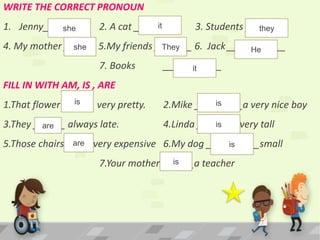
WRITE THE CORRECT PRONOUN
1. Jenny________ 2. A cat ________ 3. Students _______
4. My mother ______ 5.My friends _______ 6. Jack ___________
7. Books ___________
FILL IN WITH AM, IS , ARE
1.That flower ______ very pretty. 2.Mike _________a very nice boy
3.They ______ always late. 4.Linda ________very tall
5.Those chairs _____very expensive 6.My dog __________small
7.Your mother ______a teacher
she it they
she They He
it
is is
are is
are is
is
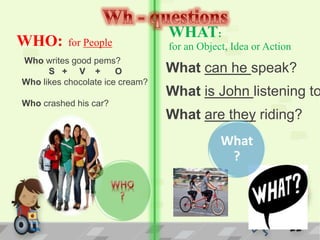
WHO: for People
Who writes good pems?
S + V + O
Who likes chocolate ice cream?
Who crashed his car?
WHAT:
for an Object, Idea or Action
What can he speak?
What is John listening to
What are they riding?
What
?
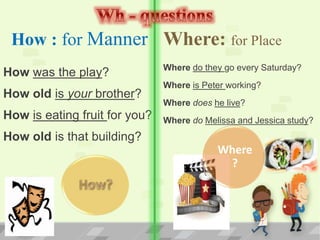
How : for Manner
How was the play?
How old is your brother?
How is eating fruit for you?
How old is that building?
Where: for Place
Where do they go every Saturday?
Where is Peter working?
Where does he live?
Where do Melissa and Jessica study?
Where
?
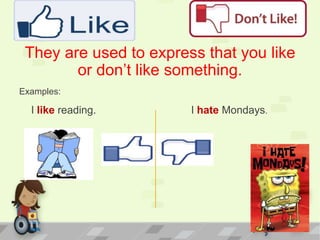
They are used to express that you like
or don’t like something.
Examples:
I like reading. I hate Mondays.
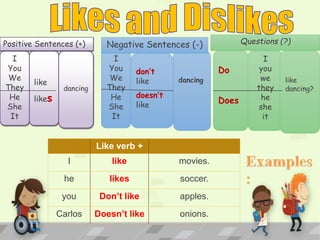
I
You
We
They
He
She
It
like
likes
dancing
I
You
We
They
He
She
It
don’t
like
doesn’t
like
dancing
Do
Does
I
you
we
they
he
she
it
like
dancing?
Positive Sentences (+) Negative Sentences (-) Questions (?)
Like verb +
I like movies.
he likes soccer.
you Don’t like apples.
Carlos Doesn’t like onions.
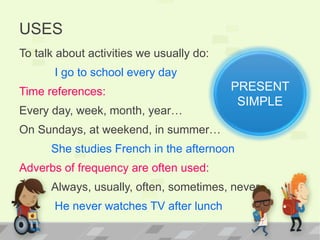
USES
To talk about activities we usually do:
I go to school every day
Time references:
Every day, week, month, year…
On Sundays, at weekend, in summer…
She studies French in the afternoon
Adverbs of frequency are often used:
Always, usually, often, sometimes, never…
He never watches TV after lunch
PRESENT
SIMPLE
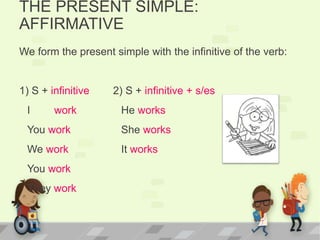
THE PRESENT SIMPLE:
AFFIRMATIVE
We form the present simple with the infinitive of the verb:
1) S + infinitive 2) S + infinitive + s/es
I work He works
You work She works
We work It works
You work
They work
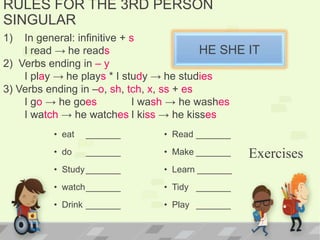
1) In general: infinitive + s
I read → he reads
2) Verbs ending in – y
I play → he plays * I study → he studies
3) Verbs ending in –o, sh, tch, x, ss + es
I go → he goes I wash → he washes
I watch → he watches I kiss → he kisses
RULES FOR THE 3RD PERSON
SINGULAR
HE SHE IT
Exercises
• eat _______
• do _______
• Study_______
• watch_______
• Drink _______
• Read _______
• Make _______
• Learn _______
• Tidy _______
• Play _______
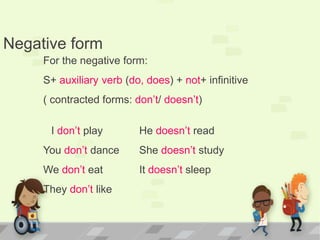
Negative form
For the negative form:
S+ auxiliary verb (do, does) + not+ infinitive
( contracted forms: don’t/ doesn’t)
I don’t play He doesn’t read
You don’t dance She doesn’t study
We don’t eat It doesn’t sleep
They don’t like
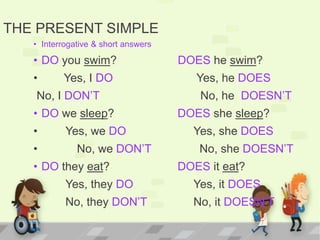
THE PRESENT SIMPLE
• Interrogative & short answers
• DO you swim? DOES he swim?
• Yes, I DO Yes, he DOES
No, I DON’T No, he DOESN’T
• DO we sleep? DOES she sleep?
• Yes, we DO Yes, she DOES
• No, we DON’T No, she DOESN’T
• DO they eat? DOES it eat?
• Yes, they DO Yes, it DOES
• No, they DON’T No, it DOESN’T
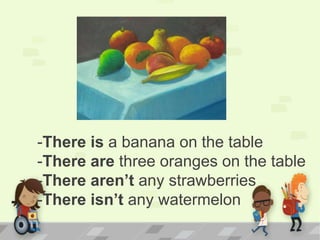
-There is a banana on the table
-There are three oranges on the table
-There aren’t any strawberries
-There isn’t any watermelon
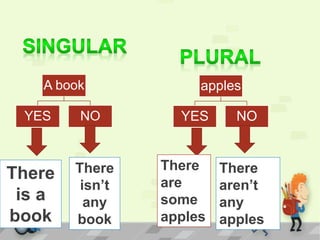
A book
YES NO
There
is a
book
There
isn’t
any
book
apples
YES NO
There
aren’t
any
apples
There
are
some
apples
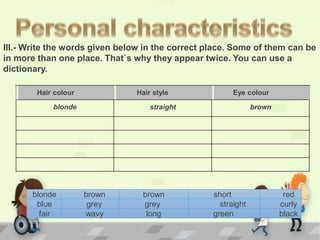
blonde brown brown short red
blue grey grey straight curly
fair wavy long green black
Hair colour Hair style Eye colour
blonde straight brown
III.- Write the words given below in the correct place. Some of them can be
in more than one place. That`s why they appear twice. You can use a
dictionary.
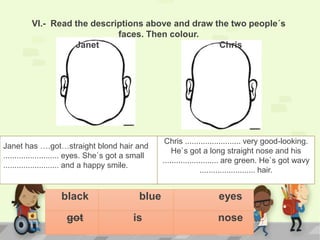
VI.- Read the descriptions above and draw the two people´s
faces. Then colour.
Janet Chris
Chris ......................... very good-looking.
He`s got a long straight nose and his
......................... are green. He`s got wavy
......................... hair.
Janet has ….got…straight blond hair and
......................... eyes. She`s got a small
......................... and a happy smile.
black blue eyes
got is nose
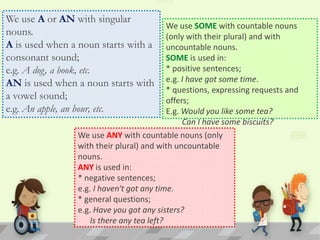
We use A or AN with singular
nouns.
A is used when a noun starts with a
consonant sound;
e.g. A dog, a book, etc.
AN is used when a noun starts with
a vowel sound;
e.g. An apple, an hour, etc.
We use SOME with countable nouns
(only with their plural) and with
uncountable nouns.
SOME is used in:
* positive sentences;
e.g. I have got some time.
* questions, expressing requests and
offers;
E.g. Would you like some tea?
Can I have some biscuits?
We use ANY with countable nouns (only
with their plural) and with uncountable
nouns.
ANY is used in:
* negative sentences;
e.g. I haven‘t got any time.
* general questions;
e.g. Have you got any sisters?
Is there any tea left?
.
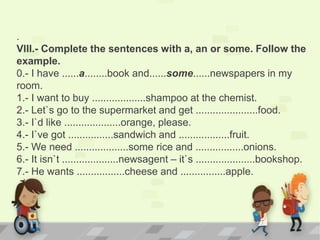
VIII.- Complete the sentences with a, an or some. Follow the
example.
0.- I have ......a........book and......some......newspapers in my
room.
1.- I want to buy ...................shampoo at the chemist.
2.- Let`s go to the supermarket and get ......................food.
3.- I`d like ....................orange, please.
4.- I`ve got ................sandwich and ..................fruit.
5.- We need ...................some rice and .................onions.
6.- It isn`t ....................newsagent – it`s .....................bookshop.
7.- He wants .................cheese and ................apple.
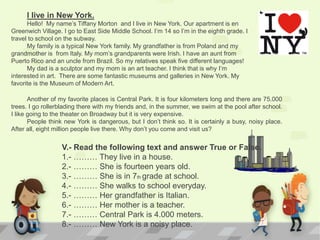
I live in New York.
Hello! My name’s Tiffany Morton and I live in New York. Our apartment is en
Greenwich Village. I go to East Side Middle School. I’m 14 so I’m in the eighth grade. I
travel to school on the subway.
My family is a typical New York family. My grandfather is from Poland and my
grandmother is from Italy. My mom’s grandparents were Irish. I have an aunt from
Puerto Rico and an uncle from Brazil. So my relatives speak five different languages!
My dad is a sculptor and my mom is an art teacher. I think that is why I’m
interested in art. There are some fantastic museums and galleries in New York. My
favorite is the Museum of Modern Art.
Another of my favorite places is Central Park. It is four kilometers long and there are 75.000
trees. I go rollerblading there with my friends and, in the summer, we swim at the pool after school.
I like going to the theater on Broadway but it is very expensive.
People think new York is dangerous, but I don’t think so. It is certainly a busy, noisy place.
After all, eight million people live there. Why don’t you come and visit us?
V.- Read the following text and answer True or False.
1.- ……… They live in a house.
2.- ……… She is fourteen years old.
3.- ……… She is in 7th grade at school.
4.- ……… She walks to school everyday.
5.- ……… Her grandfather is Italian.
6.- ……… Her mother is a teacher.
7.- ……… Central Park is 4.000 meters.
8.- ……… New York is a noisy place.
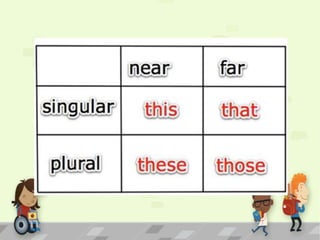
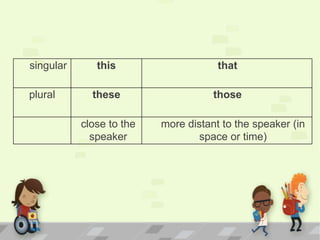
singular this that
plural these those
close to the
speaker
more distant to the speaker (in
space or time)
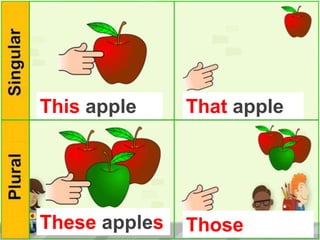
Those
This apple That apple
These apples
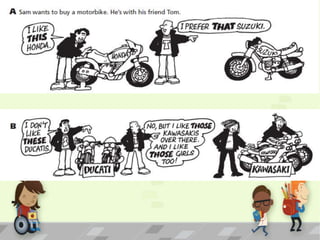
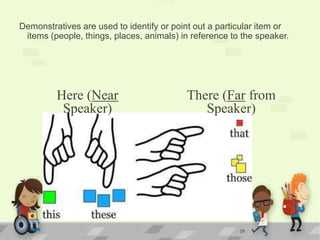
Demonstratives are used to identify or point out a particular item or
items (people, things, places, animals) in reference to the speaker.
There (Far from
Speaker)
Here (Near
Speaker)
28
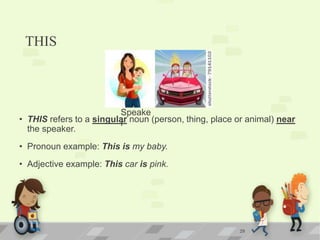
THIS
• THIS refers to a singular noun (person, thing, place or animal) near
the speaker.
• Pronoun example: This is my baby.
• Adjective example: This car is pink.
29
Speake
r
THAT
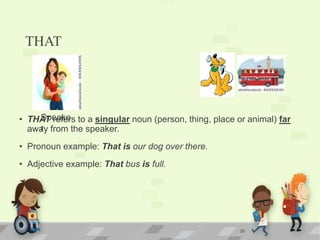
• THAT refers to a singular noun (person, thing, place or animal) far
away from the speaker.
• Pronoun example: That is our dog over there.
• Adjective example: That bus is full.
30
Speake
r
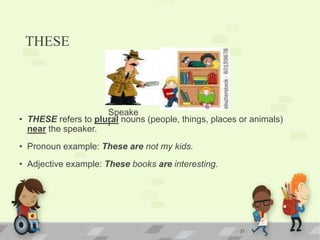
THESE
• THESE refers to plural nouns (people, things, places or animals)
near the speaker.
• Pronoun example: These are not my kids.
• Adjective example: These books are interesting.
31
Speake
r
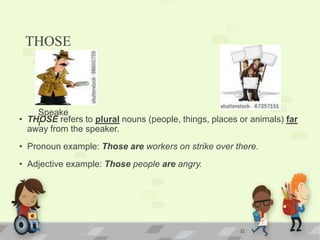
THOSE
• THOSE refers to plural nouns (people, things, places or animals) far
away from the speaker.
• Pronoun example: Those are workers on strike over there.
• Adjective example: Those people are angry.
32
Speake
r
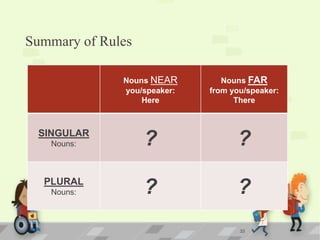
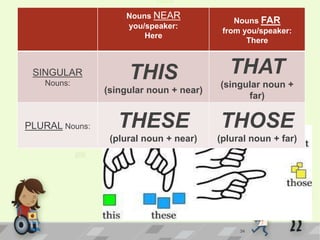
Summary of Rules
Nouns NEAR
you/speaker:
Here
Nouns FAR
from you/speaker:
There
SINGULAR
Nouns: ? ?
PLURAL
Nouns: ? ?
33
There (Far from
Speaker)
Here (Near
Speaker)
34
Nouns NEAR
you/speaker:
Here
Nouns FAR
from you/speaker:
There
SINGULAR
Nouns:
THIS
(singular noun + near)
THAT
(singular noun +
far)
PLURAL Nouns: THESE
(plural noun + near)
THOSE
(plural noun + far)
Ready for a Quiz?
Go!
35
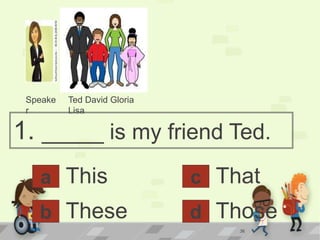
a
1. _____ is my friend Ted.
This
Theseb d
c That
Those
Ted David Gloria
Lisa
Speake
r
36
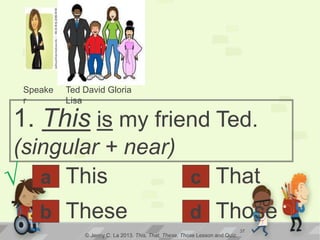
a
1. This is my friend Ted.
(singular + near)
This
© Jenny C. La 2013. This, That, These, Those Lesson and Quiz.
√
Theseb d
c That
Those
Speake
r
Ted David Gloria
Lisa
37
a
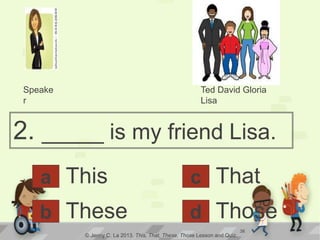
2. _____ is my friend Lisa.
This
© Jenny C. La 2013. This, That, These, Those Lesson and Quiz.
Theseb d
c That
Those
Ted David Gloria
Lisa
Speake
r
38
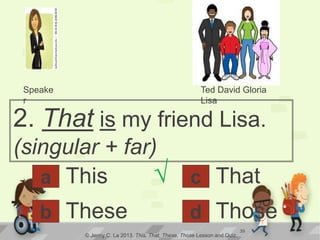
a
2. That is my friend Lisa.
(singular + far)
This
© Jenny C. La 2013. This, That, These, Those Lesson and Quiz.
√
Theseb d
c That
Those
39
Speake
r
Ted David Gloria
Lisa
a
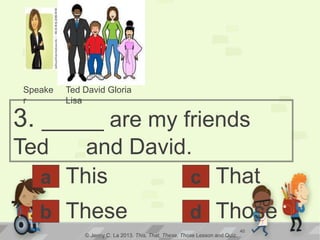
3. _____ are my friends
Ted and David.
This
© Jenny C. La 2013. This, That, These, Those Lesson and Quiz.
Theseb d
c That
Those
40
Speake
r
Ted David Gloria
Lisa
a
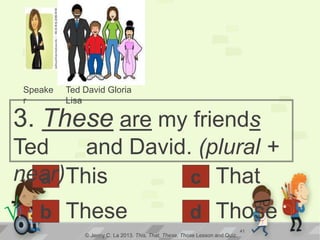
3. These are my friends
Ted and David. (plural +
near)This
© Jenny C. La 2013. This, That, These, Those Lesson and Quiz.
Theseb d
c That
Those√ 41
Speake
r
Ted David Gloria
Lisa
a
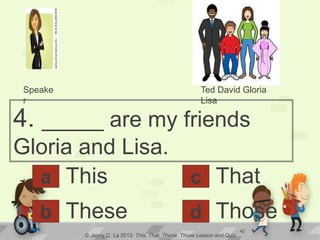
4. _____ are my friends
Gloria and Lisa.
This
© Jenny C. La 2013. This, That, These, Those Lesson and Quiz.
Theseb d
c That
Those
42
Speake
r
Ted David Gloria
Lisa
a
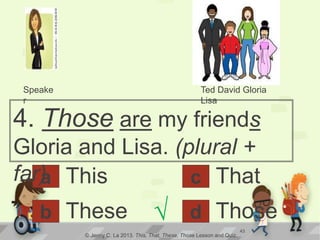
4. Those are my friends
Gloria and Lisa. (plural +
far) This
© Jenny C. La 2013. This, That, These, Those Lesson and Quiz.
Theseb d
c That
Those√ 43
Speake
r
Ted David Gloria
Lisa
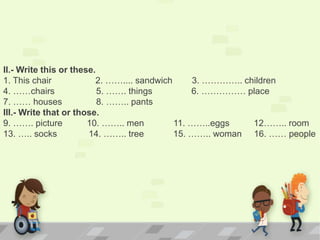
II.- Write this or these.
1. This chair 2. …….... sandwich 3. ………….. children
4. ……chairs 5. ……. things 6. …………… place
7. …… houses 8. …….. pants
III.- Write that or those.
9. ……. picture 10. …….. men 11. ……..eggs 12…….. room
13. ….. socks 14. …….. tree 15. …….. woman 16. …… people
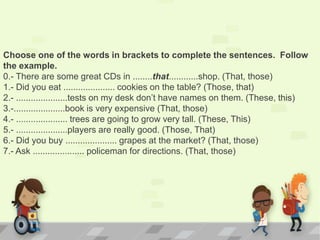
Choose one of the words in brackets to complete the sentences. Follow
the example.
0.- There are some great CDs in ........that............shop. (That, those)
1.- Did you eat ..................... cookies on the table? (Those, that)
2.- .....................tests on my desk don’t have names on them. (These, this)
3.-.....................book is very expensive (That, those)
4.- ..................... trees are going to grow very tall. (These, This)
5.- .....................players are really good. (Those, That)
6.- Did you buy ..................... grapes at the market? (That, those)
7.- Ask ..................... policeman for directions. (That, those)

5 básico

  • 2.
    •IAM • HE /SHE/ ITIS • WE / YOU / THEYARE I am Bart. I am with my family. I’m American.
  • 3.
    In an affirmativesentence in English, the verb always goes AFTER the subject EXAMPLE: I am Viola. I am a teacher. To make a negative sentence in English, we need the word NOT. The word not goes after the verb: I am not a doctor. Just like affirmative sentences, we usually contract negative sentences. There are two ways to do it: I am You are He/She/It is We/You/They are I am not He/She/It is not - isn’t We/You/They are not - aren’t For questions the change is that the auxiliary verb to be (am is are) changes position to the beginning of the sentence. Example is she dancing? Am I? Are you? Is he/she/it? Are we/you/they?
  • 4.
    WRITE THE CORRECTPRONOUN 1. Jenny________ 2. A cat ________ 3. Students _______ 4. My mother ______ 5.My friends _______ 6. Jack ___________ 7. Books ___________ FILL IN WITH AM, IS , ARE 1.That flower ______ very pretty. 2.Mike _________a very nice boy 3.They ______ always late. 4.Linda ________very tall 5.Those chairs _____very expensive 6.My dog __________small 7.Your mother ______a teacher she it they she They He it is is are is are is is
  • 5.
    WHO: for People Whowrites good pems? S + V + O Who likes chocolate ice cream? Who crashed his car? WHAT: for an Object, Idea or Action What can he speak? What is John listening to What are they riding? What ?
  • 6.
    How : forManner How was the play? How old is your brother? How is eating fruit for you? How old is that building? Where: for Place Where do they go every Saturday? Where is Peter working? Where does he live? Where do Melissa and Jessica study? Where ?
  • 7.
    They are usedto express that you like or don’t like something. Examples: I like reading. I hate Mondays.
  • 8.
    I You We They He She It like likes dancing I You We They He She It don’t like doesn’t like dancing Do Does I you we they he she it like dancing? Positive Sentences (+)Negative Sentences (-) Questions (?) Like verb + I like movies. he likes soccer. you Don’t like apples. Carlos Doesn’t like onions.
  • 9.
    USES To talk aboutactivities we usually do: I go to school every day Time references: Every day, week, month, year… On Sundays, at weekend, in summer… She studies French in the afternoon Adverbs of frequency are often used: Always, usually, often, sometimes, never… He never watches TV after lunch PRESENT SIMPLE
  • 10.
    THE PRESENT SIMPLE: AFFIRMATIVE Weform the present simple with the infinitive of the verb: 1) S + infinitive 2) S + infinitive + s/es I work He works You work She works We work It works You work They work
  • 11.
    1) In general:infinitive + s I read → he reads 2) Verbs ending in – y I play → he plays * I study → he studies 3) Verbs ending in –o, sh, tch, x, ss + es I go → he goes I wash → he washes I watch → he watches I kiss → he kisses RULES FOR THE 3RD PERSON SINGULAR HE SHE IT Exercises • eat _______ • do _______ • Study_______ • watch_______ • Drink _______ • Read _______ • Make _______ • Learn _______ • Tidy _______ • Play _______
  • 12.
    Negative form For thenegative form: S+ auxiliary verb (do, does) + not+ infinitive ( contracted forms: don’t/ doesn’t) I don’t play He doesn’t read You don’t dance She doesn’t study We don’t eat It doesn’t sleep They don’t like
  • 13.
    THE PRESENT SIMPLE •Interrogative & short answers • DO you swim? DOES he swim? • Yes, I DO Yes, he DOES No, I DON’T No, he DOESN’T • DO we sleep? DOES she sleep? • Yes, we DO Yes, she DOES • No, we DON’T No, she DOESN’T • DO they eat? DOES it eat? • Yes, they DO Yes, it DOES • No, they DON’T No, it DOESN’T
  • 15.
    -There is abanana on the table -There are three oranges on the table -There aren’t any strawberries -There isn’t any watermelon
  • 16.
    A book YES NO There isa book There isn’t any book apples YES NO There aren’t any apples There are some apples
  • 18.
    blonde brown brownshort red blue grey grey straight curly fair wavy long green black Hair colour Hair style Eye colour blonde straight brown III.- Write the words given below in the correct place. Some of them can be in more than one place. That`s why they appear twice. You can use a dictionary.
  • 19.
    VI.- Read thedescriptions above and draw the two people´s faces. Then colour. Janet Chris Chris ......................... very good-looking. He`s got a long straight nose and his ......................... are green. He`s got wavy ......................... hair. Janet has ….got…straight blond hair and ......................... eyes. She`s got a small ......................... and a happy smile. black blue eyes got is nose
  • 20.
    We use Aor AN with singular nouns. A is used when a noun starts with a consonant sound; e.g. A dog, a book, etc. AN is used when a noun starts with a vowel sound; e.g. An apple, an hour, etc. We use SOME with countable nouns (only with their plural) and with uncountable nouns. SOME is used in: * positive sentences; e.g. I have got some time. * questions, expressing requests and offers; E.g. Would you like some tea? Can I have some biscuits? We use ANY with countable nouns (only with their plural) and with uncountable nouns. ANY is used in: * negative sentences; e.g. I haven‘t got any time. * general questions; e.g. Have you got any sisters? Is there any tea left?
  • 21.
    . VIII.- Complete thesentences with a, an or some. Follow the example. 0.- I have ......a........book and......some......newspapers in my room. 1.- I want to buy ...................shampoo at the chemist. 2.- Let`s go to the supermarket and get ......................food. 3.- I`d like ....................orange, please. 4.- I`ve got ................sandwich and ..................fruit. 5.- We need ...................some rice and .................onions. 6.- It isn`t ....................newsagent – it`s .....................bookshop. 7.- He wants .................cheese and ................apple.
  • 23.
    I live inNew York. Hello! My name’s Tiffany Morton and I live in New York. Our apartment is en Greenwich Village. I go to East Side Middle School. I’m 14 so I’m in the eighth grade. I travel to school on the subway. My family is a typical New York family. My grandfather is from Poland and my grandmother is from Italy. My mom’s grandparents were Irish. I have an aunt from Puerto Rico and an uncle from Brazil. So my relatives speak five different languages! My dad is a sculptor and my mom is an art teacher. I think that is why I’m interested in art. There are some fantastic museums and galleries in New York. My favorite is the Museum of Modern Art. Another of my favorite places is Central Park. It is four kilometers long and there are 75.000 trees. I go rollerblading there with my friends and, in the summer, we swim at the pool after school. I like going to the theater on Broadway but it is very expensive. People think new York is dangerous, but I don’t think so. It is certainly a busy, noisy place. After all, eight million people live there. Why don’t you come and visit us? V.- Read the following text and answer True or False. 1.- ……… They live in a house. 2.- ……… She is fourteen years old. 3.- ……… She is in 7th grade at school. 4.- ……… She walks to school everyday. 5.- ……… Her grandfather is Italian. 6.- ……… Her mother is a teacher. 7.- ……… Central Park is 4.000 meters. 8.- ……… New York is a noisy place.
  • 26.
    singular this that pluralthese those close to the speaker more distant to the speaker (in space or time)
  • 27.
    Those This apple Thatapple These apples
  • 28.
    Demonstratives are usedto identify or point out a particular item or items (people, things, places, animals) in reference to the speaker. There (Far from Speaker) Here (Near Speaker) 28
  • 29.
    THIS • THIS refersto a singular noun (person, thing, place or animal) near the speaker. • Pronoun example: This is my baby. • Adjective example: This car is pink. 29 Speake r
  • 30.
    THAT • THAT refersto a singular noun (person, thing, place or animal) far away from the speaker. • Pronoun example: That is our dog over there. • Adjective example: That bus is full. 30 Speake r
  • 31.
    THESE • THESE refersto plural nouns (people, things, places or animals) near the speaker. • Pronoun example: These are not my kids. • Adjective example: These books are interesting. 31 Speake r
  • 32.
    THOSE • THOSE refersto plural nouns (people, things, places or animals) far away from the speaker. • Pronoun example: Those are workers on strike over there. • Adjective example: Those people are angry. 32 Speake r
  • 33.
    Summary of Rules NounsNEAR you/speaker: Here Nouns FAR from you/speaker: There SINGULAR Nouns: ? ? PLURAL Nouns: ? ? 33
  • 34.
    There (Far from Speaker) Here(Near Speaker) 34 Nouns NEAR you/speaker: Here Nouns FAR from you/speaker: There SINGULAR Nouns: THIS (singular noun + near) THAT (singular noun + far) PLURAL Nouns: THESE (plural noun + near) THOSE (plural noun + far)
  • 35.
    Ready for aQuiz? Go! 35
  • 36.
    a 1. _____ ismy friend Ted. This Theseb d c That Those Ted David Gloria Lisa Speake r 36
  • 37.
    a 1. This ismy friend Ted. (singular + near) This © Jenny C. La 2013. This, That, These, Those Lesson and Quiz. √ Theseb d c That Those Speake r Ted David Gloria Lisa 37
  • 38.
    a 2. _____ ismy friend Lisa. This © Jenny C. La 2013. This, That, These, Those Lesson and Quiz. Theseb d c That Those Ted David Gloria Lisa Speake r 38
  • 39.
    a 2. That ismy friend Lisa. (singular + far) This © Jenny C. La 2013. This, That, These, Those Lesson and Quiz. √ Theseb d c That Those 39 Speake r Ted David Gloria Lisa
  • 40.
    a 3. _____ aremy friends Ted and David. This © Jenny C. La 2013. This, That, These, Those Lesson and Quiz. Theseb d c That Those 40 Speake r Ted David Gloria Lisa
  • 41.
    a 3. These aremy friends Ted and David. (plural + near)This © Jenny C. La 2013. This, That, These, Those Lesson and Quiz. Theseb d c That Those√ 41 Speake r Ted David Gloria Lisa
  • 42.
    a 4. _____ aremy friends Gloria and Lisa. This © Jenny C. La 2013. This, That, These, Those Lesson and Quiz. Theseb d c That Those 42 Speake r Ted David Gloria Lisa
  • 43.
    a 4. Those aremy friends Gloria and Lisa. (plural + far) This © Jenny C. La 2013. This, That, These, Those Lesson and Quiz. Theseb d c That Those√ 43 Speake r Ted David Gloria Lisa
  • 44.
    II.- Write thisor these. 1. This chair 2. …….... sandwich 3. ………….. children 4. ……chairs 5. ……. things 6. …………… place 7. …… houses 8. …….. pants III.- Write that or those. 9. ……. picture 10. …….. men 11. ……..eggs 12…….. room 13. ….. socks 14. …….. tree 15. …….. woman 16. …… people
  • 45.
    Choose one ofthe words in brackets to complete the sentences. Follow the example. 0.- There are some great CDs in ........that............shop. (That, those) 1.- Did you eat ..................... cookies on the table? (Those, that) 2.- .....................tests on my desk don’t have names on them. (These, this) 3.-.....................book is very expensive (That, those) 4.- ..................... trees are going to grow very tall. (These, This) 5.- .....................players are really good. (Those, That) 6.- Did you buy ..................... grapes at the market? (That, those) 7.- Ask ..................... policeman for directions. (That, those)