Feedback
By Sawsan Fawzy
• Merill Swain’s important paper in 1985
• CO or “pushed” output
• Ss are “pushed” or “stretched” in their production to make themselves
understood
• They might modify previous utterances or try out forms that they had
not used before.
• Ss are “pushed” toward the delivery of a message that is not only
conveyed, but that is conveyed precisely, coherently, and appropriately
• So they are stimulated to move from meaning-based learning and
fluent production to accurate learning and production focusing more
on syntax and morphology
• CO plays an important role in the development of syntax and
morphology
Comprehensible Output Hypothesis
• Based on CO Hypothesis, Swain defines significant
functions of output:
• 1st Function
1. Noticing function: Ss notice the gaps between what they
want to say and what they are able to say, try to get
developed (SLA)
• So they notice what they do NOT know or only know
PARTIALLY in an SL
CO Functions
They notice when they receive feedback or
when they try to say sth and cannot
Output plays roles in SL processes
1) Interactional Feedback
• Important source of info for Ss.
• Generally, info about the success, lack of success of their
utterances, production
• Feedback techniques: explicit (negative evidence), implicit
(interactional)
• Negative evidence (explicit feedback): important esp. for
SLA adult Ss
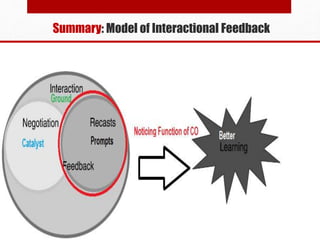
• Interactional feedback (implicit feedback) consists of three
processes: interaction, negotiation and feedback techniques
(recasts, prompts)
Output plays roles in SL processes
1) Interactional Feedback
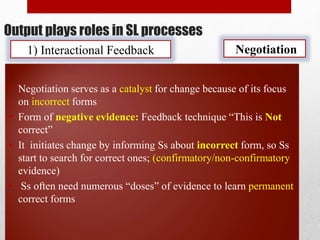
• Negotiation serves as a catalyst for change because of its focus
on incorrect forms
• Form of negative evidence: Feedback technique “This is Not
correct”
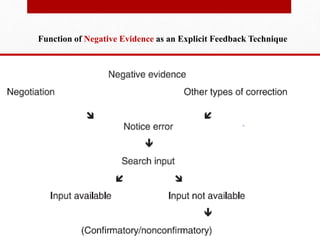
• It initiates change by informing Ss about incorrect form, so Ss
start to search for correct ones; (confirmatory/non-confirmatory
evidence)
• Ss often need numerous “doses” of evidence to learn permanent
correct forms
Negotiation
Function of Negative Evidence as an Explicit Feedback Technique
Output plays roles in SL processes
1) Interactional Feedback Negotiation
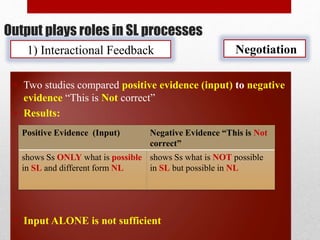
• Two studies compared positive evidence (input) to negative
evidence “This is Not correct”
• Results:
• Input ALONE is not sufficient
Positive Evidence (Input) Negative Evidence “This is Not
correct”
shows Ss ONLY what is possible
in SL and different form NL
shows Ss what is NOT possible
in SL but possible in NL
Output plays roles in SL processes
1) Interactional Feedback Negotiation
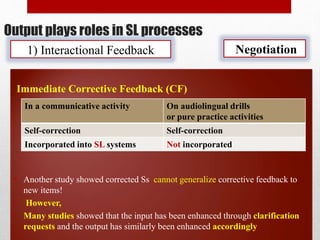
Immediate Corrective Feedback (CF)
• Another study showed corrected Ss cannot generalize corrective feedback to
new items!
• However,
• Many studies showed that the input has been enhanced through clarification
requests and the output has similarly been enhanced accordingly
In a communicative activity On audiolingual drills
or pure practice activities
Self-correction Self-correction
Incorporated into SL systems Not incorporated
Output plays roles in SL processes
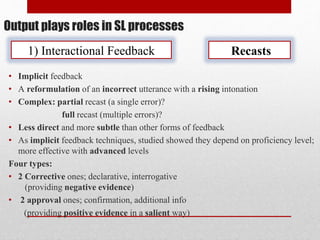
1) Interactional Feedback Recasts
• Implicit feedback
• A reformulation of an incorrect utterance with a rising intonation
• Complex: partial recast (a single error)?
full recast (multiple errors)?
• Less direct and more subtle than other forms of feedback
• As implicit feedback techniques, studied showed they depend on proficiency level;
more effective with advanced levels
Four types:
• 2 Corrective ones; declarative, interrogative
(providing negative evidence)
• 2 approval ones; confirmation, additional info
(providing positive evidence in a salient way)
Output plays roles in SL processes
1) Interactional Feedback Recasts
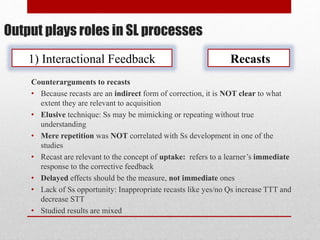
Counterarguments to recasts
• Because recasts are an indirect form of correction, it is NOT clear to what
extent they are relevant to acquisition
• Elusive technique: Ss may be mimicking or repeating without true
understanding
• Mere repetition was NOT correlated with Ss development in one of the
studies
• Recast are relevant to the concept of uptake: refers to a learner’s immediate
response to the corrective feedback
• Delayed effects should be the measure, not immediate ones
• Lack of Ss opportunity: Inappropriate recasts like yes/no Qs increase TTT and
decrease STT
• Studied results are mixed
Output plays roles in SL processes
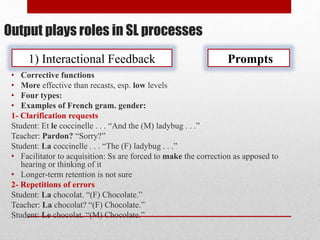
1) Interactional Feedback Prompts
• Corrective functions
• More effective than recasts, esp. low levels
• Four types:
• Examples of French gram. gender:
1- Clarification requests
Student: Et le coccinelle . . . “And the (M) ladybug . . .”
Teacher: Pardon? “Sorry?”
Student: La coccinelle . . . “The (F) ladybug . . .”
• Facilitator to acquisition: Ss are forced to make the correction as apposed to
hearing or thinking of it
• Longer-term retention is not sure
2- Repetitions of errors
Student: La chocolat. “(F) Chocolate.”
Teacher: La chocolat? “(F) Chocolate.”
Student: Le chocolat. “(M) Chocolate.”
Output plays roles in SL processes
1) Interactional Feedback Prompts
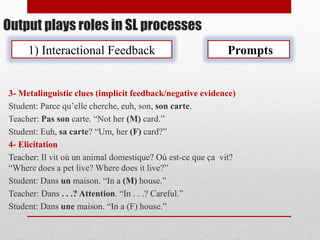
3- Metalinguistic clues (implicit feedback/negative evidence)
Student: Parce qu’elle cherche, euh, son, son carte.
Teacher: Pas son carte. “Not her (M) card.”
Student: Euh, sa carte? “Um, her (F) card?”
4- Elicitation
Teacher: Il vit où un animal domestique? Où est-ce que ça vit?
“Where does a pet live? Where does it live?”
Student: Dans un maison. “In a (M) house.”
Teacher: Dans . . .? Attention. “In . . .? Careful.”
Student: Dans une maison. “In a (F) house.”
Conclusion
• Feedback perception of Ss: Ss do not always perceive
feedback as it is intended
• Feedback has different roles in different linguistic areas
• For example, morphosyntactic feedback in not noticed in
conversations as Ss are focused on meanings rather than
forms
• For example, phonological errors may interfere with lexical
meanings so they have to be corrected separately
Ex: homophones: cell, sell; brake, break; ad, add
1) Interactional Feedback
Output plays roles in SL processes
Summary: Model of Interactional Feedback
Reference
Gass, S. & Selinker, L. (2008). Second language
acquisition (3rd ed.). Mahwah, NJ: Taylor &
Francis.
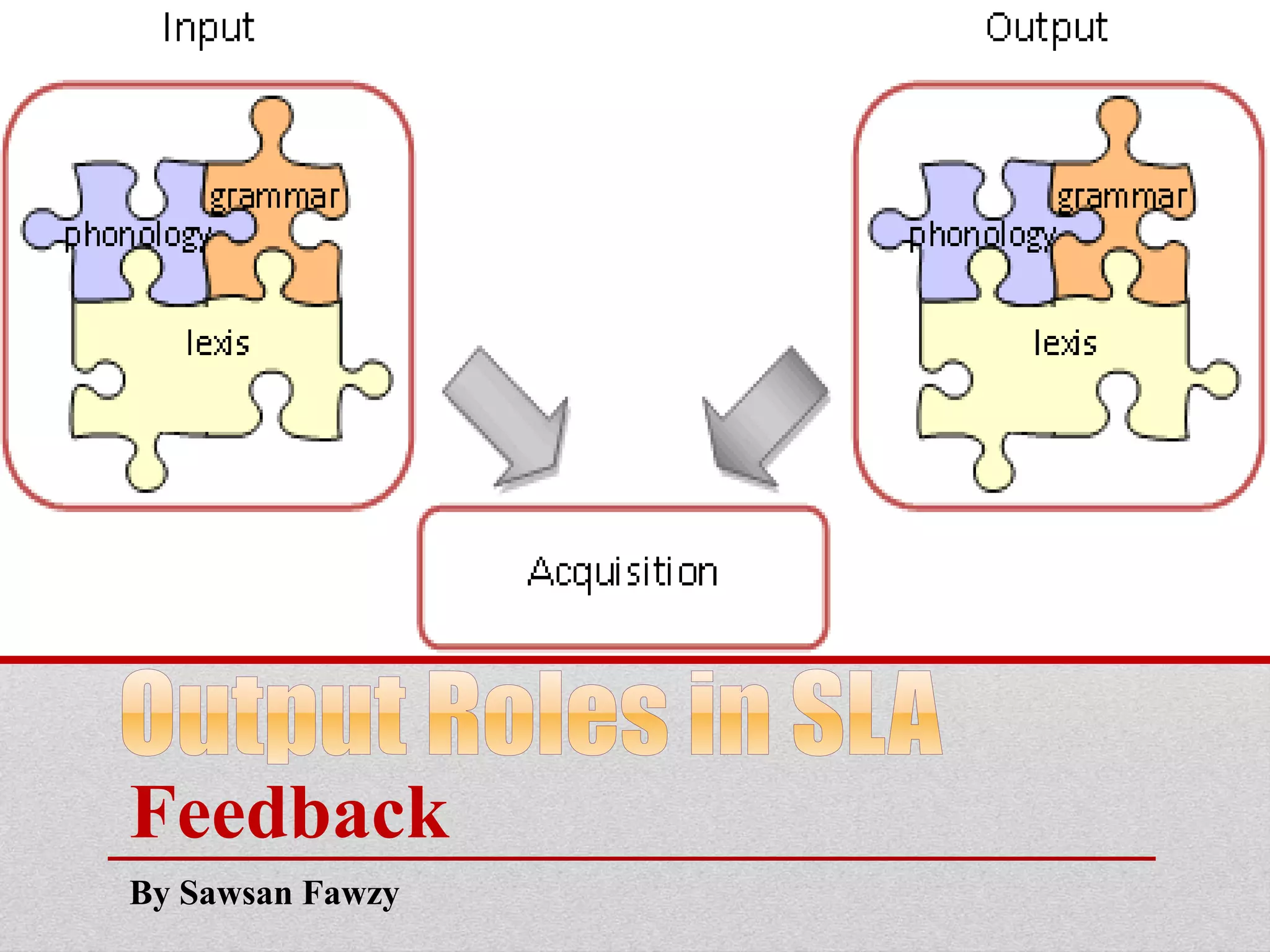
Output Functions (Feedback)

Output Functions (Feedback)

  • 1.
  • 2.
    • Merill Swain’simportant paper in 1985 • CO or “pushed” output • Ss are “pushed” or “stretched” in their production to make themselves understood • They might modify previous utterances or try out forms that they had not used before. • Ss are “pushed” toward the delivery of a message that is not only conveyed, but that is conveyed precisely, coherently, and appropriately • So they are stimulated to move from meaning-based learning and fluent production to accurate learning and production focusing more on syntax and morphology • CO plays an important role in the development of syntax and morphology Comprehensible Output Hypothesis
  • 3.
    • Based onCO Hypothesis, Swain defines significant functions of output: • 1st Function 1. Noticing function: Ss notice the gaps between what they want to say and what they are able to say, try to get developed (SLA) • So they notice what they do NOT know or only know PARTIALLY in an SL CO Functions They notice when they receive feedback or when they try to say sth and cannot
  • 4.
    Output plays rolesin SL processes 1) Interactional Feedback • Important source of info for Ss. • Generally, info about the success, lack of success of their utterances, production • Feedback techniques: explicit (negative evidence), implicit (interactional) • Negative evidence (explicit feedback): important esp. for SLA adult Ss • Interactional feedback (implicit feedback) consists of three processes: interaction, negotiation and feedback techniques (recasts, prompts)
  • 5.
    Output plays rolesin SL processes 1) Interactional Feedback • Negotiation serves as a catalyst for change because of its focus on incorrect forms • Form of negative evidence: Feedback technique “This is Not correct” • It initiates change by informing Ss about incorrect form, so Ss start to search for correct ones; (confirmatory/non-confirmatory evidence) • Ss often need numerous “doses” of evidence to learn permanent correct forms Negotiation
  • 6.
    Function of NegativeEvidence as an Explicit Feedback Technique
  • 7.
    Output plays rolesin SL processes 1) Interactional Feedback Negotiation • Two studies compared positive evidence (input) to negative evidence “This is Not correct” • Results: • Input ALONE is not sufficient Positive Evidence (Input) Negative Evidence “This is Not correct” shows Ss ONLY what is possible in SL and different form NL shows Ss what is NOT possible in SL but possible in NL
  • 8.
    Output plays rolesin SL processes 1) Interactional Feedback Negotiation Immediate Corrective Feedback (CF) • Another study showed corrected Ss cannot generalize corrective feedback to new items! • However, • Many studies showed that the input has been enhanced through clarification requests and the output has similarly been enhanced accordingly In a communicative activity On audiolingual drills or pure practice activities Self-correction Self-correction Incorporated into SL systems Not incorporated
  • 9.
    Output plays rolesin SL processes 1) Interactional Feedback Recasts • Implicit feedback • A reformulation of an incorrect utterance with a rising intonation • Complex: partial recast (a single error)? full recast (multiple errors)? • Less direct and more subtle than other forms of feedback • As implicit feedback techniques, studied showed they depend on proficiency level; more effective with advanced levels Four types: • 2 Corrective ones; declarative, interrogative (providing negative evidence) • 2 approval ones; confirmation, additional info (providing positive evidence in a salient way)
  • 10.
    Output plays rolesin SL processes 1) Interactional Feedback Recasts Counterarguments to recasts • Because recasts are an indirect form of correction, it is NOT clear to what extent they are relevant to acquisition • Elusive technique: Ss may be mimicking or repeating without true understanding • Mere repetition was NOT correlated with Ss development in one of the studies • Recast are relevant to the concept of uptake: refers to a learner’s immediate response to the corrective feedback • Delayed effects should be the measure, not immediate ones • Lack of Ss opportunity: Inappropriate recasts like yes/no Qs increase TTT and decrease STT • Studied results are mixed
  • 11.
    Output plays rolesin SL processes 1) Interactional Feedback Prompts • Corrective functions • More effective than recasts, esp. low levels • Four types: • Examples of French gram. gender: 1- Clarification requests Student: Et le coccinelle . . . “And the (M) ladybug . . .” Teacher: Pardon? “Sorry?” Student: La coccinelle . . . “The (F) ladybug . . .” • Facilitator to acquisition: Ss are forced to make the correction as apposed to hearing or thinking of it • Longer-term retention is not sure 2- Repetitions of errors Student: La chocolat. “(F) Chocolate.” Teacher: La chocolat? “(F) Chocolate.” Student: Le chocolat. “(M) Chocolate.”
  • 12.
    Output plays rolesin SL processes 1) Interactional Feedback Prompts 3- Metalinguistic clues (implicit feedback/negative evidence) Student: Parce qu’elle cherche, euh, son, son carte. Teacher: Pas son carte. “Not her (M) card.” Student: Euh, sa carte? “Um, her (F) card?” 4- Elicitation Teacher: Il vit où un animal domestique? Où est-ce que ça vit? “Where does a pet live? Where does it live?” Student: Dans un maison. “In a (M) house.” Teacher: Dans . . .? Attention. “In . . .? Careful.” Student: Dans une maison. “In a (F) house.”
  • 13.
    Conclusion • Feedback perceptionof Ss: Ss do not always perceive feedback as it is intended • Feedback has different roles in different linguistic areas • For example, morphosyntactic feedback in not noticed in conversations as Ss are focused on meanings rather than forms • For example, phonological errors may interfere with lexical meanings so they have to be corrected separately Ex: homophones: cell, sell; brake, break; ad, add 1) Interactional Feedback Output plays roles in SL processes
  • 14.
    Summary: Model ofInteractional Feedback
  • 15.
    Reference Gass, S. &Selinker, L. (2008). Second language acquisition (3rd ed.). Mahwah, NJ: Taylor & Francis.