By Khaled Al-Shamaa
Multiple Y Axis Graph (1)
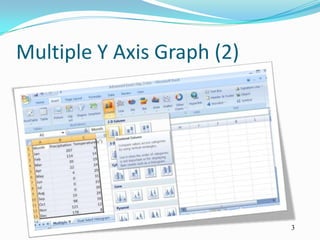
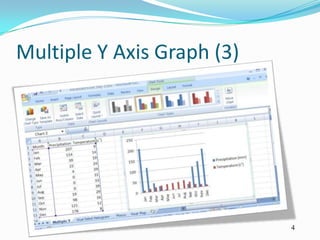
 First create a graph using your data and select the type
 you like. in our case it was a 2 line graph.

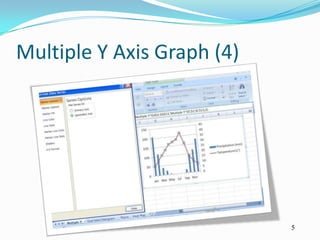
 Then right click on the smaller graph, and select the
 “Format Data Series…”

 Then we get a popup window for the series options
 with the ability to change the series axis.

 We select the Secondary axis option.
                                                          2
Multiple Y Axis Graph (2)


                            3
Multiple Y Axis Graph (3)


                            4
Multiple Y Axis Graph (4)


                            5
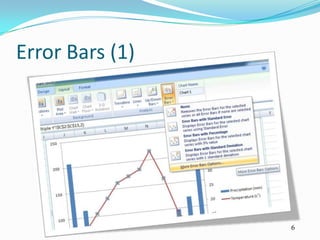
Error Bars (1)


                 6
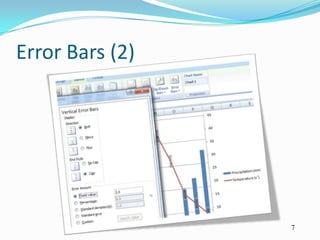
Error Bars (2)


                 7
Installing Add-Ins 2007 (1)
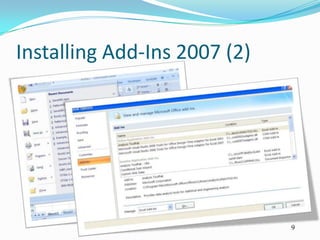
 To install an Add-In in Excel 2007 you need to click the
 Office button and press the Excel Options button.

 From the options dialog select the Add-In section.
 Select Excel-Add-ins from the Manage drop list and
 then press the Go... button.

 From the Add-Ins dialog you can use the browse
 button to locate the add-in you wish to install.

                                                        8
Installing Add-Ins 2007 (2)


                              9
SAVEDBF Add-In (1)
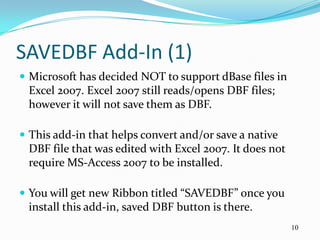
 Microsoft has decided NOT to support dBase files in
 Excel 2007. Excel 2007 still reads/opens DBF files;
 however it will not save them as DBF.

 This add-in that helps convert and/or save a native
 DBF file that was edited with Excel 2007. It does not
 require MS-Access 2007 to be installed.

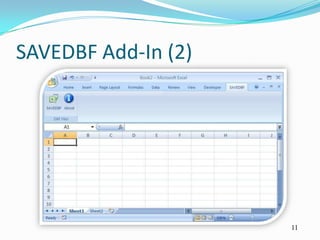
 You will get new Ribbon titled “SAVEDBF” once you
 install this add-in, saved DBF button is there.
                                                         10
SAVEDBF Add-In (2)


                     11
Pattern Fill Add-In (1)
 In Excel 2007 the chart feature of using pattern fills
  was deprecated (returned back in Excel 2010!).

 For backward compatibility the functionality was
  included in the new charting engine. Only the
  interface to it was excluded.

 This add-in provides the UI in order to use that
  functionality.

                                                           12
Pattern Fill Add-In (2)


                          13
Pattern Fill Add-In (3)
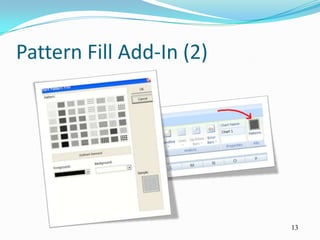
 The dialog allows you to select Foreground and
 Background colors. You can also select from the
 predefined patterns.

 When completed the chosen pattern and colors are
 applied to the select chart element, if applicable.

 Due to the fact that using VBA destroys the undo stack
 you will not be able to use undo to restore any changes
 made using the add-in.
                                                       14
Automate Task with Macros (1)
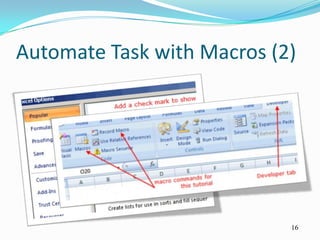
 Adding the Developer Tab:

  1.   Click on the Office button to open the drop down menu.

  2.   Click on the Excel Options button located at the bottom
       of the menu to open the Excel Options dialog box.

  3.   Click on the Popular option at the top of the left hand
       window of the open dialog box.

  4.   Click on the Show Developer Tab in the ribbon in the
       right hand window of the open dialog box.
                                                             15
Automate Task with Macros (2)


                            16
Automate Task with Macros (3)
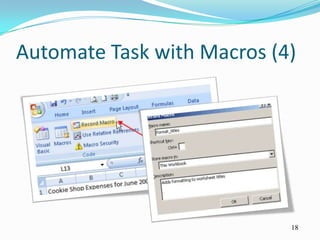
 The easiest way to create a macro in Excel is to use the
  macro recorder. To do so: Click on the Developers tab,
  then click on Record Macro in the ribbon to open the
  Record Macro dialog box.
 Clicking the OK button in the Record Macro dialog
  box starts recording the macro you have just
  identified.
 The macro recorder works by recording all keystrokes
  and clicks of the mouse.
                                                         17
Automate Task with Macros (4)


                            18
Automate Task with Macros (5)
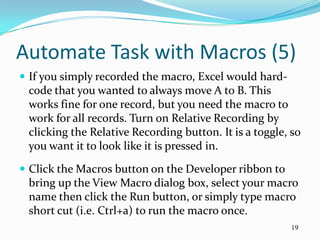
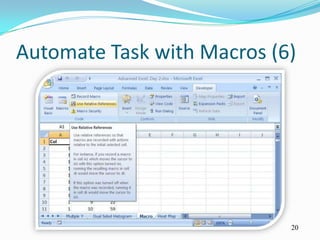
 If you simply recorded the macro, Excel would hard-
 code that you wanted to always move A to B. This
 works fine for one record, but you need the macro to
 work for all records. Turn on Relative Recording by
 clicking the Relative Recording button. It is a toggle, so
 you want it to look like it is pressed in.
 Click the Macros button on the Developer ribbon to
 bring up the View Macro dialog box, select your macro
 name then click the Run button, or simply type macro
 short cut (i.e. Ctrl+a) to run the macro once.
                                                        19
Automate Task with Macros (6)


                            20
Conditional Formatting (1)
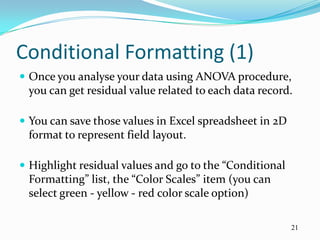
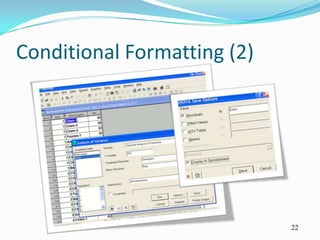
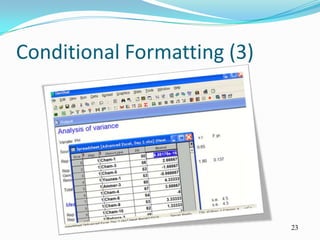
 Once you analyse your data using ANOVA procedure,
 you can get residual value related to each data record.

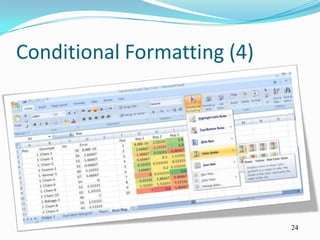
 You can save those values in Excel spreadsheet in 2D
 format to represent field layout.

 Highlight residual values and go to the “Conditional
 Formatting” list, the “Color Scales” item (you can
 select green - yellow - red color scale option)

                                                         21
Conditional Formatting (2)


                             22
Conditional Formatting (3)


                             23
Conditional Formatting (4)


                             24
Thank You


            25
                 25

Advanced Excel, Day 2

  • 1.
  • 2.
    Multiple Y AxisGraph (1)  First create a graph using your data and select the type you like. in our case it was a 2 line graph.  Then right click on the smaller graph, and select the “Format Data Series…”  Then we get a popup window for the series options with the ability to change the series axis.  We select the Secondary axis option. 2
  • 3.
    Multiple Y AxisGraph (2) 3
  • 4.
    Multiple Y AxisGraph (3) 4
  • 5.
    Multiple Y AxisGraph (4) 5
  • 6.
  • 7.
  • 8.
    Installing Add-Ins 2007(1)  To install an Add-In in Excel 2007 you need to click the Office button and press the Excel Options button.  From the options dialog select the Add-In section. Select Excel-Add-ins from the Manage drop list and then press the Go... button.  From the Add-Ins dialog you can use the browse button to locate the add-in you wish to install. 8
  • 9.
  • 10.
    SAVEDBF Add-In (1) Microsoft has decided NOT to support dBase files in Excel 2007. Excel 2007 still reads/opens DBF files; however it will not save them as DBF.  This add-in that helps convert and/or save a native DBF file that was edited with Excel 2007. It does not require MS-Access 2007 to be installed.  You will get new Ribbon titled “SAVEDBF” once you install this add-in, saved DBF button is there. 10
  • 11.
  • 12.
    Pattern Fill Add-In(1)  In Excel 2007 the chart feature of using pattern fills was deprecated (returned back in Excel 2010!).  For backward compatibility the functionality was included in the new charting engine. Only the interface to it was excluded.  This add-in provides the UI in order to use that functionality. 12
  • 13.
  • 14.
    Pattern Fill Add-In(3)  The dialog allows you to select Foreground and Background colors. You can also select from the predefined patterns.  When completed the chosen pattern and colors are applied to the select chart element, if applicable.  Due to the fact that using VBA destroys the undo stack you will not be able to use undo to restore any changes made using the add-in. 14
  • 15.
    Automate Task withMacros (1)  Adding the Developer Tab: 1. Click on the Office button to open the drop down menu. 2. Click on the Excel Options button located at the bottom of the menu to open the Excel Options dialog box. 3. Click on the Popular option at the top of the left hand window of the open dialog box. 4. Click on the Show Developer Tab in the ribbon in the right hand window of the open dialog box. 15
  • 16.
    Automate Task withMacros (2) 16
  • 17.
    Automate Task withMacros (3)  The easiest way to create a macro in Excel is to use the macro recorder. To do so: Click on the Developers tab, then click on Record Macro in the ribbon to open the Record Macro dialog box.  Clicking the OK button in the Record Macro dialog box starts recording the macro you have just identified.  The macro recorder works by recording all keystrokes and clicks of the mouse. 17
  • 18.
    Automate Task withMacros (4) 18
  • 19.
    Automate Task withMacros (5)  If you simply recorded the macro, Excel would hard- code that you wanted to always move A to B. This works fine for one record, but you need the macro to work for all records. Turn on Relative Recording by clicking the Relative Recording button. It is a toggle, so you want it to look like it is pressed in.  Click the Macros button on the Developer ribbon to bring up the View Macro dialog box, select your macro name then click the Run button, or simply type macro short cut (i.e. Ctrl+a) to run the macro once. 19
  • 20.
    Automate Task withMacros (6) 20
  • 21.
    Conditional Formatting (1) Once you analyse your data using ANOVA procedure, you can get residual value related to each data record.  You can save those values in Excel spreadsheet in 2D format to represent field layout.  Highlight residual values and go to the “Conditional Formatting” list, the “Color Scales” item (you can select green - yellow - red color scale option) 21
  • 22.
  • 23.
  • 24.
  • 25.

Editor's Notes

  • #16 In Excel 2010:Choose the File tab, and then choose Options.In the categories pane, choose Customize Ribbon.In the list of main tabs, choose Developer.Choose the OK button to close the Options dialog box.