Advanced Cardiac Life Support
(ACLS)
Department of Anesthesia
Presented by :
Swornim Gyawali
impacts multiple key links (chain of survival )that
include
1. interventions to prevent cardiac arrest,
2. treat cardiac arrest, and
3. improve outcomes of patients who achieve
return of spontaneous circulation (ROSC) after
cardiac arrest
Interventions aimed at preventing cardiac arrest
airway management,
ventilation support, and
treatment of bradyarrhythmias and
tachyarrhythmias
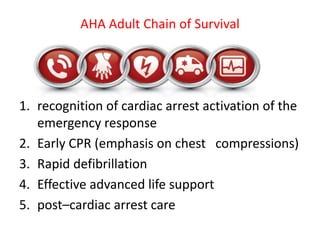
AHA Adult Chain of Survival
1. recognition of cardiac arrest activation of the
emergency response
2. Early CPR (emphasis on chest compressions)
3. Rapid defibrillation
4. Effective advanced life support
5. post–cardiac arrest care
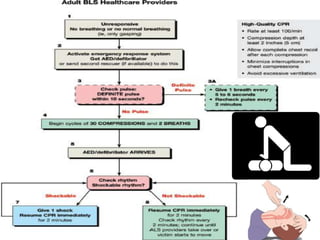
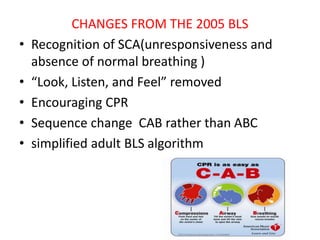
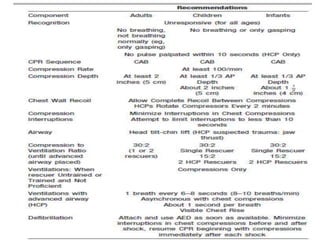
CHANGES FROM THE 2005 BLS
• Recognition of SCA(unresponsiveness and
absence of normal breathing )
• “Look, Listen, and Feel” removed
• Encouraging CPR
• Sequence change CAB rather than ABC
• simplified adult BLS algorithm
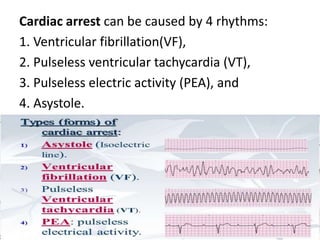
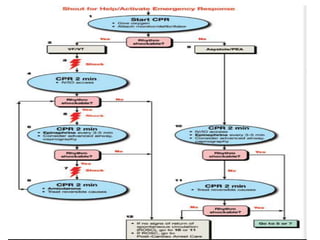
Cardiac arrest can be caused by 4 rhythms:
1. Ventricular fibrillation(VF),
2. Pulseless ventricular tachycardia (VT),
3. Pulseless electric activity (PEA), and
4. Asystole.
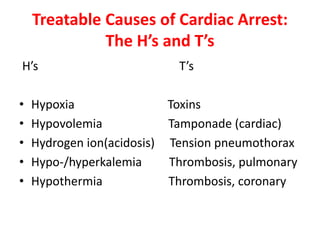
Treatable Causes of Cardiac Arrest:
The H’s and T’s
H’s T’s
• Hypoxia Toxins
• Hypovolemia Tamponade (cardiac)
• Hydrogen ion(acidosis) Tension pneumothorax
• Hypo-/hyperkalemia Thrombosis, pulmonary
• Hypothermia Thrombosis, coronary
Shock Energy
• Biphasic : Manufacturer recommendation
(eg, initial dose of 120-200 J), if unknown, use
maximum available.
• Second and subsequent doses should be
equivalent, and higher doses may be
considered.
• Monophasic : 360 J
(Note : If 1 shock fails to eliminate VF, the incremental
benefit of another shock is low, and resumption of CPR is
likely to confer a greater value than another shock)
Drug therapy
1. Peripheral IV Drug Delivery
2. IO Drug Delivery - IO cannulation provides
access to a noncollapsible venous plexus
3. Central IV Drug Delivery - It can be used to
monitor ScvO2 and estimate CPP during CPR,
both of which are predictive of ROSC
4. Endotracheal Drug Delivery - lidocaine,
epinephrine, atropine, naloxone, and
vasopressin
• Dose : 2 to 2 ½ times the recommended IV dose
Drug Therapy
• Epinephrine IV/IO Dose: 1 mg every 3-5
minutes
• Vasopressin IV/IO Dose: 40 units can replace
first or second dose of epinephrine
• Amiodarone IV/IO Dose: First dose: 300 mg
bolus. Second dose: 150 mg.
• Lidocaine
indication : PVCs, Vtach, Vfib
IV dose :1-1.5 mg/kg bolus then continuous infusion of
2-4 mg/min
Toxicity:slurred speech, seizures, altered consciousness
– Epinephrine ( alpha, beta-1, and beta-2 stimulation,
it increases heart rate,stroke volume and blood
pressure)
– Indication : vfib ; asystole ; PEA
• IV dose: 1 mg every 3-5 minutes
• Vasopressin
Similar effects to Epinephrine
IV dose = 40 IU
better for asystole
• Amiodarone
Indications: Vtach, Vfib
IV Dose: 300 mg in 20-30 ml of N/S or D5W
Followed with continuous infusion of 1 mg/min for 6
hours than .5mg/min to a maximum daily dose of 2
grams
c/I : Cardiogenic shock/Sinus Bradycardia/2nd and 3rd
degree blocks
Key changes from the 2005 ACLS
Guidelines
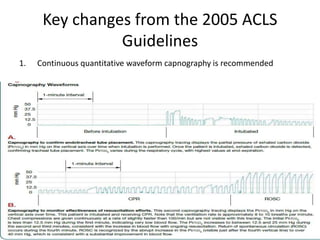
1. Continuous quantitative waveform capnography is recommended
2. Cardiac arrest algorithms are simplified and
redesigned to emphasize the importance of high
quality CPR
3. Atropine is no longer recommended for routine use
in the management of pulseless electrical activity
(PEA)/asystole
4. Adenosine is recommended as a safe and potentially
effective therapy in the initial management of stable
undifferentiated regular monomorphic wide-complex
tachycardia
THANK YOU

Advanced cardiac life support 2010

  • 1.
    Advanced Cardiac LifeSupport (ACLS) Department of Anesthesia Presented by : Swornim Gyawali
  • 2.
    impacts multiple keylinks (chain of survival )that include 1. interventions to prevent cardiac arrest, 2. treat cardiac arrest, and 3. improve outcomes of patients who achieve return of spontaneous circulation (ROSC) after cardiac arrest Interventions aimed at preventing cardiac arrest airway management, ventilation support, and treatment of bradyarrhythmias and tachyarrhythmias
  • 3.
    AHA Adult Chainof Survival 1. recognition of cardiac arrest activation of the emergency response 2. Early CPR (emphasis on chest compressions) 3. Rapid defibrillation 4. Effective advanced life support 5. post–cardiac arrest care
  • 5.
    CHANGES FROM THE2005 BLS • Recognition of SCA(unresponsiveness and absence of normal breathing ) • “Look, Listen, and Feel” removed • Encouraging CPR • Sequence change CAB rather than ABC • simplified adult BLS algorithm
  • 6.
    Cardiac arrest canbe caused by 4 rhythms: 1. Ventricular fibrillation(VF), 2. Pulseless ventricular tachycardia (VT), 3. Pulseless electric activity (PEA), and 4. Asystole.
  • 7.
    Treatable Causes ofCardiac Arrest: The H’s and T’s H’s T’s • Hypoxia Toxins • Hypovolemia Tamponade (cardiac) • Hydrogen ion(acidosis) Tension pneumothorax • Hypo-/hyperkalemia Thrombosis, pulmonary • Hypothermia Thrombosis, coronary
  • 9.
    Shock Energy • Biphasic: Manufacturer recommendation (eg, initial dose of 120-200 J), if unknown, use maximum available. • Second and subsequent doses should be equivalent, and higher doses may be considered. • Monophasic : 360 J (Note : If 1 shock fails to eliminate VF, the incremental benefit of another shock is low, and resumption of CPR is likely to confer a greater value than another shock)
  • 11.
    Drug therapy 1. PeripheralIV Drug Delivery 2. IO Drug Delivery - IO cannulation provides access to a noncollapsible venous plexus 3. Central IV Drug Delivery - It can be used to monitor ScvO2 and estimate CPP during CPR, both of which are predictive of ROSC 4. Endotracheal Drug Delivery - lidocaine, epinephrine, atropine, naloxone, and vasopressin • Dose : 2 to 2 ½ times the recommended IV dose
  • 12.
    Drug Therapy • EpinephrineIV/IO Dose: 1 mg every 3-5 minutes • Vasopressin IV/IO Dose: 40 units can replace first or second dose of epinephrine • Amiodarone IV/IO Dose: First dose: 300 mg bolus. Second dose: 150 mg.
  • 13.
    • Lidocaine indication :PVCs, Vtach, Vfib IV dose :1-1.5 mg/kg bolus then continuous infusion of 2-4 mg/min Toxicity:slurred speech, seizures, altered consciousness – Epinephrine ( alpha, beta-1, and beta-2 stimulation, it increases heart rate,stroke volume and blood pressure) – Indication : vfib ; asystole ; PEA • IV dose: 1 mg every 3-5 minutes
  • 14.
    • Vasopressin Similar effectsto Epinephrine IV dose = 40 IU better for asystole • Amiodarone Indications: Vtach, Vfib IV Dose: 300 mg in 20-30 ml of N/S or D5W Followed with continuous infusion of 1 mg/min for 6 hours than .5mg/min to a maximum daily dose of 2 grams c/I : Cardiogenic shock/Sinus Bradycardia/2nd and 3rd degree blocks
  • 15.
    Key changes fromthe 2005 ACLS Guidelines 1. Continuous quantitative waveform capnography is recommended
  • 16.
    2. Cardiac arrestalgorithms are simplified and redesigned to emphasize the importance of high quality CPR 3. Atropine is no longer recommended for routine use in the management of pulseless electrical activity (PEA)/asystole 4. Adenosine is recommended as a safe and potentially effective therapy in the initial management of stable undifferentiated regular monomorphic wide-complex tachycardia
  • 18.