ADRENERGIC ANTAGONISTS
BY
SWATHI KENCHA
ASSISTANTPROFESSOR
ABIPER
BANGALORE
DEFINITION:
 Drugs that inhibits the functions of adrenergic receptors by
blocking the active site of receptors. This type of drugs prevent
the interaction of endogenous catecholamines like epinephrine,
norepinephrine and dopamine or sympathomimetics with the
adrenergic receptors either α or ÎČ are called as adrenergic
antagonists.
 Adrenergic antagonists are also called as sympatholytics or anti-
adrenergics or adrenolytic drugs or adrenergic blockers.
CLASSIFICATION
Adrenergic antagonists are classified as :
1.Alpha adrenergic blockers: Drugs which will bind to α receptor and block the
stimulation activity.
Eg: Tolazoline, Phentolamine, Phenoxybenzamine,
Prazosin, Dihydroergotamine, Methysergide.
2.Beta adrenergic blockers: Drugs which will bind to ÎČ receptor and block the
stimulation activity .
Eg: Propranolol ,Metipranolol, Atenolol, Betaxolol,
Esmolol, Metaprolol, Labetolol, Carvedilol
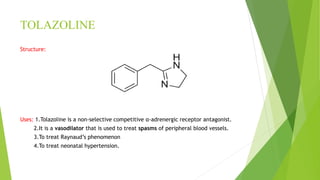
TOLAZOLINE
Structure:
Uses: 1.Tolazoline is a non-selective competitive α-adrenergic receptor antagonist.
2.It is a vasodilator that is used to treat spasms of peripheral blood vessels.
3.To treat Raynaud’s phenomenon
4.To treat neonatal hypertension.
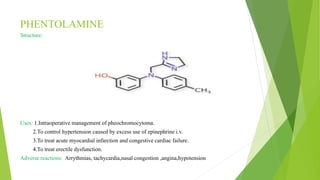
PHENTOLAMINE
Structure:
Uses: 1.Intraoperative management of pheochromocytoma.
2.To control hypertension caused by excess use of epinephrine i.v.
3.To treat acute myocardial infarction and congestive cardiac failure.
4.To treat erectile dysfunction.
Adverse reactions: Arrythmias, tachycardia,nasal congestion ,angina,hypotension
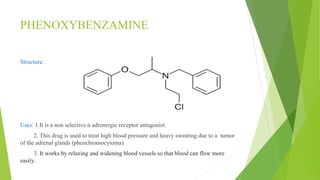
PHENOXYBENZAMINE
Structure:
Uses: 1.It is a non selective α adrenergic receptor antagonist.
2. This drug is used to treat high blood pressure and heavy sweating due to a tumor
of the adrenal glands (pheochromocytoma).
3. It works by relaxing and widening blood vessels so that blood can flow more
easily.
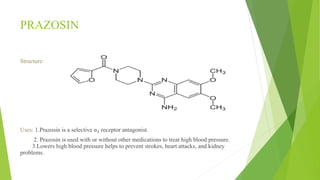
PRAZOSIN
Structure:
Uses: 1.Prazosin is a selective α₁ receptor antagonist.
2. Prazosin is used with or without other medications to treat high blood pressure.
3.Lowers high blood pressure helps to prevent strokes, heart attacks, and kidney
problems.
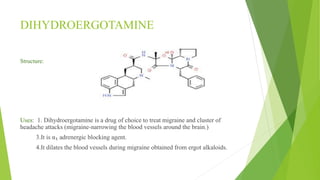
DIHYDROERGOTAMINE
Structure:
Uses: 1. Dihydroergotamine is a drug of choice to treat migraine and cluster of
headache attacks (migraine-narrowing the blood vessels around the brain.)
3.It is α₁ adrenergic blocking agent.
4.It dilates the blood vessels during migraine obtained from ergot alkaloids.
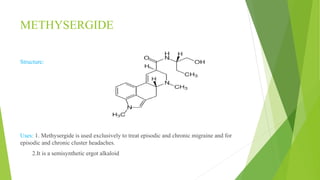
METHYSERGIDE
Structure:
Uses: 1. Methysergide is used exclusively to treat episodic and chronic migraine and for
episodic and chronic cluster headaches.
2.It is a semisynthetic ergot alkaloid
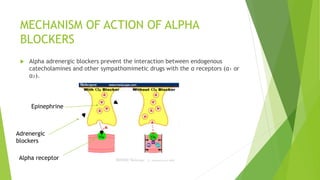
MECHANISM OF ACTION OF ALPHA
BLOCKERS
 Alpha adrenergic blockers prevent the interaction between endogenous
catecholamines and other sympathomimetic drugs with the α receptors (α₁ or
α₂).
Epinephrine
Alpha receptor
Adrenergic
blockers
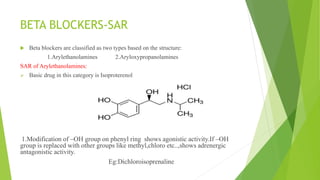
BETA BLOCKERS-SAR
 Beta blockers are classified as two types based on the structure:
1.Arylethanolamines 2.Aryloxypropanolamines
SAR of Arylethanolamines:
 Basic drug in this category is Isoproterenol
1.Modification of –OH group on phenyl ring shows agonistic activity.If –OH
group is replaced with other groups like methyl,chloro etc..,shows adrenergic
antagonistic activity.
Eg:Dichloroisoprenaline
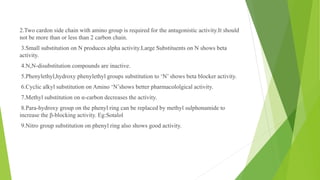
2.Two cardon side chain with amino group is required for the antagonistic activity.It should
not be more than or less than 2 carbon chain.
3.Small substitution on N produces alpha activity.Large Substituents on N shows beta
activity.
4.N,N-disubstitution compounds are inactive.
5.Phenylethyl,hydroxy phenylethyl groups substitution to ‘N’ shows beta blocker activity.
6.Cyclic alkyl substitution on Amino ‘N’shows better pharmacololgical activity.
7.Methyl substitution on α-carbon decreases the activity.
8.Para-hydroxy group on the phenyl ring can be replaced by methyl sulphonamide to
increase the ÎČ-blocking activity. Eg:Sotalol
9.Nitro group substitution on phenyl ring also shows good activity.
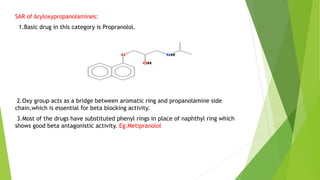
SAR of Aryloxypropanolamines:
1.Basic drug in this category is Propranolol.
2.Oxy group acts as a bridge between aromatic ring and propanolamine side
chain,which is essential for beta blocking activity.
3.Most of the drugs have substituted phenyl rings in place of naphthyl ring which
shows good beta antagonistic activity. Eg:Metipranolol
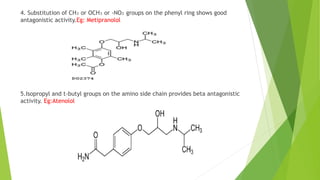
4. Substitution of CH₃ or OCH₃ or -NO₂ groups on the phenyl ring shows good
antagonistic activity.Eg: Metipranolol
5.Isopropyl and t-butyl groups on the amino side chain provides beta antagonistic
activity. Eg:Atenolol
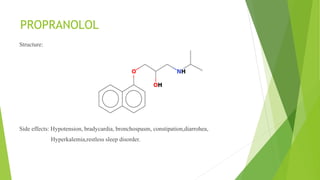
PROPRANOLOL
Structure:
Side effects: Hypotension, bradycardia, bronchospasm, constipation,diarrohea,
Hyperkalemia,restless sleep disorder.
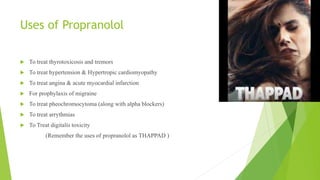
Uses of Propranolol
 To treat thyrotoxicosis and tremors
 To treat hypertension & Hypertropic cardiomyopathy
 To treat angina & acute myocardial infarction
 For prophylaxis of migraine
 To treat pheochromocytoma (along with alpha blockers)
 To treat arrythmias
 To Treat digitalis toxicity
(Remember the uses of propranolol as THAPPAD )
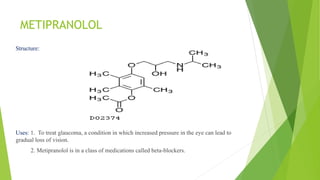
METIPRANOLOL
Structure:
Uses: 1. To treat glaucoma, a condition in which increased pressure in the eye can lead to
gradual loss of vision.
2. Metipranolol is in a class of medications called beta-blockers.
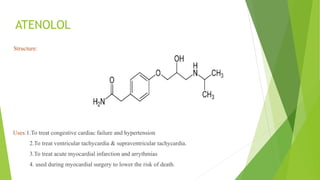
ATENOLOL
Structure:
Uses:1.To treat congestive cardiac failure and hypertension
2.To treat ventricular tachycardia & supraventricular tachycardia.
3.To treat acute myocardial infarction and arrythmias
4. used during myocardial surgery to lower the risk of death.
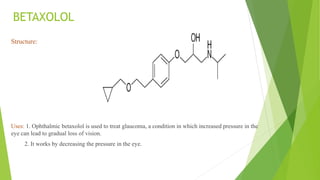
BETAXOLOL
Structure:
Uses: 1. Ophthalmic betaxolol is used to treat glaucoma, a condition in which increased pressure in the
eye can lead to gradual loss of vision.
2. It works by decreasing the pressure in the eye.
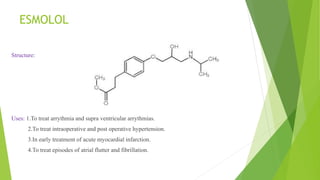
ESMOLOL
Structure:
Uses: 1.To treat arrythmia and supra ventricular arrythmias.
2.To treat intraoperative and post operative hypertension.
3.In early treatment of acute myocardial infarction.
4.To treat episodes of atrial flutter and fibrillation.
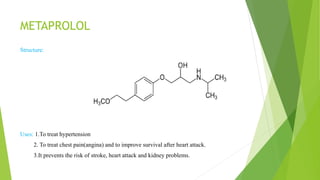
METAPROLOL
Structure:
Uses: 1.To treat hypertension
2. To treat chest pain(angina) and to improve survival after heart attack.
3.It prevents the risk of stroke, heart attack and kidney problems.
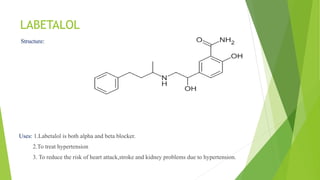
LABETALOL
Structure:
Uses: 1.Labetalol is both alpha and beta blocker.
2.To treat hypertension
3. To reduce the risk of heart attack,stroke and kidney problems due to hypertension.
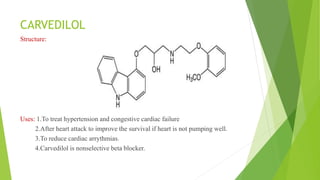
CARVEDILOL
Structure:
Uses: 1.To treat hypertension and congestive cardiac failure
2.After heart attack to improve the survival if heart is not pumping well.
3.To reduce cardiac arrythmias.
4.Carvedilol is nonselective beta blocker.
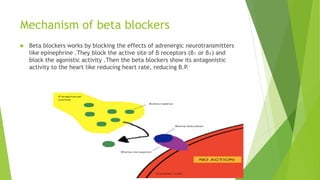
Mechanism of beta blockers
 Beta blockers works by blocking the effects of adrenergic neurotransmitters
like epinephrine .They block the active site of ÎČ receptors (ÎČ₁ or ÎČ₂) and
block the agonistic activity .Then the beta blockers show its antagonistic
activity to the heart like reducing heart rate, reducing B.P.
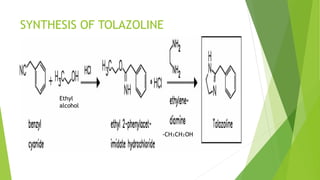
SYNTHESIS OF TOLAZOLINE
Ethyl
alcohol
-CH₃CH₂OH
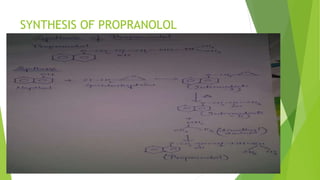
SYNTHESIS OF PROPRANOLOL
Adrenergic antagonists

Adrenergic antagonists

  • 1.
  • 2.
    DEFINITION:  Drugs thatinhibits the functions of adrenergic receptors by blocking the active site of receptors. This type of drugs prevent the interaction of endogenous catecholamines like epinephrine, norepinephrine and dopamine or sympathomimetics with the adrenergic receptors either α or ÎČ are called as adrenergic antagonists.  Adrenergic antagonists are also called as sympatholytics or anti- adrenergics or adrenolytic drugs or adrenergic blockers.
  • 3.
    CLASSIFICATION Adrenergic antagonists areclassified as : 1.Alpha adrenergic blockers: Drugs which will bind to α receptor and block the stimulation activity. Eg: Tolazoline, Phentolamine, Phenoxybenzamine, Prazosin, Dihydroergotamine, Methysergide. 2.Beta adrenergic blockers: Drugs which will bind to ÎČ receptor and block the stimulation activity . Eg: Propranolol ,Metipranolol, Atenolol, Betaxolol, Esmolol, Metaprolol, Labetolol, Carvedilol
  • 4.
    TOLAZOLINE Structure: Uses: 1.Tolazoline isa non-selective competitive α-adrenergic receptor antagonist. 2.It is a vasodilator that is used to treat spasms of peripheral blood vessels. 3.To treat Raynaud’s phenomenon 4.To treat neonatal hypertension.
  • 5.
    PHENTOLAMINE Structure: Uses: 1.Intraoperative managementof pheochromocytoma. 2.To control hypertension caused by excess use of epinephrine i.v. 3.To treat acute myocardial infarction and congestive cardiac failure. 4.To treat erectile dysfunction. Adverse reactions: Arrythmias, tachycardia,nasal congestion ,angina,hypotension
  • 6.
    PHENOXYBENZAMINE Structure: Uses: 1.It isa non selective α adrenergic receptor antagonist. 2. This drug is used to treat high blood pressure and heavy sweating due to a tumor of the adrenal glands (pheochromocytoma). 3. It works by relaxing and widening blood vessels so that blood can flow more easily.
  • 7.
    PRAZOSIN Structure: Uses: 1.Prazosin isa selective α₁ receptor antagonist. 2. Prazosin is used with or without other medications to treat high blood pressure. 3.Lowers high blood pressure helps to prevent strokes, heart attacks, and kidney problems.
  • 8.
    DIHYDROERGOTAMINE Structure: Uses: 1. Dihydroergotamineis a drug of choice to treat migraine and cluster of headache attacks (migraine-narrowing the blood vessels around the brain.) 3.It is α₁ adrenergic blocking agent. 4.It dilates the blood vessels during migraine obtained from ergot alkaloids.
  • 9.
    METHYSERGIDE Structure: Uses: 1. Methysergideis used exclusively to treat episodic and chronic migraine and for episodic and chronic cluster headaches. 2.It is a semisynthetic ergot alkaloid
  • 10.
    MECHANISM OF ACTIONOF ALPHA BLOCKERS  Alpha adrenergic blockers prevent the interaction between endogenous catecholamines and other sympathomimetic drugs with the α receptors (α₁ or α₂). Epinephrine Alpha receptor Adrenergic blockers
  • 11.
    BETA BLOCKERS-SAR  Betablockers are classified as two types based on the structure: 1.Arylethanolamines 2.Aryloxypropanolamines SAR of Arylethanolamines:  Basic drug in this category is Isoproterenol 1.Modification of –OH group on phenyl ring shows agonistic activity.If –OH group is replaced with other groups like methyl,chloro etc..,shows adrenergic antagonistic activity. Eg:Dichloroisoprenaline
  • 12.
    2.Two cardon sidechain with amino group is required for the antagonistic activity.It should not be more than or less than 2 carbon chain. 3.Small substitution on N produces alpha activity.Large Substituents on N shows beta activity. 4.N,N-disubstitution compounds are inactive. 5.Phenylethyl,hydroxy phenylethyl groups substitution to ‘N’ shows beta blocker activity. 6.Cyclic alkyl substitution on Amino ‘N’shows better pharmacololgical activity. 7.Methyl substitution on α-carbon decreases the activity. 8.Para-hydroxy group on the phenyl ring can be replaced by methyl sulphonamide to increase the ÎČ-blocking activity. Eg:Sotalol 9.Nitro group substitution on phenyl ring also shows good activity.
  • 13.
    SAR of Aryloxypropanolamines: 1.Basicdrug in this category is Propranolol. 2.Oxy group acts as a bridge between aromatic ring and propanolamine side chain,which is essential for beta blocking activity. 3.Most of the drugs have substituted phenyl rings in place of naphthyl ring which shows good beta antagonistic activity. Eg:Metipranolol
  • 14.
    4. Substitution ofCH₃ or OCH₃ or -NO₂ groups on the phenyl ring shows good antagonistic activity.Eg: Metipranolol 5.Isopropyl and t-butyl groups on the amino side chain provides beta antagonistic activity. Eg:Atenolol
  • 15.
    PROPRANOLOL Structure: Side effects: Hypotension,bradycardia, bronchospasm, constipation,diarrohea, Hyperkalemia,restless sleep disorder.
  • 16.
    Uses of Propranolol To treat thyrotoxicosis and tremors  To treat hypertension & Hypertropic cardiomyopathy  To treat angina & acute myocardial infarction  For prophylaxis of migraine  To treat pheochromocytoma (along with alpha blockers)  To treat arrythmias  To Treat digitalis toxicity (Remember the uses of propranolol as THAPPAD )
  • 17.
    METIPRANOLOL Structure: Uses: 1. Totreat glaucoma, a condition in which increased pressure in the eye can lead to gradual loss of vision. 2. Metipranolol is in a class of medications called beta-blockers.
  • 18.
    ATENOLOL Structure: Uses:1.To treat congestivecardiac failure and hypertension 2.To treat ventricular tachycardia & supraventricular tachycardia. 3.To treat acute myocardial infarction and arrythmias 4. used during myocardial surgery to lower the risk of death.
  • 19.
    BETAXOLOL Structure: Uses: 1. Ophthalmicbetaxolol is used to treat glaucoma, a condition in which increased pressure in the eye can lead to gradual loss of vision. 2. It works by decreasing the pressure in the eye.
  • 20.
    ESMOLOL Structure: Uses: 1.To treatarrythmia and supra ventricular arrythmias. 2.To treat intraoperative and post operative hypertension. 3.In early treatment of acute myocardial infarction. 4.To treat episodes of atrial flutter and fibrillation.
  • 21.
    METAPROLOL Structure: Uses: 1.To treathypertension 2. To treat chest pain(angina) and to improve survival after heart attack. 3.It prevents the risk of stroke, heart attack and kidney problems.
  • 22.
    LABETALOL Structure: Uses: 1.Labetalol isboth alpha and beta blocker. 2.To treat hypertension 3. To reduce the risk of heart attack,stroke and kidney problems due to hypertension.
  • 23.
    CARVEDILOL Structure: Uses: 1.To treathypertension and congestive cardiac failure 2.After heart attack to improve the survival if heart is not pumping well. 3.To reduce cardiac arrythmias. 4.Carvedilol is nonselective beta blocker.
  • 24.
    Mechanism of betablockers  Beta blockers works by blocking the effects of adrenergic neurotransmitters like epinephrine .They block the active site of ÎČ receptors (ÎČ₁ or ÎČ₂) and block the agonistic activity .Then the beta blockers show its antagonistic activity to the heart like reducing heart rate, reducing B.P.
  • 25.
  • 26.