Dr. Bilal Al-Jaidi
Assistant Professor in Medicinal Chemistry and Drug Design
Faculty of Pharmacy, Philadelphia University-Jordan
Email: bjaidi@philadelphia.edu.jo
Learning Outcomes
 At the end of this lesson, students will be able to:
 Define the biochemistry and Physiology of Sympathetic
system.
 Classify the difference between agonist and antagonist
agents of Adrenergic receptors
 Outline the SAR of Catecholamines.
 Demonstrate the history of bronchodilators
 Explain the use of adrenergic agonists and antagonists in
disease management.
 Demonstrate the structural differences between agonists
and antagonist at the molecular level.
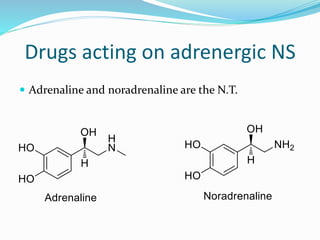
Drugs acting on adrenergic NS
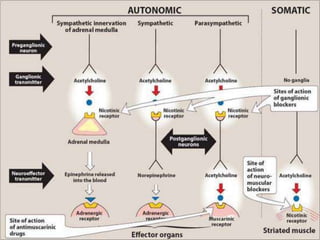
 Adrenaline and noradrenaline are the N.T.
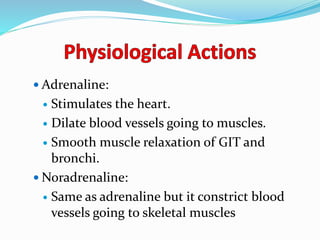
 Adrenaline:
 Stimulates the heart.
 Dilate blood vessels going to muscles.
 Smooth muscle relaxation of GIT and
bronchi.
 Noradrenaline:
 Same as adrenaline but it constrict blood
vessels going to skeletal muscles
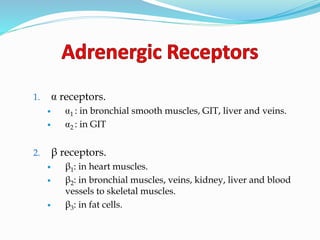
1. receptors.
 1 : in bronchial smooth muscles, GIT, liver and veins.
 2 : in GIT
2. β receptors.
 β1: in heart muscles.
 β2: in bronchial muscles, veins, kidney, liver and blood
vessels to skeletal muscles.
 β3: in fat cells.
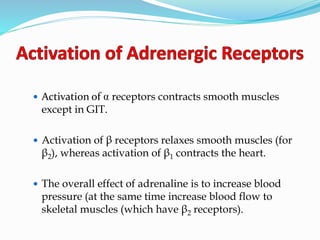
 Activation of receptors contracts smooth muscles
except in GIT.
 Activation of β receptors relaxes smooth muscles (for
β2), whereas activation of β1 contracts the heart.
 The overall effect of adrenaline is to increase blood
pressure (at the same time increase blood flow to
skeletal muscles (which have β2 receptors).
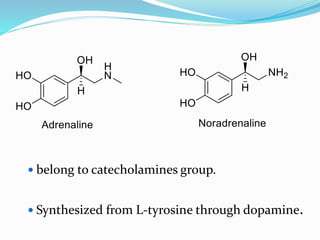
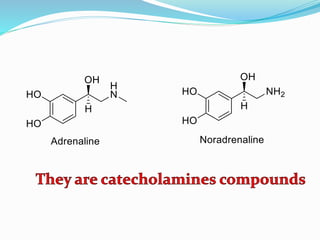
 belong to catecholamines group.
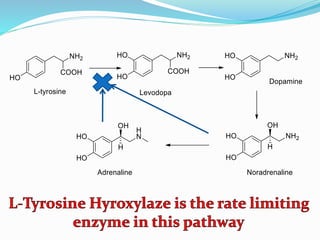
 Synthesized from L-tyrosine through dopamine.
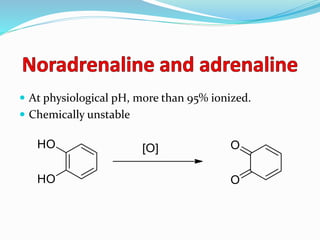
 At physiological pH, more than 95% ionized.
 Chemically unstable
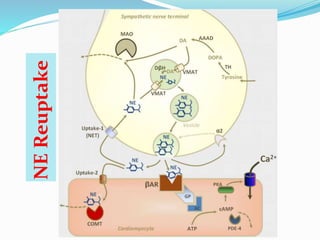
1. Reuptake mechanism: by energy-
requiring pump present in presynaptic
membrane. This pump is the site of
action of cocaine and tricyclic
antidepressents.
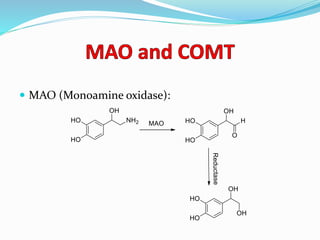
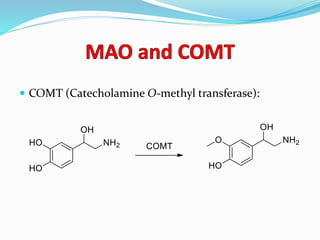
1. Metabolized by MAO and COMT in
liver.
NE
Reuptake
 MAO (Monoamine oxidase):
 COMT (Catecholamine O-methyl transferase):
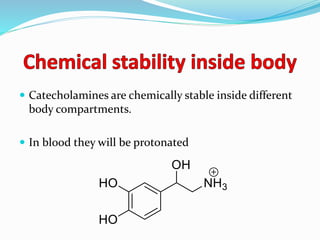
 Catecholamines are chemically stable inside different
body compartments.
 In blood they will be protonated
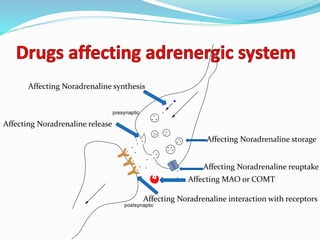
Affecting Noradrenaline release
Affecting Noradrenaline storage
Affecting Noradrenaline interaction with receptors
Affecting Noradrenaline reuptake
Affecting MAO or COMT
Affecting Noradrenaline synthesis
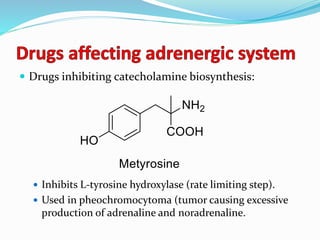
 Drugs inhibiting catecholamine biosynthesis:
 Inhibits L-tyrosine hydroxylase (rate limiting step).
 Used in pheochromocytoma (tumor causing excessive
production of adrenaline and noradrenaline.
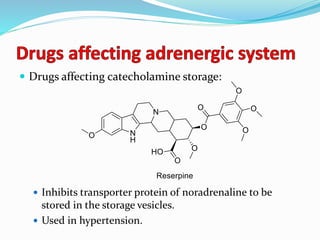
 Drugs affecting catecholamine storage:
 Inhibits transporter protein of noradrenaline to be
stored in the storage vesicles.
 Used in hypertension.
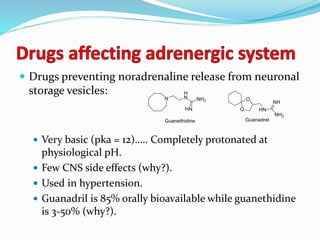
 Drugs preventing noradrenaline release from neuronal
storage vesicles:
 Very basic (pka = 12)….. Completely protonated at
physiological pH.
 Few CNS side effects (why?).
 Used in hypertension.
 Guanadril is 85% orally bioavailable while guanethidine
is 3-50% (why?).
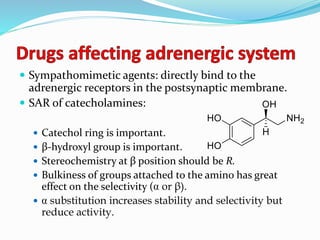
 Sympathomimetic agents: directly bind to the
adrenergic receptors in the postsynaptic membrane.
 SAR of catecholamines:
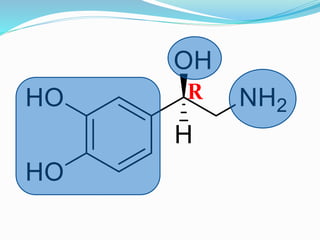
 Catechol ring is important.
 β-hydroxyl group is important.
 Stereochemistry at β position should be R.
 Bulkiness of groups attached to the amino has great
effect on the selectivity ( or β).
 substitution increases stability and selectivity but
reduce activity.
R
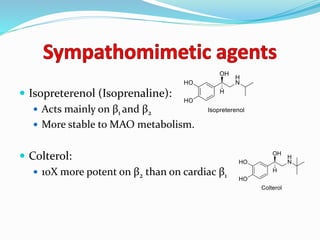
 Isopreterenol (Isoprenaline):
 Acts mainly on β1 and β2
 More stable to MAO metabolism.
 Colterol:
 10X more potent on β2 than on cardiac β1
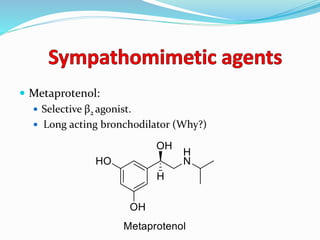
 Metaprotenol:
 Selective β2 agonist.
 Long acting bronchodilator (Why?)
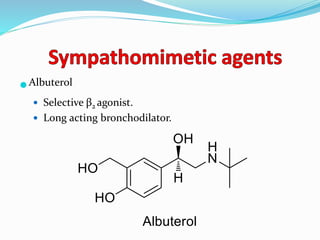
Albuterol
 Selective β2 agonist.
 Long acting bronchodilator.
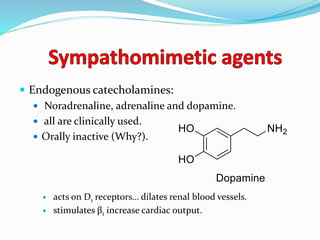
 Endogenous catecholamines:
 Noradrenaline, adrenaline and dopamine.
 all are clinically used.
 Orally inactive (Why?).
 acts on D1 receptors… dilates renal blood vessels.
 stimulates β1 increase cardiac output.
 Noradrenaline (norepinephrine):
 Used in hypotension resulting from surgical trauma and
hemorrhage.
 Orally unstable (Why?).
 Given intravenously.
 Adrenaline (epinephrine):
 Not given orally.
 Increases cardiac output.
 Results in vasoconstriction in hemorrhage and in nasal
congestion.
 Stimulates β2 receptors and relax bronchial smooth
muscles in asthmatic patients.
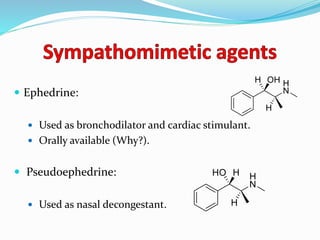
 Ephedrine:
 Used as bronchodilator and cardiac stimulant.
 Orally available (Why?).
 Pseudoephedrine:
 Used as nasal decongestant.
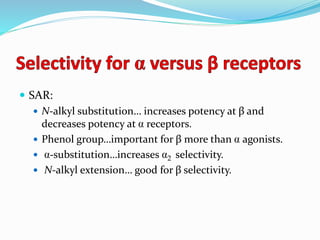
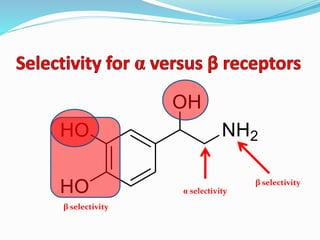
 SAR:
 N-alkyl substitution… increases potency at β and
decreases potency at receptors.
 Phenol group…important for β more than agonists.
 -substitution…increases 2 selectivity.
 N-alkyl extension… good for β selectivity.
β selectivity
selectivity
β selectivity
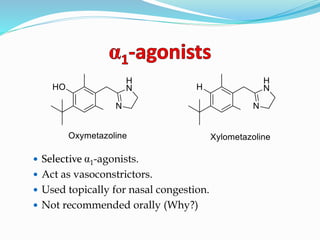
 Selective 1-agonists.
 Act as vasoconstrictors.
 Used topically for nasal congestion.
 Not recommended orally (Why?)
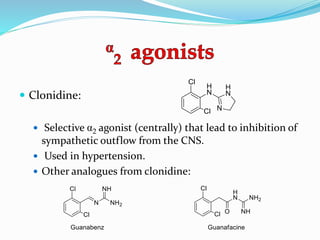
 Clonidine:
 Selective 2 agonist (centrally) that lead to inhibition of
sympathetic outflow from the CNS.
 Used in hypertension.
 Other analogues from clonidine:
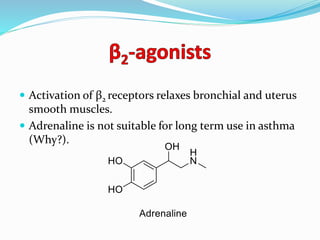
 Activation of β2 receptors relaxes bronchial and uterus
smooth muscles.
 Adrenaline is not suitable for long term use in asthma
(Why?).
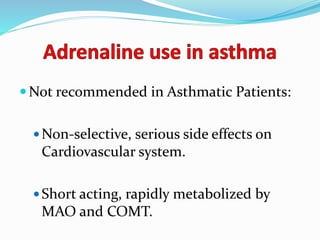
Not recommended in Asthmatic Patients:
Non-selective, serious side effects on
Cardiovascular system.
Short acting, rapidly metabolized by
MAO and COMT.
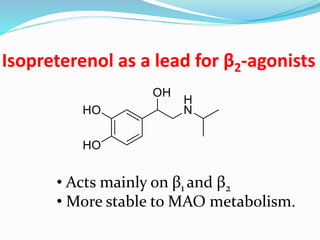
Isopreterenol as a lead for β2-agonists
• Acts mainly on β1 and β2
• More stable to MAO metabolism.
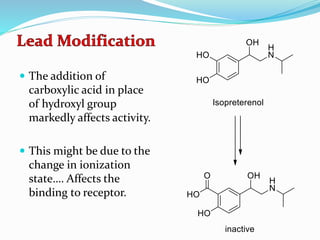
 The addition of
carboxylic acid in place
of hydroxyl group
markedly affects activity.
 This might be due to the
change in ionization
state…. Affects the
binding to receptor.
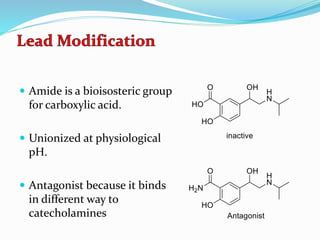
 Amide is a bioisosteric group
for carboxylic acid.
 Unionized at physiological
pH.
 Antagonist because it binds
in different way to
catecholamines
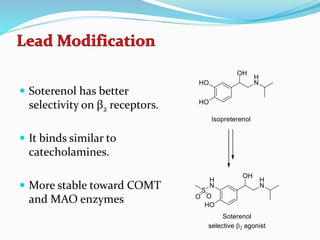
 Soterenol has better
selectivity on β2 receptors.
 It binds similar to
catecholamines.
 More stable toward COMT
and MAO enzymes
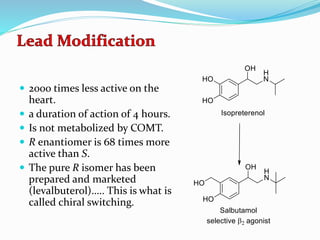
 2000 times less active on the
heart.
 a duration of action of 4 hours.
 Is not metabolized by COMT.
 R enantiomer is 68 times more
active than S.
 The pure R isomer has been
prepared and marketed
(levalbuterol)….. This is what is
called chiral switching.
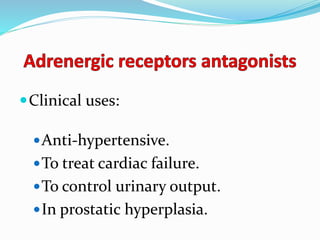
Clinical uses:
Anti-hypertensive.
To treat cardiac failure.
To control urinary output.
In prostatic hyperplasia.
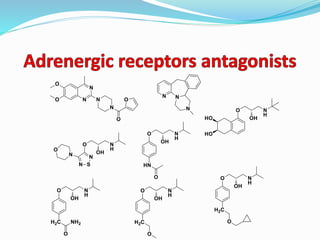
 They have diverse structural features compared to
catecholamines.
 They will block adrenergic receptors preventing
catecholamines from exerting their actions.
 The binding is reversible in almost all cases.
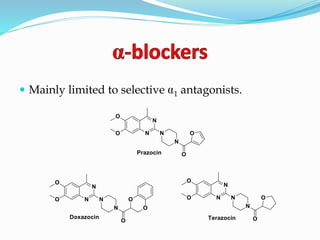
 Mainly limited to selective 1 antagonists.
 Used as anti-hypertensive and in benign prostatic
hyperplasia.
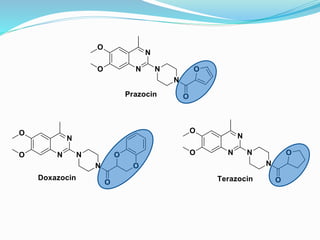
 Prazocin is short acting while terazocin and
doxazocin are longer acting (Why?)
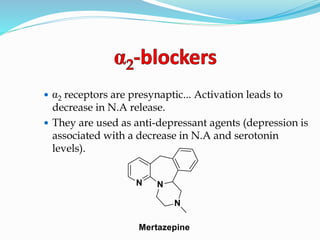
 2 receptors are presynaptic... Activation leads to
decrease in N.A release.
 They are used as anti-depressant agents (depression is
associated with a decrease in N.A and serotonin
levels).
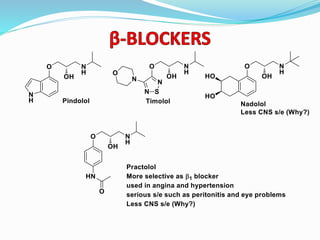
 β-blockers:
 The clinically used ones are β1-blockers.
 Clinical effects:
 Reduce cardiac output.
 Reduce rennin release from the kidney… reduce angiotensin I
formation which is the precursor for angiotensin II (a potent
vasoconstrictor).
 Clinical uses:
 in hypertension.
 Angina.
 Broncho-constriction… not recommended in asthmatic
patients.
 Fatigue and tiredness in limbs due to reduced cardiac
output.
 CNS s/e…. Mainly for lipophilic agents.
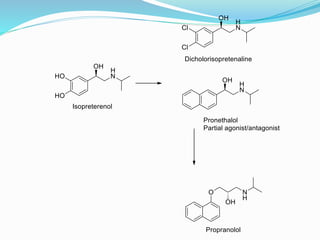
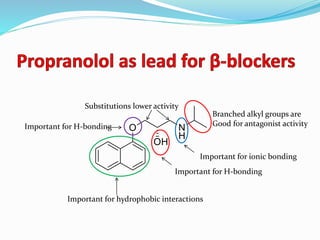
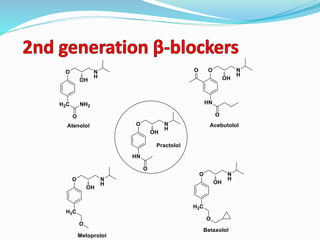
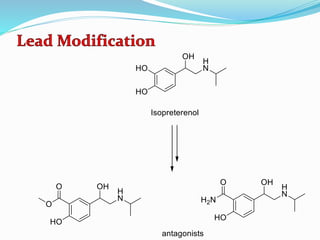
 Isopreterenol was used as a lead for the synthesis of new
selective β1-blockers although it is a β2-agonist.
 The structure was studied to convert the agonist activity
to antagonist effect.
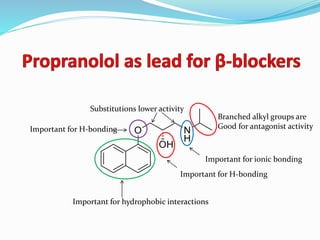
Branched alkyl groups are
Good for antagonist activity
Important for ionic bonding
Important for H-bonding
Substitutions lower activity
Important for H-bonding
Important for hydrophobic interactions
Branched alkyl groups are
Good for antagonist activity
Important for ionic bonding
Important for H-bonding
Substitutions lower activity
Important for H-bonding
Important for hydrophobic interactions
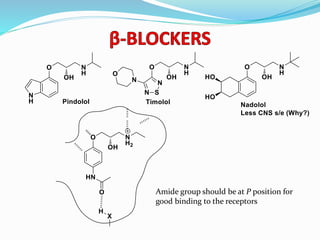
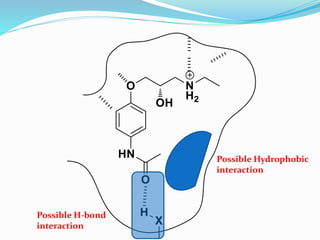
Amide group should be at P position for
good binding to the receptors
Possible Hydrophobic
interaction
Possible H-bond
interaction
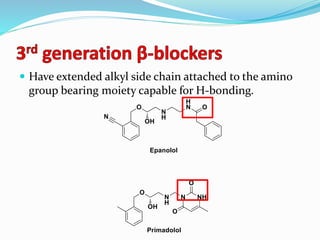
 Have extended alkyl side chain attached to the amino
group bearing moiety capable for H-bonding.
1. An introduction to Medicinal Chemistry by Graham L. Patrick.
4th edition, Oxford, 2009
2. Wilson and Gisvolds text book of organic medicinal and
pharmaceutical chemistry by John H. Black and John M. Beale,
jr. 12th edition, Lippincott Williams and Wilkings 2011.
3. Foyes principle of medicinal chemistry by David H. Williams,
Thomas L. Leuke, Williams O. Foye. Lippincott William and
Wilkins. 7th edition, 2013.
The End

16633431.ppt

  • 1.
    Dr. Bilal Al-Jaidi AssistantProfessor in Medicinal Chemistry and Drug Design Faculty of Pharmacy, Philadelphia University-Jordan Email: bjaidi@philadelphia.edu.jo
  • 2.
    Learning Outcomes  Atthe end of this lesson, students will be able to:  Define the biochemistry and Physiology of Sympathetic system.  Classify the difference between agonist and antagonist agents of Adrenergic receptors  Outline the SAR of Catecholamines.  Demonstrate the history of bronchodilators  Explain the use of adrenergic agonists and antagonists in disease management.  Demonstrate the structural differences between agonists and antagonist at the molecular level.
  • 3.
    Drugs acting onadrenergic NS  Adrenaline and noradrenaline are the N.T.
  • 4.
     Adrenaline:  Stimulatesthe heart.  Dilate blood vessels going to muscles.  Smooth muscle relaxation of GIT and bronchi.  Noradrenaline:  Same as adrenaline but it constrict blood vessels going to skeletal muscles
  • 5.
    1. receptors.  1: in bronchial smooth muscles, GIT, liver and veins.  2 : in GIT 2. β receptors.  β1: in heart muscles.  β2: in bronchial muscles, veins, kidney, liver and blood vessels to skeletal muscles.  β3: in fat cells.
  • 6.
     Activation ofreceptors contracts smooth muscles except in GIT.  Activation of β receptors relaxes smooth muscles (for β2), whereas activation of β1 contracts the heart.  The overall effect of adrenaline is to increase blood pressure (at the same time increase blood flow to skeletal muscles (which have β2 receptors).
  • 8.
     belong tocatecholamines group.  Synthesized from L-tyrosine through dopamine.
  • 11.
     At physiologicalpH, more than 95% ionized.  Chemically unstable
  • 12.
    1. Reuptake mechanism:by energy- requiring pump present in presynaptic membrane. This pump is the site of action of cocaine and tricyclic antidepressents. 1. Metabolized by MAO and COMT in liver.
  • 13.
  • 14.
  • 15.
     COMT (CatecholamineO-methyl transferase):
  • 16.
     Catecholamines arechemically stable inside different body compartments.  In blood they will be protonated
  • 17.
    Affecting Noradrenaline release AffectingNoradrenaline storage Affecting Noradrenaline interaction with receptors Affecting Noradrenaline reuptake Affecting MAO or COMT Affecting Noradrenaline synthesis
  • 18.
     Drugs inhibitingcatecholamine biosynthesis:  Inhibits L-tyrosine hydroxylase (rate limiting step).  Used in pheochromocytoma (tumor causing excessive production of adrenaline and noradrenaline.
  • 19.
     Drugs affectingcatecholamine storage:  Inhibits transporter protein of noradrenaline to be stored in the storage vesicles.  Used in hypertension.
  • 20.
     Drugs preventingnoradrenaline release from neuronal storage vesicles:  Very basic (pka = 12)….. Completely protonated at physiological pH.  Few CNS side effects (why?).  Used in hypertension.  Guanadril is 85% orally bioavailable while guanethidine is 3-50% (why?).
  • 21.
     Sympathomimetic agents:directly bind to the adrenergic receptors in the postsynaptic membrane.  SAR of catecholamines:  Catechol ring is important.  β-hydroxyl group is important.  Stereochemistry at β position should be R.  Bulkiness of groups attached to the amino has great effect on the selectivity ( or β).  substitution increases stability and selectivity but reduce activity.
  • 22.
  • 23.
     Isopreterenol (Isoprenaline): Acts mainly on β1 and β2  More stable to MAO metabolism.  Colterol:  10X more potent on β2 than on cardiac β1
  • 24.
     Metaprotenol:  Selectiveβ2 agonist.  Long acting bronchodilator (Why?)
  • 25.
    Albuterol  Selective β2agonist.  Long acting bronchodilator.
  • 26.
     Endogenous catecholamines: Noradrenaline, adrenaline and dopamine.  all are clinically used.  Orally inactive (Why?).  acts on D1 receptors… dilates renal blood vessels.  stimulates β1 increase cardiac output.
  • 27.
     Noradrenaline (norepinephrine): Used in hypotension resulting from surgical trauma and hemorrhage.  Orally unstable (Why?).  Given intravenously.
  • 28.
     Adrenaline (epinephrine): Not given orally.  Increases cardiac output.  Results in vasoconstriction in hemorrhage and in nasal congestion.  Stimulates β2 receptors and relax bronchial smooth muscles in asthmatic patients.
  • 29.
     Ephedrine:  Usedas bronchodilator and cardiac stimulant.  Orally available (Why?).  Pseudoephedrine:  Used as nasal decongestant.
  • 30.
     SAR:  N-alkylsubstitution… increases potency at β and decreases potency at receptors.  Phenol group…important for β more than agonists.  -substitution…increases 2 selectivity.  N-alkyl extension… good for β selectivity.
  • 31.
  • 32.
     Selective 1-agonists. Act as vasoconstrictors.  Used topically for nasal congestion.  Not recommended orally (Why?)
  • 33.
     Clonidine:  Selective2 agonist (centrally) that lead to inhibition of sympathetic outflow from the CNS.  Used in hypertension.  Other analogues from clonidine:
  • 34.
     Activation ofβ2 receptors relaxes bronchial and uterus smooth muscles.  Adrenaline is not suitable for long term use in asthma (Why?).
  • 35.
    Not recommended inAsthmatic Patients: Non-selective, serious side effects on Cardiovascular system. Short acting, rapidly metabolized by MAO and COMT.
  • 36.
    Isopreterenol as alead for β2-agonists • Acts mainly on β1 and β2 • More stable to MAO metabolism.
  • 37.
     The additionof carboxylic acid in place of hydroxyl group markedly affects activity.  This might be due to the change in ionization state…. Affects the binding to receptor.
  • 39.
     Amide isa bioisosteric group for carboxylic acid.  Unionized at physiological pH.  Antagonist because it binds in different way to catecholamines
  • 40.
     Soterenol hasbetter selectivity on β2 receptors.  It binds similar to catecholamines.  More stable toward COMT and MAO enzymes
  • 41.
     2000 timesless active on the heart.  a duration of action of 4 hours.  Is not metabolized by COMT.  R enantiomer is 68 times more active than S.  The pure R isomer has been prepared and marketed (levalbuterol)….. This is what is called chiral switching.
  • 43.
    Clinical uses: Anti-hypertensive. To treatcardiac failure. To control urinary output. In prostatic hyperplasia.
  • 44.
     They havediverse structural features compared to catecholamines.  They will block adrenergic receptors preventing catecholamines from exerting their actions.  The binding is reversible in almost all cases.
  • 46.
     Mainly limitedto selective 1 antagonists.
  • 47.
     Mainly limitedto selective 1 antagonists.  Used as anti-hypertensive and in benign prostatic hyperplasia.  Prazocin is short acting while terazocin and doxazocin are longer acting (Why?)
  • 49.
     2 receptorsare presynaptic... Activation leads to decrease in N.A release.  They are used as anti-depressant agents (depression is associated with a decrease in N.A and serotonin levels).
  • 50.
     β-blockers:  Theclinically used ones are β1-blockers.  Clinical effects:  Reduce cardiac output.  Reduce rennin release from the kidney… reduce angiotensin I formation which is the precursor for angiotensin II (a potent vasoconstrictor).  Clinical uses:  in hypertension.  Angina.
  • 51.
     Broncho-constriction… notrecommended in asthmatic patients.  Fatigue and tiredness in limbs due to reduced cardiac output.  CNS s/e…. Mainly for lipophilic agents.
  • 52.
     Isopreterenol wasused as a lead for the synthesis of new selective β1-blockers although it is a β2-agonist.  The structure was studied to convert the agonist activity to antagonist effect.
  • 54.
    Branched alkyl groupsare Good for antagonist activity Important for ionic bonding Important for H-bonding Substitutions lower activity Important for H-bonding Important for hydrophobic interactions
  • 55.
    Branched alkyl groupsare Good for antagonist activity Important for ionic bonding Important for H-bonding Substitutions lower activity Important for H-bonding Important for hydrophobic interactions
  • 57.
    Amide group shouldbe at P position for good binding to the receptors
  • 58.
  • 60.
     Have extendedalkyl side chain attached to the amino group bearing moiety capable for H-bonding.
  • 61.
    1. An introductionto Medicinal Chemistry by Graham L. Patrick. 4th edition, Oxford, 2009 2. Wilson and Gisvolds text book of organic medicinal and pharmaceutical chemistry by John H. Black and John M. Beale, jr. 12th edition, Lippincott Williams and Wilkings 2011. 3. Foyes principle of medicinal chemistry by David H. Williams, Thomas L. Leuke, Williams O. Foye. Lippincott William and Wilkins. 7th edition, 2013.
  • 62.