ADRENERGIC DRUGS
DEPARTMENT OF
PHARMACEUTICAL
CHEMISTRY
ISF College of Pharmacy, Moga
Presented by- Shalini jaswal
M.Pharm
1st sem
Presented to : Dr. Vikram Deep Monga
What are adrenergic drugs?
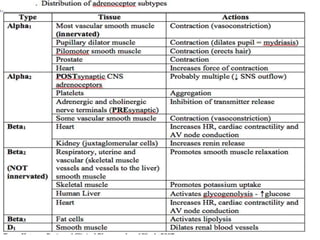
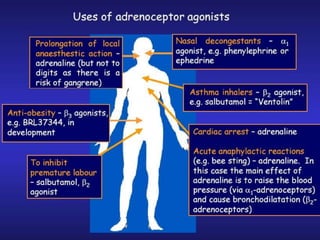
• Adrenergic drugs are medications that stimulate certain nerves in your body.
They do this either by mimicking the action of the chemical messengers
epinephrine and nor epinephrine or by stimulating their release. These drugs
are used in many life-threatening conditions, including cardiac arrest, shock,
asthma attack, or allergic reaction.
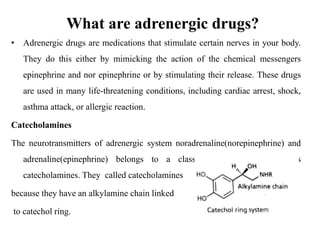
Catecholamines
The neurotransmitters of adrenergic system noradrenaline(norepinephrine) and
adrenaline(epinephrine) belongs to a class of substance known as
catecholamines. They called catecholamines
because they have an alkylamine chain linked
to catechol ring.
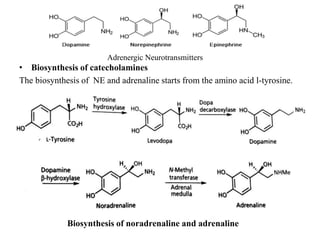
• Biosynthesis of catecholamines
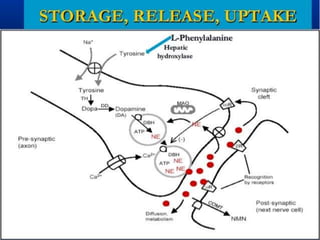
The biosynthesis of NE and adrenaline starts from the amino acid l-tyrosine.
Adrenergic Neurotransmitters
Biosynthesis of noradrenaline and adrenaline
The adrenergic binding site
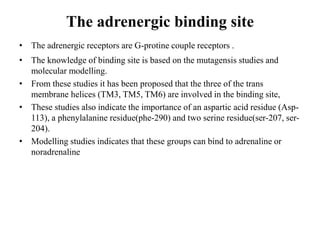
• The adrenergic receptors are G-protine couple receptors .
• The knowledge of binding site is based on the mutagensis studies and
molecular modelling.
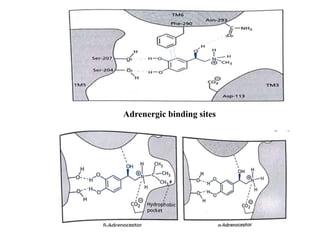
• From these studies it has been proposed that the three of the trans
membrane helices (TM3, TM5, TM6) are involved in the binding site,
• These studies also indicate the importance of an aspartic acid residue (Asp-
113), a phenylalanine residue(phe-290) and two serine residue(ser-207, ser-
204).
• Modelling studies indicates that these groups can bind to adrenaline or
noradrenaline
Adrenergic binding sites
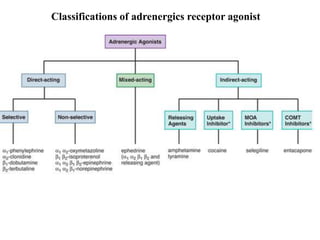
Classifications of adrenergics receptor agonist
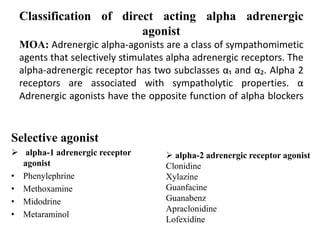
Classification of direct acting alpha adrenergic
agonist
MOA: Adrenergic alpha-agonists are a class of sympathomimetic
agents that selectively stimulates alpha adrenergic receptors. The
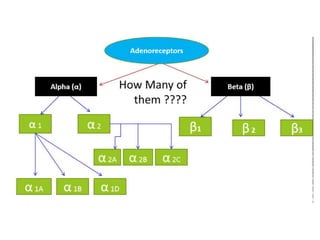
alpha-adrenergic receptor has two subclasses α₁ and α₂. Alpha 2
receptors are associated with sympatholytic properties. α
Adrenergic agonists have the opposite function of alpha blockers
Selective agonist
 alpha-1 adrenergic receptor
agonist
• Phenylephrine
• Methoxamine
• Midodrine
• Metaraminol
 alpha-2 adrenergic receptor agonist
Clonidine
Xylazine
Guanfacine
Guanabenz
Apraclonidine
Lofexidine
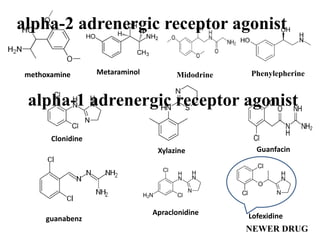
methoxamine Metaraminol
Clonidine
Xylazine Guanfacin
guanabenz
Apraclonidine
Phenylepherine
Lofexidine
Midodrine
alpha-1 adrenergic receptor agonist
alpha-2 adrenergic receptor agonist
NEWER DRUG
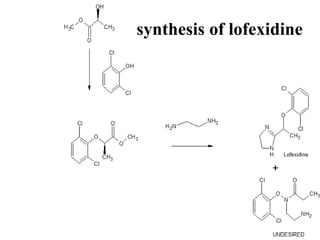
synthesis of lofexidine
Classification of direct acting beta adrenergic
agonist
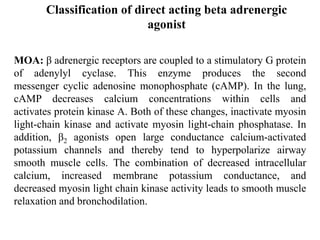
MOA: β adrenergic receptors are coupled to a stimulatory G protein
of adenylyl cyclase. This enzyme produces the second
messenger cyclic adenosine monophosphate (cAMP). In the lung,
cAMP decreases calcium concentrations within cells and
activates protein kinase A. Both of these changes, inactivate myosin
light-chain kinase and activate myosin light-chain phosphatase. In
addition, β2 agonists open large conductance calcium-activated
potassium channels and thereby tend to hyperpolarize airway
smooth muscle cells. The combination of decreased intracellular
calcium, increased membrane potassium conductance, and
decreased myosin light chain kinase activity leads to smooth muscle
relaxation and bronchodilation.
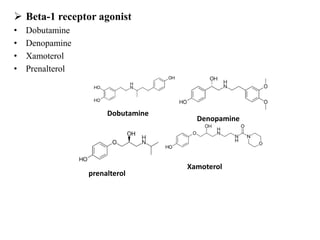
 Beta-1 receptor agonist
• Dobutamine
• Denopamine
• Xamoterol
• Prenalterol
Dobutamine
Denopamine
Xamoterol
prenalterol
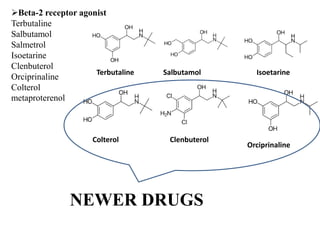
Clenbuterol
IsoetarineSalbutamolTerbutaline
Colterol
Orciprinaline
Beta-2 receptor agonist
Terbutaline
Salbutamol
Salmetrol
Isoetarine
Clenbuterol
Orciprinaline
Colterol
metaproterenol
NEWER DRUGS
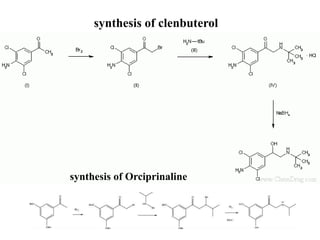
synthesis of clenbuterol
synthesis of Orciprinaline
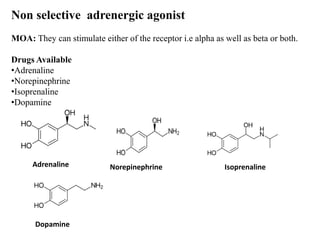
Non selective adrenergic agonist
MOA: They can stimulate either of the receptor i.e alpha as well as beta or both.
Drugs Available
•Adrenaline
•Norepinephrine
•Isoprenaline
•Dopamine
Adrenaline Norepinephrine Isoprenaline
Dopamine
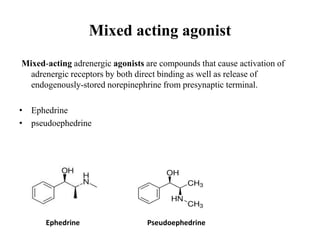
Mixed acting agonist
Mixed-acting adrenergic agonists are compounds that cause activation of
adrenergic receptors by both direct binding as well as release of
endogenously-stored norepinephrine from presynaptic terminal.
• Ephedrine
• pseudoephedrine
Ephedrine Pseudoephedrine
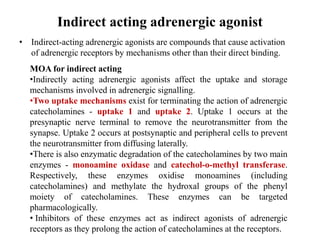
Indirect acting adrenergic agonist
• Indirect-acting adrenergic agonists are compounds that cause activation
of adrenergic receptors by mechanisms other than their direct binding.
MOA for indirect acting
•Indirectly acting adrenergic agonists affect the uptake and storage
mechanisms involved in adrenergic signalling.
•Two uptake mechanisms exist for terminating the action of adrenergic
catecholamines - uptake 1 and uptake 2. Uptake 1 occurs at the
presynaptic nerve terminal to remove the neurotransmitter from the
synapse. Uptake 2 occurs at postsynaptic and peripheral cells to prevent
the neurotransmitter from diffusing laterally.
•There is also enzymatic degradation of the catecholamines by two main
enzymes - monoamine oxidase and catechol-o-methyl transferase.
Respectively, these enzymes oxidise monoamines (including
catecholamines) and methylate the hydroxal groups of the phenyl
moiety of catecholamines. These enzymes can be targeted
pharmacologically.
• Inhibitors of these enzymes act as indirect agonists of adrenergic
receptors as they prolong the action of catecholamines at the receptors.
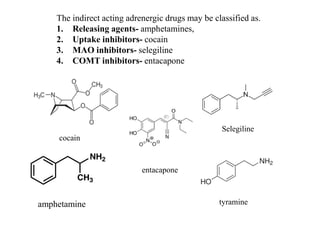
cocain
Selegiline
entacapone
amphetamine tyramine
The indirect acting adrenergic drugs may be classified as.
1. Releasing agents- amphetamines,
2. Uptake inhibitors- cocain
3. MAO inhibitors- selegiline
4. COMT inhibitors- entacapone
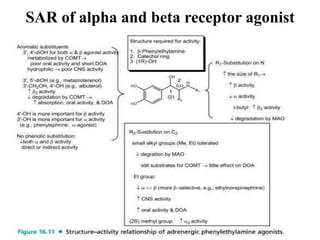
SAR of alpha and beta receptor agonist
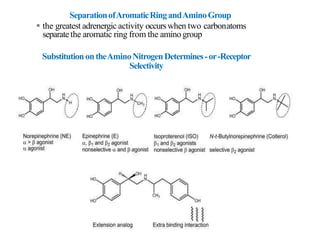
SeparationofAromaticRingandAminoGroup
 the greatest adrenergic activity occurswhen two carbonatoms
separatethe aromatic ring from the amino group
SubstitutionontheAminoNitrogenDetermines-or-Receptor
Selectivity
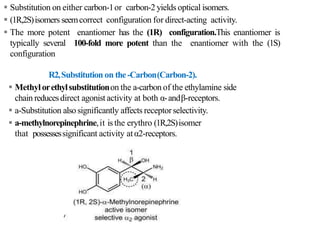
R2,Substitution on the-Carbon(Carbon-2).
 Methylorethylsubstitutionon the a-carbon of the ethylamine side
chain reducesdirect agonist activity at both α-andβ-receptors.
 a-Substitution also significantly affects receptorselectivity.
 a-methylnorepinephrine,it isthe erythro (1R,2S)isomer
that possessessignificant activity atα2-receptors.
 Substitution on either carbon-1or carbon-2 yields optical isomers.
 (1R,2S)isomers seemcorrect configuration for direct-acting activity.
 The more potent enantiomer has the (1R) configuration.This enantiomer is
typically several 100-fold more potent than the enantiomer with the (1S)
configuration
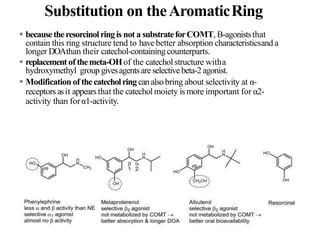
Substitution on theAromaticRing
 becausetheresorcinolringis not a substrateforCOMT, B-agoniststhat
contain this ring structure tend to havebetter absorption characteristicsand a
longer DOAthan their catechol-containingcounterparts.
 replacement of themeta-OHof the catechol structure witha
hydroxymethyl group givesagentsareselectivebeta-2agonist.
 Modification of thecatecholring canalsobring about selectivity at α-
receptors asit appears that the catechol moiety is more important for α2-
activity than forα1-activity.
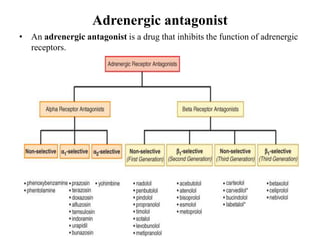
Adrenergic antagonist
• An adrenergic antagonist is a drug that inhibits the function of adrenergic
receptors.
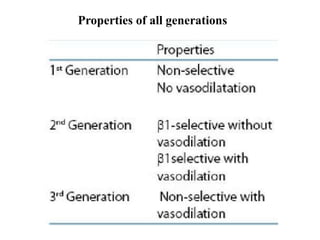
Properties of all generations
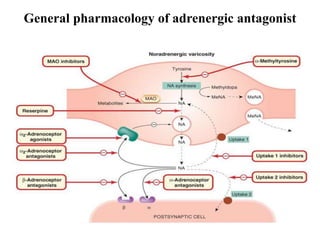
General pharmacology of adrenergic antagonist
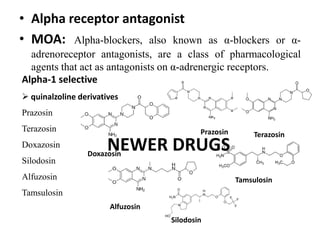
• Alpha receptor antagonist
• MOA: Alpha-blockers, also known as α-blockers or α-
adrenoreceptor antagonists, are a class of pharmacological
agents that act as antagonists on α-adrenergic receptors.
Alpha-1 selective
 quinalzoline derivatives
Prazosin
Terazosin
Doxazosin
Silodosin
Alfuzosin
Tamsulosin
Prazosin Terazosin
Doxazosin
Alfuzosin
Tamsulosin
Silodosin
NEWER DRUGS
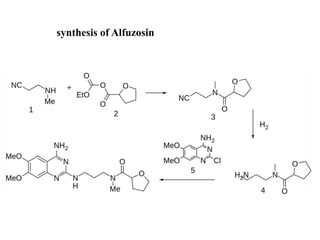
synthesis of Alfuzosin
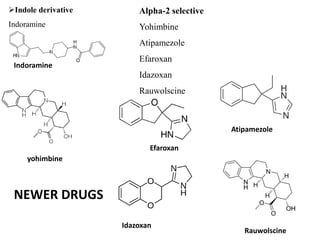
Indole derivative
Indoramine
Indoramine
Alpha-2 selective
Yohimbine
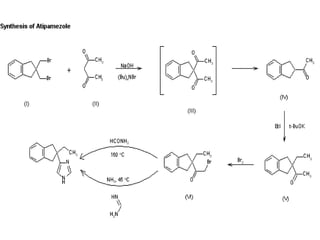
Atipamezole
Efaroxan
Idazoxan
Rauwolscine
yohimbine
Rauwolscine
Idazoxan
Atipamezole
Efaroxan
NEWER DRUGS
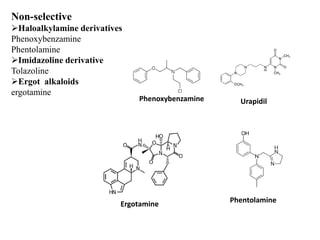
Non-selective
Haloalkylamine derivatives
Phenoxybenzamine
Phentolamine
Imidazoline derivative
Tolazoline
Ergot alkaloids
ergotamine
Phenoxybenzamine
Phentolamine
Urapidil
Ergotamine
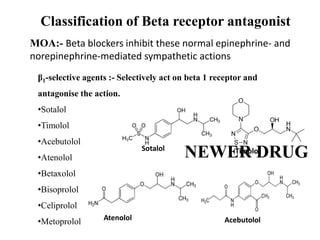
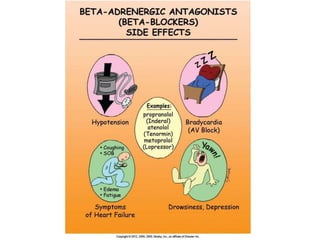
Classification of Beta receptor antagonist
MOA:- Beta blockers inhibit these normal epinephrine- and
norepinephrine-mediated sympathetic actions
β1-selective agents :- Selectively act on beta 1 receptor and
antagonise the action.
•Sotalol
•Timolol
•Acebutolol
•Atenolol
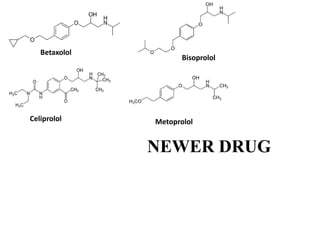
•Betaxolol
•Bisoprolol
•Celiprolol
•Metoprolol
Sotalol Timolol
AcebutololAtenolol
NEWER DRUG
Betaxolol
Bisoprolol
Celiprolol Metoprolol
NEWER DRUG
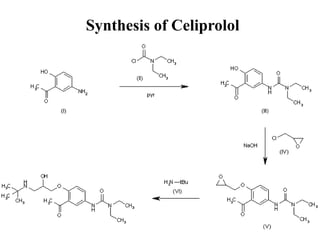
Synthesis of Celiprolol
Beta receptor antagonist
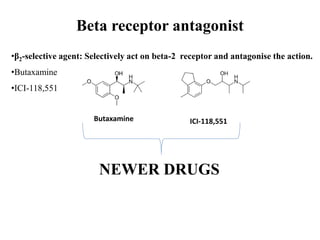
•β2-selective agent: Selectively act on beta-2 receptor and antagonise the action.
•Butaxamine
•ICI-118,551
Butaxamine ICI-118,551
NEWER DRUGS
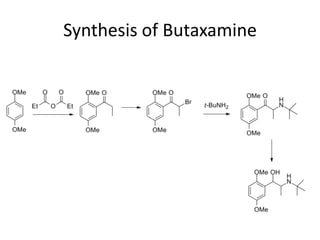
Synthesis of Butaxamine
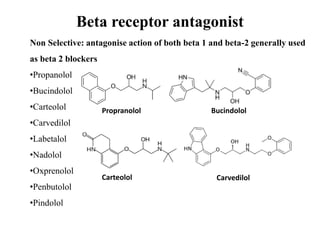
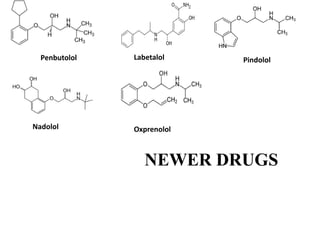
Non Selective: antagonise action of both beta 1 and beta-2 generally used
as beta 2 blockers
•Propanolol
•Bucindolol
•Carteolol
•Carvedilol
•Labetalol
•Nadolol
•Oxprenolol
•Penbutolol
•Pindolol
Beta receptor antagonist
Propranolol Bucindolol
Carteolol Carvedilol
Penbutolol
OxprenololNadolol
Labetalol Pindolol
NEWER DRUGS
Synthesis of Penbutolol
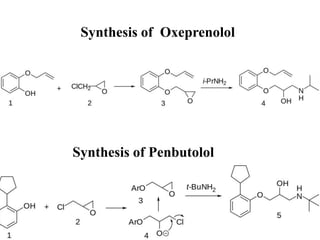
Synthesis of Oxeprenolol
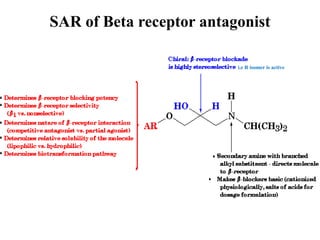
SAR of Beta receptor antagonist
i.e R isomer is active
Adrenergic drugs
Adrenergic drugs
Adrenergic drugs
Adrenergic drugs