SYMPATHOMIMETIC AGENTS
BY
KENCHA SWATHI
ASSISTANT PROFESSOR
ABIPER
BANGALORE
DEFINITION:
 Sympathomimetics are substances that mimic or modify the actions of
endogenous catecholamines of the sympathetic nervous system. Direct agonists
directly activate adrenergic receptors while indirect agonists enhance the
actions of endogenous catecholamines.
 Sympathomimetics can also be called as adrenergic agonists.
 The endogenous catecholamines or sympathetic neurotransmitters are
adrenaline, noradrenaline, dopamine.
Classification of sympathomimetics
SYMPATHOMIMETICS
DIRECT ACTING
INDIRECT ACTING
MIXED ACTING
DIRECT ACTING SYMPATHOMIMETICS
Definition: Drugs which act directly on one or more adrenergic receptors to show its
stimulating action .This type of drugs are called as direct acting sympathomimetics.
Direct acting sympathomimetics are again classified into three classes:
1.Selective α agonist: Drugs which bind selectively to any one type of α receptors.
Eg: methyldopa, clonidine, phenylephrine, naphazoline,
oxymetazoline, xylometazoline
2.Selective β agonist: Drugs which bind selectively to any one type of β receptors.
Eg: Isoproterenol, Dobutamine, salbutamol, terbutaline, bitolterol
3.Nonselective agonist: Drugs which can bind to both types of receptor(α, β) are called as
nonselective adrenergic agonists.
Eg: Epinephrine, norepinephrine, Dopamine
STRUCTURE AND ITS USES:
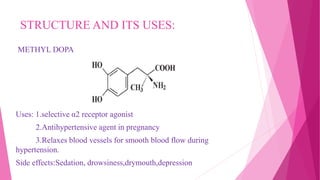
METHYL DOPA
Uses: 1.selective α2 receptor agonist
2.Antihypertensive agent in pregnancy
3.Relaxes blood vessels for smooth blood flow during
hypertension.
Side effects:Sedation, drowsiness,drymouth,depression
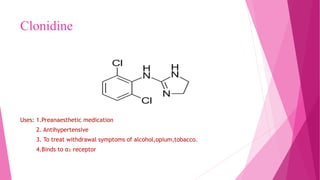
Clonidine
Uses: 1.Preanaesthetic medication
2. Antihypertensive
3. To treat withdrawal symptoms of alcohol,opium,tobacco.
4.Binds to α₂ receptor
PHENYLEPHRINE
 Uses: 1. Phenylephrine is an α₁ adrenergic receptor agonist
2.used to treat hypotension, dilate the pupil, and induce local vasoconstriction. (to
treat low b.p)
3.To treat nasal decongestion
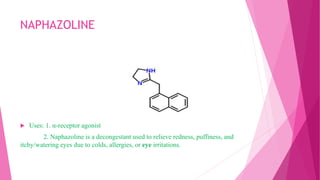
NAPHAZOLINE
 Uses: 1. α-receptor agonist
2. Naphazoline is a decongestant used to relieve redness, puffiness, and
itchy/watering eyes due to colds, allergies, or eye irritations.
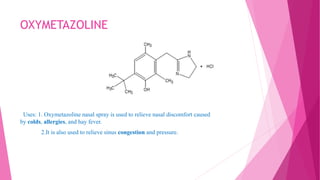
OXYMETAZOLINE
Uses: 1. Oxymetazoline nasal spray is used to relieve nasal discomfort caused
by colds, allergies, and hay fever.
2.It is also used to relieve sinus congestion and pressure.
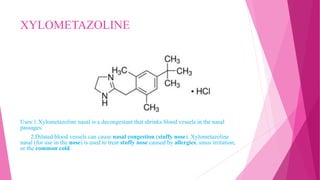
XYLOMETAZOLINE
Uses:1.Xylometazoline nasal is a decongestant that shrinks blood vessels in the nasal
passages.
2.Dilated blood vessels can cause nasal congestion (stuffy nose). Xylometazoline
nasal (for use in the nose) is used to treat stuffy nose caused by allergies, sinus irritation,
or the common cold.
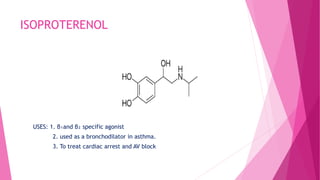
ISOPROTERENOL
USES: 1. β₁and β₂ specific agonist
2. used as a bronchodilator in asthma.
3. To treat cardiac arrest and AV block
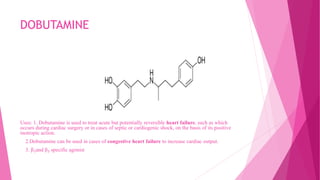
DOBUTAMINE
Uses: 1. Dobutamine is used to treat acute but potentially reversible heart failure, such as which
occurs during cardiac surgery or in cases of septic or cardiogenic shock, on the basis of its positive
inotropic action.
2.Dobutamine can be used in cases of congestive heart failure to increase cardiac output.
3. β₁and β₂ specific agonist
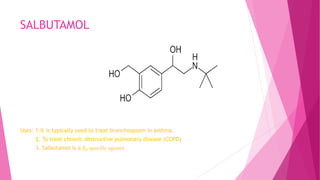
SALBUTAMOL
Uses: 1.It is typically used to treat bronchospasm in asthma.
2. To treat chronic obstructive pulmonary disease (COPD)
3. Salbutamol is a β₂ specific agonist
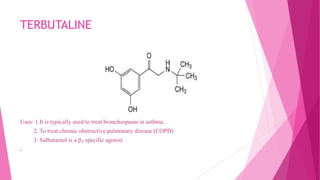
TERBUTALINE
Uses: 1.It is typically used to treat bronchospasm in asthma.
2. To treat chronic obstructive pulmonary disease (COPD)
3. Salbutamol is a β₂ specific agonist
.
BITOLTEROL
Uses: 1.Bronchodilator in chronic lung disorders.
2.withdrawan from the market in 2011 because of severe breathing difficulty in
patients after long term use.
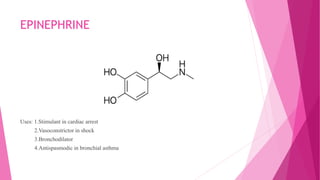
EPINEPHRINE
Uses: 1.Stimulant in cardiac arrest
2.Vasoconstrictor in shock
3.Bronchodilator
4.Antispasmodic in bronchial asthma
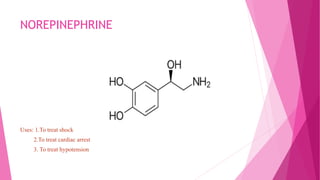
NOREPINEPHRINE
Uses: 1.To treat shock
2.To treat cardiac arrest
3. To treat hypotension
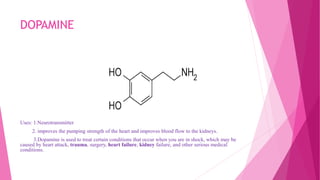
DOPAMINE
Uses: 1.Neurotransmitter
2. improves the pumping strength of the heart and improves blood flow to the kidneys.
3.Dopamine is used to treat certain conditions that occur when you are in shock, which may be
caused by heart attack, trauma, surgery, heart failure, kidney failure, and other serious medical
conditions.
INDIRECT ACTING SYMPATHOMIMETICS
Definition: Drugs which stimulates the release of endogenous
catecholamines/neurotransmitters from the synaptic nerve terminal or storage vesicles are
called as indirect acting sympathomimetics.
Eg:Hydroxyamphetamine
Pseudoephedrine
Propylhexedrine
HYDROXYAMPHETAMINE
Uses: 1. It releases norepinephrine from post synaptic nerve ending.
2.Diltaes the pupil during eye surgery
3.To treat horner’s pupil syndrome (nerve lesions in eye)
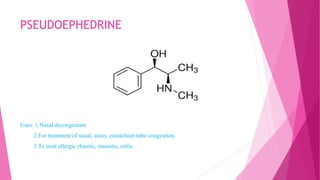
PSEUDOEPHEDRINE
Uses: 1.Nasal decongestant
2.For treatment of nasal, sinus, eustachian tube congestion.
3.To treat allergic rhinitis, sinusitis, otitis.
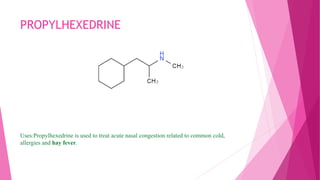
PROPYLHEXEDRINE
Uses:Propylhexedrine is used to treat acute nasal congestion related to common cold,
allergies and hay fever.
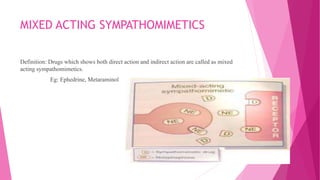
MIXED ACTING SYMPATHOMIMETICS
Definition: Drugs which shows both direct action and indirect action are called as mixed
acting sympathomimetics.
Eg: Ephedrine, Metaraminol
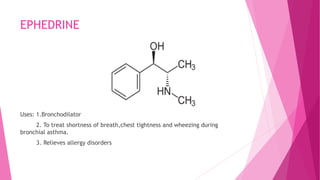
EPHEDRINE
Uses: 1.Bronchodilator
2. To treat shortness of breath,chest tightness and wheezing during
bronchial asthma.
3. Relieves allergy disorders
METARAMINOL
Uses: 1.To treat hypotension
2. To treat cardiac shock
3.Nasal decongestant
Mechanism of action
 Direct acting sympathomimetics :Direct acting sympathomimetic drugs
directly binds to the adrenergic receptors (α or β) and stimulates the
adrenergic agonistic activity.
 Indirect acting sympathomimetics: Indirectly acting sympathomimetics may
enter into the sympathetic nerve ending and displace stored neurotransmitter
into the synaptic cleft. Some of the drugs may inhibit the reuptake of
released neurotransmitter into the storage vesicle by using transporter.
 Mixed acting sympathomimetics: These drugs directly stimulates the agonistic
activity by binding to the adrenergic receptors and indirectly stimulates the
receptor by causing the release of stored neurotransmitters from the storage
vesicles in the synaptic nerve endings. Both direct and indirect activity has
been shown by the mixed acting sympathomimetic drugs.
Medicinal chemistry adrenergic agonists