Presented By:
FARAZ Ahmad
Muhammad Ahsan
ADRENAL
GLAND
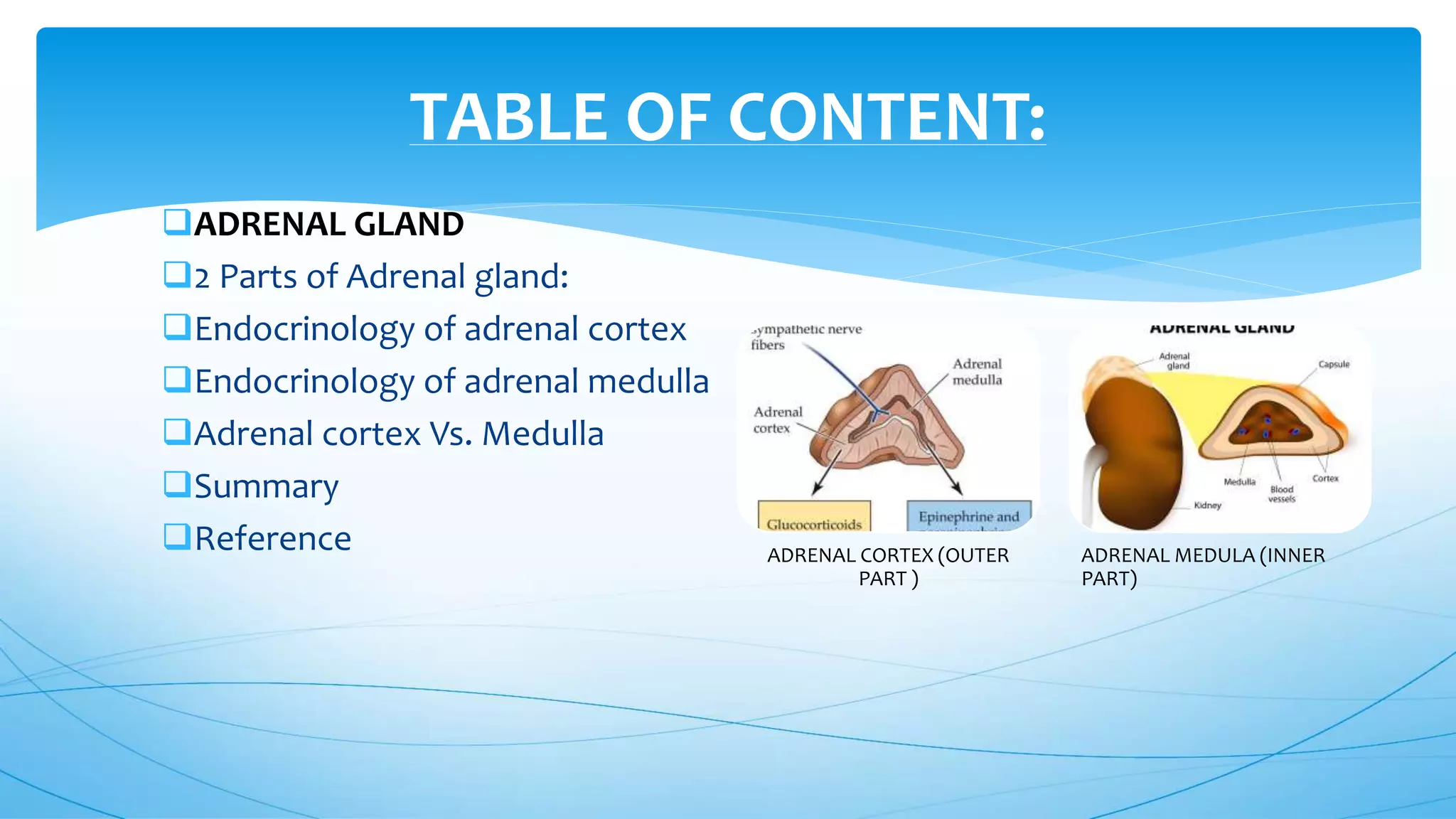
ADRENAL GLAND
2 Parts of Adrenal gland:
Endocrinology of adrenal cortex
Endocrinology of adrenal medulla
Adrenal cortex Vs. Medulla
Summary
Reference
TABLE OF CONTENT:
ADRENAL CORTEX (OUTER
PART )
ADRENAL MEDULA (INNER
PART)
 The word adrenal comes from the Latin ad
meaning "near" and Renes meaning "kidney“.
 It is also known as Supra-Renal gland. They
are found above the both of kidneys.
 Each gland has an outer cortex which
produces steroid hormones and an inner
medulla.
 These are endocrine gland that produce a
variety of hormones including adrenaline and
the steroids aldosterone and cortisol etc.
Adrenal Gland
Adrenal gland:
There are two parts are different from each other in
development, structure and functions
Parts of
Adrenal gland:
ADRENAL MEDULLA
(Central Portion)
--- Constituting 20% of the gland
ADRENAL CORTEX
(Outer portion)
---Constituting 80% of the gland
Mode Of Action Of Adrenal Gland
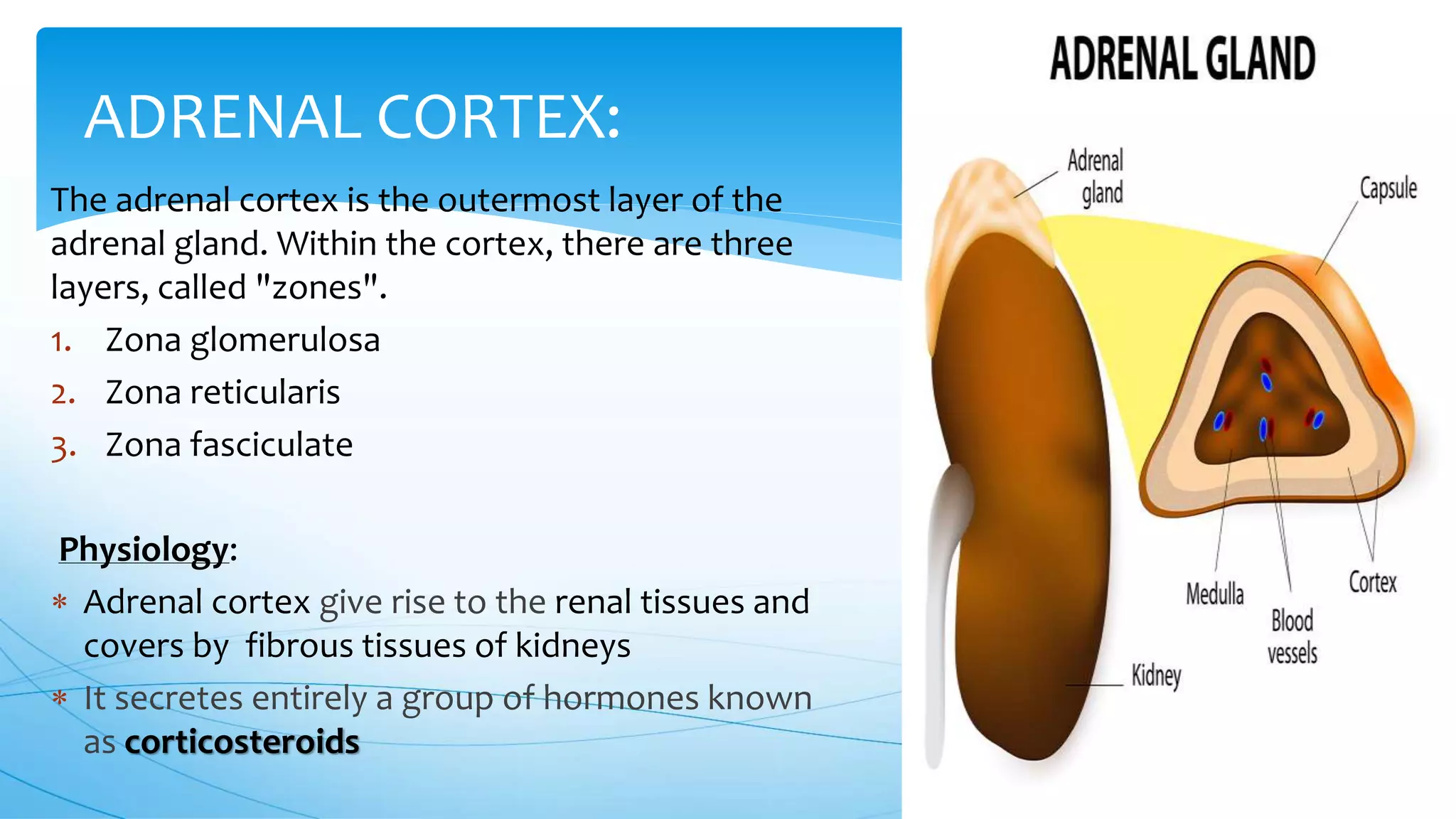
The adrenal cortex is the outermost layer of the
adrenal gland. Within the cortex, there are three
layers, called "zones".
1. Zona glomerulosa
2. Zona reticularis
3. Zona fasciculate
Physiology:
 Adrenal cortex give rise to the renal tissues and
covers by fibrous tissues of kidneys
 It secretes entirely a group of hormones known
as corticosteroids
ADRENAL CORTEX:
HORMONES OF ADRENAL CORTEX
 Adrenocortical hormones are steroids in nature, hence the name
‘corticosteroids’.
 Based on their functions, corticosteroids are classified into three groups:
1. Mineralocorticoids
2. Glucocorticoids
3. Sex hormones
1. MINERALOCORTICOIDS;
1. SOUCE OF SECRETION: ZONA GLOMERULOSA
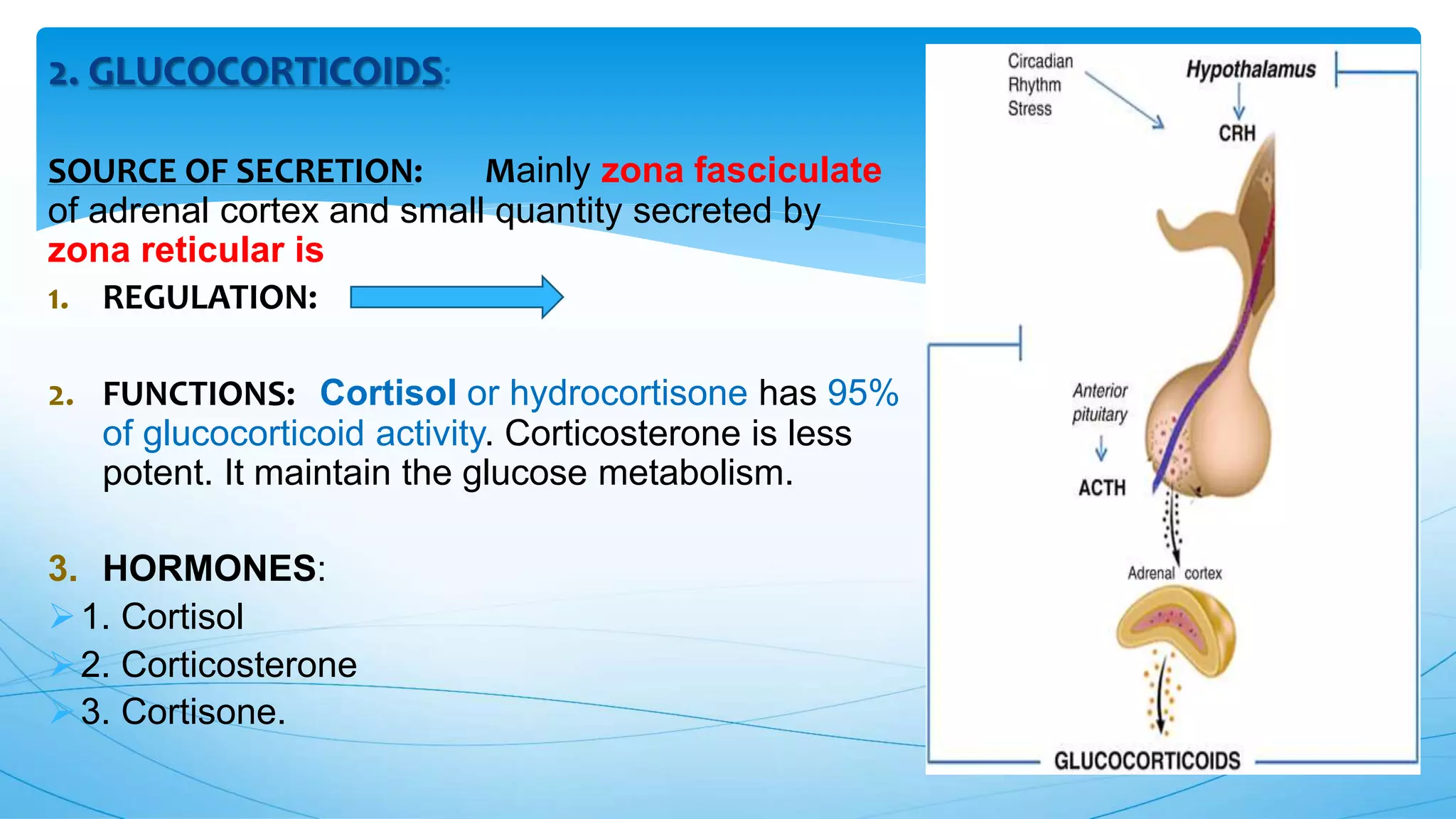
2. REGULATION: corticoid releasing hormone—(CRH) by hypothalamus
and Adrenocorticotropic hormone ---(ACTH) by pituitary gland.
3. FUNCTIONS:
 „99% of its activity is provided by aldosterone.
 It maintains the osmolality and volume of ECF.
 It is usually called Life-Saving Hormone because, its absence causes death within 3 days to 2
weeks.
 Mineralocorticoids are the corticosteroids that act on the minerals (electrolytes), particularly
Na & K+
4. HORMONES:
 Aldosterone
 11-deoxycorticosterone
Physiology of ADRENOCORTICAL HORMONES
 Aldosterone has three important functions:
It increases:
1. Reabsorption of sodium from renal tubules
2. Excretion of potassium through renal tubules
3. Secretion of hydrogen into renal tubules.
4. Increase in ECF volume and the blood volume finally leads to increase in blood
pressure.
2. GLUCOCORTICOIDS:
SOURCE OF SECRETION: Mainly zona fasciculate
of adrenal cortex and small quantity secreted by
zona reticular is
1. REGULATION:
2. FUNCTIONS: Cortisol or hydrocortisone has 95%
of glucocorticoid activity. Corticosterone is less
potent. It maintain the glucose metabolism.
3. HORMONES:
1. Cortisol
2. Corticosterone
3. Cortisone.
ACTION OF GLUCOCORTICOIDS;
1. On Carbohydrate Metabolism; Increase BG level
2. On Protein Metabolism; catabolism of proteins
3. On Fat Metabolism
4. On Water Metabolism; maintenance of water balance, by accelerating
excretion of water.
5. On Mineral Metabolism
6. On Bone; --stimulate the bone resorption (osteoclastic activity)
7. Anti-allergic Actions prevent various allergic reactions
8. Immunosuppressive Effects; -- suppress the immune system(T-cells)
3. ADRENAL SEX HORMONES
*SOURCE OF SECRETION; mainly by zona reticularis and
small quantity from zona fasciculata.
1. REGULATION
2. FUNCTIONS: Maintenance of male and female genital
hormones in both
3. HORMONES:
Androgens:
 Androgens secreted by adrenal cortex:
 1. Dehydroepiandrosterone(DHEA)
 2. Androstenedione
 3. Testosterone.
Small quantity of estrogen & progesterone is also
produces by Adrenal Cortex
1. CUSHING SYNDROME ( Hyper secretion of Adrenal Hormone)
Cushing syndrome is a disorder characterized by obesity.
Cushing syndrome is due to the HYPERSECRETION of glucocorticoids,
particularly cortisol.
It may be either due to pituitary tumor origin or adrenal origin.
2. HYPER-ALDOSTERONISM; --- Increased secretion of aldosterone.
2. ADDISON DISEASE OR
CHRONIC ADRENAL INSUFFICIENCY; ---The failure of adrenal cortex to
secrete corticosteroids.
Pathology of cortico-Adrenal Hormones:
 Adrenal Medulla is an inner part of adrenal gland and form 20% of adrenal
gland.
 Adrenal Medulla formed by 2 types of Chromaffin cells.
Types of cells :
Adrenaline secreting cells [90%].
Nor-Adrenaline secreting cells [10%].
Adrenal Medulla
Hormones of adrenal Medulla are derived from amines and catecholamine's.
1. ADRENALINE. [Epinephrine]
2. NOR-ADRENALINE. [Nor-Epinephrine]
3. DOPAMINE. [Prothrombin inhibitory hormone]
The mode of action of these hormones depends upon adrenergic receptors.
 Alpha adrenergic receptors(1&2).
 Beta adrenergic receptors (1&2).
Hormones of Adrenal Medulla
Actions
Adrenal Medullary hormones;
RESPONSES
1) On Metabolism Increase synthesis Protein.
Mobilization of Fats.
Conservation of Carbohydrates.
2) On Blood Adrenaline Dec. Coagulation time of blood.
Increase the circulation of RBC's in blood
3) On Heart
4) On Respiration
Increase Systolic Blood pressure.
Decrease Diastolic Blood pressure.
Adrenaline have stronger effects on heart than Nor-
adrenaline.
Adrenaline Inc. the rate of respiration
5. CNS: Secretion of Adrenaline increases during fight or flight
reactions after exposure of stress.
6) Skeletal Muscles Adrenaline Inc. Contraction of muscles and increases
muscles activity.
7) Smooth Muscles Catecholamine's increases the Contraction of smooth
muscles.
Adrenal Medulla secrets its hormones in rest conditions.
Also, During stress, the secretion of Adrenal hormones increase.
Adrenaline and Nor-Adrenaline initiate the flight or fight responses.
During exposure to cold secretion of catecholamine's increases.
Also in Hypoglycemia, secretion of catecholamine's increases.
Source of Secretion of catecholamine's :
Secretion of catecholamine's are from Chromaffin cells in adrenal medulla.
Regulation of secretion of Adrenal Hormone
 The abnormal secretion of hormones from Adrenal gland is harmful for
our body.
 The hyper secretion of hormones of Adrenal Medulla is called
Pheochromocytoma.
Cause:
The major cause of Pheochromocytoma is tumor of Chromofill cells in
adrenal medulla.
Pathology of Adrenal Medulla
Hypo secretion of Adrenal Hormone cause many complications in our body
Hypo secretion of adrenal gland hormones occurs due to deficiency and
decrease the synthesis of hormones.
ADDISON DISEASE OR
CHRONIC ADRENAL INSUFFICIENCY
Pathology of Adrenal Medulla
CORTISOL TEST
Aldosterone test
ACTH TEST
RENIN TEST
RFT’S
Special hormonal test:
(SPECIAL CHEMISTRY)
ADRENO-
CORTICAL
HORMONES
MINERALOCORTICOIDS
Transported in
blood by binding
with plasma
proteins
Mineralocorticoids
Hormones:
1) Aldosterone
2) 11-
deoxycorticosterone
GLUCOCORTICOIDS
Transportedby a
special plasma
protein known as
glucocorticoids-
binding globulin.
Glucocorticoids
Hormones:
1) Cortisol
2) Corticosterone
3) Cortisone.
ADRENAL SEX
HORMONES
Transported by
plasma protein known
as sex hormone-
binding globulin
Adrenal sex
hormones:
Androgens;
1.Dehydroepiandros
terone(DHEA)
2.Androstenedione
3. Testosterone.
4.Estrogen
&
progesterone
Adreno-
Medullary
Hormones
ADRENALINE NOR-ADRENALINE DOPAMINE
Epinephrine Nor-Epinephrine Prothrombin inhibitory
hormone
 https://en.wikipedia.org/wiki/Adrenal_gland
 https://www.slideshare.net/bdrabby/adrenal-hormone
 https://en.encyclopedia.org.pk/encyclo/Adrenal_gland
 https://www.elsevier_physiology.com.
 https://www.ncbi.adrenalharmones.chacha.g.
 https://www. medicalnews.com.
 https://www.sciencedirect.com. Adrenal. Pathology. 123-900-/.in.
REFERENCES:
Adrenal gland

Adrenal gland

  • 1.
  • 2.
    ADRENAL GLAND 2 Partsof Adrenal gland: Endocrinology of adrenal cortex Endocrinology of adrenal medulla Adrenal cortex Vs. Medulla Summary Reference TABLE OF CONTENT: ADRENAL CORTEX (OUTER PART ) ADRENAL MEDULA (INNER PART)
  • 3.
     The wordadrenal comes from the Latin ad meaning "near" and Renes meaning "kidney“.  It is also known as Supra-Renal gland. They are found above the both of kidneys.  Each gland has an outer cortex which produces steroid hormones and an inner medulla.  These are endocrine gland that produce a variety of hormones including adrenaline and the steroids aldosterone and cortisol etc. Adrenal Gland
  • 4.
    Adrenal gland: There aretwo parts are different from each other in development, structure and functions Parts of Adrenal gland: ADRENAL MEDULLA (Central Portion) --- Constituting 20% of the gland ADRENAL CORTEX (Outer portion) ---Constituting 80% of the gland
  • 5.
    Mode Of ActionOf Adrenal Gland
  • 6.
    The adrenal cortexis the outermost layer of the adrenal gland. Within the cortex, there are three layers, called "zones". 1. Zona glomerulosa 2. Zona reticularis 3. Zona fasciculate Physiology:  Adrenal cortex give rise to the renal tissues and covers by fibrous tissues of kidneys  It secretes entirely a group of hormones known as corticosteroids ADRENAL CORTEX:
  • 7.
    HORMONES OF ADRENALCORTEX  Adrenocortical hormones are steroids in nature, hence the name ‘corticosteroids’.  Based on their functions, corticosteroids are classified into three groups: 1. Mineralocorticoids 2. Glucocorticoids 3. Sex hormones
  • 8.
    1. MINERALOCORTICOIDS; 1. SOUCEOF SECRETION: ZONA GLOMERULOSA 2. REGULATION: corticoid releasing hormone—(CRH) by hypothalamus and Adrenocorticotropic hormone ---(ACTH) by pituitary gland. 3. FUNCTIONS:  „99% of its activity is provided by aldosterone.  It maintains the osmolality and volume of ECF.  It is usually called Life-Saving Hormone because, its absence causes death within 3 days to 2 weeks.  Mineralocorticoids are the corticosteroids that act on the minerals (electrolytes), particularly Na & K+ 4. HORMONES:  Aldosterone  11-deoxycorticosterone Physiology of ADRENOCORTICAL HORMONES
  • 9.
     Aldosterone hasthree important functions: It increases: 1. Reabsorption of sodium from renal tubules 2. Excretion of potassium through renal tubules 3. Secretion of hydrogen into renal tubules. 4. Increase in ECF volume and the blood volume finally leads to increase in blood pressure.
  • 10.
    2. GLUCOCORTICOIDS: SOURCE OFSECRETION: Mainly zona fasciculate of adrenal cortex and small quantity secreted by zona reticular is 1. REGULATION: 2. FUNCTIONS: Cortisol or hydrocortisone has 95% of glucocorticoid activity. Corticosterone is less potent. It maintain the glucose metabolism. 3. HORMONES: 1. Cortisol 2. Corticosterone 3. Cortisone.
  • 11.
    ACTION OF GLUCOCORTICOIDS; 1.On Carbohydrate Metabolism; Increase BG level 2. On Protein Metabolism; catabolism of proteins 3. On Fat Metabolism 4. On Water Metabolism; maintenance of water balance, by accelerating excretion of water. 5. On Mineral Metabolism 6. On Bone; --stimulate the bone resorption (osteoclastic activity) 7. Anti-allergic Actions prevent various allergic reactions 8. Immunosuppressive Effects; -- suppress the immune system(T-cells)
  • 12.
    3. ADRENAL SEXHORMONES *SOURCE OF SECRETION; mainly by zona reticularis and small quantity from zona fasciculata. 1. REGULATION 2. FUNCTIONS: Maintenance of male and female genital hormones in both 3. HORMONES: Androgens:  Androgens secreted by adrenal cortex:  1. Dehydroepiandrosterone(DHEA)  2. Androstenedione  3. Testosterone. Small quantity of estrogen & progesterone is also produces by Adrenal Cortex
  • 13.
    1. CUSHING SYNDROME( Hyper secretion of Adrenal Hormone) Cushing syndrome is a disorder characterized by obesity. Cushing syndrome is due to the HYPERSECRETION of glucocorticoids, particularly cortisol. It may be either due to pituitary tumor origin or adrenal origin. 2. HYPER-ALDOSTERONISM; --- Increased secretion of aldosterone. 2. ADDISON DISEASE OR CHRONIC ADRENAL INSUFFICIENCY; ---The failure of adrenal cortex to secrete corticosteroids. Pathology of cortico-Adrenal Hormones:
  • 14.
     Adrenal Medullais an inner part of adrenal gland and form 20% of adrenal gland.  Adrenal Medulla formed by 2 types of Chromaffin cells. Types of cells : Adrenaline secreting cells [90%]. Nor-Adrenaline secreting cells [10%]. Adrenal Medulla
  • 15.
    Hormones of adrenalMedulla are derived from amines and catecholamine's. 1. ADRENALINE. [Epinephrine] 2. NOR-ADRENALINE. [Nor-Epinephrine] 3. DOPAMINE. [Prothrombin inhibitory hormone] The mode of action of these hormones depends upon adrenergic receptors.  Alpha adrenergic receptors(1&2).  Beta adrenergic receptors (1&2). Hormones of Adrenal Medulla
  • 16.
    Actions Adrenal Medullary hormones; RESPONSES 1)On Metabolism Increase synthesis Protein. Mobilization of Fats. Conservation of Carbohydrates. 2) On Blood Adrenaline Dec. Coagulation time of blood. Increase the circulation of RBC's in blood 3) On Heart 4) On Respiration Increase Systolic Blood pressure. Decrease Diastolic Blood pressure. Adrenaline have stronger effects on heart than Nor- adrenaline. Adrenaline Inc. the rate of respiration 5. CNS: Secretion of Adrenaline increases during fight or flight reactions after exposure of stress. 6) Skeletal Muscles Adrenaline Inc. Contraction of muscles and increases muscles activity. 7) Smooth Muscles Catecholamine's increases the Contraction of smooth muscles.
  • 17.
    Adrenal Medulla secretsits hormones in rest conditions. Also, During stress, the secretion of Adrenal hormones increase. Adrenaline and Nor-Adrenaline initiate the flight or fight responses. During exposure to cold secretion of catecholamine's increases. Also in Hypoglycemia, secretion of catecholamine's increases. Source of Secretion of catecholamine's : Secretion of catecholamine's are from Chromaffin cells in adrenal medulla. Regulation of secretion of Adrenal Hormone
  • 18.
     The abnormalsecretion of hormones from Adrenal gland is harmful for our body.  The hyper secretion of hormones of Adrenal Medulla is called Pheochromocytoma. Cause: The major cause of Pheochromocytoma is tumor of Chromofill cells in adrenal medulla. Pathology of Adrenal Medulla
  • 19.
    Hypo secretion ofAdrenal Hormone cause many complications in our body Hypo secretion of adrenal gland hormones occurs due to deficiency and decrease the synthesis of hormones. ADDISON DISEASE OR CHRONIC ADRENAL INSUFFICIENCY Pathology of Adrenal Medulla
  • 20.
    CORTISOL TEST Aldosterone test ACTHTEST RENIN TEST RFT’S Special hormonal test: (SPECIAL CHEMISTRY)
  • 21.
    ADRENO- CORTICAL HORMONES MINERALOCORTICOIDS Transported in blood bybinding with plasma proteins Mineralocorticoids Hormones: 1) Aldosterone 2) 11- deoxycorticosterone GLUCOCORTICOIDS Transportedby a special plasma protein known as glucocorticoids- binding globulin. Glucocorticoids Hormones: 1) Cortisol 2) Corticosterone 3) Cortisone. ADRENAL SEX HORMONES Transported by plasma protein known as sex hormone- binding globulin Adrenal sex hormones: Androgens; 1.Dehydroepiandros terone(DHEA) 2.Androstenedione 3. Testosterone. 4.Estrogen & progesterone
  • 22.
  • 24.
     https://en.wikipedia.org/wiki/Adrenal_gland  https://www.slideshare.net/bdrabby/adrenal-hormone https://en.encyclopedia.org.pk/encyclo/Adrenal_gland  https://www.elsevier_physiology.com.  https://www.ncbi.adrenalharmones.chacha.g.  https://www. medicalnews.com.  https://www.sciencedirect.com. Adrenal. Pathology. 123-900-/.in. REFERENCES: