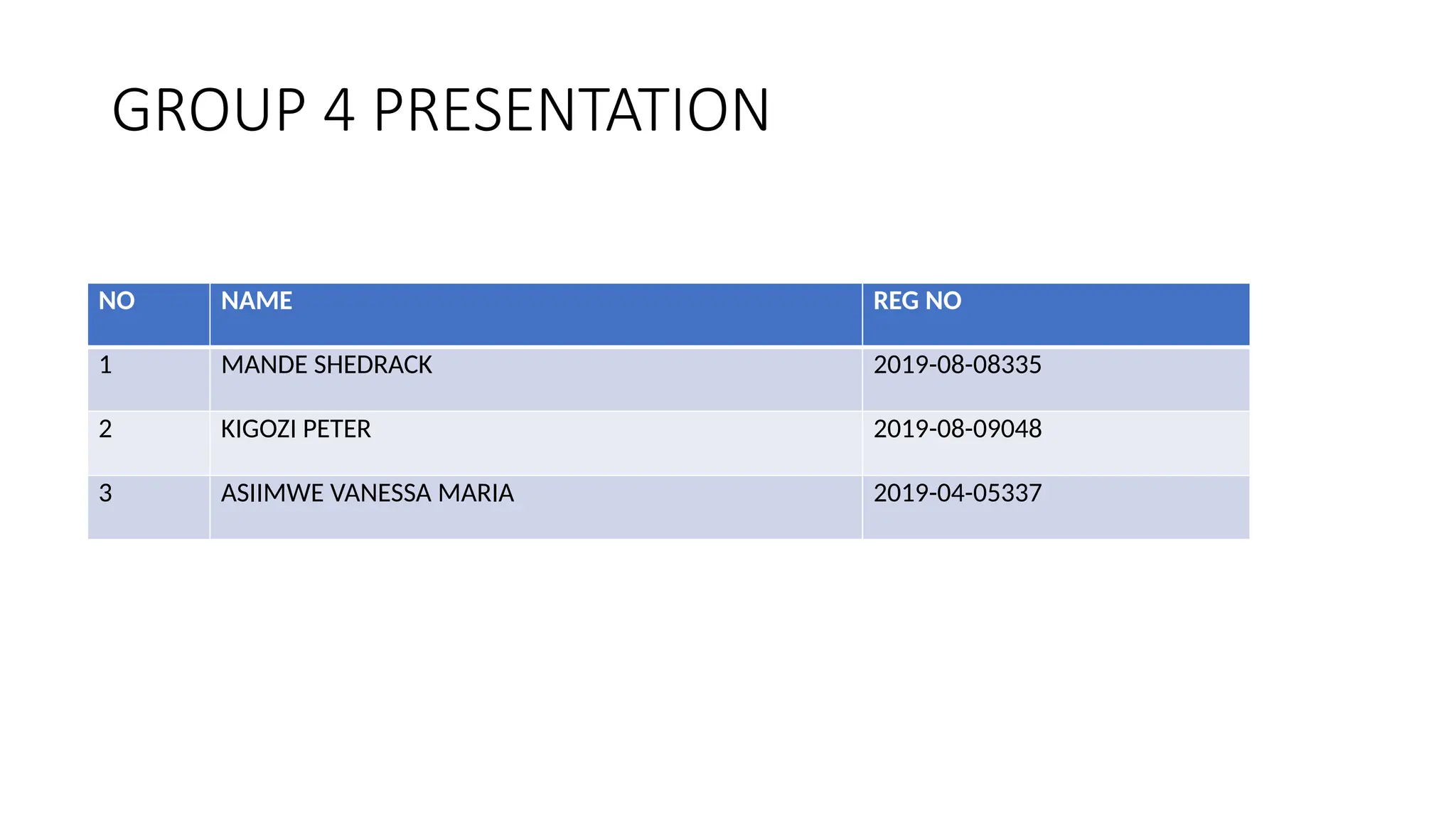
GROUP 4 PRESENTATION
NO NAME REG NO
1 MANDE SHEDRACK 2019-08-08335
2 KIGOZI PETER 2019-08-09048
3 ASIIMWE VANESSA MARIA 2019-04-05337
Attention Deficit Hyperactivity Disorder (ADHD)
OUTLINE
• INTRODUCTION
Definition
Subtypes
• EPIDEMIOLOGY
• ETIOLOGY
• DIAGNOSIS
Clinical features
Pathology and laboratory exam
• DIFFERENTIAL DIAGNOSIS
contn
• COURSE AND PROGNOSIS
• TREATMENT
Pharmacotherapy.
Stimulant
Non stimulant.
Psychosocial intervention
Multimodal treatment study.
• UNSPECIFIED ATTENTION DEFICIT HYPERACTIVE DISORDER.
Adult manifestation of ADHD
INTRODUCTION
BASIC DEFINITIONS.
• ADHD is a neuropsychiatric condition affecting preschoolers, children, adolescents,
and adults around the world, characterized by a pattern of diminished sustained
attention, and increased impulsivity or hyperactivity.
• Inattention manifests behaviorally in ADHD as wandering off tasks, failing to
follow through on instructions or finishing work or chores, having difficulty
sustaining focus, and being disorganized and the inattention is not attributable to
defiance or lack of comprehension.
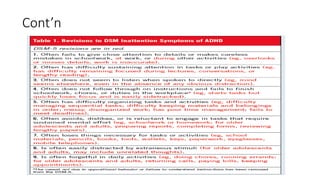
Cont’n
• Hyperactivity refers to excessive motor activity (such as a child running about)
when it is not appropriate, or excessive fidgeting, tapping, or talkativeness. In
adults, hyperactivity may manifest as extreme restlessness or wearing others out
with their activity.
• Impulsivity refers to hasty actions that occur in the moment without forethought,
which may have potential for harm to the individual (e.g., darting into the street
without looking).
• Primary deficits of ADHD may cause functional limitations of effective
communication, social participation, or academic achievement.
SUBTYPES
1. Combined presentation,
2. Predominantly inattentive presentation,
3. Predominantly hyperactive/impulsive presentation.
Epidemiology
• Rates of ADHD;
7 to 8 % in prepubertal elementary school children.
5% in youth (children & adolescents).
2.5% in adults.
• Prevalence in male to female ranges from ratios of 2:1 to as high as 9:1.
• Rate is greater in families with a hx of ADHD (1st
degree relatives) than in the
general population.( 2-8 times greater)
• At high risk of other psychiatric disorders like anxiety, disruptive & depressive
disorders.
• Increased incidence of substance use in parents with children suffering from ADHD.
ETIOLOGY
• Data suggest that the etiology of ADHD is largely genetic, with a heritability of
approximately 75%.
Factors/theologies include;
1. Genetic factors.
2. Neurochemical factors.
3. Neurophysiological factors.
4. Neuroanatomical aspects.
5. Developmental factors.
6. Psychosocial factors.
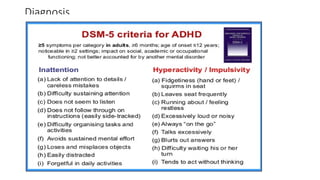
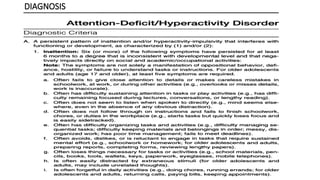
Diagnosis
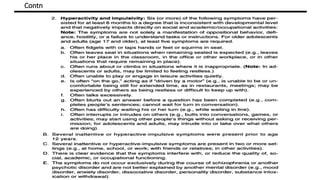
DIAGNOSIS
Contn
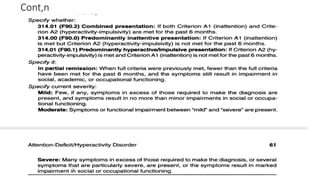
Cont,n
Cont’n
Clinical features
• ADHD can have its onset in infancy, although it is rarely recognized until a child is
at least toddler age. More commonly, infants with ADHD are active in the crib, sleep
little, and cry a great deal.
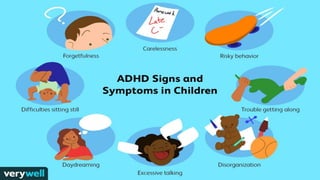
• In school going children;
Hyperactivity and inattention.
(short attention span, distractibility, perseveration, failure to finish tasks,
inattention, poor concentration).
Impulsivity.
(action before thought, abrupt shifts in activity, lack of organization, jumping
up in class)
Memory and thinking deficits.
Specific learning disabilities.
Speech and hearing deficits.
Pathology and laboratory examination
• Rule out Medical problems that may produce symptoms overlapping
with ADHD.
• A thorough cardiac history should be taken, including an investigation
of the lifetime history of syncope, family history of sudden death, and a
cardiac examination of the child. Although it is reasonable to obtain an
electrocardiography (ECG) study prior to treatment, if any cardiac risk
factors are present, a cardiology consultation and examination are
warranted.
• No specific laboratory measures are pathognomonic of ADHD.
Differential diagnosis
• Anxiety
• Bipolar 1/Mania
• Oppositional defiant disorder or conduct disorder.
• Specific learning disorders of various kinds.
Course and prognosis
• Course is variable.
• Symptoms have been shown to persist into adolescence in 60 to 85% of cases, and into
adult life in approximately 60 % of cases.
• Symptoms have been shown to persist into adolescence in 60 to 85% of cases, and into
adult life in approximately 60% of cases.
• Overactivity is usually the first symptom to remit, and distractibility is the last.
• When remission occurs, it is usually between the ages of 12 and 20.
• Children with ADHD whose symptoms persist into adolescence are at higher risk for
developing conduct disorders.
• Children with both ADHD and conduct disorders are also at risk for developing substance
use disorders.
contn
• Most children with ADHD have some social difficulties.
• Socially dysfunctional children with ADHD have significantly higher rates of
comorbid psychiatric disorders, and experience more problems with behavior in
school as well as with peers and family members.
• Overall, the outcome of ADHD in childhood seems to be related to the degree of
persistent comorbid psychopathology, especially conduct disorder, social disability,
and chaotic family factors.
• Optimal outcomes may be promoted by ameliorating children’s social functioning,
diminishing aggression, and improving family situations as early as possible.
TREATMENT
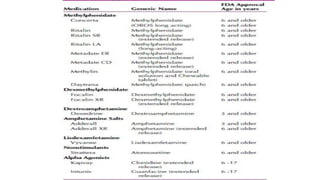
• PHARMACOTHERAPY; First line treatment.
CNS Stimulants; the first choice of agents.
Methylphenidate preperations; (Ritalin, Ritalin-SR, Concerta, Metadate CD, Metadate ER).
Newer preparation (Methylin, a chewable form of methylphenidate; Daytrana, a
methylphenidate patch; and dexmethylphenidate, the d-enantiomer (Focalin), and its
longer acting form Focalin XR)
 Dextroamphetamine; (Dexedrine, Dexedrine spansules, Vyvanse),
Dextroamphetamine and amphetamine salt combinations ; (Adderall, Adderall XR).
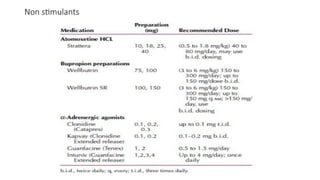
Non stimulants
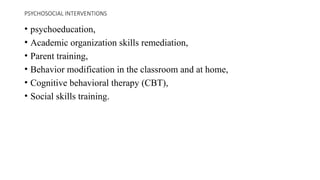
PSYCHOSOCIAL INTERVENTIONS
• psychoeducation,
• Academic organization skills remediation,
• Parent training,
• Behavior modification in the classroom and at home,
• Cognitive behavioral therapy (CBT),
• Social skills training.
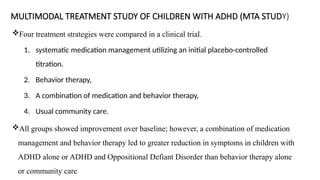
MULTIMODAL TREATMENT STUDY OF CHILDREN WITH ADHD (MTA STUDY)
Four treatment strategies were compared in a clinical trial.
1. systematic medication management utilizing an initial placebo-controlled
titration.
2. Behavior therapy,
3. A combination of medication and behavior therapy,
4. Usual community care.
All groups showed improvement over baseline; however, a combination of medication
management and behavior therapy led to greater reduction in symptoms in children with
ADHD alone or ADHD and Oppositional Defiant Disorder than behavior therapy alone
or community care
UNSPECIFIED ATTENTION-DEFICIT/HYPERACTIVITY DISORDER
• The DSM-5 includes Unspecified ADHD as a category for
disturbances of inattention or hyperactivity that cause impairment, but
do not meet the full criteria for ADHD.
ADULT MANIFESTATIONS OF ADHD
• 60 percent of children with ADHD have persistent impairment from
symptoms into adulthood.
• Among adults, evidence suggests an approximate 4 percent prevalence
of ADHD in the population
• Etiology Currently, ADHD is believed to be largely transmitted
genetically.
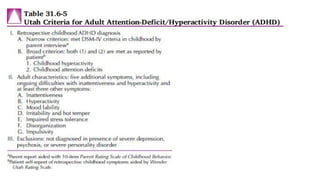
• Diagnosis and Clinical Features;
The clinical phenomenology of ADHD features inattention and manifestations
of impulsivity prevailing as the core of this disorder
REFERENCES
1. KAPLAN AND SADOCK’s synopsis of psychiatry 11th
edition by
Robert Bolland.
2. DSM -5-TR.

ADHD.pptx for undergraduates doing medicine

  • 1.
    GROUP 4 PRESENTATION NONAME REG NO 1 MANDE SHEDRACK 2019-08-08335 2 KIGOZI PETER 2019-08-09048 3 ASIIMWE VANESSA MARIA 2019-04-05337
  • 2.
    Attention Deficit HyperactivityDisorder (ADHD) OUTLINE • INTRODUCTION Definition Subtypes • EPIDEMIOLOGY • ETIOLOGY • DIAGNOSIS Clinical features Pathology and laboratory exam • DIFFERENTIAL DIAGNOSIS
  • 3.
    contn • COURSE ANDPROGNOSIS • TREATMENT Pharmacotherapy. Stimulant Non stimulant. Psychosocial intervention Multimodal treatment study. • UNSPECIFIED ATTENTION DEFICIT HYPERACTIVE DISORDER. Adult manifestation of ADHD
  • 4.
    INTRODUCTION BASIC DEFINITIONS. • ADHDis a neuropsychiatric condition affecting preschoolers, children, adolescents, and adults around the world, characterized by a pattern of diminished sustained attention, and increased impulsivity or hyperactivity. • Inattention manifests behaviorally in ADHD as wandering off tasks, failing to follow through on instructions or finishing work or chores, having difficulty sustaining focus, and being disorganized and the inattention is not attributable to defiance or lack of comprehension.
  • 5.
    Cont’n • Hyperactivity refersto excessive motor activity (such as a child running about) when it is not appropriate, or excessive fidgeting, tapping, or talkativeness. In adults, hyperactivity may manifest as extreme restlessness or wearing others out with their activity. • Impulsivity refers to hasty actions that occur in the moment without forethought, which may have potential for harm to the individual (e.g., darting into the street without looking). • Primary deficits of ADHD may cause functional limitations of effective communication, social participation, or academic achievement.
  • 6.
    SUBTYPES 1. Combined presentation, 2.Predominantly inattentive presentation, 3. Predominantly hyperactive/impulsive presentation.
  • 7.
    Epidemiology • Rates ofADHD; 7 to 8 % in prepubertal elementary school children. 5% in youth (children & adolescents). 2.5% in adults. • Prevalence in male to female ranges from ratios of 2:1 to as high as 9:1. • Rate is greater in families with a hx of ADHD (1st degree relatives) than in the general population.( 2-8 times greater) • At high risk of other psychiatric disorders like anxiety, disruptive & depressive disorders. • Increased incidence of substance use in parents with children suffering from ADHD.
  • 8.
    ETIOLOGY • Data suggestthat the etiology of ADHD is largely genetic, with a heritability of approximately 75%. Factors/theologies include; 1. Genetic factors. 2. Neurochemical factors. 3. Neurophysiological factors. 4. Neuroanatomical aspects. 5. Developmental factors. 6. Psychosocial factors.
  • 9.
  • 10.
  • 11.
  • 12.
  • 13.
  • 14.
    Clinical features • ADHDcan have its onset in infancy, although it is rarely recognized until a child is at least toddler age. More commonly, infants with ADHD are active in the crib, sleep little, and cry a great deal. • In school going children; Hyperactivity and inattention. (short attention span, distractibility, perseveration, failure to finish tasks, inattention, poor concentration). Impulsivity. (action before thought, abrupt shifts in activity, lack of organization, jumping up in class) Memory and thinking deficits. Specific learning disabilities. Speech and hearing deficits.
  • 16.
    Pathology and laboratoryexamination • Rule out Medical problems that may produce symptoms overlapping with ADHD. • A thorough cardiac history should be taken, including an investigation of the lifetime history of syncope, family history of sudden death, and a cardiac examination of the child. Although it is reasonable to obtain an electrocardiography (ECG) study prior to treatment, if any cardiac risk factors are present, a cardiology consultation and examination are warranted. • No specific laboratory measures are pathognomonic of ADHD.
  • 17.
    Differential diagnosis • Anxiety •Bipolar 1/Mania • Oppositional defiant disorder or conduct disorder. • Specific learning disorders of various kinds.
  • 18.
    Course and prognosis •Course is variable. • Symptoms have been shown to persist into adolescence in 60 to 85% of cases, and into adult life in approximately 60 % of cases. • Symptoms have been shown to persist into adolescence in 60 to 85% of cases, and into adult life in approximately 60% of cases. • Overactivity is usually the first symptom to remit, and distractibility is the last. • When remission occurs, it is usually between the ages of 12 and 20. • Children with ADHD whose symptoms persist into adolescence are at higher risk for developing conduct disorders. • Children with both ADHD and conduct disorders are also at risk for developing substance use disorders.
  • 19.
    contn • Most childrenwith ADHD have some social difficulties. • Socially dysfunctional children with ADHD have significantly higher rates of comorbid psychiatric disorders, and experience more problems with behavior in school as well as with peers and family members. • Overall, the outcome of ADHD in childhood seems to be related to the degree of persistent comorbid psychopathology, especially conduct disorder, social disability, and chaotic family factors. • Optimal outcomes may be promoted by ameliorating children’s social functioning, diminishing aggression, and improving family situations as early as possible.
  • 20.
    TREATMENT • PHARMACOTHERAPY; Firstline treatment. CNS Stimulants; the first choice of agents. Methylphenidate preperations; (Ritalin, Ritalin-SR, Concerta, Metadate CD, Metadate ER). Newer preparation (Methylin, a chewable form of methylphenidate; Daytrana, a methylphenidate patch; and dexmethylphenidate, the d-enantiomer (Focalin), and its longer acting form Focalin XR)  Dextroamphetamine; (Dexedrine, Dexedrine spansules, Vyvanse), Dextroamphetamine and amphetamine salt combinations ; (Adderall, Adderall XR).
  • 21.
  • 23.
    PSYCHOSOCIAL INTERVENTIONS • psychoeducation, •Academic organization skills remediation, • Parent training, • Behavior modification in the classroom and at home, • Cognitive behavioral therapy (CBT), • Social skills training.
  • 24.
    MULTIMODAL TREATMENT STUDYOF CHILDREN WITH ADHD (MTA STUDY) Four treatment strategies were compared in a clinical trial. 1. systematic medication management utilizing an initial placebo-controlled titration. 2. Behavior therapy, 3. A combination of medication and behavior therapy, 4. Usual community care. All groups showed improvement over baseline; however, a combination of medication management and behavior therapy led to greater reduction in symptoms in children with ADHD alone or ADHD and Oppositional Defiant Disorder than behavior therapy alone or community care
  • 25.
    UNSPECIFIED ATTENTION-DEFICIT/HYPERACTIVITY DISORDER •The DSM-5 includes Unspecified ADHD as a category for disturbances of inattention or hyperactivity that cause impairment, but do not meet the full criteria for ADHD.
  • 26.
    ADULT MANIFESTATIONS OFADHD • 60 percent of children with ADHD have persistent impairment from symptoms into adulthood. • Among adults, evidence suggests an approximate 4 percent prevalence of ADHD in the population • Etiology Currently, ADHD is believed to be largely transmitted genetically. • Diagnosis and Clinical Features; The clinical phenomenology of ADHD features inattention and manifestations of impulsivity prevailing as the core of this disorder
  • 28.
    REFERENCES 1. KAPLAN ANDSADOCK’s synopsis of psychiatry 11th edition by Robert Bolland. 2. DSM -5-TR.