DIAGNOSIS
 INVESTIGATIONS:-
• USG
• MRI
• HSG
• HYSTEROSCOPIC MYOMETRIAL BIOPSY
ULTRASONOGRAPHY
• Transabdominal sonography does not identify the often subtle myometrial changes of adenomyosis.
• TVS is preferred
• Findings on TVS are:
(1) Anterior or posterior myometrial wall appearing thicker than its counterpart
(2) Myometrial texture heterogeneity
(3) Small myometrial hypoechoic cysts, which are cystic glands within ectopic endometrial foci
(4) Striated projections extending from the endometrium into the myometrium
(5) Ill-defined endometrial echo
(6) Globally enlarged uterus
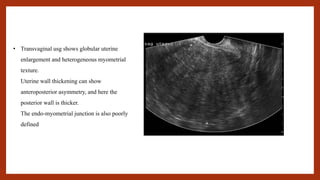
• Transvaginal usg shows globular uterine
enlargement and heterogeneous myometrial
texture.
Uterine wall thickening can show
anteroposterior asymmetry, and here the
posterior wall is thicker.
The endo-myometrial junction is also poorly
defined
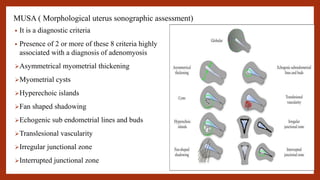
MUSA ( Morphological uterus sonographic assessment)
• It is a diagnostic criteria
• Presence of 2 or more of these 8 criteria highly
associated with a diagnosis of adenomyosis
Asymmetrical myometrial thickening
Myometrial cysts
Hyperechoic islands
Fan shaped shadowing
Echogenic sub endometrial lines and buds
Translesional vascularity
Irregular junctional zone
Interrupted junctional zone
MRI
• MR imaging may be equal or slightly superior to TVS (Dueholm, 2001; Reinhold, 1996). Thus, MR imaging may be most
appropriate when the diagnosis is inconclusive, when further delineation would affect patient management, or when
coexisting uterine myomas distort anatomy (American College of Obstetricians and Gynecologists, 2014b).
• T2-weighted sequences are key for diagnosing adenomyosis
• Adenomyosis appears as increased thickness of the junctional zone, forming an ill-defined area of low
signal intensity on T2, representing the smooth muscle hyperplasia accompanying the heterotopic
endometrial tissue. This aspect is frequently associated with bright foci on T2-weighted images, which
represent foci of heterotopic endometrial tissue, cystic dilatation of endometrial glands or haemorrhagic
foci.
• Adenomyosis is mainly located in the fundus [20] and commonly observed in the posterior wall. The
typical appearance is a large, rand asymmetric uterus, with a maximum junctional zone thickness of at
least 12 mm and punctate high-intensity myometrial foci [17].
• There are two forms of adenomyosis: diffuse, in which foci of adenomyosis are distributed throughout the
uterus (Fig. 1), and focal form, also named adenomyoma, when it affects a limited area (Fig. 2). The most
frequent finding for the diagnosis of adenomyosis is thickening of the junctional zone, with a thickness
exceeding 12 mm being highly predictive of the diagnosis
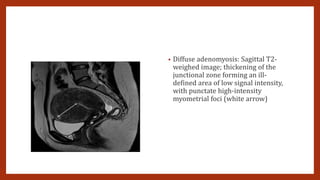
• Diffuse adenomyosis: Sagittal T2-
weighed image; thickening of the
junctional zone forming an ill-
defined area of low signal intensity,
with punctate high-intensity
myometrial foci (white arrow)
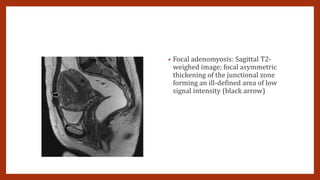
• Focal adenomyosis: Sagittal T2-
weighed image; focal asymmetric
thickening of the junctional zone
forming an ill-defined area of low
signal intensity (black arrow)
HYSTEROSALPINGOGRAPHY
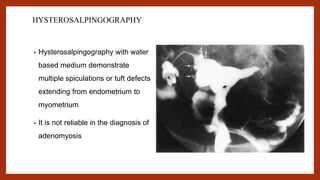
• Hysterosalpingography with water
based medium demonstrate
multiple spiculations or tuft defects
extending from endometrium to
myometrium
• It is not reliable in the diagnosis of
adenomyosis
• HYSTEROSCOPIC MYOMETRIAL BIOPSY-
Biopsy of the posterior uterine wall with the use of 5 mm loop electrode
can diagnose adenomyosis on histological examination, but rarely performed
• CA125
CA125 levels are elevated in women with adenomyosis,
They may also be elevated in those with leiomyomas, endometriosis,
pelvic infection, and pelvic malignancies
MANAGEMENT
 MEDICAL TREATMENT-
• NSAIDs ( Nonsteroidal anti- inflammatory drugs)
For young women with dysmenorrhea and heavy menstrual bleeding
• Combined oral contraceptive pills and Progestogens-
To induce endometrial atrophy and decrease prostaglandin production to improve
dysmenorrhea and heavy menstrual bleeding
 GnRH agonists –
• Goserelin or leuprolide depot once a month for 3-6 month used in women
with adenomyosis with infertility, before surgery for pain relief, and to
decrease size od adenomyoma and vascularity
• Recurrence is common after discontinuation of treatment.
 LNG-IUS (Levonorgestrel intrauterine system –
• It is useful in management of adenomyosis by causing decidualization and
atrophy of adenomyotic foci
• It also reduce menstrual blood flow and dysmenorrhea

ADENOMYOSIS PPT 1.pptx

  • 2.
    DIAGNOSIS  INVESTIGATIONS:- • USG •MRI • HSG • HYSTEROSCOPIC MYOMETRIAL BIOPSY
  • 3.
    ULTRASONOGRAPHY • Transabdominal sonographydoes not identify the often subtle myometrial changes of adenomyosis. • TVS is preferred • Findings on TVS are: (1) Anterior or posterior myometrial wall appearing thicker than its counterpart (2) Myometrial texture heterogeneity (3) Small myometrial hypoechoic cysts, which are cystic glands within ectopic endometrial foci (4) Striated projections extending from the endometrium into the myometrium (5) Ill-defined endometrial echo (6) Globally enlarged uterus
  • 4.
    • Transvaginal usgshows globular uterine enlargement and heterogeneous myometrial texture. Uterine wall thickening can show anteroposterior asymmetry, and here the posterior wall is thicker. The endo-myometrial junction is also poorly defined
  • 5.
    MUSA ( Morphologicaluterus sonographic assessment) • It is a diagnostic criteria • Presence of 2 or more of these 8 criteria highly associated with a diagnosis of adenomyosis Asymmetrical myometrial thickening Myometrial cysts Hyperechoic islands Fan shaped shadowing Echogenic sub endometrial lines and buds Translesional vascularity Irregular junctional zone Interrupted junctional zone
  • 6.
    MRI • MR imagingmay be equal or slightly superior to TVS (Dueholm, 2001; Reinhold, 1996). Thus, MR imaging may be most appropriate when the diagnosis is inconclusive, when further delineation would affect patient management, or when coexisting uterine myomas distort anatomy (American College of Obstetricians and Gynecologists, 2014b). • T2-weighted sequences are key for diagnosing adenomyosis • Adenomyosis appears as increased thickness of the junctional zone, forming an ill-defined area of low signal intensity on T2, representing the smooth muscle hyperplasia accompanying the heterotopic endometrial tissue. This aspect is frequently associated with bright foci on T2-weighted images, which represent foci of heterotopic endometrial tissue, cystic dilatation of endometrial glands or haemorrhagic foci. • Adenomyosis is mainly located in the fundus [20] and commonly observed in the posterior wall. The typical appearance is a large, rand asymmetric uterus, with a maximum junctional zone thickness of at least 12 mm and punctate high-intensity myometrial foci [17]. • There are two forms of adenomyosis: diffuse, in which foci of adenomyosis are distributed throughout the uterus (Fig. 1), and focal form, also named adenomyoma, when it affects a limited area (Fig. 2). The most frequent finding for the diagnosis of adenomyosis is thickening of the junctional zone, with a thickness exceeding 12 mm being highly predictive of the diagnosis
  • 7.
    • Diffuse adenomyosis:Sagittal T2- weighed image; thickening of the junctional zone forming an ill- defined area of low signal intensity, with punctate high-intensity myometrial foci (white arrow)
  • 8.
    • Focal adenomyosis:Sagittal T2- weighed image; focal asymmetric thickening of the junctional zone forming an ill-defined area of low signal intensity (black arrow)
  • 9.
    HYSTEROSALPINGOGRAPHY • Hysterosalpingography withwater based medium demonstrate multiple spiculations or tuft defects extending from endometrium to myometrium • It is not reliable in the diagnosis of adenomyosis
  • 10.
    • HYSTEROSCOPIC MYOMETRIALBIOPSY- Biopsy of the posterior uterine wall with the use of 5 mm loop electrode can diagnose adenomyosis on histological examination, but rarely performed • CA125 CA125 levels are elevated in women with adenomyosis, They may also be elevated in those with leiomyomas, endometriosis, pelvic infection, and pelvic malignancies
  • 11.
    MANAGEMENT  MEDICAL TREATMENT- •NSAIDs ( Nonsteroidal anti- inflammatory drugs) For young women with dysmenorrhea and heavy menstrual bleeding • Combined oral contraceptive pills and Progestogens- To induce endometrial atrophy and decrease prostaglandin production to improve dysmenorrhea and heavy menstrual bleeding
  • 12.
     GnRH agonists– • Goserelin or leuprolide depot once a month for 3-6 month used in women with adenomyosis with infertility, before surgery for pain relief, and to decrease size od adenomyoma and vascularity • Recurrence is common after discontinuation of treatment.  LNG-IUS (Levonorgestrel intrauterine system – • It is useful in management of adenomyosis by causing decidualization and atrophy of adenomyotic foci • It also reduce menstrual blood flow and dysmenorrhea