MRI Case
Dr Muhammad Tahir Javed
PGR Radiology KEMU/MHL
History
 A 45 year women presented with more than 6 month hx of
chronic pelvic pain , dysmenorrhea and menorrhagia.
 MRI pelvis with contrast is advised to rule out pelvic
pathology which is performed in our department
Sagittal T2WI Axial T2WI
Axial T1WI Axial T2 STIR
Axial T1 post Contrast
Coronal T2WI Coronal T2 STIR
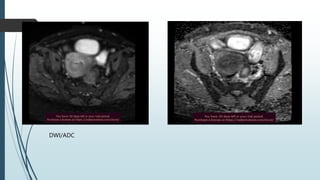
DWI/ADC
Findings
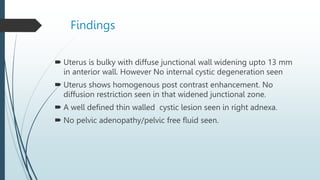
 Uterus is bulky with diffuse junctional wall widening upto 13 mm
in anterior wall. However No internal cystic degeneration seen
 Uterus shows homogenous post contrast enhancement. No
diffusion restriction seen in that widened junctional zone.
 A well defined thin walled cystic lesion seen in right adnexa.
 No pelvic adenopathy/pelvic free fluid seen.
Diagnosis
Diffuse adenomyosis with right adnexal cyst.
Adenomyosis
 Adenomyosis (or uterine adenomyosis) is a common
uterine condition of ectopic endometrial tissue in the
myometrium.
 Although most commonly asymptomatic, it may present with
menorrhagia and dysmenorrhea.
 Pelvic imaging (i.e. ultrasound, MRI) may show characteristic
findings
Epidemiology
 Classically, adenomyosis most commonly affects multiparous women of
reproductive age.
 Adenomyosis is seen with higher frequency in women with a history of uterine
surgical procedures (e.g. Caesarean section, dilatation and curettage).
 Patients with high oestrogen exposure (e.g. short menstrual cycles, early
menarche) have an increased risk of adenomyosis.
 Adenomyosis is relatively rare in postmenopausal women
 but a higher incidence of adenomyosis has been reported in women treated
with tamoxifen for breast cancer.
CLINICAL PRESENTATION
 Most patients with adenomyosis are asymptomatic.
 Symptoms related to adenomyosis include dysmenorrhoea,
menorrhagia, dyspareunia, chronic pelvic pain, and
menometrorrhagia.
 The ectopic endometrial glands within the myometrium do
not respond to cyclic ovarian hormones, unlike those
of endometriosis.
 Pelvic tenderness on examination is associated with diffuse
enlargement of the uterus.
PATHPHSIOLOGY
 Adenomyosis is histologically-defined as the presence of
ectopic endometrial glandular and stromal tissue within
the myometrium.
 The exact cause of adenomyosis is unknown, but it is thought
that endometrial glands directly invade the myometrium
resulting in spiral vessel angiogenesis, and adjacent smooth
muscle hyperplasia and hypertrophy.
Types
 Three forms can be distinguished:
• diffuse adenomyosis: most common
• focal adenomyosis / adenomyoma: sometimes considered
distinct
• cystic adenomyosis and adenomyotic cyst: rare
MRI features:
Pelvic MRI is the modality of choice to diagnose and characterise
adenomyosis. Small field of view T2-weighted images (sagittal and axial)
are most useful.
MRI has a sensitivity of 78-88% and specificity of 67-93%
 The most easily recognised feature is thickening of the junctional zone
≥12 mm, either diffusely or focally (normal junctional zone thickness is
up to ~5 mm) .
• T1
• foci of high T1 signal are often seen, indicating menstrual haemorrhage into the
ectopic endometrial tissues
• T2
• typically a region of adenomyosis appears as an ill-defined ovoid/diffuse
region of thickening, often with small high T2 signal regions representing
small areas of cystic change
• the region may also have a striated appearance
• T1 C+
• contrast-enhanced MRI evaluation is usually not required for evaluation of
adenomyosis, however, if performed, shows enhancement of the ectopic
endometrial glands
Differentials:
 For diffuse disease consider:
• normal uterus
• diffuse uterine leiomyomatosis (uterus appears diffusely enlarged
showing multiple innumerable ill-defined leiomyomas without discrete
margins)
• myometrial contraction: transient finding , may appear as focal lesion of
low-signal-intensity. This finding disappeared on subsequent (axial and
coronal) T2W images.
• malignancy
• endometrial carcinoma (the usual symptom of a postmenopausal bleed. A thickened
endometrium requires endometrial sampling. carcinomatous tissue will enhance
less than normal endometrium. DWI: show impeded diffusion)
 For focal disease (adenomyoma) consider:
• uterine fibroid (leiomyoma)
• better defined than adenomyoma
• may have pseudocapsule of compressed adjacent myometrial tissue 5
• on colour Doppler: tend to displace vessels, demonstrating circumferential peripheral
flow
• vascular malformations
• does not disrupt the endometrial-myometrial interface
• on colour Doppler: demonstrates turbulent high-velocity flow
THANK YOU

MRI Case (Adenomyosis).pptx

  • 1.
    MRI Case Dr MuhammadTahir Javed PGR Radiology KEMU/MHL
  • 2.
    History  A 45year women presented with more than 6 month hx of chronic pelvic pain , dysmenorrhea and menorrhagia.  MRI pelvis with contrast is advised to rule out pelvic pathology which is performed in our department
  • 3.
  • 4.
    Axial T1WI AxialT2 STIR Axial T1 post Contrast
  • 5.
  • 6.
  • 7.
    Findings  Uterus isbulky with diffuse junctional wall widening upto 13 mm in anterior wall. However No internal cystic degeneration seen  Uterus shows homogenous post contrast enhancement. No diffusion restriction seen in that widened junctional zone.  A well defined thin walled cystic lesion seen in right adnexa.  No pelvic adenopathy/pelvic free fluid seen.
  • 8.
  • 9.
    Adenomyosis  Adenomyosis (oruterine adenomyosis) is a common uterine condition of ectopic endometrial tissue in the myometrium.  Although most commonly asymptomatic, it may present with menorrhagia and dysmenorrhea.  Pelvic imaging (i.e. ultrasound, MRI) may show characteristic findings
  • 10.
    Epidemiology  Classically, adenomyosismost commonly affects multiparous women of reproductive age.  Adenomyosis is seen with higher frequency in women with a history of uterine surgical procedures (e.g. Caesarean section, dilatation and curettage).  Patients with high oestrogen exposure (e.g. short menstrual cycles, early menarche) have an increased risk of adenomyosis.  Adenomyosis is relatively rare in postmenopausal women  but a higher incidence of adenomyosis has been reported in women treated with tamoxifen for breast cancer.
  • 11.
    CLINICAL PRESENTATION  Mostpatients with adenomyosis are asymptomatic.  Symptoms related to adenomyosis include dysmenorrhoea, menorrhagia, dyspareunia, chronic pelvic pain, and menometrorrhagia.  The ectopic endometrial glands within the myometrium do not respond to cyclic ovarian hormones, unlike those of endometriosis.  Pelvic tenderness on examination is associated with diffuse enlargement of the uterus.
  • 12.
    PATHPHSIOLOGY  Adenomyosis ishistologically-defined as the presence of ectopic endometrial glandular and stromal tissue within the myometrium.  The exact cause of adenomyosis is unknown, but it is thought that endometrial glands directly invade the myometrium resulting in spiral vessel angiogenesis, and adjacent smooth muscle hyperplasia and hypertrophy.
  • 13.
    Types  Three formscan be distinguished: • diffuse adenomyosis: most common • focal adenomyosis / adenomyoma: sometimes considered distinct • cystic adenomyosis and adenomyotic cyst: rare
  • 14.
    MRI features: Pelvic MRIis the modality of choice to diagnose and characterise adenomyosis. Small field of view T2-weighted images (sagittal and axial) are most useful. MRI has a sensitivity of 78-88% and specificity of 67-93%  The most easily recognised feature is thickening of the junctional zone ≥12 mm, either diffusely or focally (normal junctional zone thickness is up to ~5 mm) . • T1 • foci of high T1 signal are often seen, indicating menstrual haemorrhage into the ectopic endometrial tissues
  • 15.
    • T2 • typicallya region of adenomyosis appears as an ill-defined ovoid/diffuse region of thickening, often with small high T2 signal regions representing small areas of cystic change • the region may also have a striated appearance • T1 C+ • contrast-enhanced MRI evaluation is usually not required for evaluation of adenomyosis, however, if performed, shows enhancement of the ectopic endometrial glands
  • 16.
    Differentials:  For diffusedisease consider: • normal uterus • diffuse uterine leiomyomatosis (uterus appears diffusely enlarged showing multiple innumerable ill-defined leiomyomas without discrete margins) • myometrial contraction: transient finding , may appear as focal lesion of low-signal-intensity. This finding disappeared on subsequent (axial and coronal) T2W images. • malignancy • endometrial carcinoma (the usual symptom of a postmenopausal bleed. A thickened endometrium requires endometrial sampling. carcinomatous tissue will enhance less than normal endometrium. DWI: show impeded diffusion)
  • 17.
     For focaldisease (adenomyoma) consider: • uterine fibroid (leiomyoma) • better defined than adenomyoma • may have pseudocapsule of compressed adjacent myometrial tissue 5 • on colour Doppler: tend to displace vessels, demonstrating circumferential peripheral flow • vascular malformations • does not disrupt the endometrial-myometrial interface • on colour Doppler: demonstrates turbulent high-velocity flow
  • 18.