Total Physical Response By
Raj Wali Khan
Lecturer in English
Department Of English Language & Literature
University of Lahore (Pakistan)
raj.wali@ell.uol.edu.pk
WHAT IS TPR?
Total Physical Response (TPR) is a language teaching method built
around the coordination of speech and action; it attempts to teach
language through physical (motor) activity.
In TPR, instructors give commands to students in the target
language, and students respond with whole-body actions.
Total physical response is often used alongside other methods and
techniques. It is popular with beginners and with young
learners, although it can be used with students of all levels and all age
groups.
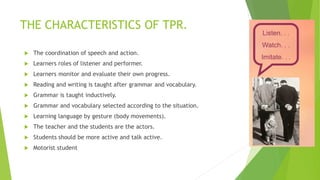
THE CHARACTERISTICS OF TPR.
The coordination of speech and action.
Learners roles of listener and performer.
Learners monitor and evaluate their own progress.
Reading and writing is taught after grammar and vocabulary.
Grammar is taught inductively.
Grammar and vocabulary selected according to the situation.
Learning language by gesture (body movements).
The teacher and the students are the actors.
Students should be more active and talk active.
Motorist student
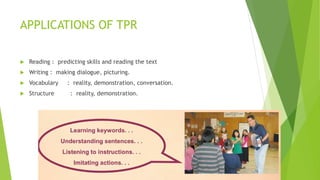
APPLICATIONS OF TPR
Reading : predicting skills and reading the text
Writing : making dialogue, picturing.
Vocabulary : reality, demonstration, conversation.
Structure : reality, demonstration.
BASIC PRINCIPLES OF TPR
Listening ability and vocabulary must be developed first.
There must not be any stress in the class.
Regular repetition.
Action verbs are the core of TPR.
TPR is also technique of teaching vocabulary.
No forcing but exploit the student’s errors
for exposing others structure points
expose the natural use of language.
Create an artificial English community in the classroom.
The more often we trace memory and the more intensively we repeat,
the stonger the memory associations are and the more likely it will be recalled.
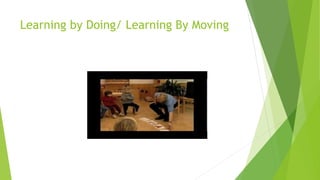
Learning by Doing/ Learning By Moving
THE ADVANTAGES OF TPR
It is fun, easy, and memorable
It is a good tool for building vocabulary.
It can facilitate students with the meaning in real context.
It does not require a great deal of preparation.
Help the students immediately understand the target language.
TPR is inclusive and works well a class with mixed ability levels.
Helps learners achieve fluency faster in learning language
It benefits the Struggling students.
THE DISADVANTAGES OF TPR
Students are not generally given the opportunity to express their
own thoughts in a creative way.
It can be a challenge for shy students.
It is not a very creative method.
Overusing TPR causes someone easily bored.
Certain target languages may not be suited to this method.
It is limited, since everything cannot be explained with this method.
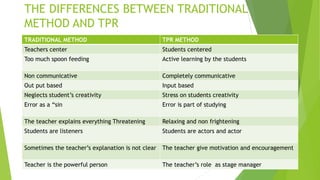
THE DIFFERENCES BETWEEN TRADITIONAL
METHOD AND TPR
TRADITIONAL METHOD TPR METHOD
Teachers center Students centered
Too much spoon feeding Active learning by the students
Non communicative Completely communicative
Out put based Input based
Neglects student’s creativity Stress on students creativity
Error as a “sin Error is part of studying
The teacher explains everything Threatening Relaxing and non frightening
Students are listeners Students are actors and actor
Sometimes the teacher’s explanation is not clear The teacher give motivation and encouragement
Teacher is the powerful person The teacher’s role as stage manager
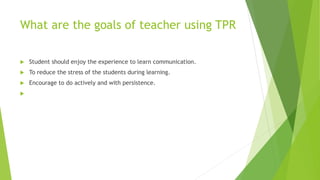
What are the goals of teacher using TPR
Student should enjoy the experience to learn communication.
To reduce the stress of the students during learning.
Encourage to do actively and with persistence.
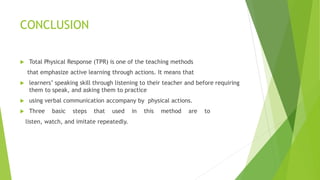
CONCLUSION
Total Physical Response (TPR) is one of the teaching methods
that emphasize active learning through actions. It means that
learners’ speaking skill through listening to their teacher and before requiring
them to speak, and asking them to practice
using verbal communication accompany by physical actions.
Three basic steps that used in this method are to
listen, watch, and imitate repeatedly.
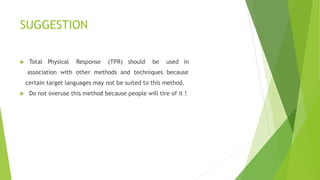
SUGGESTION
Total Physical Response (TPR) should be used in
association with other methods and techniques because
certain target languages may not be suited to this method.
Do not overuse this method because people will tire of it !
Thanks for your time
Good bye

Total physical response

  • 1.
    Total Physical ResponseBy Raj Wali Khan Lecturer in English Department Of English Language & Literature University of Lahore (Pakistan) raj.wali@ell.uol.edu.pk
  • 2.
    WHAT IS TPR? TotalPhysical Response (TPR) is a language teaching method built around the coordination of speech and action; it attempts to teach language through physical (motor) activity. In TPR, instructors give commands to students in the target language, and students respond with whole-body actions. Total physical response is often used alongside other methods and techniques. It is popular with beginners and with young learners, although it can be used with students of all levels and all age groups.
  • 3.
    THE CHARACTERISTICS OFTPR. The coordination of speech and action. Learners roles of listener and performer. Learners monitor and evaluate their own progress. Reading and writing is taught after grammar and vocabulary. Grammar is taught inductively. Grammar and vocabulary selected according to the situation. Learning language by gesture (body movements). The teacher and the students are the actors. Students should be more active and talk active. Motorist student
  • 4.
    APPLICATIONS OF TPR Reading: predicting skills and reading the text Writing : making dialogue, picturing. Vocabulary : reality, demonstration, conversation. Structure : reality, demonstration.
  • 5.
    BASIC PRINCIPLES OFTPR Listening ability and vocabulary must be developed first. There must not be any stress in the class. Regular repetition. Action verbs are the core of TPR. TPR is also technique of teaching vocabulary. No forcing but exploit the student’s errors for exposing others structure points expose the natural use of language. Create an artificial English community in the classroom. The more often we trace memory and the more intensively we repeat, the stonger the memory associations are and the more likely it will be recalled.
  • 6.
    Learning by Doing/Learning By Moving
  • 7.
    THE ADVANTAGES OFTPR It is fun, easy, and memorable It is a good tool for building vocabulary. It can facilitate students with the meaning in real context. It does not require a great deal of preparation. Help the students immediately understand the target language. TPR is inclusive and works well a class with mixed ability levels. Helps learners achieve fluency faster in learning language It benefits the Struggling students.
  • 8.
    THE DISADVANTAGES OFTPR Students are not generally given the opportunity to express their own thoughts in a creative way. It can be a challenge for shy students. It is not a very creative method. Overusing TPR causes someone easily bored. Certain target languages may not be suited to this method. It is limited, since everything cannot be explained with this method.
  • 9.
    THE DIFFERENCES BETWEENTRADITIONAL METHOD AND TPR TRADITIONAL METHOD TPR METHOD Teachers center Students centered Too much spoon feeding Active learning by the students Non communicative Completely communicative Out put based Input based Neglects student’s creativity Stress on students creativity Error as a “sin Error is part of studying The teacher explains everything Threatening Relaxing and non frightening Students are listeners Students are actors and actor Sometimes the teacher’s explanation is not clear The teacher give motivation and encouragement Teacher is the powerful person The teacher’s role as stage manager
  • 10.
    What are thegoals of teacher using TPR Student should enjoy the experience to learn communication. To reduce the stress of the students during learning. Encourage to do actively and with persistence.
  • 11.
    CONCLUSION Total Physical Response(TPR) is one of the teaching methods that emphasize active learning through actions. It means that learners’ speaking skill through listening to their teacher and before requiring them to speak, and asking them to practice using verbal communication accompany by physical actions. Three basic steps that used in this method are to listen, watch, and imitate repeatedly.
  • 12.
    SUGGESTION Total Physical Response(TPR) should be used in association with other methods and techniques because certain target languages may not be suited to this method. Do not overuse this method because people will tire of it !
  • 13.
    Thanks for yourtime Good bye