AUDIO MEDIA
Definition
Guidelines
Types
Examples DisadvantagesAdvantages
Demonstration
Characteristics
History and
Development
An audio media is a form of media
communication that uses audio or voice
recording as a medium in the delivery
of information.
These are teaching-learning devices
that appeal to the auditory sense.
Back
History and Development
 The modern age has blessed us with the
ability to capture and play back sound.
From the phonograph to MP3, we're
forever improving audio technology in a
quest to make music more accessible.
 Here is a brief history of audio formats
past, and a peek into how we might listen
to music in the 21st century.
.
Back
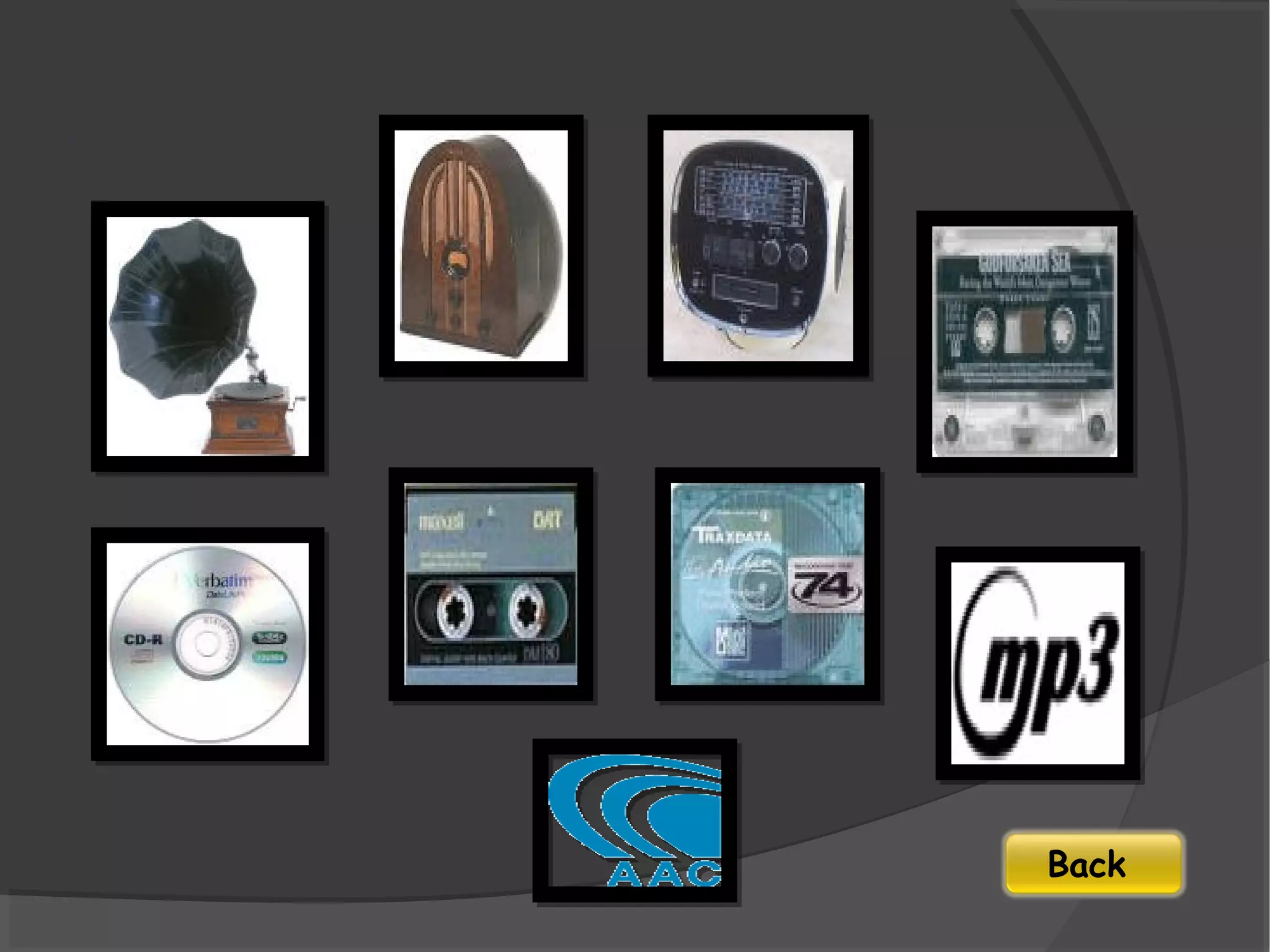
Phonographs
 In the early 19th century, it was all
but impossible to imagine what great
changes were in store for the world of
audio. Although the first successful
recording device was developed in
1855, it wasn't until Thomas Edison's
phonograph (invented in 1877) and
Emile Berliner's Gramophone (patented
in 1887) that the phonograph started
to come into its own.
Back
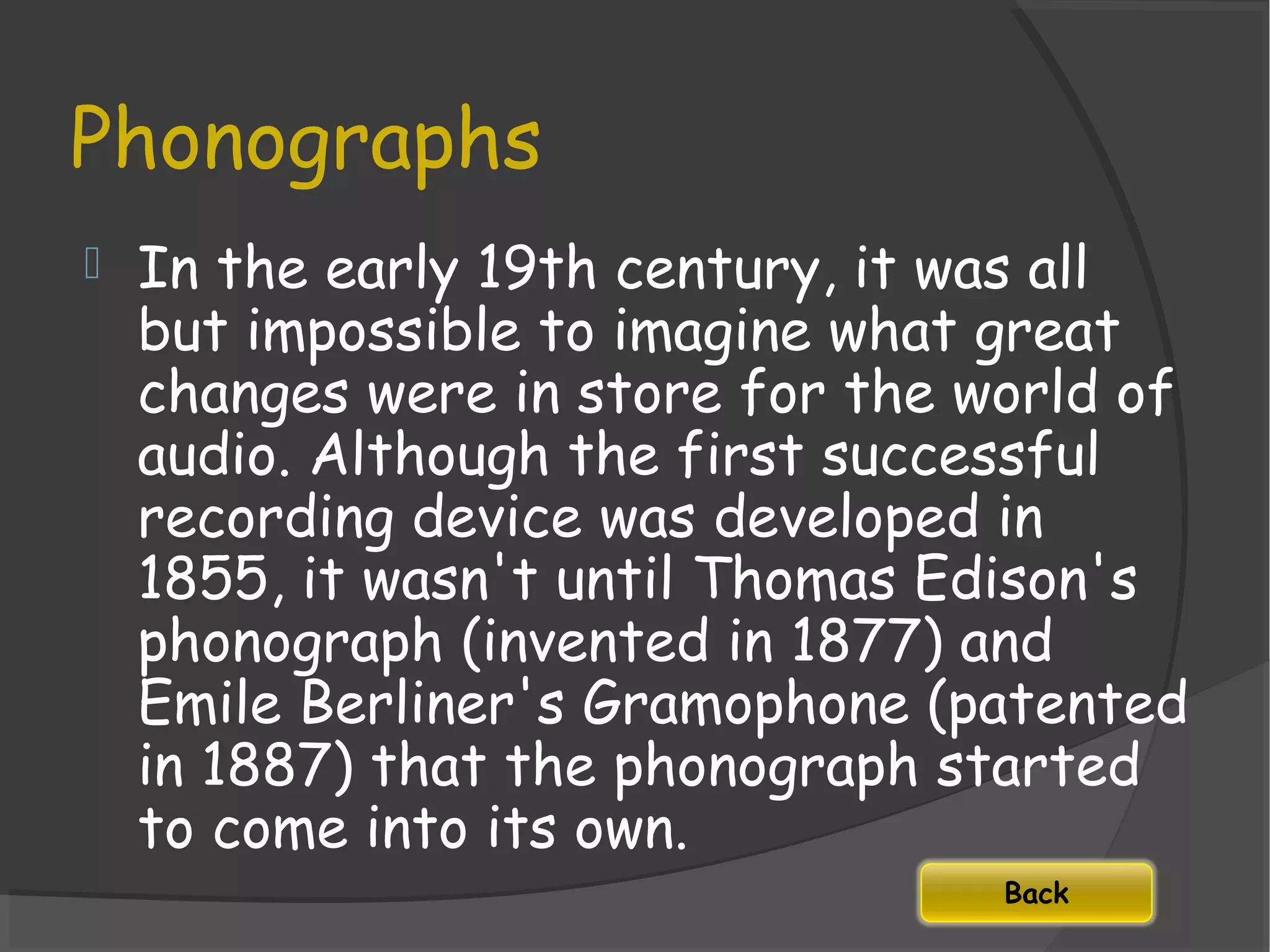
Radio
 Radio was originally developed for
military use during World War I, but
the gramophone industry helped spur
demand for recorded music delivered
over the air. When the Radio
Corporation of America (RCA) acquired
the Victor Talking Machine Company in
1929, the modern era of the music
industry was born.
Back
8 - Track
 Invented in the early 1960s by William
Powell Lear, and heavily marketed and
used in the '70s, the 8-track was the
premier portable audio format for
almost 15 years. The 8-track was
designed around a single reel with the
two ends of the plastic recording tape
joined with a piece of conductive foil
tape to make one continuous loop.
Back
Cassette Tapes
 The cassette as we know it didn't come into
the average home until the late 1970s.
However, magnetic tape recording got its
start in music studios around 1950. Musicians
could record in longer sessions, and seamless
splice editing allowed artists and producers
to select and combine the best cuts into
polished songs.
 The debut of Sony's Walkman in 1979 was
the final nail in the 8-track's coffin;
cassette tape sales soared into the '80s.
Back
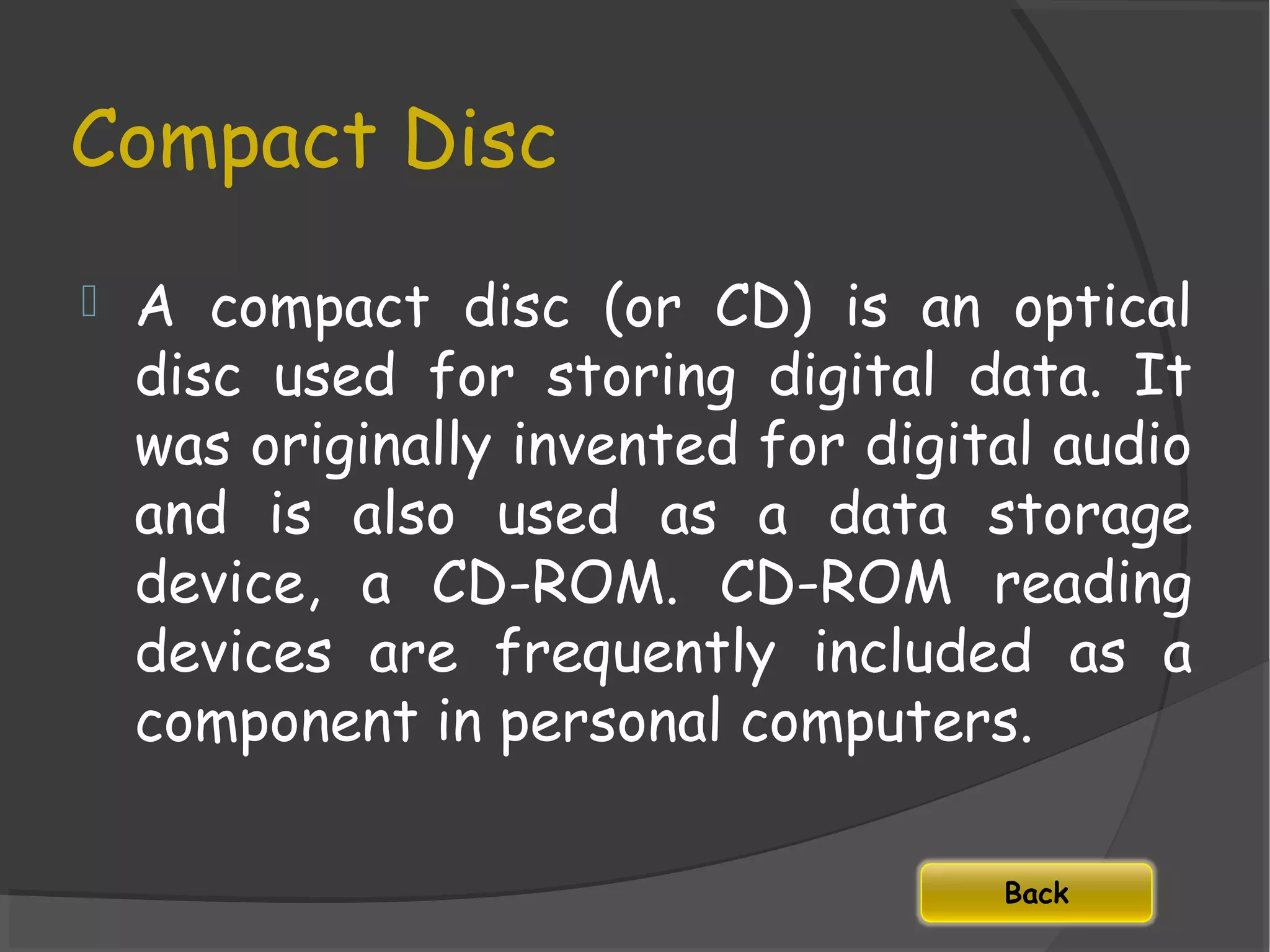
Compact Disc
 A compact disc (or CD) is an optical
disc used for storing digital data. It
was originally invented for digital audio
and is also used as a data storage
device, a CD-ROM. CD-ROM reading
devices are frequently included as a
component in personal computers.
Back
Digital Audio Tapes
 Introduced in 1987 for the studio market,
digital audio tapes quickly became de
rigueur in professional recording industry
circles. Although DATs never fully caught
on in the consumer market because of the
high cost of DAT players, they remain a
mainstay of the pro-audio world because
of their low price and enhanced digital
storage capabilities.
Back
Mini Disc
MiniDisc (MD) is a disc-based
data storage device for storing any kind of
data, usually audio. The technology was
announced by Sony in 1991 and introduced
January 12, 1992. MD Data, a version for
storing computer data was announced by
Sony in 1993, but it never gained
significant ground, so today MDs are used
primarily for audio storage. The audio
discs can be premastered or recordable
(blank).
Back
MP3
 Invented in 1989 in Erlangen, Germany,
MP3 has quickly come to symbolize a
paradigm shift in the way many people
access their music. The home computer
revolution, along with the Internet, has
allowed millions of Net-connected
music fans to take advantage of the
latest audio medium.
Next
MP3
 Short for Moving Picture Experts Group,
Audio Layer III, MP3 is a compression
format that shrinks digital audio files with
negligible sound-quality degradation. In 1997,
the format truly realized its potential,
thanks to a man named Tomislav Uzelac, who
created the AMP MP3 playback engine. The
first MP3 player was invented just in time
for the Napster revolution in the form of
1998's Winamp -- widely regarded as the
first free, consumer-ready MP3 player.
Back
AAC
 AAC is a new audio compression technology, Advanced
Audio Coding. This new standard, developed by Dolby,
the Fraunhofer Institute, and others, may become the
major ingredient in 21st century digital music
distribution.
 The AAC codec was formally introduced to the world at
the Consumer Electronics Show 2001, along with dozens
of new digital audio players able to play AAC files.
Currently, companies such as Liquid Audio distribute
audio using AAC. Promising smaller file sizes and better
sound quality than the aging MP3 format, AAC also
features built-in copyright protection.
Back
Recordings
Audio media has of two kinds.
These are:
Radio Broadcast
Back
Radio Broadcast
Radio broadcasting  is a one way 
wireless  transmission over  radio waves
  intended to reach a wide  audience.
Stations can be linked in 
radio networks  to broadcast a common 
radio format, either in 
broadcast syndication  or  simulcast  or
both.
Next
Radio Broadcast
 Audio broadcasting also can be done
via  cable radio,local wire 
television networks,  satellite radio,
and  internet radio  viastreaming media
  on the  Internet.
 The signal types can be either 
analog audio  or  digital audio.
Back
Audio Recordings
 Sound recording and reproduction  is
an electrical or mechanical inscription
and re-creation of  sound  waves, such
as spoken voice, singing, 
instrumental music, or sound effects.
 The two main classes of sound
recording technology are 
analog recording  and  digital recording
. 
Back
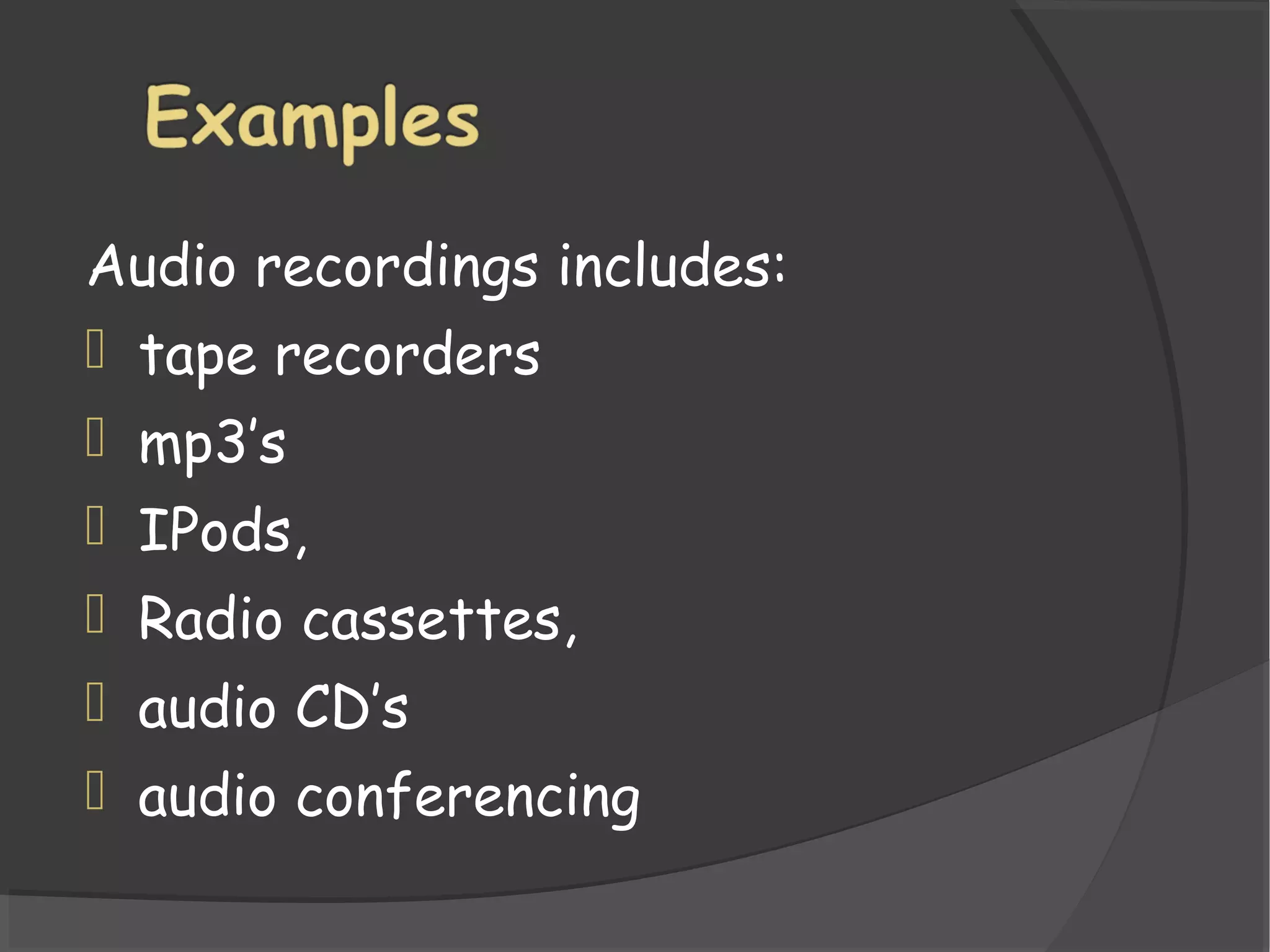
Audio recordings includes:
 tape recorders
 mp3’s
 IPods,
 Radio cassettes,
 audio CD’s
 audio conferencing
Back
Audio Conferencing
 Audio  conferencing  usually refers to
meetings held by people in different
places using devices that allow sounds to
be sent and received. These meetings may
only involve two parties, but in many cases,
there are numerous parties involved.
 Audio  conferencing  allows multiple
parties to connect using devices such as
phones or computers.
Back
Improve listening skills
Easy to operate
Safe way of restoring information
Can be used for small or big groups
Best used to improve speech skills
Lessen distraction when used with
headphones
Next
 Useful to add, maintain and stimulate interest
 Can be used as a set induction strategy
 Can clarify problems and ambiguity
 Can aid memory
 Can be use in stimulating emotions
 Useful in distant learning
 Helpful in stimulating creative thinking, increase
imagination
Back
Extended use may bore students
Costly compared to actual presentations
 Power failure issues can disturb the
learning environment
 Strong lesson planning is to be done
 Trained teachers are needed who can
manage it effectively
Back
 Preview the materials
 Prepare an outline of important points
that will be presented
 Motivate the students to listen
carefully to some important details
 End with questions, discussions and
other forms of evaluation
Back
1. Clarity of voice
2. Relevant to the topic
3. Clear pitch of the audio
4. Appropriate length
5. Appropriate language
6. Unbiased
Back

Audio media

  • 1.
  • 2.
  • 3.
    An audio mediais a form of media communication that uses audio or voice recording as a medium in the delivery of information. These are teaching-learning devices that appeal to the auditory sense. Back
  • 4.
    History and Development The modern age has blessed us with the ability to capture and play back sound. From the phonograph to MP3, we're forever improving audio technology in a quest to make music more accessible.  Here is a brief history of audio formats past, and a peek into how we might listen to music in the 21st century.
  • 5.
  • 6.
    Phonographs  In theearly 19th century, it was all but impossible to imagine what great changes were in store for the world of audio. Although the first successful recording device was developed in 1855, it wasn't until Thomas Edison's phonograph (invented in 1877) and Emile Berliner's Gramophone (patented in 1887) that the phonograph started to come into its own. Back
  • 7.
    Radio  Radio wasoriginally developed for military use during World War I, but the gramophone industry helped spur demand for recorded music delivered over the air. When the Radio Corporation of America (RCA) acquired the Victor Talking Machine Company in 1929, the modern era of the music industry was born. Back
  • 8.
    8 - Track Invented in the early 1960s by William Powell Lear, and heavily marketed and used in the '70s, the 8-track was the premier portable audio format for almost 15 years. The 8-track was designed around a single reel with the two ends of the plastic recording tape joined with a piece of conductive foil tape to make one continuous loop. Back
  • 9.
    Cassette Tapes  Thecassette as we know it didn't come into the average home until the late 1970s. However, magnetic tape recording got its start in music studios around 1950. Musicians could record in longer sessions, and seamless splice editing allowed artists and producers to select and combine the best cuts into polished songs.  The debut of Sony's Walkman in 1979 was the final nail in the 8-track's coffin; cassette tape sales soared into the '80s. Back
  • 10.
    Compact Disc  Acompact disc (or CD) is an optical disc used for storing digital data. It was originally invented for digital audio and is also used as a data storage device, a CD-ROM. CD-ROM reading devices are frequently included as a component in personal computers. Back
  • 11.
    Digital Audio Tapes Introduced in 1987 for the studio market, digital audio tapes quickly became de rigueur in professional recording industry circles. Although DATs never fully caught on in the consumer market because of the high cost of DAT players, they remain a mainstay of the pro-audio world because of their low price and enhanced digital storage capabilities. Back
  • 12.
    Mini Disc MiniDisc (MD)is a disc-based data storage device for storing any kind of data, usually audio. The technology was announced by Sony in 1991 and introduced January 12, 1992. MD Data, a version for storing computer data was announced by Sony in 1993, but it never gained significant ground, so today MDs are used primarily for audio storage. The audio discs can be premastered or recordable (blank). Back
  • 13.
    MP3  Invented in1989 in Erlangen, Germany, MP3 has quickly come to symbolize a paradigm shift in the way many people access their music. The home computer revolution, along with the Internet, has allowed millions of Net-connected music fans to take advantage of the latest audio medium. Next
  • 14.
    MP3  Short forMoving Picture Experts Group, Audio Layer III, MP3 is a compression format that shrinks digital audio files with negligible sound-quality degradation. In 1997, the format truly realized its potential, thanks to a man named Tomislav Uzelac, who created the AMP MP3 playback engine. The first MP3 player was invented just in time for the Napster revolution in the form of 1998's Winamp -- widely regarded as the first free, consumer-ready MP3 player. Back
  • 15.
    AAC  AAC isa new audio compression technology, Advanced Audio Coding. This new standard, developed by Dolby, the Fraunhofer Institute, and others, may become the major ingredient in 21st century digital music distribution.  The AAC codec was formally introduced to the world at the Consumer Electronics Show 2001, along with dozens of new digital audio players able to play AAC files. Currently, companies such as Liquid Audio distribute audio using AAC. Promising smaller file sizes and better sound quality than the aging MP3 format, AAC also features built-in copyright protection. Back
  • 16.
    Recordings Audio media hasof two kinds. These are: Radio Broadcast Back
  • 17.
    Radio Broadcast Radio broadcasting  isa one way  wireless  transmission over  radio waves   intended to reach a wide  audience. Stations can be linked in  radio networks  to broadcast a common  radio format, either in  broadcast syndication  or  simulcast  or both. Next
  • 18.
    Radio Broadcast  Audiobroadcasting also can be done via  cable radio,local wire  television networks,  satellite radio, and  internet radio  viastreaming media   on the  Internet.  The signal types can be either  analog audio  or  digital audio. Back
  • 19.
    Audio Recordings  Soundrecording and reproduction  is an electrical or mechanical inscription and re-creation of  sound  waves, such as spoken voice, singing,  instrumental music, or sound effects.  The two main classes of sound recording technology are  analog recording  and  digital recording .  Back
  • 20.
    Audio recordings includes: tape recorders  mp3’s  IPods,  Radio cassettes,  audio CD’s  audio conferencing
  • 21.
  • 22.
    Audio Conferencing  Audio conferencing  usually refers to meetings held by people in different places using devices that allow sounds to be sent and received. These meetings may only involve two parties, but in many cases, there are numerous parties involved.  Audio  conferencing  allows multiple parties to connect using devices such as phones or computers. Back
  • 23.
    Improve listening skills Easyto operate Safe way of restoring information Can be used for small or big groups Best used to improve speech skills Lessen distraction when used with headphones Next
  • 24.
     Useful toadd, maintain and stimulate interest  Can be used as a set induction strategy  Can clarify problems and ambiguity  Can aid memory  Can be use in stimulating emotions  Useful in distant learning  Helpful in stimulating creative thinking, increase imagination Back
  • 25.
    Extended use maybore students Costly compared to actual presentations  Power failure issues can disturb the learning environment  Strong lesson planning is to be done  Trained teachers are needed who can manage it effectively Back
  • 26.
     Preview thematerials  Prepare an outline of important points that will be presented  Motivate the students to listen carefully to some important details  End with questions, discussions and other forms of evaluation Back
  • 27.
    1. Clarity ofvoice 2. Relevant to the topic 3. Clear pitch of the audio 4. Appropriate length 5. Appropriate language 6. Unbiased Back