Addison’s Disease
Abdullatiff Sami Al-Rashed
Block 2.3
College of Medicine, King Faisal University
Al-Ahsa, Saudi Arabia
Objectives
Definition
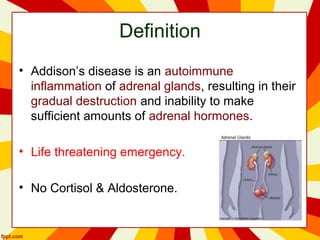
• Addison’s disease is an autoimmune
inflammation of adrenal glands, resulting in their
gradual destruction and inability to make
sufficient amounts of adrenal hormones.
• Life threatening emergency.
• No Cortisol & Aldosterone.
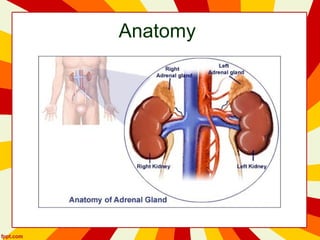
Anatomy
Etiology
Epidemiology
• The frequency rate of Addison's disease:
• Addison's can afflict persons of any age, gender, or
ethnicity, but it typically presents in adults between 30
and 50 years of age
Human Population 1 in 10,000
Pathogenesis
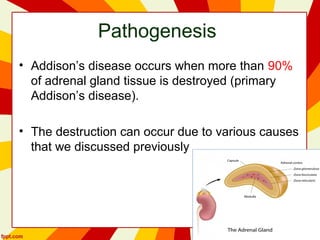
• Addison’s disease occurs when more than 90%
of adrenal gland tissue is destroyed (primary
Addison’s disease).
• The destruction can occur due to various causes
that we discussed previously
Clinical Features
Clinical Features
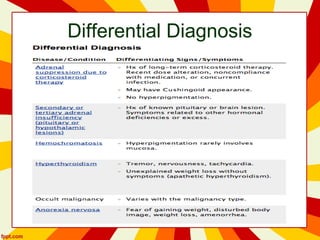
Differential Diagnosis
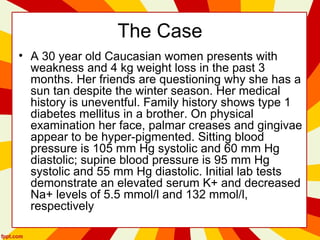
The Case
• A 30 year old Caucasian women presents with
weakness and 4 kg weight loss in the past 3
months. Her friends are questioning why she has a
sun tan despite the winter season. Her medical
history is uneventful. Family history shows type 1
diabetes mellitus in a brother. On physical
examination her face, palmar creases and gingivae
appear to be hyper-pigmented. Sitting blood
pressure is 105 mm Hg systolic and 60 mm Hg
diastolic; supine blood pressure is 95 mm Hg
systolic and 55 mm Hg diastolic. Initial lab tests
demonstrate an elevated serum K+ and decreased
Na+ levels of 5.5 mmol/l and 132 mmol/l,
respectively
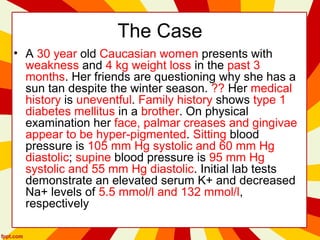
The Case
• A 30 year old Caucasian women presents with
weakness and 4 kg weight loss in the past 3
months. Her friends are questioning why she has a
sun tan despite the winter season. ?? Her medical
history is uneventful. Family history shows type 1
diabetes mellitus in a brother. On physical
examination her face, palmar creases and gingivae
appear to be hyper-pigmented. Sitting blood
pressure is 105 mm Hg systolic and 60 mm Hg
diastolic; supine blood pressure is 95 mm Hg
systolic and 55 mm Hg diastolic. Initial lab tests
demonstrate an elevated serum K+ and decreased
Na+ levels of 5.5 mmol/l and 132 mmol/l,
respectively
References
• http://autoimmune.pathology.jhmi.edu/dise
ases.cfm?systemID=3&DiseaseID=16
Addison's disease

Addison's disease

  • 1.
    Addison’s Disease Abdullatiff SamiAl-Rashed Block 2.3 College of Medicine, King Faisal University Al-Ahsa, Saudi Arabia
  • 2.
  • 3.
    Definition • Addison’s diseaseis an autoimmune inflammation of adrenal glands, resulting in their gradual destruction and inability to make sufficient amounts of adrenal hormones. • Life threatening emergency. • No Cortisol & Aldosterone.
  • 4.
  • 5.
  • 6.
    Epidemiology • The frequencyrate of Addison's disease: • Addison's can afflict persons of any age, gender, or ethnicity, but it typically presents in adults between 30 and 50 years of age Human Population 1 in 10,000
  • 7.
    Pathogenesis • Addison’s diseaseoccurs when more than 90% of adrenal gland tissue is destroyed (primary Addison’s disease). • The destruction can occur due to various causes that we discussed previously
  • 8.
  • 9.
  • 10.
  • 11.
    The Case • A30 year old Caucasian women presents with weakness and 4 kg weight loss in the past 3 months. Her friends are questioning why she has a sun tan despite the winter season. Her medical history is uneventful. Family history shows type 1 diabetes mellitus in a brother. On physical examination her face, palmar creases and gingivae appear to be hyper-pigmented. Sitting blood pressure is 105 mm Hg systolic and 60 mm Hg diastolic; supine blood pressure is 95 mm Hg systolic and 55 mm Hg diastolic. Initial lab tests demonstrate an elevated serum K+ and decreased Na+ levels of 5.5 mmol/l and 132 mmol/l, respectively
  • 12.
    The Case • A30 year old Caucasian women presents with weakness and 4 kg weight loss in the past 3 months. Her friends are questioning why she has a sun tan despite the winter season. ?? Her medical history is uneventful. Family history shows type 1 diabetes mellitus in a brother. On physical examination her face, palmar creases and gingivae appear to be hyper-pigmented. Sitting blood pressure is 105 mm Hg systolic and 60 mm Hg diastolic; supine blood pressure is 95 mm Hg systolic and 55 mm Hg diastolic. Initial lab tests demonstrate an elevated serum K+ and decreased Na+ levels of 5.5 mmol/l and 132 mmol/l, respectively
  • 14.

Editor's Notes

  • #6 Most frequently, it is due to autoimmune process, when immune system attacks adrenal glands. Tuberculosis as a cause of Addison’s disease is more common in developed countries. Rarely, adrenal glands can be destroyed by infections, cancer metastasis, amyloidosis, or hemorrhage.