Table 6: Isabelle Britto, Alex Picard, Feroz Shahid

ADDISON’S DISEASE
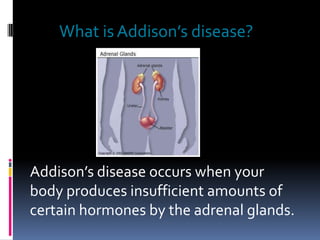
What is Addison’s disease?


Addison’s disease occurs when your
body produces insufficient amounts of
certain hormones by the adrenal glands.
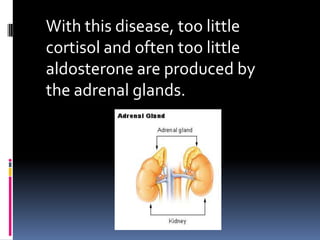
With this disease, too little
cortisol and often too little
aldosterone are produced by
the adrenal glands.
Addison’s
disease can
occur in any
age, and in
any gender, at
any time. It
should be
caught early,
as it is life
threatening.
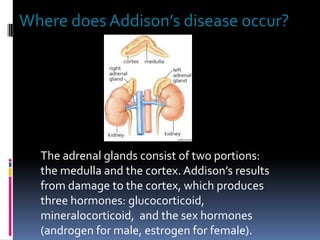
Where does Addison’s disease occur?


  The adrenal glands consist of two portions:
  the medulla and the cortex. Addison’s results
  from damage to the cortex, which produces
  three hormones: glucocorticoid,
  mineralocorticoid, and the sex hormones
  (androgen for male, estrogen for female).
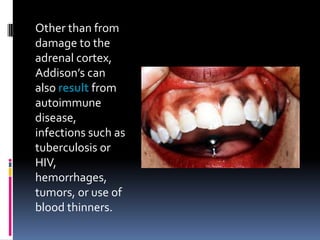
Other than from
damage to the
adrenal cortex,
Addison’s can
also result from
autoimmune
disease,
infections such as
tuberculosis or
HIV,
hemorrhages,
tumors, or use of
blood thinners.
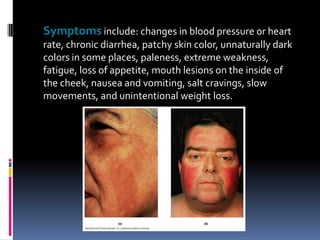
Symptoms include: changes in blood pressure or heart
rate, chronic diarrhea, patchy skin color, unnaturally dark
colors in some places, paleness, extreme weakness,
fatigue, loss of appetite, mouth lesions on the inside of
the cheek, nausea and vomiting, salt cravings, slow
movements, and unintentional weight loss.
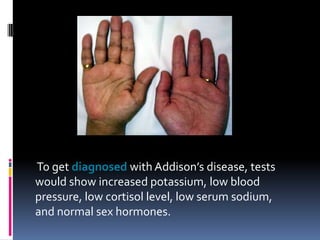
To get diagnosed with Addison’s disease, tests
would show increased potassium, low blood
pressure, low cortisol level, low serum sodium,
and normal sex hormones.
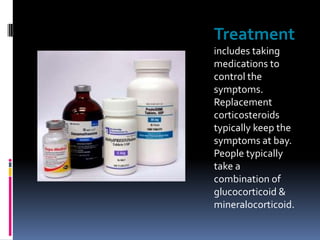
Treatment
includes taking
medications to
control the
symptoms.
Replacement
corticosteroids
typically keep the
symptoms at bay.
People typically
take a
combination of
glucocorticoid &
mineralocorticoid.
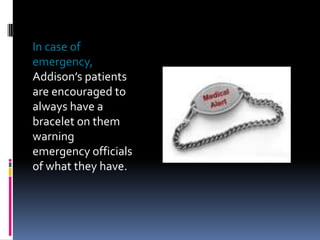
In case of
emergency,
Addison’s patients
are encouraged to
always have a
bracelet on them
warning
emergency officials
of what they have.
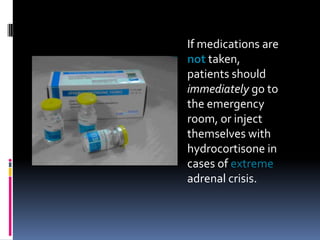
If medications are
not taken,
patients should
immediately go to
the emergency
room, or inject
themselves with
hydrocortisone in
cases of extreme
adrenal crisis.
Fun Fact:
            One of our
            most famous
            and well known
            presidents,
            John F.
            Kennedy,
            suffered from
            Addison’s
            disease.
Work Cited
Addison's disease. (2009, November 25). Retrieved from
          http://www.ncbi.nlm.nih.gov/pubmedhealth/PMH0001416/

 Addison's disease. (2010, June 10). Retrieved from
          http://www.mayoclinic.com/health/addisons-disease/DS00361

Addison's disease. (n.d.). Retrieved from
         http://www.medicinenet.com/addison_disease/article.htm

Seibel, J. A. (2009, December 13). Understanding Addison's disease. Retrieved
           from http://www.webmd.com/a-to-z-guides/understanding-addisons-
           disease-basics

Thompson , E. G. (2011, May 11). Addison's disease. Retrieved from
       http://www.fletcherallen.org/health_information/?id=hw65865

Addison's disease. (n.d.). Retrieved from http://www.web-
           books.com/eLibrary/Medicine/Endocrine/Addison.htm

Addison’s disease

  • 1.
    Table 6: IsabelleBritto, Alex Picard, Feroz Shahid ADDISON’S DISEASE
  • 2.
    What is Addison’sdisease? Addison’s disease occurs when your body produces insufficient amounts of certain hormones by the adrenal glands.
  • 3.
    With this disease,too little cortisol and often too little aldosterone are produced by the adrenal glands.
  • 4.
    Addison’s disease can occur inany age, and in any gender, at any time. It should be caught early, as it is life threatening.
  • 5.
    Where does Addison’sdisease occur? The adrenal glands consist of two portions: the medulla and the cortex. Addison’s results from damage to the cortex, which produces three hormones: glucocorticoid, mineralocorticoid, and the sex hormones (androgen for male, estrogen for female).
  • 6.
    Other than from damageto the adrenal cortex, Addison’s can also result from autoimmune disease, infections such as tuberculosis or HIV, hemorrhages, tumors, or use of blood thinners.
  • 7.
    Symptoms include: changesin blood pressure or heart rate, chronic diarrhea, patchy skin color, unnaturally dark colors in some places, paleness, extreme weakness, fatigue, loss of appetite, mouth lesions on the inside of the cheek, nausea and vomiting, salt cravings, slow movements, and unintentional weight loss.
  • 8.
    To get diagnosedwith Addison’s disease, tests would show increased potassium, low blood pressure, low cortisol level, low serum sodium, and normal sex hormones.
  • 9.
    Treatment includes taking medications to controlthe symptoms. Replacement corticosteroids typically keep the symptoms at bay. People typically take a combination of glucocorticoid & mineralocorticoid.
  • 10.
    In case of emergency, Addison’spatients are encouraged to always have a bracelet on them warning emergency officials of what they have.
  • 11.
    If medications are nottaken, patients should immediately go to the emergency room, or inject themselves with hydrocortisone in cases of extreme adrenal crisis.
  • 12.
    Fun Fact: One of our most famous and well known presidents, John F. Kennedy, suffered from Addison’s disease.
  • 13.
    Work Cited Addison's disease.(2009, November 25). Retrieved from http://www.ncbi.nlm.nih.gov/pubmedhealth/PMH0001416/ Addison's disease. (2010, June 10). Retrieved from http://www.mayoclinic.com/health/addisons-disease/DS00361 Addison's disease. (n.d.). Retrieved from http://www.medicinenet.com/addison_disease/article.htm Seibel, J. A. (2009, December 13). Understanding Addison's disease. Retrieved from http://www.webmd.com/a-to-z-guides/understanding-addisons- disease-basics Thompson , E. G. (2011, May 11). Addison's disease. Retrieved from http://www.fletcherallen.org/health_information/?id=hw65865 Addison's disease. (n.d.). Retrieved from http://www.web- books.com/eLibrary/Medicine/Endocrine/Addison.htm