Addison’s Disease Ali Chakera
Focus for Discussion A general update on Addison’s disease Diagnostic pathway Treatment regimes Monitoring Addison’s disease? Surgical guidelines. Is there a good screening test? For us or for primary care.
Start with a case 26 year old, VE Nursery school teacher Gets lots of bugs D&V. Iv fluids,  Δ   gastroenteritis. Home Begins to feel a bit dizzy and weak. Five more admissions with the same.
VE, 26F Eventually someone did a SST 0 ΄  <20 30 ΄   <20 60 ΄   <20 However, still having problems Turned up to A&E, vomiting Waiting for 2 hours before being told to call Devon Docs!
Addison’s Disease Primary vs secondary adrenal insufficiency Concentrate on primary Diagnosis Clinical suspicion SST + ACTH Then look for underlying cause Lifelong hydrocortisone +/- fludrocortisone treatment
Clinical Suspicion Hyponatraemia Hyperkalaemia Hypoglycaemia Raised urea Metabolic acidosis Hypercalcaemia Raised thyroid stimulating hormone Normocytic anaemia Hyperpigmentation of skin & mucous membrane  Low blood pressure  Postural hypotension Fatigue Malaise Loss of appetite Nausea & vomiting Abdominal pain Weight loss Postural dizziness Myalgia Joint pain Salt craving Loss of libido (women) Laboratory results Signs  Symptoms
Testing for Addison’s disease SST 250mcg synacthen test 1mcg synacthen test ITT More laborious and potentially dangerous Gold standard
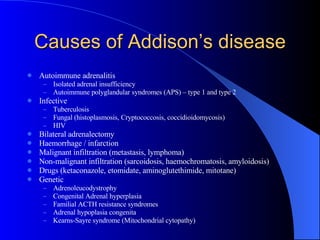
Causes of Addison’s disease Autoimmune adrenalitis Isolated adrenal insufficiency Autoimmune polyglandular syndromes (APS) – type 1 and type 2 Infective Tuberculosis  Fungal (histoplasmosis, Cryptococcosis, coccidioidomycosis) HIV Bilateral adrenalectomy Haemorrhage / infarction Malignant infiltration (metastasis, lymphoma) Non-malignant infiltration (sarcoidosis, haemochromatosis, amyloidosis) Drugs (ketaconazole, etomidate, aminoglutethimide, mitotane) Genetic Adrenoleucodystrophy Congenital Adrenal hyperplasia Familial ACTH resistance syndromes Adrenal hypoplasia congenita Kearns-Sayre syndrome (Mitochondrial cytopathy)
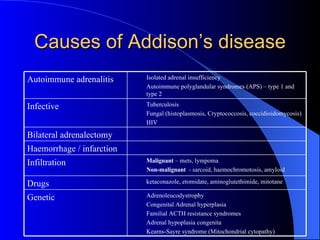
Causes of Addison’s disease Adrenoleucodystrophy Congenital Adrenal hyperplasia Familial ACTH resistance syndromes Adrenal hypoplasia congenita Kearns-Sayre syndrome (Mitochondrial cytopathy) Genetic ketaconazole, etomidate, aminoglutethimide, mitotane Drugs Malignant  – mets, lympoma Non-malignant  - sarcoid, haemochromotosis, amyloid Infiltration Haemorrhage / infarction Bilateral adrenalectomy Tuberculosis  Fungal (histoplasmosis, Cryptococcosis, coccidioidomycosis) HIV Infective Isolated adrenal insufficiency  Autoimmune polyglandular syndromes (APS) – type 1 and type 2 Autoimmune adrenalitis
 
Optimum treatment? Some evidence that tds hydrocortisone is better than bd No RCT’s Non-randomised/retrospective data ? Intuitive Latest literature suggesting starting dose of 15mg/24hrs. Most suggest 20-25mg/24hrs
Monitoring? No optimum test. ACTH Respond quickly to cortisol, so no time period that you could count as normal Day Curves Hydrocortisone doesn’t have a smooth release so what are we really checking 24 hour urine cortisol To check if they are taking it
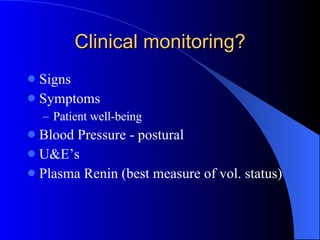
Clinical monitoring? Signs Symptoms Patient well-being Blood Pressure - postural U&E’s Plasma Renin (best measure of vol. status)
On the Horizon Delayed release hydrocortisone Slow release hydrocortisone Hydrocortisone pump
Any Questions?
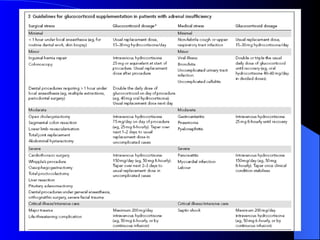
Treatment in Surgery No consensus No clinical evidence General principles: Larger doses traditionally given generally not needed. Amounts should correlate to physiological increases in cortisol according to degree of stress. Over-treatment may have wound healing consequences
Treatment in surgery
Any comments?
Is there a good screening test?
Is a baseline cortisol of value? Is a morning cortisol a good screening test? Evidence: Hagg E, Asplund K, Lithner F.  Value of basal plasma cortisol assays in the assessment of pituitary-adrenal insufficiency.  Clin Endocrinol (Oxf)  1987;  26:  221–26. Lee MT, Won JG, Lee TI, Yang HJ, Lin HD, Tang KT.  The relationship between morning serum cortisol and the short ACTH test in the evaluation of adrenal insufficiency.  Zhonghua Yi Xue Za Zhi (Taipei). 2002 Dec;65(12):580-7. Both suggest that a cutoff of 300nmol/l rules out Addison’s
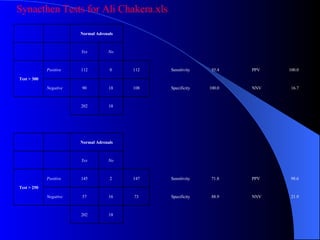
Our results over the past year 220 SST’s over the past year 18 results consistent with adrenal insufficiency Everyone with a baseline cortisol >300 had a normal SST
Synacthen  Tests for Ali  Chakera.xls   18 202   21.9 NNV 88.9 Specificity 73 16 57 Negative 98.6 PPV 71.8 Sensitivity 147 2 145 Positive Test > 250   No Yes     Normal Adrenals       18 202   16.7 NNV 100.0 Specificity 108 18 90 Negative 100.0 PPV 55.4 Sensitivity 112 0 112 Positive Test > 300   No Yes     Normal Adrenals    
Our results for the past  3  years 648 SST’s over the past year 60 results consistent with adrenal insufficiency = 53 patients All bar one patient with a baseline cortisol >350 had a normal SST
3 years of  synacthen   results.xls   57 591   15.0 NNV 98.2 Specificity 374 56 318 Negative 99.6 PPV 46.2 Sensitivity 274 1 273 Positive Test > 350   No Yes     Normal Adrenals       58 590   12.8 NNV 98.3 Specificity 445 57 388 Negative 99.5 PPV 34.2 Sensitivity 203 1 202 Positive Test > 400   No Yes     Normal Adrenals    
Conclusions Addison’s disease needs a high index of suspicion. There is no clear biochemical marker of adequate treatment. There is no clear cut-off in terms of baseline cortisol – but perhaps GP’s could consider SST’s in primary care
Any  Questions?
 

Addison’s Disease

  • 1.
  • 2.
    Focus for DiscussionA general update on Addison’s disease Diagnostic pathway Treatment regimes Monitoring Addison’s disease? Surgical guidelines. Is there a good screening test? For us or for primary care.
  • 3.
    Start with acase 26 year old, VE Nursery school teacher Gets lots of bugs D&V. Iv fluids, Δ gastroenteritis. Home Begins to feel a bit dizzy and weak. Five more admissions with the same.
  • 4.
    VE, 26F Eventuallysomeone did a SST 0 ΄ <20 30 ΄ <20 60 ΄ <20 However, still having problems Turned up to A&E, vomiting Waiting for 2 hours before being told to call Devon Docs!
  • 5.
    Addison’s Disease Primaryvs secondary adrenal insufficiency Concentrate on primary Diagnosis Clinical suspicion SST + ACTH Then look for underlying cause Lifelong hydrocortisone +/- fludrocortisone treatment
  • 6.
    Clinical Suspicion HyponatraemiaHyperkalaemia Hypoglycaemia Raised urea Metabolic acidosis Hypercalcaemia Raised thyroid stimulating hormone Normocytic anaemia Hyperpigmentation of skin & mucous membrane Low blood pressure Postural hypotension Fatigue Malaise Loss of appetite Nausea & vomiting Abdominal pain Weight loss Postural dizziness Myalgia Joint pain Salt craving Loss of libido (women) Laboratory results Signs Symptoms
  • 7.
    Testing for Addison’sdisease SST 250mcg synacthen test 1mcg synacthen test ITT More laborious and potentially dangerous Gold standard
  • 8.
    Causes of Addison’sdisease Autoimmune adrenalitis Isolated adrenal insufficiency Autoimmune polyglandular syndromes (APS) – type 1 and type 2 Infective Tuberculosis Fungal (histoplasmosis, Cryptococcosis, coccidioidomycosis) HIV Bilateral adrenalectomy Haemorrhage / infarction Malignant infiltration (metastasis, lymphoma) Non-malignant infiltration (sarcoidosis, haemochromatosis, amyloidosis) Drugs (ketaconazole, etomidate, aminoglutethimide, mitotane) Genetic Adrenoleucodystrophy Congenital Adrenal hyperplasia Familial ACTH resistance syndromes Adrenal hypoplasia congenita Kearns-Sayre syndrome (Mitochondrial cytopathy)
  • 9.
    Causes of Addison’sdisease Adrenoleucodystrophy Congenital Adrenal hyperplasia Familial ACTH resistance syndromes Adrenal hypoplasia congenita Kearns-Sayre syndrome (Mitochondrial cytopathy) Genetic ketaconazole, etomidate, aminoglutethimide, mitotane Drugs Malignant – mets, lympoma Non-malignant - sarcoid, haemochromotosis, amyloid Infiltration Haemorrhage / infarction Bilateral adrenalectomy Tuberculosis Fungal (histoplasmosis, Cryptococcosis, coccidioidomycosis) HIV Infective Isolated adrenal insufficiency Autoimmune polyglandular syndromes (APS) – type 1 and type 2 Autoimmune adrenalitis
  • 10.
  • 11.
    Optimum treatment? Someevidence that tds hydrocortisone is better than bd No RCT’s Non-randomised/retrospective data ? Intuitive Latest literature suggesting starting dose of 15mg/24hrs. Most suggest 20-25mg/24hrs
  • 12.
    Monitoring? No optimumtest. ACTH Respond quickly to cortisol, so no time period that you could count as normal Day Curves Hydrocortisone doesn’t have a smooth release so what are we really checking 24 hour urine cortisol To check if they are taking it
  • 13.
    Clinical monitoring? SignsSymptoms Patient well-being Blood Pressure - postural U&E’s Plasma Renin (best measure of vol. status)
  • 14.
    On the HorizonDelayed release hydrocortisone Slow release hydrocortisone Hydrocortisone pump
  • 15.
  • 16.
    Treatment in SurgeryNo consensus No clinical evidence General principles: Larger doses traditionally given generally not needed. Amounts should correlate to physiological increases in cortisol according to degree of stress. Over-treatment may have wound healing consequences
  • 17.
  • 18.
  • 19.
    Is there agood screening test?
  • 20.
    Is a baselinecortisol of value? Is a morning cortisol a good screening test? Evidence: Hagg E, Asplund K, Lithner F. Value of basal plasma cortisol assays in the assessment of pituitary-adrenal insufficiency. Clin Endocrinol (Oxf) 1987; 26: 221–26. Lee MT, Won JG, Lee TI, Yang HJ, Lin HD, Tang KT. The relationship between morning serum cortisol and the short ACTH test in the evaluation of adrenal insufficiency. Zhonghua Yi Xue Za Zhi (Taipei). 2002 Dec;65(12):580-7. Both suggest that a cutoff of 300nmol/l rules out Addison’s
  • 21.
    Our results overthe past year 220 SST’s over the past year 18 results consistent with adrenal insufficiency Everyone with a baseline cortisol >300 had a normal SST
  • 22.
    Synacthen Testsfor Ali Chakera.xls   18 202   21.9 NNV 88.9 Specificity 73 16 57 Negative 98.6 PPV 71.8 Sensitivity 147 2 145 Positive Test > 250   No Yes     Normal Adrenals       18 202   16.7 NNV 100.0 Specificity 108 18 90 Negative 100.0 PPV 55.4 Sensitivity 112 0 112 Positive Test > 300   No Yes     Normal Adrenals    
  • 23.
    Our results forthe past 3 years 648 SST’s over the past year 60 results consistent with adrenal insufficiency = 53 patients All bar one patient with a baseline cortisol >350 had a normal SST
  • 24.
    3 years of synacthen results.xls   57 591   15.0 NNV 98.2 Specificity 374 56 318 Negative 99.6 PPV 46.2 Sensitivity 274 1 273 Positive Test > 350   No Yes     Normal Adrenals       58 590   12.8 NNV 98.3 Specificity 445 57 388 Negative 99.5 PPV 34.2 Sensitivity 203 1 202 Positive Test > 400   No Yes     Normal Adrenals    
  • 25.
    Conclusions Addison’s diseaseneeds a high index of suspicion. There is no clear biochemical marker of adequate treatment. There is no clear cut-off in terms of baseline cortisol – but perhaps GP’s could consider SST’s in primary care
  • 26.
  • 27.