By Tapendra Koirala
2nd Batch
Senior Clerkship
10th June 3016
Content
 Introduction
 Etiology
 Classification
 Clinical Features
 Management
 References
Cushing syndrome
•Cushing's Syndrome
• Excess cortisol due
to any cause
•Cushing's Disease
• Excess cortisol due to
pituitary micro-
adenoma
An array of symptoms as a result of
abnormally high levels of cortisol or other
glucocorticoids in the blood
Etiology
Exogenous/
iatrogenic
Prolonged
administration of
Glucocorticoids
ACTH
Endogenous
ACTH dependent
causes
Hypothalamic
lesions:
Increased CRH
production
Pituitary lesions:
Microadenoma
Macroedema
Ectopic lesions:
Oat cell ca
Bronchial carcinoid
Pancreatic ca
Neuroblastoma
Wilm’s tumor
ACTH independent
causes
Adrenal
adenoma/carcinom
a/hyperplasia
McCune Albright
syndrome
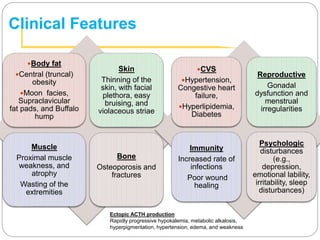
Clinical Features
Body fat
Central (truncal)
obesity
Moon facies,
Supraclavicular
fat pads, and Buffalo
hump
Skin
Thinning of the
skin, with facial
plethora, easy
bruising, and
violaceous striae
Muscle
Proximal muscle
weakness, and
atrophy
Wasting of the
extremities
Bone
Osteoporosis and
fractures
CVS
Hypertension,
Congestive heart
failure,
Hyperlipidemia,
Diabetes
Reproductive
Gonadal
dysfunction and
menstrual
irregularities
Immunity
Increased rate of
infections
Poor wound
healing
Psychologic
disturbances
(e.g.,
depression,
emotional lability,
irritability, sleep
disturbances)
Ectopic ACTH production
Rapidly progressive hypokalemia, metabolic alkalosis,
hyperpigmentation, hypertension, edema, and weakness
Cont’d...
Findings are more obvious in infants
Children with adrenal tumors
Signs of abnormal masculinization
Growth impairment
Short stature
In Pediatric
Patients
Cont’d...
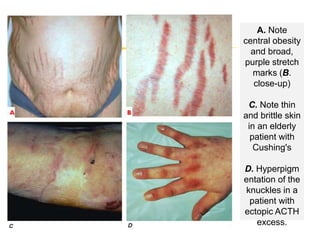
A. Note
central obesity
and broad,
purple stretch
marks (B.
close-up)
C. Note thin
and brittle skin
in an elderly
patient with
Cushing's
D. Hyperpigm
entation of the
knuckles in a
patient with
ectopic ACTH
excess.
Evaluation
 Most important step in suspected CS
is to establish the correct diagnosis
 Exclude exogenous glucocorticoid use
 Screening tests to confirm hypercortisolism
Overnight/single dose dexamethasone suppression
test (DST)
24 hr urinary free cortisol
Late night salivary cortisol level
Cont’d...
A single-dose DST
A dose of 25-30 ug/kg (maximum of 2 mg) given at 11 PM
Plasma cortisol level measured at 8 AM the next morning
Value <50 nmol/L Adequate suppression
 Rules out Cushing syndrome
↓
2nd line screening test: Low dose DST
Eight doses of dexamethasone (5ug/kg per dose every six
hours for 2 days, 1.25 mg/m2/day four dose for two days
Measure serum cortisol at 8 AM
Suppression (<50 nmol/L) of cortisol rules out Cushing
syndrome
Cont’d...
If Dx of Cushing syndrome has been established
then,
The next step is to find out the cause
↓
Serum ACTH level
If low or undetectable– ACTH independent cause
[Adrenal cause likely]
If high– Cushing’s disease or Ectopic ACTH syndrome
 Two differentiate between these two: High dose DST is to be done
Cont’d...
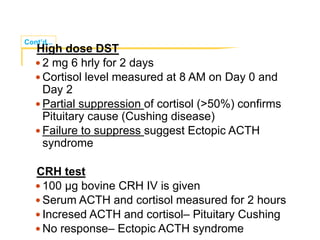
High dose DST
 2 mg 6 hrly for 2 days
 Cortisol level measured at 8 AM on Day 0 and
Day 2
 Partial suppression of cortisol (>50%) confirms
Pituitary cause (Cushing disease)
 Failure to suppress suggest Ectopic ACTH
syndrome
CRH test
 100 µg bovine CRH IV is given
 Serum ACTH and cortisol measured for 2 hours
 Incresed ACTH and cortisol– Pituitary Cushing
 No response– Ectopic ACTH syndrome
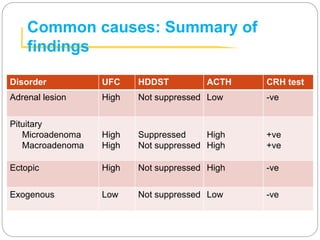
Common causes: Summary of
findings
Disorder UFC HDDST ACTH CRH test
Adrenal lesion High Not suppressed Low -ve
Pituitary
Microadenoma
Macroadenoma
High
High
Suppressed
Not suppressed
High
High
+ve
+ve
Ectopic High Not suppressed High -ve
Exogenous Low Not suppressed Low -ve
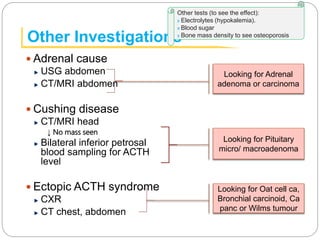
Other Investigations
 Adrenal cause
USG abdomen
CT/MRI abdomen
 Cushing disease
CT/MRI head
↓ No mass seen
Bilateral inferior petrosal
blood sampling for ACTH
level
 Ectopic ACTH syndrome
CXR
CT chest, abdomen
Other tests (to see the effect):
x Electrolytes (hypokalemia).
x Blood sugar
x Bone mass density to see osteoporosis
Looking for Adrenal
adenoma or carcinoma
Looking for Pituitary
micro/ macroadenoma
Looking for Oat cell ca,
Bronchial carcinoid, Ca
panc or Wilms tumour
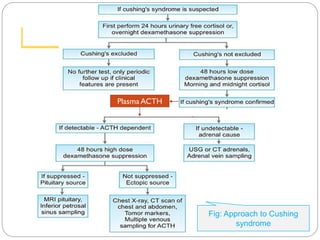
Fig: Approach to Cushing
syndrome
Differential Diagnosis
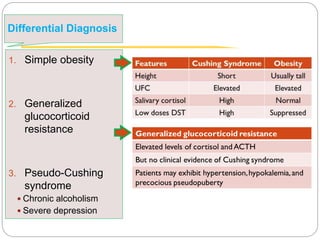
1. Simple obesity
2. Generalized
glucocorticoid
resistance
3. Pseudo-Cushing
syndrome
 Chronic alcoholism
 Severe depression
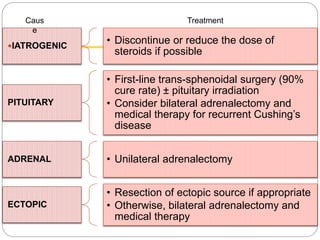
IATROGENIC
• Discontinue or reduce the dose of
steroids if possible
PITUITARY
• First-line trans-sphenoidal surgery (90%
cure rate) ± pituitary irradiation
• Consider bilateral adrenalectomy and
medical therapy for recurrent Cushing’s
disease
ADRENAL • Unilateral adrenalectomy
ECTOPIC
• Resection of ectopic source if appropriate
• Otherwise, bilateral adrenalectomy and
medical therapy
Caus
e
Treatment
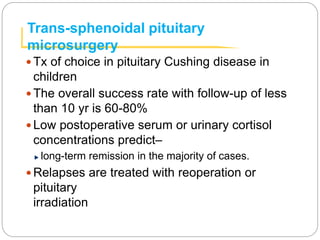
Trans-sphenoidal pituitary
microsurgery
 Tx of choice in pituitary Cushing disease in
children
 The overall success rate with follow-up of less
than 10 yr is 60-80%
 Low postoperative serum or urinary cortisol
concentrations predict–
long-term remission in the majority of cases.
 Relapses are treated with reoperation or
pituitary
irradiation
Adrenalectomy
 Irresponsive to treatment or if ACTH is secreted by
an ectopic metastatic tumor
 May lead to Nelson Syndrome, when there is
Increased ACTH secretion by an unresected pituitary
adenoma
Evidenced mainly by marked hyperpigmentation
 Requires adequate preoperative and postoperative
replacement therapy
 Postoperative complications may include
Sepsis, pancreatitis, thrombosis, poor wound healing, and
sudden collapse
Medical therapy
 Inhibitors of adrenal steroidogenesis
[Metyrapone, ketoconazole, aminoglutethimide,
etomidate]
Used preoperatively to normalize circulating cortisol
levels
 Centrally acting serotonin antagonist
[Cyproheptadine]
Blocks ACTH release
References
 Part 26, Section 4, Chapter 577, Nelsons Text
Book of Pediatrics, 20th edition
 Part 16, Section 1, Chapter 406, Harrison’s
Principle of Internal Medicine, 19th edition
Thank You

Cushing syndrome

  • 1.
    By Tapendra Koirala 2ndBatch Senior Clerkship 10th June 3016
  • 2.
    Content  Introduction  Etiology Classification  Clinical Features  Management  References
  • 3.
    Cushing syndrome •Cushing's Syndrome •Excess cortisol due to any cause •Cushing's Disease • Excess cortisol due to pituitary micro- adenoma An array of symptoms as a result of abnormally high levels of cortisol or other glucocorticoids in the blood
  • 4.
    Etiology Exogenous/ iatrogenic Prolonged administration of Glucocorticoids ACTH Endogenous ACTH dependent causes Hypothalamic lesions: IncreasedCRH production Pituitary lesions: Microadenoma Macroedema Ectopic lesions: Oat cell ca Bronchial carcinoid Pancreatic ca Neuroblastoma Wilm’s tumor ACTH independent causes Adrenal adenoma/carcinom a/hyperplasia McCune Albright syndrome
  • 5.
    Clinical Features Body fat Central(truncal) obesity Moon facies, Supraclavicular fat pads, and Buffalo hump Skin Thinning of the skin, with facial plethora, easy bruising, and violaceous striae Muscle Proximal muscle weakness, and atrophy Wasting of the extremities Bone Osteoporosis and fractures CVS Hypertension, Congestive heart failure, Hyperlipidemia, Diabetes Reproductive Gonadal dysfunction and menstrual irregularities Immunity Increased rate of infections Poor wound healing Psychologic disturbances (e.g., depression, emotional lability, irritability, sleep disturbances) Ectopic ACTH production Rapidly progressive hypokalemia, metabolic alkalosis, hyperpigmentation, hypertension, edema, and weakness
  • 6.
    Cont’d... Findings are moreobvious in infants Children with adrenal tumors Signs of abnormal masculinization Growth impairment Short stature In Pediatric Patients
  • 7.
    Cont’d... A. Note central obesity andbroad, purple stretch marks (B. close-up) C. Note thin and brittle skin in an elderly patient with Cushing's D. Hyperpigm entation of the knuckles in a patient with ectopic ACTH excess.
  • 8.
    Evaluation  Most importantstep in suspected CS is to establish the correct diagnosis  Exclude exogenous glucocorticoid use  Screening tests to confirm hypercortisolism Overnight/single dose dexamethasone suppression test (DST) 24 hr urinary free cortisol Late night salivary cortisol level
  • 9.
    Cont’d... A single-dose DST Adose of 25-30 ug/kg (maximum of 2 mg) given at 11 PM Plasma cortisol level measured at 8 AM the next morning Value <50 nmol/L Adequate suppression  Rules out Cushing syndrome ↓ 2nd line screening test: Low dose DST Eight doses of dexamethasone (5ug/kg per dose every six hours for 2 days, 1.25 mg/m2/day four dose for two days Measure serum cortisol at 8 AM Suppression (<50 nmol/L) of cortisol rules out Cushing syndrome
  • 10.
    Cont’d... If Dx ofCushing syndrome has been established then, The next step is to find out the cause ↓ Serum ACTH level If low or undetectable– ACTH independent cause [Adrenal cause likely] If high– Cushing’s disease or Ectopic ACTH syndrome  Two differentiate between these two: High dose DST is to be done
  • 11.
    Cont’d... High dose DST 2 mg 6 hrly for 2 days  Cortisol level measured at 8 AM on Day 0 and Day 2  Partial suppression of cortisol (>50%) confirms Pituitary cause (Cushing disease)  Failure to suppress suggest Ectopic ACTH syndrome CRH test  100 µg bovine CRH IV is given  Serum ACTH and cortisol measured for 2 hours  Incresed ACTH and cortisol– Pituitary Cushing  No response– Ectopic ACTH syndrome
  • 12.
    Common causes: Summaryof findings Disorder UFC HDDST ACTH CRH test Adrenal lesion High Not suppressed Low -ve Pituitary Microadenoma Macroadenoma High High Suppressed Not suppressed High High +ve +ve Ectopic High Not suppressed High -ve Exogenous Low Not suppressed Low -ve
  • 13.
    Other Investigations  Adrenalcause USG abdomen CT/MRI abdomen  Cushing disease CT/MRI head ↓ No mass seen Bilateral inferior petrosal blood sampling for ACTH level  Ectopic ACTH syndrome CXR CT chest, abdomen Other tests (to see the effect): x Electrolytes (hypokalemia). x Blood sugar x Bone mass density to see osteoporosis Looking for Adrenal adenoma or carcinoma Looking for Pituitary micro/ macroadenoma Looking for Oat cell ca, Bronchial carcinoid, Ca panc or Wilms tumour
  • 14.
    Fig: Approach toCushing syndrome
  • 15.
    Differential Diagnosis 1. Simpleobesity 2. Generalized glucocorticoid resistance 3. Pseudo-Cushing syndrome  Chronic alcoholism  Severe depression
  • 17.
    IATROGENIC • Discontinue orreduce the dose of steroids if possible PITUITARY • First-line trans-sphenoidal surgery (90% cure rate) ± pituitary irradiation • Consider bilateral adrenalectomy and medical therapy for recurrent Cushing’s disease ADRENAL • Unilateral adrenalectomy ECTOPIC • Resection of ectopic source if appropriate • Otherwise, bilateral adrenalectomy and medical therapy Caus e Treatment
  • 18.
    Trans-sphenoidal pituitary microsurgery  Txof choice in pituitary Cushing disease in children  The overall success rate with follow-up of less than 10 yr is 60-80%  Low postoperative serum or urinary cortisol concentrations predict– long-term remission in the majority of cases.  Relapses are treated with reoperation or pituitary irradiation
  • 19.
    Adrenalectomy  Irresponsive totreatment or if ACTH is secreted by an ectopic metastatic tumor  May lead to Nelson Syndrome, when there is Increased ACTH secretion by an unresected pituitary adenoma Evidenced mainly by marked hyperpigmentation  Requires adequate preoperative and postoperative replacement therapy  Postoperative complications may include Sepsis, pancreatitis, thrombosis, poor wound healing, and sudden collapse
  • 20.
    Medical therapy  Inhibitorsof adrenal steroidogenesis [Metyrapone, ketoconazole, aminoglutethimide, etomidate] Used preoperatively to normalize circulating cortisol levels  Centrally acting serotonin antagonist [Cyproheptadine] Blocks ACTH release
  • 21.
    References  Part 26,Section 4, Chapter 577, Nelsons Text Book of Pediatrics, 20th edition  Part 16, Section 1, Chapter 406, Harrison’s Principle of Internal Medicine, 19th edition
  • 22.

Editor's Notes

  • #5 islet cell carcinoma of the pancreas, neuroblastoma or ganglioneuroblastoma, hemangiopericytoma, Wilms tumor, and thymic carcinoid
  • #7 Masculinization: hirsutism on the face and trunk, pubic hair, acne, deepening of the voice, and enlargement of the clitoris in girls.
  • #9 Cortisol levels in blood Normally elevated at 8 am and decrease to less than 50% by midnight except in infants and young children In patients with Cushing syndrome this circadian rhythm is lost; midnight cortisol levels >4.4 ug/dL Can be measured in saliva samples Urinary excretion of free cortisol is increased 24-hr urine sample, and is expressed as a ratio of micrograms of cortisol excreted per gram of creatinine
  • #13 The 2-step dexamethasone suppression test consists of administration of dexamethasone, 30 and 120 ug/kg/24 hr in 4 divided doses, on consecutive days. In children with pituitary Cushing syndrome, the larger dose, but not the smaller dose,
  • #15 A microadenoma or macroadenoma may be visualized by pituitary magnetic resonance scanning. Risk of carcinoma in adrenal tumors 4–6 cm is 6%. Radiographic clues include tumor heterogeneity and irregular borders (see Fig. 336-8). 17-KS, 17-ketosteroids; DHEA, dehydroepiandrosterone; ACTH, adrenocorticotropic hormone; CT, computed tomography
  • #20 Replacement tx with a corticosteroid