MUSCLE WEAKNESS & SKIN RASH
( DERMATOMYOSITIS )


Dr. Mohammad Tanvir Islam
Assistant Professor , Dept of Medicine
Bangabandhu Sheikh Mujib Medical University, Dhaka, Bangladesh
IS THIS A CASE OF MYOPATHY??
   Proximal muscle weakness evident by-

   Difficulty in standing from sitting position,
    combing hair etc.

   Normal tendon reflexes

   Pain & tenderness often present
WHAT MAY BE THE CAUSE OF THIS MYOPATHY

 Inflammatory myopathy
 Drug induced

 Endocrine

 Infection

 Alcohol
MYOPATHY WITH SKIN RASH

   Dermatomyositis

   Steroid induced myopathy

   Hypothyroidism

   Other CTDs
DERMATOMYOSITIS
 Double peak of onset
 Average age of onset is 40


   In 40% individuals the skin disease is the sole
    manifestation at onset

Muscle disease may occur-
 Concurrently,
 Precede the skin disease, or
 Follow the skin disease by weeks to years.
CLINICAL PRESENTATION
   Proximal myopathy

   Skin rash

 Systemic features-
 fever, malaise , arthralgia, arthritis, dyspnea,
  dysphagia, arrhythmia, and dysphonia,
  raynauds.

   Malignancy- lungs, GI tract, breast, overy etc
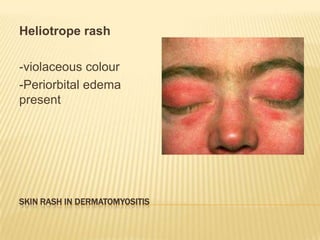
Heliotrope rash

-violaceous colour
-Periorbital edema
present


SKIN RASH IN DERMATOMYOSITIS
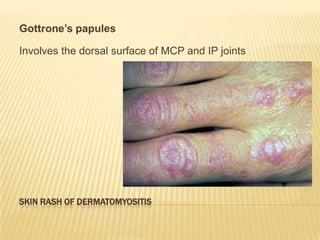
Gottrone’s papules

Involves the dorsal surface of MCP and IP joints


SKIN RASH OF DERMATOMYOSITIS
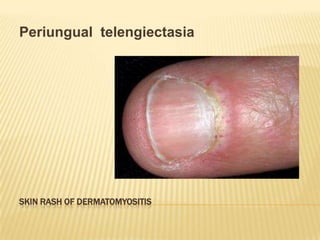
Periungual telengiectasia


SKIN RASH OF DERMATOMYOSITIS
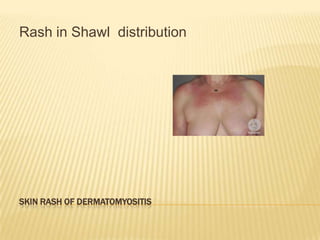
Rash in Shawl distribution


SKIN RASH OF DERMATOMYOSITIS
COMPLICATIONS
Dermatomyositis & malignancy

 6-7 fold increase risk of malignacy
 Usually early within 3 years of diagnosis

 chances decreases thereafter

 Highest in patients diagnosed after 45yrs of
  age
 Ovarian and gastric cancer and lymphoma
  are most common
COMPLICATIONS

 Cardiomyopathy & Cardiac conduction
  defects
 Aspiration pneumonia

 Diffuse interstitial pneumonitis/fibrosis

 Large-bowel infarction

 Muscle atrophy & Muscle calcification

 Ocular complications including iritis,
  nystagmus, cotton-wool spots, optic atrophy,
  conjunctival, edema and pseudopolyposis
CLASSIFICATION CRITERIA FOR POLYMYOSITIS
AND DERMATOMYOSITIS*
1. Skin lesions
 Heliotrope: red-purple edematous erythema on the upper palpebra
 Gottron’s sign: red-purple keratotic, atrophic erythema or macules on the
 extensor surface of finger joints
 Erythema on the extensor surface of extremity joints, slight raised red-purple
 erythema over elbows or knees
2. Proximal muscle weakness (upper or lower extremity and trunk)
3. Elevated serum creatine kinase or aldolase level
4. Muscle pain on grasping or spontaneous pain
5. Myogenic changes on electromyography (short-duration, polyphasic motor
    unit potentials with spontaneous fibrillation potentials)
6. Positive anti-Jo-1 antibody test (histidyl-tRNA synthetase)
7. Nondestructive arthritis or arthralgias
8. Systemic inflammatory signs (temperature: more than 37°C [98.6°F] at axilla,
   elevated serum C-reactive protein level or accelerated erythrocyte
   sedimentation rate of more than 20 mm per hour by Westergren)
9. Pathologic findings compatible with inflammatory myositis (inflammatory
   infiltration of skeletal evidence of active regeneration may be seen)
CLINICAL CRITERIA

 1975, Bohan and Pete
 Set of 5 criteria to aid in the diagnosis and
  classification of dermatomyositis
  and polymyositis
1. progressive proximal symmetrical weakness,

2. elevated levels of muscle enzymes,

3. an abnormal finding on electromyography,

4. an abnormal finding on muscle biopsy

5. Cutaneous disease.
SUBSETS OF MYOSITIS
Bohan and Peter suggested 5 subsets of myositis, as
  follows :
 Dermatomyositis
 Polymyositis
 Myositis with malignancy
 Childhood dermatomyositis/polymyositis
 Myositis overlapping with another collagen-vascular
  disorder


   Others-
   postmyopathic dermatomyositis
    amyopathic dermatomyositis [ADM], or dermatomyositis
    sine myositis
HOW WILL YOU INVESTIGATE

Enzymes –
   CK

   Aldolase

   LDH

   carbonic anhydrase isoenzyme III
ANTIBODIES

 ANA commonly positive (60-80%)
 Anti –Mi-2 highly specific but sensitivity only
  25%
 Anti-Jo-1 more in polymyositis,associated
  with ILD,raynauds and arthritis (positive in
  20%)
 autoantibody against p155 highly associated
  with cancer
IMAGING
 MRI- useful in diagnosing inflammatory
  myopathy(even in patients without weakness), it
  also helps in taking muscle biopsy in choosing
  proper site
 EMG- helps to differentiate from neuropathy and
  choosing biopsy site.
 CXR
 Barium swallow
 USG
 CT scan
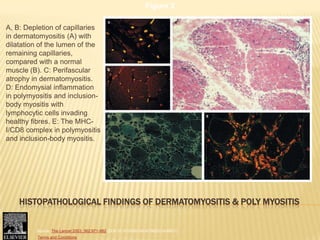
HISTOPATHOLOGICAL FINDINGS
   Findings on muscle biopsy can be
    diagnostic.
    Perivascular and interfascicular
    inflammatory infiltrates with adjoining groups
    of muscle fiber degeneration/regeneration

   This contrasts with polymyositis infiltrates,
    which are mainly intrafascicular
    (endomysial inflammation) with scattered
    individual muscle fiber necrosis.
Figure 2

A, B: Depletion of capillaries
in dermatomyositis (A) with
dilatation of the lumen of the
remaining capillaries,
compared with a normal
muscle (B). C: Perifascular
atrophy in dermatomyositis.
D: Endomysial inflammation
in polymyositis and inclusion-
body myositis with
lymphocytic cells invading
healthy fibres. E: The MHC-
I/CD8 complex in polymyositis
and inclusion-body myositis.


    HISTOPATHOLOGICAL FINDINGS OF DERMATOMYOSITIS & POLY MYOSITIS


         Source: The Lancet 2003; 362:971-982 (DOI:10.1016/S0140-6736(03)14368-1)
          Terms and Conditions
TREATMENT

   Oral prednisolone is the mainstay of treatment

   0.5-1.5 mg/kg starting dose.given untill CK level
    is normal , then tapered slowly over 12 month
    period

   Prednisolone itself worsen myopathy in some
    cases and steroid induced myopathy is
    differentiated by sparing the neck flexor
    strength
TREATMENT

   Other drugs used- methotrexate,azathiprine,
    cyclophosphamide, cyclosporine

   IV immunoglobulin for refractory cases

   Physiotherapy
TREATMENT

For skin component

   Hydroxychloroquine

   Topical steroids

   sunprotection
PROGNOSIS
 Spontaneous remission in 20%
 5% have fulminant progression and eventual
  death
 Poor prognostic factor-recalcitrant disease,
  delay in diagnosis, older age, malignancy,
  fever, asthenia-anorexia, pulmonary
  interstitial fibrosis, dysphagia and
  leukocytosis.
 Cause of death-Malignancy, cardiac and
  pulmonary dysfunction, and infection
USEFUL LINKS
   http://www.aafp.org/afp/2001/1101/p1565.pdf

   http://emedicine.medscape.com/article/332783
The value of experience is not in seeing
             much, but in seeing wisely.

                      SIR WILLIAM OSLER
Thank you all

Muscle weakness & rash (Dermatomyositis)

  • 1.
    MUSCLE WEAKNESS &SKIN RASH ( DERMATOMYOSITIS ) Dr. Mohammad Tanvir Islam Assistant Professor , Dept of Medicine Bangabandhu Sheikh Mujib Medical University, Dhaka, Bangladesh
  • 2.
    IS THIS ACASE OF MYOPATHY??  Proximal muscle weakness evident by-  Difficulty in standing from sitting position, combing hair etc.  Normal tendon reflexes  Pain & tenderness often present
  • 3.
    WHAT MAY BETHE CAUSE OF THIS MYOPATHY  Inflammatory myopathy  Drug induced  Endocrine  Infection  Alcohol
  • 4.
    MYOPATHY WITH SKINRASH  Dermatomyositis  Steroid induced myopathy  Hypothyroidism  Other CTDs
  • 5.
    DERMATOMYOSITIS  Double peakof onset  Average age of onset is 40  In 40% individuals the skin disease is the sole manifestation at onset Muscle disease may occur-  Concurrently,  Precede the skin disease, or  Follow the skin disease by weeks to years.
  • 6.
    CLINICAL PRESENTATION  Proximal myopathy  Skin rash  Systemic features-  fever, malaise , arthralgia, arthritis, dyspnea, dysphagia, arrhythmia, and dysphonia, raynauds.  Malignancy- lungs, GI tract, breast, overy etc
  • 7.
    Heliotrope rash -violaceous colour -Periorbitaledema present SKIN RASH IN DERMATOMYOSITIS
  • 8.
    Gottrone’s papules Involves thedorsal surface of MCP and IP joints SKIN RASH OF DERMATOMYOSITIS
  • 9.
  • 10.
    Rash in Shawldistribution SKIN RASH OF DERMATOMYOSITIS
  • 11.
    COMPLICATIONS Dermatomyositis & malignancy 6-7 fold increase risk of malignacy  Usually early within 3 years of diagnosis  chances decreases thereafter  Highest in patients diagnosed after 45yrs of age  Ovarian and gastric cancer and lymphoma are most common
  • 12.
    COMPLICATIONS  Cardiomyopathy &Cardiac conduction defects  Aspiration pneumonia  Diffuse interstitial pneumonitis/fibrosis  Large-bowel infarction  Muscle atrophy & Muscle calcification  Ocular complications including iritis, nystagmus, cotton-wool spots, optic atrophy, conjunctival, edema and pseudopolyposis
  • 13.
    CLASSIFICATION CRITERIA FORPOLYMYOSITIS AND DERMATOMYOSITIS* 1. Skin lesions  Heliotrope: red-purple edematous erythema on the upper palpebra  Gottron’s sign: red-purple keratotic, atrophic erythema or macules on the  extensor surface of finger joints  Erythema on the extensor surface of extremity joints, slight raised red-purple  erythema over elbows or knees 2. Proximal muscle weakness (upper or lower extremity and trunk) 3. Elevated serum creatine kinase or aldolase level 4. Muscle pain on grasping or spontaneous pain 5. Myogenic changes on electromyography (short-duration, polyphasic motor unit potentials with spontaneous fibrillation potentials) 6. Positive anti-Jo-1 antibody test (histidyl-tRNA synthetase) 7. Nondestructive arthritis or arthralgias 8. Systemic inflammatory signs (temperature: more than 37°C [98.6°F] at axilla, elevated serum C-reactive protein level or accelerated erythrocyte sedimentation rate of more than 20 mm per hour by Westergren) 9. Pathologic findings compatible with inflammatory myositis (inflammatory infiltration of skeletal evidence of active regeneration may be seen)
  • 14.
    CLINICAL CRITERIA  1975,Bohan and Pete  Set of 5 criteria to aid in the diagnosis and classification of dermatomyositis and polymyositis 1. progressive proximal symmetrical weakness, 2. elevated levels of muscle enzymes, 3. an abnormal finding on electromyography, 4. an abnormal finding on muscle biopsy 5. Cutaneous disease.
  • 15.
    SUBSETS OF MYOSITIS Bohanand Peter suggested 5 subsets of myositis, as follows :  Dermatomyositis  Polymyositis  Myositis with malignancy  Childhood dermatomyositis/polymyositis  Myositis overlapping with another collagen-vascular disorder  Others-  postmyopathic dermatomyositis  amyopathic dermatomyositis [ADM], or dermatomyositis sine myositis
  • 16.
    HOW WILL YOUINVESTIGATE Enzymes –  CK  Aldolase  LDH  carbonic anhydrase isoenzyme III
  • 17.
    ANTIBODIES  ANA commonlypositive (60-80%)  Anti –Mi-2 highly specific but sensitivity only 25%  Anti-Jo-1 more in polymyositis,associated with ILD,raynauds and arthritis (positive in 20%)  autoantibody against p155 highly associated with cancer
  • 18.
    IMAGING  MRI- usefulin diagnosing inflammatory myopathy(even in patients without weakness), it also helps in taking muscle biopsy in choosing proper site  EMG- helps to differentiate from neuropathy and choosing biopsy site.  CXR  Barium swallow  USG  CT scan
  • 19.
    HISTOPATHOLOGICAL FINDINGS  Findings on muscle biopsy can be diagnostic. Perivascular and interfascicular inflammatory infiltrates with adjoining groups of muscle fiber degeneration/regeneration  This contrasts with polymyositis infiltrates, which are mainly intrafascicular (endomysial inflammation) with scattered individual muscle fiber necrosis.
  • 20.
    Figure 2 A, B:Depletion of capillaries in dermatomyositis (A) with dilatation of the lumen of the remaining capillaries, compared with a normal muscle (B). C: Perifascular atrophy in dermatomyositis. D: Endomysial inflammation in polymyositis and inclusion- body myositis with lymphocytic cells invading healthy fibres. E: The MHC- I/CD8 complex in polymyositis and inclusion-body myositis. HISTOPATHOLOGICAL FINDINGS OF DERMATOMYOSITIS & POLY MYOSITIS Source: The Lancet 2003; 362:971-982 (DOI:10.1016/S0140-6736(03)14368-1) Terms and Conditions
  • 21.
    TREATMENT  Oral prednisolone is the mainstay of treatment  0.5-1.5 mg/kg starting dose.given untill CK level is normal , then tapered slowly over 12 month period  Prednisolone itself worsen myopathy in some cases and steroid induced myopathy is differentiated by sparing the neck flexor strength
  • 22.
    TREATMENT  Other drugs used- methotrexate,azathiprine, cyclophosphamide, cyclosporine  IV immunoglobulin for refractory cases  Physiotherapy
  • 23.
    TREATMENT For skin component  Hydroxychloroquine  Topical steroids  sunprotection
  • 24.
    PROGNOSIS  Spontaneous remissionin 20%  5% have fulminant progression and eventual death  Poor prognostic factor-recalcitrant disease, delay in diagnosis, older age, malignancy, fever, asthenia-anorexia, pulmonary interstitial fibrosis, dysphagia and leukocytosis.  Cause of death-Malignancy, cardiac and pulmonary dysfunction, and infection
  • 25.
    USEFUL LINKS  http://www.aafp.org/afp/2001/1101/p1565.pdf  http://emedicine.medscape.com/article/332783
  • 26.
    The value ofexperience is not in seeing much, but in seeing wisely. SIR WILLIAM OSLER
  • 27.